
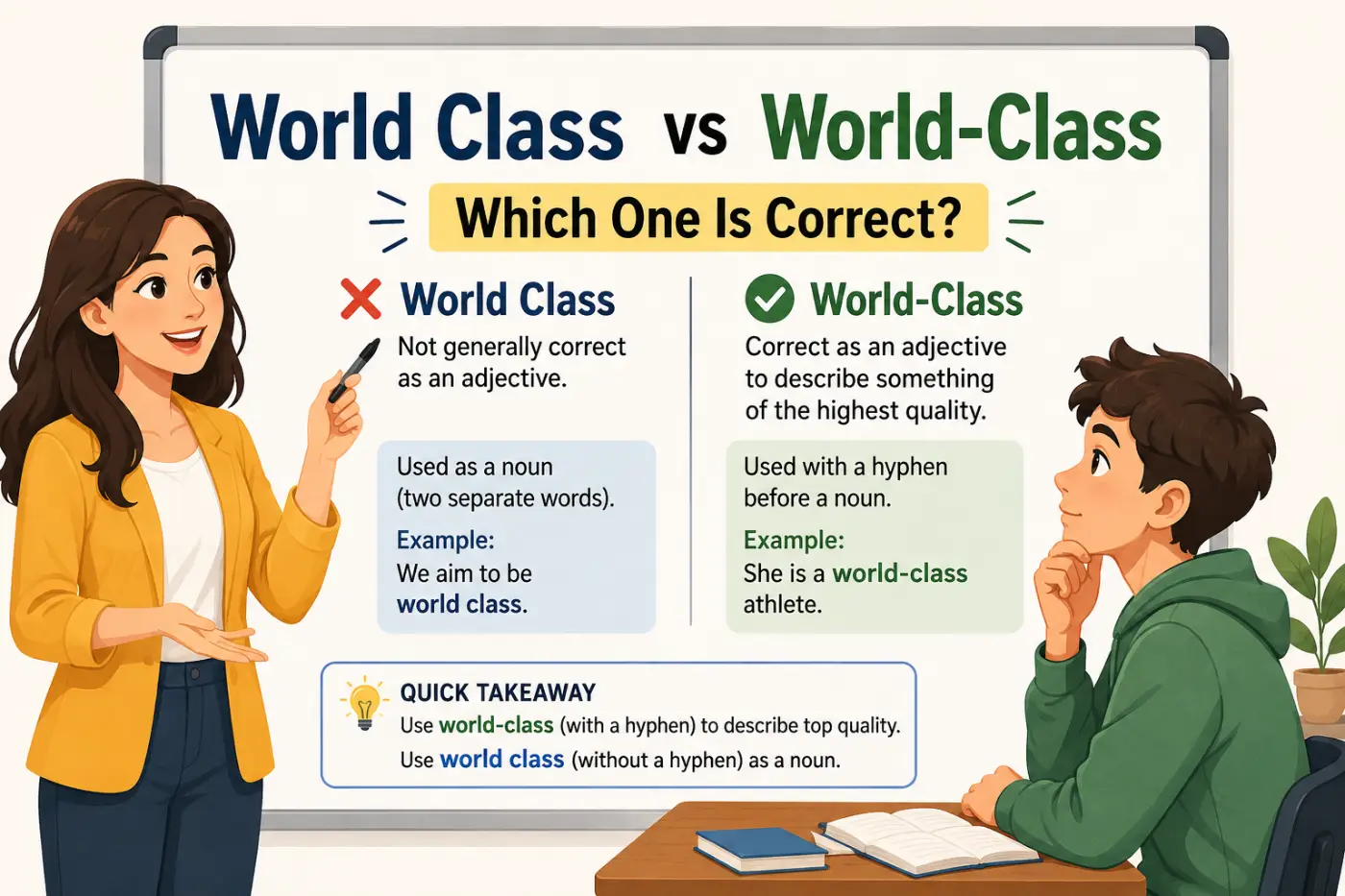
World Class vs World-Class is a common grammar question because both versions appear in books, newspapers, advertisements, websites, and everyday writing. At first glance, they seem identical, but the small hyphen changes how the phrase works in a sentence.
Many writers accidentally remove the hyphen when it should stay or add it when it is unnecessary. This mistake often appears in resumes, business websites, product descriptions, sports articles, and marketing materials. Since world class is a widely used expression, understanding the grammar behind it can instantly improve your writing.
The good news is that the rule is straightforward. Once you understand how compound adjectives work, you’ll know when to write world-class and when world class is the better choice.
Short Answer
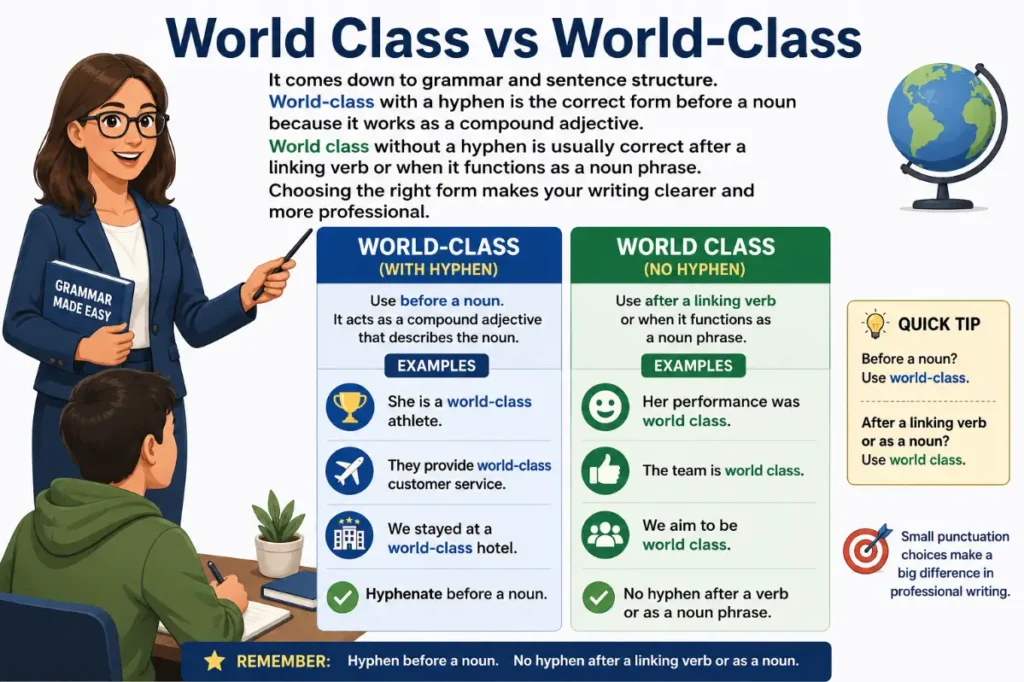
World Class vs World-Class comes down to grammar and sentence structure. World-class with a hyphen is the correct form before a noun because it works as a compound adjective. World class without a hyphen is usually correct after a linking verb or when it functions as a noun phrase. Choosing the right form makes your writing clearer and more professional.
Table of Contents
- Short Answer
- What Does World Class Mean
- World Class vs World-Class at a Glance
- Comparison Table
- The Grammar Rule Behind the Difference
- When to Use World-Class
- When to Use World Class
- Pronunciation
- Word Origin
- Why the Hyphen Matters
- Common Writing Situations
- Professional Examples
- Common Mistakes
- Memory Tips
- Related Grammar Notes
- Frequently Asked Questions
- Key Takeaways
- Conclusion
What Does World Class Mean
The expression world class describes something that ranks among the very best in the world. It can refer to people, organizations, products, services, skills, performances, facilities, or achievements that meet an exceptionally high standard.
For example:
- The athlete delivered a world-class performance.
- Their customer service is world class.
Although both sentences express the same idea, the grammar changes because the phrase serves different purposes. The expression is common in business, sports, education, healthcare, technology, travel, entertainment, and many other fields. It often highlights excellence, outstanding quality, or international recognition.
World Class vs World-Class at a Glance
The difference between World Class vs World-Class is not about meaning. Both express exceptional quality. The difference lies in grammar.
- World-class is a compound adjective placed before a noun.
- World class is usually used after a linking verb or as a noun phrase.
Think of the hyphen as a connector. It joins two words into one descriptive unit before a noun.
Compare these examples:
✔ She is a world-class pianist.
✔ Her piano skills are world class.
Both sentences are correct because each follows the proper grammatical pattern.
Comparison Table
| Feature | World-Class | World Class |
|---|---|---|
| Part of speech | Compound adjective | Noun phrase or predicate adjective |
| Hyphen | Yes | No |
| Used before a noun | Yes | Usually no |
| Used after a linking verb | Usually no | Yes |
| Meaning | Among the best in the world | Among the best in the world |
| Formal writing | Preferred before nouns | Preferred after verbs |
| Example | World-class education | The education is world class. |
The Grammar Rule Behind the Difference
The rule is based on compound adjectives. A compound adjective consists of two or more words working together to describe a noun. English often uses hyphens to show that these words belong together.
Consider these examples:
- Full-time employee
- Long-term plan
- High-quality materials
- Well-known author
- World-class athlete
In each example, the hyphen prevents confusion by showing that the words function as a single adjective. Without the hyphen, readers may briefly wonder which words belong together.
For example:
Correct
A world-class restaurant.
Here, world-class modifies restaurant as one adjective.
Less clear
A world class restaurant.
While many readers will understand the meaning, most modern style guides recommend the hyphen because the phrase appears before the noun.
Why Compound Adjectives Need Hyphens
Hyphens improve readability.
Imagine reading this sentence:
A small business owner.
Now compare it with:
A small-business owner.
The second version immediately tells you the owner runs a small business rather than being a small owner.
The same principle applies to world-class.
The hyphen signals that world and class work together as one descriptive unit.
When to Use World-Class
Use world-class before the noun it describes. This is the most common use in professional writing.
Examples
A world-class university attracts talented students from around the globe.
Explanation: World-class describes the noun university.
They built a world-class research center.
Explanation: The compound adjective modifies research center.
The company offers world-class customer support.
Explanation: The adjective describes customer support.
She received world-class training before joining the Olympic team.
Explanation: The hyphen joins the words into one adjective before training.
Our city now has a world-class airport.
Explanation: The adjective modifies airport.
Common Nouns That Follow World-Class
- Athlete
- Coach
- Hotel
- Restaurant
- University
- Hospital
- Museum
- Performance
- Education
- Facility
- Technology
- Team
- Service
- Product
- Experience
- Leader
- Expert
- Engineer
- Research center
- Company
In each case, world-class comes directly before the noun.
When to Use World Class
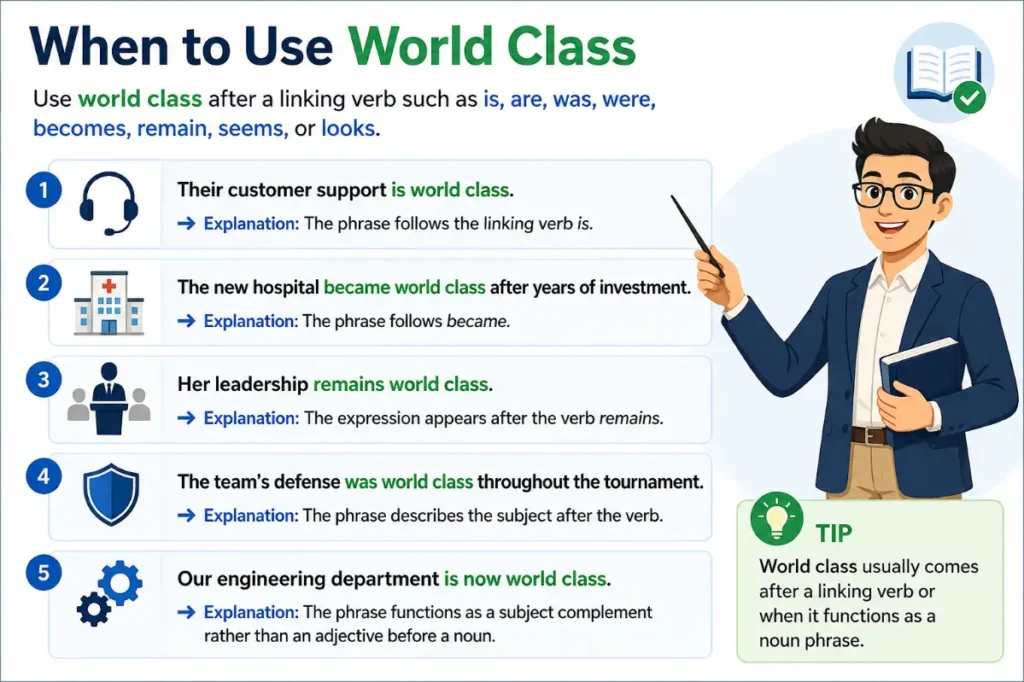
Use world class after a linking verb such as is, are, was, were, becomes, remain, seems, or looks.
Examples include:
Their customer support is world class.
Explanation: The phrase follows the linking verb is.
The new hospital became world class after years of investment.
Explanation: The phrase follows became.
Her leadership remains world class.
Explanation: The expression appears after the verb remains.
The team’s defense was world class throughout the tournament.
Explanation: The phrase describes the subject after the verb.
Our engineering department is now world class.
Explanation: The phrase functions as a subject complement rather than an adjective before a noun.
Pronunciation
Both forms share the same pronunciation.
World class
/wɝːld klæs/ (American English)
/wɜːld klɑːs/ (British English)
The hyphen changes only the written form. It does not affect pronunciation.
Native speakers pronounce both versions naturally without pausing between the words.
Word Origin
The phrase world class originated from the idea of ranking people or things according to international standards of excellence. The word class has long referred to categories or levels of quality, while world broadens the comparison to a global scale.
As English evolved, editors increasingly used the hyphen when the phrase appeared before nouns. This follows a broader pattern in English where compound modifiers are joined with hyphens for clarity.
Today, major dictionaries and style guides recognize world-class as the standard adjective before a noun, while world class remains common after linking verbs.
Why the Hyphen Matters
A single punctuation mark can make writing easier to read.
Consider these examples.
Correct
The company hired a world-class designer.
The adjective clearly modifies designer.
Correct
The designer is world class.
The phrase follows a linking verb, so the hyphen is unnecessary.
Incorrect
The company hired a world class designer.
Many readers will still understand the sentence, but most professional editors would add the hyphen because the phrase appears before the noun. In formal writing, consistent hyphenation reflects attention to detail and strengthens credibility. Business reports, academic papers, marketing materials, and news articles commonly follow this convention.
Different Style Guides May Vary Slightly
English style guides generally agree on the main rule, but some publications have their own house styles. For example, some marketing materials remove hyphens to create a cleaner visual appearance. You may also see world class used without a hyphen in advertising headlines or brand slogans.
However, in edited American English, the safest choice is:
- Use world-class before a noun.
- Use world class after a linking verb.
Following this guideline will keep your writing consistent and grammatically correct in nearly every situation.
Professional Writing Examples
The easiest way to master World Class vs World-Class is to see the phrase used in real writing. Notice how the hyphen appears before nouns but usually disappears after linking verbs.
Business
The company provides world-class consulting services.
Explanation: World-class modifies the noun consulting services.
Their consulting services are world class.
Explanation: The phrase follows the linking verb are.
Education
The university offers a world-class learning environment.
Explanation: The compound adjective describes learning environment.
Its academic programs are world class.
Explanation: The phrase comes after the linking verb.
Healthcare
The hospital built a world-class cancer treatment center.
Explanation: The adjective modifies cancer treatment center.
The medical care is world class.
Explanation: The phrase functions as a subject complement.
Sports
She became a world-class swimmer at a young age.
Explanation: The adjective modifies swimmer.
Her swimming technique is world class.
Explanation: The phrase follows the linking verb.
Technology
They developed a world-class cybersecurity platform.
Explanation: The adjective modifies cybersecurity platform.
Their security system is world class.
Explanation: The phrase follows the verb is.
Everyday Examples
Understanding grammar is easier when you connect it to daily conversations.
Correct:
I want to study at a world-class university.
The hotel offers world-class amenities.
He bought a world-class camera.
We attended a world-class concert.
She received world-class coaching.
Correct:
That university is world class.
The hotel is world class.
His photography skills are world class.
The concert was world class.
Their coaching is world class.
Each pair expresses the same meaning. The only change is the sentence structure.
Incorrect and Correct Examples
Many writers make the same mistakes repeatedly. Comparing incorrect and correct versions makes the grammar easier to remember.
| Incorrect | Correct | Why |
|---|---|---|
| A world class athlete | A world-class athlete | Compound adjective before a noun |
| World class facilities attract visitors | World-class facilities attract visitors | Hyphen needed before the noun |
| The facilities are world-class | The facilities are world class | Hyphen usually removed after the linking verb |
| They built a world class hospital | They built a world-class hospital | Compound modifier before the noun |
| The hospital is world-class | The hospital is world class | Predicate use normally has no hyphen |
Common Mistakes
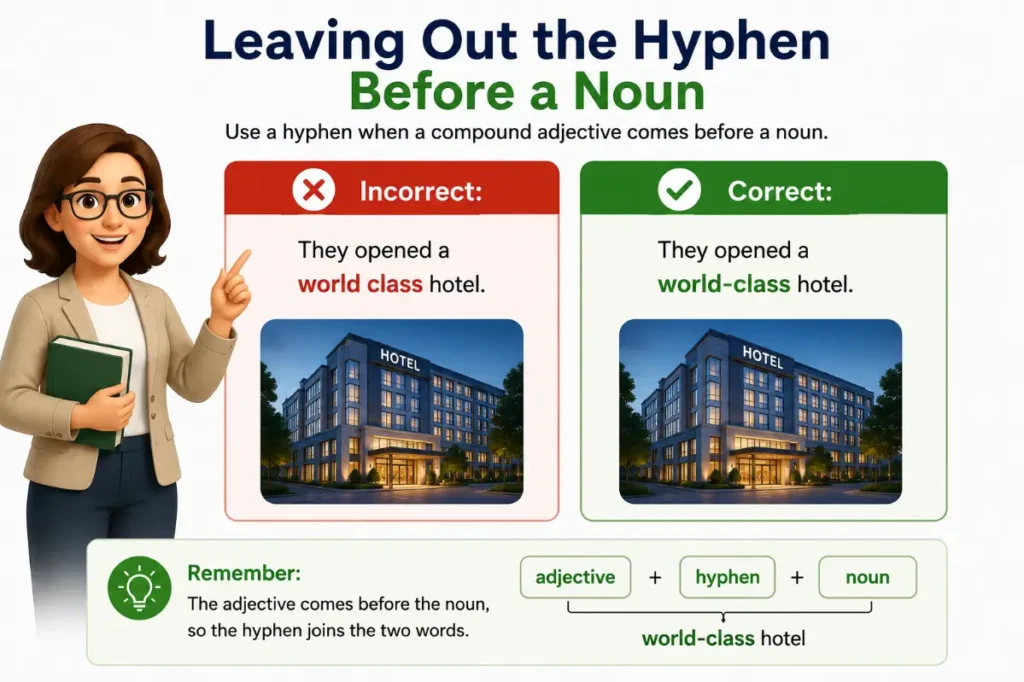
1. Leaving Out the Hyphen Before a Noun
Incorrect:
They opened a world class hotel.
Correct:
They opened a world-class hotel.
The adjective comes before the noun, so the hyphen joins the two words.
2. Adding the Hyphen After a Linking Verb
Less Preferred:
The hotel is world-class.
Preferred:
The hotel is world class.
Many publishers accept both forms after a linking verb, but most modern style guides prefer removing the hyphen because the phrase no longer functions as a compound modifier before a noun.
3. Using Different Styles in the Same Document
Incorrect:
The company provides world-class training.
Our training is world-class.
The report switches styles without a reason.
Better:
The company provides world-class training.
Our training is world class.
Consistency improves readability.
4. Confusing the Meaning
Some writers think the hyphen changes the meaning. It does not. Both forms mean “among the best in the world.” The difference is grammatical, not semantic.
Memory Tips
Simple memory tricks can help you remember the rule every time.
Tip One
Before a noun, use the hyphen. A world-class chef. A world-class invention.
Tip Two
After is, are, was, were, became, or seems, drop the hyphen. The chef is world class. The school is world class. The invention became world class.
Tip Three
Think of the hyphen as glue. Before a noun, the two words need to stick together to describe the noun. After a linking verb, they no longer need the glue.
Why Good Writers Use the Hyphen
Professional editors value clarity. Hyphens prevent readers from stopping to figure out how words relate to one another.
Compare these examples.
A fast growing company.
A fast-growing company.
The second version immediately tells readers that the company is growing quickly.
The same applies to world-class.
A world-class musician is instantly recognized as one descriptive unit.
Without the hyphen, readers may still understand the sentence, but the writing looks less polished.
Formal and Informal Usage
The phrase appears in both formal and informal English.
Formal Writing
Academic papers
Business reports
Company profiles
Press releases
News articles
Government publications
Example:
The organization established a world-class innovation center.
Informal Writing
Social media
Personal blogs
Travel reviews
Online discussions
Text messages
Example:
That restaurant is world class. Although informal writing is more flexible, following the standard grammar rule still improves readability.
American vs British English
The rule is almost identical in American and British English. American publishers generally write: A world-class university. The university is world class. British publishers follow the same pattern. A world-class football academy. The academy is world class. Differences usually depend on a publisher’s house style rather than regional grammar.
Professional Writing Tips
If you write for work, these habits will help your documents look more professional.
- Check every occurrence of World Class vs World-Class before publishing.
- Look at the word immediately after the phrase.
- If a noun follows, use the hyphen.
- If a linking verb comes before the phrase, remove the hyphen.
- Stay consistent throughout the document.
Editors appreciate consistency because it makes documents easier to read and proofread.
Related Grammar and Usage Notes
Understanding similar compound adjectives makes this rule much easier.
| Before a Noun | After a Linking Verb |
|---|---|
| High-quality product | The product is high quality. |
| Well-known author | The author is well known. |
| Full-time employee | The employee works full time. |
| Long-term strategy | The strategy is long term. |
| World-class facility | The facility is world class. |
Notice the pattern. Hyphens are common before nouns. After linking verbs, the words often stand separately. Once you recognize this pattern, you’ll avoid many common punctuation mistakes beyond World Class vs World-Class.
Similar Expressions
English includes many expressions that follow the same grammatical pattern.
- State-of-the-art equipment
- Best-selling novel
- Well-trained staff
- High-performance engine
- Good-looking actor
- Time-saving device
- Long-lasting battery
- Well-designed website
- Energy-efficient building
- User-friendly software
These expressions become compound adjectives when they appear before nouns.
People Also Ask
Is world class one word?
No. It is normally written as two words (world class) or as the hyphenated compound adjective (world-class). It is not written as a single word.
Why is world-class hyphenated?
The hyphen joins world and class into a single adjective before a noun, making the sentence easier to read.
Can I write world class without a hyphen?
Yes. Use world class after a linking verb or when it functions as a noun phrase.
Do dictionaries accept both forms?
Yes. Major dictionaries recognize both world class and world-class, with the choice depending on how the phrase functions in a sentence.
Does the hyphen change the meaning?
No. The meaning remains the same. The hyphen only changes the grammatical role of the expression.
Is world-class always an adjective?
When hyphenated, it almost always functions as a compound adjective before a noun.
Is world class formal English?
Yes. Both forms are standard English. The correct choice depends on grammar, not formality.
Should resumes use world-class?
Yes, if the phrase appears before a noun.
Example:
Managed a world-class engineering team.
If it follows a linking verb, write:
The engineering team was world class.
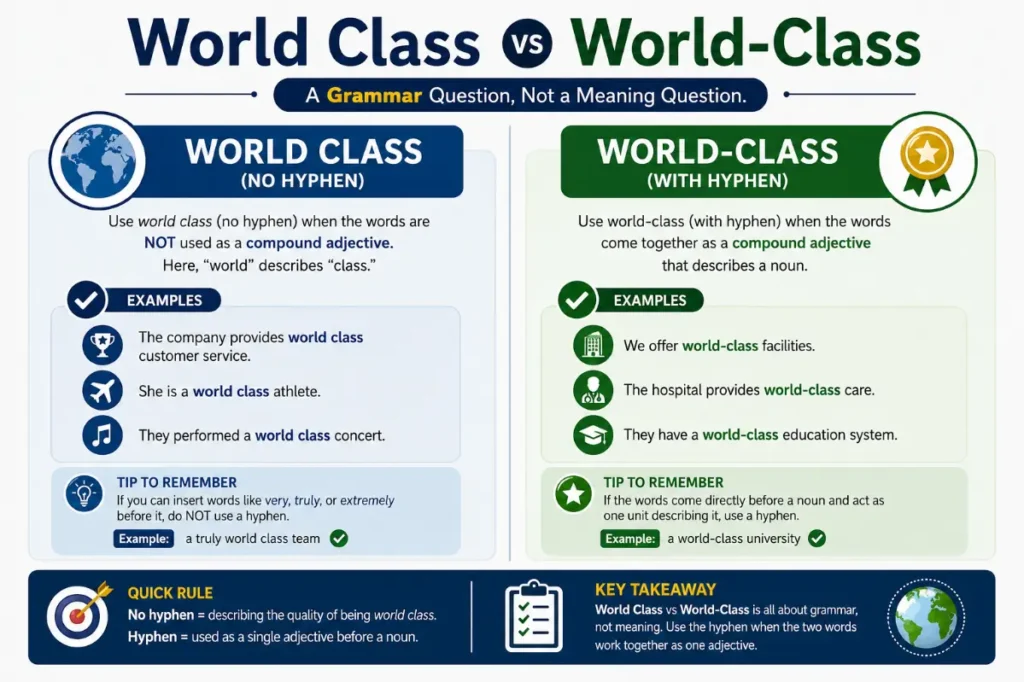
Key Takeaways
- World Class vs World-Class is a grammar question rather than a meaning question.
- Both forms describe something among the best in the world.
- Use world-class before a noun.
- Use world class after a linking verb.
- The hyphen creates a compound adjective.
- Following this simple rule makes your writing clearer and more professional.
- The same pattern applies to many other compound adjectives in English.
- Consistent punctuation helps readers understand your writing quickly.
Conclusion
Understanding World Class vs World-Class is easier than it first appears. The two forms have the same meaning, but they serve different grammatical roles.
When the phrase comes before a noun, write world-class with a hyphen because it functions as a compound adjective. When it comes after a linking verb, write world class without a hyphen because it acts as a predicate complement rather than a modifier before a noun.
This pattern is not unique to this expression. It follows the same rule used with many compound adjectives in English, including high-quality, well-known, long-term, and full-time. Once you recognize the pattern, you’ll naturally make the correct choice in your writing.
Frequently Asked Questions
Is World Class vs World-Class a grammar issue or a spelling issue?
It is primarily a grammar and punctuation issue. Both world class and world-class are correctly spelled. The choice depends on how the phrase functions in the sentence. Use world-class before a noun and world class after a linking verb.
Which is correct: world class or world-class?
Both are correct in the right context. Write world-class when the phrase comes before a noun, such as a world-class museum. Write world class after a linking verb, such as The museum is world class.
Is world-class an adjective?
Yes. World-class is a compound adjective because it combines two words with a hyphen to describe a noun.
Example:
She is a world-class violinist.
Here, world-class modifies the noun violinist.
Can I use world class as an adjective?
Yes, but only in a predicate position after a linking verb.
Example:
Their customer service is world class.
In this sentence, the phrase describes the subject after the verb is rather than directly modifying a noun.
Is the hyphen always required?
No. The hyphen is generally required only when world-class appears immediately before a noun. When the phrase follows a linking verb, most style guides recommend writing world class without a hyphen.
Do American and British English use the same rule?
Yes. American and British English follow the same general rule for compound adjectives. Individual publishers may have slight style differences, but the standard usage is the same.
Can I use world-class in marketing content?
Absolutely. It is widely used in advertising, branding, and business writing to emphasize exceptional quality.
Example:
We provide world-class software solutions.
Using the hyphen before the noun makes the phrase grammatically correct and professional.
Is world class overused?
It can be. Because the phrase is common in marketing, readers may ignore it if it is not supported by evidence. Instead of simply calling something world-class, explain what makes it exceptional.
For example:
- Award-winning customer support
- Internationally recognized faculty
- Olympic-level coaching
- Certified specialists
- Industry-leading research
These details make the claim more believable.
What words are similar to world class?
Depending on the context, you can use:
- Outstanding
- Exceptional
- Elite
- Premier
- Top-tier
- First-rate
- High-quality
- Best-in-class
- Internationally recognized
- Leading
Choose the word that best fits your audience and the level of formality.
How can I remember the difference between world class and world-class?
Use this simple rule:
Before a noun, add the hyphen.
A world-class athlete.
After a linking verb, remove the hyphen.
The athlete is world class.
This single rule works in almost every situation.

Confusing Words, Spelling & Word Choice
Claire Whitmore is a U.S.-based English editor who writes about commonly confused words, spelling differences, and word choice. Her work helps readers understand subtle distinctions between similar-looking words through simple definitions, practical examples, and modern usage guidance in both American and British English.