
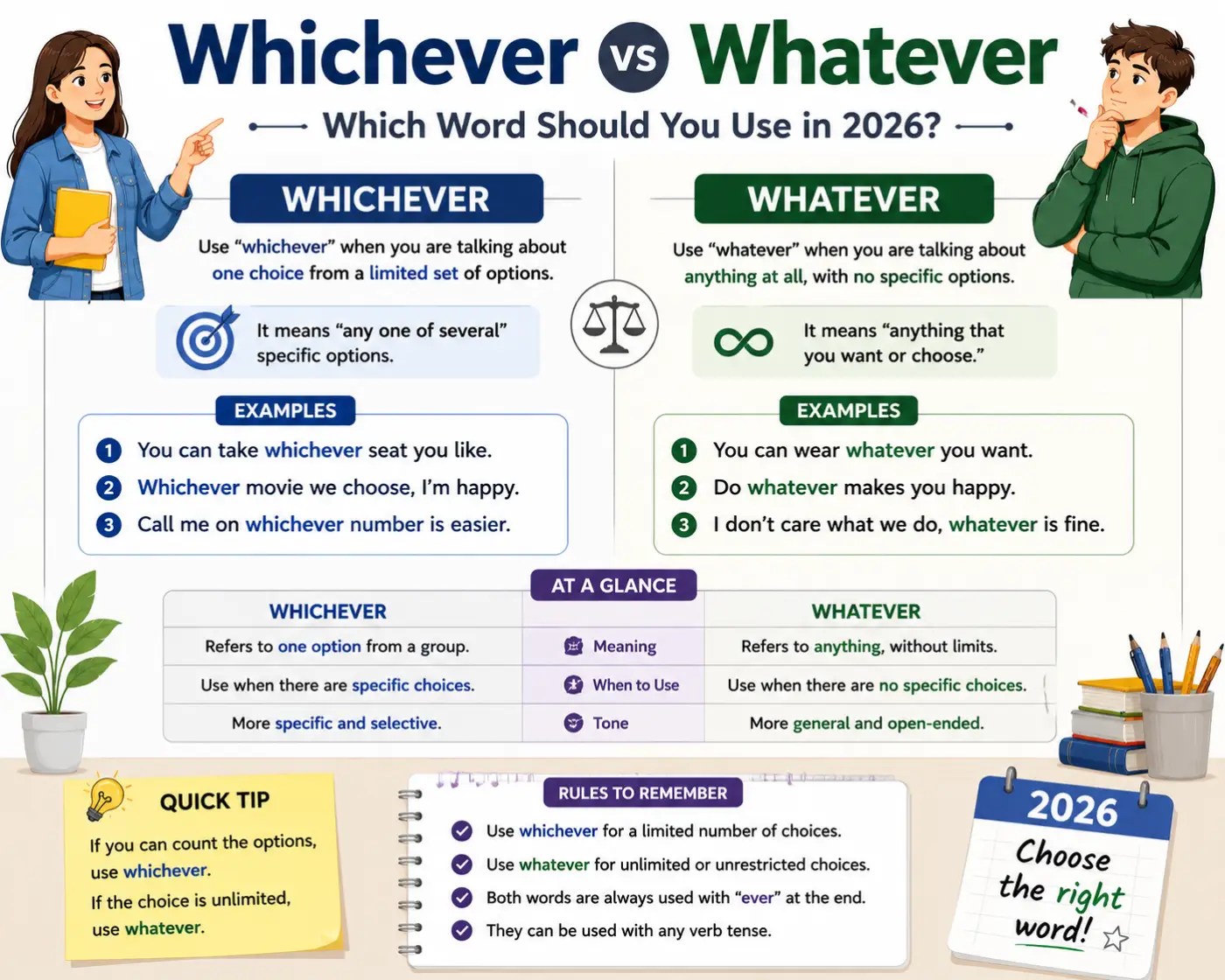
Whichever vs Whatever is a common point of confusion for English learners and even native speakers. At first glance, both words seem interchangeable because they introduce choices without mentioning a specific item. In reality, they serve different purposes and create different meanings.
Imagine someone asks you to choose a dessert from a menu with five options. You would probably say, I’ll have whichever cake is the freshest. Now imagine someone asks what you want for dinner and you truly have no preference. You might answer, Whatever you cook is fine. The difference is subtle but important.
Understanding this distinction helps you avoid awkward sentences, improve your grammar, and communicate more precisely. It also makes your writing sound more natural in conversations, emails, academic papers, and professional communication.
Short Answer
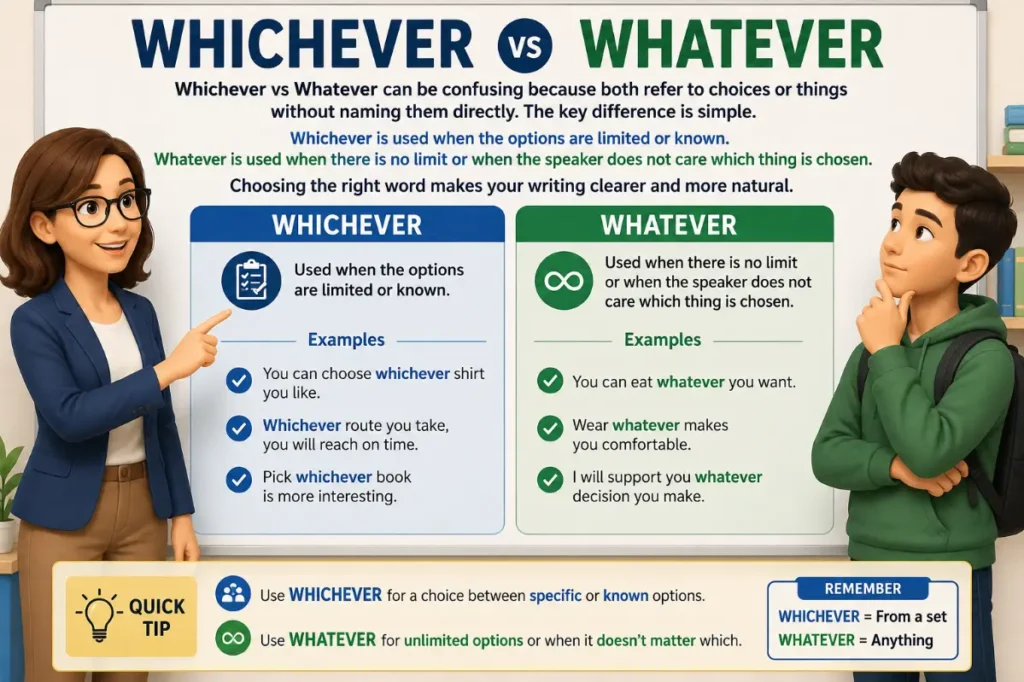
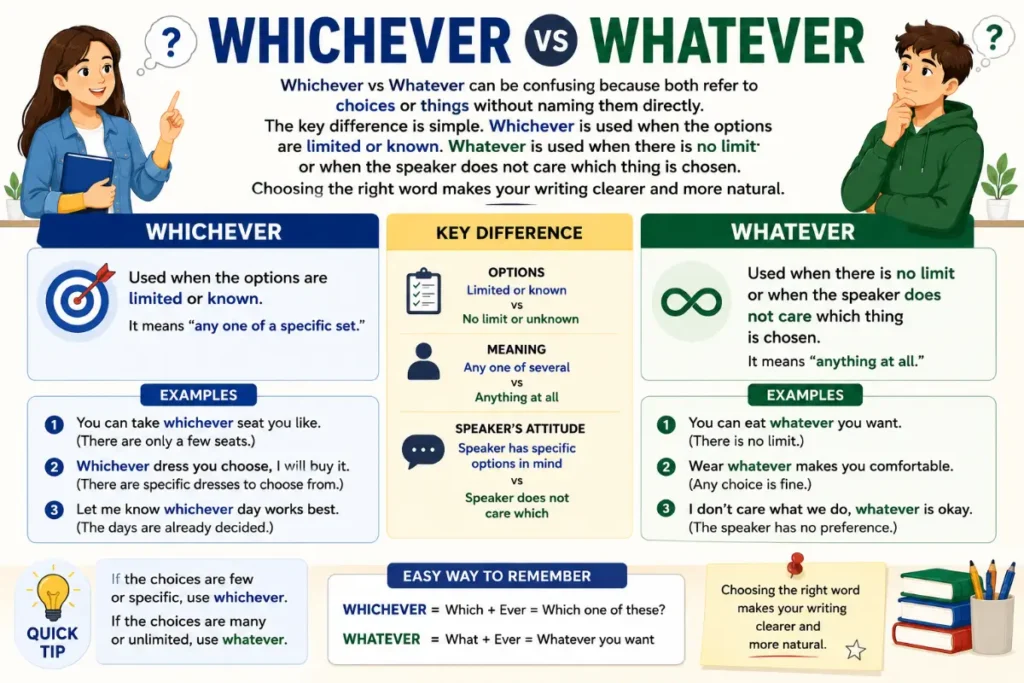
Whichever vs Whatever can be confusing because both refer to choices or things without naming them directly. The key difference is simple. Whichever is used when the options are limited or known. Whatever is used when there is no limit or when the speaker does not care which thing is chosen. Choosing the right word makes your writing clearer and more natural.
Table of Contents
- What Does Whichever Mean
- What Does Whatever Mean
- Whichever vs Whatever Comparison Table
- The Main Difference Between Whichever and Whatever
- Grammar Rules for Whichever and Whatever
- When to Use Whichever
- When to Use Whatever
- Real Life Examples
- Formal and Informal Usage
- American and British English
- Common Mistakes
- Memory Tricks
- Related Grammar Notes
- Frequently Asked Questions
- Key Takeaways
- Conclusion
What Does Whichever Mean
Whichever is a determiner and pronoun used when someone is choosing from a known or limited group of options. The speaker knows there are choices available, even if the exact number is not mentioned. Examples include selecting one restaurant from several nearby restaurants, choosing one book from a bookshelf, or picking one route from two possible roads.
Definition
Whichever means any one from a specific or limited group.
Examples
- Choose whichever seat you prefer.
The speaker knows there are available seats.
- Take whichever cookie looks the best.
The cookies are already present and limited.
- Wear whichever jacket matches your outfit.
The jackets belong to a known collection.
- Pick whichever answer you believe is correct.
The answers come from a fixed list.
- You may visit whichever museum interests you most.
The museums belong to a specific group.
Key Idea
Whenever the choice comes from a limited or identifiable set, whichever is usually the correct word.
What Does Whatever Mean
Whatever is a pronoun, determiner, and adjective that refers to anything at all without limiting the possibilities. It often expresses unlimited choice, lack of preference, surprise, disbelief, or emphasis depending on the context.
Definition
Whatever means anything, no matter what, or it does not matter what.
Examples
- Eat whatever you like.
There are no stated limits.
- Say whatever comes to mind.
Anything is acceptable.
- We’ll help whatever happens.
The situation is unknown and unlimited.
- Take whatever you need.
There is no specified list.
- Do whatever makes you happy.
Any action that brings happiness is acceptable.
Key Idea
Use whatever when the possibilities are unlimited or when the exact choice does not matter.
Whichever vs Whatever Comparison Table
| Feature | Whichever | Whatever |
|---|---|---|
| Meaning | Any one from a limited group | Anything at all |
| Number of choices | Limited or known | Unlimited or unknown |
| Shows selection | Yes | Not always |
| Indicates no preference | Sometimes | Often |
| Common in instructions | Yes | Yes |
| Common in casual speech | Yes | Very common |
| Example | Choose whichever book you want. | Read whatever interests you. |
The Main Difference Between Whichever and Whatever
The easiest way to understand Whichever vs Whatever is to think about the number of possible choices.
Whichever points to a specific collection of options.
Whatever opens the door to every possible option.
Compare these examples.
Choose whichever movie you want.
The available movies are already known.
Watch whatever you want tonight.
The possibilities include every movie available anywhere.
Notice how the meaning changes even though both sentences talk about making a choice.
Another example shows the difference clearly.
Take whichever pen is on the desk.
Only the pens on the desk are available.
Take whatever you need for class.
Anything needed for class is acceptable.
This distinction becomes especially important in academic writing and professional communication because it removes ambiguity.
Grammar Rules for Whichever and Whatever
Understanding the grammar behind these words makes them much easier to use correctly.
Rule One
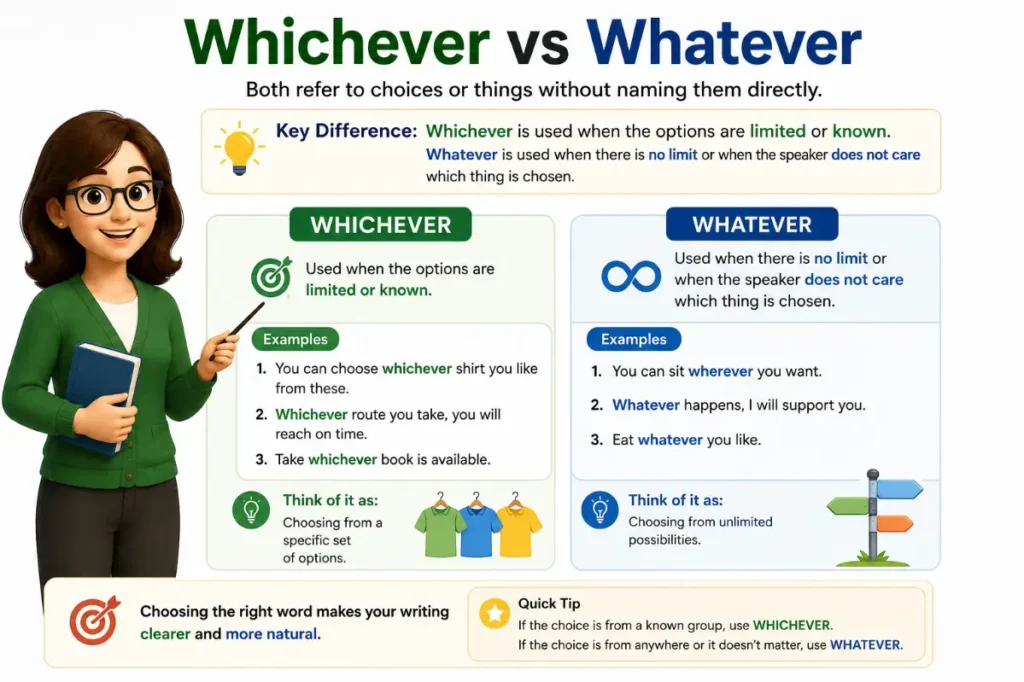
Use whichever when referring to a limited set of choices.
Correct example.
You can borrow whichever laptop is available.
The laptops belong to a known group.
Rule Two
Use whatever when referring to unlimited possibilities.
Correct example.
You may study whatever interests you.
There are no restrictions.
Rule Three
Both words can function as pronouns.
Whichever arrives first will receive the prize.
Whatever happens next will be interesting.
Rule Four
Both words can introduce noun clauses. Choose whichever route saves the most time. Do whatever feels right.
Rule Five
The surrounding context determines the correct word more than the sentence structure.
For example.
Take whichever sandwich is left.
The sandwiches are limited.
Take whatever food you can find.
The food is not limited to one known group.
When to Use Whichever
Use whichever whenever the reader or listener understands that the options come from a particular set.
Choosing Between Known Options
Choose whichever shirt fits best. There are several shirts already available.
Giving Permission
You may sit in whichever chair is empty. The chairs belong to one room.
Comparing Alternatives
We’ll support whichever proposal receives the most votes. The proposals are already known.
Following Instructions
Click whichever button appears first. The possible buttons exist within the program.
Making Recommendations
Buy whichever phone meets your budget. The comparison is among available phones.
When to Use Whatever
Use whatever when there is no defined limit or when the exact choice makes no difference.
Expressing Unlimited Choice
Read whatever inspires you. No list of books is specified.
Showing Flexibility
I’m happy with whatever you decide. The speaker has no preference.
Talking About Unknown Situations
We’ll adapt to whatever comes next. The future is uncertain.
Giving Broad Permission
Wear whatever makes you comfortable. Any clothing is acceptable.
Showing Indifference
Order whatever you want. The speaker does not mind the choice.
Can Whichever and Whatever Ever Be Interchangeable
Sometimes the two words appear to fit the same sentence, but they often create slightly different meanings.
Consider this example.
Choose whichever dessert you want.
This suggests the desserts come from a menu or a display.
Choose whatever dessert you want.
This sounds broader, almost as if any dessert anywhere is possible.
Another example.
Read whichever book is on the shelf.
Only books on the shelf are included.
Read whatever book interests you.
The choice extends beyond a single shelf.
Native speakers occasionally use whatever where whichever might be more precise, especially in casual conversation. However, careful writing usually follows the distinction between limited choices and unlimited possibilities.
Understanding the Difference Through Everyday Situations
Looking at everyday situations makes Whichever vs Whatever much easier to remember. Imagine you’re standing in an ice cream shop with twelve flavors displayed in front of you.
You tell your friend.
I’ll try whichever flavor has the fewest calories.
The flavors are limited to those in the shop.
Now imagine your friend asks what dessert you enjoy in general.
You reply.
I like whatever tastes homemade.
The answer is not limited to one shop or one menu.
Here’s another example.
A teacher tells students.
Complete whichever assignment your group received.
Each group has a specific assignment.
A parent tells a child.
You can play whatever game you want after dinner.
The child may choose any game.
These everyday situations show that context matters more than the words themselves. The number of available choices determines which word fits best.
Real Life Examples of Whichever vs Whatever
The best way to master Whichever vs Whatever is to see the words in realistic situations. Notice how whichever refers to a known set of choices while whatever leaves the possibilities open.
At Home
Whichever: Choose whichever blanket is warmest.
Explanation: The blankets are part of a known collection.
Whatever: Cook whatever you feel like eating.
Explanation: Any meal is acceptable.
At School
Whichever: Answer whichever question you understand best.
Explanation: The questions come from a specific exam.
Whatever: Ask whatever comes to your mind.
Explanation: Any question is welcome.
At Work
Whichever: Use whichever meeting room is available.
Explanation: The available rooms belong to the office.
Whatever: Tell me whatever information you have.
Explanation: There is no limit on the information.
While Traveling
Whichever: Board whichever train arrives first.
Explanation: The trains are known options.
Whatever: Pack whatever you think you’ll need.
Explanation: Any necessary item may be packed.
Shopping
Whichever: Buy whichever laptop offers the best value.
Explanation: The choice comes from available laptops.
Whatever: Spend whatever amount fits your budget.
Explanation: The amount is unrestricted.
Formal and Informal Usage
Both words are common in formal and informal English, but they are used slightly differently depending on the situation.
Formal Writing
In reports, business communication, and academic writing, precision matters.
Correct examples:
Choose whichever option best satisfies the project requirements.
The committee will review whatever evidence is submitted.
Formal writing benefits from using the exact word that matches the intended meaning.
Informal Conversation
In casual speech, people sometimes use whatever even when whichever would be more precise.
For example:
Take whatever cookie you want.
Although many native speakers say this naturally, whichever cookie is more precise because the cookies belong to a limited group.
American and British English
There is no meaningful difference between American and British English in the use of whichever and whatever.
Both varieties follow the same grammar rules.
American English:
Choose whichever route is faster.
British English:
Choose whichever route is quicker.
American English:
Do whatever makes sense.
British English:
Do whatever seems sensible.
Only vocabulary changes. The grammar remains the same.
Common Mistakes
Many learners make predictable mistakes with these words.
Mistake 1
❌ Choose whatever chair is empty.
✔ Choose whichever chair is empty.
Why: The chairs belong to a limited set.
Mistake 2
❌ Whichever happens tomorrow, we’ll be ready.
✔ Whatever happens tomorrow, we’ll be ready.
Why: Tomorrow’s events are unknown and unlimited.
Mistake 3
❌ Eat whichever you want.
✔ Eat whatever you want.
Why: There is no specific list mentioned.
Mistake 4
❌ I’ll accept whatever of these books you recommend.
✔ I’ll accept whichever of these books you recommend.
Why: The books belong to a known group.
Mistake 5
❌ Do whichever makes you happy.
✔ Do whatever makes you happy.
Why: Happiness is not limited to one predefined option.
Memory Tips
Remembering the difference becomes much easier with a few simple tricks.
Tip One
Think of which inside whichever.
The word which naturally suggests choosing from known options.
Tip Two
Think of what inside whatever. The word what can refer to almost anything.
Tip Three
Ask yourself one question.
Are the choices limited?
If yes, use whichever.
If no, use whatever.
Tip Four
Imagine a menu. Choosing from the menu usually calls for whichever. Talking about food in general usually calls for whatever.
Tip Five
Remember this simple phrase. Limited choices use whichever. Unlimited choices use whatever.
Related Grammar and Usage Notes
Understanding related grammar patterns helps reinforce the difference.
Whoever vs Anyone
Whoever finishes first wins. Anyone can join. Both refer to people, but the meanings differ slightly.
Wherever vs Anywhere
Go wherever you feel safe. Go anywhere you like. Again, one introduces a clause while the other simply refers to a place.
Whenever vs Anytime
Call whenever you need help. Call anytime. These words follow similar patterns.
Which vs What
Which is your favorite color?
Use which when choices are limited.
What is your favorite color?
Use what when the possibilities are open.
This distinction explains why whichever and whatever behave differently.
Professional Writing Tips
Professional writing values clarity.
Instead of writing:
Choose whatever report is complete.
Write:
Choose whichever report is complete.
The second sentence clearly indicates that the reports belong to a known set.
Likewise, instead of writing:
We’ll respond to whichever concerns arise.
Write:
We’ll respond to whatever concerns arise.
Future concerns are not limited to a predefined list.
Editors often look for this distinction because it improves precision.
People Also Ask
Is whichever more formal than whatever?
No. Both are standard English words. The correct choice depends on meaning rather than formality.
Can whatever mean no matter what?
Yes.
Example:
We’ll continue whatever happens.
It means the same as no matter what happens.
Can whichever mean no matter which?
Yes.
Example:
Take whichever seat you prefer.
It means no matter which seat.
Why do native speakers mix them up?
In everyday conversation, many people use whatever broadly because listeners usually understand the intended meaning. Careful writing still benefits from using the more precise word.
Key Takeaways
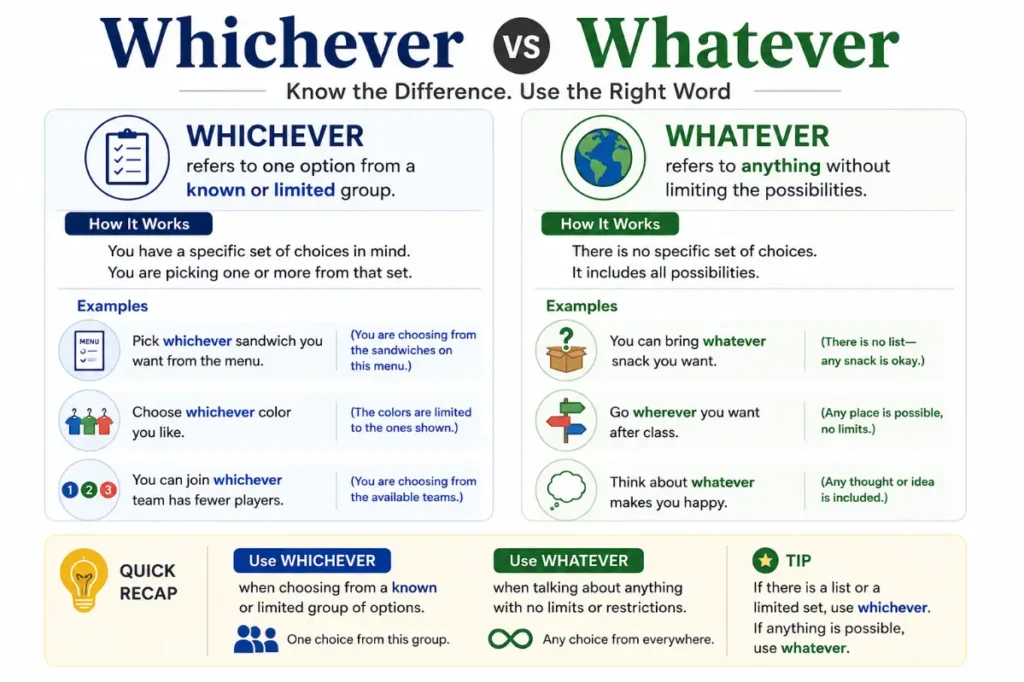
- Whichever refers to one option from a known or limited group.
- Whatever refers to anything without limiting the possibilities.
- Ask yourself if the available choices are limited.
- Use whichever for specific selections.
- Use whatever for unlimited possibilities or when the exact choice is unimportant.
- Both words are correct when used in the proper context.
- Native speakers sometimes blur the distinction in conversation, but precise writing follows the grammar rule.
- Mastering this difference improves both spoken and written English.
Conclusion
Understanding Whichever vs Whatever is easier once you focus on one simple idea. Whichever belongs to situations with limited or identifiable choices, while whatever works when the possibilities are unlimited or when the specific choice is unimportant.
Although the two words may sound similar, they communicate different meanings. Using the correct one makes your writing more accurate, natural, and professional. The distinction is especially valuable in academic work, business communication, and polished everyday writing where clarity matters.
The next time you pause between Whichever vs Whatever, ask yourself a simple question. Am I choosing from a known set of options, or can the choice be anything at all? The answer will almost always lead you to the correct word.
Frequently Asked Questions
What is the difference between Whichever vs Whatever?
Whichever refers to one choice from a limited or known group. Whatever refers to anything without limiting the possibilities.
When should I use whichever?
Use whichever when someone is choosing from specific options.
When should I use whatever?
Use whatever when the choice is unlimited or when the exact choice does not matter.
Can whichever and whatever be used interchangeably?
Sometimes in casual conversation, yes. However, they often express different meanings, so they are not true synonyms.
Is whichever grammatically correct?
Yes. It is a standard English determiner and pronoun used for limited choices.
Is whatever grammatically correct?
Yes. It is commonly used to mean anything, no matter what, or it does not matter what.
Which word is better for formal writing?
Neither word is better. Use the one that correctly matches the meaning of your sentence.
How can I remember the difference?
Remember this rule.
Whichever equals limited choices.
Whatever equals unlimited choices.

English Grammar & Usage
Nathan Holloway is an American grammar writer and language researcher who specializes in English grammar, sentence structure, verb usage, and common writing mistakes. He enjoys breaking down confusing grammar rules into practical explanations with clear examples, making English easier for students, professionals, and everyday writers.