
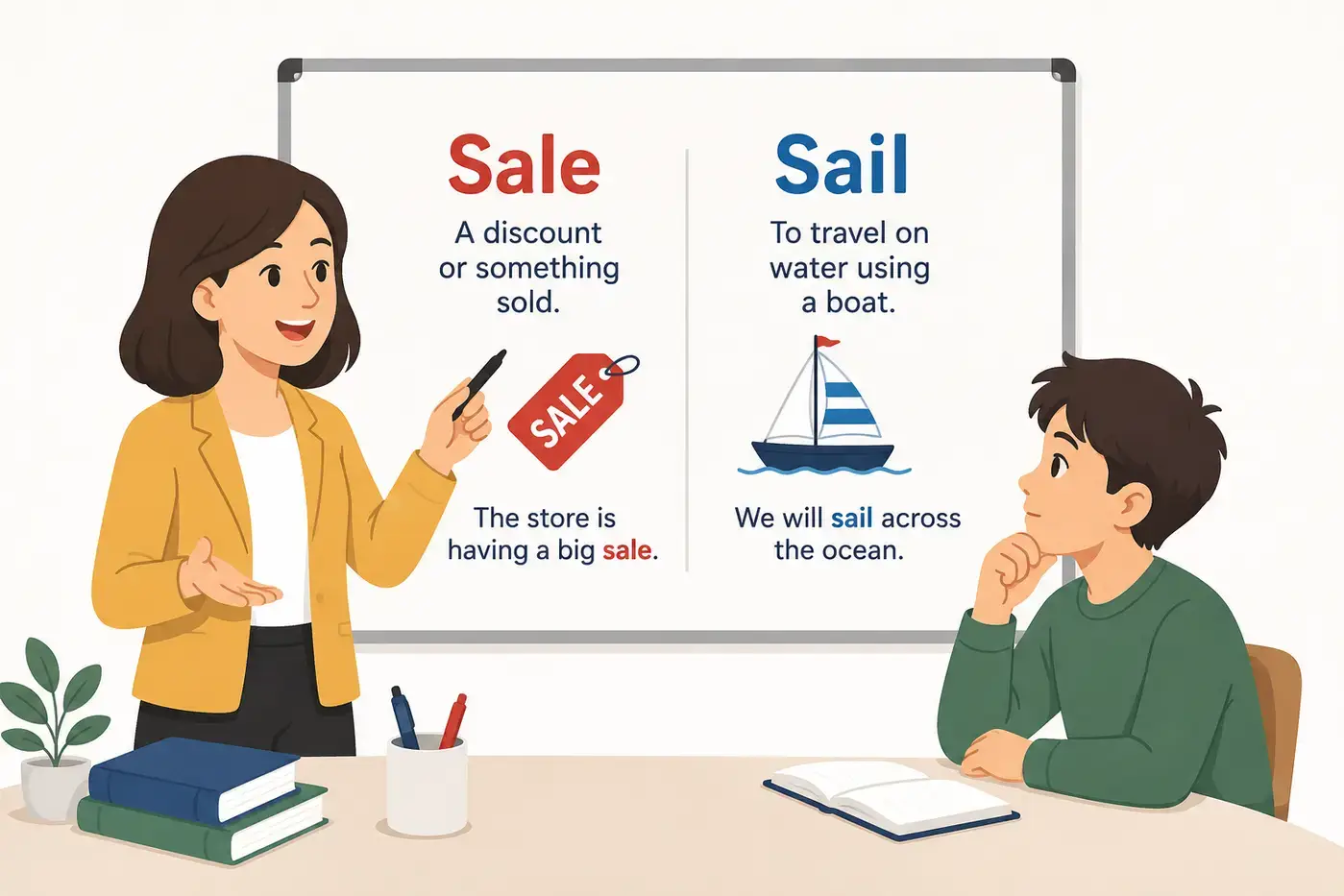
Sale vs Sail is a common source of confusion because both words are pronounced the same but belong to different parts of speech and describe entirely different ideas.
One word belongs to the world of shopping and business. The other belongs to boats, ships, and travel on water. Since they sound identical, many English learners and even native speakers occasionally mix them up in writing.
The good news is that telling them apart is easy once you understand their meanings and see them used in real sentences. This guide explains the differences in clear American English. You will learn what each word means, how to pronounce it, when to use it, common mistakes to avoid, and simple tricks to remember the correct spelling every time.
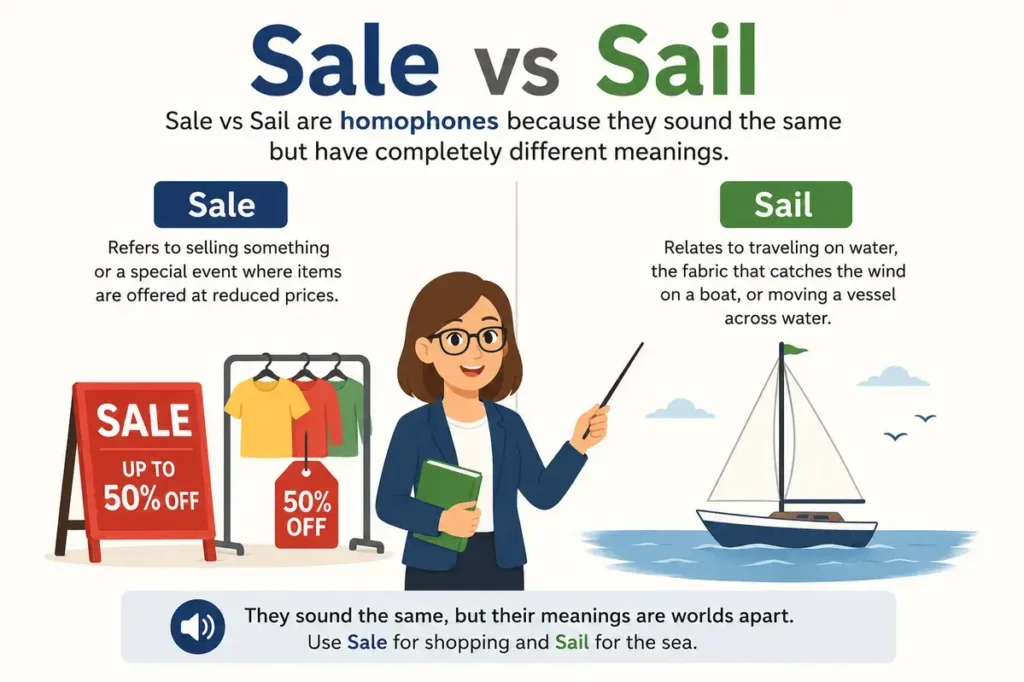
Sale vs Sail Short Answer
These words are homophones because they sound the same but have completely different meanings. Sale refers to selling something or a special event where items are offered at reduced prices. Sail relates to traveling on water, the fabric that catches the wind on a boat, or moving a vessel across water.
Table of Contents
- What Is the Difference Between Sale and Sail
- Comparison Table
- What Does Sale Mean
- What Does Sail Mean
- Pronunciation of Sale and Sail
- Why Are Sale and Sail Confused
- Grammar Rules
- Parts of Speech
- Real Life Examples
- Common Contexts for Each Word
What Is the Difference Between Sale and Sail
The main difference is simple.
Sale is connected with buying and selling.
Sail is connected with boats, ships, and traveling on water.
Although both words are pronounced exactly the same, they have different spellings, meanings, and uses. This makes them homophones.
If someone says there is a sale this weekend, they are talking about shopping.
If someone says they plan to sail this weekend, they are talking about traveling across water.
Understanding the context almost always tells you which word is correct.
Sale vs Sail Comparison Table
| Feature | Sale | Sail |
|---|---|---|
| Meaning | The act of selling or a discount event | Travel on water or the cloth attached to a boat |
| Part of Speech | Noun | Noun and verb |
| Pronunciation | Sayl | Sayl |
| Category | Shopping and business | Boating and transportation |
| Can Be a Verb | No | Yes |
| Common Context | Retail stores, online shopping, business | Boats, ships, oceans, lakes |
| Example | The store has a huge sale today. | We will sail across the lake tomorrow. |
What Does Sale Mean
A sale is the exchange of goods or services for money. It can also describe a promotional event where products are offered at lower prices.
Definition One
The act of selling something.
Example
The sale of the house was completed last week.
Explanation
Here, sale refers to the business transaction in which ownership changed from one person to another.
Definition Two
A shopping event offering reduced prices.
Example
The electronics store announced a holiday sale.
Explanation
The word describes a promotional event where customers can buy products at discounted prices.
Common Expressions with Sale
- For sale.
- On sale.
- Garage sale.
- Clearance sale.
- Flash sale.
- Final sale.
- Yard sale.
- Big sale.
- Summer sale.
- End of season sale.
Example Sentences
The bicycle is for sale.
Explanation
The owner wants to sell the bicycle.
The shoes are on sale this weekend.
Explanation
The shoes are available at a reduced price.
The company reported record sales during the holiday season.
Explanation
Here, sales is the plural noun referring to the number or value of items sold.
What Does Sail Mean
Sail has more than one meaning. It can be a noun or a verb.
As a noun, it refers to the large piece of fabric that catches the wind to move a boat.
As a verb, it means to travel across water in a boat or ship.
Sail as a Verb
Example
They plan to sail across the Atlantic next year.
Explanation
The verb describes traveling on water.
Another example.
We sailed around the island during our vacation.
Explanation
The action of moving a boat across water happened in the past.
Sail as a Noun
Example
The captain repaired the torn sail before leaving the harbor.
Explanation
Here, sail refers to the cloth attached to the boat.
Common Expressions with Sail
- Set sail.
- Sail away.
- Sail across.
- Sail into the harbor.
- Sail around the world.
- Full sail.
- Smooth sailing.
- Raise the sail.
- Lower the sail.
- Under sail.
Example Sentences
The children watched the white sail from the beach.
Explanation
The word names part of the boat.
The crew will sail before sunrise.
Explanation
The word functions as a verb describing an action.
Pronunciation of Sale and Sail
Both words are pronounced exactly the same.
Sale
Pronunciation: /seɪl/
Sail
Pronunciation: /seɪl/
Because they share the same pronunciation but have different meanings and spellings, they are called homophones.
This is why spelling mistakes often happen when people write quickly or rely only on sound.
Why Are Sale and Sail Confused
Several factors cause people to confuse these words.
They Sound Identical
English has many homophones. Since sale and sail are pronounced the same way, listeners cannot tell which spelling is intended without context.
Spell Check May Not Catch the Error
Both words are correctly spelled English words.
If someone writes:
The boat went on sale across the lake.
The spelling checker may accept every word because sale is a valid word. Only the meaning is incorrect.
Fast Typing
Many writing mistakes happen because people focus on pronunciation instead of meaning.
English Learners
People learning English often memorize pronunciation before mastering spelling, making homophones especially challenging.
Grammar Rules
Learning the grammar behind each word makes choosing the correct spelling much easier.
Sale Is Always a Noun
Sale names an event, transaction, or business activity.
Correct examples.
The store announced a sale.
The sale lasted three days.
The sale of the property took months.
Notice that sale names something instead of describing an action.
Sail Can Be Both a Noun and a Verb
As a noun.
The sail caught the wind.
As a verb.
They sail every summer.
This flexibility makes sail different from sale.
Parts of Speech
| Word | Noun | Verb | Adjective |
|---|---|---|---|
| Sale | Yes | No | No |
| Sail | Yes | Yes | No |
Remember this simple rule.
If the word describes an action on water, choose sail.
If the word refers to shopping, business, or selling, choose sale.
Real Life Examples
Shopping
The furniture store is having a weekend sale.
The laptop was on sale for half the original price.
Everything in the bookstore is on sale today.
The art gallery hosted a charity sale.
The home sold quickly after the sale was announced.
Boating
The family will sail along the coast tomorrow.
The captain checked every sail before departure.
We sailed through calm waters.
The ship continued to sail despite strong winds.
The sailors lowered the sail before the storm.
Common Contexts for Sale
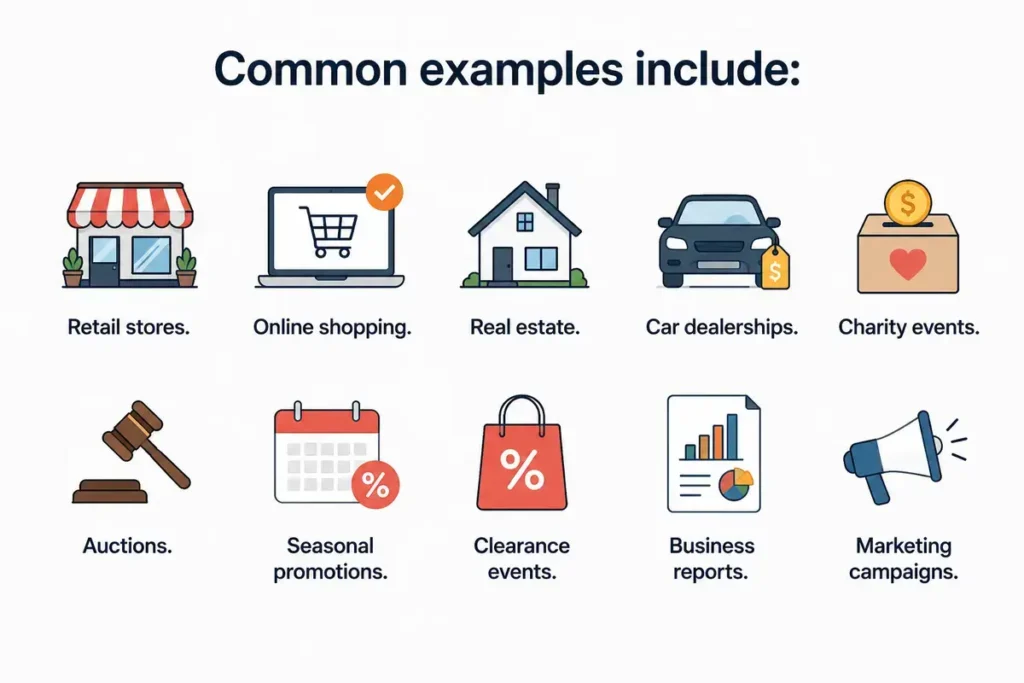
You will most often see sale in situations involving business, commerce, and shopping.
Common examples include:
- Retail stores.
- Online shopping.
- Real estate.
- Car dealerships.
- Charity events.
- Auctions.
- Seasonal promotions.
- Clearance events.
- Business reports.
- Marketing campaigns.
Examples
The store announced a Black Friday sale.
The house is finally for sale.
Tickets went on sale this morning.
The company celebrated its biggest annual sale.
Common Contexts for Sail
You will most often encounter sail when discussing water travel, boats, or navigation.
Common situations include:
- Sailing competitions.
- Cruises.
- Fishing boats.
- Naval history.
- Maritime transportation.
- Adventure travel.
- Yacht racing.
- Recreational boating.
- Ocean exploration.
- Sailing lessons.
Examples
They learned to sail during summer camp.
The ship set sail before sunrise.
The wind filled the sail.
The crew sailed safely back to shore.
Common Mistakes With Sale vs Sail
Since Sale vs Sail are homophones, many writing mistakes happen because people choose the word that sounds right instead of the one that fits the meaning. The following examples show some of the most common errors and how to fix them.
| Incorrect | Correct | Why |
|---|---|---|
| We will sale across the lake. | We will sail across the lake. | Sail is the verb for traveling on water. |
| The boat has a large sale. | The boat has a large sail. | Sail is the fabric attached to a boat. |
| The shoes are sail today. | The shoes are on sale today. | Sale refers to discounted prices. |
| The family enjoyed the sale around the island. | The family enjoyed the sail around the island. | They traveled on water. |
| The bicycle is sail. | The bicycle is for sale. | Sale refers to something available to buy. |
| The captain repaired the sale. | The captain repaired the sail. | The cloth on a boat is a sail. |
| We watched the sale fill with wind. | We watched the sail fill with wind. | Boats use sails, not sales. |
| Tickets will sail tomorrow. | Tickets will go on sale tomorrow. | Shopping context requires sale. |
Memory Tips
Simple memory tricks can help you remember the correct spelling without stopping to think.
Connect Sale With Store
The word sale appears in stores every day.
Think about these familiar signs.
- On Sale.
- Final Sale.
- Clearance Sale.
If shopping is involved, choose sale.
Connect Sail With Sea
Both sail and sea begin with the letter S.
If the sentence is about water, boats, or ships, sail is almost always correct.
Think About Action
Ask yourself one question.
Is someone buying or selling something?
If the answer is yes, use sale.
Is someone traveling across water?
If the answer is yes, use sail.
A Quick Trick You Can Remember
Picture two scenes.
The first scene shows a shopping mall with signs advertising huge discounts.
That is sale.
The second scene shows a sailboat moving across a lake.
That is sail.
Creating a mental picture makes the correct spelling much easier to remember.
Real Life Examples
Looking at authentic situations helps reinforce the difference.
Business
Our online store started a summer sale.
The company announced a flash sale on electronics.
The sale attracted thousands of customers.
The property remained for sale for several months.
Sales increased after the holiday promotion.
Travel
They plan to sail around the Greek islands.
The captain taught us how to sail.
The boat sailed through calm water.
A strong wind filled the sail.
The crew prepared to set sail before dawn.
Sale in Everyday Expressions
English speakers use sale in many common phrases.
On Sale
The jackets are on sale today.
This means they cost less than usual.
For Sale
That cabin is for sale.
This means the owner wants to sell it.
Final Sale
All purchases are final sale.
This means the items cannot be returned.
Garage Sale
Our neighbors held a garage sale last Saturday.
People sold used household items from their home.
Clearance Sale
The store held a clearance sale before moving.
Old inventory was sold at lower prices.
Sail in Everyday Expressions
Set Sail
The explorers set sail at sunrise.
This means they began their journey by boat.
Smooth Sailing
After fixing the software bug, it was smooth sailing.
This expression means everything became easy after the problem was solved.
Sail Through
She sailed through the interview.
This idiom means she completed it easily and successfully.
Under Sail
The ship remained under sail for three days.
This describes a vessel moving with its sails raised.
Sale as a Business Term
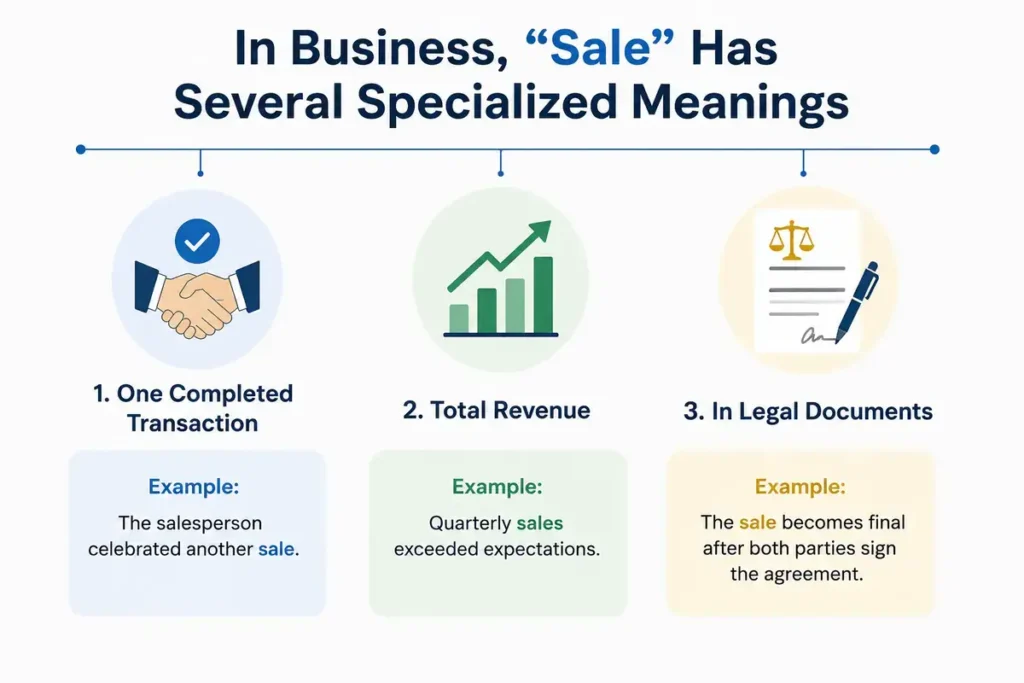
In business, sale has several specialized meanings.
It can refer to one completed transaction.
Example.
The salesperson celebrated another sale.
It can describe total revenue.
Example.
Quarterly sales exceeded expectations.
It also appears in legal documents.
Example.
The sale becomes final after both parties sign the agreement.
Sail in Maritime Language
The word sail has been part of maritime vocabulary for centuries.
Professional sailors use it in many technical expressions.
Examples include.
Raise the sail.
Lower the sail.
Trim the sails.
Full sail.
Reef the sail.
Even if you never operate a boat, you will encounter these terms in books, movies, documentaries, and news stories.
Sale vs Sail in Different Parts of Speech
| Word | Noun | Verb | Example |
|---|---|---|---|
| Sale | Yes | No | The sale starts Friday. |
| Sail | Yes | Yes | They sail every weekend. |
Notice that only sail functions as both a noun and a verb.
Sale vs Sail in Formal Writing
Formal writing values precision.
A single incorrect homophone can change the meaning of a sentence.
Correct.
The company completed the sale yesterday.
Correct.
The research vessel will sail tomorrow morning.
Incorrect.
The company completed the sail yesterday.
Incorrect.
The research vessel will sale tomorrow morning.
These mistakes may confuse readers and make your writing appear less polished.
Sale vs Sail in Informal Writing
Text messages and social media often contain homophone mistakes because people type quickly.
Example.
“I can’t wait for the sail tomorrow.”
Without context, readers might think you are talking about boating instead of shopping.
Choosing the correct spelling keeps your message clear.
Professional Writing Tips
Good writers develop habits that reduce spelling mistakes.
Read the Entire Sentence
Do not focus only on the confusing word.
Read the complete sentence to understand its meaning.
Ask What Is Happening
Is someone buying or selling?
Choose sale.
Is someone traveling by boat?
Choose sail.
Proofread Slowly
Homophone errors often survive spell check because both words exist in English.
Reading your work aloud can help you notice meaning errors.
Look at Nearby Words
Words like boat, ship, ocean, captain, and wind usually point to sail.
Words like price, customer, discount, buy, store, and purchase usually point to sale.
Related Grammar and Usage Notes
Learning related words strengthens your vocabulary and reduces future mistakes.
Sale and Sell
These words are connected but not interchangeable.
Sell is a verb.
Example.
They sell handmade furniture.
Sale is a noun.
Example.
The furniture sale begins Friday.
Sail and Sailing
Sail is the base form.
Example.
They sail every weekend.
Sailing is the present participle or gerund.
Example.
Sailing is her favorite hobby.
Sales
The plural noun sales refers to multiple transactions or business revenue.
Example.
The company reported record sales this year.
Sailor
A sailor is someone who works on or operates a boat or ship.
Example.
The experienced sailor crossed the Pacific Ocean.
Similar Homophones
English contains many homophones similar to Sale vs Sail.
| Word Pair | Difference |
|---|---|
| Sea vs See | Water versus vision. |
| Brake vs Break | Stopping a vehicle versus separating into pieces. |
| Meet vs Meat | Encounter someone versus animal food. |
| Flour vs Flower | Baking ingredient versus blooming plant. |
| Piece vs Peace | Part of something versus calm or harmony. |
| Right vs Write | Correct or direction versus putting words on paper. |
| Son vs Sun | Male child versus the star in our solar system. |
| Hole vs Whole | Opening versus complete. |
Recognizing these patterns helps improve spelling accuracy across many commonly confused words.
People Also Ask
Is sale ever used as a verb?
No. Sale is always a noun. The verb is sell.
Correct.
They sell fresh vegetables.
Incorrect.
They sale fresh vegetables.
Can sail be both a noun and a verb?
Yes.
As a noun.
The sail needs repair.
As a verb.
They sail every Saturday.
Why do sale and sail sound the same?
English pronunciation developed from many different languages over centuries. As a result, different words sometimes share the same pronunciation even though they have different spellings and meanings. These are called homophones.
How can I avoid confusing sale and sail?
Think about the context first.
Shopping means sale.
Boats and water mean sail.
This simple habit prevents most mistakes.
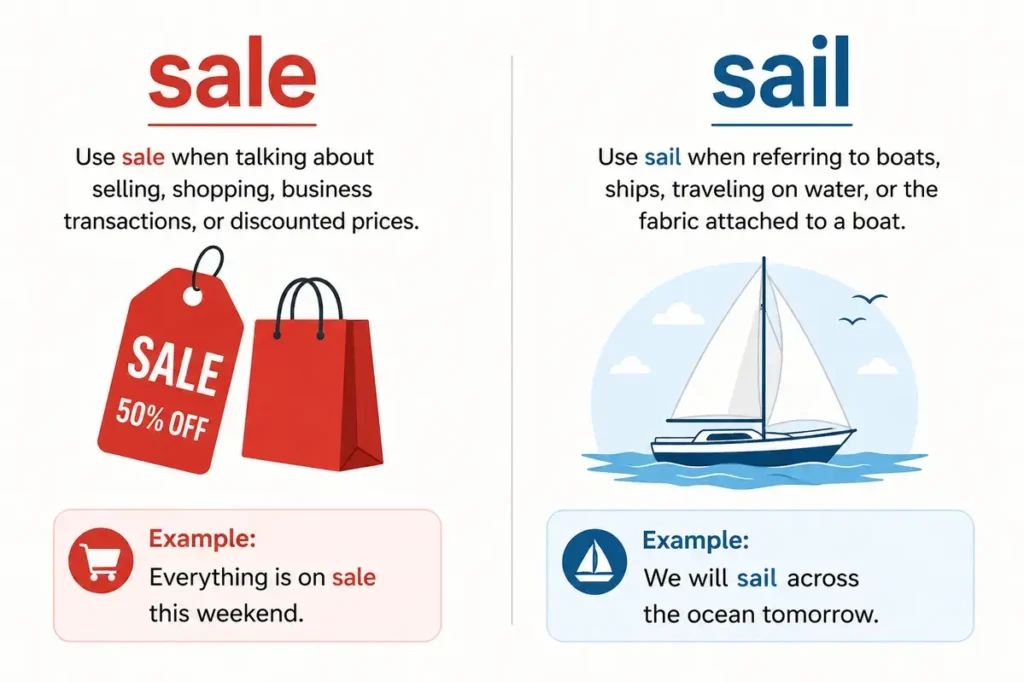
key Takeaways
- Sale and sail are homophones because they have the same pronunciation but different meanings and spellings.
- Use sale when talking about selling, shopping, business transactions, or discounted prices.
- Use sail when referring to boats, ships, traveling on water, or the fabric attached to a boat.
- Sale is always a noun.
- Sail can be both a noun and a verb.
- Context is the easiest way to choose the correct word.
- Words like store, discount, customer, and purchase usually indicate sale.
- Words like boat, ship, captain, wind, and ocean usually indicate sail.
- Reading your sentence for meaning is the best way to avoid confusing these homophones.
- Regular practice with real examples will help you remember the difference naturally.
Practice Quiz
Test your understanding by choosing the correct word.
1. The department store is having a huge _____ this weekend.
A. sale
B. sail
Answer: A. sale
Explanation: The sentence is about shopping and discounts.
2. They hope to _____ around the island tomorrow.
A. sale
B. sail
Answer: B. sail
Explanation: The action is traveling on water.
3. The old fishing boat needed a new _____.
A. sale
B. sail
Answer: B. sail
Explanation: A boat uses a sail to catch the wind.
4. The house is now _____.
A. for sale
B. for sail
Answer: A. for sale
Explanation: The owner wants to sell the house.
5. The captain ordered the crew to raise the _____.
A. sale
B. sail
Answer: B. sail
Explanation: The crew raises the sail before moving the boat.
6. Our favorite clothing store announced a summer _____.
A. sale
B. sail
Answer: A. sale
Explanation: A store holds a sale, not a sail.
7. We watched the ship _____ into the harbor.
A. sale
B. sail
Answer: B. sail
Explanation: The ship is moving across water.
8. Tickets go on _____ next Monday.
A. sale
B. sail
Answer: A. sale
Explanation: Tickets become available for purchase.
Related Words You May Also Confuse
If you found Sale vs Sail helpful, you may also want to learn these commonly confused word pairs.
- Sell vs Cell.
- Sea vs See.
- Buy vs By vs Bye.
- Stationary vs Stationery.
- Complement vs Compliment.
- Affect vs Effect.
- Principal vs Principle.
- Desert vs Dessert.
- Their vs There vs They’re.
- To vs Too vs Two.
Learning these pairs together will strengthen your spelling, grammar, and overall writing accuracy.
Conclusion
Understanding Sale vs Sail becomes simple once you focus on the meaning instead of the pronunciation. Even though the two words sound exactly alike, they belong to different contexts and serve different purposes in English.
Use sale when writing about shopping, discounts, business transactions, or something offered for purchase. Use sail when referring to boats, ships, the fabric that catches the wind, or the action of traveling across water.
A quick context check before you write can prevent most homophone mistakes. Ask yourself a simple question. Is the sentence about buying and selling, or is it about traveling on water? The answer will almost always point you to the correct spelling.
With regular reading and practice, choosing between sale and sail will soon become second nature, making your writing clearer, more accurate, and more professional.
Frequently Asked Questions
Can sale and sail ever mean the same thing?
No. Although they sound identical, they have completely different meanings. Sale relates to selling or discounts, while sail relates to boats and traveling on water.
Why are sale and sail called homophones?
They are homophones because they share the same pronunciation, /seɪl/, but have different spellings and meanings.
Is “for sail” ever correct?
Only in rare situations where you are literally describing something connected to a sail. If you mean an item is available to buy, the correct phrase is for sale.
Correct example:
The antique clock is for sale.
Is “on sail” correct?
Not when referring to discounts.
The correct expression is on sale.
On sail may appear in very specialized maritime writing, but it is not used to describe shopping or promotions.
Can sail be used without a boat?
Yes. The verb sail can describe traveling in any vessel designed for sailing, and it is also used figuratively.
Examples:
The project sailed through approval.
Time seemed to sail by.
In both examples, sail suggests smooth or effortless movement.
What is the difference between sale and sell?
Sell is the verb.
Example:
They sell handmade jewelry online.
Sale is the noun.
Example:
The jewelry sale starts tomorrow.
Is sail always about the ocean?
No. People can sail on oceans, seas, rivers, lakes, and even large reservoirs. The word refers to traveling on water, not to a specific body of water.
Which word is more common in everyday English?
Both are common, but they appear in different contexts.
If you read shopping websites, advertisements, or business news, you will see sale frequently.
If you read travel articles, maritime history, or boating guides, you will encounter sail more often.
How can I remember the correct spelling?
Use this simple association.
Sale belongs in a store.
Sail belongs on the sea.
The matching first letters make the distinction easy to remember.
Does spell check catch sale and sail mistakes?
Not always.
Because both words are correctly spelled English words, many spell checkers do not recognize when the wrong homophone has been used. Proofreading for meaning is essential.

Confusing Words, Spelling & Word Choice
Claire Whitmore is a U.S.-based English editor who writes about commonly confused words, spelling differences, and word choice. Her work helps readers understand subtle distinctions between similar-looking words through simple definitions, practical examples, and modern usage guidance in both American and British English.