
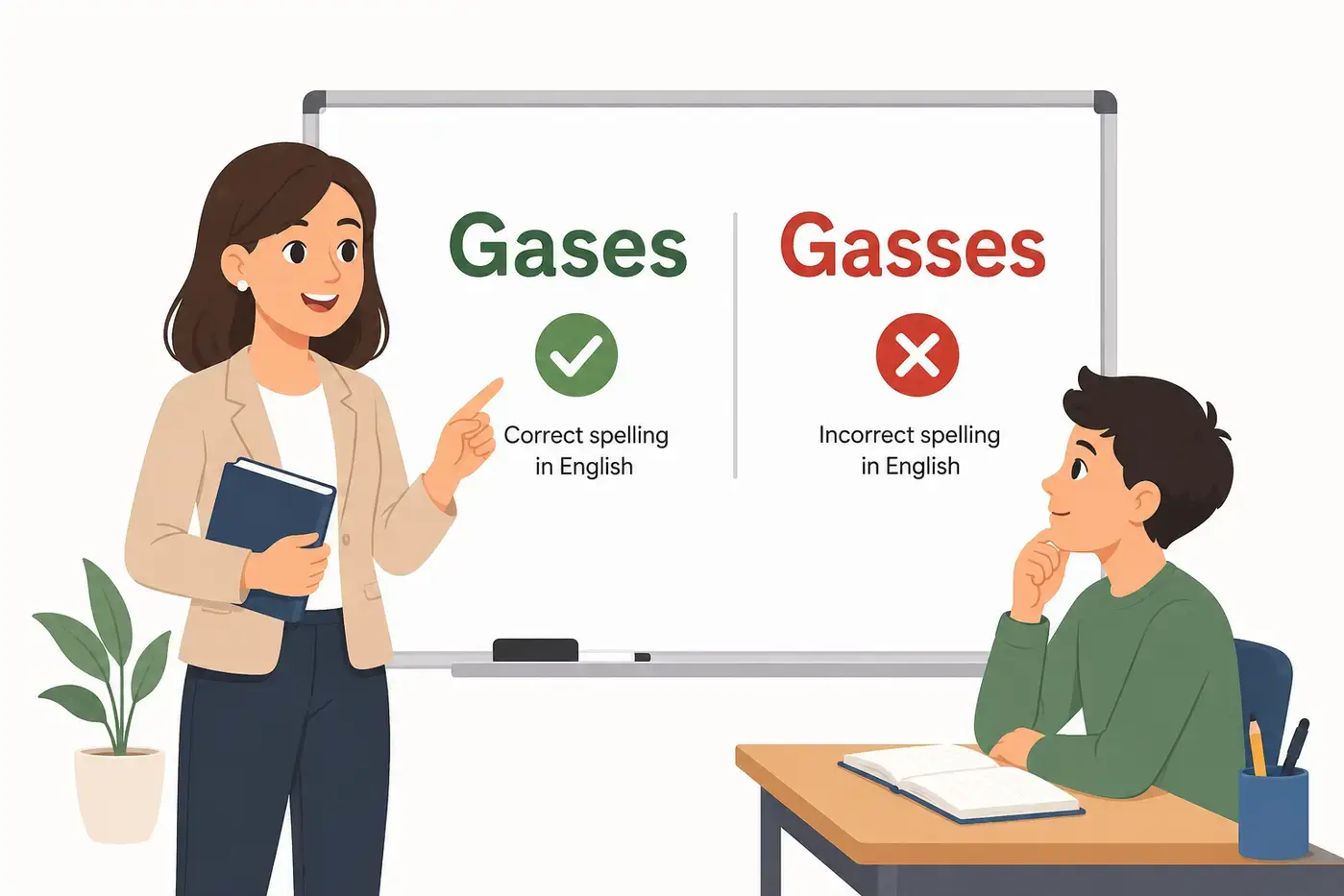
Gases or Gasses is a common spelling question because both words exist in English, but they serve different grammatical purposes. Many people assume one spelling is always wrong, while others use them interchangeably. In reality, each word has a specific role.
If you are talking about substances such as oxygen, nitrogen, helium, or carbon dioxide, the correct plural noun is gases. If you are using the verb gas in the present tense with he, she, or it, the correct form is gasses.
This guide explains the complete difference between Gases or Gasses, including meanings, grammar rules, pronunciation, word origins, examples, common mistakes, exceptions, professional writing tips, and memory tricks. By the end, you will know exactly which spelling to use in every situation.
Short Answer
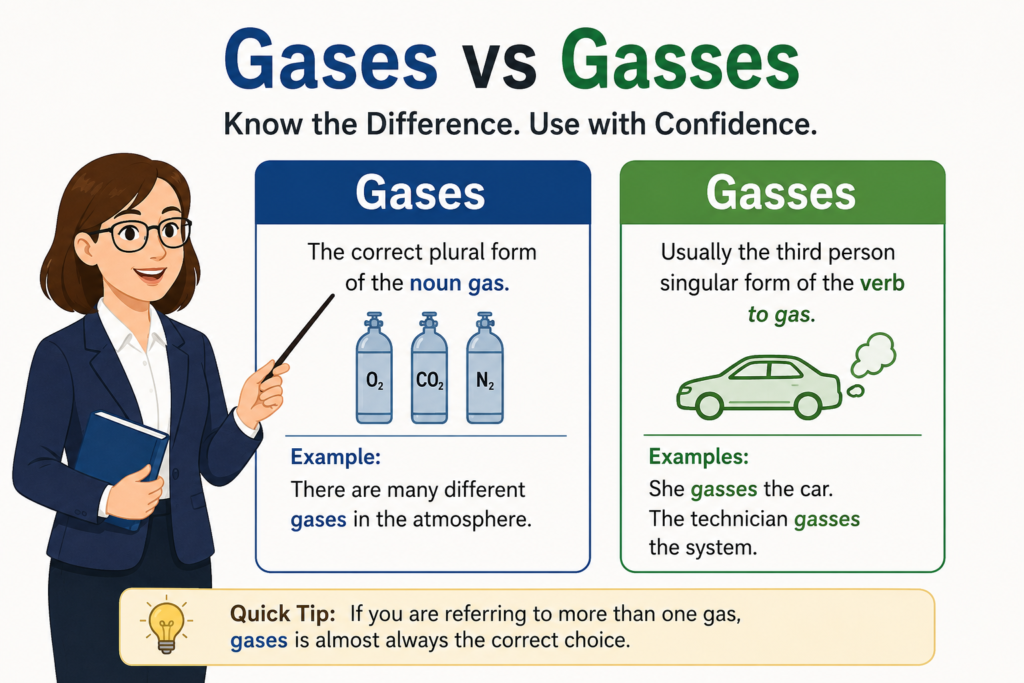
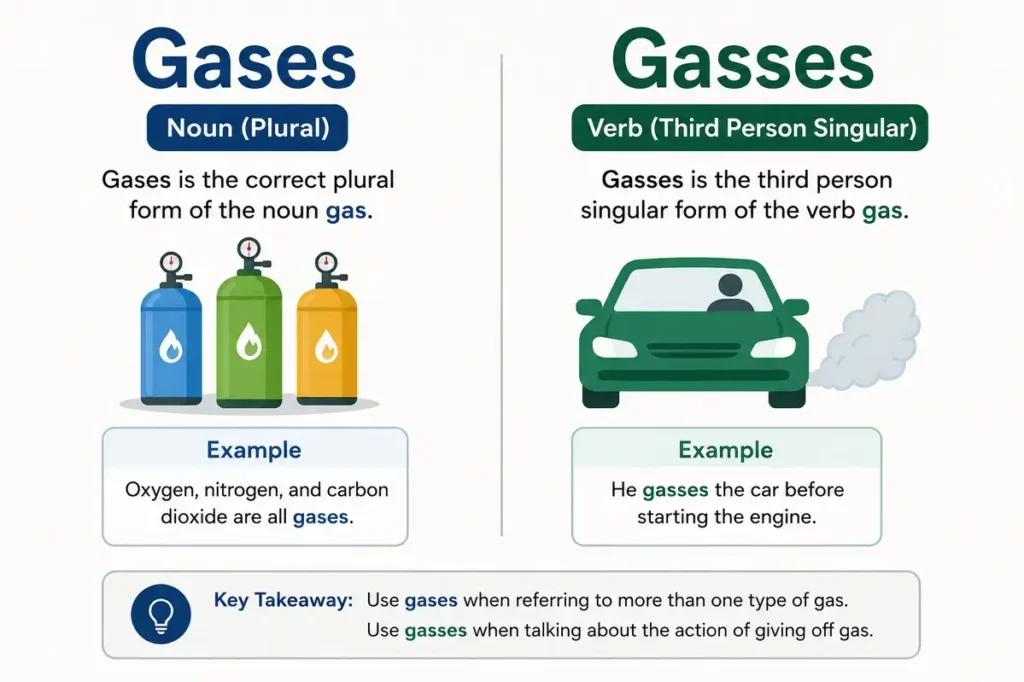
Gases is the correct plural form of the noun gas. Gasses is usually the third person singular form of the verb to gas, as in She gasses the car or The technician gasses the system. If you are referring to more than one gas, gases is almost always the correct choice.
Table of Contents
- What Is the Difference Between Gases and Gasses
- Comparison Table
- What Does Gases Mean
- What Does Gasses Mean
- Which Spelling Is Correct
- Grammar Rule
- Pronunciation
- Word Origin
- When to Use Gases
- When to Use Gasses
- Can They Be Used Interchangeably
- Examples in Everyday English
- Common Mistakes
- Memory Tips
- Related Grammar Notes
- Frequently Asked Questions
- Key Takeaways
- Conclusion
What Is the Difference Between Gases and Gasses
The difference is based on grammar rather than meaning.
Gases is the plural noun of gas.
Gasses is a verb form that means applies gas, fills with gas, or talks excessively in certain informal contexts.
The two words are both correct, but they cannot usually replace each other.
Comparison Table
| Feature | Gases | Gasses |
|---|---|---|
| Part of speech | Noun | Verb |
| Meaning | More than one gas | Third person singular of gas |
| Correct for plural substances | Yes | No |
| Used in science | Yes | Rarely |
| Used in chemistry | Yes | Rarely |
| Used in everyday writing | Very common | Less common |
| Example | Greenhouse gases affect climate. | She gasses the vehicle every Friday. |
Which Spelling Is Correct
The answer depends on what you are trying to say. If you mean more than one gas, write gases. If you mean someone performs the action of gassing something, write gasses.
Correct
The atmosphere contains several gases. The mechanic gasses the air conditioning system.
Incorrect
The atmosphere contains several gasses. The mechanic gases the air conditioning system. The first incorrect sentence uses the wrong plural noun. The second incorrect sentence uses the wrong verb form.
What Does Gases Mean
Gases is the plural form of the noun gas.
A gas is one of the basic states of matter. Unlike solids and liquids, gases have no fixed shape or volume. They expand to fill the space around them.
Definition
More than one gas.
Examples
The Earth’s atmosphere contains many gases.
Explanation: The sentence refers to several different gases, including nitrogen, oxygen, and argon.
Scientists study greenhouse gases to understand climate change.
Explanation: Multiple gases contribute to the greenhouse effect.
The laboratory stores several compressed gases safely.
Explanation: Different gases are being stored.
What Does Gasses Mean
Gasses is the third person singular present tense of the verb gas.
The verb has several meanings depending on the context.
Meaning One
To fill something with gas.
Example: The technician gasses the refrigeration system.
Explanation: The technician adds refrigerant gas to the system.
Meaning Two
To supply fuel.
Example: She gasses the lawn mower before every use.
Explanation: She fills it with gasoline.
Meaning Three
To expose someone or something to gas.
Example: The factory accidentally gasses the storage chamber.
Explanation: Gas is released into the chamber.
Meaning Four
Informal English
In informal American English, gasses can also mean talks continuously or boasts.
Example: He always gasses his friends about his fishing trips.
Explanation: He talks at length, often with exaggeration.
Grammar Rule Behind Gases and Gasses
This spelling difference follows two separate grammar rules.
Rule One
Plural nouns ending in s often add es.
Gas becomes gases.
Class becomes classes.
Bus becomes buses.
Box becomes boxes.
Rule Two
Verbs ending in s also add es in the third person singular.
Gas becomes gasses.
Pass becomes passes.
Miss becomes misses.
Buzz becomes buzzes.
Although both forms end in es, they belong to different parts of speech.
Pronunciation
The pronunciation is nearly identical.
| Word | IPA | Simple Pronunciation |
|---|---|---|
| Gases | /ˈɡæsɪz/ | GAS iz |
| Gasses | /ˈɡæsɪz/ | GAS iz |
Since they sound exactly alike, context tells readers which word is correct.
Word Origin
The noun gas entered English in the seventeenth century. It was introduced by the Flemish chemist Jan Baptist van Helmont, who created the term to describe substances that behave differently from solids and liquids. The word likely developed from the Greek word chaos, reflecting the idea of something shapeless or formless. As English evolved, gas became both a noun and a verb. This is why modern English includes both gases and gasses, each serving a different grammatical purpose.
When to Use Gases
Use gases whenever you are talking about more than one gas. This is by far the more common spelling.
Common Contexts
- Chemistry.
- Physics.
- Environmental science.
- Medicine.
- Engineering.
- Manufacturing.
- Education.
- Weather reports.
Examples
Air contains several important gases.
Explanation: Air is made up of multiple gases.
Industrial gases have many commercial uses.
Explanation: The sentence refers to different types of gases used in industry.
Greenhouse gases trap heat in the atmosphere.
Explanation: Several gases contribute to global warming.
Natural gases occur beneath the Earth’s surface.
Explanation: The sentence discusses gas deposits found underground.
When to Use Gasses
Use gasses only when gas functions as a verb. Although correct, this form appears much less often than gases.
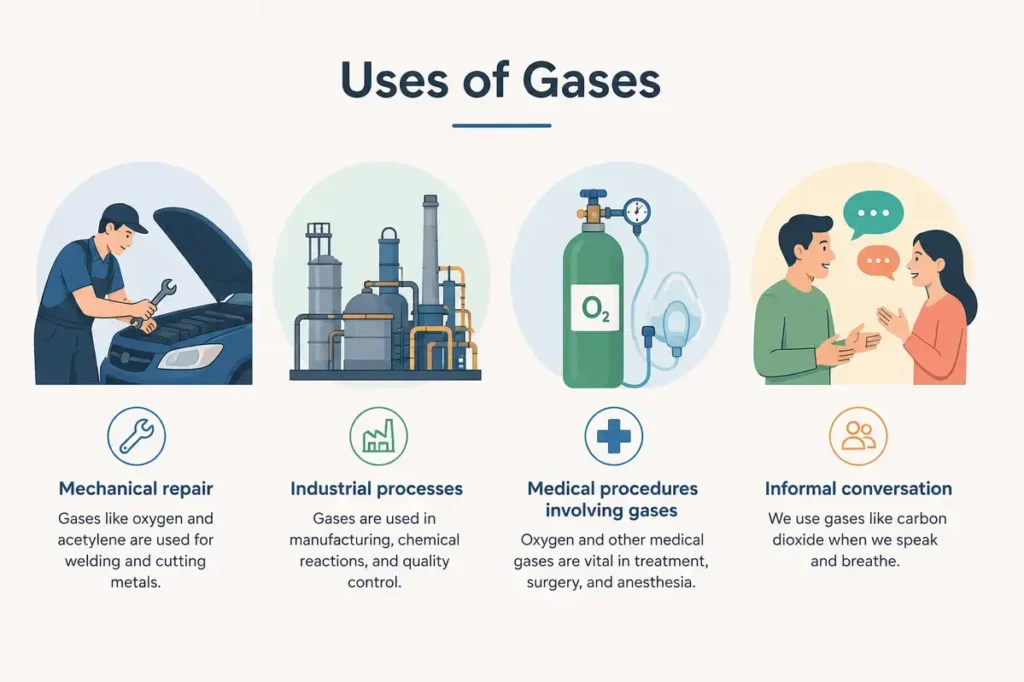
Common Contexts
- Automotive maintenance.
- Mechanical repair.
- Industrial processes.
- Medical procedures involving gases.
- Informal conversation.
Examples
The mechanic gasses every vehicle before the road test.
Explanation: The mechanic fills each vehicle with fuel.
She gasses the welding equipment each morning.
Explanation: Gas is supplied before work begins.
The laboratory technician carefully gasses the chamber.
Explanation: Gas is introduced into the chamber under controlled conditions.
Can Gases and Gasses Be Used Interchangeably
No.
Although they have the same pronunciation, they perform different grammatical functions.
Compare these examples.
Correct: The experiment produced several gases.
Correct: The engineer gasses the pipeline before testing it.
Incorrect: The experiment produced several gasses.
Incorrect: The engineer gases the pipeline before testing it.
The noun requires gases.
The verb requires gasses.
Learning this simple distinction will help you avoid one of the most common spelling mistakes involving the word gas.
Real Life Examples of Gases
The following examples show how gases is correctly used as the plural noun.
Example 1
The Earth’s atmosphere contains several gases.
Explanation: The sentence refers to multiple gases, including nitrogen, oxygen, argon, and carbon dioxide.
Example 2
Scientists analyzed the gases released during the experiment.
Explanation: More than one gas was produced and examined.
Example 3
Medical gases are stored in specially designed cylinders.
Explanation: Hospitals use different gases, such as oxygen and nitrous oxide.
Example 4
The factory monitors harmful gases every day.
Explanation: The company checks several gases to meet safety and environmental standards.
Example 5
Greenhouse gases contribute to global warming.
Explanation: Multiple gases trap heat in the Earth’s atmosphere.
Example 6
Compressed gases require careful handling.
Explanation: The sentence refers to various gases stored under pressure.
Example 7
The laboratory measured the density of several gases.
Explanation: Researchers compared different gaseous substances.
Example 8
Engineers tested the gases inside the storage tanks.
Explanation: Multiple gases were examined during the inspection.
Real Life Examples of Gasses
These examples demonstrate the correct use of gasses as a verb.
Example 1
The technician gasses the refrigeration unit before testing it.
Explanation: The technician fills the system with refrigerant gas.
Example 2
She gasses her car every Sunday evening.
Explanation: She fills the fuel tank before the workweek begins.
Example 3
The mechanic gasses each vehicle after completing the repairs.
Explanation: Fuel is added before returning the vehicle to the customer.
Example 4
The operator carefully gasses the chamber before starting the experiment.
Explanation: Gas is introduced into the chamber according to safety procedures.
Example 5
He gasses the welding equipment before every project.
Explanation: The equipment receives the required gas supply.
Example 6
The maintenance worker gasses the industrial system according to the manufacturer’s instructions.
Explanation: Gas is added as part of routine maintenance.
Example 7
She always gasses the generator before storm season.
Explanation: Fuel is added so the generator is ready for use.
Example 8
The laboratory assistant gasses the equipment under close supervision.
Explanation: Gas is supplied carefully to ensure safe operation.
Common Mistakes
Many writers confuse Gases or Gasses because both spellings look correct. These are the mistakes that appear most often.
Mistake 1
The atmosphere contains many gasses.
Incorrect.
Correct: The atmosphere contains many gases.
Explanation: The sentence needs the plural noun.
Mistake 2
The mechanic gases the air conditioning system.
Incorrect.
Correct: The mechanic gasses the air conditioning system.
Explanation: The sentence uses a verb, so gasses is correct.
Mistake 3
Thinking gasses is simply another plural spelling.
It is not.
Gasses is primarily a verb.
Mistake 4
Using gases every time because it looks more familiar.
Although gases is much more common, it is incorrect when the word functions as a verb.
Mistake 5
Assuming dictionaries list only one correct spelling. Most dictionaries include both spellings because both are standard English words with different grammatical roles.
Exceptions and Special Cases
English has a few situations where context determines the correct spelling.
Scientific Writing
In chemistry, biology, engineering, physics, medicine, and environmental science, gases is almost always the correct form because these fields usually discuss multiple gaseous substances.
Example: The instrument detects toxic gases.
Technical Manuals
Repair manuals sometimes use gasses because they describe actions.
Example: The technician gasses the cooling system.
Informal Speech
People often avoid gasses by rewriting the sentence.
Instead of writing:
She gasses the car every week.
Many writers prefer:
She fills the car with gas every week.
This sounds more natural in everyday English.
Memory Tips
Simple memory tricks make it easy to remember Gases or Gasses.
Memory Trick 1
Ask yourself a question.
Is this talking about more than one gas?
If yes, use gases.
Memory Trick 2
Look for the action.
If someone is doing something with gas, the verb is probably needed.
Action equals gasses.
Memory Trick 3
Remember this simple phrase.
Many gases.
Someone gasses.
The first is a plural noun.
The second is a verb.
Memory Trick 4
Replace the word.
If you can replace it with substances, choose gases.
If you can replace it with fills with gas, choose gasses.
Related Grammar and Usage Notes
Understanding similar spelling patterns helps reinforce the rule.
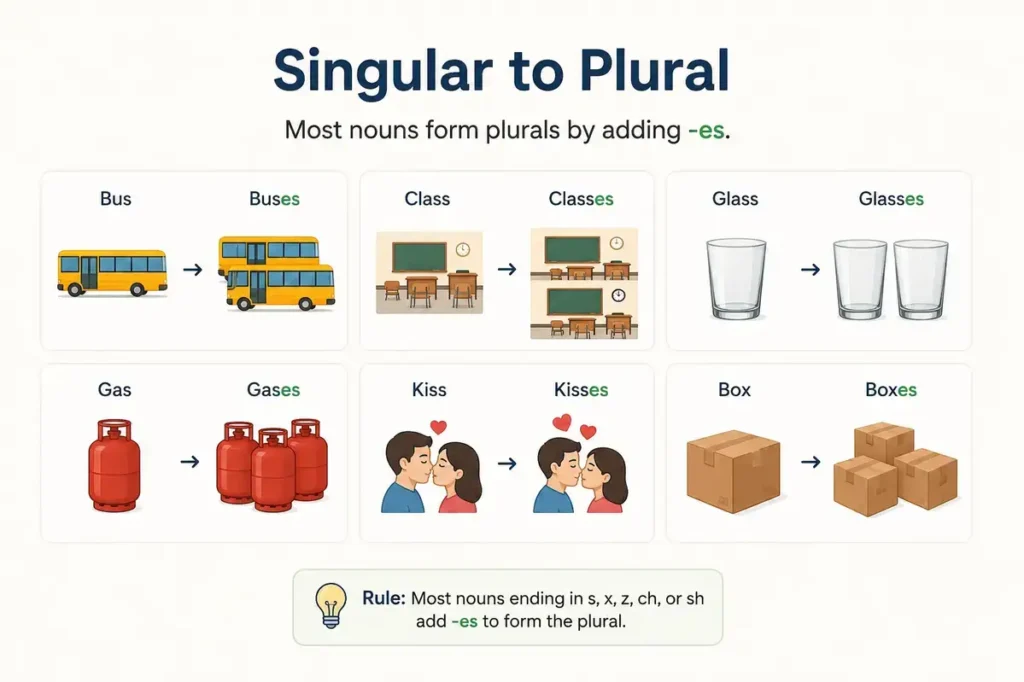
Other Plural Nouns Ending in ES
| Singular | Plural |
|---|---|
| Bus | Buses |
| Class | Classes |
| Glass | Glasses |
| Gas | Gases |
| Kiss | Kisses |
| Box | Boxes |
These are all nouns.
Other Third Person Singular Verbs Ending in ES
| Base Verb | Third Person Singular |
|---|---|
| Pass | Passes |
| Miss | Misses |
| Buzz | Buzzes |
| Gas | Gasses |
| Fix | Fixes |
| Wash | Washes |
These are verbs. Notice that English sometimes produces identical endings for plural nouns and verb forms. The sentence structure tells you which one is correct.
Similar Words That Cause Confusion
Many English learners confuse these pairs because they involve similar spelling patterns.
| Correct Pair | Difference |
|---|---|
| Advice and Advise | Noun versus verb |
| Practice and Practise | US and UK variation |
| License and Licence | Noun versus verb in British English |
| Breaths and Breathes | Noun versus verb |
| Devices and Devises | Noun versus verb |
| Gases and Gasses | Noun versus verb |
Recognizing the grammatical role before choosing the spelling is the safest approach.
Professional Writing Tips
Using the correct spelling makes your writing more precise and credible.
Use gases when:
- Writing about science.
- Discussing the environment.
- Referring to chemistry.
- Describing more than one gas.
- Writing educational content.
Use gasses when:
- Describing the action of adding gas.
- Writing repair instructions.
- Explaining industrial processes.
- Referring to fueling equipment.
- Using the verb gas in the present tense.
Editing Tip
Use gases when referring to two or more gases.If the word describes an action, choose gasses.
This simple editing habit prevents almost every mistake involving this word pair.
Key Takeaways
- Gases is the correct plural form of the noun gas.
- Gasses is the third person singular form of the verb gas.
- If you are referring to more than one gas, use gases.
- If someone is adding gas, fueling equipment, or exposing something to gas, use gasses.
- Both words are correct English spellings, but they have different grammatical functions.
- Gases is far more common than gasses in everyday writing.
- Scientific, medical, and environmental writing almost always uses gases.
- Sentence context determines which spelling is correct.
Related Grammar and Usage Notes
Many English words change spelling based on their grammatical role. Gases or Gasses is one example of this pattern.
Compare these similar pairs:
| Noun | Verb |
|---|---|
| Advice | Advise |
| Device | Devise |
| Breath | Breathe |
| Practice (US) | Practice (US) |
| Licence (UK) | License (UK verb) |
| Gases | Gasses |
Looking at the role a word plays in the sentence is often more helpful than focusing only on its spelling.
Conclusion
Understanding Gases or Gasses is easier once you recognize the difference between a noun and a verb. Gases is the correct plural form of gas and should be used when referring to two or more gaseous substances, such as oxygen, nitrogen, helium, or greenhouse gases. Gasses, on the other hand, is the present tense verb used when someone adds gas, fuels equipment, or exposes something to gas.
Although both spellings are correct, they are not interchangeable. Choosing the right one depends entirely on the role the word plays in your sentence. If you are naming substances, write gases. If you are describing an action involving gas, write gasses.
By remembering this simple grammar rule and reviewing the examples in this guide, you can confidently use both spellings in academic writing, professional documents, technical manuals, and everyday English without hesitation.
Frequently Asked Questions
Is gases or gasses correct?
Both are correct, but they have different meanings. Gases is the plural noun, while gasses is the verb form.
What is the plural of gas?
The plural of gas is gases.
Example: The cylinder contains several industrial gases.
Why isn’t the plural spelled gasses?
English spelling follows established plural rules for the noun gas. The accepted plural is gases. The spelling gasses is reserved for the verb.
What does gasses mean?
It means someone fills something with gas, fuels it, exposes it to gas, or performs another action related to gas.
Is gasses commonly used?
Yes, but much less often than gases. It mainly appears in technical writing, maintenance instructions, and certain everyday situations.
Which spelling should I use in scientific writing?
Use gases almost every time because scientific writing usually refers to multiple gaseous substances rather than the action of adding gas.
How can I remember the difference?
Think about the sentence. If the word names substances, use gases. If the word describes an action, use gasses.
Are both words pronounced the same?
Yes. Both are commonly pronounced GAS iz, so the surrounding sentence provides the meaning.
Can spell check confuse these words?
Yes. Many spelling tools accept both words because both are correct English spellings. They may not detect the error if you choose the wrong form for the sentence.
What is the easiest rule to remember?
Remember this simple guideline. Many gases. Someone gasses. That single rule will help you choose the correct spelling in almost every situation.

Confusing Words, Spelling & Word Choice
Claire Whitmore is a U.S.-based English editor who writes about commonly confused words, spelling differences, and word choice. Her work helps readers understand subtle distinctions between similar-looking words through simple definitions, practical examples, and modern usage guidance in both American and British English.