
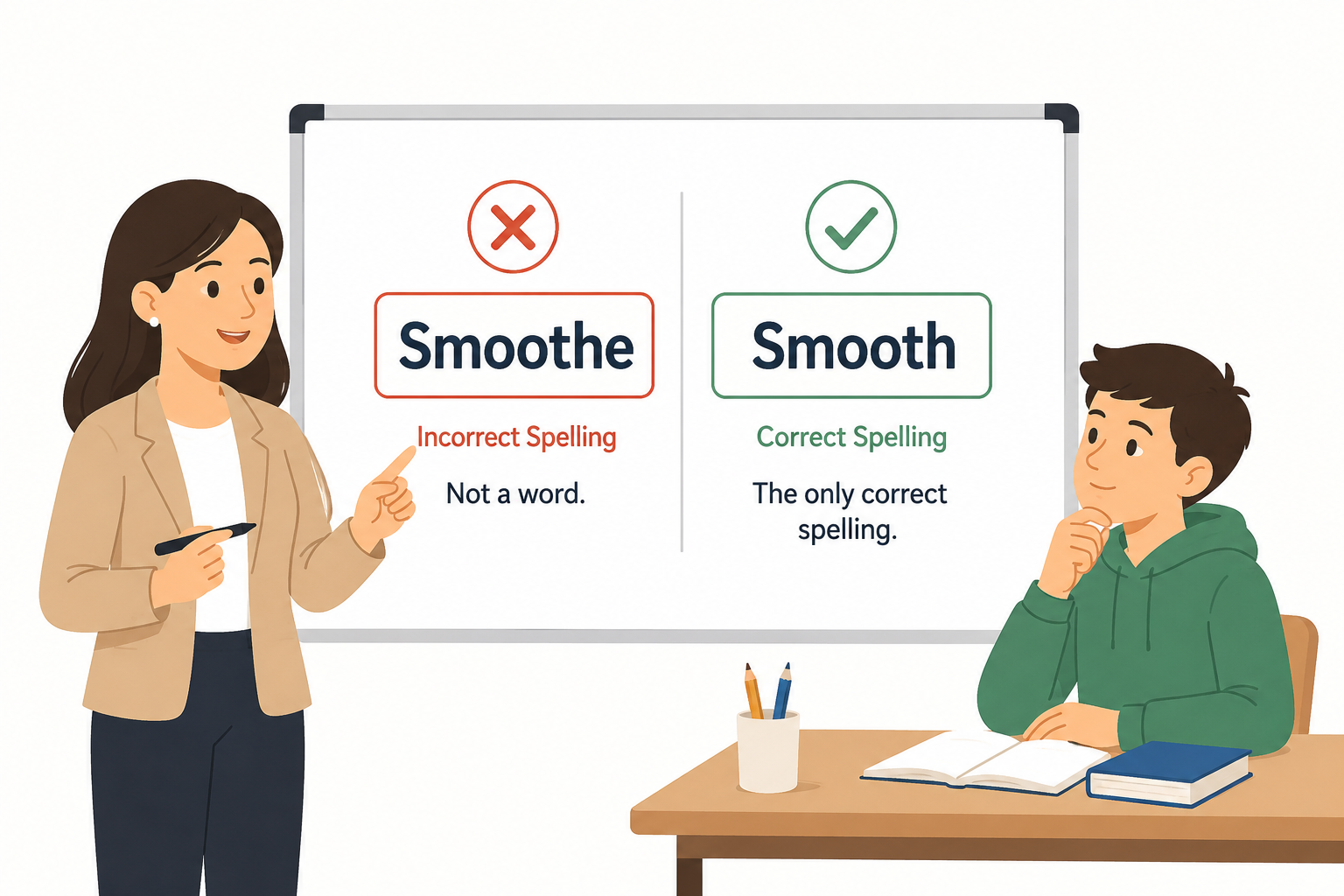
Smoothe vs Smooth is a common spelling question because both words look believable. The extra e at the end makes many people wonder if smoothe is an acceptable alternative or simply a misspelling.
The short answer is clear. Smooth is the standard spelling recognized by modern English dictionaries. It works as an adjective, a verb, and a noun in certain contexts. Smoothe is considered an obsolete spelling in standard English and rarely appears outside historical documents, surnames, business names, or intentional stylistic choices.
This guide explains everything you need to know about Smoothe vs Smooth, including spelling, pronunciation, meanings, grammar, origins, examples, common mistakes, memory tricks, and professional writing advice.
Short Question
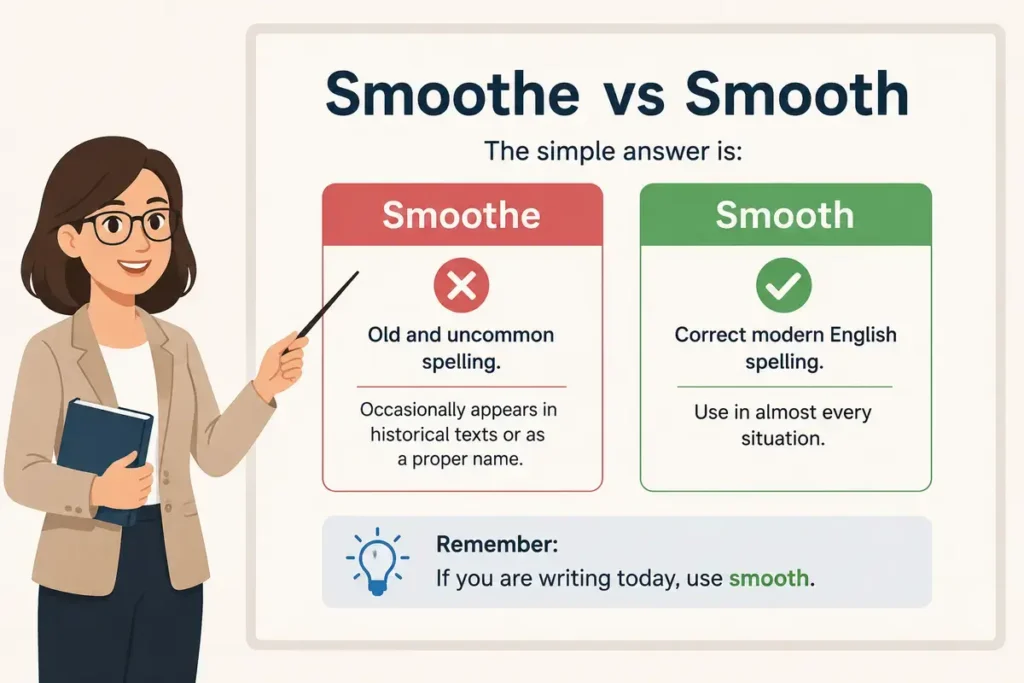
Smoothe vs Smooth has a simple answer. Smooth is the correct modern English spelling in almost every situation. Smoothe is an old and uncommon spelling that occasionally appears in historical texts or as a proper name, but it is not the standard spelling in modern English. If you are writing today, use smooth.
Table of Contents
- Is It Smoothe or Smooth
- Comparison Table
- What Does Smooth Mean
- Is Smoothe a Real Word
- Pronunciation Guide
- Parts of Speech
- Word Origin
- Grammar Rules
- When to Use Smooth
- Can You Ever Use Smoothe
- Examples in Everyday English
- Common Mistakes
- Memory Tips
- Related Grammar Notes
- Frequently Asked Questions
- Key Takeaways
- Conclusion
Is It Smoothe or Smooth
The correct spelling is smooth.
Modern English dictionaries recognize smooth as the accepted spelling.
Although smoothe existed in earlier forms of English, it has disappeared from standard modern usage. Most spell checkers, grammar checkers, dictionaries, style guides, and editors recommend smooth.
Quick Answer Table
| Question | Answer |
|---|---|
| Correct modern spelling | Smooth |
| Standard English | Smooth |
| Common mistake | Smoothe |
| Found in dictionaries | Smooth |
| Historical spelling | Smoothe |
| Recommended for writing | Smooth |
Comparison Table
| Feature | Smooth | Smoothe |
|---|---|---|
| Correct modern spelling | Yes | No |
| Found in current dictionaries | Yes | Rarely as an obsolete form |
| Used in everyday writing | Yes | No |
| Used in business names or surnames | Occasionally | Yes |
| Accepted in academic writing | Yes | No |
| Pronunciation | Smooth | Same pronunciation |
| Recommended spelling | Yes | No |
What Does Smooth Mean
Smooth has several meanings depending on how it is used.
It usually describes something that has an even surface, something that happens without difficulty, or someone who behaves in a confident and polished way.
Definition as an Adjective
Having an even surface without roughness.
Examples
The table has a smooth finish.
Explanation: The surface feels even and polished.
She has smooth skin after using the moisturizer.
Explanation: The skin feels soft and even.
Definition as a Verb
To make something even, flat, or free from wrinkles.
Examples
Please smooth the paper before printing.
Explanation: Flatten the paper.
He smoothed the blanket before making the bed.
Explanation: He removed folds and wrinkles.
Definition as a Noun
In specialized fields, smooth may describe a smooth surface or a smooth movement, although this use is less common.
Example:
The road changes from rough to smooth.
Is Smoothe a Real Word
This is one of the most common questions people ask about Smoothe vs Smooth.
Technically, smoothe has existed in historical English. Older texts occasionally used it as a spelling variant before English spelling became standardized.
Today, however, smoothe is no longer considered the standard spelling.
Modern dictionaries list smooth as the correct form.
You may still encounter Smoothe in these situations.
- Historical books.
- Old manuscripts.
- Family surnames.
- Company names.
- Brand names.
- Creative writing that intentionally imitates older English.
Outside these cases, use smooth.
Pronunciation Guide
One reason people confuse Smoothe vs Smooth is that both spellings are pronounced exactly the same.
| Word | IPA | Simple Pronunciation |
|---|---|---|
| Smooth | /smuːð/ | Smooth |
| Smoothe | /smuːð/ | Smooth |
The silent e does not change the pronunciation.
Parts of Speech
Understanding grammar makes correct spelling easier.
| Word | Part of Speech | Example |
|---|---|---|
| Smooth | Adjective | Smooth fabric feels soft. |
| Smooth | Verb | Smooth the edges carefully. |
| Smooth | Noun | The road became smooth. |
| Smoothe | Obsolete spelling | Rare in modern English |
Notice that every modern grammatical use relies on smooth, not smoothe.
Word Origin
The word smooth comes from Old English smōth, meaning even, level, or free from roughness.
It has Germanic roots and is related to words in several older Germanic languages that describe flat or polished surfaces.
During earlier periods of English, spelling was not standardized. Writers often spelled the same word in different ways, including smoothe.
As dictionaries and printing became more consistent, smooth became the accepted spelling.
Today, nearly every publisher, editor, educator, and style guide follows this standard.
Grammar Rules
Understanding the grammar behind smooth helps prevent mistakes.
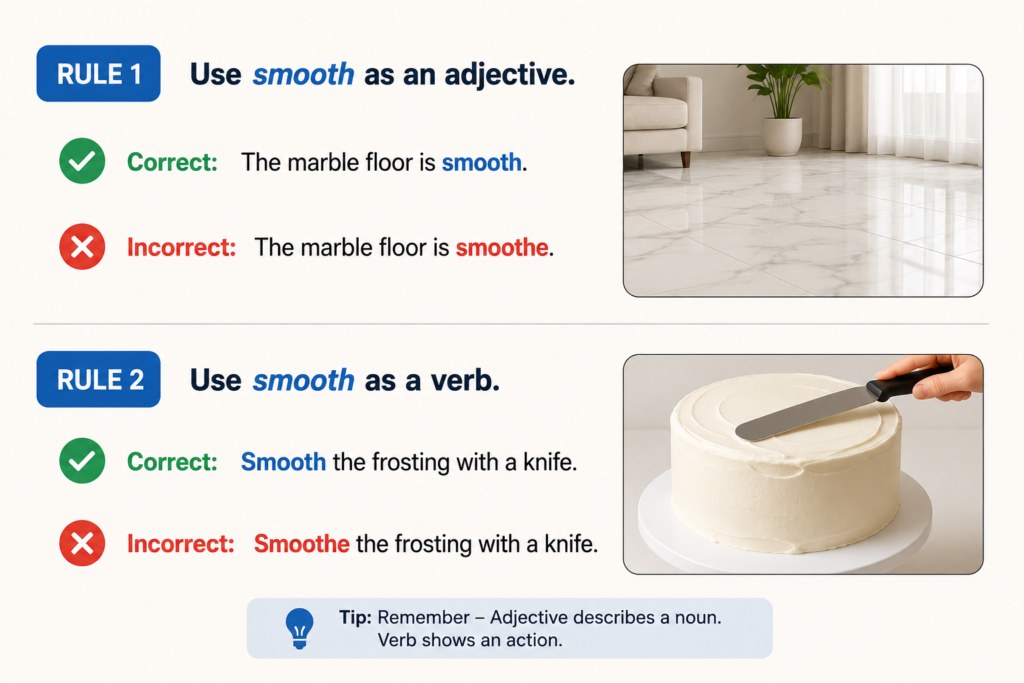
Rule 1
Use smooth as an adjective.
Correct:
The marble floor is smooth.
Incorrect:
The marble floor is smoothe.
Rule 2
Use smooth as a verb.
Correct:
Smooth the frosting with a knife.
Incorrect:
Smoothe the frosting with a knife.
Rule 3
Past tense uses smoothed.
Correct:
She smoothed the fabric carefully.
Incorrect:
She smoothede the fabric carefully.
Rule 4
Comparative and superlative forms follow normal grammar.
Positive:
Smooth
Comparative:
Smoother
Superlative:
Smoothest
Never write:
Smootheer
or
Smootheest
Why Do People Write Smoothe
Several factors explain the confusion.
The Silent E Pattern
Many English words end with a silent e.
Examples include:
- Hope.
- Shape.
- Brave.
- Smile.
Because of this familiar spelling pattern, some writers naturally assume smooth should end with e.
Similar Looking Words
Words such as these reinforce the assumption.
- Breathe.
- Bathe.
- Wreathe.
These verbs end in e, while smooth does not.
Auto Correction Errors
Occasionally, typing mistakes or autocorrect settings can introduce smoothe, especially if a person’s name or business name contains that spelling.
When to Use Smooth
Use smooth in every normal writing situation.
Describing a Surface
The glass feels smooth.
The adjective describes texture.
Describing Movement
The airplane had a smooth landing.
The adjective describes an event without problems.
Describing Speech
She gave a smooth presentation.
The adjective describes polished communication.
Using the Verb
Smooth the icing before serving the cake.
The verb means to make something even.
Describing Personality
He is a smooth negotiator.
The adjective describes someone who communicates confidently and tactfully.
Can You Ever Use Smoothe
For almost all modern writing, the answer is no.
If you are writing an essay, article, email, report, blog post, advertisement, or social media update, choose smooth.
There are only a few situations where Smoothe may appear correctly.
Historical Documents
Older books and manuscripts sometimes use smoothe because English spelling was less standardized.
Example:
A historical manuscript may contain the sentence:
The waters were smoothe and calm.
Explanation: This reflects historical spelling, not modern English.
Proper Names
Some people, businesses, products, or organizations use Smoothe as part of their official name.
Example:
Smoothe Salon
Explanation: The spelling is correct because it is part of the brand name.
Creative Writing
An author writing historical fiction may intentionally use smoothe to create an authentic historical tone.
Outside these exceptions, smooth remains the correct spelling.
Real Life Examples of Smooth
The following examples show how smooth naturally appears in modern English.
Example 1
The baby has smooth skin.
Explanation: The adjective describes soft, even skin.
Example 2
Please smooth the tablecloth before dinner.
Explanation: The verb means to remove wrinkles.
Example 3
Traffic was surprisingly smooth this morning.
Explanation: The journey happened without delays.
Example 4
She gave a smooth performance during the interview.
Explanation: Her speaking style was polished and confident.
Example 5
The painter smoothed the wall before applying fresh paint.
Explanation: The wall was made even to prepare it for painting.
Example 6
His smooth voice made the podcast enjoyable to hear.
Explanation: The voice sounded calm and pleasant.
Example 7
The software update created a smooth user experience.
Explanation: Everything worked efficiently without problems.
Example 8
The road became smooth after the repairs were completed.
Explanation: The surface was no longer rough.
Examples Showing Why Smoothe Is Incorrect
These examples demonstrate mistakes that frequently appear online.
Incorrect
The countertop feels smoothe.
Correct:
The countertop feels smooth.
Incorrect
Please smoothe your shirt before the meeting.
Correct:
Please smooth your shirt before the meeting.
Incorrect
She has very smoothe hair.
Correct:
She has very smooth hair.
Incorrect
The presentation went smoothe.
Correct:
The presentation went smoothly.
Explanation: Here you need the adverb smoothly, not the adjective smooth.
Common Mistakes
People often make the same errors when comparing Smoothe vs Smooth.
Mistake 1
Adding an unnecessary e.
Incorrect:
The surface is smoothe.
Correct:
The surface is smooth.
Mistake 2
Confusing smooth with smoothly.
Incorrect:
Everything went smooth.
Better:
Everything went smoothly.
Explanation: The verb went requires an adverb.
Mistake 3
Writing smoothe because similar words end with e.
Examples include:
- Breathe.
- Bathe.
- Wreathe.
These words follow different spelling patterns.
Mistake 4
Using smoothe after spell check suggestions from outdated sources.
Modern English style guides recommend smooth.
Mistake 5
Assuming both spellings are acceptable.
Only smooth is standard in contemporary English.
Memory Tips
Simple tricks make Smoothe vs Smooth easy to remember.
Memory Trick 1
Think of the phrase:
Smooth moves.
You have probably seen or heard this expression many times.
There is no extra e.
Memory Trick 2
Remember the comparison.
Smooth
Smoother
Smoothest
Every form keeps the same spelling.
Memory Trick 3
Think about the adverb.
Smooth
becomes
Smoothly
The ly is added directly.
There is never an extra e.
Memory Trick 4
Picture a perfectly polished surface.
The clean surface reminds you that the spelling stays clean too.
Just smooth.
Related Grammar and Usage Notes
Understanding nearby grammar points helps prevent similar spelling errors.
Smooth Versus Smoothly
Smooth is usually an adjective or a verb.
Smoothly is an adverb.
Correct:
The machine runs smoothly.
Correct:
The machine is smooth.
Incorrect:
The machine runs smooth.
Although some informal speech uses runs smooth, formal writing prefers runs smoothly.
Smooth Versus Soft
These words are related but not identical.
Smooth describes an even surface.
Soft describes how something feels when touched.
Example:
The pillow is soft.
Example:
The wooden table is smooth.
A surface may be smooth without being soft.
Smooth Versus Flat
A flat object is level.
A smooth object is free from roughness.
Something can be smooth but curved.
Something can be flat but rough.
Formal and Informal Usage
The word smooth works naturally in every level of English.
Formal Writing
You will often see smooth in:
- Academic papers.
- Technical manuals.
- Business reports.
- Scientific writing.
- Professional emails.
Informal Writing
It is equally common in:
- Text messages.
- Blogs.
- Social media posts.
- Everyday conversations.
Very few English words work comfortably in both formal and informal settings, and smooth is one of them.
American and British English
There is no spelling difference between American English and British English.
Both varieties use:
Smooth
Neither standard variety recommends smoothe.
Pronunciation may vary slightly depending on regional accents, but the spelling remains the same.
Professional Writing Tips
Editors almost always replace smoothe with smooth unless the spelling is part of a proper name or historical quotation.
To make your writing more polished:
- Use smooth for surfaces, movement, speech, and texture.
- Use smoothly when describing how an action happens.
- Avoid smoothe in modern documents.
- Check brand names before correcting their spelling.
- Remember that dictionaries and style guides recognize smooth as the accepted modern form.
Smoothe Vs Smooth Synonyms
The correct synonym depends on the word you mean. Smooth is the correct English word and can describe a flat surface, an easy process, or calm and polished behavior. Common synonyms include even, flat, sleek, soft, polished, level, seamless, silky, gentle, and refined.
Smoothe is not a standard English word and has no recognized meaning in modern dictionaries. It is usually a misspelling of smooth or the verb smooth. If you’re looking for alternatives, always choose synonyms that match the correct word smooth rather than the incorrect spelling smoothe.
Similar Words
The following words are commonly associated with smooth.
| Word | Meaning |
|---|---|
| Polished | Made shiny or refined |
| Even | Flat or level |
| Sleek | Smooth and elegant |
| Silky | Soft and smooth in texture |
| Glossy | Smooth with a shiny finish |
| Refined | Improved in quality or style |
| Seamless | Without interruptions or visible joins |
| Velvety | Exceptionally smooth and soft |
Each of these words has its own nuance, but all share the idea of something being pleasant, even, or refined.
Related Expressions
English includes several common expressions built around smooth.
Smooth Sailing
Meaning:
A situation that progresses without problems.
Example:
After solving the technical issue, it was smooth sailing.
Smooth Operator
Meaning:
Someone who is charming, confident, and persuasive.
Example:
He negotiated the contract like a smooth operator.
Smooth Things Over
Meaning:
To reduce tension or resolve a disagreement.
Example:
She apologized to smooth things over after the misunderstanding.
Smooth as Silk
Meaning:
Extremely soft or free from roughness.
Example:
The new fabric feels as smooth as silk.
These expressions are common in both spoken and written English and always use the standard spelling smooth.
Frequently Asked Questions
Is smoothe a correct spelling?
No. In modern English, smooth is the correct spelling. Smoothe is an obsolete spelling that may appear in historical documents, surnames, or brand names, but it is not appropriate for standard writing.
Is smooth or smoothe used in American English?
American English uses smooth. The spelling smoothe is not considered standard.
Is smooth or smoothe used in British English?
British English also uses smooth. There is no modern spelling difference between American and British English for this word.
Why do some people write smoothe?
Many people add the extra e because they are familiar with words like breathe, bathe, and wreathe. Since those words end in e, smoothe can seem correct even though it is not the accepted modern spelling.
Is smoothe ever acceptable?
Yes, but only in limited situations. You may see Smoothe used in:
- Historical texts.
- Family names.
- Business names.
- Product names.
- Creative writing that intentionally uses older English spelling.
For all modern writing, use smooth.
What is the past tense of smooth?
The past tense is smoothed.
Example:
She smoothed the fabric before sewing it.
Is smooth an adjective or a verb?
It can be both.
As an adjective:
The stone is smooth.
As a verb:
Please smooth the edges with sandpaper.
What is the adverb form of smooth?
The adverb is smoothly.
Example:
The presentation went smoothly.
Is smoothely a word?
No.
The correct adverb is smoothly.
What are some synonyms for smooth?
Common synonyms include:
- Even.
- Polished.
- Sleek.
- Silky.
- Glossy.
- Refined.
- Velvety.
- Seamless.
Each synonym has a slightly different meaning, but all relate to the idea of something being even, polished, or free from roughness.
Key Takeaways
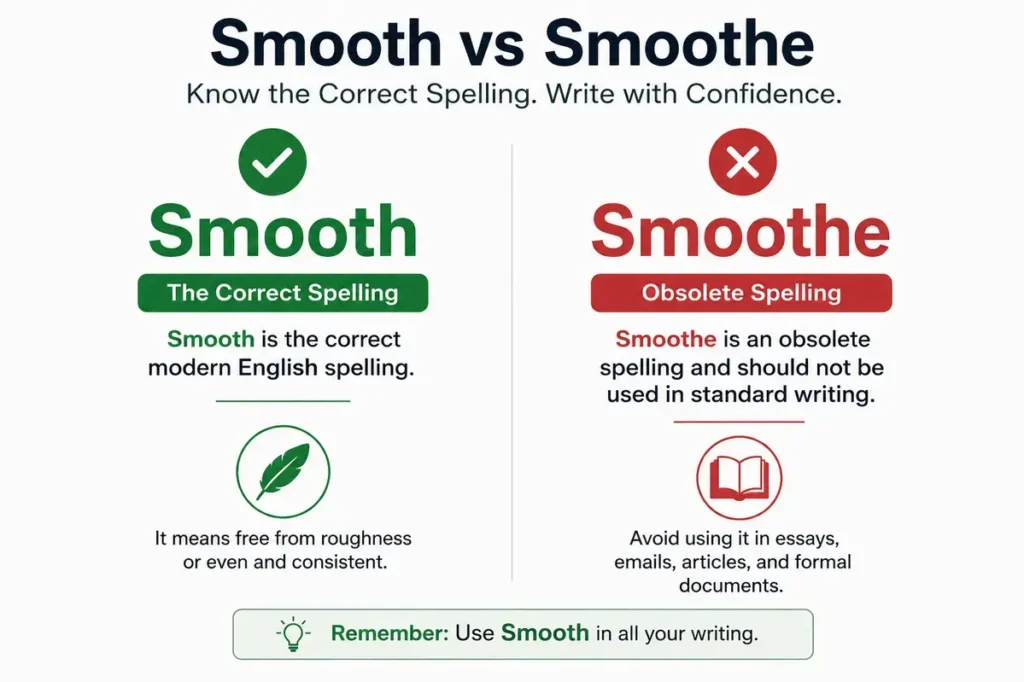
- Smooth is the correct modern English spelling.
- Smoothe is an obsolete spelling and should not be used in standard writing.
- Both American English and British English use smooth.
- Smooth functions as both an adjective and a verb.
- The past tense is smoothed.
- The adverb form is smoothly.
- Use smooth to describe texture, movement, speech, appearance, or actions that happen without difficulty.
- Smoothe may appear in historical texts, surnames, and business names, but not in everyday English.
- Spell checkers, dictionaries, and professional editors recommend smooth.
- If you are unsure, remember this simple rule: modern English always prefers smooth.
Conclusion
Understanding Smoothe vs Smooth is easier once you know that only one spelling is accepted in modern English. Smooth is the standard form recognized by dictionaries, grammar guides, publishers, and educators. It works as both an adjective and a verb and appears naturally in everyday conversation, professional writing, academic work, and creative writing.
Although smoothe has historical roots, it is no longer part of standard English spelling. Today, you are most likely to encounter it only in historical documents, surnames, company names, or deliberate stylistic choices. Outside those limited situations, it is best avoided.
A simple way to remember the difference is to think about familiar forms such as smoother, smoothest, smoothed, and smoothly. Every one of these words keeps the same base spelling without an extra e. Following that pattern will help you write confidently and avoid one of the most common spelling mistakes involving Smoothe vs Smooth.

Confusing Words, Spelling & Word Choice
Claire Whitmore is a U.S.-based English editor who writes about commonly confused words, spelling differences, and word choice. Her work helps readers understand subtle distinctions between similar-looking words through simple definitions, practical examples, and modern usage guidance in both American and British English.