
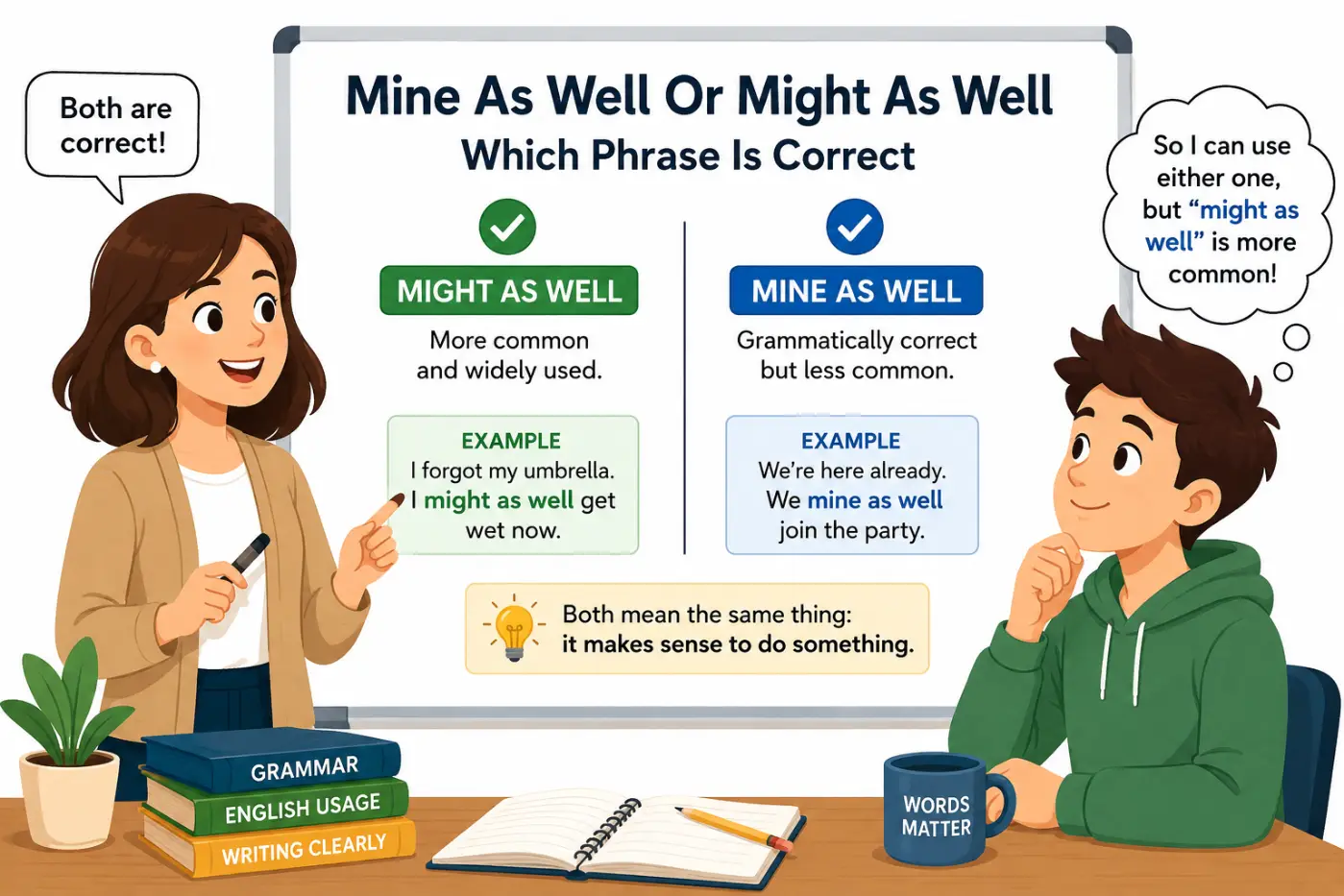
Mine as Well or Might as Well is a common source of confusion because the two phrases often sound almost identical in casual conversation. Many people first hear the expression before they ever see it written. As a result they write what they think they heard instead of the actual words.
The correct expression is might as well. It has been part of English for centuries and appears in books newspapers academic writing business communication and everyday conversations. Mine as well is not a recognized English expression. It usually appears because of mishearing or phonetic spelling.
Once you understand how might as well works the mistake becomes easy to avoid. This guide explains the meaning grammar pronunciation history usage examples common mistakes and memory tricks. By the end you will know exactly when to use the correct phrase with confidence.
Short Answer
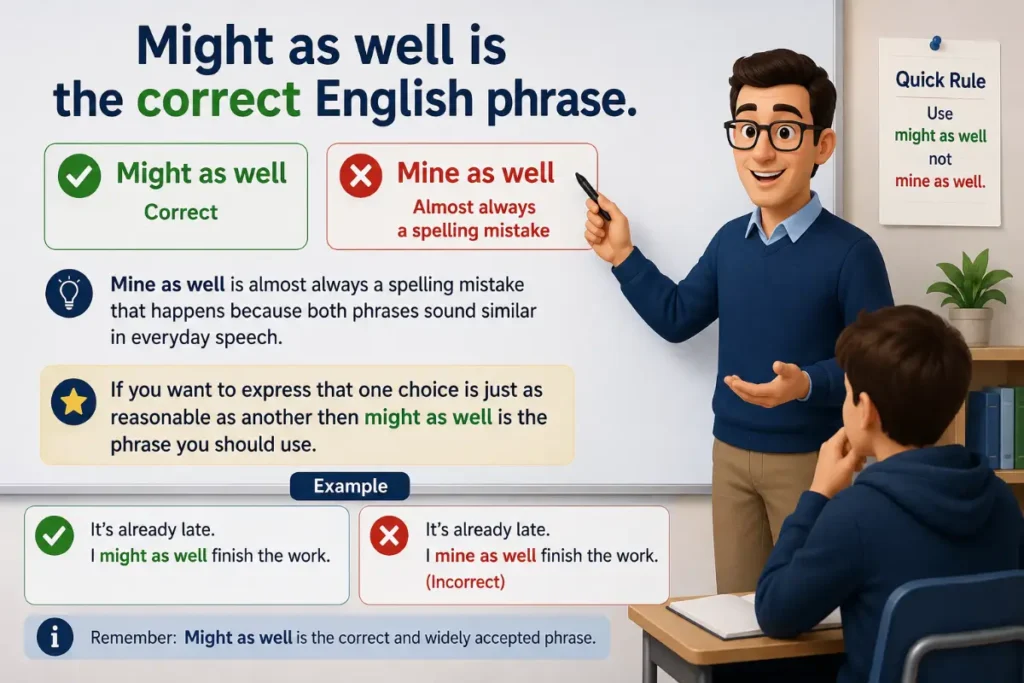
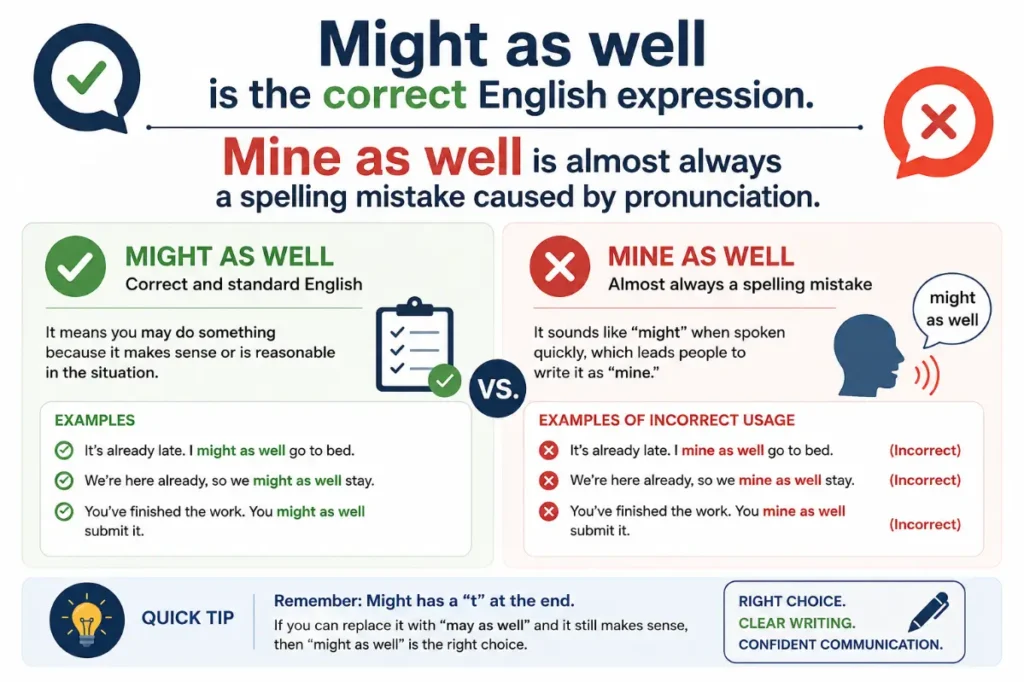
Might as well is the correct English phrase. Mine as well is almost always a spelling mistake that happens because both phrases sound similar in everyday speech. If you want to express that one choice is just as reasonable as another then might as well is the phrase you should use.
Table Of Contents
- Mine As Well Or Might As Well Which One Is Correct.
- Why People Confuse These Two Phrases.
- What Might As Well Means.
- How Might As Well Works In English Grammar.
- Why Mine As Well Is Incorrect.
- Comparison Table.
- Real Life Examples.
- Common Situations Where You Can Use Might As Well.
- Common Mistakes To Avoid.
- Memory Trick That Actually Works.
Mine As Well Or Might As Well Which One Is Correct
The answer is simple. Might as well is correct. Mine as well is incorrect in almost every situation. People usually write mine as well because spoken English often blends sounds together. When someone says might as well quickly the final sound in might becomes very soft. To many listeners it sounds surprisingly close to mine as well. That creates a spelling mistake instead of a grammar rule. Professional editors treat mine as well as an error unless someone intentionally writes it in dialogue to show a character’s pronunciation.
Comparison Table
| Feature | Might As Well | Mine As Well |
|---|---|---|
| Correct English phrase | Yes | No |
| Accepted in dictionaries | Yes | No |
| Standard grammar | Yes | No |
| Used by professional writers | Yes | Rarely, except in intentional dialogue |
| Means one option is just as reasonable as another | Yes | No |
| Common spelling mistake | No | Yes |
The table tells the whole story. One phrase belongs in standard English. The other does not.
Why People Confuse These Two Phrases
English contains many expressions that people hear long before they read them. Children learn language by listening. Adults also pick up expressions from conversations movies podcasts and television. That creates something linguists call an eggcorn. An eggcorn happens when someone replaces unfamiliar words with similar sounding words that seem logical. For example someone may hear: Might as well. But write: Mine as well. The replacement sounds reasonable because mine is a familiar word. Unfortunately it changes the phrase into something English grammar does not recognize. This same pattern appears in many other common mistakes.
- For all intensive purposes instead of for all intents and purposes.
- Escape goat instead of scapegoat.
- Nip it in the butt instead of nip it in the bud.
- Wet your appetite instead of whet your appetite.
Each mistake comes from hearing sounds instead of seeing the actual words.
What Might As Well Means
The phrase might as well expresses that one action is just as good practical or reasonable as another. Sometimes it suggests that no better option exists. It can show that someone accepts the situation. It can suggest going ahead because there is little to lose.
Consider these examples.
We have an hour before the movie starts. We might as well grab some coffee.
The speaker believes getting coffee is a sensible way to spend the extra time.
Nobody answered the phone. We might as well leave.
How Might As Well Works In English Grammar
From a grammar perspective might is a modal verb. Modal verbs express ideas such as possibility advice permission expectation or reasonable choices.
Common modal verbs include:
- Can.
- Could.
- May.
- Might.
- Must.
- Shall.
- Should.
- Will.
- Would.
In the phrase might as well the modal verb does not simply express possibility. Instead it creates an idiomatic expression that means one option is about as reasonable as another.
The basic structure looks like this.
Subject + might as well + base verb.
Examples.
I might as well stay home.
She might as well apply for the job.
They might as well start now.
We might as well finish today.
The verb after might as well always stays in its base form.
Correct.
We might as well leave.
Incorrect.
We might as well leaving.
Correct.
She might as well try.
Incorrect.
She might as well tries.
Understanding this pattern helps you avoid grammar mistakes beyond the spelling itself.
Why Mine As Well Is Incorrect
The word mine has its own job in English. It is a possessive pronoun.
Examples include:
That backpack is mine.
The decision is mine.
This seat is mine.
Real Life Examples Of Might As Well
Seeing the phrase in natural situations makes it much easier to remember.
Everyday Conversation
I’m already awake. I might as well get an early start. The speaker decides to use extra time productively. We’re passing the grocery store. We might as well buy milk now. Stopping saves another trip later. The weather cleared up. We might as well go for a walk. Conditions improved so going outside makes sense.
At Work
The meeting ended early. We might as well review tomorrow’s agenda. The available time creates another useful opportunity. You’ve already completed most of the report. You might as well finish the last page today. Completing the task now avoids extra work later.
At School
The library is still open. We might as well study for another hour. The speaker sees a practical chance to prepare. You’ve already read three chapters. You might as well read the fourth one. Finishing one more chapter requires little extra effort.
During Travel
The museum opens in twenty minutes. We might as well explore the nearby park. The waiting time becomes productive. Our flight is delayed. We might as well grab lunch. Eating makes sense during the unexpected delay. These examples all share one idea. The chosen action feels practical because no better alternative exists or because the opportunity is already there.
Common Situations Where You Can Use Might As Well
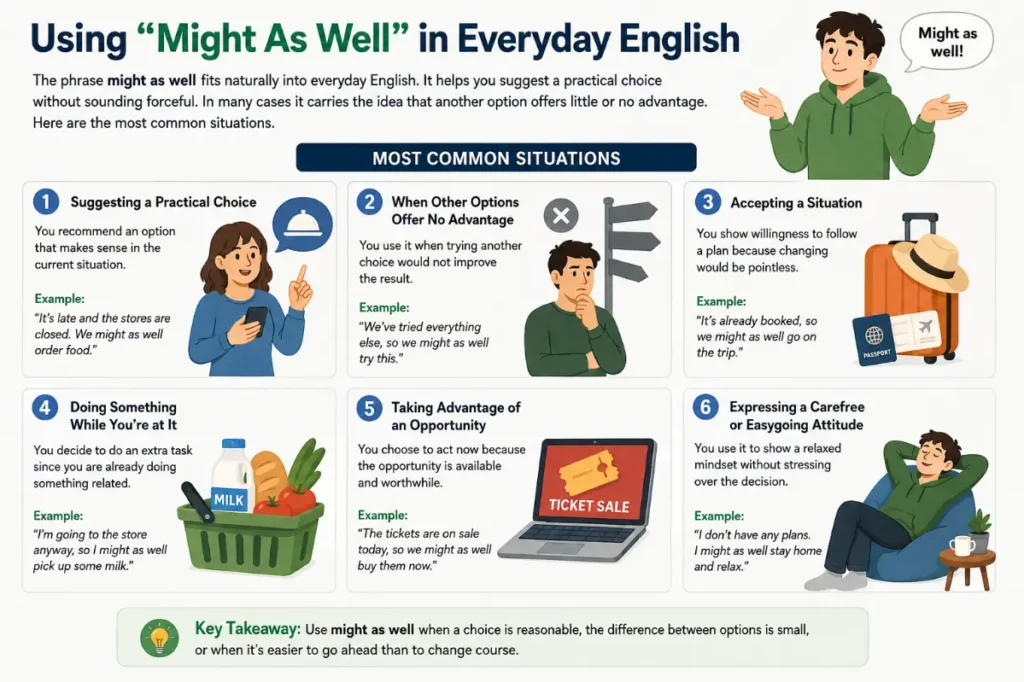
The phrase might as well fits naturally into everyday English. It helps you suggest a practical choice without sounding forceful. In many cases it carries the idea that another option offers little or no advantage. Here are the most common situations.
When No Better Option Exists
This is the most common use. If every available choice leads to a similar result then one option becomes the obvious pick.
Examples.
The store is closed. We might as well come back tomorrow.
Nobody is answering. I might as well leave a message.
The rain isn’t stopping. We might as well stay inside.
Each sentence shows that another choice would not improve the outcome.
When You Are Already Doing Something
Sometimes one action naturally leads to another.
Examples.
I’m already cleaning the kitchen. I might as well mop the floor too.
You’re already at the bank. You might as well deposit the check.
She’s already writing the report. She might as well finish the conclusion.
The extra effort is small compared with the benefit.
When Giving Friendly Advice
The phrase often sounds softer than a direct command.
Examples.
You might as well ask your teacher.
It’s a good idea to call before you drive there.
You might as well save a copy of the file.
These suggestions feel helpful instead of demanding.
When Accepting A Situation
Life does not always go according to plan. Sometimes people accept reality and move forward.
Examples.
The tickets are sold out. We might as well watch the game at home.
The train already left. We might as well take the next one.
The restaurant is full. We might as well try the place across the street.
The phrase shows acceptance instead of frustration.
Difference Between Might As Well And May As Well
Many learners wonder if may as well is also correct. Yes. It is grammatically correct. Still might as well is far more common in modern English. Native speakers use it in conversation writing and professional communication much more often than may as well.
Compare these examples.
We might as well leave now.
We may as well leave now.
Both are correct. The first sentence sounds more natural to most American speakers.
Difference Between Might As Well And Should
These expressions can look similar but they do not mean the same thing. Should gives advice or expresses a recommendation. Might as well suggests that one choice is as reasonable as any other.
Compare these sentences.
You should wear a jacket.
This is advice because the weather is cold.
Difference Between Might As Well And Could
Could talks about possibility or ability. Might as well talks about the most practical choice.
Examples.
We could visit the museum tomorrow.
This means visiting is one possible option.
We might as well visit the museum tomorrow.
This means visiting tomorrow seems like the most sensible choice.
Pronunciation
One reason people write mine as well is pronunciation. When native speakers talk quickly they often reduce sounds. Listen to these words. Might as well. The final sound in might blends into the next word. The phrase often sounds like this in casual speech. Mightaswell. Someone hearing it for the first time may think the first word is mine. That explains the mistake. It does not make the spelling correct. Reading the phrase regularly helps train your eyes to recognize the proper form.
Word Origin
The expression might as well has existed for hundreds of years. The modal verb might comes from Old English and originally expressed ability or possibility. Over time English speakers began using might as well as an idiomatic expression to show that one action made just as much sense as another. Today the phrase appears in literature newspapers magazines business writing academic publications and everyday conversations. Its long history explains why dictionaries recognize it as the standard expression.
Formal And Informal Usage
Another common question involves formality. The answer is simple. Might as well works in both formal and informal English.
Informal Conversation
I might as well order pizza tonight. We might as well watch another episode.
Workplace Communication
We might as well schedule the meeting for Friday. You might as well include the updated figures.
Academic Writing
The participants might as well have completed the survey online because paper responses offered no additional benefit. Although formal writing sometimes prefers more direct wording the phrase remains completely acceptable.
Common Mistakes To Avoid
Many writers repeat the same errors. Learning them now can improve your writing immediately.
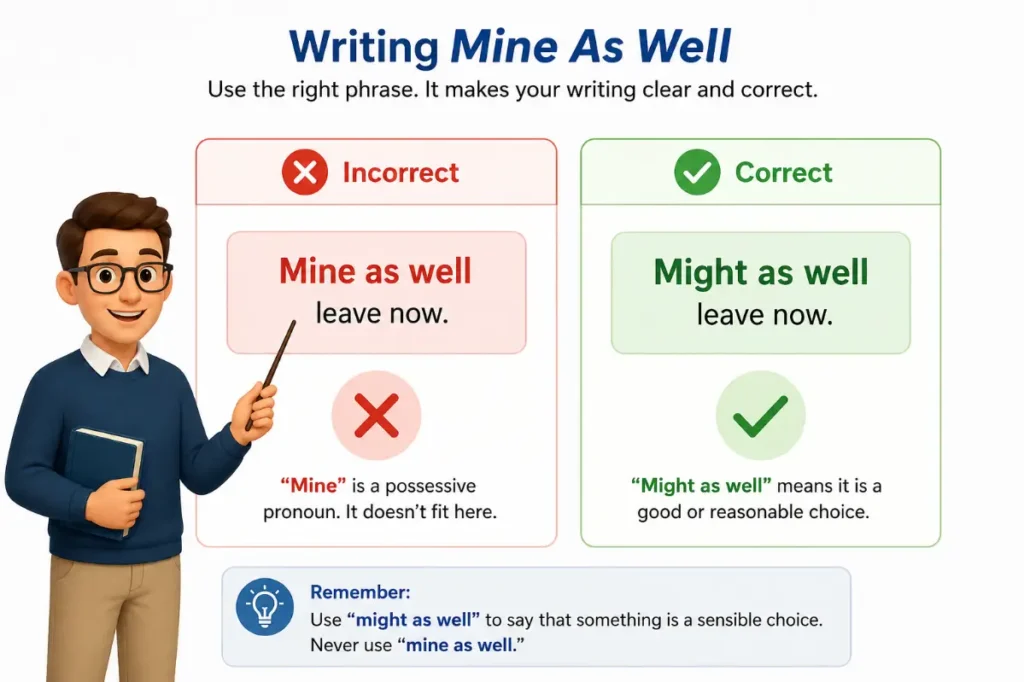
Writing Mine As Well
Incorrect.
Mine as well leave now.
Correct.
Might as well leave now.
Using The Wrong Verb Form
Incorrect.
We might as well going home.
Correct.
We might as well go home.
Always use the base form of the verb.
Thinking Mine As Well Is An Alternative Spelling
It is not. Unlike words such as color and colour this is not a regional spelling difference. English recognizes only might as well.
Using It To Show Ownership
The word mine expresses possession.
Examples.
That laptop is mine.
The blue notebook is mine.
It never replaces might in the idiom.
Memory Trick That Actually Works
Simple memory tricks often work better than complicated grammar rules. Remember this sentence. Might means maybe. Mine means belongs to me. Now think about the expression. We might as well leave. The sentence talks about making a reasonable choice. It does not talk about ownership. Since ownership has nothing to do with the sentence the word mine cannot be correct. Another easy trick is this. Ask yourself one question. Can I replace mine with my?
Example.
Mine as well go now.
Would this become:
Related Expressions
Learning similar expressions makes your English more flexible.
May As Well
Less common but correct. We may as well leave early.
Had Better
Expresses stronger advice. You had better lock the door.
No Point In
Shows that an action has little value. There’s no point in waiting.
Go Ahead
Encourages someone to continue. Go ahead and ask your question.
If You Are Going To
This often introduces a logical next step. If you are going to bake cookies you might as well make enough for everyone. Each expression has a different purpose but they all appear in situations involving choices or recommendations.
Professional Writing Tips
Editors notice small language mistakes quickly. Using the correct expression strengthens your credibility.
Keep these habits in mind.
- Read your writing aloud before sending it.
- Slow down when proofreading familiar phrases.
- Trust dictionaries instead of social media posts.
- Learn common English expressions as complete phrases instead of individual words.
- Save a personal list of phrases you often confuse.
Professional writers rarely memorize grammar rules alone. They build familiarity through reading and consistent practice.
People Also Ask
Is Mine As Well Ever Correct?
In standard English the answer is no.
The phrase appears almost entirely as a spelling mistake caused by pronunciation. Outside of intentional dialogue or creative writing it should be corrected to might as well.
Why Do People Say Mine As Well?
People usually hear might as well before they see it written. Fast speech blends the sounds together and creates confusion.
Is Might As Well An Idiom?
Yes.
The meaning cannot be understood by looking at each word separately. Together they create an idiomatic expression that means one choice is just as reasonable as another.
Can I Use Might As Well In Formal Writing?
Yes.
It is acceptable in business writing academic work professional emails and everyday communication when it fits the context.
Key Takeaways
- Might as well is the correct English expression.
- Mine as well is almost always a spelling mistake caused by pronunciation.
- The phrase means one choice is just as practical or reasonable as another.
- Might functions as a modal verb in the expression.
- The verb after might as well always stays in its base form.
- The phrase works in both formal and informal writing.
- Reading and writing the expression regularly helps prevent future mistakes.
- Remember that mine shows ownership. It never replaces might in this idiom.
Conclusion
The answer is straightforward. Might as well is the correct phrase, and mine as well is a common spelling mistake that comes from the way people hear spoken English. Once you know the difference, the confusion disappears.
The easiest way to remember it is to focus on meaning. Might as well expresses a practical decision. It suggests that one option makes just as much sense as another because there is no clear advantage in choosing something else. The word mine has a completely different job. It shows ownership, so it cannot replace might in this expression.
English contains many phrases that sound different from the way they are written. This is one of the most common examples. Reading quality English, paying attention to fixed expressions, and proofreading your work will help you avoid the mistake every time.
The next time you stop and think about Mine as Well or Might as Well, you’ll know the correct answer with confidence. Choose might as well in every standard writing situation, and your English will sound natural, accurate, and polished.
Frequently Asked Questions
Is Mine As Well Grammatically Correct?
No. Standard English does not recognize mine as well as a correct phrase. The accepted expression is might as well. If you write mine as well in an email essay report or article editors will almost always correct it.
Why Does Mine As Well Sound Correct?
The confusion comes from pronunciation. Native speakers often say might as well very quickly. The sounds blend together and can resemble mine as well. This is a listening mistake rather than a grammar rule.
What Does Might As Well Mean?
Might as well means one choice is just as sensible or practical as another. It often suggests that no better option exists or that there is little reason not to do something.
Example.
We’re already here. We might as well go inside.
Is Might As Well Formal Or Informal?
It works in both. You’ll hear it in everyday conversations, but you’ll also find it in books, newspapers, business emails, and academic writing. The phrase sounds natural in almost every setting when it fits the context.
Can I Replace Might As Well With Should?
Not always. Should gives advice. Might as well suggests that one option is the most practical or reasonable choice.
Is May As Well Also Correct
Yes. Both expressions are grammatically correct. Still, might as well is far more common in modern American English. It sounds more natural in everyday speech and writing.
Can Might As Well Be Used In Questions
Yes. Examples. Might we as well leave now. Might I as well finish the project today. Questions like these are less common than statements, but they are grammatically correct.
Is Mine As Well Ever Accepted In Dictionaries
No. Major English dictionaries recognize might as well as the standard expression. Mine as well does not appear as an accepted alternative.
How Can I Remember The Correct Phrase
Think about the meaning. The phrase expresses a reasonable choice. It has nothing to do with ownership. If you can replace the first word with belongs to me, the sentence immediately falls apart. Mine as well leave now. Belongs to me as well leave now. That clearly does not work. The correct phrase is might as well.
Does This Mistake Matter
Yes. Small language mistakes affect credibility more than many people realize. Teachers notice them.Editors notice them. Employers notice them. Clients notice them. Using the correct phrase makes your writing look polished and professional.

Idioms, Expressions & Figurative Language
Mason Ellsworth is an American language writer with a passion for English expressions, figurative language, and everyday communication. He explains idioms, similes, popular phrases, and commonly misunderstood expressions in a straightforward, engaging style that helps readers improve both their writing and spoken English.