
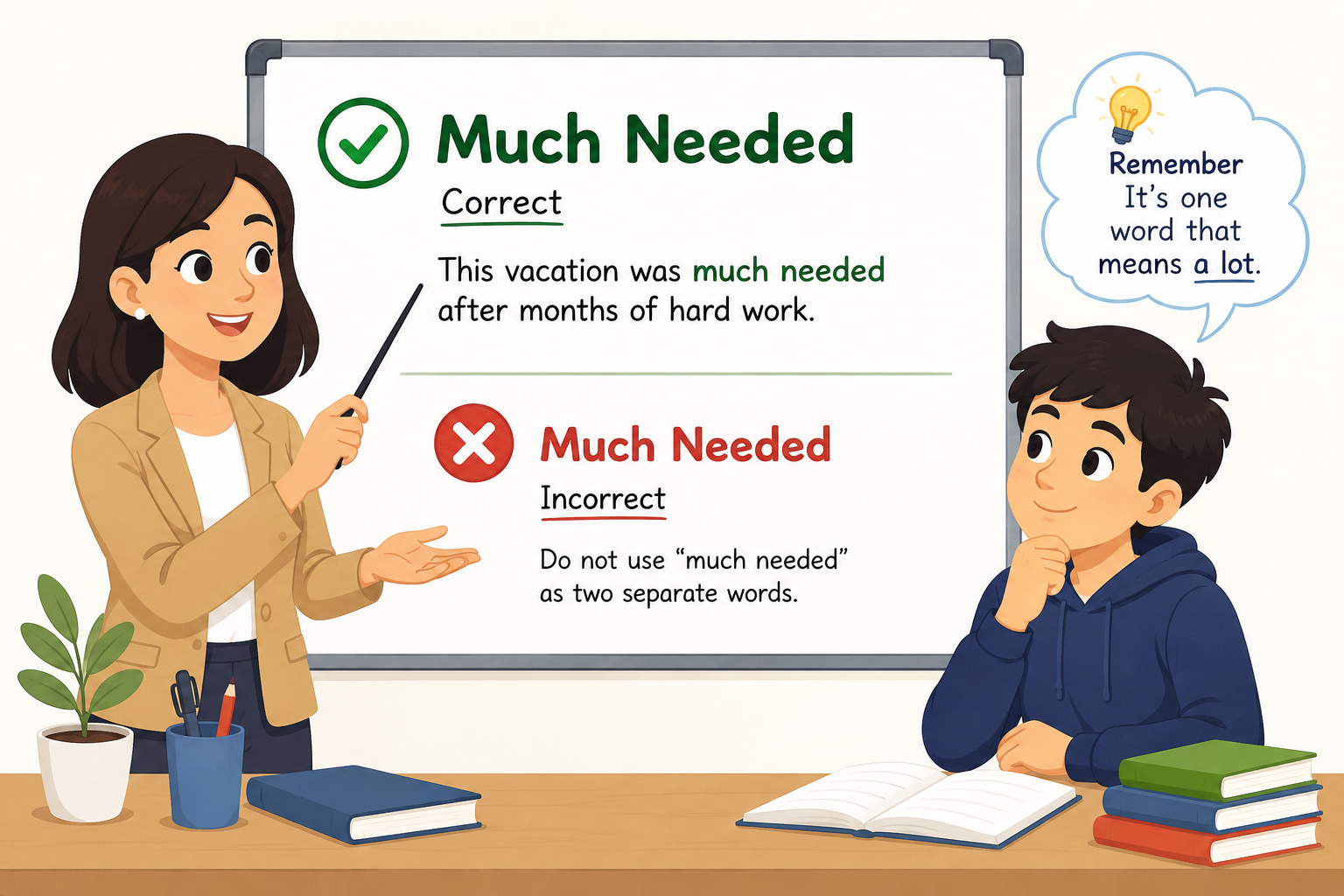
Much Needed vs Much Needed is a question that confuses many English writers. You might see one form in a newspaper, another in a business report, and a third in a book. That can make it seem like English has no clear rule.
The good news is that the rule is easier than it looks. Once you understand how the words work together, you’ll know which form fits naturally. You won’t have to guess every time you write.
This guide explains the grammar behind the expression, shows real examples, clears up common mistakes, and shares simple memory tricks you can use right away. By the end, you’ll know how professional editors decide which form belongs in every sentence.
Short Answer
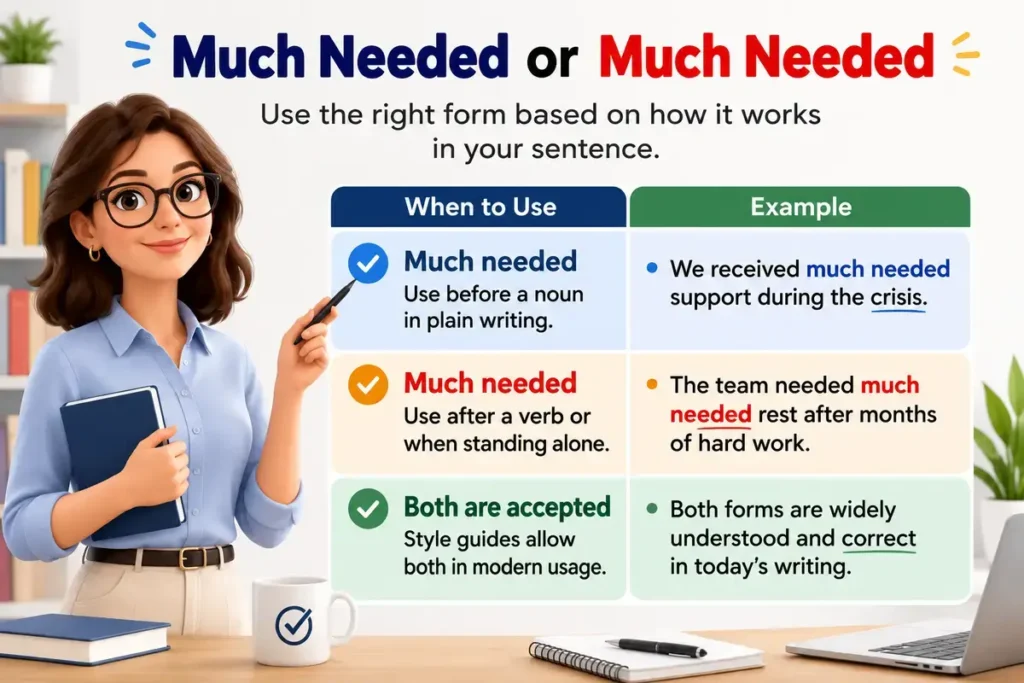
In these words depends on how the words work in a sentence. Use much needed after a verb or when it stands alone. Use much needed before a noun in plain writing, while many style guides also accept much needed as an open compound in modern usage. The right choice depends on grammar, context, and your preferred style guide.
Table Of Contents
- Which Form Is Correct.
- What Much Needed Means.
- Why Writers Get Confused.
- The Grammar Behind The Expression.
- When To Use Much Needed.
- When To Use Much Needed.
- Comparison Table.
- Real World Examples.
- Common Mistakes.
- Professional Writing Tips.
- Memory Tricks.
- Related Grammar Notes.
- Frequently Asked Questions.
- Key Takeaways.
- Conclusion.
Which Form Is Correct
The short answer is simple. Both forms appear in English. The correct choice depends on how the expression functions in a sentence. When the phrase comes after the verb, writers normally use much needed.
Example. The team finally received much needed support. The words describe the support after the action, so the open form reads naturally. When the phrase directly describes a noun before it appears, many publishers and style guides have traditionally preferred the closed descriptive form in careful editing. At the same time, many modern publications now use the open form in almost every situation because English punctuation has become less rigid over time.
Understanding This Phrase
The expression means greatly needed or strongly needed. It describes something that people have wanted for a long time or something that arrives at the perfect moment. Examples include financial help after a disaster, rest after a busy week, or rain during a drought. In every case, the idea stays the same. Something fills an important need.
Example.
The community finally received much needed funding.
The funding solved an important problem.
Why Writers Get Confused
Several reasons cause this confusion. First, English compound expressions often change over time. A phrase that once followed a strict punctuation pattern may become more flexible as usage evolves. Second, different publishers follow different editorial styles. A newspaper may write the expression one way. A university may choose another. A publishing house may follow its own style guide.
Third, modern digital writing has reduced punctuation in many compound expressions. Writers often prefer cleaner looking text unless punctuation prevents confusion. Finally, people learn English from many sources. They read books, websites, magazines, and social media. Since each source follows different editorial rules, they naturally see different versions of the same expression.
The Grammar Behind The Expression
Understanding the grammar makes the choice much easier. The word much acts as an intensifier. The word needed comes from the verb need, but here it works as an adjective. Together they create a descriptive phrase. In simple terms, much increases the strength of needed. Think about these examples.
Very tired.
Deeply concerned.
Highly respected.
Much needed.
Why Compound Expressions Matter
English contains thousands of compound expressions. Some eventually become single words. Some remain separate forever. Others change depending on their position in a sentence. Consider these familiar examples. High quality product. The product is high quality.
Is There One Universal Rule
No. English rarely works through absolute rules. Instead, editors balance grammar, readability, and consistency.
Major dictionaries recognize much needed as a standard expression. Style manuals sometimes recommend different punctuation practices before nouns, but modern publications increasingly accept the open form because readers understand it without difficulty. This shift reflects a broader trend in English.
Many compound expressions have gradually lost punctuation as readers became familiar with them. Examples include words like email, online, healthcare, and website. Many of these forms looked different only a few decades ago. Language changes because people use it differently over time. Professional editors pay attention to current usage instead of relying only on older traditions.
How Professional Editors Make The Decision
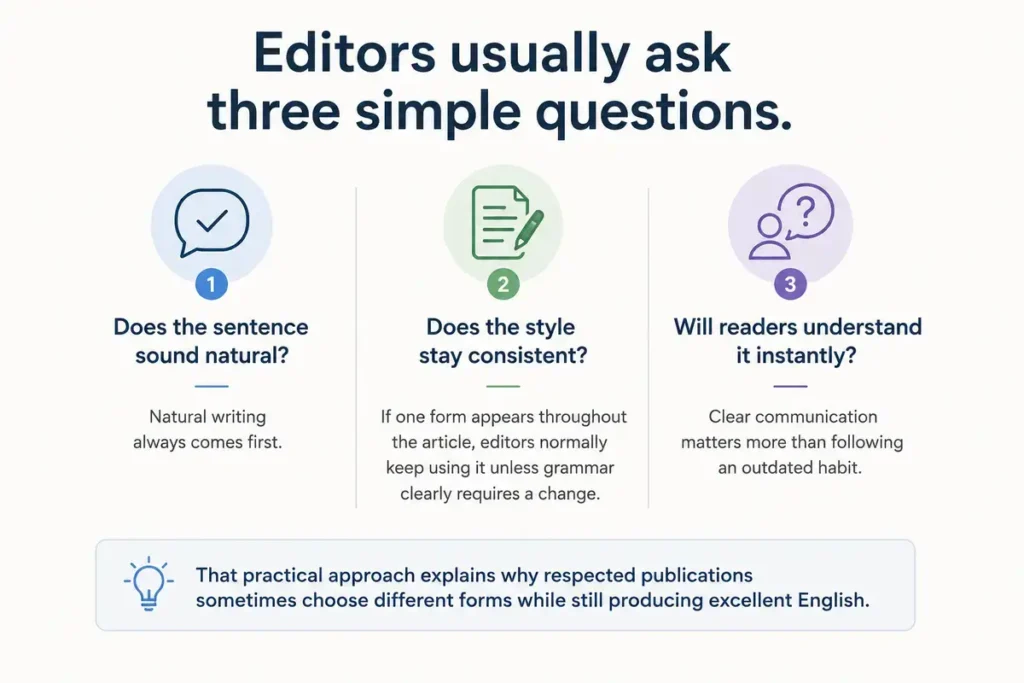
Editors usually ask three simple questions.
- Does the sentence sound natural.
Natural writing always comes first.
- Does the style stay consistent.
If one form appears throughout the article, editors normally keep using it unless grammar clearly requires a change.
- Will readers understand it instantly.
Clear communication matters more than following an outdated habit.
That practical approach explains why respected publications sometimes choose different forms while still producing excellent English.
Why Modern Usage Is Becoming More Flexible
Language never stands still. Expressions that once followed strict editorial rules often become simpler as readers grow familiar with them. Digital publishing has accelerated this change. Online newspapers. Blogs. Business websites. Marketing pages.
How to Use This Phrase
Use much needed after a verb or when the expression follows the noun it describes. In this position, the words work together as a descriptive phrase instead of appearing directly before a noun. This is the most natural choice in everyday English.
Examples.
The help was much needed.
The break felt much needed after a busy week.
Their support became much needed during the crisis.
Before a Noun
The expression also appears before nouns.
Examples.
The city received much needed funding.
She enjoyed much needed rest.
The school welcomed much needed improvements.
The company announced much needed reforms.
Comparison Table
| Situation | Preferred Form | Example |
|---|---|---|
| After a linking verb | Much needed | The vacation was much needed. |
| After another verb | Much needed | Their support became much needed. |
| Before a noun in modern writing | Much needed | The team received much needed funding. |
| Formal documents following a traditional house style | Follow the required editorial style | Always stay consistent throughout the document. |
| Everyday conversation | Much needed | That break was much needed. |
The biggest lesson is consistency. If you’re writing for yourself, choose one style and use it throughout the document. If you’re writing for a company, publisher, university, or client, follow that organization’s style guide.
Real Life Examples
Seeing real examples makes the pattern much easier to remember.
Example 1.
After months of overtime, the employees finally enjoyed much needed time off.
Explanation.
The time off provided relief after a long period of hard work.
Example 2.
The charity received much needed donations.
Explanation.
The donations solved an urgent problem.
Example 3.
The rain arrived just in time and brought much needed relief to farmers.
Explanation.
The relief came because the rain helped dry fields recover.
Example 4.
Our software update included much needed security improvements.
Explanation.
The improvements fixed existing problems.
Example 5.
His calm leadership became much needed during the emergency.
Explanation.
The sentence explains that his leadership proved valuable when people needed it most.
Example 6.
The doctor recommended much needed rest.
Explanation.
The rest helped the patient recover.
Example 7.
Parents appreciated the much needed school renovations.
Explanation.
The renovations improved learning conditions.
Example 8.
The company hired additional staff after experiencing much needed growth.
Explanation.
Growth created the need for more employees.
Common Mistakes
Many writers repeat the same errors. Understanding them now can save you from future editing.
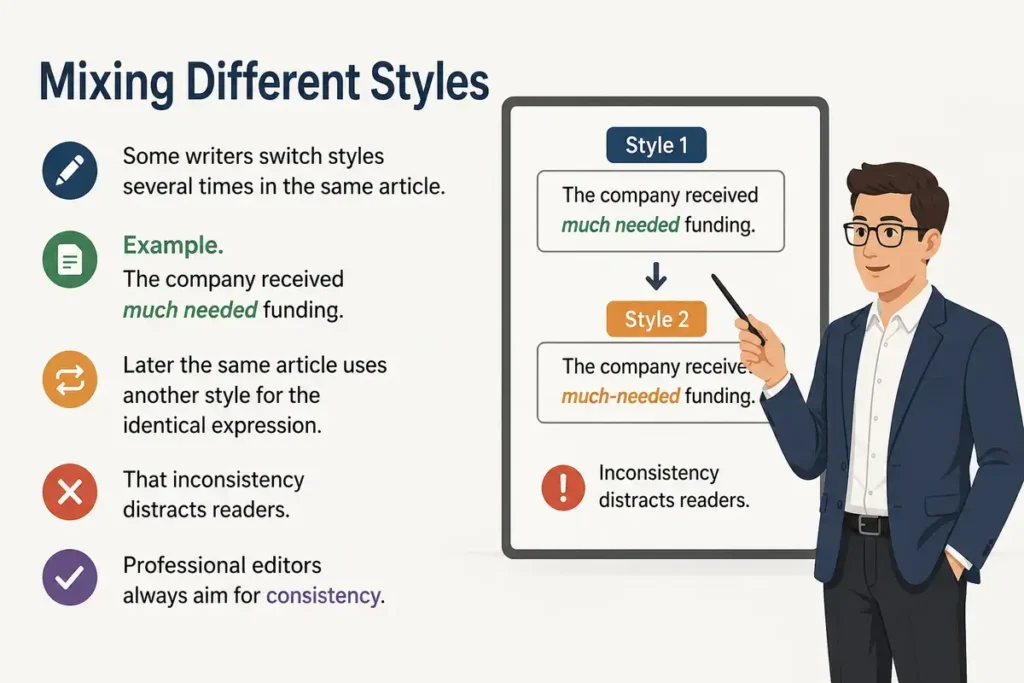
Mixing Different Styles
Some writers switch styles several times in the same article.
Example.
The company received much needed funding.
Later the same article uses another style for the identical expression.
Copying Every Source You Read
Different websites follow different editorial standards. Copying each style creates inconsistent writing. Instead, choose one trusted style guide or follow your company’s editorial standards.
Assuming There Is Only One Correct Form
English is full of variations. Many expressions change over time. The goal is clear communication, not memorizing rigid rules that every publisher ignores.
Professional Writing Tips
Professional editors focus on readability first. If your audience immediately understands the sentence, you’ve already succeeded.
Here are several habits experienced writers follow.
- Keep the same style throughout the document.
- Read every sentence aloud.
- Remove anything that interrupts natural reading.
- Follow your organization’s editorial guide if one exists.
- Prioritize clarity over tradition.
These habits improve every piece of writing, not just this expression.
Memory Tricks
Simple memory tricks help the rule stick.
Think About The Meaning First
Ask yourself one question. Does the phrase simply mean greatly needed. If the answer is yes, you’re already on the right track.
Read The Sentence Naturally
If the sentence sounds smooth when spoken aloud, it will usually sound smooth to readers too. Reading aloud catches awkward wording faster than silent reading.
Stay Consistent
Professional writing values consistency more than tiny stylistic differences. Readers notice inconsistency much faster than they notice small editorial preferences.
Related Expressions
Many English expressions follow a similar pattern.
Highly respected.
Deeply concerned.
Strongly recommended.
Closely watched.
Related Grammar Notes
This topic connects with several other grammar ideas.
Compound Modifiers
English often joins two or more words to describe a noun. Examples include. Long term plan. High quality product. Full time employee. These expressions sometimes change their appearance depending on placement in the sentence and the style guide being used.
Adverbs And Intensifiers
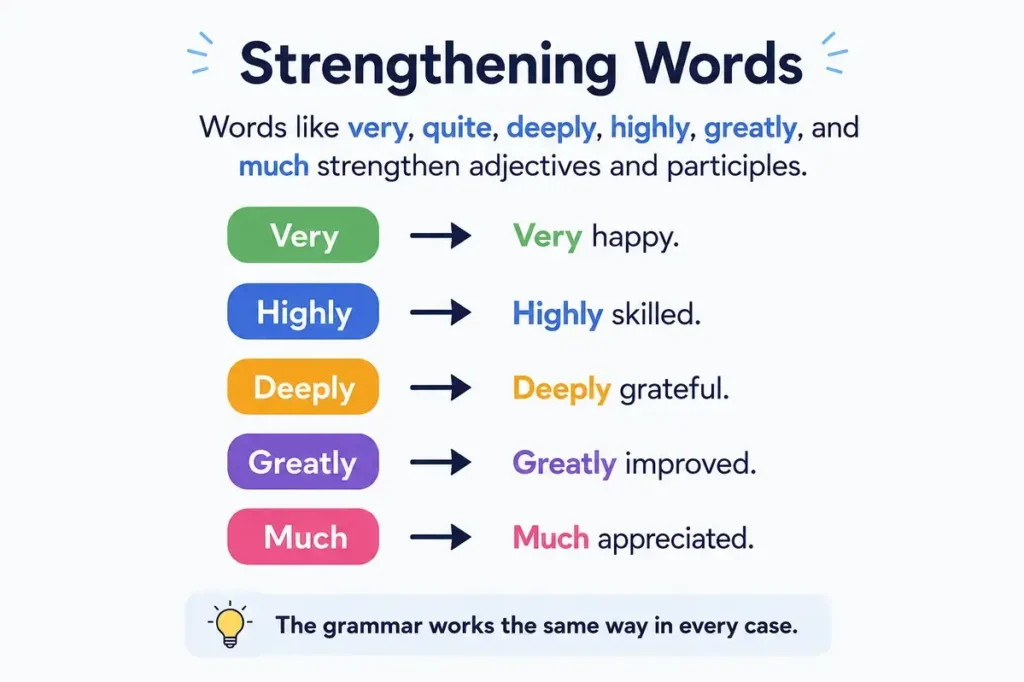
Words like very, quite, deeply, highly, greatly, and much strengthen adjectives and participles.
Examples.
Very happy.
Highly skilled.
Deeply grateful.
Much appreciated.
The grammar works the same way in every case.
Why English Changes
English constantly evolves. Publishers simplify spelling. Editors reduce unnecessary punctuation. Readers adapt quickly. That is why modern English often looks cleaner than English from several decades ago. The meaning stays the same even as presentation changes.
Conclusion
Much Needed vs Much Needed may look like a small grammar question, but it highlights an important truth about English. Language changes over time, and editorial styles change with it. Good writers understand the rules, but they also recognize that clarity and consistency matter more than following outdated habits.
For most people, much needed is the best choice because it reads naturally, sounds familiar, and appears across modern English. It works well in everyday communication, business writing, blogs, news articles, and professional documents.
At the same time, don’t be surprised if you see another style in older books or publications with strict editorial guidelines. That doesn’t make the writing wrong. It simply reflects a different editing preference
Frequently Asked Questions
Is Much Needed Correct?
Yes. Much Needed vs Much Needed is a common question because the expression appears in different styles of writing. Many publishers use it in newspapers, books, websites, and business writing.
Which Form Do Most Modern Writers Use?
Most modern writers use much needed. It looks clean, reads naturally, and matches the trend toward simpler punctuation. Many editors prefer this style unless a publication has its own editorial rules.
Do American And British English Use Different Forms?
No major difference exists between American and British English for this expression. . The choice usually depends on the publication’s style guide instead of regional English.
Can I Use Much Needed In Formal Writing?
Yes. Much needed works well in formal reports, academic papers, business documents, articles, and professional emails. The most important rule is consistency. Follow the style guide required by your school, company, publisher, or client.
Is Much Needed Grammatically Correct?
Yes. It is grammatically correct. The word much acts as an intensifier, while needed functions as an adjective.
Example.
The community received much needed support.
Why Do Different Dictionaries And Publications Show Different Styles?
English has never been completely uniform. Different publishers follow different editorial traditions. Some prefer older conventions, while others adopt modern usage. Both approaches aim to produce clear and readable English.
Is This Expression Common In Everyday Conversation?
Yes. Native speakers use it regularly.
Examples.
That vacation was much needed.
The extra help was much needed.
The rain was much needed after weeks of dry weather.
These sentences sound natural because the expression is familiar in everyday speech.
Can I Replace Much Needed With Another Expression?
Yes. Depending on the sentence, you can use similar expressions such as:
Greatly needed.
Badly needed.
Long awaited.
Highly desirable.
Essential.
Necessary.
Welcome.
Choose the alternative that best matches your meaning. Each one carries a slightly different tone.
How Can I Remember The Correct Form?
Focus on meaning instead of memorizing complicated rules. If you want to say that something is greatly needed, much needed is a safe and natural choice in modern writing. Stay consistent throughout your document, and you’ll avoid almost every editing problem related to this expression.

Confusing Words, Spelling & Word Choice
Claire Whitmore is a U.S.-based English editor who writes about commonly confused words, spelling differences, and word choice. Her work helps readers understand subtle distinctions between similar-looking words through simple definitions, practical examples, and modern usage guidance in both American and British English.