
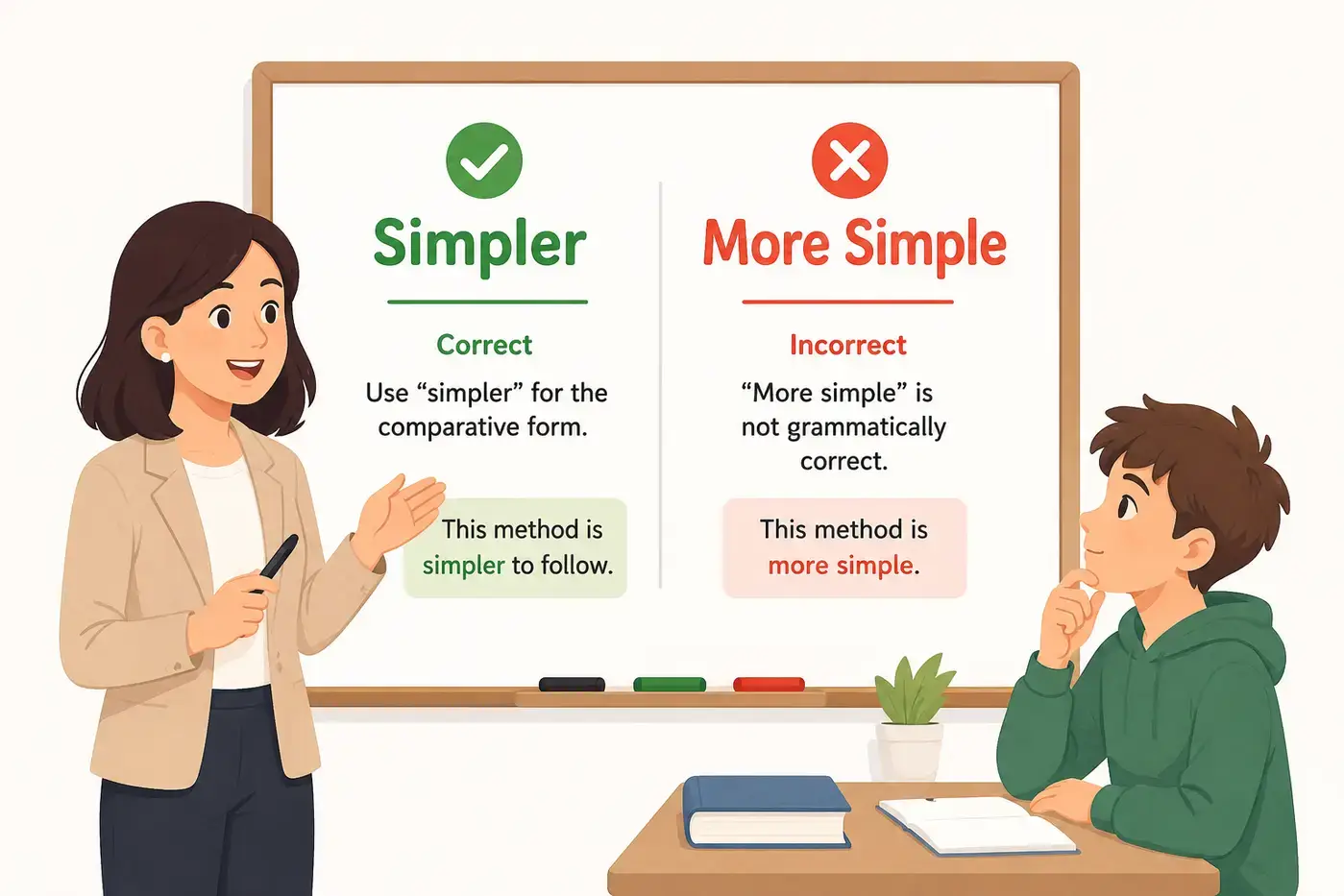
Simpler vs More Simple is a question many English learners and even native speakers ask. At first glance, both forms seem correct. After all, both express the idea that one thing has less complexity than another. So why do most people say simpler instead of more simple?
The answer comes from how English forms comparatives. Most short adjectives add er to create the comparative form. Longer adjectives usually use more instead. Since simple is a short adjective with two syllables, English normally follows the first pattern. That makes simpler the natural choice in everyday conversation and professional writing.
Still, more simple has not disappeared from English. You may hear it in speeches, academic writing, literature, or situations where a speaker wants extra emphasis. It is grammatically acceptable, but it is much less common. This guide explains every important detail. You’ll learn the grammar rule, discover why both forms exist, understand the subtle differences in meaning, see plenty of real examples, avoid common mistakes, and gain the confidence to choose the right expression every time.
Short Answer
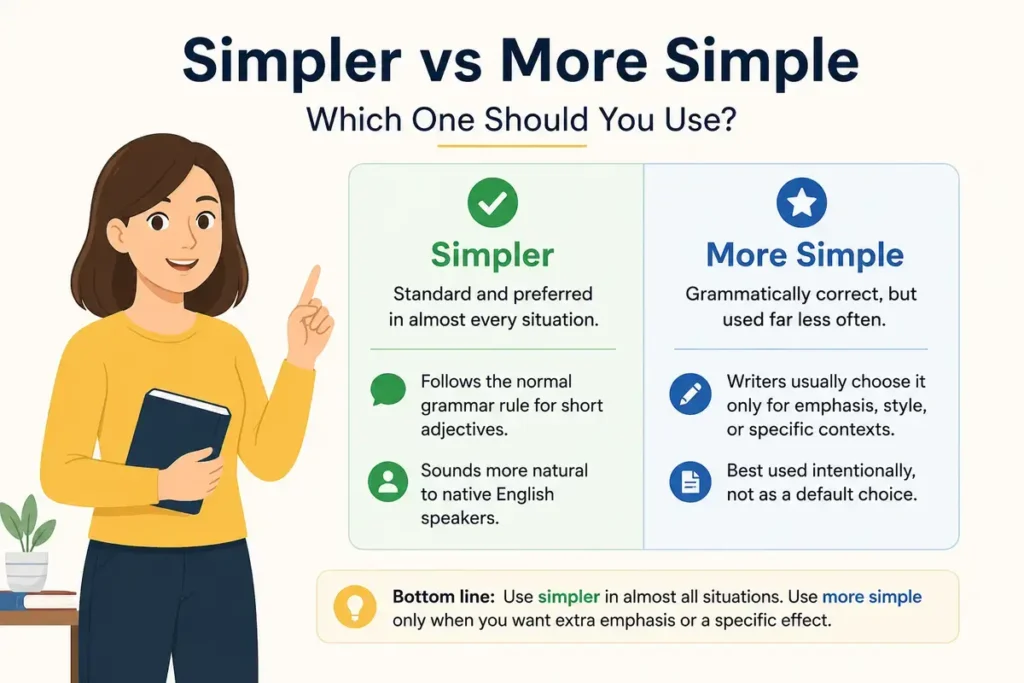
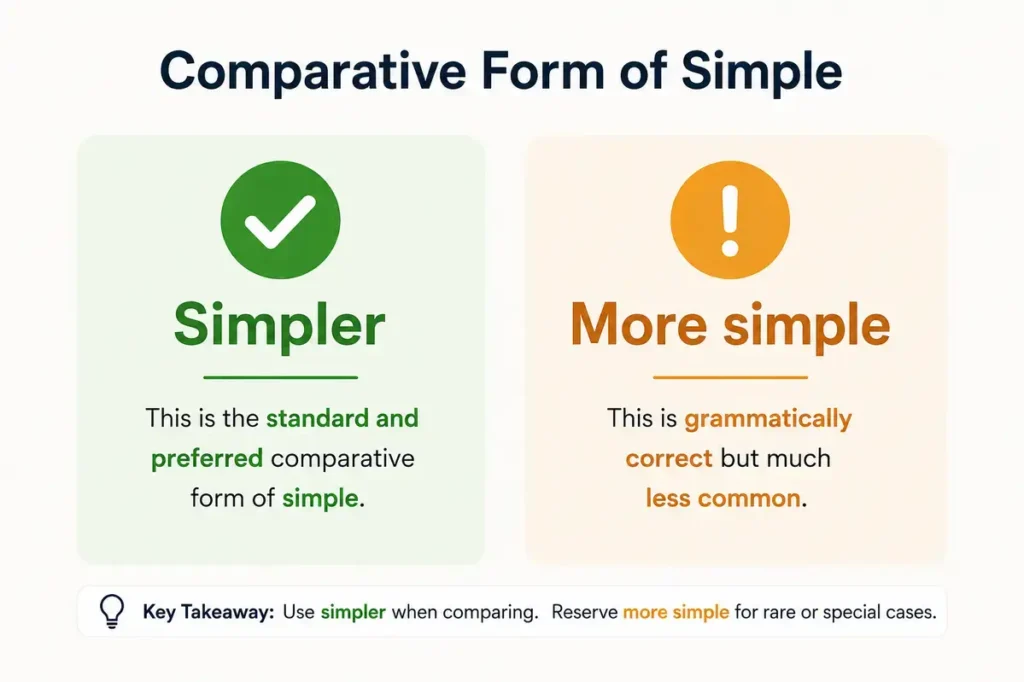
Simpler is the standard and preferred form in almost every situation. It follows the normal grammar rule for short adjectives and sounds more natural to native English speakers. More simple is also grammatically correct, but people use it far less often. Writers usually choose it only for emphasis, style, or specific contexts.
Table Of Contents
- Simpler Vs More Simple Quick Comparison.
- Is Simpler Or More Simple Correct.
- Why Simpler Is Usually Better.
- Why More Simple Still Exists.
- Grammar Rule Behind Simpler And More Simple.
- When You Can Use More Simple.
- Real World Examples.
- Common Mistakes To Avoid.
- Professional Writing Tips.
- Frequently Asked Questions.
- Key Takeaways.
- Conclusion.
Simpler Vs More Simple Quick Comparison
| Feature | Simpler | More Simple |
|---|---|---|
| Grammar | Correct. | Correct. |
| Common in everyday English | Yes. | Rarely. |
| Preferred in American English | Yes. | Occasionally. |
| Preferred in British English | Yes. | Occasionally. |
| Natural sounding | Yes. | Less natural. |
| Formal writing | Preferred. | Sometimes used for emphasis. |
| Academic writing | Common. | Possible in certain contexts. |
| Recommended for learners | Yes. | Only in special situations. |
The table gives the short answer most people need. Both expressions are grammatically correct. Still, simpler is the form that native speakers naturally expect in almost every situation.
Is Simpler Or More Simple Correct
Both expressions are correct English. That surprises many learners because grammar lessons often teach only one answer. The reality is more interesting. English allows two different ways to create comparative adjectives. The first method adds er to the adjective. Simple becomes simpler. Fast becomes faster. Small becomes smaller. The second method places more before the adjective. Bigger. Faster. Stronger.
Since simple is a short adjective, English naturally prefers simpler. That preference has existed for centuries and appears consistently in newspapers, books, academic journals, business writing, and everyday conversation.
Why Simpler Is Usually Better
English values efficiency. Native speakers often prefer expressions that communicate an idea with fewer words. That’s one reason simpler sounds more natural. Compare these examples. This solution is simpler than the previous one. This solution is more simple than the previous one. Both sentences communicate the same meaning. The first one feels smoother because it follows the normal comparative pattern. The same principle appears with many common adjectives. Easy becomes easier. Quiet becomes quieter. Bright becomes brighter. Simple becomes simpler. Readers process these forms almost automatically because they appear constantly in spoken and written English.
Grammar Rule Behind Simpler And More Simple
Understanding one grammar rule removes almost all confusion. English creates comparative adjectives in two main ways.
| Adjective | Comparative |
|---|---|
| Tall | Taller |
| Fast | Faster |
| Small | Smaller |
| Kind | Kinder |
| Happy | Happier |
| Simple | Simpler |
| Beautiful | More beautiful |
| Expensive | More expensive |
| Comfortable | More comfortable |
| Difficult | More difficult |
The adjective simple belongs to an interesting group. Most grammar guides classify it as a two syllable adjective that comfortably accepts the er ending. That makes simpler the standard comparative. Some two syllable adjectives work in both forms.
For example.
Clever.
Cleverer.
More clever.
Friendly.
Friendlier.
More friendly.
Simple.
Simpler.
More simple.
Why More Simple Still Exists
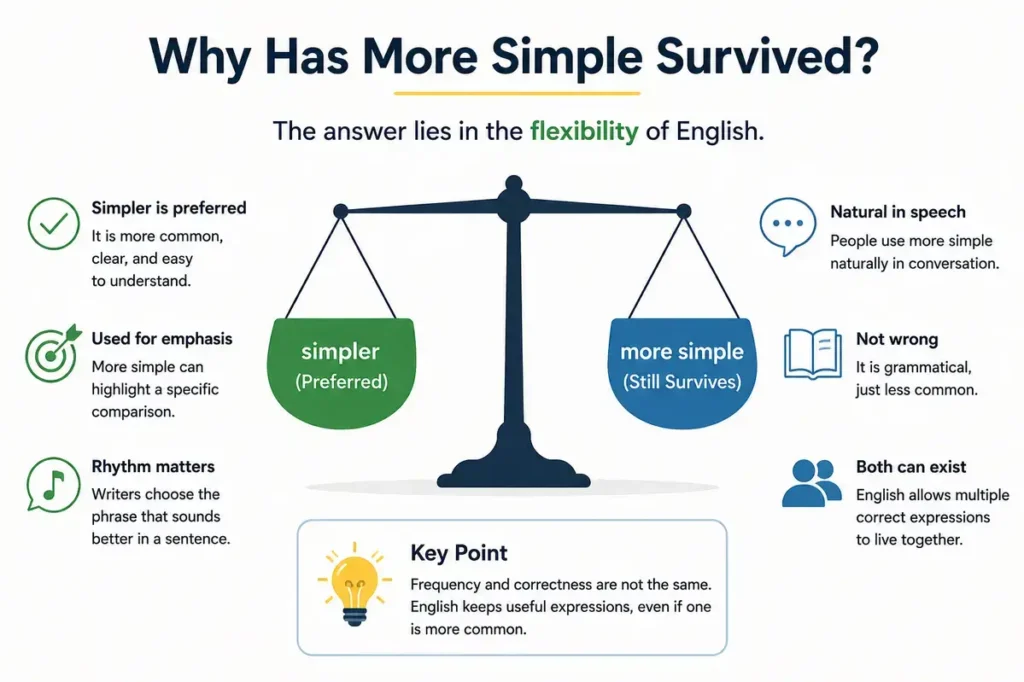
If simpler is preferred, why has more simple survived? The answer lies in the flexibility of English. English rarely removes an expression simply because another one is more common. Instead, multiple forms often exist side by side. Writers sometimes choose more simple for emphasis.
When To Use Simpler
If you’re unsure which form to choose, simpler is almost always the safest answer. It sounds natural. It aligns with standard grammar. Here are situations where simpler is the best choice.
Everyday Conversation
People naturally use simpler in daily speech.
Examples
This recipe is simpler than the old one.
Your explanation is much simpler now.
We found a simpler solution.
Business Writing
Clear communication matters in business. Concise language helps readers understand information quickly.
Examples
The new process is simpler and more efficient.
We developed a simpler approval system.
Our updated policy uses simpler language.
Professional editors would almost always keep simpler in these sentences.
Academic Writing
Academic writing values precision and consistency.
Examples
Researchers proposed a simpler model.
The revised theory offers a simpler explanation.
Scientists developed a simpler testing method.
The shorter comparative fits naturally in formal writing.
Technical Documentation
Technical documents should remove confusion instead of creating it.
Examples
The new interface is simpler to use.
This method provides a simpler installation process.
Version two includes a simpler setup procedure.
Readers appreciate direct language that moves quickly.
When More Simple Can Work
Although simpler remains the preferred choice, more simple is not incorrect. You may occasionally see it in specific situations.
For Extra Emphasis
Sometimes a writer wants readers to notice the comparison itself.
Example
We are not looking for a faster solution. We need a more simple approach.
Here, the speaker places extra attention on simplicity.
Even then, many editors would still rewrite the sentence using simpler.
For Rhythm
Good writing also has music. Authors sometimes choose words because they create a better rhythm inside a sentence. Read these aloud. The second design is simpler for beginners. The second design is more simple for beginners. Most people naturally prefer the first sentence.
In Historical Writing
Older books occasionally use more simple more often than modern publications. English has changed over centuries. Many comparative forms competed with one another before usage gradually settled. Today, simpler clearly dominates.
Real Life Examples
Looking at real examples makes the rule easier to remember.
Education
The teacher gave us a simpler explanation. The second textbook uses simpler language. Students understood the simpler example immediately. Every sentence feels natural because simpler follows the expected grammar pattern.
Technology
This software has a simpler interface. The latest update offers a simpler setup process. Engineers created a simpler design. Technology companies often prefer concise language because clarity improves user experience.
Healthcare
Doctors explained the procedure in simpler terms. The nurse provided a simpler description. The brochure uses simpler language for patients. Medical communication works best when people understand it quickly.
Everyday Life
This route is simpler. Your plan is simpler than mine. Can you give me a simpler answer. These are exactly the kinds of sentences native speakers produce every day.
Simpler Vs More Simple In American And British English
Many English learners wonder if American English and British English prefer different forms. The answer is surprisingly simple. Both varieties strongly favor simpler. It appears consistently across American and British newspapers, television, and published books. That consistency makes your choice easy. You do not need to change your writing for a US or UK audience.
Why Native Speakers Prefer Simpler
Grammar explains part of the answer. Usage explains the rest. Languages naturally become more efficient over time. People often choose shorter expressions when both versions communicate the same idea.
Compare these examples.
1.Friendlier instead of more friendly.
2.Nicer instead of more nice.
3.Quicker instead of more quick.
4.Simpler instead of more simple.
Common Mistakes
Many learners understand the rule but still make a few predictable mistakes. Learning these mistakes can help you avoid them.
Using More Simple Every Time
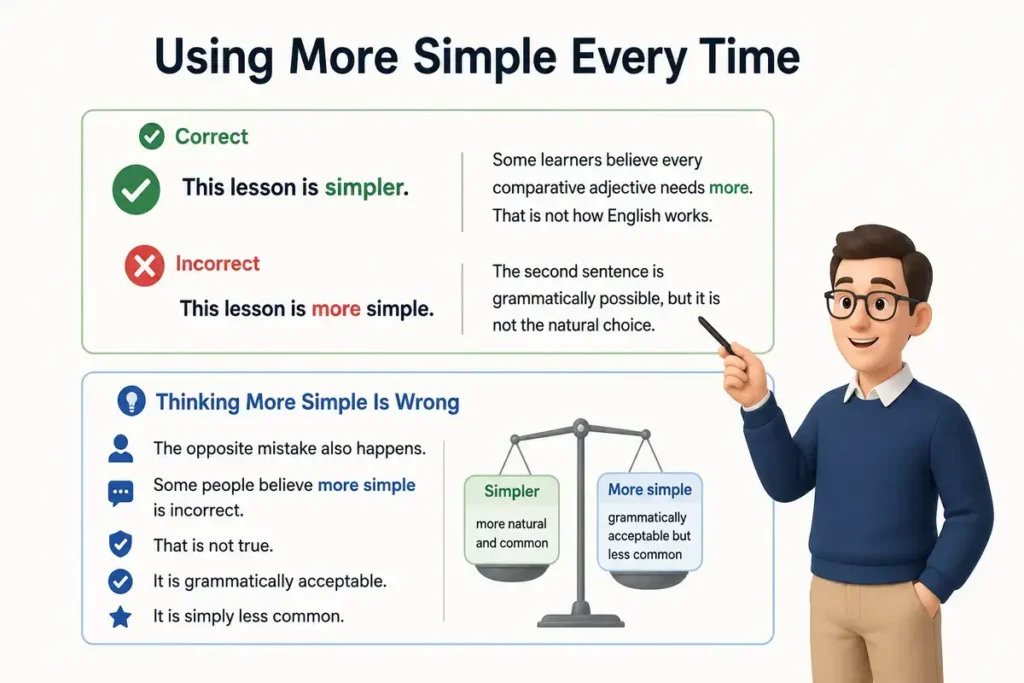
Some learners believe every comparative adjective needs more.
That is not how English works.
Correct.
This lesson is simpler.
Incorrect.
This lesson is more simple.
The second sentence is grammatically possible, but it is not the natural choice.
Thinking More Simple Is Wrong
The opposite mistake also happens. Some people believe more simple is incorrect. That is not true. It is grammatically acceptable. It is simply less common.
Mixing Comparative Forms
Never combine both comparative patterns.
Incorrect.
This solution is more simpler.
Correct.
This solution is simpler.
Correct.
This solution is more simple.
Using both comparative markers creates a grammar mistake.
Choosing Longer Forms Without A Reason
Longer expressions are not automatically better. Professional writers usually remove unnecessary words. Compare these examples.
1.Our new process is simpler.
2.Our new process is more simple.
3.The shorter version reads better.
Memory Trick
Remember one easy sentence. Simple becomes simpler because short adjectives usually add er. Think about similar words. Small becomes smaller. Fast becomes faster. Bright becomes brighter. Kind becomes kinder. Simple becomes simpler. The pattern repeats again and again. Once your brain connects these words, choosing the correct comparative becomes almost automatic.
Related Grammar Rules
Understanding similar grammar patterns helps reinforce the rule.
| Positive | Comparative | Superlative |
|---|---|---|
| Simple | Simpler | Simplest |
| Easy | Easier | Easiest |
| Small | Smaller | Smallest |
| Fast | Faster | Fastest |
| Quiet | Quieter | Quietest |
Notice something interesting. None of these common adjectives normally use more for the comparative. They all follow the er pattern. That is another reason simpler feels so natural.
Professional Writing Tip
Professional editors look for clarity before anything else. Every extra word gives readers one more thing to process. That does not mean every short sentence is better. It means every word should earn its place. Choosing simpler instead of more simple removes an unnecessary word without changing the meaning. That small improvement makes writing cleaner. Strong writing often comes from hundreds of small decisions like this. Each one seems tiny. Together, they create writing that feels polished, confident, and easy to read.
Key Takeaways
- Simpler is the standard and preferred comparative form of simple.
- More simple is grammatically correct but much less common.
- Native speakers almost always choose simpler in everyday conversation and professional writing.
- American English and British English both favor simpler.
- Never write more simpler because it combines two comparative forms.
- Use more simple only when a specific style, rhythm, or emphasis clearly improves the sentence.
- Choosing simpler usually makes your writing sound smoother, more natural, and more confident.
Conclusion
The debate around Simpler vs More Simple is much easier to solve than many people expect. Both expressions are grammatically correct, but they are not equally common.
In modern English, simpler is the clear winner. It follows the standard comparative pattern for short adjectives, appears naturally in speech and writing, and is the form preferred by editors, teachers, publishers, and native speakers. If your goal is clear, natural, and polished English, simpler is almost always the right choice. That does not mean more simple is wrong. English allows it, and experienced writers occasionally use it to add emphasis or create a particular rhythm. Still, those situations are the exception rather than the rule.
A useful habit is to think about similar adjectives. We naturally say smaller, faster, easier, and quieter. Simpler belongs to that same family. Once you recognize the pattern, choosing the correct comparative becomes almost automatic. Good writing rarely depends on one dramatic change. It grows from small decisions that make every sentence clearer and easier to read. Choosing simpler instead of more simple is one of those small decisions that quietly strengthens your writing every time.
Frequently Asked Questions
Is Simpler Correct English?
Yes. Simpler is correct English and is the preferred comparative form of simple. It follows the standard grammar rule for many short adjectives and appears naturally in everyday conversation, academic writing, business communication, and professional editing.
Is More Simple Grammatically Correct?
Yes. More simple is grammatically correct. However, native speakers use it much less often than simpler. Most writers choose simpler because it sounds more natural and concise.
Which Sounds More Natural Simpler Or More Simple?
Simpler sounds more natural in almost every situation. It matches the way native speakers normally form comparative adjectives and is the version you will encounter most often in books, newspapers, websites, and conversations.
Why Do Some Writers Use More Simple?
Some writers use more simple to create emphasis, improve sentence rhythm, or match a particular writing style. Although this choice is acceptable, it remains much less common than simpler.
Is Simpler Better In Professional Writing?
Yes. Professional writers and editors usually prefer simpler because it communicates the same idea using fewer words. Clear and concise writing improves readability and keeps readers engaged.
Do American And British English Use Different Forms?
No. American English and British English both strongly prefer simpler. You may occasionally find more simple, but it is uncommon in both varieties of English.
Can I Say More Simpler?
No. More simpler is grammatically incorrect because it uses two comparative markers together.
Correct. This explanation is simpler.
Correct. This explanation is more simple.
Incorrect. This explanation is more simpler.
What Is The Superlative Form Of Simple?
The superlative form is simplest.
Examples. This is the simplest solution.
What Part Of Speech Is Simple?
Simple is an adjective. It describes a noun by showing that something is easy to understand, uncomplicated, or not complex.
Examples.
An easy answer.
A neat design.
An effective solution.
Are There Other Adjectives Like Simple?
Yes. English has many adjectives that normally add er to form the comparative.
Examples include.
Easy becomes easier. Quiet becomes quieter. Narrow becomes narrower. Clever becomes cleverer. Happy becomes happier.

English Grammar & Usage
Nathan Holloway is an American grammar writer and language researcher who specializes in English grammar, sentence structure, verb usage, and common writing mistakes. He enjoys breaking down confusing grammar rules into practical explanations with clear examples, making English easier for students, professionals, and everyday writers.