
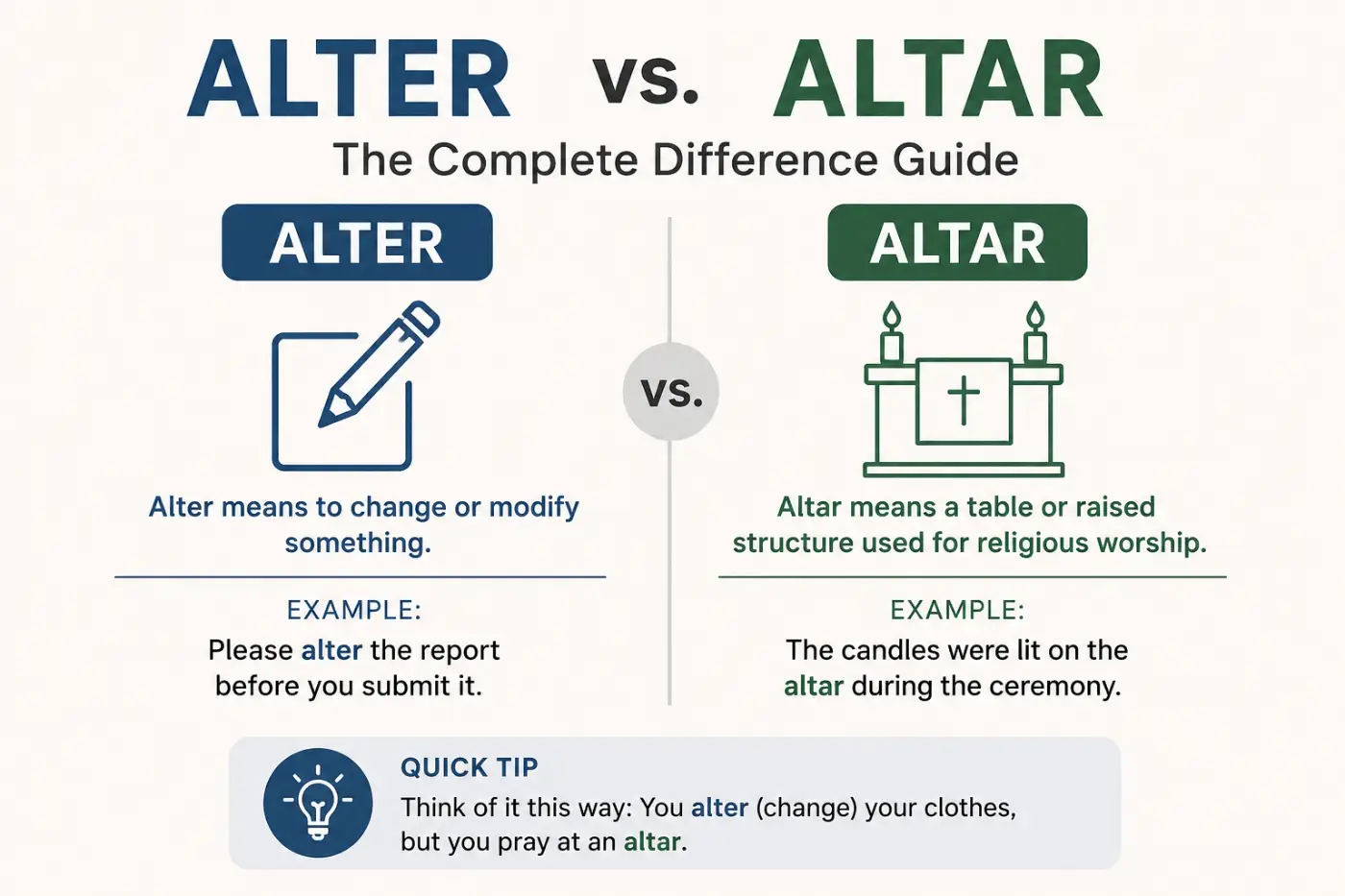
Alter vs altar is a common English word comparison because the two words sound alike but have completely different meanings. Alter is a verb that means to change something, while altar is a noun that refers to a structure used for worship or religious ceremonies. Remembering this difference will help you choose the correct word in school assignments, emails, professional documents, and everyday writing.
The confusion usually happens because both words share the same pronunciation in American English. When people hear them in conversation, they cannot tell which spelling the speaker intends without context. However, their meanings make the distinction easy once you know what each word describes.
The simplest way to remember the difference is to connect alter with alteration, which means a change, and altar with worship, prayer, and religious ceremonies. Once you learn these associations, you can recognize the correct spelling quickly and avoid a common writing mistake.
Short Answer
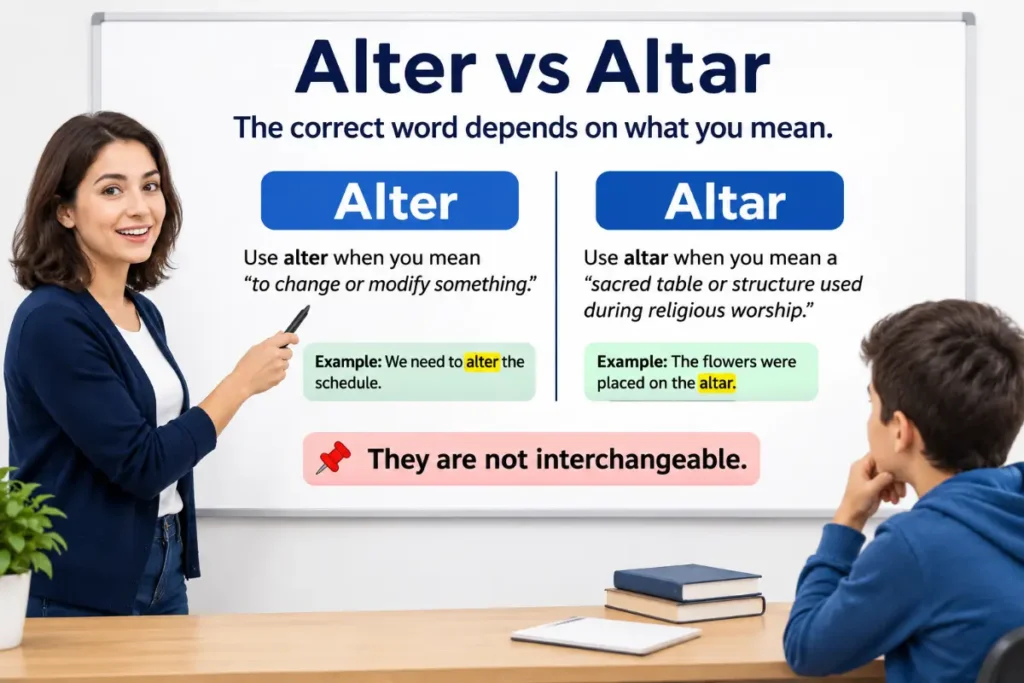
Alter means to change something or make it different. Altar is a raised structure used for religious ceremonies or worship. Although these words sound alike in American English, they have different meanings and spellings. Use alter when describing a change and altar when referring to a religious structure. For example, you can alter a dress, but you can kneel at an altar.
Table of Contents
- What Alter Means.
- What Altar Means.
- The Difference Between Alter and Altar.
- Alter vs Altar Comparison Table.
- How to Use Alter Correctly.
- How to Use Altar Correctly.
- Pronunciation and Word Origins.
- Real Life Examples.
- Common Mistakes to Avoid.
- Easy Memory Tricks.
- Related Words and Expressions.
- Professional Writing Tips.
- Frequently Asked Questions.
- Key Takeaways.
- Conclusion.
What Alter Means
Alter is a verb that means to change something, modify it, or make it different without necessarily replacing it completely. The change can involve appearance, size, shape, behavior, plans, conditions, or other qualities.
For example, a tailor can alter a pair of pants to make them fit better. A business owner can alter a work schedule to accommodate employees. A person can also alter a habit to improve their daily routine.
The main idea is simple. When you alter something, you make a change to it.
Alter as a Verb
A verb expresses an action or state. Alter describes the action of making a change to something that already exists.
Consider this sentence.
The designer decided to alter the original plan.
The designer changed the plan instead of necessarily discarding it and creating an entirely new one. The verb alter clearly communicates that modification.
Here are more examples.
- The school altered its schedule to give students more time for the examination. The school changed the existing schedule.
- She altered her dress before the wedding. She had the dress adjusted to improve its fit.
- The company altered its advertising strategy after reviewing customer feedback. The company modified its approach.
- The storm altered the course of the river. The storm changed the river’s path.
- He altered his opinion after learning the facts. He changed his view based on new information.
In each sentence, alter describes a change to an existing thing, idea, plan, or condition.
Different Forms of Alter
Alter follows the regular verb pattern in English. Its main forms are alter, alters, altered, and altering.
| Verb form | Example | Explanation |
|---|---|---|
| Base form | I need to alter the document. | Describes a change that needs to happen. |
| Third person singular | She alters old clothes. | Used with he, she, or it in the simple present. |
| Simple past | They altered the design. | Describes a completed change. |
| Past participle | The design has been altered. | Used with has, have, had, or passive constructions. |
| Present participle | He is altering the schedule. | Describes an action in progress. |
These forms are useful in both spoken and written English. Learning them also makes it easier to recognize alter in different sentence structures.
Alter Does Not Always Mean a Major Change
An alteration can be small or significant. You might alter the length of a sleeve by an inch or alter an entire business strategy.
The word itself does not tell you how large the change is. The surrounding sentence provides that information.
For example, I altered one sentence in the report describes a small edit. By contrast, The discovery altered our understanding of the disease describes a much more significant change.
Common Expressions With Alter
Alter appears in several everyday and professional expressions.
- Alter a plan. Change an existing plan because circumstances or priorities have changed.
- Alter your appearance. Make changes to how you look.
- Alter your behavior. Modify the way you act.
- Alter the course of events. Change how a situation develops.
- Alter the terms of an agreement. Modify the conditions of an agreement.
- Alter your perception. Change how you understand or interpret something.
These expressions show that alter works in many settings, from casual conversation to formal writing.
What Altar Means
Altar is a noun that refers to a raised table, platform, or other designated structure used in religious worship, ceremonies, offerings, or rituals. Its exact form and purpose depend on the religious tradition and cultural setting.
In many Christian churches, an altar is associated with prayer, communion, and other forms of worship. In other religious traditions, altars may hold sacred objects, offerings, candles, flowers, or images used during devotional practices.
Unlike alter, altar does not describe an action. It names a physical structure or a place associated with religious activity.
Altar as a Noun
A noun names a person, place, thing, or idea. Altar names a structure used for a particular religious or ceremonial purpose.
Consider this example.
The family placed flowers on the altar.
The sentence refers to a physical structure where the family placed flowers. It does not describe changing anything.
Here are additional examples.
- The priest stood near the altar during the service. The sentence identifies the location of the priest during a religious ceremony.
- The couple exchanged vows at the altar. The sentence describes a wedding ceremony taking place at a designated ceremonial location.
- Worshippers placed candles on the altar. The sentence identifies where the candles were placed.
- The church decorated its altar for the holiday service. The sentence describes decorating a religious structure.
- The ancient temple contained an altar used for offerings. The sentence refers to a structure associated with historical religious practices.
Each example uses altar as a noun because the word identifies a structure rather than an action.
What an Altar Represents
An altar can have different meanings depending on the context. The word also appears in figurative expressions. For example, the phrase sacrifice everything at the altar of success describes giving up important things in pursuit of a goal. It does not refer to a literal religious structure.
Understanding these meanings helps you recognize altar in both literal and figurative writing.
Common Expressions With Altar
The word altar appears in several familiar expressions.
- At the altar. This can refer to a wedding ceremony or to being at a religious structure used for worship.
- Lead someone to the altar. This means to marry someone or bring a relationship to the point of marriage.
- Sacrifice something at the altar of success. This means giving up something valuable to achieve success.
- Lay something on the altar. This can describe offering or surrendering something for a particular cause or purpose.
- The altar of freedom. This is a figurative expression that can refer to sacrifice made in pursuit of freedom.
These expressions often carry emotional, cultural, or religious meaning. The word altar remains a noun even when an expression uses it metaphorically.
The Difference Between Alter and Altar
The main difference is grammatical and semantic. Alter is a verb meaning to change or modify something. Altar is a noun naming a structure used for religious or ceremonial purposes.
Both words have the same pronunciation in standard American English, but they do not have the same spelling or meaning. You must choose the spelling that matches the idea you want to express.
A useful way to think about the difference is to ask yourself what the sentence describes. If it describes an action involving change, use alter. If it names a religious structure, use altar.
Meaning and Part of Speech
The part of speech provides one of the clearest ways to distinguish these words.
Alter expresses an action.
The tailor will alter the jacket.
Here, alter tells us what the tailor will do. The tailor will modify the jacket.
Altar names a thing.
The congregation gathered around the altar.
Here, altar identifies the structure around which people gathered.
This grammatical difference is especially useful when proofreading. If the sentence needs an action word, alter may be the right choice. If the sentence needs a noun referring to a religious structure, altar is appropriate.
Spelling and Context
The two words differ by one letter. Alter contains an e, while altar contains an a in its second syllable.
However, the letter difference is only useful when you connect it to meaning. Simply memorizing the spellings may not help if you forget which word represents which concept.
Context provides the strongest clue.
For example, in The artist altered the painting, the verb refers to changing the artwork. In The painting hung above the altar, the noun refers to a religious structure.
The surrounding words make the intended meaning clear.
When Both Words Appear in One Sentence
You can use both words in a single sentence when you need to describe changing something connected to an altar.
For example.
The caretaker decided to alter the decorations around the altar.
Alter describes the action of changing the decorations. Altar names the religious structure around which the decorations are arranged.
This example is a helpful reminder that the words are not interchangeable, even though they can appear naturally in the same sentence.
Alter vs Altar Comparison Table
| Feature | Alter | Altar |
|---|---|---|
| Part of speech | Verb | Noun |
| Main meaning | To change or modify | A structure used for worship or ceremonies |
| Pronunciation | /ˈɔːltər/ in common US pronunciation | /ˈɔːltər/ in common US pronunciation |
| Example | Please alter the document. | The flowers are on the altar. |
| Related word | Alteration | Altar cloth |
| Common setting | Editing, clothing, plans, behavior, and conditions | Churches, temples, shrines, and religious ceremonies |
| Grammatical role | Describes an action | Names a structure or ceremonial place |
| Memory clue | Alter means to adjust | Altar is associated with worship |
The table shows that the words have different grammatical roles and meanings, even though their sounds are alike.
How to Use Alter Correctly
Use alter when you want to describe changing, adjusting, or modifying something. The word works with physical objects, plans, ideas, personal habits, and many other things.
It is common in everyday conversation, business writing, academic work, legal documents, and technical explanations. The tone is generally neutral and can sound slightly formal in some contexts.
Altering Clothes and Physical Objects
One of the most familiar uses of alter involves adjusting clothing.
For example.
I need to alter these pants before the interview.
The sentence means that the pants need adjustments, perhaps in length or fit. The word is appropriate because the clothing will be changed.
Other examples include the following.
- The tailor altered the sleeves to fit the customer. The tailor adjusted the sleeves rather than replacing the entire garment.
- We altered the kitchen cabinets to create more storage space. The cabinets were modified to serve a different practical purpose.
- She altered the curtains to fit the wider window. The curtains were adjusted to match the window’s dimensions.
- The mechanic altered the bracket to fit the new part. The mechanic modified a component so it would work with another component.
In these examples, alter describes a physical adjustment.
Altering Plans and Decisions
Alter is also useful when plans change because of new information, unexpected events, or changing priorities.
For example.
The manager altered the meeting schedule after the client requested a different time.
The manager changed the original schedule to accommodate the client’s request.
More examples show how this usage works.
- We altered our travel plans because of the weather. The weather caused us to change the original arrangements.
- The school altered its attendance policy. The school modified an existing rule.
- She altered her decision after discussing the issue with her family. She changed her earlier choice.
- The team altered its strategy during the second half of the game. The team changed its approach to respond to the situation.
Alter works well in these sentences because each one describes a modification to an existing plan, decision, rule, or strategy.
Altering Behavior and Habits
People can also alter their actions, routines, and ways of thinking.
For example.
He altered his daily routine to make more time for exercise.
The sentence describes a change in the way he organizes his day.
Other examples include these.
- She altered her eating habits after consulting a nutrition professional. She changed the way she approached food.
- The employee altered his communication style to make his reports easier to understand. He modified how he communicated.
- The experience altered her perspective on leadership. The experience changed how she viewed leadership.
- The students altered their study methods before the final examination. They changed their approach to preparing for the test.
Notice that alter can describe both visible changes and changes in thought or behavior.
Altering Documents and Information
In professional and academic settings, alter often describes editing or modifying written material, records, images, or data.
For example.
Please alter the report to include the latest figures.
The sentence asks someone to revise the report by adding updated information.
Other examples include the following.
- The editor altered the paragraph to improve clarity. The editor revised the wording to make the message easier to understand.
- The researcher altered the presentation after reviewing the results. The researcher modified the presentation to reflect the findings.
- The designer altered the image to improve its composition. The designer made changes to the image’s arrangement or appearance.
- The lawyer reviewed the proposed changes to the contract. The sentence uses changes as a noun, but the underlying action is modifying the contract’s terms.
A related distinction matters in legal and professional writing. Alter can mean making a change, but the word does not automatically tell readers if the change is permitted. The surrounding circumstances determine that.
Alter in Formal Writing
Alter is appropriate in formal writing when you need to describe a modification precisely.
For instance, a report might state that a company altered its operating procedures after an internal review. An academic paper might explain that new evidence altered the researchers’ interpretation of earlier findings.
In casual conversation, people may prefer change because it is shorter and more familiar. However, alter is not limited to formal writing. It is perfectly natural in everyday sentences such as I had to alter my plans.
Choose alter when it fits your sentence and desired tone. You do not need to replace it simply to sound more conversational.
Which One Is Correct
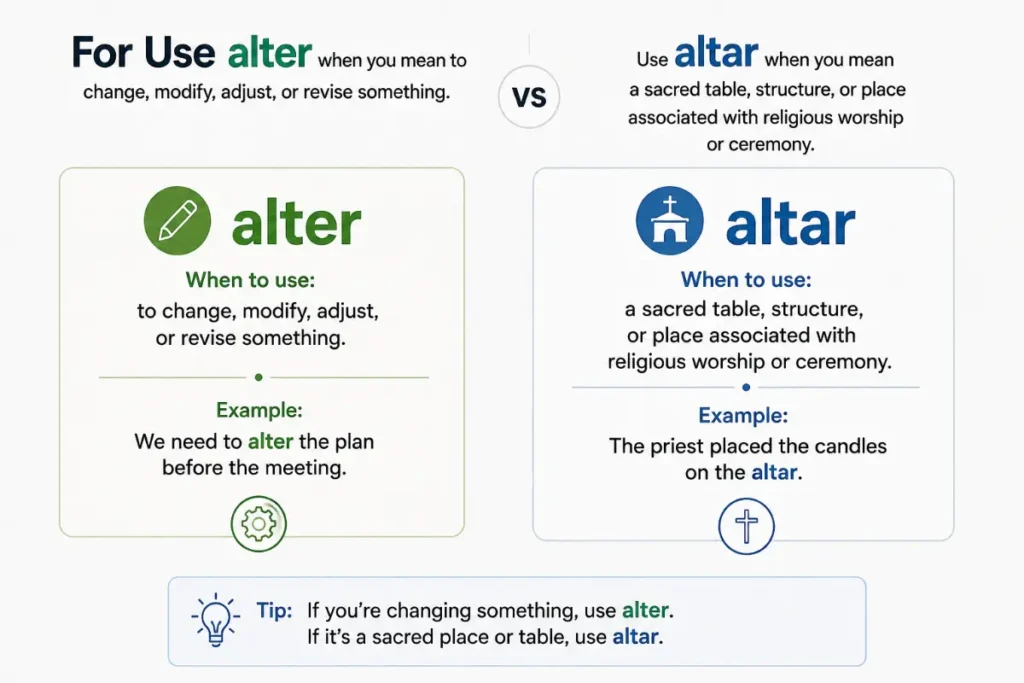
Both words are correct, but they are correct in different situations. Use alter when you mean to change, modify, adjust, or revise something. Use altar when you mean a sacred table, structure, or place associated with religious worship or ceremony.
Consider this quick test.
If you can replace the word with change, choose alter.
If you can replace it with sacred table or place of worship, choose altar.
How to Use Altar Correctly
Use altar when referring to a structure or designated place associated with worship, religious observances, or ceremonies. The word is a noun, so it commonly appears after articles such as the, a, or an, or after prepositions such as at, near, beside, and around.
For example.
The flowers were arranged beside the altar.
The word altar identifies the structure beside which the flowers were arranged.
Altar in Religious Settings
Altars appear in many religious traditions, although their design and purpose vary. They may serve as places for prayer, offerings, sacred objects, ceremonial acts, or other forms of worship.
Consider these examples.
- The priest prepared the altar before the service. The sentence refers to preparing a religious structure for a ceremony.
- The family placed a small candle on the altar. The altar serves as a place for a devotional object.
- The temple had an altar decorated with flowers. The sentence describes a structure within a religious setting.
- Worshippers gathered near the altar during the ceremony. The word identifies the location where the worshippers gathered.
- The museum displayed an ancient altar from a historical site. Here, altar refers to a religious artifact preserved for public viewing.
These examples show that altar is appropriate when the sentence refers to a physical structure or designated ceremonial place.
Altar in Wedding Ceremonies
Altar is also associated with weddings, particularly in expressions that describe a couple getting married.
For example.
The couple stood at the altar and exchanged vows.
The sentence refers to the ceremonial location where the couple made their marriage vows.
The expression walk down the aisle is often associated with the same event, although the aisle and the altar are different things. The aisle is the passage through which someone walks, while the altar is the ceremonial structure or designated area.
In everyday English, people sometimes use altar figuratively when discussing marriage. The expression leave someone at the altar means to abandon a person at the point of marriage, often by canceling the wedding unexpectedly.
For example.
He was afraid his partner would leave him at the altar.
This sentence uses a familiar wedding expression rather than describing a literal act of leaving someone beside a religious structure.
Altar in Figurative Language
Altar can also appear in expressions that describe devotion, sacrifice, or the pursuit of a goal. These expressions draw on the word’s religious associations.
Consider the sentence below.
She refused to sacrifice her family life at the altar of career success.
The sentence does not describe a literal altar. Instead, it suggests that she refused to give up her family relationships in pursuit of professional achievement.
Here are additional examples.
- The community placed its hopes at the altar of progress. This figurative expression suggests that the community devoted its hopes to progress.
- He sacrificed his free time at the altar of ambition. The sentence describes giving up leisure to pursue personal goals.
- The leader would not place public trust at the altar of political gain. This means the leader would not sacrifice public trust to gain a political advantage.
These expressions are more rhetorical than ordinary conversation. They can add emphasis to essays, speeches, opinion pieces, and literary writing.
Pronunciation and Word Origins
Pronunciation and etymology can help you understand the relationship between confusing words. In this case, pronunciation explains why people mix up alter and altar, while their origins show how the words developed different meanings.
How to Pronounce Alter and Altar
In standard American English, alter and altar are homophones. Homophones are words that sound alike but have different meanings and often different spellings.
Both words are commonly pronounced /ˈɔːltər/ in American English, although the exact vowel quality can vary by accent. Each word has two syllables, and the stress falls on the first syllable.
Because their pronunciation is the same, you cannot reliably identify the intended spelling by sound alone. You need to use context.
For example, if someone says a tailor will alter a jacket, the context points to the verb meaning to change. If someone says a couple stood at the altar, the context points to the noun associated with a wedding ceremony.
Why Homophones Cause Spelling Mistakes
English contains many words that sound alike but carry different meanings. Speakers often learn these words by listening before they learn their written forms, which can make spelling mistakes more likely.
Alter and altar create this problem because their pronunciation does not provide a clear clue about which spelling to choose. The difference becomes clear only when you consider the sentence’s meaning and grammar.
Other familiar homophones include pair and pear, flour and flower, and right and write. Each pair shares a pronunciation in many accents but has different meanings.
Learning words in context is more effective than memorizing isolated spellings. When you connect each word with a clear example, you build a stronger association between its spelling and meaning.
The Origin of Alter
Alter entered English through French and Latin influences. It is related to Latin alterare, meaning to change or modify, and ultimately to alter, meaning other or the other of two.
The historical connection fits the word’s modern meaning. When you alter something, you make it different from its earlier form or condition.
The related English noun alteration refers to the act or result of changing something. This connection offers a useful spelling clue because both alter and alteration describe change.
For example.
The alteration to the schedule affected the entire department.
Here, alteration names the change that was made. The verb alter describes the action of making that change.
The Origin of Altar
Altar has a different history. It developed from Latin altare, a word associated with a structure used for religious offerings and worship.
Over time, the word entered English and retained its association with religious ceremonies and sacred places. Its modern use includes both literal references to worship structures and figurative expressions involving devotion or sacrifice.
The historical difference helps explain why alter and altar should not be treated as alternative spellings of the same word. They developed from different sources and carry different meanings.
American and British English Usage
The meanings of alter and altar remain essentially the same in American and British English. Both varieties use alter as a verb meaning to change and altar as a noun referring to a religious or ceremonial structure.
Their pronunciation can vary slightly across regional accents, but the distinction between the words does not change. Neither spelling is an American or British variant of the other.
For writers, this means there is no need to choose a regional spelling. The correct choice depends on meaning, not location.
Real Life Examples of Alter and Altar
Seeing both words in familiar situations makes the distinction easier to remember. The following examples show how the words work in school, work, home, religion, and everyday communication.
Examples From Everyday Life
- I need to alter my schedule before the weekend. The speaker plans to change an existing schedule.
- The tailor will alter my jacket tomorrow. The tailor will adjust the jacket’s fit.
- The storm altered our plans for the picnic. The weather caused the original plan to change.
Examples From School and Work
- The teacher altered the lesson plan to help struggling students. The teacher modified the original plan to meet students’ needs.
- The editor altered the introduction to make the main point clearer. The editor revised the wording of the introduction.
- The company altered its return policy after reviewing customer complaints. The company changed an existing policy.
Common Mistakes to Avoid
Even confident English writers sometimes confuse these words. The best way to avoid errors is to check the meaning of the sentence rather than relying on how the word sounds.
Using Altar When You Mean Change
Incorrect: The tailor will altar the dress before the event.
Correct: The tailor will alter the dress before the event.
The correct word is alter because the tailor will modify the dress. Altar names a religious structure and does not work as the verb in this sentence.
Using Alter When You Mean a Religious Structure
Incorrect: The candles were placed on the alter.
Correct: The candles were placed on the altar.
The sentence describes where the candles were placed. Since it refers to a structure used for worship or ceremony, altar is correct.
Assuming the Words Are Different Pronunciations
Some writers expect words with different meanings to sound different. However, alter and altar are homophones in standard American English.
You cannot solve this spelling problem by listening more carefully. Instead, consider the meaning of the sentence and identify the grammatical role the word needs to perform.
Treating Altar as a Verb
Incorrect: We need to altar the original design.
Correct: We need to alter the original design.
The sentence needs a verb describing the action of changing the design. Alter is the correct choice.
Treating Alter as a Noun for a Worship Structure
Incorrect: The priest stood beside the alter.
Correct: The priest stood beside the altar.
The word after beside identifies a place or structure. Altar is the correct noun.
Choosing a Spelling Based Only on Memory
A writer might remember that both spellings exist but forget which meaning belongs to each one. This can lead to mistakes even when the writer knows the words individually.
The solution is to memorize a short example for each word. For alter, remember alter a plan. For altar, remember pray at the altar. These examples connect each spelling with its meaning.
Easy Memory Tricks
A good memory trick should be short, clear, and easy to recall under pressure. The following methods connect each spelling to a familiar idea.
Connect Alter With Alteration
Alter and alteration share the same root and refer to changing something.
Remember this sentence.
I alter a plan when I need to make an alteration.
Both words refer to change. If you are talking about modifying a schedule, document, garment, or decision, alter is the spelling you need.
Connect Altar With Worship
Think of an altar inside a church, temple, or other place of worship. This mental image connects the word with religious ceremonies and sacred spaces.
Remember this sentence.
The worshippers gathered around the altar.
The word altar identifies the structure or designated place associated with the ceremony.
Use the Action and Object Test
Ask yourself what the sentence describes.
- If it describes an action that changes something, choose alter.
- If it names a structure used for worship or a religious ceremony, choose altar.
For example, in They altered the room, the word describes an action. In They decorated the altar, the word identifies a structure.
This test works well because it combines meaning with grammar.
Learn One Sentence for Each Word
Memorize two short sentences that clearly show the difference.
I altered my plans.
I prayed at the altar.
The first sentence describes a change. The second identifies a religious structure. Recalling these examples can help you choose the right spelling when you are writing quickly.
Picture the Difference
Visual memory can make the words easier to distinguish. Imagine a calendar with a changed appointment when you think of alter. Picture a decorated religious structure when you think of altar.
These mental images connect the spelling to the meaning instead of forcing you to remember two unrelated letter patterns.
Related Words and Expressions
Understanding related words gives you a wider vocabulary and helps you recognize the correct form in different contexts.
Alteration
Alteration is a noun that means a change or modification.
Example: The alteration to the jacket improved its fit.
The sentence uses alteration to name the change made to the jacket. It is closely related to the verb alter.
Alternative
Alternative is a noun or adjective that refers to another option or possibility.
Example: We need an alternative plan.
The sentence identifies another plan that could be used. Alternative and alter look similar, but they do not mean the same thing. Alter means to change something, while alternative refers to another choice.
Alternate
Alternate can function as a verb or adjective. As a verb, it can mean to take turns or switch between options. As an adjective, it can mean every other or serving as a substitute, depending on context.
Example: The workers alternate between morning and evening shifts.
The sentence describes switching between shifts. It does not mean the workers are changing a single object in the same way that alter would suggest.
Altered
Altered is the past tense and past participle of alter.
Example: The altered schedule was sent to all employees.
The word describes a schedule that has already been changed.
Altar Cloth
An altar cloth is a piece of fabric used to cover or decorate an altar in certain religious traditions.
Example: The altar cloth was carefully prepared for the service.
The expression refers to a cloth associated with a religious structure.
Altar Server
An altar server is someone who assists with particular duties during religious services in traditions that use this role.
Example: The altar server helped prepare for the ceremony.
The word altar identifies the religious setting associated with the person’s duties.
At the Altar
This expression commonly refers to a wedding ceremony or a ceremonial moment associated with marriage.
Example: They stood at the altar and exchanged vows.
The phrase refers to the location where the couple participated in the ceremony.
Sacrifice at the Altar of Something
This figurative expression describes giving up something valuable to pursue a goal or serve a cause.
Example: He refused to sacrifice his health at the altar of ambition.
The sentence means that he did not want to damage his health in pursuit of success. It uses altar metaphorically rather than literally.
Professional Writing Tips
Correct spelling matters in emails, reports, essays, articles, and professional documents. Since alter and altar sound alike, proofreading should focus on meaning and sentence structure.
Read the Whole Sentence
Do not check the spelling in isolation. Read the complete sentence and identify what the word refers to.
For example, The committee will alter the proposal describes an action. The committee visited the altar describes a place or structure.
The surrounding words provide the information needed to select the right spelling.
Check the Part of Speech
Ask yourself if the sentence needs a verb or a noun. Alter usually serves as a verb, while altar serves as a noun.
This is a useful proofreading technique because grammatical structure often reveals a wrong word choice even when the sentence sounds correct aloud.
Prefer Clear Wording
If a sentence feels confusing, rewrite it to make the meaning more direct.
For example, instead of writing The document needs an altar, write The document needs to be altered if you mean it requires changes.
The revised sentence uses the correct verb form and makes the intended meaning clear.
Use a Spellchecker With Care
Spellcheckers may not flag alter when you intended to write altar because both are correctly spelled English words. A tool can recognize spelling patterns without knowing your intended meaning.
Always review the sentence itself. Context is what distinguishes a correctly spelled but incorrectly used word from the word you actually need.
Alter vs Altar in One Minute
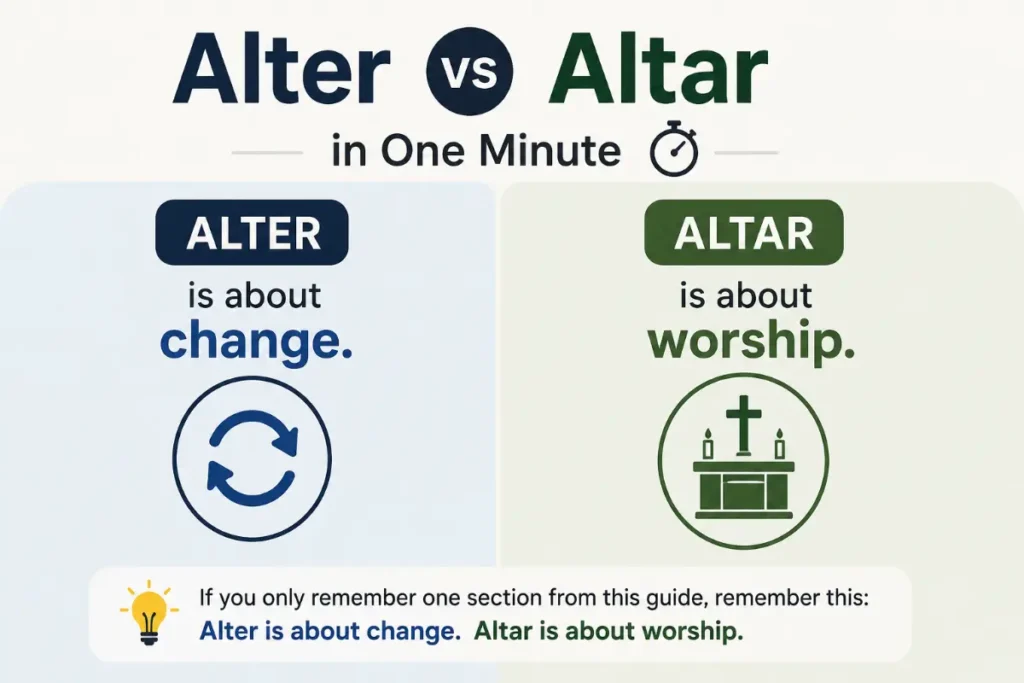
If you only remember one section from this guide, remember this:
Alter is about change.
Altar is about worship.
Alter is generally a verb.
Altar is a noun.
You alter a plan.
You alter a dress.
Ahmad approach an altar.
You place flowers on an altar.
The pronunciation may be the same, but the meanings are completely different.
Key Takeaways
- Alter is a verb that means to change, adjust, or modify something.
- Altar is a noun that refers to a structure or designated place used for religious worship or ceremonies.
- Both words sound alike in standard American English.
- Alter is related to alteration, which means a change.
- Altar is associated with worship, prayer, offerings, and religious ceremonies.
- Use context and grammar to choose the correct spelling.
- Remember the examples alter a plan and pray at the altar.
- Proofread carefully because spellcheckers may not catch a correctly spelled word used with the wrong meaning.
Conclusion
Alter vs altar is easier to understand when you remember that alter means to change something, while altar refers to a structure used for religious worship or ceremonies. The words sound alike, but their meanings and grammatical roles are different. Choosing the correct spelling depends on the message you want to communicate.
Use alter when you describe modifying a plan, adjusting clothing, revising a document, or changing a person’s behavior. Use altar when you refer to a religious structure, a wedding ceremony, or a figurative expression involving devotion and sacrifice. When you are unsure, check the meaning of the entire sentence instead of relying on pronunciation.
The easiest memory trick is to connect alter with alteration and altar with worship. Remember that you can alter a schedule, but you can pray at an altar. With these simple associations and a little practice, you’ll be able to use both words accurately in everyday conversation, academic assignments, and professional writing.
Frequently Asked Questions
What Is the Difference Between Alter and Altar?
Alter means to change or modify something. Altar is a noun that refers to a structure used for religious worship or ceremonies. For example, you can alter a dress, but you can place flowers on an altar.
Are Alter and Altar Homophones?
Yes. Alter and altar are homophones in standard American English because they share the same pronunciation but have different meanings and spellings. You must use context to determine which word is correct.
Is Alter a Verb or a Noun?
Alter is primarily a verb. It describes the action of changing or modifying something. For example, She altered the schedule means she changed the existing schedule.
Is Altar a Verb or a Noun?
Altar is a noun. It names a structure or designated place used for religious worship or ceremonies. For example, The candles stood on the altar identifies where the candles were placed.
How Do You Remember the Difference Between Alter and Altar?
Connect alter with alteration because both words refer to change. Connect altar with worship and religious ceremonies. Remembering alter a plan and pray at the altar provides two simple examples.
Can Alter and Altar Appear in the Same Sentence?
Yes. For example, The caretaker decided to alter the decorations around the altar. Alter describes the action of changing the decorations, while altar names the religious structure.
Is Alter or Altar Correct for a Wedding?
Altar is correct when referring to the ceremonial structure or designated area associated with a wedding. For example, The couple stood at the altar and exchanged vows. Alter would be correct if you were describing a change to the wedding plans.
What Is the Past Tense of Alter?
The past tense of alter is altered. For example, The manager altered the schedule yesterday. The sentence describes a change that happened in the past.
Does Altar Have a Figurative Meaning?
Yes. Altar appears in figurative expressions involving devotion, sacrifice, and commitment. For example, She refused to sacrifice her friendships at the altar of success means she did not want to give up her friendships to achieve success.
Why Do People Confuse Alter and Altar?
People confuse these words because they sound alike in American English. Their spellings differ by one letter, and basic spellcheckers may accept either word even when the writer has chosen the wrong one. Learning their meanings and grammatical roles helps prevent mistakes.
Is Alter vs Altar an American or British English Difference?
No. The distinction is not a regional spelling difference. Both American and British English use alter to mean change and altar to refer to a religious or ceremonial structure.

Confusing Words, Spelling & Word Choice
Claire Whitmore is a U.S.-based English editor who writes about commonly confused words, spelling differences, and word choice. Her work helps readers understand subtle distinctions between similar-looking words through simple definitions, practical examples, and modern usage guidance in both American and British English.