
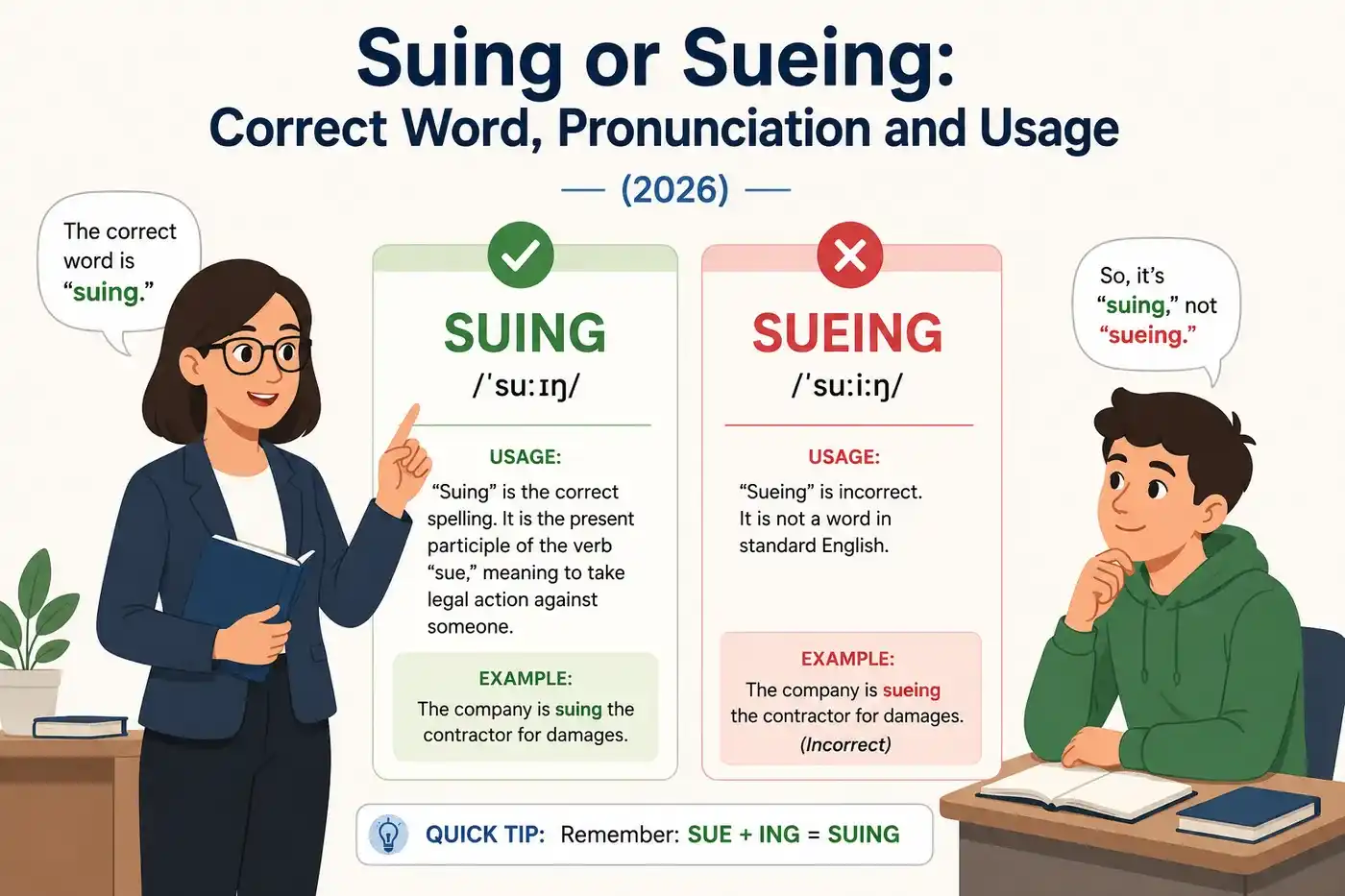
Suing vs sueing is a common spelling question because the verb sue ends with a silent e. When you want to describe someone taking legal action against another person or organization, the correct word is suing. The spelling sueing may look reasonable, but it doesn’t follow the standard English rule for adding ing to a verb that ends in a silent e.
The rule is simple. In most cases, you drop the final silent e before adding ing. That change turns sue into suing, just as argue becomes arguing and continue becomes continuing. Learning this pattern can help you avoid spelling mistakes in everyday messages, school assignments, legal discussions, and professional writing.
This guide explains the difference between the two spellings, the grammar rule behind the correct form, and the best ways to use suing in a sentence. You’ll also find practical examples, common mistakes, pronunciation guidance, and answers to frequently asked questions. By the end, you’ll know how to spell the word correctly and recognize the same pattern in other English verbs.
Short Answer
Suing is the correct spelling in standard American English. Sueing is a misspelling. When you add the ending ing to the verb sue, you drop the silent final e to form suing. For example, She is suing the company for damages is correct. This spelling rule also applies to verbs such as argue and arguing.
Table of Contents
- Which Spelling Is Correct.
- What Suing Means.
- Why Suing Is Correct.
- The Rule for Adding Ing.
- Suing vs Sueing Comparison.
- How to Use Suing in a Sentence.
- Real Life Examples of Suing.
- Common Spelling Mistakes.
- Words That Follow the Same Rule.
- When the Final E Stays.
- Pronunciation and Word Origin.
- Tips to Remember the Correct Spelling.
- Related Grammar and Usage Notes.
- Frequently Asked Questions.
- Key Takeaways.
- Conclusion.
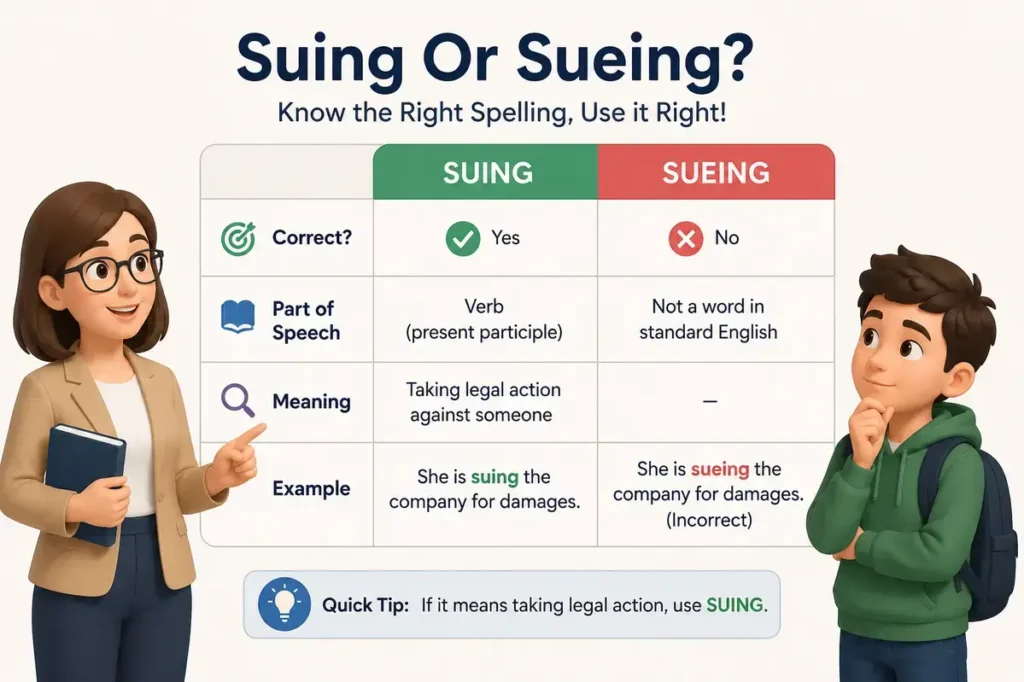
Suing Or Sueing Comparison Table
| Feature | Suing | Sueing |
|---|---|---|
| Correct spelling | Yes | No |
| Dictionary entry | Yes | No |
| Meaning | Taking legal action against someone | Misspelling of suing |
| Part of speech | Present participle and gerund | Not a standard English word |
| Grammar status | Correct | Incorrect |
| Origin | From the verb sue | Formed by applying the wrong spelling pattern |
| Usage frequency | Very common | Extremely rare except as an error |
| Formal writing | Accepted | Never accepted |
| Legal writing | Standard | Incorrect |
| Academic writing | Standard | Incorrect |
| Professional communication | Standard | Incorrect |
| Example | She is suing the contractor. | She is sueing the contractor. Incorrect. |
Which Spelling Is Correct
The correct spelling is suing. It is the present participle of the verb sue and describes the act of bringing a legal claim against a person, business, or other party.
The spelling sueing is incorrect in standard modern English. You should leave out the final e when you add ing to sue.
Consider these examples.
1. Correct: The customer is suing the company for misleading advertising.
The verb suing describes legal action that the customer is taking against the company.
2. Incorrect: The customer is sueing the company for misleading advertising.
The word sueing contains an unnecessary e and doesn’t follow the standard spelling rule.
3. Correct: They are suing their former landlord over the unpaid deposit.
The spelling is correct because sue becomes suing when the ing ending is added.
In American English, suing is the accepted spelling for this verb form. The same spelling is used in British English, Canadian English, Australian English, and other major varieties of English.
You don’t need a regional spelling alternative for this word. Simply remember to drop the final e before adding ing.
What Suing Means
Suing means taking legal action against someone through a court. A person or organization may sue another party to seek compensation, resolve a legal dispute, or obtain another remedy allowed by law.
The word comes from the verb sue. Adding ing creates a verb form that can describe an action in progress or serve other grammatical purposes.
For example, consider this sentence.
The family is suing the hospital over alleged negligence.
The word suing tells readers that the family is pursuing a legal claim against the hospital. The sentence doesn’t establish that the hospital did anything wrong. It only describes the legal action being taken.
The word often appears in news reports, business documents, legal discussions, and everyday conversations. People may use it when discussing disputes involving contracts, property, personal injuries, employment, or alleged wrongdoing.
Here are several common uses.
1. Personal injury. A driver is suing another driver after a collision.
The sentence describes a legal claim connected to an accident.
2. Business disputes. A supplier is suing a retailer over an unpaid invoice.
The word refers to legal action related to a business payment dispute.
3. Employment claims. A former employee is suing an employer over alleged discrimination.
The sentence describes a claim involving workplace conduct.
4. Property disputes. A homeowner is suing a contractor over damage to the property.
The word identifies the homeowner’s legal action against the contractor.
5. Contract disputes. A company is suing a partner for allegedly breaking a contract.
The sentence describes a disagreement that has become a legal matter.
These examples show how the word works in different settings. Its spelling stays the same, even when the type of legal dispute changes.
Why Suing Is Correct
The correct spelling follows a standard English spelling pattern. When a verb ends in a silent e, writers generally remove that final letter before adding ing.
The base verb is sue. Its final e is silent, so adding ing produces suing, not sueing.
The spelling change looks small, but it follows a pattern found in many common English words.
- Sue becomes suing.
- Argue becomes arguing.
- Rescue becomes rescuing.
- Continue becomes continuing.
- Value becomes valuing.
- Pursue becomes pursuing.
Notice that the spelling of each word changes before the ing ending is added. The final e disappears, but the rest of the base verb remains intact.
The rule helps explain why suing is correct even though sue contains the letters u and e at the end. You don’t keep both letters simply because they appear in the original word.
English spelling can sometimes feel inconsistent, but this pattern is dependable for many verbs ending in a silent e. Once you recognize it, you’ll find it easier to spell similar words correctly.
The Rule for Adding Ing
The basic rule is straightforward. For most verbs ending in a silent final e, remove the e and then add ing.
The formula looks like this.
Base verb ending in silent e + ing = remove the final e + ing.
For example, make becomes making. The final e disappears before the ending is added. The same process turns write into writing and bake into baking.
The verb sue follows the same pattern.
- Start with the base verb sue.
- Identify the silent final e.
- Remove that final e.
- Add ing to the remaining letters.
- Write the completed form as suing.
This process gives you the standard spelling without adding an extra letter.
Why You Do Not Keep the E
Many learners assume that the spelling sueing must be correct because the base word is sue. They may believe that adding an ending should preserve every letter in the original word.
English spelling doesn’t work that way for most verbs ending in a silent e. The final letter commonly disappears when an ending begins with a vowel, as it does in ing.
Compare these forms.
| Base verb | Correct form | Incorrect form |
|---|---|---|
| Sue | Suing | Sueing |
| Argue | Arguing | Argueing |
| Rescue | Rescuing | Rescueing |
| Bake | Baking | Bakeing |
| Write | Writing | Writeing |
| Drive | Driving | Driveing |
| Hope | Hoping | Hopeing |
| Smile | Smiling | Smileing |
Each correct form follows the same general pattern. The incorrect forms retain a final e that should be removed.
Does the Rule Apply to Every Verb
No. English has spelling exceptions, so you shouldn’t remove the final e automatically from every word.
For example, see becomes seeing. The spelling retains both e letters because this verb follows a different pattern. Similarly, agree becomes agreeing.
The key is to learn common patterns along with their established exceptions. For a verb such as sue, the standard form is clear: suing.
What Happens to the Sound
The spelling change doesn’t require you to pronounce an extra syllable. The word suing usually has two syllables, with the vowel sound from sue followed by the ending ing.
The written form drops the silent e, but the pronunciation preserves the main sound of the original verb. That distinction helps explain why the spelling can look different from what some learners expect.
Suing vs Sueing Comparison
The difference between these spellings is not a difference in meaning. Only one form is accepted as the standard spelling of the verb.
| Feature | Suing | Sueing |
|---|---|---|
| Standard spelling | Yes | No |
| Correct in American English | Yes | No |
| Correct in British English | Yes | No |
| Base verb | Sue | Sue |
| Grammar | Present participle or gerund | Nonstandard misspelling |
| Meaning | Taking legal action | Intended to mean taking legal action |
| Suitable for formal writing | Yes | No |
The comparison makes the answer clear. Use suing in schoolwork, emails, articles, legal discussions, and professional documents.
The form sueing may appear in online posts or informal messages, but seeing a spelling mistake in use doesn’t make it correct. Standard spelling depends on established English conventions, not on how often people accidentally type a form.
Is There a Difference in Meaning
No. Writers who use sueing generally intend the same meaning as suing. However, because sueing is a misspelling, it shouldn’t be treated as a separate word with its own definition.
For example, these sentences are intended to communicate the same idea.
1. Correct: The artist is suing the publisher.
The sentence says that the artist is taking legal action against the publisher.
2. Incorrect: The artist is sueing the publisher.
The intended message is understandable, but the spelling is wrong.
In professional writing, correct spelling helps readers focus on the message instead of noticing an avoidable error.
Which Form Should You Use in American English
Use suing every time you need the present participle or gerund of sue. American English doesn’t use sueing as an accepted alternative.
You can follow this rule in news writing, academic work, business communication, personal correspondence, and general online content. You don’t need to change the spelling based on the audience or the formality of the document.
How to Use Suing in a Sentence
The word suing can appear in several sentence structures. It often follows a form of be, such as is, are, was, or were, when the sentence describes legal action in progress.
For example, The homeowner is suing the builder. The word is works with suing to form the present progressive tense. This structure tells readers that the legal action is happening or ongoing.
Here are the main grammatical uses.
Suing in the Present Progressive Tense
Use suing with a present form of be to describe an action in progress.
1. The company is suing a former business partner.
The sentence describes a legal action the company is pursuing now.
2. Several residents are suing the property developer.
The plural subject residents takes are before suing.
3. My neighbor is suing the insurance company.
The sentence describes an ongoing legal dispute involving an insurance claim.
4. The musicians are suing over the unauthorized use of their work.
The word suing identifies the legal action, while the rest of the sentence explains its subject.
Suing in the Past Progressive Tense
You can also use suing with was or were to describe legal action that was in progress at a past time.
1. The restaurant was suing its landlord when the two sides reached an agreement.
The sentence describes legal action that was ongoing before the agreement was reached.
2. The employees were suing the company when the dispute attracted public attention.
The past progressive structure places the legal action within a past situation.
Suing as a Gerund
A gerund is a verb form ending in ing that functions as a noun. The word suing can serve this purpose in a sentence.
1. Suing can be expensive.
The word suing acts as the subject of the sentence.
2. She considered suing after the dispute remained unresolved.
The word suing follows the verb considered and acts as the object of that verb.
3. They discussed suing during the meeting.
The word suing names the action they discussed.
4. Suing without understanding the legal costs can create financial problems.
The gerund acts as the subject and introduces the action being discussed.
These examples show that suing doesn’t always need a form of be before it. Its grammatical role depends on how the writer builds the sentence.
Suing in Questions and Negative Sentences
The spelling stays the same in questions and negative sentences.
1. Is the customer suing the manufacturer.
This sentence asks about an ongoing legal action. In formal writing, use a question mark instead of a period.
2. The customer isn’t suing the manufacturer.
The sentence denies that the customer is taking legal action.
3. Are the workers suing their former employer.
This question asks about the workers’ legal action. It should end with a question mark.
4. The workers aren’t suing their former employer.
The negative form uses aren’t before suing.
Changing the sentence structure never changes the spelling of the word itself.
Real Life Examples of Suing
Realistic examples can help you see how the correct spelling works in different contexts. The following sentences illustrate common situations. They don’t describe specific legal cases or offer legal advice.
Examples in Everyday English
1. She is suing her landlord over the damaged apartment.
The sentence describes a tenant taking legal action connected to property damage.
2. He threatened to sue the contractor but later resolved the dispute.
This example uses sue, the base form, after to. It shows why you shouldn’t add ing in every sentence about legal action.
3. They are suing the airline after their luggage was lost.
The word suing describes the legal action, while the rest of the sentence gives the reason for the dispute.
4. The family discussed suing but decided to seek legal advice first.
Here, suing acts as a gerund after the verb discussed.
5. The business is suing a supplier over an alleged breach of contract.
The sentence uses the present progressive tense to describe an ongoing legal claim.
Examples in Academic and Professional Writing
1. The report states that the former employee is suing the company.
This sentence communicates a legal development in a neutral and professional way.
2. The newspaper reported that the residents were suing the city.
The past progressive form describes legal action that was ongoing at the time covered by the report.
3. The possibility of suing prompted the company to review its contract.
In this sentence, suing acts as a gerund after the noun possibility.
4. The attorney discussed the risks of suing before the client made a decision.
The word identifies a potential legal action being considered.
5. The article explains why suing may not be the only way to resolve a dispute.
The gerund functions as the subject of the clause introduced by why.
When writing about legal matters, use neutral language and distinguish an allegation from a proven fact. A person can be suing someone without a court having decided the case.
Common Spelling Mistakes
Many spelling mistakes happen because writers apply a familiar pattern without checking how the word actually changes. The form sueing is a good example of this problem.
Keeping the Final E
The most common error is adding ing without removing the final e.
Incorrect: The employee is sueing the company.
Correct: The employee is suing the company.
The correct version removes the final e before adding ing. The meaning remains the same, but the spelling follows standard English usage.
Applying the Wrong Rule
Some writers confuse verbs ending in a silent e with verbs that keep their final letters before adding ing.
For example, see becomes seeing, but sue becomes suing. These words look similar at the end, yet their accepted forms differ.
You should learn the established form of each verb rather than assume that every word ending in e behaves identically.
Confusing the Base Verb With Its Other Forms
The verb sue has several forms that serve different grammatical purposes.
| Form | Example | Purpose |
|---|---|---|
| Sue | They plan to sue. | Base form |
| Sues | She sues the company. | Present tense with a singular third person subject |
| Sued | They sued last year. | Simple past tense |
| Suing | They are suing now. | Present participle |
| Sued | The company was sued. | Past participle in a passive construction |
Knowing these forms helps you choose the right word for your sentence. It also prevents spelling errors caused by mixing different verb endings.
Assuming Spell Check Always Finds the Problem
Spell checkers can catch many misspellings, but they don’t replace a basic understanding of English spelling. Some tools may flag sueing, while others may miss errors depending on their dictionaries and settings.
A proofreading tool can help you spot problems. Still, you should know the standard form so you can correct an error confidently.
Words That Follow the Same Rule
Learning related words is one of the easiest ways to remember the correct spelling. Many common verbs drop the final silent e before adding ing.
Common Examples
| Base verb | Correct form | Example sentence |
|---|---|---|
| Argue | Arguing | They are arguing about the schedule. |
| Rescue | Rescuing | The team is rescuing the stranded hikers. |
| Pursue | Pursuing | She is pursuing a new career. |
| Value | Valuing | The company is valuing its assets. |
| Continue | Continuing | He is continuing his studies. |
| Create | Creating | They are creating a new plan. |
| Decide | Deciding | I am deciding what to do next. |
| Imagine | Imagining | She is imagining a different outcome. |
| Prepare | Preparing | We are preparing for the meeting. |
| Write | Writing | He is writing a report. |
Each example follows the usual pattern of removing the final silent e and adding ing.
Why Related Words Help
Spelling becomes easier when you recognize patterns instead of memorizing every word as an isolated fact. Once you know that argue becomes arguing, the form suing may feel more natural.
You can use the same strategy when learning new verbs. Look at the base form, identify the final letter, and check how the verb changes when you add an ending.
However, remember that English includes exceptions. For instance, dye becomes dyeing in standard usage to distinguish it from dying, the form of die. The correct spelling depends on the verb and its established pattern.
When the Final E Stays
The rule for suing is common, but English spelling has exceptions. Some verbs keep the final e before adding ing. Knowing these exceptions helps you avoid replacing one spelling mistake with another.
Verbs That Keep the E
The verb see becomes seeing, and agree becomes agreeing. Both forms retain the final e from the base verb.
Other examples include the following.
1. Be becomes being.
The final e remains in the standard spelling.
2. Flee becomes fleeing.
Both e letters remain before the ing ending.
3. Dye becomes dyeing.
This spelling helps distinguish the verb from die, which becomes dying.
4. Age becomes aging or ageing.
Both forms are accepted, with aging more common in American English and ageing common in British English.
5. Sing becomes singing.
This word doesn’t end in a silent e, so the final e rule doesn’t apply.
These examples show why it’s useful to learn the spelling pattern and its exceptions together.
How Suing Differs From Seeing
The words suing and seeing may look similar, but their spelling patterns differ.
The verb sue becomes suing because the final e is dropped. The verb see becomes seeing because its standard spelling retains both e letters.
Compare these sentences.
1. The customer is suing the company.
The sentence describes legal action.
2. The customer is seeing the company representative.
The sentence describes meeting or visiting a representative.
The different spellings reflect the established forms of two different verbs. Don’t use the spelling of one word to determine the spelling of another without checking the rule.
Pronunciation and Word Origin
The correct spelling becomes easier to remember when you understand how the word sounds and where it comes from.
How to Pronounce Suing
In standard American English, suing is usually pronounced with two syllables. The first syllable has the same main vowel sound as sue, and the second contains the sound represented by ing.
The spelling sueing doesn’t represent a different standard pronunciation. It’s simply a nonstandard spelling of the intended word.
When learning the word, say it aloud and connect the sound to the correct written form. This can help you remember that the accepted spelling contains no e between u and i.
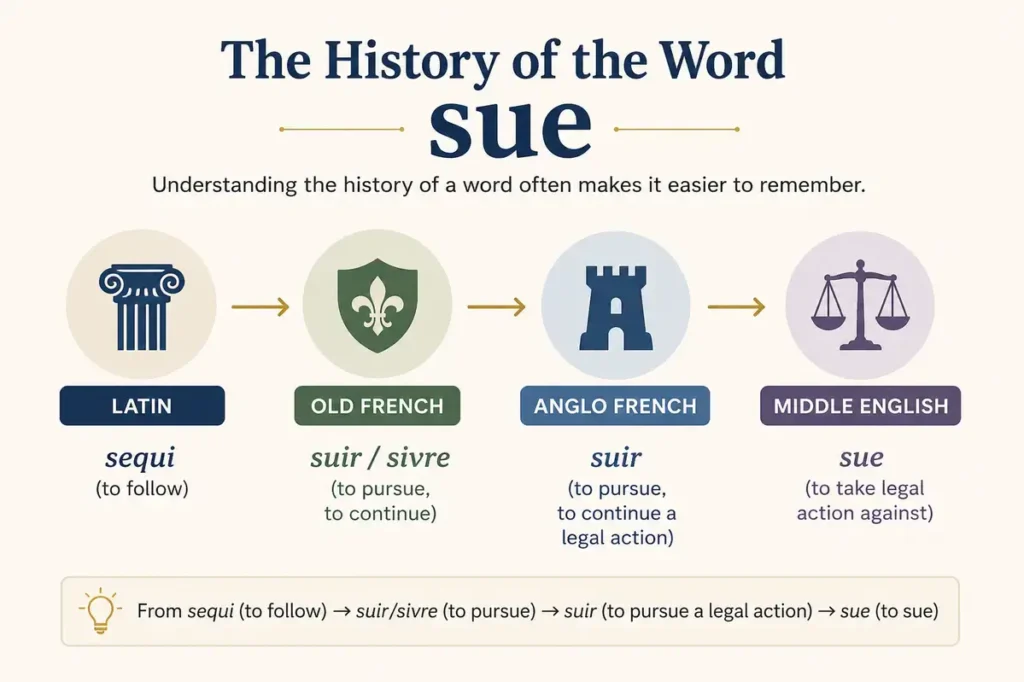
Where the Word Sue Comes From
The verb sue entered English through Anglo French and Old French forms associated with following or pursuing a claim. Over time, its meaning developed into the legal sense of pursuing a case or bringing a claim before a court.
The modern verb is commonly used in legal and everyday contexts. Its history helps explain its meaning, but the spelling of suing follows a modern English spelling rule rather than requiring knowledge of its origin.
Is the Spelling Different in British English
No. The standard spelling is suing in both American and British English.
Some English words have regional spelling differences. For example, American English generally uses color, while British English commonly uses colour. The word suing doesn’t have that kind of regional variation.
You can use the same spelling in American school assignments, British publications, Canadian business writing, and Australian English.
Tips to Remember the Correct Spelling
A simple memory trick can help you avoid this mistake whenever you write about a lawsuit or legal dispute.
Remember the Silent E Rule
Think of the base verb sue. When you add ing, remove the final e first.
- Write sue.
- Remove the final e.
- Add ing.
- Check the result: suing.
Repeat the pattern with familiar verbs such as argue and rescue. These examples reinforce the same spelling rule.
Use a Short Memory Sentence
Remember this sentence: When you sue, you are suing.
The sentence connects the base verb to its correct ing form. It also uses both forms naturally, making the spelling easier to recall.
Check the Middle Letters
The correct word has the letter sequence s u i n g. The incorrect form adds an extra e before the i.
When proofreading, look for that extra letter. If you see sueing, change it to suing.
Practice With Your Own Examples
Writing a few short sentences can make the pattern stick.
- The customer is suing the seller.
- The family is suing for damages.
- They discussed suing the contractor.
- Suing can involve legal costs.
- The company isn’t suing its former partner.
Read each sentence and identify the verb form. This practice helps you recognize suing in different grammatical structures.
Related Grammar and Usage Notes
The spelling of suing is only one part of using the word correctly. You should also know how it fits into a sentence and how it differs from related terms.
Sue vs Sued vs Suing
The forms sue, sued, and suing come from the same verb, but they serve different grammatical roles.
1. Sue. Use the base form after to or with certain helping verbs. For example, They plan to sue the company.
2. Sued. Use the simple past form to describe a completed action. For example, They sued the company last year.
3. Suing. Use the present participle with a form of be or use it as a gerund. For example, They are suing the company.
Choosing the correct form depends on the sentence, not just the spelling rule.
Suing vs Filing a Lawsuit
The expression filing a lawsuit refers to formally starting a legal case by submitting the required documents to a court. The word suing is broader in everyday use and can describe the act of pursuing legal action against another party.
For example, She is suing the manufacturer gives a general description of the legal action. She filed a lawsuit against the manufacturer describes a more specific procedural step.
The expressions are related, but they aren’t always interchangeable in every legal context. Exact procedures depend on the court and the type of claim.
Suing vs Being Sued
These expressions describe different positions in a legal dispute.
1. The business is suing the supplier.
The business is bringing a legal claim against the supplier.
2. The business is being sued by the supplier.
The supplier is bringing a legal claim against the business.
The first sentence uses an active construction. The second uses a passive construction. The spelling of suing stays the same in the active form.
Suing in Formal Writing
The word suing is suitable for formal and informal writing. You can use it in a legal report, a news article, a business email, or an everyday conversation.
However, legal writing sometimes requires more precise terms. A document may refer to a plaintiff, defendant, claim, complaint, or lawsuit, depending on the situation. Use the term that accurately describes the legal process.
Don’t state that someone is guilty or legally responsible just because another person is suing them. A lawsuit represents a claim or dispute, not necessarily a final court decision.
A Quick Editing Checklist
Before publishing or submitting a sentence containing the word, check the following points.
- Confirm that you mean the verb sue.
- Use suing when you need the ing form.
- Remove the final e from the base verb.
- Check that the sentence uses the right tense.
- Keep allegations separate from proven facts when writing about legal disputes.
This checklist works well for schoolwork, business documents, articles, and general correspondence.
Suing vs Sueing in Search and Everyday Writing
People often type both forms into search engines because they want to confirm the spelling before using the word. The extra e can seem logical when someone adds an ending to a word that already ends in e.
However, search behavior doesn’t determine correct spelling. A search query can contain a misspelling and still lead to useful information about the correct form. If you’re editing a document, correct the spelling directly. If you’re writing an article, use the standard form consistently.
The key distinction in suing vs sueing is that one form follows standard spelling conventions and the other does not. You don’t need a complicated grammar explanation to make the right choice. Recognizing the base verb and applying the usual rule is enough.
Key Takeaways
- Suing is the correct spelling in standard English.
- Sueing is a misspelling and shouldn’t be used in formal or informal writing.
- The spelling rule requires you to drop the final silent e before adding ing.
- The word suing can function as a present participle or a gerund.
- The spelling is the same in American and British English.
- Related verbs such as argue, rescue, and pursue follow the same general pattern.
- English has exceptions, so learn the established form of each verb.
- Proofread carefully when writing about lawsuits or other legal matters.
Conclusion
Suing vs sueing has one clear answer. Suing is the correct spelling, and sueing is incorrect in standard English. When you add ing to sue, remove the final silent e first. This gives you the accepted form used in American English and other major varieties of English.
The rule is easy to apply once you recognize the pattern. Words such as arguing, rescuing, and pursuing follow the same general principle. Learning these examples together can help you spell similar verbs correctly and avoid common mistakes in your writing.
Use suing in your emails, essays, articles, and professional documents. If you remember one thing from this guide, remember to drop the final e before adding ing. That small change will help you write the word correctly every time.
Frequently Asked Questions
Is Suing or Sueing Correct?
Suing is correct. The word sueing is a misspelling in standard English because you must remove the final silent e from sue before adding ing.
Why Is Suing Spelled Without an E?
English generally drops the final silent e from a verb before adding ing. Since sue ends in a silent e, the correct form is suing.
Is Sueing Ever Correct in English?
No. Sueing isn’t the standard spelling of this verb in modern English. Use suing in academic, professional, legal, and everyday writing.
What Is the Difference Between Suing and Sueing?
The difference is spelling, not meaning. Suing is the correct form used to describe taking legal action. Sueing is a misspelling of the same intended word.
Is Suing Correct in American English?
Yes. Suing is the standard spelling in American English. It is also the accepted form in British, Canadian, and Australian English.
How Do You Use Suing in a Sentence?
You can write, The customer is suing the company for damages. Here, suing works with is to describe an ongoing legal action.
What Is the Base Form of Suing?
The base form is sue. Its other common forms include sues, sued, and suing. The correct form depends on the tense and structure of the sentence.
Does Suing Have Two Syllables?
Yes. In standard American English, suing is usually pronounced with two syllables. It doesn’t gain an extra syllable from the spelling change.
Is Suing a Verb or a Noun?
Suing is a verb form that can function as a present participle or a gerund. For example, in They are suing the company, it is part of the verb phrase. In Suing can be expensive, it functions as a noun.
How Can I Remember the Difference Between Suing vs Sueing?
Remember the silent e rule. Remove the final e from sue before adding ing. This produces suing, just as argue becomes arguing.

Confusing Words, Spelling & Word Choice
Claire Whitmore is a U.S.-based English editor who writes about commonly confused words, spelling differences, and word choice. Her work helps readers understand subtle distinctions between similar-looking words through simple definitions, practical examples, and modern usage guidance in both American and British English.