
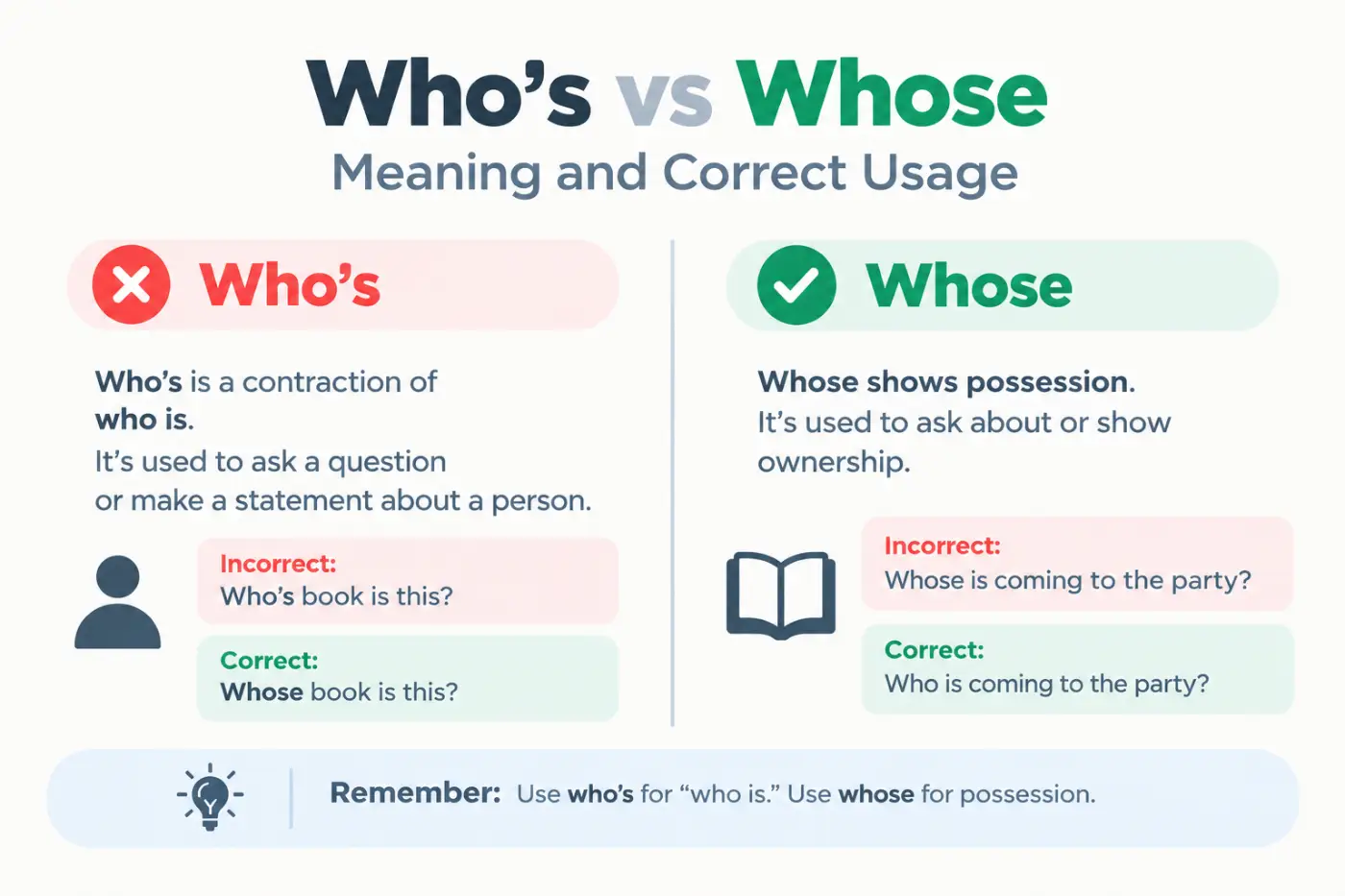
Who’s vs whose is a common source of confusion in English because both words sound exactly alike. However, they serve different grammatical purposes. Who’s stands for who is or who has, while whose shows ownership or a relationship to someone. Learning this simple distinction can help you write clearer sentences and avoid a mistake that often slips past spell checkers.
The easiest way to choose the right word is to look at the meaning of your sentence. If you can replace who’s with who is or who has and the sentence still makes sense, who’s is correct. If you’re asking who owns something or identifying the person connected to something, use whose. This quick test works in everyday conversations, school assignments, emails, reports, and professional writing.
Both words are standard in American English and British English. Neither is more formal or more correct than the other. The difference comes down to grammar and meaning, not geography or writing style. Once you understand how each word works, you’ll be able to choose the correct form without second guessing yourself.
Short Answer
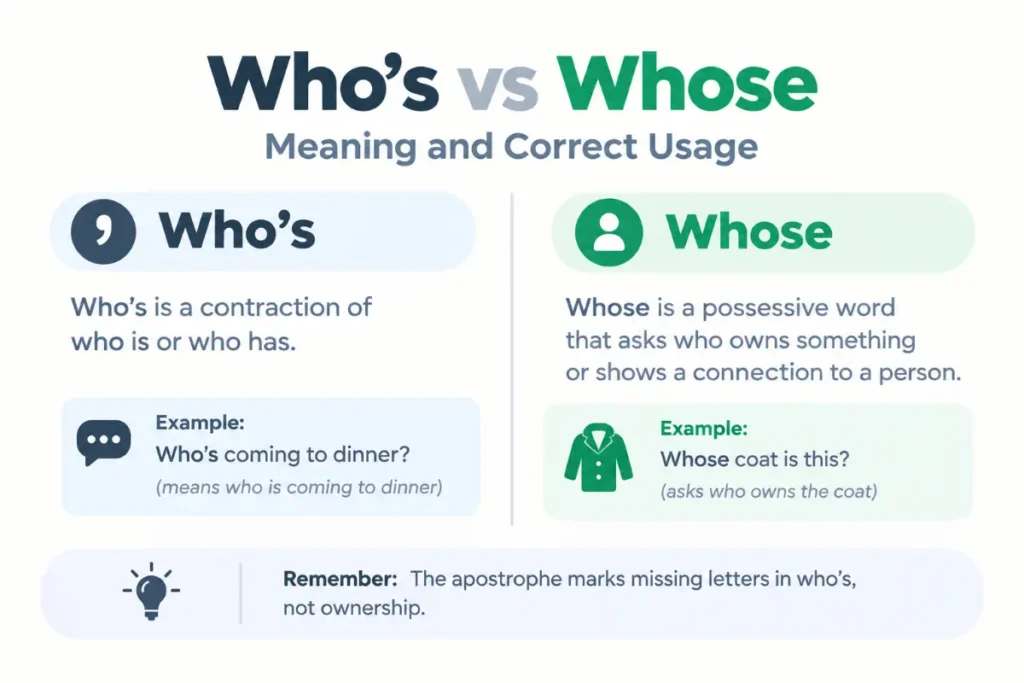
Who’s is a contraction of who is or who has. Whose is a possessive word that asks who owns something or shows a connection to a person. For example, who’s coming to dinner means who is coming to dinner. Whose coat is this asks who owns the coat. The apostrophe marks missing letters in who’s, not ownership.
Table of Contents
- What Who’s Means.
- What Whose Means.
- The Main Difference Between the Two Words.
- How to Use Who’s Correctly.
- How to Use Whose Correctly.
- The Replacement Test.
- Examples in Everyday English.
- Common Mistakes to Avoid.
- Who’s and Whose in Questions.
- Pronunciation and Word Origins.
- Related Grammar Rules.
- Memory Tricks for Choosing the Right Word.
- Frequently Asked Questions.
- Key Takeaways.
- Conclusion.
What Who’s Means
Who’s is a contraction of two words: who is or who has. A contraction combines words and replaces one or more letters with an apostrophe. In this case, the apostrophe marks the letters removed when the full phrase becomes shorter.
For example, who’s calling can be expanded to who is calling. Similarly, who’s finished can mean who has finished. The sentence tells you which full form the contraction represents.
Who’s is common in spoken English and informal writing. It’s also acceptable in many forms of professional writing when the tone allows contractions. In formal academic writing, some style guides or instructors may prefer the full forms who is and who has. That preference doesn’t make the contraction grammatically incorrect.
Who’s as a Contraction of Who Is
Use who’s when you mean who is. The contraction can appear before a noun, an adjective, a verb ending in ing, or another expression that follows the verb is.
Consider these examples.
- Who’s at the door? This means who is at the door and asks about the person standing outside.
- Who’s responsible for this report? This means who is responsible for the report and asks someone to identify the person in charge.
- Who’s waiting for us? This means who is waiting for us and asks which people are waiting.
- Who’s your new teacher? This means who is your new teacher and asks for the teacher’s identity.
- Who’s ready to leave? This means who is ready to leave and asks which people are prepared to go.
In each sentence, who’s works because you can replace it with who is without changing the basic meaning.
Who’s as a Contraction of Who Has
Who’s can also mean who has. This form often appears with a past participle, such as finished, arrived, seen, or completed. The exact meaning depends on the sentence.
Here are some examples.
- Who’s finished the assignment? This means who has finished the assignment and asks which person completed it.
- Who’s seen my keys? This means who has seen my keys and asks if anyone knows where they are.
- Who’s already left? This means who has already left and asks which person departed.
- Who’s taken my seat? This means who has taken my seat and asks who occupied the seat.
- Who’s been to New York? This means who has been to New York and asks which people have visited the city.
Notice that who’s doesn’t always mean who is. In these examples, the contraction represents who has. Recognizing the verb that follows it helps you identify the intended meaning.
How to Identify the Correct Meaning of Who’s
Look at the words that follow who’s and read the sentence as a complete thought. If the expanded sentence uses is, the contraction expresses a state, identity, action in progress, or description. If the expanded sentence uses has, it often describes an experience or an action connected to the present.
For example, who’s working means who is working. The phrase describes an action in progress. Who’s completed the work means who has completed the work. The phrase refers to a completed action.
Context can help when both expansions seem possible. The surrounding sentence or conversation usually makes the intended meaning clear. You don’t need to memorize a separate rule for every example. You only need to understand the two phrases that who’s can replace.
What Whose Means
Whose is a possessive word used to ask who owns something or to show that something belongs to or is associated with a person. It can function as a possessive interrogative determiner in questions or as a possessive relative determiner in sentences that provide more information about someone or something.
Unlike who’s, whose doesn’t stand for two words. It doesn’t need an apostrophe because it already has a possessive meaning. Think of it as a word that connects a person to something they own, use, create, experience, or have a connection with.
For example, whose phone is this asks who owns the phone. The question isn’t asking who is using the phone at that moment. It’s asking which person the phone belongs to.
Whose in Direct Questions
Use whose when you want to identify the owner of something. It usually appears before a noun, such as book, car, bag, idea, or responsibility.
Here are some clear examples.
- Whose jacket is on the chair? The speaker wants to know who owns the jacket.
- Whose car is parked outside? The speaker asks which person owns the car.
- Whose turn is it? The question asks which person should act next.
- Whose keys are these? The speaker wants to identify the owner of the keys.
- Whose idea was that? The speaker asks who came up with the idea.
In each example, whose introduces a question about ownership or association. The noun after whose helps identify the thing being discussed.
Whose in Indirect Questions
Whose also works in indirect questions. These sentences contain a question within a larger statement or question. They don’t always use the word order of a direct question.
Consider these examples.
- I don’t know whose bag this is. The speaker doesn’t know who owns the bag.
- Can you tell me whose phone is ringing? The speaker asks someone to identify the owner of the ringing phone.
- She asked whose car was blocking the driveway. The sentence reports a question about the car’s owner.
- We need to find out whose signature is missing. The sentence explains that someone must identify the person whose signature hasn’t been provided.
- Do you remember whose birthday it is today? The speaker asks if someone remembers which person has a birthday today.
Notice that indirect questions don’t always place the verb before the subject. For example, you say, Can you tell me whose phone is ringing? You don’t need to rearrange the words into a separate direct question inside the sentence.
Whose in Relative Clauses
Whose can also connect a person or thing to a noun in a longer sentence. In this role, it introduces information about someone or something already mentioned.
For example, consider this sentence.
The student whose laptop broke borrowed mine.
The word whose connects the student to the laptop. It tells us which student borrowed the laptop and explains the relationship between that student and the broken device.
Here are more examples.
- I met a writer whose books are popular with young readers. Whose connects the writer to the books the writer wrote.
- She hired a designer whose work impressed the entire team. Whose identifies the designer through the designer’s work.
- We visited a family whose house overlooks the lake. Whose connects the family to the house.
- He spoke to a teacher whose advice helped him improve. Whose connects the teacher to the advice.
- They adopted a dog whose owner could no longer care for it. Whose identifies the owner through the relationship with the dog.
In these sentences, whose doesn’t introduce a direct question. It provides identifying information inside a larger sentence.
Can Whose Refer to Things
Yes. Whose can refer to people, animals, organizations, and things. Some writers assume that it must refer only to a person, but standard English also uses whose to show a relationship involving an object, company, country, or other nonhuman subject.
For example, consider this sentence.
The company whose products we use has opened a new office.
The company is the subject, and whose connects it to its products. The sentence is grammatically correct because whose can express a relationship beyond personal ownership.
Other examples include the following.
- We visited a town whose streets were lined with trees. Whose connects the town to its streets.
- Scientists studied a plant whose leaves change color. Whose identifies the leaves as belonging to the plant.
- She bought a laptop whose battery lasts all day. Whose connects the laptop to its battery.
- The museum whose collection attracted thousands of visitors received a grant. Whose links the museum to its collection.
- They repaired a bridge whose supports had weakened. Whose connects the bridge to its supports.
When you need to show a clear relationship between a noun and something associated with it, whose is often the most natural choice.
The Main Difference Between the Two Words
The main distinction is simple. Who’s is a contraction of who is or who has. Whose expresses possession or association.
The words sound alike, so pronunciation won’t help you choose. You need to examine the meaning and structure of the sentence.
| Feature | Who’s | Whose |
|---|---|---|
| Meaning | Who is or who has | Belonging or related to whom |
| Grammatical role | Contraction | Possessive word |
| Apostrophe | Required | Not used |
| Typical use | Asking about identity or action | Asking about ownership or showing a relationship |
| Example | Who’s coming tonight? | Whose coat is this? |
| Quick test | Replace with who is or who has | Check for ownership or association |
Why the Apostrophe Matters
An apostrophe often marks missing letters in a contraction. In who’s, the apostrophe signals that who is or who has has been shortened.
However, an apostrophe doesn’t always indicate possession. In English, apostrophes also appear in contractions such as it’s, they’re, and she’s. The role of the apostrophe depends on the word.
Whose already expresses a possessive relationship, so it doesn’t need an apostrophe. Adding one changes the word into who’s, which has a different grammatical function.
Compare these sentences.
- Who’s calling me? The sentence asks who is calling.
- Whose phone is calling? The sentence asks who owns the phone that is ringing.
The first sentence asks about a person’s identity. The second asks about ownership. The apostrophe helps distinguish the written forms, but the meaning of the sentence determines the correct choice.
Who’s and Whose Are Homophones
Who’s and whose are homophones. Homophones are words that sound alike but have different meanings or spellings. Other familiar examples include their and there, to and too, and brake and break.
Because who’s and whose have the same pronunciation, listeners generally rely on context to understand them. Writers, however, must select the correct spelling.
For example, if someone says a sentence aloud that sounds like whose coming, the listener may understand the intended meaning from the conversation. In writing, the correct form is who’s coming because the full sentence means who is coming.
If the sentence asks about ownership, as in whose coat is missing, the possessive form is necessary.
This distinction matters in emails, essays, captions, reports, text messages, and website content. A spell checker may accept both spellings because both are legitimate English words. It may not recognize that one doesn’t fit the sentence.
How to Use Who’s Correctly
Use who’s when the sentence means who is or who has. This rule applies to questions, statements, and other sentence structures.
Use Who’s to Ask About Identity
Who’s can introduce a question about a person’s identity or role.
For example, Who’s your manager? means who is your manager. The speaker wants to identify the person who manages the team.
You can use the same pattern in different situations.
- Who’s your favorite author? The question asks which author you like most.
- Who’s in charge of the event? The speaker wants to identify the person responsible for the event.
- Who’s that person by the window? The speaker asks for someone’s identity.
- Who’s the new student? The question asks which person has recently joined the class.
- Who’s available to help? The speaker asks which people can provide assistance.
These examples show that who’s can introduce questions about people, roles, and availability.
Use Who’s to Describe a Current Action
Who’s also works before a verb ending in ing when the full sentence means who is performing an action.
For example, Who’s driving tonight? means who is driving tonight. The question asks which person will drive.
More examples include the following.
- Who’s speaking at the conference? The speaker wants to know which person will give a presentation.
- Who’s knocking at the door? The sentence asks who is making the knocking sound.
- Who’s bringing dessert? The speaker asks which person is responsible for bringing dessert.
- Who’s using my computer? The question asks who is currently using the computer.
- Who’s waiting in the lobby? The speaker wants to identify the people waiting there.
In everyday English, this construction is natural and widely used. It can describe an action happening now or a planned action in the near future.
Use Who’s With Adjectives
When who’s means who is, it can appear before an adjective that describes a person.
For example, Who’s ready? means who is ready. The adjective ready describes the person’s state.
Other examples make the pattern clear.
- Who’s hungry? The speaker asks which people want food.
- Who’s absent today? The question asks which person isn’t present.
- Who’s responsible for the mistake? The speaker wants to identify the person responsible.
- Who’s available this afternoon? The question asks who has time free.
- Who’s happy with the result? The speaker asks which people are satisfied.
You can also use who’s in statements such as I know who’s responsible. In this sentence, who’s still means who is, even though the sentence isn’t a direct question.
Use Who’s With Past Participles
Who’s can mean who has when it appears in a present perfect construction. This often involves a past participle, such as finished, arrived, written, or forgotten.
For example, Who’s finished the test? means who has finished the test. The question asks which person completed it.
Here are additional examples.
- Who’s written this note? The speaker asks who has written the note.
- Who’s forgotten their password? The question asks which person has forgotten the password.
- Who’s arrived early? The speaker asks which person has arrived before the expected time.
- Who’s eaten the last cookie? The question asks who has eaten it.
- Who’s completed the training? The speaker wants to identify the people who have completed the training.
The past participle often signals that who’s represents who has. However, you should still read the entire sentence to confirm the meaning.
When Who’s Doesn’t Fit
Who’s isn’t a possessive form. Don’t use it before a noun when you want to identify an owner.
Incorrect: Who’s backpack is on the floor?
Correct: Whose backpack is on the floor?
The correct version asks who owns the backpack. You can’t replace who’s with who is or who has and preserve the intended meaning.
Another common mistake occurs when a writer sees an apostrophe and assumes it must show ownership. English doesn’t follow that pattern for this word. The apostrophe in who’s marks a contraction, not possession.
How to Use Whose Correctly
Use whose to ask about ownership or to connect a person or thing with something related to them. It can appear in direct questions, indirect questions, and relative clauses.
Use Whose Before a Noun
Whose often appears immediately before a noun. The noun identifies the thing whose owner or connection you want to establish.
For example, Whose notebook is this? asks who owns the notebook.
This pattern works with many nouns.
- Whose shoes are by the door? The speaker wants to identify the owner of the shoes.
- Whose desk is this? The question asks which person uses or owns the desk.
- Whose opinion matters most? The speaker asks whose opinion carries the most weight.
- Whose responsibility is it? The question asks which person is responsible.
- Whose name is on the list? The speaker asks which person’s name appears on the list.
Notice that ownership doesn’t always mean legal ownership. Whose can also express responsibility, authorship, association, or a personal connection.
For example, Whose turn is next? asks who should act next. Nobody owns a turn in the same way they own a car, but the word whose still expresses a relationship between a person and a turn.
Use Whose to Show Relationships
Whose is useful when you need to identify someone through a family member, possession, characteristic, or other connection.
Consider this sentence.
I spoke to a woman whose son attends my school.
The word whose connects the woman to her son. It helps identify the woman by describing her family relationship.
Here are more examples.
- We met a musician whose songs appear on the radio. Whose connects the musician to the songs.
- She thanked the nurse whose care helped her recover. Whose identifies the nurse through the care provided.
- I know a student whose parents teach at the university. Whose connects the student to the student’s parents.
- They hired an engineer whose designs saved time. Whose connects the engineer to the designs.
- He adopted a cat whose playful behavior made everyone laugh. Whose connects the cat to its behavior.
These sentences sound natural because whose provides a direct connection between the main noun and the information that follows.
Use Whose in Formal and Professional Writing
Whose works in academic essays, business reports, journalism, legal writing, and everyday communication. It isn’t limited to casual questions.
For example, a business report might say, The department whose budget increased will hire two additional employees. The word whose links the department to its budget.
An academic paper might include a sentence such as, Researchers whose studies focus on language development often examine how children learn words. Here, whose identifies a group of researchers through their area of study.
In formal writing, whose is often clearer and shorter than a longer phrase such as of which the department or belonging to the researchers. Still, the sentence must make the relationship clear.
When Whose Doesn’t Fit
Whose can’t replace who’s when the intended meaning is who is or who has.
Incorrect: Whose going to lead the meeting?
Correct: Who’s going to lead the meeting?
The correct sentence means who is going to lead the meeting. It asks which person will take charge.
Another example is Whose been using my laptop? The intended meaning is who has been using my laptop, so who’s is correct.
The best way to avoid these mistakes is to identify the full meaning before choosing the spelling.
The Replacement Test
The replacement test is one of the quickest ways to choose the correct word. It works because who’s has two specific expansions, while whose expresses possession or association.
Step One to Replace Who’s With Who Is
Read the sentence and replace who’s with who is. If the sentence still makes sense, who’s may be correct.
For example, Who’s at the window? becomes Who is at the window? The sentence remains grammatical and keeps its meaning.
Try these examples.
- Who’s calling? becomes Who is calling? The replacement works, so who’s is correct.
- Who’s your supervisor? becomes Who is your supervisor? The replacement works, so who’s is correct.
- Who’s ready for lunch? becomes Who is ready for lunch? The replacement works, so who’s is correct.
If the expanded sentence sounds wrong or changes the intended meaning, try the second expansion.
Step Two to Replace Who’s With Who Has
Replace who’s with who has when the sentence describes a completed action or an experience.
For example, Who’s taken my pen? becomes Who has taken my pen? The sentence remains grammatical, so who’s is correct.
Try these examples.
- Who’s finished the project? becomes Who has finished the project? The replacement works, so who’s is correct.
- Who’s seen this movie? becomes Who has seen this movie? The replacement works, so who’s is correct.
- Who’s broken the window? becomes Who has broken the window? The replacement works, so who’s is correct.
Remember that who has can also express possession in other contexts, but the contraction who’s still follows the same grammatical rule.
Step Three to Check for Ownership or Association
If neither replacement fits, ask yourself if the sentence identifies an owner or shows a relationship. If it does, whose is probably the correct choice.
For example, Whose shoes are these? asks who owns the shoes. Neither who is shoes nor who has shoes expresses the same question in the intended form.
Consider these examples.
- Whose book did you borrow? The question asks who owns the book.
- Whose team won the match? The question asks which team’s players won.
- Whose idea changed the plan? The sentence asks who proposed the idea.
The test is especially useful when you’re editing quickly. It focuses on meaning rather than appearance.
Practice the Replacement Test
Read each sentence and decide which word belongs in the blank.
- _____ coming to the party tonight?
- _____ jacket did you leave in the car?
- Do you know _____ completed the assignment?
- _____ keys are on the kitchen counter?
- _____ been to this restaurant before?
The correct answers are as follows.
- Who’s coming to the party tonight? The full phrase is who is coming.
- Whose jacket did you leave in the car? The question asks about the jacket’s owner.
- Do you know who’s completed the assignment? The full phrase is who has completed.
- Whose keys are on the kitchen counter? The question asks who owns the keys.
- Who’s been to this restaurant before? The full phrase is who has been.
These examples cover both forms of the contraction and the possessive use of whose. Practicing them helps make the distinction automatic.
Examples in Everyday English
The difference becomes easier to remember when you see the two words in realistic situations. The examples below show how each form works in conversation, school, work, and online communication.
In Everyday Conversation
- Who’s picking us up after dinner? This means who is picking us up and asks which person will drive.
- Whose umbrella is leaning against the wall? This asks who owns the umbrella.
- Who’s got my coffee? This informal sentence means who has my coffee and asks who has it.
- Whose idea was it to order pizza? This asks who suggested ordering pizza.
- Who’s staying for the weekend? This means who is staying and asks which people will remain.
These examples reflect natural spoken English. Contractions are especially common in conversation because they make speech sound relaxed and direct.
In School and Academic Writing
- Who’s presenting the research tomorrow? This asks who is presenting the research.
- Whose essay received the highest grade? This asks which student’s essay received the highest grade.
- The student whose answer was correct received extra credit. Whose connects the student to the answer.
- Who’s completed the reading assignment? This asks who has finished reading.
- I know who’s responsible for the final section. This means I know who is responsible for that section.
Both words are suitable for schoolwork. The choice depends on grammar, while the decision to use contractions in formal assignments depends on the instructor’s or publication’s style requirements.
In Workplace Communication
- Who’s leading the client presentation? This asks who is leading the presentation.
- Whose approval do we need before sending the contract? This asks which person’s approval is required.
- The manager whose team exceeded its target received recognition. Whose links the manager to the team.
- Who’s reviewed the latest draft? This asks who has reviewed it.
- Do you know whose meeting room this is? This asks which person or team uses the room.
In professional writing, these forms can prevent confusion about roles, responsibility, and ownership. A short grammar check can make a message easier to understand.
In Emails and Text Messages
- Who’s joining the call? This asks who is joining.
- Whose email address should I use? This asks for the correct person’s email address.
- Who’s sent the updated file? This asks who has sent it.
- Whose turn is it to reply to the customer? This asks which person should respond.
- Who’s available for a quick meeting? This asks who is free.
Contractions are common in emails and messages, especially when the tone is friendly. In a very formal letter or report, you can write who is or who has instead.
In Social Media and Online Content
- Who’s watching the game tonight? This asks who is watching.
- Whose recipe did you try? This asks who created or shared the recipe.
- Who’s posted the new video? This asks who has posted it.
- Whose comment started the discussion? This asks which person wrote the comment.
- Who’s ready for the weekend? This asks who is ready.
Online writing often moves quickly, which makes homophone errors easy to miss. Don’t rely only on spell check. Read the sentence and confirm that the word matches the meaning.
Common Mistakes to Avoid
Even experienced writers sometimes confuse these words because they sound alike. The following mistakes show how to spot the problem and correct it.
Using Who’s to Show Ownership
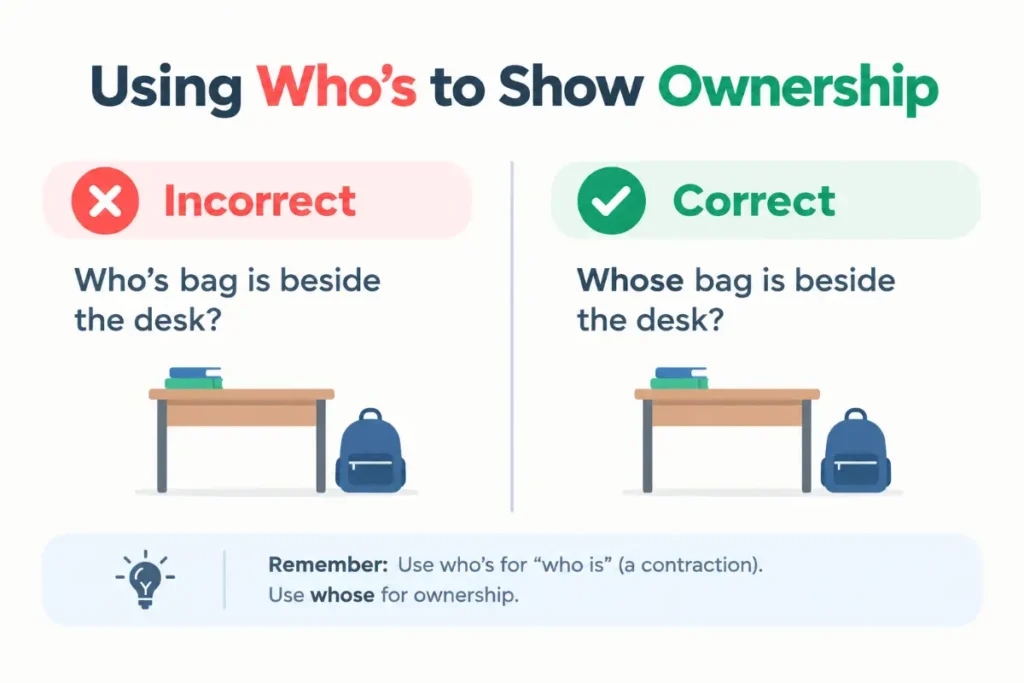
Incorrect: Who’s bag is beside the desk?
Correct: Whose bag is beside the desk?
The sentence asks who owns the bag. It doesn’t mean who is bag or who has bag in the intended grammatical structure. Use whose to show possession.
Using Whose for Who Is
Incorrect: Whose coming to dinner?
Correct: Who’s coming to dinner?
The sentence means who is coming to dinner. Since who’s can replace who is, the contraction is correct.
Using Whose for Who Has
Incorrect: Whose finished the report?
Correct: Who’s finished the report?
The intended meaning is who has finished the report. The contraction represents who has, so the apostrophe is necessary.
Adding an Apostrophe to Whose
Incorrect: Whose’s phone is ringing?
Correct: Whose phone is ringing?
Whose already expresses possession. Adding an apostrophe and an s creates an incorrect form for this meaning.
Trusting Spell Check Without Checking Meaning
A spelling checker may accept both who’s and whose because both are standard English words. It may not flag a sentence that uses the wrong one.
For example, a checker might accept Who’s book is this? even though whose is required to ask about ownership. Always review the meaning of the sentence instead of relying entirely on automated corrections.
Confusing Possession With Contractions
English uses apostrophes in several ways, so it’s easy to assume that every apostrophe marks ownership. In who’s, the apostrophe represents missing letters. In whose, the possessive meaning is already part of the word.
Compare these examples.
- Who’s responsible? The phrase means who is responsible.
- Whose responsibility is this? The phrase asks which person’s responsibility it is.
The difference becomes clear when you expand the contraction or identify the possessive relationship.
Who’s and Whose in Questions
Questions are one of the most common places to encounter these words. The type of information you’re asking for usually tells you which spelling to use.
Questions About Identity
Use who’s when you want to identify a person or ask what role someone has.
For example, Who’s your doctor? means who is your doctor. The speaker wants to know the doctor’s identity.
Other examples include Who’s the winner? and Who’s speaking next? Both questions use who’s because they mean who is.
Questions About Ownership
Use whose when you want to know who owns something or who is connected to it.
For example, Whose phone is on the table? asks which person owns the phone.
You can also ask Whose name appears on the document? or Whose idea are we discussing? Both sentences use whose to identify a connection.
Questions Inside Other Sentences
Indirect questions follow the same basic distinction.
Consider these examples.
- I wonder who’s at the door. This means I wonder who is at the door.
- I wonder whose shoes these are. This asks who owns the shoes.
- Can you tell me who’s responsible? This means can you tell me who is responsible.
- Can you tell me whose responsibility this is? This asks which person is responsible.
The sentence structure changes, but the meanings of the two words stay the same.
Pronunciation and Word Origins
Who’s and whose are pronounced alike in standard American English. Both are generally pronounced /huːz/, with the same vowel sound found in who and a final z sound.
Because they sound the same, pronunciation alone cannot tell you which spelling to use. You must rely on context and grammar.
Why the Words Sound the Same
Who’s developed as a contraction of who is or who has. Whose is the possessive form associated with who. Over time, their pronunciations became identical in modern English, even though their spellings and grammatical functions remained different.
This is a common feature of English. Words can share a pronunciation while retaining distinct meanings and grammatical roles.
Is the Difference American or British English
No. The grammatical distinction is the same in American and British English. Both varieties use who’s for who is or who has and whose for possession or association.
Spelling preferences can vary between American and British English for some words, but this isn’t one of those cases. You don’t need a regional rule to choose the correct form.
Related Grammar Rules
Understanding a few related words can help you avoid other common mistakes.
Who’s Versus Whose and Its Versus It’s
The distinction between these pairs follows a similar pattern.
It’s is a contraction of it is or it has. Its is the possessive form of it.
For example, It’s raining means it is raining. The phrase Its color is blue shows possession.
Likewise, who’s means who is or who has, while whose shows possession or association. In both pairs, the apostrophe marks a contraction rather than the possessive form.
Who’s Versus Whose and They’re Versus Their
They’re is a contraction of they are. Their is a possessive determiner that shows a connection to a group of people or things.
For example, They’re ready means they are ready. Their bags are outside shows that the bags belong to or are associated with them.
The same replacement test helps with who’s and whose. Expand the contraction when possible. If you need to show possession, choose the possessive form.
Who’s Versus Whose and You’re Versus Your
You’re means you are. Your shows possession or association.
For example, You’re early means you are early. Your seat is available shows which seat belongs to or is assigned to you.
Similarly, who’s can be expanded to who is or who has, while whose identifies a relationship or owner.
Who’s Versus Whose and Who
Who is a pronoun used to refer to a person or ask about someone’s identity. Whose is its possessive form.
For example, Who called you? asks about the person who made the call. Whose phone did you use? asks who owns the phone.
Who’s is different because it combines who with is or has. Keeping these grammatical roles separate makes it easier to write accurate sentences.
Memory Tricks for Choosing the Right Word
A good memory trick gives you a quick answer without forcing you to memorize a long grammar explanation.
Remember That the Apostrophe Means Missing Letters
Think of who’s as a shortened phrase. The apostrophe signals that letters have been left out.
- Who’s ready? Expand it to who is ready.
- Who’s finished? Expand it to who has finished.
- Who’s calling? Expand it to who is calling.
If the expanded sentence makes sense, who’s is the right choice.
Connect Whose With Ownership
Whose doesn’t need an apostrophe because its possessive meaning is already built into the word.
Think of questions such as Whose book? Whose car? Whose idea? Each asks about an owner or connection.
You can also remember that whose works in sentences such as the writer whose book I read. In this case, it links the writer to the book.
Ask Yourself One Simple Question
Before choosing a spelling, ask what your sentence means.
If you mean who is or who has, write who’s. If you mean belonging to whom or connected to whom, write whose.
This method works in nearly every ordinary use of the two words. It also helps you catch errors that a spell checker may overlook.
Key Takeaways
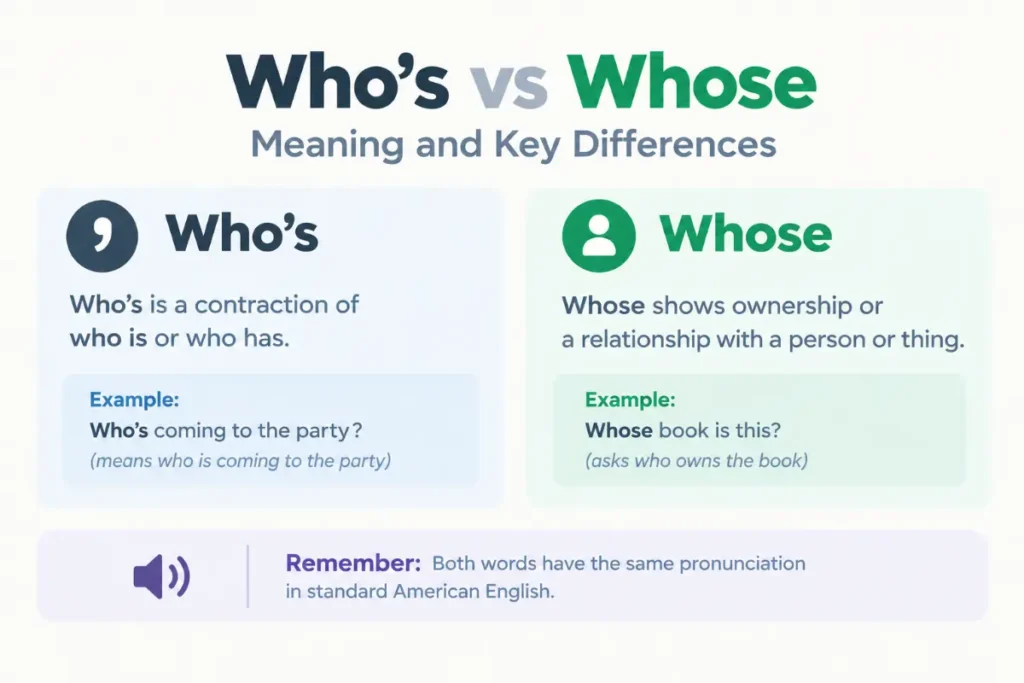
- Who’s is a contraction of who is or who has.
- Whose shows ownership or a relationship with a person or thing.
- Both words have the same pronunciation in standard American English.
- The apostrophe in who’s marks missing letters, not possession.
- Whose can appear in direct questions, indirect questions, and relative clauses.
- Both forms are used in American and British English.
- Replace who’s with who is or who has to test the sentence.
- Use whose when the sentence asks who owns something or identifies a connection.
- Don’t rely entirely on spell check because it may accept the wrong word in context.
- The meaning of the sentence determines the correct spelling.
Conclusion
Who’s vs whose becomes easy to understand once you focus on meaning instead of pronunciation. Who’s is a contraction of who is or who has, while whose expresses ownership or association. The two words sound alike, but they perform different grammatical jobs.
When you’re unsure which form to use, expand who’s into its full phrase. If who is or who has fits the sentence, use who’s. If you’re asking who owns something or connecting a person or thing to a related noun, use whose. This simple test works in everyday conversation, school assignments, professional emails, and formal writing.
The key is to understand what your sentence says before choosing the spelling. You don’t need to memorize dozens of separate rules. Learn the difference between contractions and possessive words, practice with real examples, and check your writing for meaning as well as spelling. With a little practice, you’ll choose the correct form naturally.
Frequently Asked Questions
Is who’s or whose correct?
Both are correct English words, but they have different meanings. Who’s means who is or who has. Whose expresses ownership or association. The correct choice depends on the sentence.
What is the difference between who’s vs whose?
Who’s is a contraction of who is or who has, while whose is a possessive word. For example, who’s calling means who is calling, while whose phone is this asks about ownership.
Does who’s mean who is or who has?
Who’s can mean either who is or who has. In Who’s waiting? it means who is waiting. In Who’s finished? it usually means who has finished.
Why doesn’t whose have an apostrophe?
Whose doesn’t have an apostrophe because it already functions as a possessive word. The apostrophe in who’s marks missing letters in the contraction of who is or who has.
Can whose refer to things instead of people?
Yes. Whose can refer to people, animals, organizations, and things. For example, The house whose roof was damaged needs repairs uses whose to connect the house with its roof.
Are who’s and whose pronounced the same?
Yes. In standard American English, both are pronounced /huːz/. Since they sound alike, you must use the sentence’s meaning to choose the correct spelling.
Is whose only used in questions?
No. Whose also appears in relative clauses that provide information about a person or thing. For example, The teacher whose class I joined was helpful uses whose to connect the teacher with the class.
Is who’s acceptable in formal writing?
Yes. Who’s is grammatically correct in formal writing, although some style guides and academic settings prefer avoiding contractions. Whose is also appropriate in formal and informal writing when the sentence requires it.
How do I remember the difference between who’s and whose?
Replace who’s with who is or who has. If the sentence makes sense, the contraction is correct. If you’re asking who owns something or showing a relationship, use whose.
Can I use whose for a company or organization?
Yes. Whose can show a relationship involving an organization. For example, The company whose sales increased hired more staff uses whose to connect the company with its sales.
Why does my spell checker accept both words?
Both forms are legitimate English words, so a spell checker may not recognize a grammatical mistake based on context. Read the sentence and check its meaning before deciding which form to use.

Confusing Words, Spelling & Word Choice
Claire Whitmore is a U.S.-based English editor who writes about commonly confused words, spelling differences, and word choice. Her work helps readers understand subtle distinctions between similar-looking words through simple definitions, practical examples, and modern usage guidance in both American and British English.