
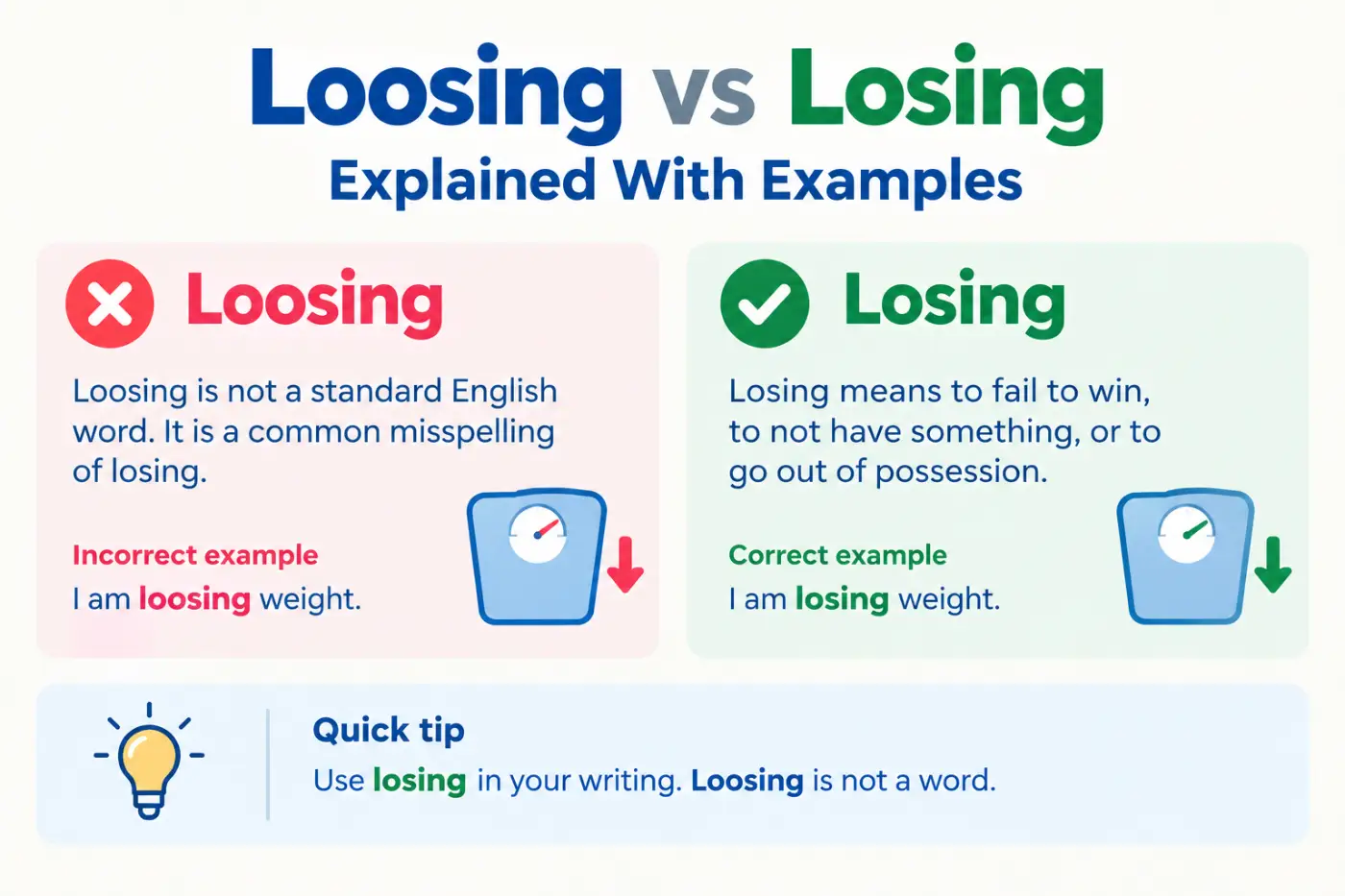
Loosing vs losing is a common spelling confusion because both words look and sound similar. However, they have different meanings, and using the wrong one can change the message of your sentence. If you cannot find your keys, you are losing them. If you release an arrow from a bow, you are loosing it.
The confusion often comes from the verb lose and its present participle losing. Many writers mistakenly add an extra o because they associate the word with loose, which means not tight or firmly attached. The spelling difference may seem small, but it matters when you want your writing to be clear and correct.
The easiest way to remember the distinction is to connect each word with its meaning. Losing usually describes something you no longer have, a defeat, or a decline. Loosing describes the act of releasing something or setting it free. Once you understand the base words and their meanings, choosing the correct spelling becomes much easier.
Short Answer
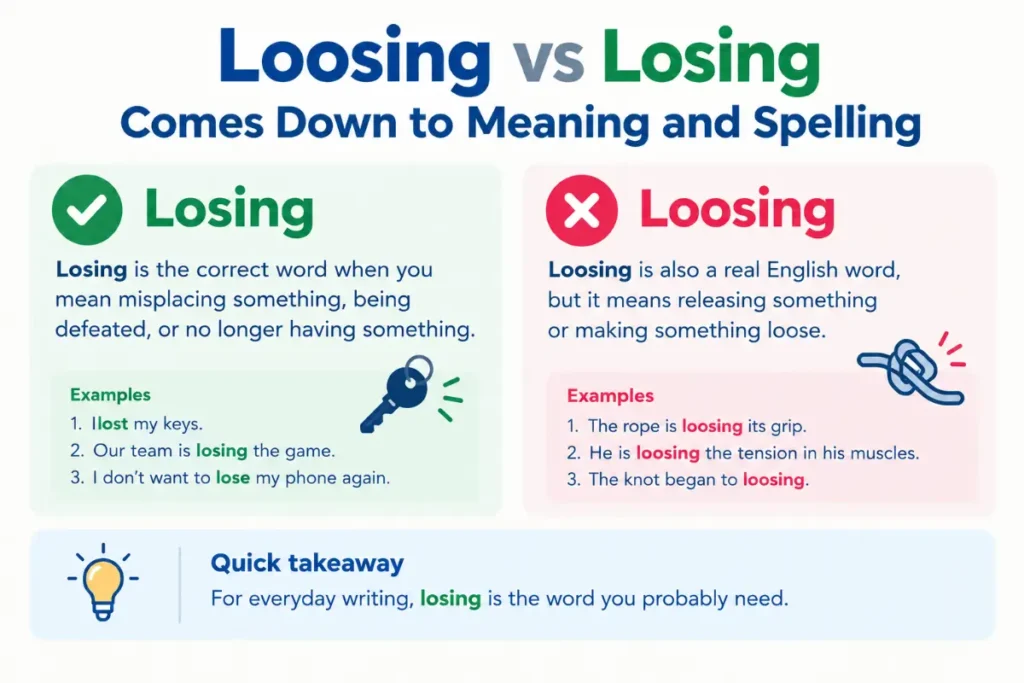
Loosing vs losing comes down to meaning and spelling. Losing is the correct word when you mean misplacing something, being defeated, or no longer having something. Loosing is also a real English word, but it means releasing something or making something loose. For everyday writing, losing is the word you probably need.
Table of Contents
- The Difference Between Loosing and Losing
- What Losing Means
- What Loosing Means
- Why People Confuse These Words
- Comparison Table
- Grammar Rules for Losing and Loosing
- Real Life Examples
- Common Spelling Mistakes
- Memory Tricks
- Similar Words That Cause Confusion
- Professional Writing Tips
- Frequently Asked Questions
- Key Takeaways
- Conclusion
The Difference Between Loosing and Losing
The main difference is that losing means failing to keep or obtain something, while loosing means releasing something or making it free from restraint. Losing is common in everyday English. Loosing is much less common and usually appears in specific contexts.
Consider these examples.
- She is losing her patience. This means her patience is gradually running out.
- The archer is loosing an arrow. This means the archer is releasing the arrow from the bow.
- Our team is losing the game. This means the team is behind or being defeated.
- He is loosing the rope. This means he is releasing or loosening the rope, depending on the intended action.
The words come from different base verbs. Losing comes from lose, while loosing comes from loose. That difference in their roots explains why their meanings are not interchangeable.
When you write about defeat, loss, failure to keep something, or a decline, choose losing. When you describe releasing, freeing, or unfastening something, loosing may be appropriate. In many everyday situations involving making something less tight, the more natural word is loosening rather than loosing.
What Losing Means
Losing is the present participle of the verb lose. It can describe the process of no longer having something, failing to win, missing an opportunity, or experiencing a reduction.
The word appears frequently in everyday conversation, academic writing, business communication, sports reporting, and professional documents. It can describe physical objects, personal relationships, emotions, money, time, or abstract qualities.
Losing Something You Had
Use losing when you are misplacing something or no longer have control over it.
Examples.
- I keep losing my glasses. This means I repeatedly misplace my glasses and cannot find them.
- She is losing her phone signal. This means the signal is becoming weaker or disappearing.
- He is losing control of the situation. This means he is finding it harder to manage what is happening.
In these sentences, losing describes something disappearing, becoming unavailable, or slipping out of someone’s control.
Losing a Game or Competition
Losing also means being defeated in a contest, match, election, or competition.
Examples.
- Our team is losing by two points. This means the opposing team has scored two more points.
- She hates losing at chess. This means she dislikes being defeated in chess games.
- The candidate is losing support among voters. This means fewer voters are supporting the candidate.
This meaning is especially common in sports, politics, and discussions about competition. The word can describe a current situation or a general experience.
Losing Weight or Money
The word can describe a reduction in amount, size, value, or quantity.
Examples.
- He is losing weight through regular exercise. This means his body weight is decreasing.
- The company is losing money this quarter. This means its expenses or financial losses are exceeding its earnings.
- The old car is losing value. This means the car is becoming worth less money.
These examples show that losing does not always mean misplacing something. It can also describe a measurable decline.
Losing an Opportunity
Use losing when someone misses a chance or fails to maintain an advantage.
Examples.
- We are losing valuable time. This means time is passing without being used effectively.
- She is losing her chance to qualify. This means her opportunity to qualify is becoming less likely.
- The business is losing customers to competitors. This means customers are choosing other businesses instead.
The word can also describe less tangible things, such as confidence, interest, hope, or motivation.
Losing Interest or Patience
Losing frequently appears with emotions and personal qualities.
Examples.
- I am losing interest in the show. This means the show is becoming less interesting to me.
- He is losing patience with the delays. This means he is becoming less willing to tolerate the delays.
- They are losing confidence in the plan. This means they trust the plan less than they did before.
In each example, something that a person once had is fading or diminishing.
What Loosing Means
Loosing is the present participle of the verb loose, which can mean to release, free, or set something loose. Although the word is grammatically correct, it is uncommon in modern everyday English.
You may encounter loosing in historical writing, literature, religious texts, archery descriptions, or formal contexts involving release. In ordinary conversation, writers often choose more familiar words such as releasing, setting free, or loosening.
Loosing an Arrow
One traditional use of loosing involves archery. An archer draws a bow and then releases the arrow.
Example.
The archer is loosing an arrow toward the target.
This means the archer is releasing the arrow from the bow. The sentence does not mean that the archer is misplacing the arrow or failing to hit the target.
Loosing an Animal
The word can also describe freeing an animal from restraint.
Example.
The farmer is loosing the horses from their stalls.
This means the farmer is releasing the horses so they can leave their stalls. In contemporary everyday English, releasing the horses or letting the horses out would usually sound more natural.
Loosing Something Restrained
Loosing can describe releasing something held in place or freeing someone from a restriction.
Example.
The guard is loosing the prisoner’s bonds.
This means the guard is releasing the restraints that hold the prisoner. The wording sounds formal or literary, so removing the prisoner’s restraints would be clearer in most modern writing.
Loosing in Historical and Literary Writing
Older texts sometimes use loose to mean release, unleash, or set free. As a result, loosing can appear in descriptions of arrows, animals, restraints, and forces that are released.
For example.
The commander ordered the soldiers to loose the hounds.
This means the soldiers were instructed to release the hounds. The sentence has a traditional or dramatic tone, and modern writers might use release the hounds instead.
Is Loosing the Same as Loosening
No. Although the words are related, they usually describe different actions.
Loosing generally means releasing or setting free. Loosening means making something less tight, less firm, or less restrictive.
Examples.
- She is loosening the knot. This means she is making the knot less tight.
- She is loosing the bird from its cage. This means she is releasing the bird.
The first sentence focuses on reducing tightness. The second focuses on freedom from confinement.
In everyday writing, loosening is generally the better choice when you mean making a screw, knot, grip, or piece of clothing less tight.
Why People Confuse These Words
The confusion comes from the close relationship between the spellings of lose and loose. Both words contain similar letters, and their endings can make writers second guess the correct form.
However, English spelling follows the base word in these cases. The verb lose becomes losing, while the verb loose becomes loosing.
The Extra O Problem
Many people write loosing when they mean losing because they remember the adjective loose. The extra letter feels natural to them, but it changes the base word and meaning.
For example.
Incorrect: I keep loosing my keys.
Correct: I keep losing my keys.
The correct sentence uses losing because the writer means that the keys are repeatedly being misplaced.
The Similar Sound Problem
In many American English accents, lose and loose have different vowel sounds. Lose has a voiced final consonant sound, while loose ends with an unvoiced sound. The difference can help you recognize the words when speaking, but spelling mistakes still happen because the words look so similar.
It helps to learn each word as part of a word family rather than relying on sound alone.
- Lose, losing, lost.
- Loose, loosing, loosen, loosened, loosening.
These word families make the relationship between spelling and meaning easier to remember.
The Missing E Problem
Some writers assume that adding the ending ing to lose should preserve the final e. English spelling rules usually drop a silent final e before adding ing.
For example.
- Make becomes making.
- Write becomes writing.
- Lose becomes losing.
By contrast, loose already ends with two letters that represent its long vowel sound. Adding ing gives loosing.
Knowing the base form prevents the extra letter from sneaking into the wrong word.
Comparison Table
The following table shows how the two words differ in meaning, grammar, and everyday use.
| Feature | Losing | Loosing |
|---|---|---|
| Base word | Lose | Loose |
| Part of speech | Present participle or gerund | Present participle or gerund |
| Main meaning | Failing to keep something or being defeated | Releasing or setting something free |
| Everyday use | Very common | Uncommon |
| Sports context | Losing a game | Releasing something restrained |
| Personal feelings | Losing hope or patience | Rarely used for this purpose |
| Physical action | Losing a tool or object | Releasing an arrow or animal |
| Example | I am losing my keys. | The archer is loosing an arrow. |
| Common alternative | Misplacing or dropping | Releasing or setting free |
The main point is simple. If you mean that something is disappearing, decreasing, or no longer in your possession, use losing. If you mean releasing something from restraint, loosing may be correct.
Grammar Rules for Losing and Loosing
Understanding the grammar behind these words makes the spelling easier to apply. Both forms end in ing, but they come from different verbs.
How Losing Is Formed
The word losing comes from the verb lose. When you add ing to lose, you remove the final silent e.
Lose becomes losing.
The same spelling pattern appears in many English verbs.
- Hope becomes hoping.
- Drive becomes driving.
- Save becomes saving.
- Lose becomes losing.
This pattern is useful because it connects the spelling to a familiar English rule. When the base verb ends in a silent e, the e usually disappears before the ing ending.
How Loosing Is Formed
The word loosing comes from the verb loose. Unlike lose, loose already ends in the letter sequence oo followed by se. When you add ing, you keep both letters o.
Loose becomes loosing.
Other forms of the same word include loosed and looses. The exact form depends on the tense and subject of the sentence.
Examples.
- The hunter looses the dogs. This describes the hunter releasing the dogs.
- The hunter loosed the dogs. This means the hunter released the dogs in the past.
- The hunter is loosing the dogs. This describes the ongoing act of releasing them.
Although these forms are grammatically possible, modern writers often prefer releases, released, or is releasing because those words are more familiar.
Losing as a Present Participle
A present participle commonly appears with a form of the verb be to create a continuous verb tense.
Examples.
- I am losing my patience. The present continuous tense describes patience gradually running out.
- She was losing confidence. The past continuous tense describes a decline in confidence that was happening in the past.
- They will be losing valuable time. The future continuous tense describes a loss of time expected to happen.
In each sentence, losing works with an auxiliary verb to describe an ongoing action or process.
Losing as a Gerund
A gerund is an ing form of a verb that functions as a noun. The same spelling can serve different grammatical roles depending on how the sentence is structured.
Examples.
- Losing hurts. Here, losing acts as the subject of the sentence and refers to the experience of being defeated or suffering a loss.
- She worries about losing her job. Here, losing her job acts as the object of the preposition about.
- Losing weight requires consistent habits. Here, losing weight acts as the subject of the sentence.
Recognizing gerunds helps you understand why the word can appear at the beginning or middle of a sentence without changing its spelling.
Loosing as a Present Participle
Like losing, loosing can appear in continuous tenses.
Examples.
- The archer is loosing an arrow. The present continuous tense describes the act of releasing an arrow.
- The soldiers were loosing the animals. The past continuous tense describes an action that was happening in the past.
- The handler is loosing the dogs from their restraints. The sentence describes the ongoing release of the dogs.
These examples are grammatically sound, but the word is uncommon in ordinary conversation. For a modern audience, releasing will often communicate the same idea more clearly.
Real Life Examples of Losing and Loosing
The best way to understand these words is to see how they work in familiar situations. The following examples cover school, work, sports, relationships, and everyday conversation.
Examples From Everyday Life
- I keep losing my house keys. This means I repeatedly misplace my keys and have trouble finding them.
- She is losing her favorite earrings. This suggests she cannot keep track of the earrings or may have misplaced them.
- We are losing daylight. This means the amount of daylight is decreasing as evening approaches.
- He is losing his temper. This means he is becoming angry and finding it harder to remain calm.
- The dog owner is loosing the puppy from its leash. This means the owner is releasing the puppy from restraint, although unclipping the leash or letting the puppy off the leash would sound more natural in everyday English.
These examples demonstrate that losing covers a wide range of common experiences. Loosing generally describes a more specific physical action.
Examples From School and Education
- I am losing marks because of spelling errors. This means the errors are causing a lower score.
- The student is losing confidence before the exam. This means the student is becoming less confident.
- The teacher is loosing the class from its strict seating arrangement. This means the teacher is releasing students from a restriction, although relaxing the seating rules would be more natural.
Students should pay special attention to the first two examples because losing marks and losing confidence are common expressions in educational settings.
Examples From Business and Work
- The company is losing customers. This means fewer customers are buying from or staying with the company.
- We are losing time because the equipment keeps breaking down. This means the delays are reducing the time available for work.
- The manager is losing trust in the proposal. This means the manager has less confidence in the proposal.
- The worker is loosing the safety strap. This means the worker is releasing the strap from its restraint, although releasing the safety strap is clearer in most workplace instructions.
In professional writing, the first three examples use losing in natural and familiar ways. The fourth illustrates a rare use that may confuse readers.
Examples From Sports
- Our team is losing the championship game. This means the team is being defeated in the game.
- The player is losing stamina. This means the player is becoming less able to maintain physical effort.
- The archer is loosing an arrow during practice. This means the archer is releasing an arrow from the bow.
Sports provide a useful contrast because losing a match is common, while loosing an arrow belongs to the specific action of archery.
Examples From Relationships and Emotions
- She is losing faith in her friend. This means she trusts her friend less than before.
- He is losing interest in the relationship. This means his interest is fading.
- They are losing hope of finding a solution. This means they are becoming less optimistic about solving the problem.
- The writer describes loosing a spirit from its earthly bonds. This means the spirit is being released from restraint in a literary or symbolic sense.
The final example uses loosing figuratively. Such uses can appear in creative writing, but everyday writers should choose wording that fits the audience and context.
Common Mistakes With Losing and Loosing
Spelling mistakes often happen when writers focus on how a word looks instead of what it means. These errors are easy to fix once you identify the base verb.
Using Loosing When You Mean Losing
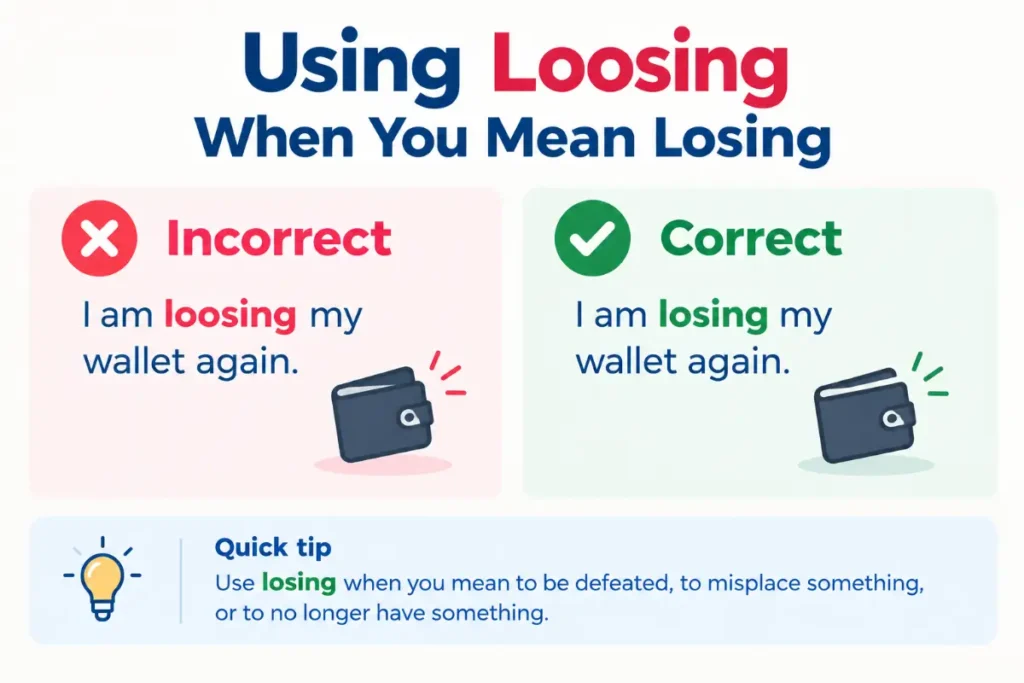
Incorrect: I am loosing my wallet again.
Correct: I am losing my wallet again.
The correct sentence describes repeatedly misplacing a wallet. It needs losing because the base verb is lose, not loose.
Writing Loosing Weight
Incorrect: She is loosing weight through exercise.
Correct: She is losing weight through exercise.
The sentence describes a reduction in body weight. The correct spelling is losing, even though the word loose can describe clothing or something that is not tight.
Confusing Losing With Loosening
Incorrect: He is losing the knot to remove it.
Better: He is loosening the knot to remove it.
The intended meaning is that he is making the knot less tight. Loosening expresses that action more naturally than losing or loosing.
Using Losing When You Mean Releasing
Incorrect: The archer is losing an arrow from the bow.
Correct: The archer is loosing an arrow from the bow.
The second sentence uses loosing to describe the release of an arrow. However, releasing an arrow is more familiar to many modern readers and may be the clearest choice.
Assuming Loosing Is Always Wrong
Incorrect belief: Loosing is never a real English word.
Correct understanding: Loosing is a legitimate form of the verb loose, but it is uncommon in modern English.
The problem is not that loosing is always misspelled. The problem is using it in a sentence that needs losing.
A Quick Editing Checklist
Before you finalize a sentence, ask yourself these questions.
- Am I describing a loss, defeat, reduction, or failure to keep something? Use losing.
- Am I describing the release of something from restraint? Consider loosing or the clearer alternative releasing.
- Am I describing something becoming less tight? Use loosening.
- Would a reader understand the intended action immediately? If not, choose a more familiar word.
These checks are especially useful when editing emails, school assignments, blog posts, reports, and social media captions.
Memory Tips to Remember the Correct Spelling
A simple memory trick can help you choose the correct word without looking up the spelling every time.
Remember the Base Word
Connect each word to its root.
- Lose becomes losing. Think about losing your keys, losing a game, or losing money.
- Loose becomes loosing. Think about releasing an arrow or setting something free.
- Loose becomes loosening. Think about making a tight knot less tight.
Learning the three forms together prevents confusion.
Use the One O Rule
When you mean a loss, remember the single o in losing. The word comes from lose, which has one o.
When you mean releasing something, remember the double o in loosing. The word comes from loose, which has two o letters.
This trick works best when you connect the spelling to the meaning rather than memorizing the letters alone.
Picture a Missing Item
Imagine searching your house for your phone. You cannot find it, so you say, I am losing my phone.
Now imagine an archer holding a bow and releasing an arrow. The archer is loosing an arrow.
The mental pictures make the meanings distinct. One situation involves something you cannot keep track of, while the other involves deliberately setting something free.
Use a Short Sentence Test
Try completing these sentences without looking at the answers.
- I am _____ my patience.
- The archer is _____ an arrow.
- She is _____ the knot.
- Our team is _____ the match.
The correct answers are losing, loosing, loosening, and losing. Each answer matches the meaning of its base word.
Similar Words That Cause Confusion
English contains many words that look or sound alike but have different meanings. Learning their differences can improve your spelling and overall writing.
Lose vs Loose
Lose is a verb that means to misplace something, fail to win, or no longer have something. Loose is usually an adjective that means not tight or firmly fixed.
Examples.
- Do not lose your ticket. This means you should keep the ticket safe.
- My shirt is loose. This means the shirt does not fit tightly.
Remember that lose describes an action or state of loss, while loose usually describes a condition.
Losing vs Loosening
Losing means experiencing a loss or decline. Loosening means making something less tight or less firm.
Examples.
- She is losing her grip on the handle. This means her hold is weakening.
- She is loosening her grip on the handle. This means she is deliberately relaxing her hold.
The two sentences differ in intention. In the first, the grip is becoming weaker. In the second, the person is actively making the grip less tight.
Lost vs Loosed
Lost is the past tense and past participle of lose. Loosed is the past tense and past participle of loose when the verb means to release.
Examples.
- I lost my wallet yesterday. This means I misplaced it or could no longer find it.
- The archer loosed an arrow. This means the archer released the arrow.
The spelling of lost is irregular, so it does not follow the same pattern as loosing.
Loss vs Loose
Loss is a noun that refers to the act or result of losing something. Loose is generally an adjective that describes something not firmly attached or tight.
Examples.
- The company reported a financial loss. This refers to a negative financial result.
- The screw is loose. This means the screw is not firmly secured.
Although these words look similar, their grammatical roles and meanings differ.
Loosen vs Lose
Loosen is a verb meaning to make something less tight. Lose means to fail to keep something or to be deprived of it.
Examples.
- Loosen the cap before opening the bottle. This means turning the cap until it is less tight.
- Do not lose the cap. This means you should avoid misplacing it.
The difference becomes clear when you focus on the action described in the sentence.
Pronunciation of Losing and Loosing
The words losing and loosing have different standard pronunciations in American English. Learning the sound difference can help you recognize them when listening, although context remains useful.
Losing is pronounced with a voiced z sound in the middle. Its first syllable rhymes with the word choose without the initial ch sound.
Loosing has an s sound in the middle. Its first syllable rhymes with the word goose without the initial g sound.
The difference between the voiced and unvoiced consonants helps distinguish the words. However, spelling mistakes can still occur because the written forms are similar.
When writing, rely on the intended meaning rather than pronunciation alone. If you are talking about losing a game or misplacing an item, choose losing. If you are describing the release of something, loosing may fit.
Word Origins and Historical Usage
The difference between the words becomes easier to understand when you look at their histories.
Lose developed from older English forms associated with loss and deprivation. Its modern meanings include failing to keep something, being defeated, and experiencing a reduction.
Loose has a different history and is associated with freedom from restraint, a lack of tightness, or the act of releasing something. As a verb, it can mean to set something free or release it.
The words are related in appearance, but they developed distinct meanings and spelling patterns. This is why losing and loosing cannot normally replace each other.
In older English writing, loose was used more freely as a verb in contexts involving release. Modern English tends to favor more direct verbs such as release, free, and let go. That shift helps explain why loosing may sound old fashioned or unusual to many readers.
American and British English Usage
The spelling distinction between losing and loosing is the same in standard American and British English. Neither variety normally uses loosing as an alternative spelling of losing.
American English: I am losing my keys.
British English: I am losing my keys.
Both sentences use the same spelling because the meaning is identical. Regional differences in English spelling affect some words, such as color and colour, but they do not change the standard distinction between these two forms.
In both varieties, loosing remains a valid but uncommon verb form meaning releasing or setting free. Writers in either variety should use the word that matches the intended meaning.
Formal and Informal Usage
The word losing works naturally in almost every register of English. You can use it in casual conversation, academic writing, workplace communication, journalism, and formal reports.
Examples.
- We are losing money on this project. This is clear and suitable for both casual discussion and a business meeting.
- The candidate is losing public support. This is appropriate for formal political reporting.
- I keep losing my headphones. This is natural in everyday conversation.
Loosing is more limited in use. It may appear in historical writing, poetry, religious language, or a precise description of releasing something.
Example.
The warrior loosed his arrow.
The sentence is grammatically correct, but many modern readers would find released his arrow more familiar. In formal writing, choose loosing only when it communicates the intended meaning clearly and suits the tone.
Professional Writing Tips
Correct spelling matters because even a small error can distract readers from your message. The best approach is to choose words based on meaning, then check the sentence for clarity.
Prefer Familiar Words
If your audience may not know loosing, use releasing or setting free when those words fit the sentence. Familiar wording helps readers understand the action without stopping to interpret an unusual term.
For example, instead of writing, The handler is loosing the animal, write, The handler is releasing the animal.
Both sentences can express the same action, but the second is more accessible to most readers.
Check the Meaning Before Correcting the Spelling
Do not automatically replace every instance of loosing with losing. First, determine what the sentence means.
If the sentence describes losing a job, losing a match, or losing patience, use losing. If it describes releasing an arrow, freeing an animal, or removing restraints, loosing may be correct.
A spelling checker can identify some errors, but it may not recognize an incorrect word when that word is spelled properly. Meaning matters as much as spelling.
Read the Sentence Aloud
Reading a sentence aloud can help you hear when a word sounds wrong or does not fit the intended meaning. It is especially helpful when editing sentences that contain similar words.
However, do not rely on sound alone. The distinction between the voiced sound in losing and the unvoiced sound in loosing is useful, but the meaning of the sentence remains the most reliable guide.
Keep the Reader in Mind
In general writing, use the clearest word available. Losing is a familiar word that needs no explanation in most contexts. Loosing is less familiar, so consider your audience before using it.
In a technical or historical description where the specific action of loosing is meaningful, the word may be appropriate. In a general article, email, or report, a simpler alternative will often work better.
Key Takeaways
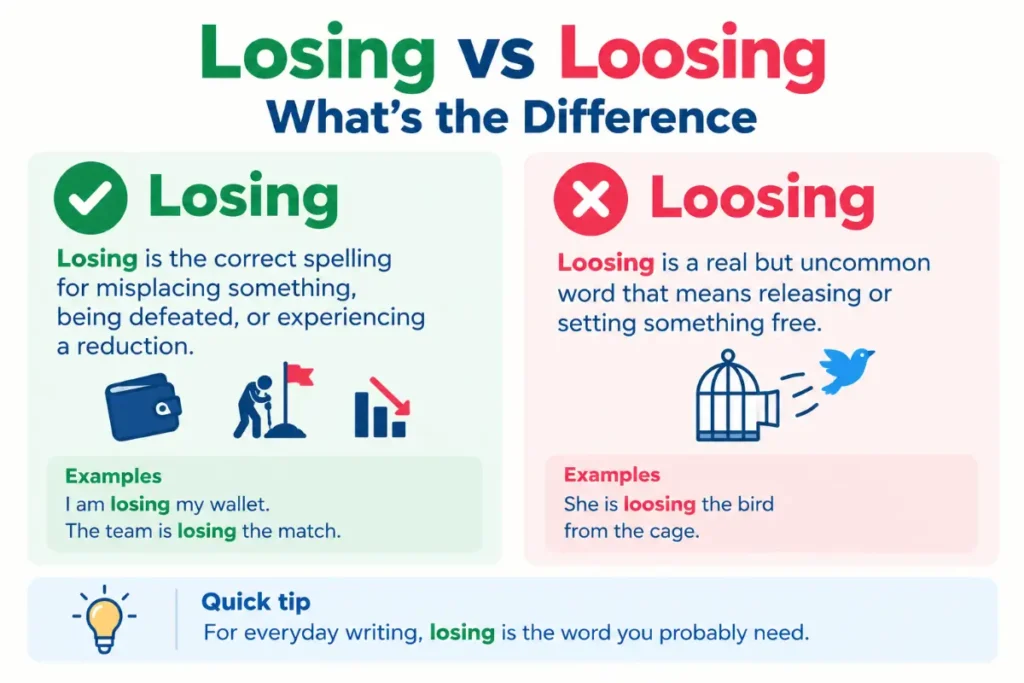
- Losing is the correct spelling for misplacing something, being defeated, or experiencing a reduction.
- Loosing is a real but uncommon word that means releasing or setting something free.
- Loosening means making something less tight or less firm.
- The base word determines the spelling. Lose becomes losing, while loose becomes loosing.
- American and British English follow the same spelling distinction.
- When a sentence feels unclear, choose a familiar word such as releasing or loosening if it expresses your intended meaning.
- The best memory trick is to connect each form with its root word and meaning.
Conclusion
Loosing vs losing is easier to understand once you connect each spelling to its base word. Losing means misplacing something, being defeated, or experiencing a decline. Loosing means releasing something or setting it free. The extra o changes the meaning, so it is worth checking the word before you finish a sentence.
In everyday American English, losing is the form you will need most often. You might be losing your keys, losing a game, losing money, or losing confidence. In these situations, the spelling always comes from the verb lose. Reserve loosing for situations that involve releasing something, especially in traditional or literary descriptions.
Remember the simple rule: lose becomes losing, and loose becomes loosing. If you are describing something becoming less tight, use loosening. These three forms cover most situations and make it much easier to choose the correct word when writing emails, articles, school assignments, or professional documents.
Frequently Asked Questions
What is the difference between loosing vs losing?
Losing means failing to keep something, being defeated, or experiencing a decline. Loosing means releasing something or setting it free. The correct word depends on the action you want to describe.
Is loosing a real word?
Yes. Loosing is a real English word formed from the verb loose. It means releasing or setting something free, but it is much less common than losing.
Is losing the correct spelling?
Yes, losing is correct when you mean misplacing something, being defeated, or experiencing a reduction. For example, I am losing my keys is correct because the speaker cannot keep track of the keys.
Why do people spell losing as loosing?
People often add an extra o because they confuse lose with loose. The two words look similar, but losing comes from lose, while loosing comes from loose.
Is loosing weight correct?
No, not when you mean a reduction in body weight. The correct phrase is losing weight. For example, She is losing weight through regular exercise uses the correct spelling.
What does loosing an arrow mean?
Loosing an arrow means releasing it from a bow. The word is a traditional verb used in descriptions of archery. In everyday writing, releasing an arrow is often easier to understand.
Is losing the opposite of winning?
Yes, when the words describe a contest or competition. Losing means being defeated, while winning means achieving victory. For example, a team can win a game or lose a game.
Should I write losing or loosening?
Use losing when something is disappearing, decreasing, or no longer in your possession. Use loosening when you are making something less tight, such as a knot, screw, or grip.
Do Americans and British people spell losing differently?
No. Standard American and British English both use losing for the present participle of lose. Both also recognize loosing as a form of loose meaning releasing something.
How can I remember the difference between losing and loosing?
Connect losing with lose and loosing with loose. Losing a game or misplacing your keys requires one o in the base word. Releasing something comes from loose, which has two o letters.
Can loosing be used in a sentence?
Yes. For example, The archer is loosing an arrow means the archer is releasing the arrow. The sentence is grammatically correct, although releasing an arrow is more common in modern English.
Is loosing always a spelling mistake?
No. Loosing is correct when it means releasing or setting something free. It is a mistake only when the intended meaning calls for losing, such as in losing money, losing a game, or losing patience.

Confusing Words, Spelling & Word Choice
Claire Whitmore is a U.S.-based English editor who writes about commonly confused words, spelling differences, and word choice. Her work helps readers understand subtle distinctions between similar-looking words through simple definitions, practical examples, and modern usage guidance in both American and British English.