
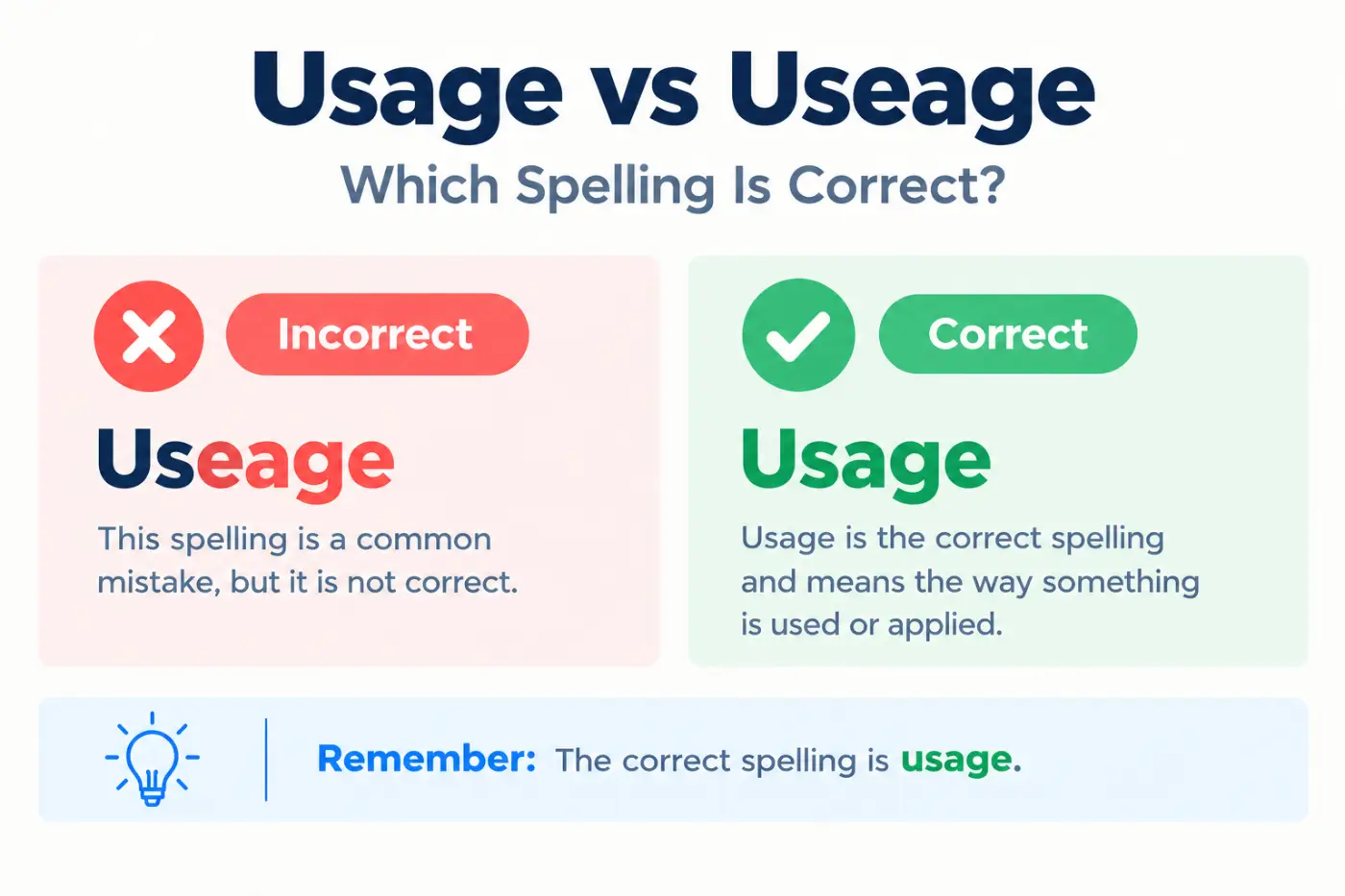
Usage vs useage is a common spelling question because the word use ends with an e, which can make the incorrect spelling look reasonable. However, the correct word is usage, with no e between the s and a. If you’re writing an email, preparing a report, editing an article, or studying English, remember to use usage.
The word usage describes how people use something. It can refer to language, grammar, technology, products, resources, habits, or accepted practices. For example, a teacher might explain the usage of a particular verb, while a utility company might report household water usage. The meaning changes with the context, but the spelling stays the same.
The confusion comes from the relationship between use and usage. Both words are connected in meaning, but English spelling doesn’t always follow a simple pattern when one word develops from another. Once you learn the standard spelling and understand how the two words function in a sentence, this mistake becomes much easier to avoid.
Short Answer
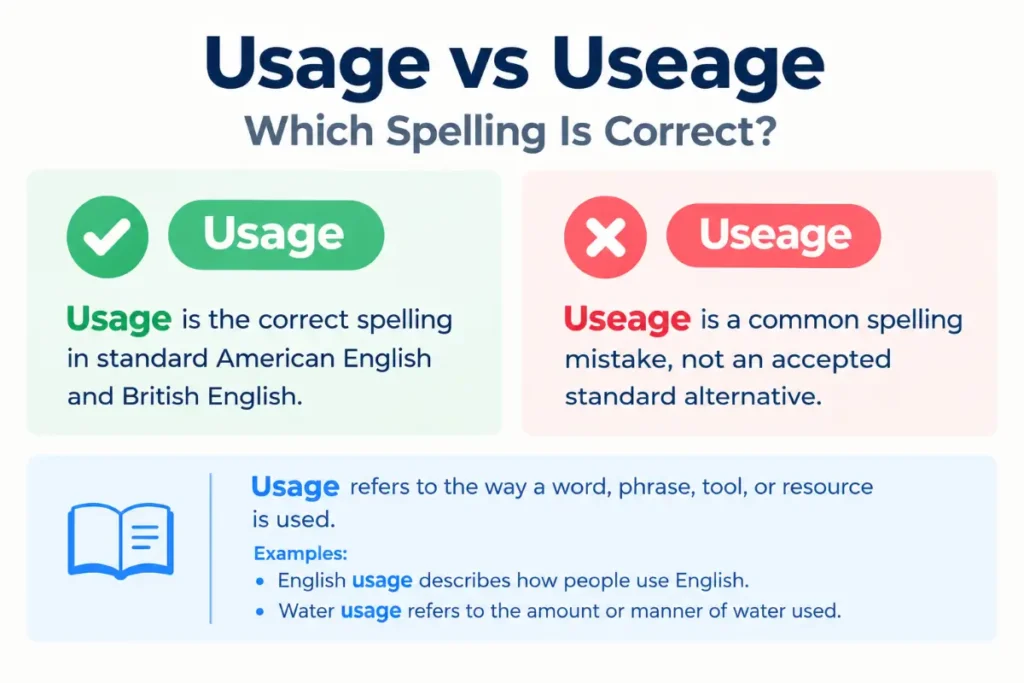
Usage is the correct spelling in standard American English and British English. Useage is a common spelling mistake, not an accepted standard alternative. The word usage refers to the way a word, phrase, tool, or resource is used. For example, English usage describes how people use English, while water usage refers to the amount or manner of water used.
Table of Contents
- The Correct Spelling of Usage.
- What Usage Means.
- What Useage Means.
- Usage vs Useage Comparison.
- Why People Misspell Usage.
- How to Use Usage Correctly.
- Usage vs Use.
- Usage in American and British English.
- Common Spelling Mistakes.
- Memory Tips.
- Professional Writing Tips.
- Related Words and Expressions.
- Frequently Asked Questions.
- Key Takeaways.
- Conclusion.
The Correct Spelling of Usage
The correct spelling is usage. Useage is incorrect in standard English and should be corrected in formal writing, academic work, business communication, and everyday digital content.
Usage is a noun. It describes the way something is used or the accepted way a word or expression is used in a language.
Consider these examples.
- Correct: The teacher explained the usage of the word affect. The sentence uses usage to describe how a particular word works in English.
- Incorrect: The teacher explained the useage of the word affect. The meaning is clear, but the spelling is wrong.
- Correct: The report shows a steady increase in electricity usage. Here, usage refers to the amount of electricity consumed.
- Incorrect: The report shows a steady increase in electricity useage. The writer has added an unnecessary e.
The key rule is simple. Write usage every time you need this noun. Don’t add an extra e just because the related verb is spelled use.
Is Usage One Word
Yes. Usage is a single word, and it doesn’t require a space, apostrophe, or hyphen.
For example, correct phrases include language usage, internet usage, word usage, data usage, and fuel usage. Each phrase uses usage as a noun modified by another word.
Is Useage Ever Correct
Useage isn’t recognized as a standard spelling of the noun in contemporary general English. You may encounter it in informal online writing, user generated material, or text containing typographical errors, but those appearances don’t make it correct.
In edited American English, choose usage. The same spelling applies in standard British English.
What Usage Means
Usage has two major meanings. It can describe the way something is used, or it can describe a customary or accepted way of using language.
The surrounding words usually make the intended meaning clear. A discussion of grammar often uses usage in the linguistic sense, while a discussion of energy or mobile data usually uses it in the practical sense.
Usage in Language and Grammar
In linguistics, usage refers to how people actually use words, expressions, grammatical structures, and punctuation. It can also refer to the accepted conventions that guide effective communication.
For example, a style editor might examine the usage of pronouns in a business report. The editor would look at how the writer uses pronouns and identify forms that are unclear, awkward, or inconsistent with the intended style.
Usage can also help explain changes in language. People sometimes use a word in a new way, and that pattern may become common over time. Dictionaries and language guides record many of these developments.
Consider this sentence.
Example: Modern English usage accepts many expressions that earlier generations considered informal.
The sentence means that accepted language practices can change over time. It doesn’t suggest that every new expression is suitable for every setting. A phrase may work in casual conversation but sound out of place in a legal document or formal report.
Usage in Everyday Life
Outside grammar, usage often refers to how much of a resource someone consumes or how a product or service is used.
For example, a smartphone company may track data usage to help customers manage their mobile plans. A household may monitor electricity usage to understand its monthly bills.
Here are additional examples.
- Water usage: The family reduced its water usage during the summer. This means the family used less water.
- Internet usage: My internet usage increases when I work from home. This describes how much or how often the speaker uses the internet.
- Fuel usage: The driver checked the car’s fuel usage before a long trip. The sentence refers to the amount of fuel the vehicle consumes.
- Software usage: The company reviewed employee software usage. This describes how employees use the software and may include frequency or duration.
These examples show that usage isn’t limited to grammar. It works naturally in discussions of technology, business, personal habits, and resource management.
Usage as a Custom or Convention
Usage can also refer to an established practice within a group, profession, or society.
For example, legal usage includes conventions about how certain terms appear in legal documents. Medical usage may describe established ways professionals use specific terms or expressions.
Example: The phrase has a different meaning in legal usage.
This means the phrase is interpreted differently in the language conventions or practices of the legal profession. The sentence focuses on a specialized context rather than general conversation.
What Useage Means
Useage is a misspelling of usage. It doesn’t have a separate standard definition that makes it an appropriate replacement for usage in ordinary English writing.
People often produce this spelling because they recognize use as the base word and assume that adding age should preserve the final e. English spelling, however, includes many word forms that don’t follow that assumption.
For instance, the correct word is marriage, not marriagee, and the correct word is storage, not storeage. These examples illustrate why writers shouldn’t automatically preserve a final e when forming a related noun.
Why Useage Looks Correct
The spelling useage can appear logical at first glance. The verb use is familiar, and writers may expect the related noun to retain its full spelling before the ending.
However, familiarity isn’t the same as correctness. Standard spelling depends on the established form of the word, not simply on how someone thinks it should be constructed.
The same issue appears with other English words. People may write definately instead of definitely or seperate instead of separate because the incorrect forms seem plausible when written quickly. Repeated exposure to the correct spelling helps prevent these errors.
How to Correct Useage in a Sentence
When you find useage in a draft, replace it with usage unless you’re reproducing an original text exactly for a specific editorial or documentary reason.
For example, change the sentence The useage of this expression varies by region to The usage of this expression varies by region.
The correction fixes the spelling without changing the intended meaning. You don’t need to rewrite the entire sentence just because the noun was misspelled.
Usage vs Useage Comparison
The difference between the two forms is straightforward. Usage is the standard spelling, while useage is an error in ordinary modern English.
| Feature | Usage | Useage |
|---|---|---|
| Spelling status | Correct | Incorrect in standard English |
| Part of speech | Noun | Intended as a noun but misspelled |
| Standard dictionary form | Yes | Not a standard alternative |
| American English | Correct | Incorrect |
| British English | Correct | Incorrect |
| Formal writing | Appropriate | Should be corrected |
| Example | Word usage varies by context. | Word useage varies by context. |
The table makes the distinction clear. Only usage belongs in standard edited writing.
Usage vs Useage in Real Sentences
Compare the following examples to see how the spelling works in context.
- Correct: The guide explains the usage of commas in complex sentences. Usage refers to the accepted or appropriate way to use commas.
- Incorrect: The guide explains the useage of commas in complex sentences. The extra e makes the noun misspelled.
- Correct: The application lets users monitor their monthly data usage. Usage refers to the amount of data consumed.
- Incorrect: The application lets users monitor their monthly data useage. The sentence needs the standard spelling.
- Correct: English usage differs across regions and social groups. The sentence describes variation in how people use English.
- Incorrect: English useage differs across regions and social groups. The intended meaning remains understandable, but the spelling is wrong.
The lesson is the same in every example. The context may change, but the correct spelling doesn’t.
Why People Misspell Usage
Spelling errors often occur when writers apply a familiar pattern to a word that doesn’t follow it. Usage is especially vulnerable because it looks closely related to the verb use.
Several factors can make the mistake more likely.
The Influence of the Word Use
The verb use ends with an e. Writers may assume that the noun must retain that letter when they add a suffix.
English doesn’t always work that way. The spelling of a derived word may differ from what a writer expects based on the original word.
For example, the verb pronounce gives us pronunciation, not pronounceation. The noun changes form instead of simply keeping the full verb spelling. Similarly, usage has its own established spelling.
Pronunciation Doesn’t Reveal the Spelling
Usage and the misspelling useage are often intended to represent the same spoken word. Because the extra e doesn’t usually create a different pronunciation, a reader may not notice the error when hearing the word aloud.
This makes spelling knowledge particularly useful. When you write an unfamiliar word, don’t rely only on how it sounds. Check its standard written form if you’re unsure.
Typing Quickly
People often make spelling errors when drafting messages, taking notes, or typing on a phone. A writer might produce useage without noticing the extra letter.
Spellcheck tools can catch many mistakes, but they aren’t perfect. A careful final review is still useful, especially when preparing published articles, school assignments, professional documents, or customer facing material.
Repeated Exposure to Incorrect Forms
If you repeatedly see a misspelling online, it may begin to look familiar. Familiarity can make an incorrect spelling seem acceptable even when it isn’t.
The best response is to learn the correct form and use it consistently. When you edit a document, search for useage and correct each unintended occurrence.
How to Use Usage Correctly
Knowing the spelling is only the first step. You should also understand how usage fits into a sentence and when it sounds natural.
Because usage is a noun, it commonly appears after an article, possessive, adjective, or another noun that identifies the kind of use being discussed.
Usage With Articles
You can use usage with articles such as a and the when the sentence treats it as a countable instance or a particular kind of practice. In many general contexts, however, usage functions as an uncountable noun.
Examples help clarify the distinction.
Example: The usage of this phrase is common in casual conversation.
Here, usage refers to a particular language practice. The definite article the points to the specific practice under discussion.
Example: The report examines usage across several age groups.
Here, usage is used without an article because it refers broadly to patterns of use.
In everyday writing, the natural choice depends on the intended meaning and sentence structure. Avoid adding an article automatically when the noun is being used in a broad or general sense.
Usage With Adjectives
Adjectives can describe the type, quality, or setting of usage.
Common combinations include common usage, standard usage, proper usage, regional usage, technical usage, and everyday usage.
For example, The dictionary explains standard usage in formal writing.
This sentence means that the dictionary describes accepted language conventions suitable for formal contexts.
Another example is Heavy internet usage can increase monthly costs.
Here, heavy describes the extent of internet use. The sentence suggests that using more internet may lead to higher charges under the relevant plan.
Usage With Prepositions
Usage frequently appears in phrases beginning with of, in, and across.
- Usage of a word: The teacher explained the usage of the word imply. The phrase identifies the specific word being discussed.
- Usage in writing: Proper usage in academic writing helps readers understand an argument. The phrase identifies the context in which the conventions apply.
- Usage across regions: The study compares language usage across regions. The phrase describes a comparison among different geographical areas.
These combinations are common and useful, but you don’t need to force them into every sentence. Sometimes use or the relevant verb creates a simpler and more natural sentence.
When Usage Sounds Too Formal
Usage is useful in professional, academic, and technical writing, but it can sound unnecessarily formal in casual conversation.
For example, I checked my phone usage settings is perfectly natural when discussing a phone’s built in tracking features. In a casual conversation about a habit, however, I use my phone too much may sound more direct.
Good writing isn’t about choosing the longest word. It’s about choosing the word that communicates the intended meaning clearly.
Usage in American and British English
American English and British English use the same spelling for this word. Usage is correct in both varieties, and useage isn’t a standard alternative in either one.
Some English words have different accepted spellings in the United States and the United Kingdom. For example, American English commonly uses color, while British English commonly uses colour. That regional difference doesn’t apply to usage.
Does American English Prefer Usage
Yes. Usage is the standard spelling in American English. You should use it in school assignments, newspaper articles, business reports, websites, emails, and other forms of writing.
For example, The editor reviewed the usage of technical terms throughout the report.
This sentence follows standard American spelling and uses usage to describe how technical terms appear in the report.
Is Useage Accepted in British English
No. British English also uses usage as the standard spelling.
For example, The teacher discussed the usage of informal expressions in British English.
The sentence is correctly spelled and grammatically natural. Adding an e to create useage would introduce a spelling error rather than a British spelling variant.
Does Usage Change Meaning Across Regions
The spelling remains the same, but language practices can differ between regions. A word or expression may be common in American English but less common in British English, or the reverse.
For example, the words apartment and flat refer to similar types of homes, but their everyday use differs by region. A discussion of their usage would examine how speakers choose between these words in different settings.
This distinction matters because regional variation affects the words people choose, not the standard spelling of usage itself.
Common Mistakes With Usage
Writers sometimes confuse spelling, meaning, and grammar at the same time. Learning to separate these issues makes editing easier.
Adding an Extra E
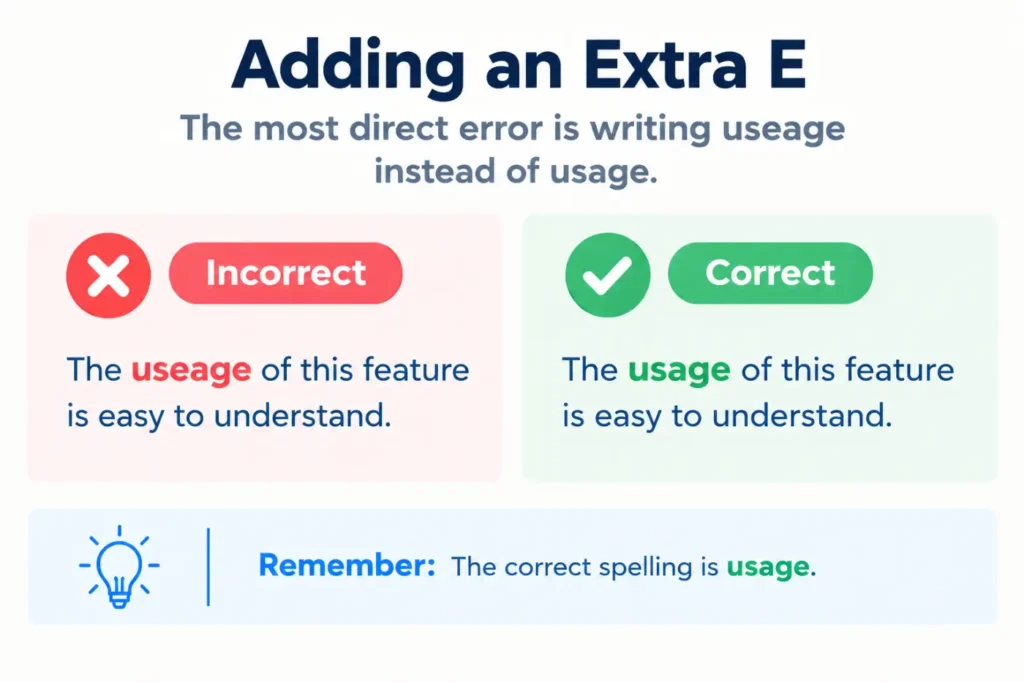
The most direct error is writing useage instead of usage.
Incorrect: The useage of this feature is easy to understand.
Correct: The usage of this feature is easy to understand.
The corrected sentence retains the original meaning and fixes the spelling.
Confusing Usage With Use
Usage and use are related, but they don’t always fit the same sentence equally well.
Consider these examples.
Example: The usage of this phrase is unusual.
This sentence focuses on the way the phrase is used or on its place within established language practices.
Example: The use of this phrase is unusual.
This sentence is also correct. It focuses more directly on the act or instance of using the phrase.
The difference is subtle, and the two nouns sometimes overlap. Choose the one that sounds most natural for your intended meaning.
Treating Usage as a Verb
Usage is a noun, so it can’t replace a verb such as use.
Incorrect: I usage this tool every morning.
Correct: I use this tool every morning.
The verb use describes the action. Usage names the practice or manner of using something.
You can write The usage of this tool has increased, but you can’t use usage as the main verb in I usage this tool.
Assuming Usage Always Means Consumption
Usage can refer to consumption, but that isn’t its only meaning.
For example, energy usage describes the amount of energy consumed. Language usage describes the way people use language.
If you assume that usage always means consumption, you may misunderstand sentences about grammar, customs, or professional conventions. Always consider the context.
Overusing the Noun
Sometimes writers choose usage when a simpler verb or noun would improve the sentence.
Wordy: The usage of the application by the team increased during the month.
Clearer: The team used the application more often during the month.
The second sentence identifies who performed the action and describes what changed. It also sounds more natural in everyday American English.
Professional writing benefits from this kind of editing. The goal isn’t to avoid usage altogether, but to use it when it adds precision.
Memory Tips to Remember the Correct Spelling
A simple memory trick can help you avoid this error for good. The correct spelling is usage, and you don’t need to preserve the final e in use when writing this noun.
Remember the Shorter Spelling
Think of usage as use with the final e removed before adding age.
Use + age becomes usage.
This is a practical spelling aid rather than a complete rule for forming every English noun. It works for remembering this particular word.
Connect the Word With Its Meaning
Link the word usage with phrases you already know, such as word usage, data usage, and water usage.
The more familiar these combinations become, the easier it is to recognize the correct spelling. Repeating the word in meaningful contexts is usually more effective than memorizing isolated letters.
Use a Quick Editing Test
Before submitting a document, search for useage. If you find it, check the context and replace it with usage when the intended word is the standard noun.
This small editing habit can prevent an avoidable error from appearing in published content or professional communication.
Practice With Correct Sentences
Read these sentences and notice the spelling.
- Good word usage makes a message easier to understand.
- The company monitors its monthly energy usage.
- The guide explains the usage of common expressions.
- Internet usage varies among households.
- The editor corrected several errors in the article.
Each sentence demonstrates a natural context for usage. Practicing with different meanings helps you remember the word instead of memorizing a single example.
Professional Writing Tips
Correct spelling builds trust with readers. A misspelling may not prevent someone from understanding a sentence, but repeated errors can make a document appear careless.
Choose Precision Over Complexity
Use usage when you need to describe a language convention, a pattern of behavior, or the way a resource is consumed.
For example, The study examines social media usage among teenagers is appropriate in a research report.
In a more conversational setting, The study examines how teenagers use social media may sound clearer.
Both sentences communicate a similar idea, but the second uses a direct verb construction. The best choice depends on the audience and the purpose of the document.
Match the Word to the Audience
In academic writing, usage may be useful when discussing grammar, linguistics, or established conventions. In technical reports, it may describe consumption or activity. In casual conversation, use may be more direct.
For example, a software report might discuss customer usage patterns, while a conversation might simply describe how customers use the software.
Think about what readers need to understand. A clear sentence is more valuable than a formal sounding one.
Proofread More Than Once
A spellchecker can catch many errors, but proofreading also helps you identify awkward phrasing, repeated words, and sentences that don’t communicate the intended meaning.
Read the document once for spelling and again for clarity. Pay special attention to words that look plausible but may contain an extra or missing letter.
If the document is important, ask another person to review it. A fresh reader may notice errors you’ve overlooked because you’re already familiar with the text.
Related Words and Expressions
Understanding related words helps you choose the most precise expression for your sentence.
Usage and Usability
Usage describes how something is used. Usability describes how easy or practical something is to use.
Example: The team studied website usage and usability.
The sentence refers to two different areas. Website usage concerns how visitors interact with the site, while usability concerns how easily visitors can complete tasks.
Usage and Utilization
Utilization often refers to making practical use of a resource, tool, or capacity. Usage is a more general term and often sounds more natural in everyday writing.
Example: The report measures machine utilization during each shift.
The sentence focuses on how effectively the machines’ available capacity is being used. In less technical writing, machine usage may be a simpler choice.
Usage and Application
Application can refer to putting a rule, idea, or method into practice. Usage focuses on the way something is used or on an established practice.
Example: The application of the grammar rule improved the student’s writing.
Here, application means putting the rule into practice. Usage would be more appropriate if the sentence discussed how a word or grammatical structure is commonly used.
Usage and Practice
Practice can refer to a repeated activity, a customary method, or a professional activity. Usage often focuses more specifically on how language or a resource is used.
Example: Checking a dictionary is a useful writing practice.
This sentence describes a helpful habit. It doesn’t need the word usage because the writer is discussing an action performed regularly.
Usage and Misuse
Usage describes the way something is used. Misuse refers to using something incorrectly or in an inappropriate way.
Example: The article explains the usage and misuse of common expressions.
The sentence distinguishes ordinary patterns of use from incorrect or inappropriate use. In a language discussion, the distinction may depend on context, established conventions, and the purpose of the communication.
Key Takeaways
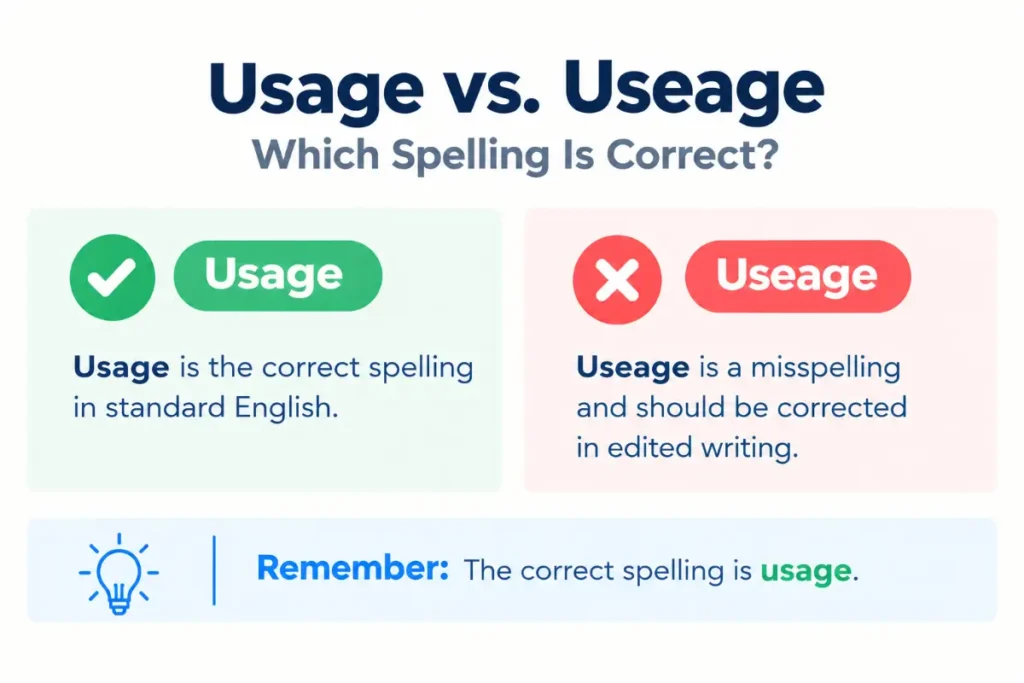
- Usage is the correct spelling in standard English.
- Useage is a misspelling and should be corrected in edited writing.
- Both American and British English use usage.
- Usage is a noun that describes a way of using something, a pattern of activity, or an accepted language practice.
- Use can function as a noun or a verb, while usage is a noun.
- The final e in use doesn’t appear in the standard spelling of usage.
- Choose usage for discussions of language conventions, resource consumption, and patterns of use.
- Prefer a direct verb such as use when it makes a sentence clearer.
- Proofreading and spellcheck tools can help you catch spelling mistakes before publishing.
- Remember the correct spelling and use it consistently in academic, professional, and everyday writing.
Conclusion
Usage vs useage has a simple answer. Usage is the correct spelling, and useage is a misspelling. The correct word appears in both American and British English and describes the way something is used or an established practice. Remember to leave out the extra e when writing usage.
The word is useful in many settings, from grammar lessons and academic papers to technology reports and discussions about household resources. You can write about language usage, internet usage, or electricity usage, depending on the point you want to make. When a direct verb communicates the idea more clearly, use may be the better choice.
Build the correct spelling into your everyday writing habits. Review your work before submitting it, correct useage whenever it appears unintentionally, and choose words that communicate your meaning clearly. Once you remember the standard spelling, this common mistake becomes easy to avoid.
Frequently Asked Questions
1. Is Usage or Useage Correct?
Usage is correct. Useage is a misspelling and isn’t an accepted standard alternative in American or British English.
2. Why Is Useage Incorrect?
The established spelling of the noun is usage. The final e in the verb use doesn’t remain in the standard noun spelling.
3. Is Usage Correct in American English?
Yes. Usage is the standard spelling in American English and is appropriate for academic, professional, and everyday writing.
4. Is Usage Correct in British English?
Yes. British English uses the same spelling, usage. Useage isn’t a standard British variant.
5. What Does Usage Mean?
Usage refers to the way something is used or to an accepted practice. It can describe language conventions, resource consumption, technology activity, and customary behavior.
6. What Is the Difference Between Use and Usage?
Use can function as a noun or a verb. Usage is a noun that often describes a pattern, manner, or practice of use.
For example, I use this application every day describes an action, while My application usage has increased describes a pattern of activity.
7. Is Usage a Noun or a Verb?
Usage is a noun. Use can be a noun or a verb, depending on the sentence.
For example, The usage of this expression is common uses usage as a noun. I use this expression often uses use as a verb.
8. How Do You Remember the Spelling of Usage?
Remember that the correct spelling is usage, without an extra e after the s. You can also practice familiar phrases such as language usage and data usage.
9. Can I Use Usage in Formal Writing?
Yes. Usage is appropriate in academic papers, professional reports, technical documents, and formal communication. However, use may sound simpler and more direct in some sentences.
10. Is Usage Countable or Uncountable?
Usage is often uncountable when it refers generally to a pattern or amount of use. In some specialized contexts, writers may use it to refer to a particular type or instance of language practice.
The correct form depends on the intended meaning and sentence structure.
11. Does Usage Have a Different Spelling in the United States and the United Kingdom?
No. Both American and British English use usage. There is no standard regional spelling difference for this word.
12. What Should I Write Instead of Useage?
Write usage when you mean the way something is used or an accepted practice. If your sentence describes a direct action, consider using the verb use instead.
For example, replace The useage of the tool increased with The usage of the tool increased, or write People used the tool more often if you want a more direct sentence.

Confusing Words, Spelling & Word Choice
Claire Whitmore is a U.S.-based English editor who writes about commonly confused words, spelling differences, and word choice. Her work helps readers understand subtle distinctions between similar-looking words through simple definitions, practical examples, and modern usage guidance in both American and British English.