
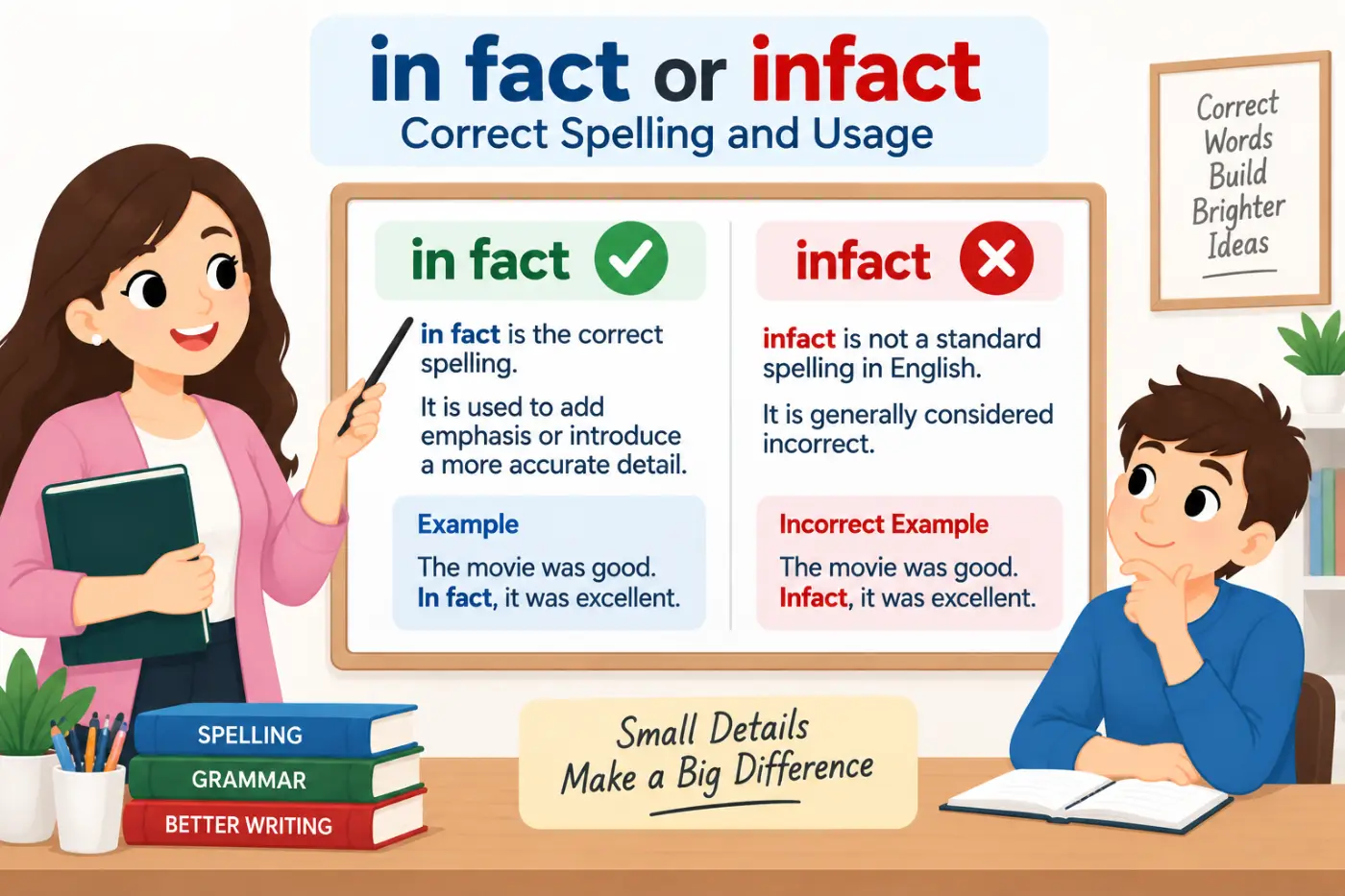
Infact or in fact is a common spelling question because the phrase sounds like a single word in everyday conversation. However, standard American English uses two separate words. The correct form is in fact, and it helps you emphasize information, clarify a point, or introduce a surprising detail.
You will often see this expression in emails, school assignments, business reports, articles, and casual messages. Writers use it to strengthen a statement or show that the actual situation differs from what someone might expect. For example, The restaurant looked small. In fact, it had three dining rooms. The phrase introduces a detail that adds useful information.
Learning this simple spelling rule can make your writing clearer and more professional. Once you understand how the expression works, you can use it confidently without second guessing the spelling. You will also learn when to add a comma, how the phrase differs from similar expressions, and which mistakes to avoid.
Quick Answer
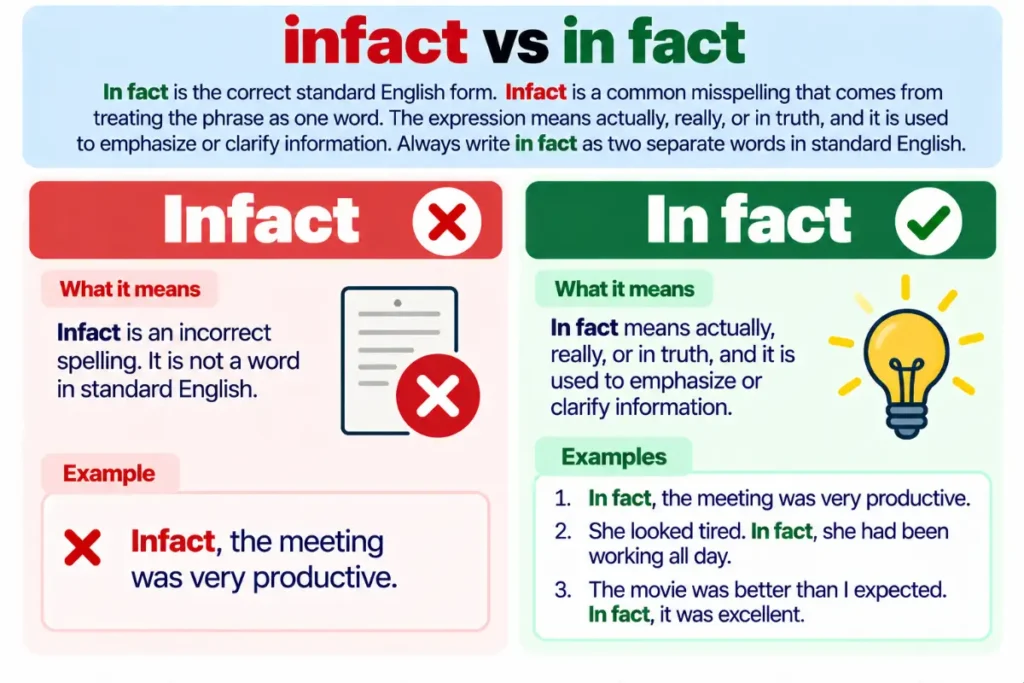
In fact is the correct spelling. Write it as two separate words when you want to add information, correct a misunderstanding, or emphasize a statement. Infact is a common spelling mistake because the phrase sounds like one word when spoken. For example, write In fact, I finished the report yesterday. Never combine the two words in standard English writing.
Table of Contents
- The Correct Spelling.
- What In Fact Means.
- How to Use In Fact in a Sentence.
- In Fact vs Other Similar Expressions.
- Punctuation Rules for In Fact.
- Real Life Examples.
- Common Spelling and Grammar Mistakes.
- Easy Memory Tips.
- American and British English Usage.
- Related Grammar and Usage Notes.
- Frequently Asked Questions.
- Key Takeaways.
- Conclusion.
The Correct Spelling
The correct spelling is in fact. It consists of two words that work together as an expression.
The word in is a preposition, and fact is a noun. Together, they form a phrase that speakers use to emphasize a statement or present information that supports or clarifies a previous point.
Consider these examples.
- In fact, she already knows the answer. The phrase emphasizes that she has the knowledge right now.
- I thought the trip would be expensive. In fact, it cost less than expected. The phrase introduces information that contrasts with the original expectation.
- He is not angry. In fact, he is quite pleased. The phrase strengthens the correction and highlights his actual feelings.
In each example, the two words remain separate. The spelling does not change based on the sentence, the writing style, or the level of formality.
Why Infact Is Incorrect
The spelling infact combines two words into one. Standard American English does not recognize it as the correct form of this expression.
People often make this mistake because they pronounce the phrase quickly. In natural speech, the words can blend together, making the expression sound like a single unit. However, pronunciation does not determine the correct written form.
For example, this sentence is incorrect.
Infact, the store closes at nine.
The corrected sentence is:
In fact, the store closes at nine.
The second version follows standard spelling conventions. Use it in academic assignments, professional documents, online articles, and everyday writing.
What In Fact Means
The phrase in fact means actually, in reality, or as a matter of fact. Writers use it to emphasize something true, provide additional information, or correct an inaccurate impression.
Its exact meaning depends on the context. In some sentences, it confirms a statement. In others, it introduces a contrast or adds a detail that makes the message more convincing.
In Fact Means Actually
Use the phrase to explain what is really true about a situation.
Example: I thought Mark lived in Texas. In fact, he lives in Arizona.
The speaker corrects an earlier belief. The phrase signals that the information that follows reflects the actual situation.
Another example is The movie was actually better than I expected. In fact, I watched it twice.
Here, the phrase adds emphasis to the speaker’s positive opinion and provides a detail that supports it.
In Fact Adds Emphasis
Sometimes, you already know that a statement is true, but you want to make it sound stronger.
Example: She is a talented musician. In fact, she has won several national awards.
The first sentence praises her ability. The second sentence adds evidence that supports the praise.
You can use this pattern in essays, presentations, reviews, and conversations. Just make sure the additional detail genuinely supports your point.
In Fact Corrects a Misunderstanding
The expression can also help you correct an assumption without sounding unnecessarily harsh.
Example: You may think the task is difficult. In fact, it becomes easier with practice.
The phrase introduces a different perspective. It tells the reader that the first impression does not tell the whole story.
Another example is I assumed the meeting was canceled. In fact, it was moved to Friday.
The second sentence corrects the speaker’s original assumption and gives the accurate information.
In Fact Introduces a Surprising Detail
Writers often use the phrase when the next piece of information differs from what readers might expect.
Example: The tiny bookstore attracts visitors from across the country. In fact, some people travel hundreds of miles to visit it.
The second sentence reveals an unexpected detail that makes the first statement more meaningful.
This use works well in storytelling, journalism, and explanatory writing. However, the information should be relevant rather than surprising just for the sake of it.
How to Use In Fact in a Sentence
The phrase works in several positions within a sentence. Your choice depends on what you want to emphasize and how the sentence flows.
Use In Fact at the Beginning
Starting a sentence with the phrase is one of the most common patterns.
Example: In fact, we have enough food for everyone.
The phrase introduces information that supports or clarifies the previous discussion. Place a comma after it when it introduces the sentence in this way.
Another example is In fact, the new policy saves the company money.
This sentence emphasizes a practical benefit and prepares the reader for supporting information.
Use In Fact in the Middle
You can place the expression within a sentence to emphasize a particular point.
Example: The proposal is, in fact, a practical solution.
The phrase adds emphasis to the statement. The commas set it apart from the rest of the sentence because it functions as an interrupting expression.
Another example is Her explanation was in fact accurate.
This sentence is also grammatically acceptable without commas when the phrase fits naturally into the sentence and does not need separate emphasis. Adding commas can make the emphasis more noticeable.
Use In Fact at the End
You can place the phrase at the end when you want to emphasize the statement that comes before it.
Example: The situation was more complicated than we first believed, in fact.
This construction is possible, but it sounds awkward in many contexts. A clearer version is The situation was more complicated than we first believed. In fact, we had overlooked several major problems.
The revised version gives the phrase a clearer role and improves the flow of the writing.
Use In Fact in Formal Writing
The expression is appropriate in professional and academic writing when it adds useful emphasis or introduces relevant evidence.
Example: The survey included 500 participants. In fact, the final response rate exceeded the original estimate.
The second sentence adds information that strengthens the discussion.
However, avoid using the phrase repeatedly. If every paragraph begins with it, your writing may sound predictable. Choose it when it serves a clear purpose.
Use In Fact in Casual Conversation
The expression also sounds natural in everyday conversation.
Example: I thought you were busy today. In fact, I was hoping we could meet for lunch.
The phrase helps the speaker add a clarification or move the conversation in a slightly different direction.
You can use it in text messages and informal emails as well. The main rule remains the same: always write the words separately.
In Fact vs Other Similar Expressions
Several English expressions have meanings close to in fact. Although they sometimes work in the same sentence, they do not always communicate exactly the same idea.
| Expression | Main meaning | Example |
|---|---|---|
| In fact | Actually or in reality | In fact, the store is still open. |
| As a matter of fact | Emphasizes a fact or correction | As a matter of fact, I met her yesterday. |
| Actually | Corrects or clarifies information | Actually, we have already paid. |
| Indeed | Confirms or strengthens a statement | The plan was indeed successful. |
| Really | Emphasizes truth or degree | The test was really difficult. |
| In reality | Describes the actual situation | In reality, the process takes much longer. |
| For example | Introduces an example | For example, you could start with a short paragraph. |
| Therefore | Shows a result or conclusion | The roads were closed. Therefore, we stayed home. |
In Fact vs Actually
Both expressions can correct an incorrect assumption, but their tone and placement can differ.
Example: I thought the shop was closed. In fact, it is open until ten.
The phrase introduces a correction with a slightly formal or explanatory tone.
Compare it with Actually, the shop is open until ten.
The second sentence is shorter and often sounds more conversational. Both versions are correct.
In Fact vs As a Matter of Fact
These expressions often communicate a similar idea. However, as a matter of fact can sound more emphatic or conversational, depending on the context.
Example: As a matter of fact, I have already completed the assignment.
The speaker emphasizes that the assignment is finished. The phrase can sound especially natural when responding to a question or correcting someone’s assumption.
By comparison, In fact, I have already completed the assignment delivers the same information in a direct and neutral way.
In Fact vs Indeed
Use indeed when you want to confirm or strengthen a statement. Use in fact when you want to clarify, emphasize, or introduce actual information.
Example: The presentation was indeed impressive.
This sentence confirms that the presentation was impressive.
Now consider The presentation was impressive. In fact, the audience gave the speaker a standing ovation.
The second version adds evidence to support the original statement.
In Fact vs In Reality
These expressions overlap, but in reality often highlights the difference between appearances and the actual situation.
Example: The job looked easy. In reality, it required months of training.
The phrase emphasizes the gap between appearance and reality.
By contrast, In fact, the job required months of training can simply introduce a factual detail without placing as much emphasis on that contrast.
In Fact vs For Example
These phrases serve different purposes.
Example: Many fruits contain vitamin C. In fact, oranges are a familiar source.
The phrase emphasizes or adds factual information.
Now consider Many fruits contain vitamin C. For example, oranges and strawberries provide it.
The second sentence lists examples. It does not simply emphasize the original statement.
In Fact vs Therefore
Do not confuse a phrase that adds or clarifies information with a transition that shows a result.
Example: The road was flooded. Therefore, the school closed.
The second sentence describes a consequence of the flooding.
Compare that with The road was flooded. In fact, several nearby streets were also underwater.
The second sentence adds related information rather than showing a direct result.
Punctuation Rules for In Fact
Correct spelling is only part of good writing. Punctuation also affects how clearly the phrase fits into a sentence.
Put a Comma After In Fact at the Beginning
When the phrase introduces a complete sentence, a comma usually follows it.
Correct: In fact, we arrived before everyone else.
The comma separates the introductory expression from the main statement.
Incorrect: In fact we arrived before everyone else.
Although readers can understand the sentence, the comma is the standard choice for this introductory use.
Use Commas Around In Fact in the Middle When Needed
When the phrase interrupts a sentence, commas can mark it as additional emphasis.
Example: The answer is, in fact, correct.
The commas show that the phrase adds emphasis without changing the basic sentence structure.
However, commas are not mandatory in every middle position.
Example: The answer is in fact correct.
This version can also be acceptable. It reads more smoothly when the phrase is closely integrated into the sentence.
Choose punctuation based on sentence structure, emphasis, and the style guide you follow. Consistency matters more than inserting commas mechanically.
Use a Period When the Phrase Introduces a New Sentence
You can begin a new sentence with the phrase after a complete thought.
Example: We expected a long delay. In fact, the package arrived early.
The period closes the first statement. The next sentence introduces information that contrasts with the expectation.
Avoid joining two complete sentences with only a comma.
Incorrect: We expected a long delay, in fact, the package arrived early.
This creates a comma splice because two independent clauses are joined incorrectly.
Correct: We expected a long delay. In fact, the package arrived early.
You could also write We expected a long delay; in fact, the package arrived early.
The semicolon joins two closely related independent clauses, while the phrase helps clarify their relationship.
Should In Fact Be Followed by a Colon
Usually, no. When the phrase introduces a normal sentence, a comma is the natural choice.
Correct: In fact, the answer is quite simple.
A colon may work in a larger sentence if the grammar and structure support it, but you do not need one simply because the phrase introduces important information.
For most everyday writing, a comma or a period will be enough.
Real Life Examples
The easiest way to remember a grammar rule is to see it in situations you recognize. The following examples show how the phrase works in everyday writing.
Examples for School and Education
- In fact, the teacher explained the answer twice. The phrase emphasizes that the teacher provided extra explanation.
- I expected the exam to be difficult. In fact, it was easier than the practice test. The second sentence corrects the original expectation.
- The student improved quickly. In fact, her latest score was twenty points higher. The phrase introduces a specific detail that supports the claim.
- In fact, reading aloud can help some students notice spelling mistakes. The phrase emphasizes a practical learning suggestion.
Examples for Work and Business
- In fact, the project finished ahead of schedule. The phrase highlights a result that may surprise the reader.
- The client seemed uncertain. In fact, she approved the proposal that afternoon. The second sentence contrasts with the initial impression.
- Our expenses were lower than expected. In fact, we stayed within the original budget. The phrase reinforces the positive outcome.
- The report is, in fact, ready for review. The phrase emphasizes the report’s current status.
Examples for Everyday Conversation
- In fact, I was just about to call you. The speaker adds a timely detail.
- I thought you disliked coffee. In fact, you order it every morning. The second sentence corrects the speaker’s assumption.
- The park is closer than it looks. In fact, it is only a five minute walk away. The phrase introduces a useful detail.
- In fact, we can finish the shopping before lunch. The phrase emphasizes a practical possibility.
Examples for Writing and Communication
- In fact, the article explains the issue in simple terms. The phrase emphasizes the article’s clarity.
- The first draft needed several changes. In fact, the writer rewrote the introduction completely. The second sentence gives a specific example of the changes.
- The instructions appear complicated. In fact, the process requires only three steps. The phrase corrects the reader’s likely impression.
- Her message was, in fact, polite and professional. The phrase strengthens the description of her message.
Examples That Show Incorrect and Correct Usage
| Incorrect sentence | Correct sentence | Explanation |
|---|---|---|
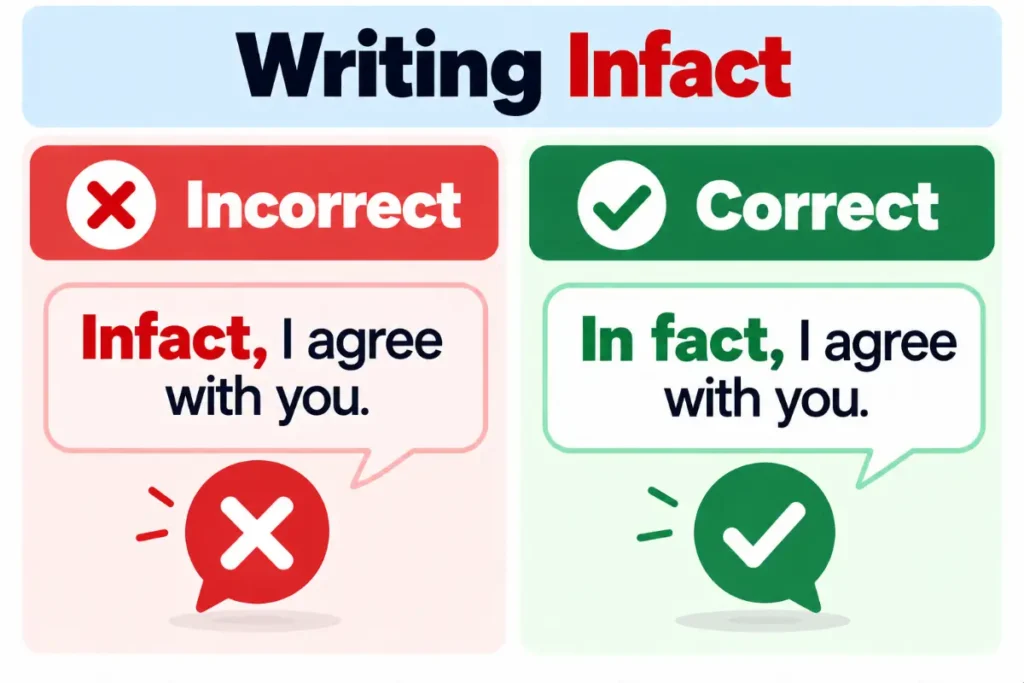
| Infact, I agree with you. | In fact, I agree with you. | The expression must contain two words. |
| The answer is infact correct. | The answer is in fact correct. | Separate the phrase even when it appears in the middle. |
| In fact I enjoyed the show. | In fact, I enjoyed the show. | Add a comma after the introductory phrase. |
| We were late, in fact, we missed the opening speech. | We were late. In fact, we missed the opening speech. | Use a period to avoid a comma splice. |
| She is in fact, a good leader. | She is, in fact, a good leader. | Commas around the interrupting phrase make the structure clearer. |
Common Mistakes and Misspellings
Even confident writers can make small mistakes with familiar expressions. These are the most common problems to watch for.
Writing Infact as One Word
The main mistake is combining the two words.
Incorrect: Infact, the answer was correct.
Correct: In fact, the answer was correct.
The solution is simple. Remember that the expression consists of two separate words in standard English.
Using In Fact Too Often
Repeating the phrase can make your writing sound stiff.
Example: In fact, the meeting started late. In fact, the speaker arrived after noon. In fact, the audience waited for twenty minutes.
The sentences are understandable, but the repeated opening becomes distracting.
A better version is The meeting started late because the speaker arrived after noon. The audience waited for twenty minutes.
The revised version preserves the information while creating a smoother flow.
Adding a Comma in the Wrong Place
Some writers insert commas without considering the sentence structure.
Incorrect: The answer is in fact, correct.
Better: The answer is, in fact, correct.
Also acceptable in many contexts: The answer is in fact correct.
The first corrected version clearly separates the interrupting phrase. The second integrates it into the sentence.
Confusing Emphasis With Evidence
The phrase can strengthen a statement, but it does not prove that the statement is true.
Example: In fact, this is the best product on the market.
The phrase emphasizes the claim. However, readers still need reliable evidence to judge the statement.
A stronger version is In fact, the product received higher customer satisfaction scores than the other models in the study.
The revised sentence offers a specific basis for the claim. In professional and academic writing, supporting evidence is more persuasive than emphasis alone.
Using the Phrase When Another Transition Fits Better
Not every sentence needs this expression.
Incorrect choice: The temperature dropped below freezing. In fact, the pipes burst because of the cold.
The second sentence describes a consequence. A clearer version is The temperature dropped below freezing. As a result, the pipes burst.
The revised transition communicates cause and effect more directly.
Easy Memory Tips
Remembering the correct spelling does not require a complicated grammar lesson. A few simple habits can help you avoid the mistake.
Think of Two Separate Words
The easiest trick is to picture the phrase as two units.
In + fact = in fact.
You would not normally combine these words in standard writing just because they appear together in speech. Keeping the space between them is the essential rule.
Replace It With Actually
Try replacing the expression with actually. If the sentence still makes sense, you are probably using the phrase correctly.
Example: In fact, the store is open.
You can rewrite this as Actually, the store is open.
The meaning remains close enough to help you recognize the expression’s function.
However, the two expressions do not work perfectly in every context. Use this trick as a spelling aid rather than a universal grammar test.
Read the Sentence Aloud
Reading your sentence aloud can help you hear how the phrase connects to the rest of the thought.
Example: I thought the event was canceled. In fact, it starts at six.
The pause after the introductory phrase helps you notice where the comma belongs.
Still, trust standard spelling rules rather than pronunciation alone. Spoken English often blends words together.
Use a Quick Editing Check
Before submitting an assignment or sending a professional email, search your draft for the incorrect spelling.
- Search for infact.
- Replace each incorrect occurrence with in fact.
- Review the surrounding sentence for punctuation.
- Read the paragraph again to check for repetition.
This quick check can catch a common spelling error before it reaches your reader.
American and British English Usage
The spelling of this expression does not change between American and British English. Both varieties use in fact as two separate words.
| Writing feature | American English | British English |
|---|---|---|
| Correct spelling | In fact | In fact |
| Incorrect standard form | Infact | Infact |
| Meaning | Actually or in reality | Actually or in reality |
| Introductory punctuation | In fact, she agreed. | In fact, she agreed. |
| Common contexts | Essays, emails, articles, conversation | Essays, emails, articles, conversation |
The same spelling rule applies in other major varieties of English. Regional differences may affect vocabulary, pronunciation, and some punctuation preferences, but they do not make infact the standard spelling.
For American readers, use in fact in school papers, workplace communication, website content, and everyday messages. The expression is familiar and suitable for both formal and informal situations.
Related Grammar and Usage Notes
Understanding how the phrase works can help you make better choices throughout your writing.
Is In Fact an Adverb
The entire expression often functions as an adverbial phrase or a sentence adverbial. It modifies the meaning of a statement by adding emphasis, clarification, or a connection to the previous thought.
Example: In fact, the team exceeded its goal.
The phrase comments on the statement as a whole rather than describing a single action in the way that quickly describes how someone moves.
Its grammatical role depends on how it appears in the sentence, but its basic function remains clear. It helps the writer frame the information that follows.
Is In Fact a Transition Word
Yes. Writers often use it as a transitional expression because it connects one idea with another.
Example: The building looks old. In fact, it was renovated last year.
The phrase connects the first impression with information that adds or changes the reader’s understanding.
However, it does not show every kind of relationship. Use therefore for a result, however for a contrast, and for example to introduce an illustration.
Is In Fact Formal or Informal
The phrase works in both formal and informal English.
In a professional report, you might write In fact, the findings support the original recommendation.
In a casual conversation, you might say In fact, I already bought the tickets.
The phrase itself is not overly formal. The rest of the sentence determines how formal the message feels.
Can You Start a Paragraph With In Fact
Yes. You can begin a paragraph with the phrase when the new paragraph builds on the previous discussion or adds information that changes the reader’s understanding.
Example:
The original estimate suggested that the repairs would take two weeks.
In fact, the work was completed in just eight days.
The second paragraph adds a meaningful detail. This structure works best when the relationship between the paragraphs is clear.
Can You Use In Fact in Academic Writing
Yes, but use it with a purpose. Academic writing benefits from precise claims and clear evidence. The phrase can introduce a correction, emphasize a finding, or connect related statements.
Example: The initial results showed a modest improvement. In fact, the final analysis revealed a larger increase among participants who completed the program.
The phrase helps introduce the more detailed finding. The data itself must support the claim.
Avoid using the expression as a substitute for research or proof. Strong academic writing explains the evidence behind its conclusions.
Does In Fact Have a Hyphen
No. Standard English writes the expression as two words without a hyphen.
Correct: In fact, the plan worked.
Incorrect: In fact, written with a hyphen between the words.
The phrase does not require a hyphen when it appears at the beginning, middle, or end of a sentence.
What Is the Origin of In Fact
The expression developed from the ordinary English words in and fact. The noun fact ultimately comes from Latin factum, meaning something done or an event, through the history of English and French.
In modern English, fact commonly refers to something known or established to be true. The phrase in fact developed a broader use that lets speakers emphasize reality, clarify a statement, or introduce additional information.
You do not need to know its history to spell it correctly. Still, understanding the meaning of the individual words can help explain why the expression refers to what is actually true.
Expert Editor Insight
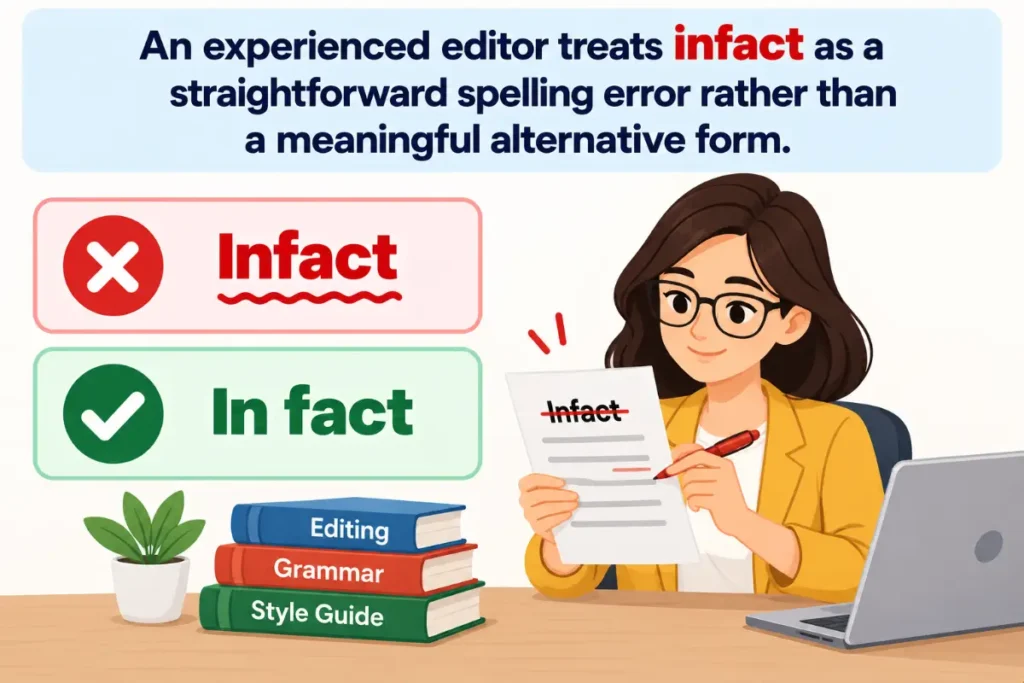
An experienced editor treats infact as a straightforward spelling error rather than a meaningful alternative form. The confusion usually comes from connected speech and fast typing, not from a real difference in meaning. Editing and spelling tools may flag the single word because standard English recognizes the expression as two words. The best fix is simple: restore the space and check the surrounding sentence to make sure the phrase actually adds emphasis or clarification.
Key Takeaways
- The correct spelling is in fact.
- Write the expression as two words without a hyphen.
- Use it to emphasize information, correct an assumption, or add clarification.
- Place a comma after the phrase when it introduces a sentence.
- Use commas around the phrase in the middle when the sentence structure and emphasis call for them.
- Avoid repeating the expression too often because repetition can make writing less natural.
- Choose transitions carefully. In fact adds or clarifies information, while therefore introduces a result.
- American and British English follow the same spelling rule.
- Use the phrase in casual and formal writing when it serves a clear purpose.
- Review your final draft for spelling and punctuation errors before publishing or submitting it.
Conclusion
Infact or in fact has a simple answer. In fact is the correct spelling in standard American English. Keep the two words separate whenever you use the expression to emphasize a point, clarify information, or correct a mistaken belief. The incorrect form infact should not appear in polished writing.
The phrase works naturally in school assignments, professional emails, articles, and everyday conversation. Add a comma after it when it introduces a sentence, and use commas around it in the middle when they improve clarity. Choose the expression because it strengthens your message, not just to make a sentence sound more emphatic.
With this rule in mind, you can write with greater confidence and avoid a common spelling mistake. Remember the simple pattern: in plus fact equals in fact. A small space makes the difference between a common error and correct English.
Frequently Asked Questions
1. Is It Infact or In Fact?
In fact is correct. Standard English treats it as two separate words. The spelling infact is a common mistake and should be corrected in formal and informal writing.
2. What Does In Fact Mean?
The expression means actually, in reality, or as a matter of fact. Writers use it to emphasize information, correct a misunderstanding, or introduce a relevant detail.
3. Should I Put a Comma After In Fact?
Usually, yes, when the phrase begins a sentence. For example, In fact, we finished early. When the phrase appears in the middle, punctuation depends on sentence structure and emphasis.
4. Can I Use In Fact in Formal Writing?
Yes. The expression works in academic papers, reports, professional emails, and other formal documents. Use it when it clarifies a point or introduces meaningful information.
5. Is In Fact One Word or Two Words?
It is two words. Always leave a space between in and fact in standard English writing.
6. Is In Fact the Same as Actually?
The meanings often overlap. Both expressions can clarify information or correct an assumption. However, in fact can also introduce evidence or emphasize a connection with a previous statement.
7. Can I Start a Sentence With In Fact?
Yes. Starting a sentence with the phrase is common and grammatically acceptable. Add a comma after it when it introduces the sentence.
8. Is Infact Ever Correct?
No. Infact is not the standard spelling of this expression in American English or British English. Use in fact instead.
9. Does In Fact Need a Hyphen?
No. The phrase consists of two words and does not need a hyphen. Write in fact in every standard sentence position.
10. What Is a Simple Example of In Fact?
I thought the store was closed. In fact, it is open until nine.
The phrase introduces information that corrects the speaker’s original assumption.
11. Is In Fact a Transition Phrase?
Yes. It can connect ideas by adding clarification, emphasis, or information that changes the reader’s understanding. Choose another transition when you need to show a result or introduce an example.
12. How Can I Remember the Correct Spelling?
Remember that the expression contains the preposition in and the noun fact. Keep them separate, and check your writing for the common one word mistake.

Confusing Words, Spelling & Word Choice
Claire Whitmore is a U.S.-based English editor who writes about commonly confused words, spelling differences, and word choice. Her work helps readers understand subtle distinctions between similar-looking words through simple definitions, practical examples, and modern usage guidance in both American and British English.