
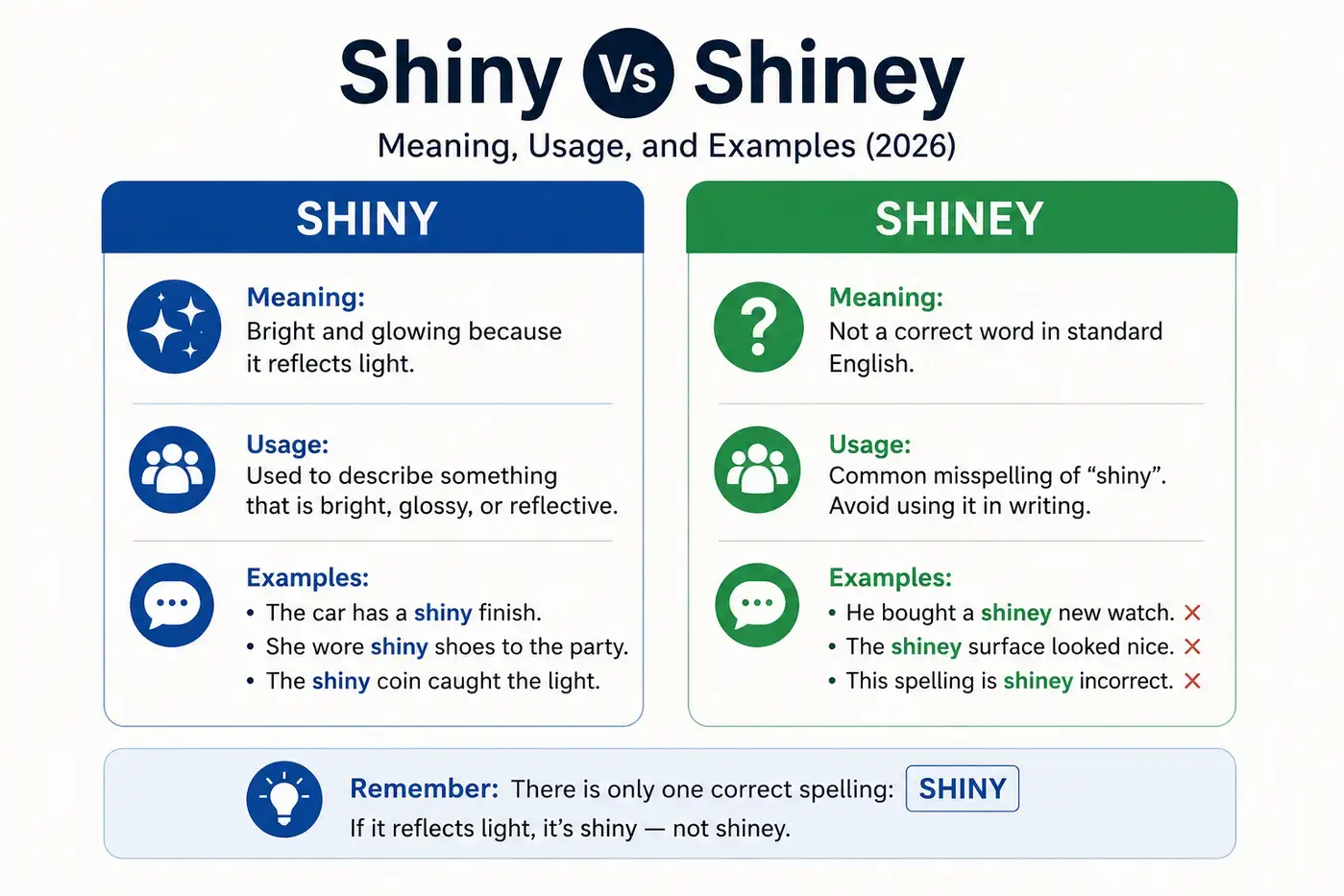
Shiny vs shiney is a common spelling question because the word comes from shine. At first glance, adding y to shine may seem like it should produce shiney. English spelling does not always work that way. When shine becomes an adjective with y, the final silent e is removed before y is added. The correct result is shiny.
This small spelling rule causes a surprisingly large number of mistakes. People often write shiney because they can see the base word shine inside it. The spelling looks logical at first. However, standard English uses shiny in dictionaries and everyday writing. Cambridge defines shiny as an adjective describing something bright because it reflects light.
Once you connect shiny with the base word shine and understand the spelling change, the correct form becomes much easier to remember. The same pattern appears in other English words formed by removing a final silent e before adding y. This guide explains the spelling, meaning, pronunciation, grammar, word formation, common mistakes, examples, and related forms so you can use the word confidently.
Shiny Vs Shiney Quick Definition
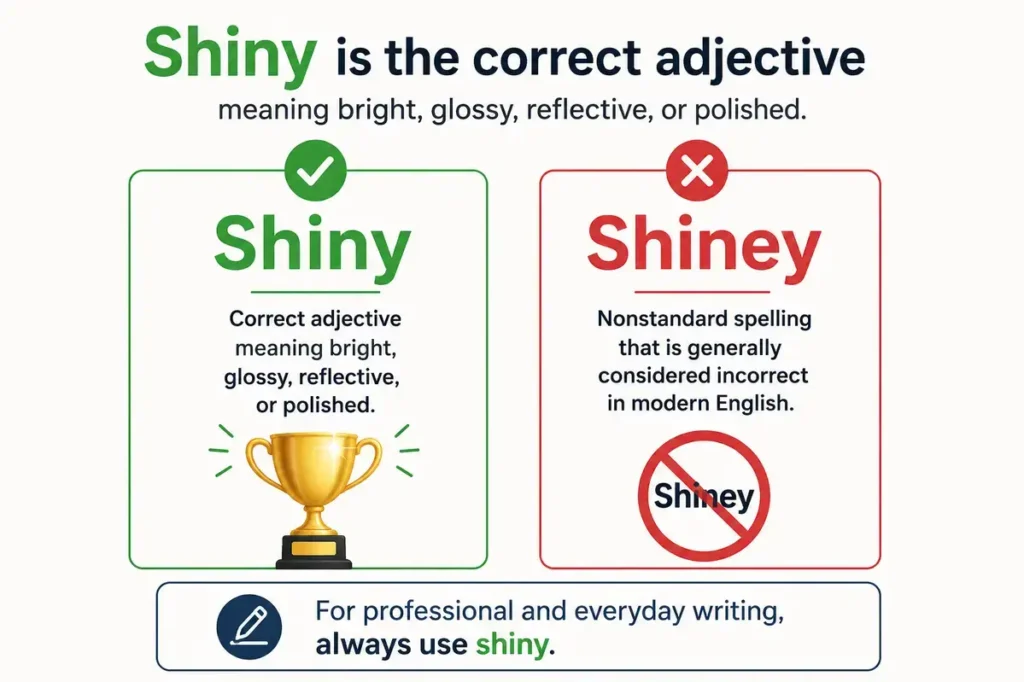
Shiny is the correct adjective meaning bright, glossy, reflective, or polished. Shiney is a nonstandard spelling that is generally considered incorrect in modern English. For professional and everyday writing, always use shiny.
Short Answer
Shiny is the correct spelling. Shiney is a misspelling and should not be used in standard English. Shiny is an adjective that describes something bright or glossy because it reflects light. For example, you can have shiny shoes, shiny hair, or a shiny metal surface. The word comes from the verb shine with the suffix y.
Table of Contents
- The correct spelling.
- What shiny means.
- Why shiney is incorrect.
- How shiny is formed from shine.
- How to use shiny in a sentence.
- Shiny as an adjective.
- Shiny and shine compared.
- Pronunciation of shiny.
- American and British English.
- Comparative and superlative forms.
- Common spelling mistakes.
- Common usage mistakes.
- Real life examples.
- Memory tips.
- Related words and expressions.
- Professional writing tips.
- Frequently asked questions.
- Key takeaways.
- Conclusion.
The Correct Spelling
The correct spelling is shiny.
The spelling shiney is incorrect in standard English. If you are writing an email, school assignment, article, report, product description, or professional document, use shiny.
The difference is only one letter, but that letter changes the spelling from the accepted English form to a misspelling.
Consider these examples.
- She bought a shiny new purse.
- The floor looked shiny after it was cleaned.
- His shoes were clean and shiny.
- Sunlight reflected from the shiny surface.
- The children collected shiny stones from the beach.
In every example, shiny describes something that has a bright or reflective surface.
A useful rule is simple.
Shine + y does not become shiney. It becomes shiny.
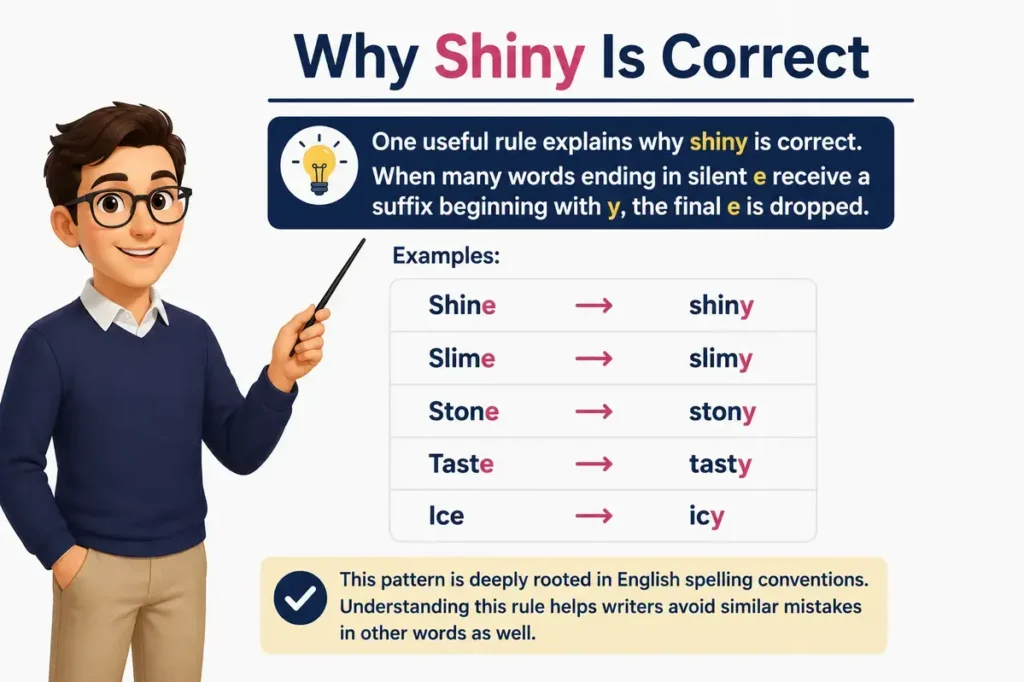
The final e in shine is dropped before the suffix y is added.
What Shiny Means
Shiny is an adjective. It describes something that reflects light and therefore looks bright, polished, glossy, or smooth.
Cambridge gives examples such as shiny hair, shiny black shoes, and a shiny silver dollar. Its American English dictionary also identifies shiny as an adjective and gives the same basic meaning of being bright because a surface reflects light.
The word can describe many different things.
- A shiny car can reflect sunlight from its polished surface.
- Shiny shoes can look polished and well cared for.
- Shiny hair can reflect light and appear glossy.
- A shiny table may have a polished finish.
- Shiny wrapping paper can reflect light strongly.
- A shiny coin can look bright after being polished.
- Shiny leaves may have naturally glossy surfaces.
- A shiny metal object can reflect its surroundings.
The word does not always mean that something is perfectly smooth. A surface can have an uneven shape and still look shiny if it reflects enough light.
Shiny can also have a figurative meaning in informal English. For example, someone may call a new product shiny to suggest that it looks attractive or exciting because it is new. This use is more casual than the literal meaning.
Why Shiney Is Incorrect
The spelling shiney seems reasonable because shine is the base word. A person may naturally think that adding y gives shiney.
English spelling does not simply attach suffixes without changing the base word. Some word building patterns require a small spelling adjustment.
With shiny, the final silent e of shine disappears before the y is added.
The process is:
- Start with shine.
- Remove the final silent e.
- Add y.
- The result is shiny.
This gives us the standard spelling.
The same basic idea can be seen in words such as sleepy, noisy, and smoky. Their spelling does not preserve every letter of the base form in a simple mechanical way.
The mistake becomes especially easy to make when you think about pronunciation. Shine ends with a long i sound. Shiny begins with the same long i sound but adds another syllable. The spelling can therefore feel less obvious than the pronunciation.
The safest approach is not to spell the adjective from sound alone. Remember the established form: shiny.
How Shiny Is Formed From Shine
Shine is an English verb and noun. As a verb, it can mean to give off light, reflect light, make something bright, or perform very well. As a noun, it can refer to brightness or gloss.
Shiny is formed from shine and functions as an adjective.
The spelling change matters because shine already ends in a silent e. When the adjective is formed, that e is removed.
This gives a useful word family.
- Shine is the base word.
- Shiny is the adjective.
- Shinier is the comparative form.
- Shiniest is the superlative form.
- Shining is the present participle.
- Shone and shined are past forms of shine in different uses.
Cambridge lists shinier and shiniest as the comparative and superlative forms of shiny.
This word family shows why shiney does not fit the standard pattern. The established adjective is shiny.
How to Use Shiny in a Sentence
Shiny normally comes before a noun when it directly describes that noun.
For example:
- She wore shiny black shoes.
- We bought a shiny red balloon.
- The mechanic polished the shiny metal.
- He gave me a shiny new coin.
- The kitchen has shiny white cabinets.
It can also appear after a linking verb.
- The floor looks shiny.
- Her hair is shiny.
- The new car seems shiny in the sunlight.
- The surface became shiny after polishing.
In these sentences, shiny remains an adjective. It describes the condition or appearance of the subject.
A simple test can help. If the word answers the question what is it like, shiny is probably functioning as an adjective.
Consider this sentence.
The table is shiny.
Ask, What is the table like.
The answer is shiny.
That confirms its adjective role.
Shiny as an Adjective
Shiny is most often used to describe appearance.
It can describe physical objects and surfaces.
- Shiny glass reflects the light.
- The shiny floor made the room look brighter.
- She placed the shiny vase on the shelf.
- The new shoes have a shiny finish.
- The polished wood looks shiny.
It can also describe natural things.
- The bird had shiny feathers.
- The leaves looked shiny after the rain.
- His hair was naturally shiny.
- The fish had shiny scales.
- The beetle had a shiny shell.
The word can describe color and surface together.
- A shiny black car.
- A shiny silver watch.
- A shiny red apple.
- A shiny blue jacket.
- A shiny gold ornament.
In these examples, shiny does not describe the color itself. It describes the surface or appearance of the object.
That distinction matters. A black car can be shiny or dull. A silver watch can be shiny or matte. A red apple can be glossy or soft looking.
Shiny And Shine Compared
Shiny and shine are related, but they do different grammatical jobs.
Shine is commonly used as a verb.
For example:
The sun shines through the window.
Here, shines tells us what the sun does.
Shine can also be a noun.
The table has a beautiful shine.
Here, shine names the quality of brightness or gloss.
Shiny is an adjective.
The table has a shiny surface.
Here, shiny describes the table surface.
The difference becomes clearer in this comparison.
This distinction is useful because many spelling problems begin with confusion about related word forms.
If you need a word to describe a noun, shiny is usually the form you want.
If you need a noun that refers to brightness or gloss, shine can work as a noun.
Pronunciation Of Shiny
Shiny is pronounced with two syllables.
The pronunciation is commonly represented as /ˈʃaɪni/. Cambridge gives this pronunciation for both British and American English.
The first syllable receives the main stress.
The pronunciation helps explain why the word can sometimes be misspelled. The spelling of the first part closely resembles shine, while the final y represents the ending that creates the second syllable.
Even so, pronunciation should not be used as the only guide to spelling. English has many words whose sounds do not reveal every spelling detail.
For writing purposes, remember the visual form as well as the sound.
American And British English
Shiny is standard in both American and British English.
There is no standard American spelling shiney and British spelling shiny distinction here. The correct form is shiny in both varieties.
Cambridge lists shiny in both its British and American dictionary resources. It also gives the same basic meaning in each variety.
That means you do not need to change the spelling based on your audience.
For example, these forms are correct in both American and British writing.
- shiny shoes.
- shiny hair.
- shiny surface.
- shiny metal.
- shiny finish.
If you are writing for a US audience, use shiny.
If you are writing for a British audience, use shiny.
The spelling remains the same.
Comparative And Superlative Forms
Because shiny is an adjective, it can have comparative and superlative forms.
The comparative form is shinier.
The superlative form is shiniest.
For example:
- This floor is shinier than the old one.
- Her shoes look shinier after polishing.
- The new car is shinier than my old car.
- That was the shiniest object in the display.
- This metal has the shiniest finish in the room.
Notice another spelling change.
Shiny becomes shinier rather than shinyer.
Shiny becomes shiniest rather than shinyest.
The y changes to i before the comparative or superlative ending is added.
This is another common English spelling pattern.
The forms are:
- shiny.
- shinier.
- shiniest.
Understanding the entire word family makes spelling easier because you stop treating each word as an isolated item.
Common Spelling Mistakes
The most common mistake is writing shiney instead of shiny.
For example:
Incorrect: The floor looks shiney.
Correct: The floor looks shiny.
Incorrect: She has shiney hair.
Correct: She has shiny hair.
Incorrect: He bought a shiney new car.
Correct: He bought a shiny new car.
Another mistake is writing shiny when you actually need shine.
For example:
Incorrect: The shoes need a shiny.
Correct: The shoes need a shine.
Here, shine is a noun. The sentence refers to the brightness or polish that the shoes need.
Another example:
Incorrect: Please shiny the shoes.
Correct: Please shine the shoes.
Here, shine is the verb.
These errors show that spelling and grammar are closely connected. Choosing the right word form often solves both problems at once.
Common Usage Mistakes
Spelling is only one part of using the word correctly.
A frequent mistake is assuming shiny always means new. It does not.
Something can be old and shiny.
For example:
The old silver coin was still shiny after careful polishing.
The word describes the surface appearance. It does not automatically describe age.
Another mistake is assuming shiny means wet. Water can make some surfaces look shiny, but shiny does not mean wet.
For example:
The polished floor was shiny but completely dry.
Another mistake is using shiny as a noun.
You would normally say:
The table has a beautiful shine.
Not:
The table has a beautiful shiny.
Shiny is an adjective, so it needs a noun or linking structure to complete its role.
You can say:
The table is shiny.
You can also say:
The table has a beautiful shine.
The first sentence uses the adjective. The second uses the noun.
Real Life Examples
Real world writing gives you plenty of chances to use shiny naturally.
Clothing
Shiny can describe fabrics, shoes, buttons, accessories, and other parts of clothing.
- She wore a shiny black jacket to the party.
- His shiny shoes looked freshly polished.
- The dress had a shiny silver finish.
- The handbag had shiny metal clasps.
Each example focuses on reflected light or a glossy appearance.
Cars
Car descriptions often use shiny to describe polished paint or metal.
- His shiny blue car stood outside the house.
- The dealership displayed several shiny new vehicles.
- She washed the car until the surface looked shiny.
- The chrome trim was bright and shiny.
The word works naturally in product descriptions because appearance matters when people describe cars.
Hair
Shiny is also common when describing hair.
- Her hair looked shiny after the treatment.
- He has naturally shiny black hair.
- The conditioner left my hair soft and shiny.
- The model had long shiny hair.
Here, shiny generally means that the hair reflects light and looks glossy.
Household Objects
You can use shiny for furniture, appliances, floors, kitchen surfaces, and decorations.
- The kitchen had shiny white cabinets.
- I cleaned the shiny countertop.
- The lamp has a shiny metal base.
- The newly polished table looked shiny.
Nature
The word is not limited to manufactured objects.
- The leaves were shiny after the rain.
- A shiny beetle crawled across the branch.
- The fish had shiny scales.
- The wet rocks looked shiny in the sunlight.
The context tells you why the surface reflects light.
Memory Tips
A good spelling memory trick is to focus on the base word and the ending.
Think:
shine becomes shiny.
Do not keep the final e.
You can also remember the phrase:
A shiny thing shines.
The two words are closely connected in meaning, but shiny is the adjective you use to describe the thing.
Another useful trick is to picture a shiny object and say the word silently as you write it. The correct spelling has no e between n and y.
You can also connect shiny with shinier and shiniest.
- shiny.
- shinier.
- shiniest.
Seeing the whole family makes shiney look less natural.
If you are unsure during editing, pause and ask yourself one question.
Am I describing something as bright or glossy.
If the answer is yes, shiny is probably the form you need.
Related Words And Expressions
Shiny belongs to a larger group of words connected with light, reflection, brightness, and appearance.
Glossy
Glossy often means smooth and shiny.
For example:
The magazine has a glossy cover.
Glossy can suggest a polished or smooth visual finish.
Polished
Polished can mean made smooth and bright through rubbing or treatment.
For example:
He wore polished shoes.
Polished can also describe quality or style in a figurative sense.
Bright
Bright has a broader meaning. It can describe strong light, vivid color, intelligence, or a cheerful quality.
For example:
The room was bright.
This does not necessarily mean the surfaces were shiny.
Sparkling
Sparkling can describe something that gives off many small points of light.
For example:
The water looked sparkling in the morning sun.
Sparkling often creates a more lively visual impression than shiny.
Gleaming
Gleaming suggests a strong clean shine.
For example:
The freshly polished floor was gleaming.
The word can sound more vivid than shiny.
Lustrous
Lustrous is a more formal word that describes something with a soft or attractive shine.
For example:
The fabric had a lustrous appearance.
This word appears more often in formal descriptions, product writing, fashion writing, and literary contexts.
Shiny And Glossy
Both words overlap, but they are not always interchangeable.
Shiny is a broad everyday word for something that reflects light.
Glossy often suggests a smooth and polished surface with a noticeable sheen.
Consider these examples.
The apple has shiny skin.
The magazine has a glossy cover.
Both words relate to reflection, but glossy often carries a stronger sense of surface finish.
In ordinary conversation, shiny is usually the simpler choice.
In product descriptions, glossy can be more precise when the finish itself matters.
Shiny And Sparkly
Shiny and sparkly describe different visual effects.
A shiny object reflects light from its surface.
A sparkly object appears to produce many small flashes or points of light.
For example:
The shiny floor reflected the ceiling lights.
The sparkly dress caught the light from every direction.
A surface can be both shiny and sparkly, but the words focus on different qualities.
This distinction helps you choose more precise vocabulary.
Formal And Informal Usage
Shiny is perfectly normal in formal and informal English.
You can use it in everyday conversation.
My new shoes are shiny.
You can also use it in professional writing.
The product features a shiny protective coating.
You may see shiny in technical descriptions when the surface appearance matters.
For example:
The sample developed a shiny surface after treatment.
There is no need to replace shiny with a more complicated word simply to sound formal. Clear language is often the better choice.
If the context requires technical precision, a more specific term such as glossy, reflective, polished, or lustrous may fit better.
Professional Writing Tips
Professional writers should use shiny when the intended meaning is clear.
Product descriptions often benefit from specific surface language.
Instead of writing:
The object looks nice.
You can write:
The object has a smooth shiny finish.
That sentence gives the reader useful information.
However, avoid using shiny as empty praise. A strong product description should explain what makes the surface shiny.
For example:
The stainless steel has a shiny finish that reflects light and gives the appliance a polished appearance.
This gives the reader more information than simply calling the appliance shiny.
In technical writing, choose the word that describes the actual surface property you mean.
If the surface reflects light strongly, shiny may work.
If it reflects a strong beam of light, reflective may be the better term.
Good writing is not about choosing the most impressive word. It is about choosing the word that says exactly what you mean.
Why People Write Shiney
People usually write shiney because they connect the spelling directly to shine.
That mistake is understandable. The pronunciation of shiny also makes the relationship between the words obvious.
Another reason is that English has many suffixes that can be added without changing the base word much. Writers may therefore assume the same thing happens here.
But English word formation has many spelling patterns. A final silent e can disappear when another ending is added.
Once you know this pattern, the spelling becomes much easier.
The important point is that shiney is not a separate standard adjective with a special meaning. It is normally just a misspelling of shiny.
Is Shiney Ever Acceptable
In standard English writing, use shiny.
You may occasionally see shiney online, in usernames, business names, character names, informal posts, or other creative contexts. A person can intentionally alter a spelling for a name or brand. That does not make the spelling the standard English adjective.
For school, work, professional writing, edited content, and general English usage, choose shiny.
A proper name or deliberately stylized name is a separate matter because names can use unusual spellings. The ordinary adjective remains shiny.
Common Sentence Corrections
Here are some quick corrections that show the pattern.
- Incorrect: The new shoes are shiney.
Correct: The new shoes are shiny. - Incorrect: She has shiney hair.
Correct: She has shiny hair. - Incorrect: I bought a shiney jacket.
Correct: I bought a shiny jacket. - Incorrect: The kitchen floor is very shiney.
Correct: The kitchen floor is very shiny. - Incorrect: The coin became shiney after cleaning.
Correct: The coin became shiny after cleaning. - Incorrect: He polished the table until it was shiney.
Correct: He polished the table until it was shiny. - Incorrect: The surface looks shiney in the sunlight.
Correct: The surface looks shiny in the sunlight. - Incorrect: They installed a shiney metal panel.
Correct: They installed a shiny metal panel.
These corrections all follow the same rule. The standard adjective is shiny.
A Simple Grammar Test
If you are unsure about the word, place it before a noun.
Try:
shiny shoes.
shiny car.
These combinations sound natural because shiny is an adjective.
Now try the same test with shine.
shine shoes.
shine car.
These do not work in the same way because shine is not the adjective in these phrases.
You can use shine as a verb in a sentence such as:
I will shine my shoes.
You can also use it as a noun.
The shoes have a nice shine.
This simple test helps separate the related forms.
Related Grammar Notes
Shiny follows normal adjective grammar.
It can appear before a noun.
The shiny floor was clean.
It can appear after a linking verb.
The floor was shiny.
It can be modified by words such as very, extremely, quite, and incredibly.
The floor was very shiny.
The surface looked extremely shiny.
It can also form comparisons.
This floor is shinier than the old one.
That floor is the shiniest one in the building.
The adjective therefore behaves like many other regular descriptive adjectives.
Expert Language Insight On Shiny Vs Shiney
As an editor, I’ve seen thousands of spelling mistakes, and shiney appears surprisingly often. The reason is simple. People trust what looks logical. When writers see the word shine, they naturally expect the adjective to remain close to the original spelling. That’s a reasonable assumption. Unfortunately, English spelling doesn’t always reward logic.
The language developed over centuries through influences from Germanic languages, French, Latin, and countless regional variations. As a result, spelling patterns can feel inconsistent. Native speakers almost always write shiny. Most don’t consciously remember the spelling rule. They simply recognize the word because they’ve seen it repeatedly in books, advertisements, websites, and everyday communication.
Key Takeaways
- Shiny is the correct standard spelling.
- Shiney is a misspelling in standard English.
- Shiny is an adjective.
- Shiny describes something that reflects light and looks bright or glossy.
- The word comes from shine with the final silent e removed before y is added.
- Shiny works in both American and British English.
- The pronunciation is commonly represented as /ˈʃaɪni/.
- The comparative form is shinier.
- The superlative form is shiniest.
- Shine can function as a verb or noun.
- Shiny can describe objects, surfaces, hair, clothing, cars, plants, animals, and many other things.
- The easiest memory rule is to remember shine becomes shiny.
Conclusion
Shiny vs shiney has a simple answer. Shiny is the correct spelling and shiney is a misspelling in standard English and Shiny is an adjective that describes something bright or glossy because its surface reflects light.
The spelling makes sense once you connect the word to shine. Remove the final silent e from shine and add y to get shiny. This same word family also gives you shinier and shiniest.
The best way to remember the difference is to keep the correct form in your everyday vocabulary. Write shiny shoes, shiny hair, shiny metal, and shiny surfaces. When you need the adjective, choose shiny every time.
Frequently Asked Questions
Is shiny the correct spelling?
Yes. Shiny is the correct standard English spelling for the adjective meaning bright or glossy because a surface reflects light. Shiney is a misspelling and should not be used in standard writing.
Is shiney a real English word?
Shiney is not the standard spelling of the adjective. In ordinary English writing, use shiny. An unusual spelling may appear in a name, username, or creative context, but that does not make it the standard adjective.
Why is shiny spelled without the e?
The final silent e in shine is removed before the adjective ending y is added. That produces shiny rather than shiney.
What does shiny mean?
Shiny means bright or glossy because something reflects light from its surface. You can describe shoes, hair, metal, glass, cars, leaves, coins, and many other things as shiny.
Is shiny an adjective?
Yes. Shiny is an adjective because it describes a quality or appearance. For example, in the sentence The car is shiny, the word shiny describes the car.
Is shiny American or British English
Shiny is standard in both American and British English. The spelling does not change between these varieties.
How do you pronounce shiny?
Shiny has two syllables and is commonly represented as /ˈʃaɪni/. The first syllable receives the main stress. Cambridge gives this pronunciation for both American and British English.
What is the comparative form of shiny?
The comparative form is shinier. For example, This car is shinier than mine.
What is the superlative form of shiny?
The superlative form is shiniest. For example, That was the shiniest car in the parking lot.
What is the difference between shine and shiny?
Shine can function as a verb or noun. Shiny is an adjective. You can say The sun shines, The table has a shine, or The table is shiny.
Can you use shiny for hair?
Yes. Shiny is commonly used to describe hair that reflects light and looks glossy. For example, She has shiny hair.
Can shiny describe something old?
Yes. Shiny describes appearance rather than age. An old coin can become shiny after careful polishing.

Confusing Words, Spelling & Word Choice
Claire Whitmore is a U.S.-based English editor who writes about commonly confused words, spelling differences, and word choice. Her work helps readers understand subtle distinctions between similar-looking words through simple definitions, practical examples, and modern usage guidance in both American and British English.