
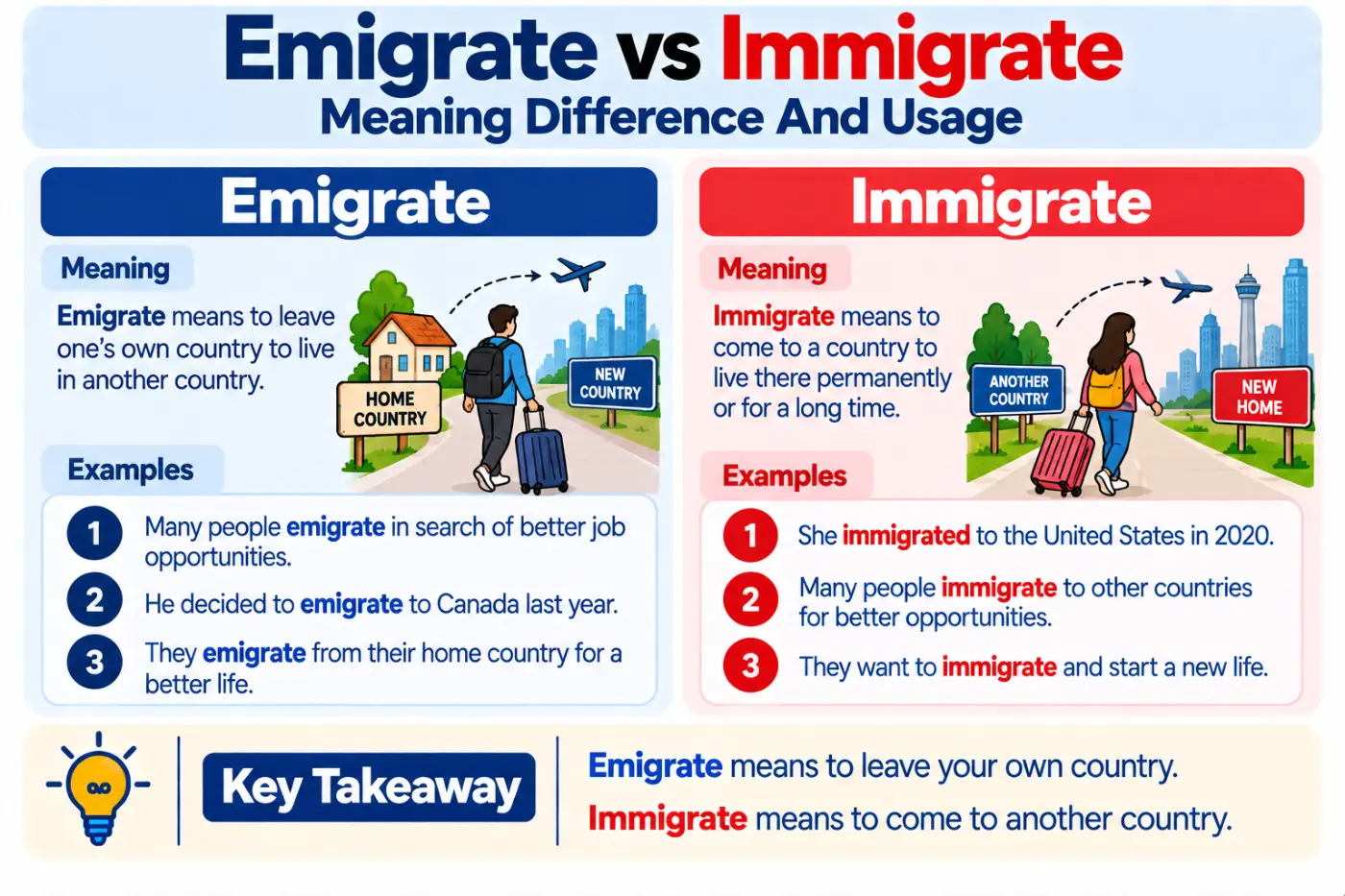
The difference in emigrate vs immigrate comes down to the direction of movement. Emigrate means to leave your own country to live somewhere else. Immigrate means to enter another country to live there. Both words describe the same international move but they look at it from different sides.
For example if Maria leaves Mexico and moves permanently to the United States she emigrates from Mexico. From the American point of view she immigrates to the United States. The event is the same but the perspective changes.
This distinction often causes confusion because the two words share the same Latin root and both describe people moving from one country to another. The easiest way to separate them is to focus on the direction. Think of emigrate as moving out and immigrate as moving in. Once you understand that simple idea you can use both words naturally in conversation academic writing news reports immigration documents and everyday communication. This guide explains their meanings grammar pronunciation history common mistakes regional usage and practical examples.
Quick Definition
Emigrate means to leave your home country and move to another country to live. Immigrate means to enter a foreign country and move there to live. A person can emigrate from one country and immigrate to another during the same move. The difference depends on the direction and point of view.
Quick Answer
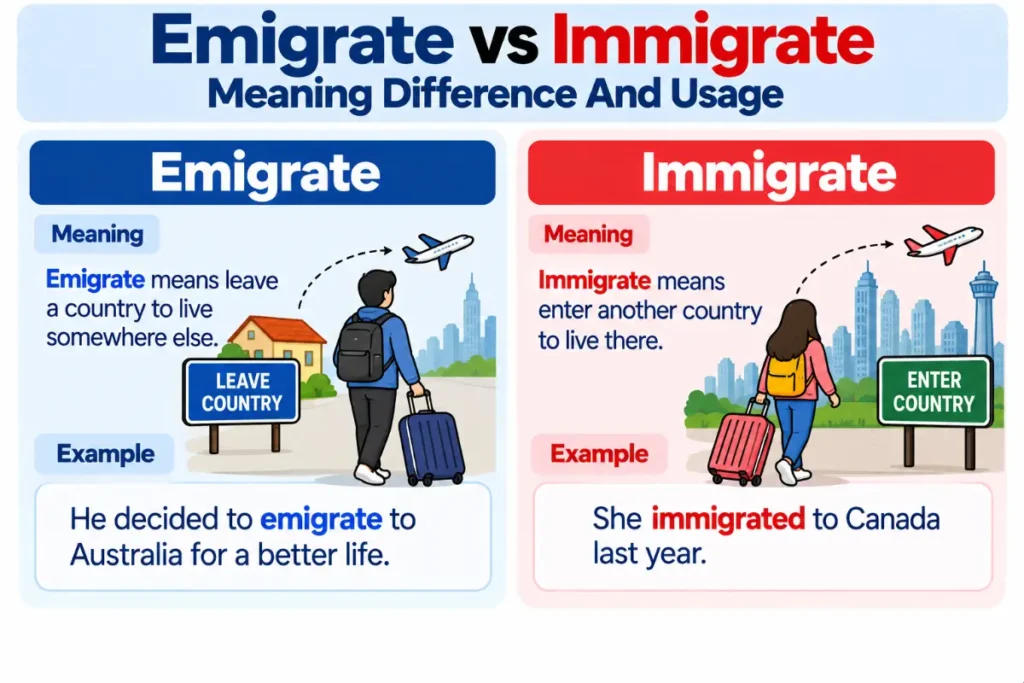
Emigrate means leave a country to live somewhere else. Immigrate means enter another country to live there.
For example, if someone leaves India and moves to Canada, that person emigrates from India and immigrates to Canada. The words describe two sides of the same international move.
A simple memory trick is this. Emigrate means exit. Immigrate means enter.
Comparison Table Emigrate And Immigrate
| Form | Meaning | Part of Speech | Origin | Usage Frequency | Formality | Common Contexts | Example |
|---|---|---|---|---|---|---|---|
| Emigrate | To leave one country and settle in another | Verb | Latin through French and English | Common | Neutral and formal | Migration, history, news, personal writing | Her family emigrated from Italy. |
| Immigrate | To enter another country and settle there | Verb | Latin through French and English | Common | Neutral and formal | Immigration, government, news, history | Her family immigrated to Canada. |
Both words are standard English. Neither is a misspelling of the other. The important issue is choosing the word that matches the direction of movement.
Meaning And Definition
Meaning Of Emigrate
Emigrate means to leave your country of origin or residence and move to another country with the intention of living there.
The focus is on departure.
Consider this sentence.
James emigrated from Ireland in 2015.
The sentence focuses on James leaving Ireland.
You can usually think of emigrate as looking backward toward the country a person leaves. Common patterns include emigrate from a country and emigrate to another country.
For example:
She emigrated from Brazil.
They emigrated from Poland to Australia.
The first sentence focuses only on the country of departure. The second gives both the departure point and destination.
Emigrate can describe an individual family or larger group.
Thousands of families emigrated from the region during the economic crisis.
The word can also appear in historical discussions.
Many Europeans emigrated to North America during the nineteenth century.
In all these cases the central idea is leaving one country to establish life somewhere else.
Meaning Of Immigrate
Immigrate means to enter and settle in another country as a permanent or long term resident.
The focus is on arrival.
Consider this sentence.
James immigrated to Canada in 2015.
The sentence focuses on James entering Canada to live there.
The most common grammatical pattern is immigrate to a country.
For example:
She immigrated to Australia.
They immigrated to the United States.
You can also mention the country the person left.
She immigrated to Canada from India.
That sentence gives both sides of the move while keeping the main focus on the destination.
Immigrate often appears in discussions about immigration policy residency citizenship employment family reunification and population movement.
The noun immigration comes from the same word family.
For example:
Immigration has changed the population of the city.
The verb immigrate describes the action while immigration describes the broader process or movement.
The Core Difference
The clearest way to understand these words is to imagine yourself standing at a border.
If you are looking at the country a person leaves, use emigrate.
If you are looking at the country a person enters, use immigrate.
- Emigrate focuses on leaving. A person emigrates from their home country.
- Immigrate focuses on entering. A person immigrates to a new country.
- Both can describe the same person. Someone can emigrate from China and immigrate to the United States.
- The prepositions matter. Emigrate commonly appears with from while immigrate commonly appears with to.
- Neither word is wrong by itself. The correct choice depends on the perspective you want to express.
Here is the simplest example.
David emigrated from Spain.
David immigrated to France.
Both sentences can describe the same move. The first focuses on Spain as the country David left. The second focuses on France as the country he entered.
A Simple Memory Trick
The easiest memory trick uses the first letters.
E means exit.
I means in.
Emigrate starts with E so connect it with exit. It describes leaving a country.
Immigrate starts with I so connect it with in. It describes entering a country.
You can also remember the common prepositions.
Emigrate from.
Immigrate to.
For example:
I emigrated from Pakistan.
I immigrated to the United States.
This is not a complete grammar rule for every possible sentence but it is a highly useful memory aid for ordinary writing.
Another useful trick is to imagine two doors. Emigration happens through the door you leave. Immigration happens through the door you enter.
Emigrate And Immigrate In Grammar
Both words are verbs.
They describe an action involving movement from one country to another.
The most common structure for emigrate is:
Subject + emigrate + from + country.
Example:
My grandparents emigrated from Germany.
You can add the destination.
My grandparents emigrated from Germany to the United States.
The most common structure for immigrate is:
Subject + immigrate + to + country.
Example:
My grandparents immigrated to the United States.
You can also include the origin.
My grandparents immigrated to the United States from Germany.
The grammar becomes much easier when you connect each verb with its usual preposition.
Emigrate focuses on the place left behind.
Immigrate focuses on the destination.
Can You Use Emigrate With To
Yes. This is a point that sometimes gets overlooked.
Although emigrate from is the most natural pattern when emphasizing departure, emigrate can also appear with a destination.
For example:
The family emigrated from France to Canada.
You may also see:
Many people emigrated to the United States during that period.
The word still emphasizes the act of leaving one country. The destination simply provides additional information.
The same person can therefore be described from two perspectives.
They emigrated from France.
They immigrated to Canada.
Both statements can be accurate at the same time.
Can You Use Immigrate With From
Yes.
Immigrate commonly takes to when the destination is the main focus but you can also mention the country of origin with from.
For example:
She immigrated to Australia from Vietnam.
The main action is entering Australia. Vietnam identifies where she came from.
This pattern is especially useful when you want to provide the complete migration path in one sentence.
Emigrate Vs Immigrate In Everyday English
Native speakers often choose these words carefully in formal contexts but may use simpler expressions in casual conversation.
Instead of saying:
My parents immigrated to Chicago from another country.
Someone might simply say:
My parents moved to Chicago from another country.
Moved is broader and more conversational. It does not specifically identify international migration.
Emigrate and immigrate become more useful when the international aspect matters.
For example:
My grandparents emigrated from Poland after the war.
This sentence carries more specific information than:
My grandparents moved from Poland after the war.
The second sentence could describe any kind of move. The first clearly describes international migration.
Which Word Should You Use
Choose the word based on the part of the journey you want to emphasize.
Use emigrate when the country being left is the main focus.
Use immigrate when the country being entered is the main focus.
Suppose someone leaves South Korea and settles in the United States.
You could write:
He emigrated from South Korea.
You could also write:
He immigrated to the United States.
Both sentences are correct.
If you want to mention the complete journey you can write:
He emigrated from South Korea and immigrated to the United States.
That sentence is completely natural in formal writing when the distinction matters.
Sentence Examples
Here are ten examples showing how these words work naturally.
- My grandparents emigrated from Italy when they were young.
- Her family immigrated to Canada in the early 1990s.
- Thousands of people emigrated from the region during the economic downturn.
- His parents immigrated to the United States before he was born.
- The family emigrated from Argentina and settled in Spain.
- Many workers immigrated to Australia in search of new opportunities.
- She emigrated from her home country after accepting a job abroad.
- His ancestors immigrated to North America several generations ago.
- The historian studied why so many families emigrated from Ireland.
- The report examines how newcomers immigrated to the city and became part of the local community.
Notice how the prepositions help reveal the intended direction. From usually points toward the place left behind. To usually points toward the destination.
Common Mistakes
Using Immigrate For Leaving
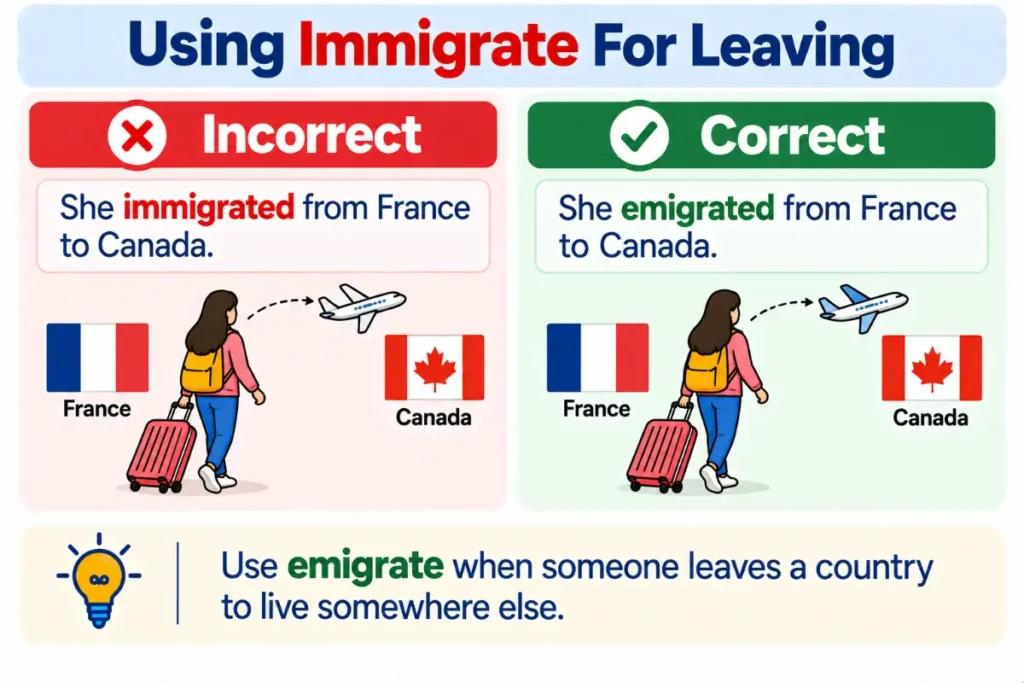
Incorrect:
She immigrated from France to Canada.
This sentence is not always impossible grammatically because from can identify the origin while to identifies the destination. However, if the intended focus is the act of leaving France, emigrate is more precise.
Better:
She emigrated from France and immigrated to Canada.
Using Emigrate For Entering
A common mistake is to say:
He emigrated to Canada.
This construction can occur in English, but it may sound less precise when the focus is entering Canada.
If you want to emphasize arrival and settlement in Canada, use:
He immigrated to Canada.
Confusing The Nouns
Emigration refers to the act or process of leaving a country.
Immigration refers to entering and settling in another country.
The same movement can involve both.
Emigration from one country can happen alongside immigration to another.
Confusing Migrant With Immigrant
Migrant is a broader term. It can describe someone who moves from one place to another for many reasons and does not always refer specifically to permanent international settlement.
Immigrant usually refers to someone who moves to another country to live there.
Treating The Words As Synonyms
The words are closely related but they aren’t interchangeable in every sentence.
If the sentence focuses on departure use emigrate.
If it focuses on arrival use immigrate.
This small difference changes the viewpoint rather than the basic event.
Pronunciation Guide
Emigrate is commonly pronounced /ˈɛmɪɡreɪt/.
An easy pronunciation guide is:
EM uh grayt.
The main stress falls on the first syllable.
Immigrate is commonly pronounced /ˈɪmɪɡreɪt/.
An easy pronunciation guide is:
IM uh grayt.
Again the first syllable receives the main stress.
The words sound very similar because they share the same ending and historical root. The main difference appears at the beginning.
The pronunciation can contribute to confusion for English learners because the first vowel changes only slightly.
A useful strategy is to connect sound with meaning.
EMigrate means exit.
IMmigrate means in.
The spelling then becomes a reminder of the direction.
Etymology And Word Origin
The two words are closely related historically.
Both ultimately connect to Latin roots involving movement and departure. The Latin verb migrare meant to move or depart. English later developed related words through French and Latin based forms.
The prefix e carries the idea of out or away. That helps explain why emigrate refers to leaving a country.
The prefix im is related to in. That helps explain why immigrate refers to entering a country.
The relationship becomes clearer when you look at related nouns.
Emigrate gives us emigration.
Immigrate gives us immigration.
The historical structure therefore supports the modern distinction. The words share a root but their prefixes help indicate direction.
English has many word pairs that differ because of prefixes. Here the prefixes provide a useful clue instead of being merely decorative spelling.
Regional Usage
American English
Both words are standard in American English. Emigrate commonly appears with discussions of people leaving the United States or another country. Immigrate commonly appears in discussions about people entering and settling in the United States.
For example:
He emigrated from the United States.
He immigrated to Canada.
American English also frequently uses immigration as a broad noun for international population movement and related legal or social issues.
British English
British English follows the same basic distinction. Emigrate refers to leaving a country while immigrate refers to entering another country.
The grammar and core meanings do not change significantly between American and British English.
Australian English
Australian English uses both terms in the standard way. Immigration is especially common in discussions of people moving to Australia while emigration describes people leaving Australia for another country.
The distinction remains based on direction rather than regional spelling.
Canadian English
Canadian English also maintains the same distinction. A person can emigrate from another country and immigrate to Canada.
There is no major regional variation that changes the core meanings of the two verbs.
Emigration And Immigration
The nouns follow the same basic distinction as the verbs.
Emigration means the act or process of leaving a country to live elsewhere.
Immigration means the act or process of entering another country to live there.
For example:
The country experienced high levels of emigration.
Canada experienced increased immigration.
Again the same movement can be described from two viewpoints.
A family leaving Country A is part of that country’s emigration.
The same family entering Country B is part of Country B’s immigration.
This is why immigration and emigration statistics can describe connected parts of international population movement without being interchangeable terms.
Migrant Immigrant And Emigrant
These related nouns can also cause confusion.
Migrant
Migrant is the broadest term. It can refer to someone who moves from one place to another. The move may happen within a country or across international borders depending on context.
Immigrant
An immigrant is someone who moves into another country to live there.
The focus is on the destination.
Emigrant
An emigrant is someone who leaves their country to live somewhere else.
The focus is on the country of departure.
For example:
Maria left Brazil and settled in Canada.
From Brazil’s perspective Maria is an emigrant.
From Canada’s perspective Maria is an immigrant.
In a broader sense she is also a migrant.
The perspective determines which specific term fits best.
Immigration And Emigration In Formal Writing
These terms work especially well in formal writing because they provide precise information about direction.
Consider a research paper discussing population change.
The paper might say:
The region experienced significant emigration during the twentieth century.
That statement focuses on people leaving the region.
A report about the destination might say:
The country experienced significant immigration during the same period.
That statement focuses on people entering the country.
The distinction helps readers understand the direction without needing a long explanation.
In casual writing you can often use move instead.
My family moved from India to Canada.
This is perfectly natural. But if the direction of international migration matters to the discussion, emigrate and immigrate offer more precise vocabulary.
Real Life Usage Examples
Daily Conversation
My uncle emigrated from Mexico when he was twenty.
My cousins immigrated to the United States several years later.
In casual speech, people may simply say they moved from one country to another. The more specific verbs are useful when the international context matters.
Email And Workplace Communication
Our records show that the employee immigrated to Canada in 2018.
The report examines why skilled workers emigrated from the region.
Professional communication often benefits from these precise terms because the direction of movement is clear.
Academic Writing
The study examines patterns of emigration from rural communities.
Researchers also analyzed immigration to major urban centers.
Academic writing often uses these terms because population movement needs precise description.
News Writing
Thousands of residents emigrated from the country during the decade.
The city welcomed new immigrants who had recently arrived from several regions.
Journalism frequently uses migration vocabulary to describe demographic changes.
Literature And Storytelling
Her grandparents emigrated from Ireland with little more than a few possessions.
Years later their children immigrated to a country they had once known only through stories.
In storytelling these words can make the direction of a family’s journey clear without lengthy explanation.
Related And Confused Terms
Migrate
Migrate means to move from one place to another. It can describe people animals or groups. Unlike the two more specific verbs here, it does not automatically tell you the direction from a country level perspective.
Migration
Migration is the broad noun for movement from one place to another. It can describe internal or international movement.
Immigration
Immigration refers to entering and settling in another country. The destination is the main focus.
Emigration
Emigration refers to leaving one country to settle somewhere else. The departure point is the main focus.
Immigrant
An immigrant is a person who moves into another country to live there.
Emigrant
An emigrant is a person who leaves their country to live somewhere else.
Relocate
Relocate means to move to a new place. It does not necessarily involve crossing an international border.
Expatriate
Expatriate commonly describes someone living outside their native country. Depending on context it can describe a temporary or long term situation. It does not always carry exactly the same legal or social meaning as immigrant.
These terms overlap but they aren’t interchangeable in every context. Choosing the right one depends on the movement being described and the perspective of the sentence.
Why The Confusion Is So Common
The two words are confusing because they share almost the same letters and sound.
Both contain the root related to movement. Both describe international relocation. Both can describe the same person during the same journey.
The only major difference is the prefix.
That small difference carries a lot of meaning.
Think about the sentence:
Daniel moved from Brazil to Portugal.
From Brazil’s point of view Daniel emigrated.
From Portugal’s point of view Daniel immigrated.
Nothing about Daniel’s physical journey changed. The viewpoint changed.
This is a useful lesson in vocabulary. Sometimes two words aren’t describing different events. They are describing the same event from different angles.
How To Choose The Right Word
When you’re unsure which verb to use, ask one simple question.
Am I focusing on the country the person left or the country the person entered?
If you’re focusing on the place left behind, use emigrate.
If you’re focusing on the destination, use immigrate.
Then check the preposition.
Emigrate from.
Immigrate to.
For example:
They emigrated from Egypt.
They immigrated to France.
If you want to describe both directions in one sentence, use both verbs.
They emigrated from Egypt and immigrated to France.
This is one of the clearest ways to show the distinction.

Expert Editor Insight
An experienced editor looks at the direction of movement before choosing either word. The confusion is understandable because the terms share a root and can describe the same person during one international move. Grammar tools may not flag the wrong choice because both words are legitimate English verbs and a sentence can remain grammatically sound even when the intended perspective is unclear. A useful editing habit is to underline the country involved and ask if it is the place being left or the destination. That quick check usually reveals the right word.
Conclusion
emigrate vs immigrate becomes simple once you focus on direction. Emigrate means leaving a country to live somewhere else while immigrate means entering another country to live there. The same person can do both during one international move. Someone can emigrate from Mexico and immigrate to the United States.
The two words are closely related and share a historical root connected with movement. Their prefixes provide a useful clue. The E in emigrate can remind you of exit while the I in immigrate can remind you of in. That small memory trick makes the distinction much easier to recall.
For clear writing, remember the basic patterns emigrate from and immigrate to. If you focus on the country someone leaves, choose emigrate. If you focus on the destination, choose immigrate. When both sides matter, you can use both words in the same sentence.
FAQs
What is the difference between emigrate and immigrate?
Emigrate means leaving a country to live somewhere else. Immigrate means entering another country to live there. For example, someone who leaves India and settles in Canada emigrates from India and immigrates to Canada. The two words describe the same international move from different perspectives. Emigration focuses on departure while immigration focuses on arrival.
Is it correct to say immigrate from a country?
Yes, you can mention the country of origin with immigrate, especially when the destination is also stated. For example, She immigrated to Canada from India is natural English. The verb still focuses on entering Canada. If you want to emphasize leaving India, emigrated from India is the more precise choice.
Is it correct to say emigrate to another country?
Yes. Emigrate can appear with a destination, especially in sentences that describe the complete movement. For example, They emigrated from Spain to Argentina is completely natural. However, when the sentence focuses specifically on entering the destination country, immigrate to is usually the clearer choice. The difference is mainly about perspective.
What is the easiest way to remember these words?
Connect the first letter with the direction. Emigrate starts with E, so think of exit. Immigrate starts with I, so think of in. You can also remember the common patterns emigrate from and immigrate to. If the country is the place someone leaves, emigrate fits. If it is the place someone enters, immigrate fits.
Are emigrant and immigrant the same thing?
They can describe the same person from different perspectives. An emigrant is someone viewed from the country they leave. An immigrant is someone viewed from the country they enter. For example, a person leaving Brazil and settling in Canada can be called an emigrant in relation to Brazil and an immigrant in relation to Canada.
What is the difference between migrate and immigrate?
Migrate is a broader term for moving from one place to another. It can describe internal movement or international movement depending on context. Immigrate specifically focuses on entering another country to live there. Someone can migrate from one city to another without immigrating because immigration normally involves movement into another country.
Which preposition is used with emigrate?
From is the most common preposition when emigrate focuses on the country a person leaves. For example, She emigrated from France. To can also appear when the destination is included, as in She emigrated from France to Canada. The key idea is that emigrate emphasizes departure while the destination may be added as extra information.
Which preposition is used with immigrate?
To is the most common preposition with immigrate when the destination is the focus. For example, He immigrated to Australia. You can also include the origin with from, as in He immigrated to Australia from India. Remember the basic pattern as immigrate to a destination and emigrate from a place of departure.

English Grammar & Usage
Nathan Holloway is an American grammar writer and language researcher who specializes in English grammar, sentence structure, verb usage, and common writing mistakes. He enjoys breaking down confusing grammar rules into practical explanations with clear examples, making English easier for students, professionals, and everyday writers.