
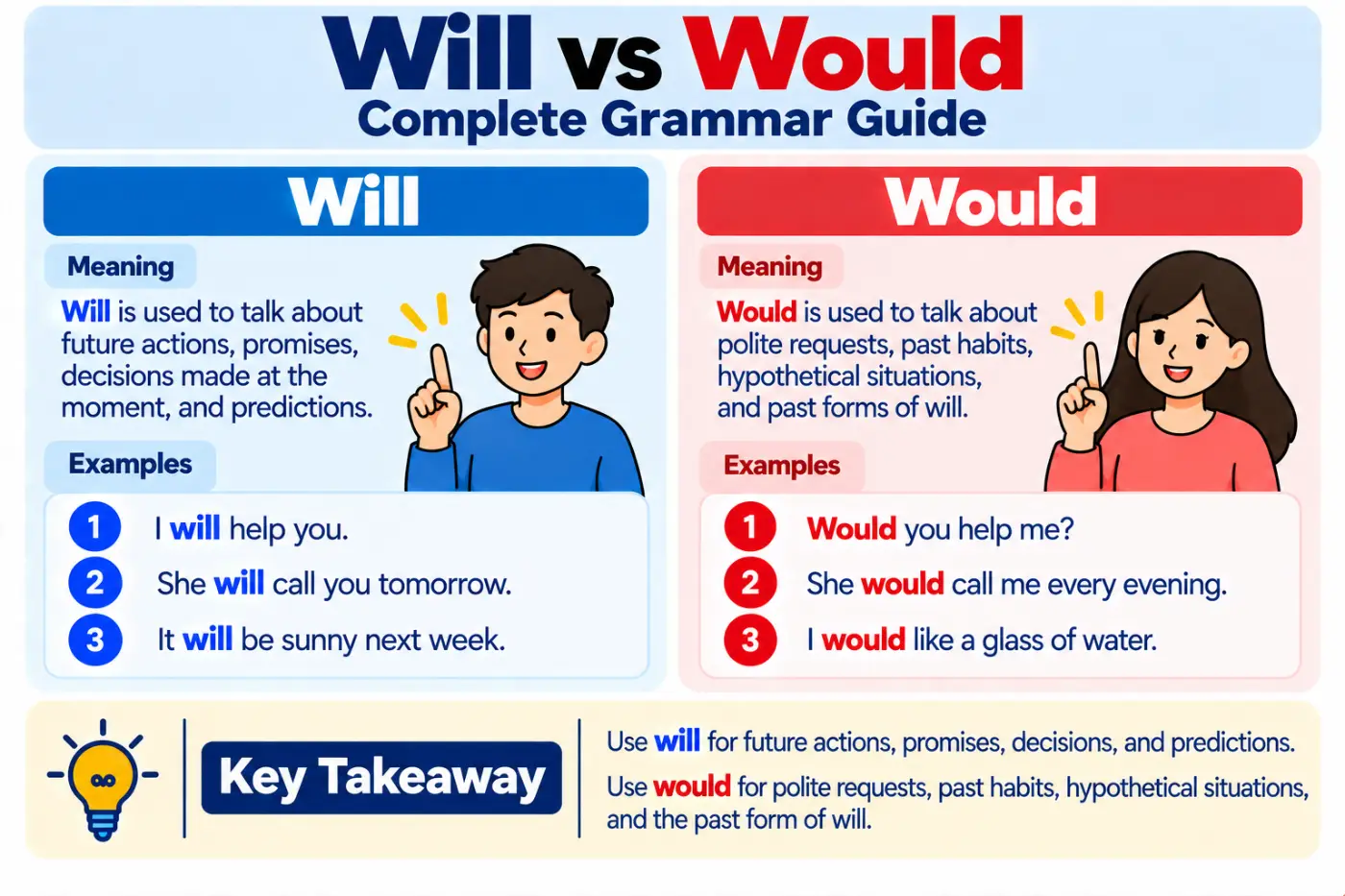
Will vs would can confuse even strong English learners because both modal verbs connect to the future and both can appear in conditional sentences. The difference becomes clearer when you look at what the speaker means. Will generally points toward a future action or shows a firm decision. Would creates more distance and often makes an idea more polite less direct or more hypothetical.
The two words also change meaning based on context. A speaker can use will for a prediction such as She will arrive soon. The same speaker can use would to describe a past prediction such as She said she would arrive soon. Would can also describe a repeated past action or express a preference. That range gives would several important jobs in English.
This guide explains the grammar behind will and would with simple rules and practical examples. You’ll learn how native speakers use these modal verbs in everyday conversation professional writing questions requests promises predictions and conditional sentences.
Short Answer
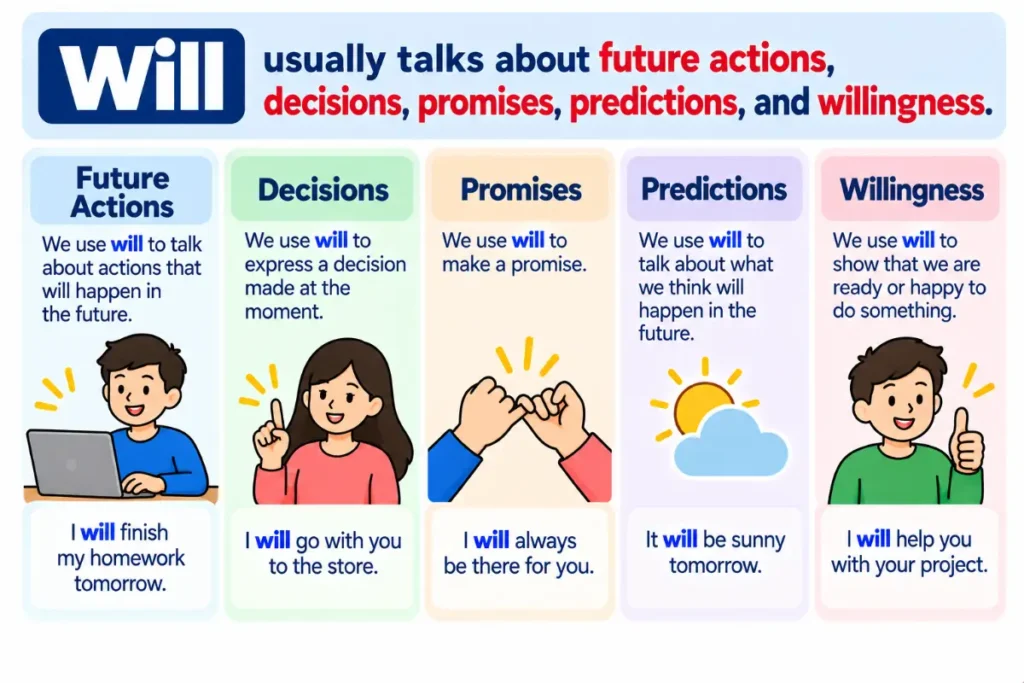
Will usually talks about future actions decisions promises predictions and willingness. Would often talks about polite requests imagined situations past habits preferences and future events viewed from the past. The right choice depends on the time frame and meaning of the sentence. Understanding that difference makes these two modal verbs much easier to use correctly.
Table of Contents
- What Will Means.
- What Would Means.
- The Main Difference Between Will And Would.
- When To Use Will.
- When To Use Would.
- Will For The Future.
- Would For The Future From The Past.
- Will And Would In Conditional Sentences.
- Will And Would For Requests.
- Will And Would For Offers And Invitations.
- Will And Would For Preferences.
- Will And Would For Predictions.
- Will And Would For Past Habits.
- Will And Would For Willingness.
- Will And Would In Reported Speech.
- Will And Would In Questions.
- Will And Would With If.
- Will And Would With Polite Language.
- Common Mistakes.
- Real Life Examples.
- Pronunciation And Contractions.
- Formal And Informal Usage.
- American And British English.
- Memory Tips.
- Related Grammar Notes.
- Key Takeaways.
What Will Means
Will is a modal auxiliary verb. English speakers commonly use it to talk about the future. It can also express willingness decisions promises requests predictions and certainty about a future event.
Consider these examples.
I will call you tonight.
She will finish the report tomorrow.
We will meet at six.
In each sentence the speaker connects the action with a future time.
Will can also show a decision made at the moment of speaking.
The phone is ringing. I’ll answer it.
I’m tired. I’ll make some coffee.
That decision happens as the speaker talks. The speaker does not describe a plan made earlier.
Will can also express willingness.
I will help you.
He will listen if you explain the problem.
In these sentences will does more than identify a future event. It shows a willingness to perform an action.
English speakers also use will for predictions.
The weather will improve tomorrow.
You’ll enjoy this book.
The meeting will probably end early.
The prediction can come from evidence or personal judgment.
What Would Means
Would is also a modal auxiliary verb. It has several major uses. It can describe hypothetical situations polite requests preferences past habits and future events viewed from a past point in time.
For example.
I would help you if I had more time.
The speaker describes an imagined situation. The person does not say that the action will definitely happen.
Would also makes requests more polite.
Would you like some coffee.
Compared with Will you open the window the question sounds less direct and often more courteous.
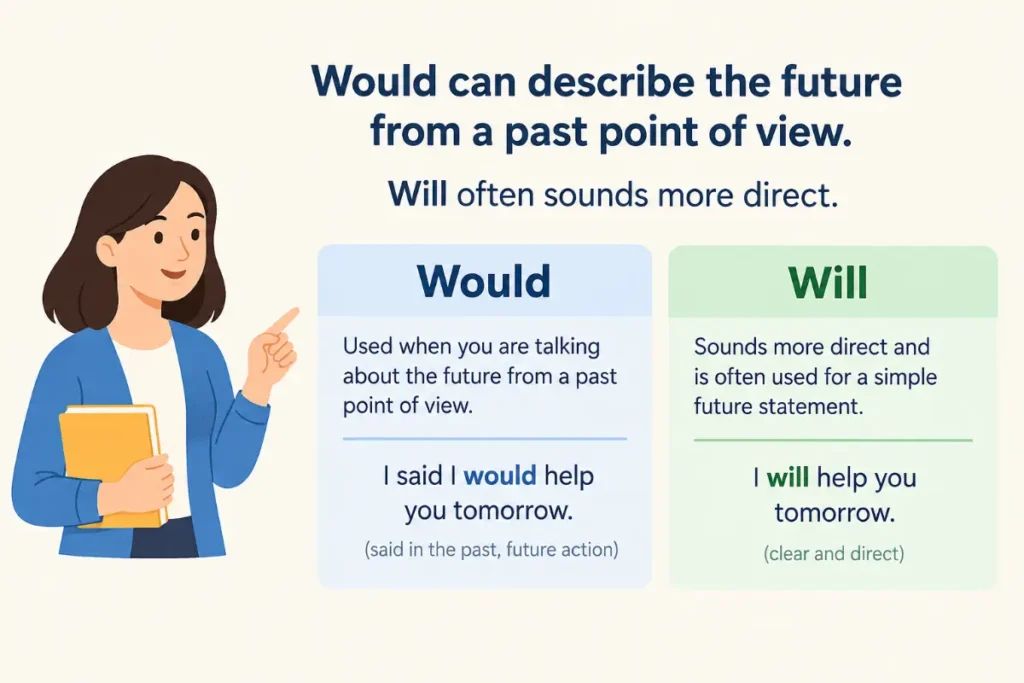
Would can also describe a future action from a past point of view.
She said she would call later.
Here the original expectation concerned the future. The reporting happens later. Would shifts the future idea into the past viewpoint.
Would also describes repeated actions in the past.
When we were children we would visit our grandparents every summer.
This use focuses on something that happened repeatedly.
The Main Difference Between Will And Would
The clearest difference involves certainty distance and time perspective.
| Use | Will | Would |
|---|---|---|
| Future action | Common | Less direct or viewed from the past |
| Immediate decision | Common | Not normally used |
| Prediction | Common | Common in hypothetical situations |
| Polite request | Possible | More polite |
| Hypothetical situation | Less common | Common |
| Past habit | Not used for this meaning | Common |
| Future in reported speech | Not usually after a past reporting verb | Common |
| Preference | Not normally used | Common |
| Willingness | Common | Common in hypothetical contexts |
| Offer | Common | Common in polite forms |
A useful way to remember the contrast is to think of will as more direct and would as more distant.
That distance can involve time.
She says she will come.
She said she would come.
It can involve possibility.
I will help you.
I would help you if I could.
It can also involve politeness.
Will you help me.
Would you help me.
The second question usually sounds softer.
When To Use Will
Use will when you need to express a future action decision promise prediction or willingness.
Future Actions
Use will for actions that you expect to happen in the future.
I will see you tomorrow.
The store will open at nine.
They will arrive next week.
These sentences simply place the action in the future.
Decisions Made Now
Use will when you decide something while speaking.
That looks heavy. I’ll carry it.
We need more chairs. I’ll get some.
I’m hungry. I’ll order a sandwich.
The speaker makes the decision at that moment.
Promises
Will can express a promise.
I will never forget your help.
I’ll send the documents tonight.
I’ll call you after work.
The speaker presents the action as a commitment.
Predictions
Use will when you predict a future event.
The team will win the game.
You’ll feel better after some rest.
The price will increase next year.
These predictions can come from knowledge experience evidence or personal judgment.
Willingness
Will can show that someone agrees to do something.
She will help us.
I’ll stay late to finish the work.
He will talk to the manager.
In negative sentences will can show refusal.
He won’t listen.
The car won’t start.
The first example describes refusal. The second describes something that fails to operate. Context tells you which meaning applies.
When To Use Would
Use would for hypothetical situations polite requests preferences past habits and future actions viewed from a past perspective.
Hypothetical Situations
Would commonly appears when someone imagines a situation.
I would buy that house if I had enough money.
She would travel more if she had more free time.
We would stay longer if we could.
The speaker does not present the action as a definite future event. The action depends on an imagined condition.
Polite Requests
Would makes requests sound less direct.
Would you mind waiting for a few minutes.
These forms are common in polite everyday English and professional communication.
Preferences
Would often appears when someone talks about what they prefer.
I would rather stay home.
I’d rather take the train.
She would prefer to meet in the morning.
Would rather means prefer one option over another.
I’d rather drink tea than coffee.
The phrase has a specific structure. After would rather the next verb normally uses the base form.
I’d rather go now.
Not.
I’d rather to go now.
Past Habits
Would can describe repeated past actions.
Every summer we would visit the lake.
My grandfather would tell us stories after dinner.
When I was young I would play outside until sunset.
This use works best for repeated actions. It usually does not describe a single past event.
For a single event use simple past.
When I was young I visited the lake once.
Would does not naturally replace visited in that sentence because the meaning involves one completed event.
Future From A Past Viewpoint
Would can show that someone expected a future event from a past point in time.
She knew she would need more time.
He said he would call.
I thought they would arrive early.
At the time of thinking or speaking in the past the event had not happened yet.
This is one of the most important reasons English uses would after past reporting verbs.
Will For The Future
Will is one of the main ways English expresses future meaning.
You’ll often see it with time expressions such as tomorrow next week later soon and next year.
I will call you tomorrow.
They will move next year.
She will return soon.
However English has several ways to talk about the future. Native speakers also use be going to the present continuous and the simple present.
For example.
I’m going to call her tonight.
I’m meeting her tonight.
The train leaves at seven.
Will remains especially useful for predictions spontaneous decisions promises and willingness.
Would For The Future From The Past
English uses would when a future action is viewed from a past point.
Compare these sentences.
She says she will come.
She said she would come.
The first sentence uses present reporting language. The second uses past reporting language.
The same relationship appears in many sentences.
He thinks he will win.
He thought he would win.
I know they will arrive.
I knew they would arrive.
This grammar pattern is often called future in the past.
The idea is simple. Someone in the past looked ahead toward an event that had not happened yet. From our present viewpoint that future event belongs to the past perspective.
Will And Would In Conditional Sentences
Conditional sentences create some of the most common confusion between these two verbs.
Consider this sentence.
If I have enough money I will buy the car.
The condition is presented as a real possibility. The speaker sees the purchase as a possible future result.
Now compare it with this sentence.
If I had enough money I would buy the car.
The second sentence presents a hypothetical situation. The speaker does not have enough money now.
This pattern is extremely useful.
If plus present simple usually pairs with will for a likely future result.
If plus past simple often pairs with would for a hypothetical result.
Compare these examples.
If she studies she will pass.
If she studied more she would pass.
The exact meaning depends on context but the grammar pattern provides a strong guide.
Will And Would For Requests
Both verbs can appear in requests but they create different tones.
Will you help me.
Would you help me.
The first question is direct. The second is usually more polite and less forceful.
Will you wait here.
Would you wait here.
Both sentences ask someone to wait. Would creates more distance.
This does not mean will is rude. It simply sounds more direct.
In casual conversation direct requests are normal.
Will you pass me the salt.
Would you pass me the salt.
Both can work naturally.
For professional communication or situations where you want to sound especially courteous would often fits better.
Will And Would For Offers And Invitations
Will can make a direct offer.
I’ll carry that for you.
I’ll get you some water.
Would can appear in polite invitations.
Would you like some help.
The expression Would you like is one of the most common polite patterns in English.
A natural response might be.
Yes please.
That would be great.
No thank you.
I’d love to.
Notice that would also appears in the response That would be great. Here it expresses a positive response to a proposed situation.
Will And Would For Preferences
Would has a special role in talking about preferences.
I would rather stay home.
I’d rather walk.
She would rather wait.
Would rather means prefer.
The usual structure is would rather plus base verb.
I’d rather leave now.
He’d rather eat later.
They’d rather stay here.
When comparing two actions you can use than.
I’d rather walk than drive.
She’d rather read than watch television.
Would prefer has a similar meaning.
I would prefer to stay home.
She would prefer to wait.
The grammar differs slightly.
Would rather usually takes the base verb.
I’d rather go.
Would prefer usually takes to plus the verb.
I’d prefer to go.
Will And Would For Predictions
Will commonly expresses a prediction about the future.
You’ll like this restaurant.
The package will arrive tomorrow.
The company will announce the results soon.
Would can express a prediction from a past viewpoint.
I thought the package would arrive today.
She believed the meeting would finish early.
They expected the weather would improve.
Would can also appear in hypothetical predictions.
That would probably cause more problems.
The speaker imagines a possible result and comments on it.
Will And Would For Past Habits
Would can describe repeated actions in the past.
When we lived near the beach we would walk there every evening.
My father would read the newspaper after breakfast.
During summer vacation we would swim in the river.
The repeated nature of the action matters.
Would does not normally describe a permanent past state.
I used to know the answer.
Not.
I would know the answer.
Used to works better for past states.
She used to live in Chicago.
She would live in Chicago does not normally carry the same meaning.
Would works naturally with repeated actions because the sentence describes something that happened again and again.
Will And Would For Willingness
Will can show willingness.
I’ll help you.
She’ll speak to him.
They’ll work with us.
Would can express willingness in an imagined situation.
I would help you if I had the time.
He would come if you invited him.
The distinction comes from the condition.
I will help you.
This presents the help as a real commitment.
I would help you if I could.
This presents the help as dependent on a condition.
Would can also describe someone’s past willingness.
He wouldn’t listen to me.
She wouldn’t cooperate.
Depending on context these sentences can describe refusal rather than simple unwillingness.
Will And Would In Reported Speech
Reported speech often changes will to would after a past reporting verb.
Direct statement.
I will call you tomorrow.
Reported statement.
She said she would call me the next day.
The original speaker used will because the call was future from that moment. The reporting sentence shifts the viewpoint into the past so English commonly uses would.
More examples include.
He said he would help.
They promised they would return.
I knew she would understand.
We expected the meeting would end early.
This pattern helps explain why would is not simply a softer form of will. The two words can show different time relationships.
Will And Would In Questions
Questions with will often sound direct and straightforward.
Will you come with us.
Will they accept the offer.
Questions with would often sound more polite or hypothetical.
Would you come with us.
Would they accept the offer.
The meaning changes with the context.
Would you come with us can simply sound polite.
Would you come with us if we paid for your ticket presents a condition.
This distinction makes would especially useful when you want to ask about a hypothetical choice.
Will And Would With If
If clauses deserve special attention because learners sometimes put would in the wrong place.
A common first conditional pattern is.
If you study you will improve.
If they hurry they will catch the bus.
A common second conditional pattern is.
If I had more time I would travel.
If we lived closer we would visit more often.
A common mistake is placing would directly after if in a standard second conditional.
Incorrect.
If I would have more time I would travel.
Correct.
If I had more time I would travel.
There are special uses of would after if in English but learners should first master the standard conditional patterns. In ordinary hypothetical sentences use the past form after if and would in the result clause.
Will And Would With Polite Language
Would often makes language sound more indirect.
Compare these examples.
Give me a moment.
Would you give me a moment.
The second sentence sounds more courteous because it frames the request as a question.
This does not mean every polite request needs would.
Could you help me is also natural.
Can you help me is also polite in many everyday situations.
English speakers choose among several modal verbs depending on the situation and level of formality.
Would you mind is another useful polite structure.
Would you mind waiting outside.
After would you mind English normally uses a verb ending in ing.
Would you mind helping me.
Not.
Would you mind to help me.
Common Mistakes
Using Would For Every Future Sentence
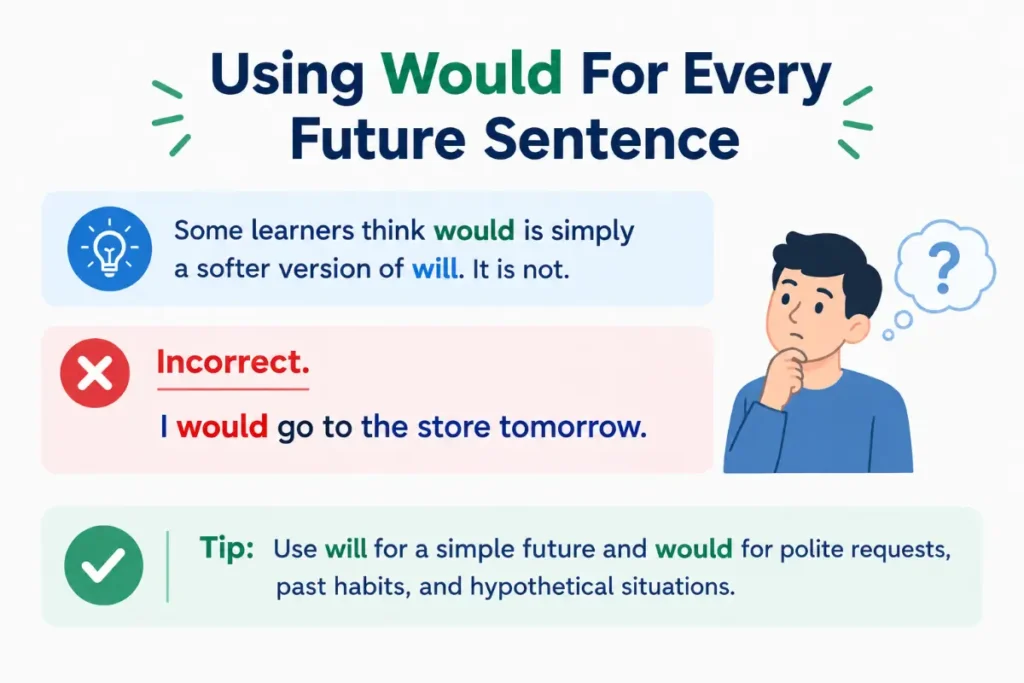
Some learners think would is simply a softer version of will. It is not.
Incorrect.
I would go to the store tomorrow.
If you simply mean that you plan to go or expect to go you normally need will or another future structure.
I will go to the store tomorrow.
Would needs a reason such as a hypothetical condition a past viewpoint or a special polite structure.
Using Will After A Past Reporting Verb
Learners sometimes keep will after a past reporting verb.
He said he will call.
This can occur in some contexts when the speaker still treats the future event as current or relevant. In traditional reported speech the usual form is would.
He said he would call.
Context can affect the choice.
Using Would In The If Clause
Avoid the common pattern.
If I would know the answer I would tell you.
Use.
If I knew the answer I would tell you.
The condition takes the appropriate verb form and the result uses would.
Confusing Would With Used To
Would can describe repeated past actions but it does not replace used to in every situation.
I used to live in Boston.
This describes a past state.
I would visit Boston every summer.
This describes a repeated action.
The distinction is important.
Forgetting The Base Verb After Will
Modal verbs use the base form of the main verb.
I will go.
She will work.
They will arrive.
Not.
I will goes.
She will working.
They will arrived.
The same rule applies to would.
I would go.
She would work.
They would arrive.
Adding To After Will
Will does not take to before the main verb.
Correct.
I will call you.
Incorrect.
I will to call you.
Would has a different pattern when used with prefer.
I would prefer to call you.
The structure changes because prefer normally takes to before its following verb.
Real Life Examples
At Work
I’ll send the report this afternoon.
This expresses a future action or commitment.
She said she would send the report before lunch.
This places the expected action in a past viewpoint.
Would you review this document before the meeting.
This makes the request polite.
At Home
I’ll wash the dishes.
The speaker offers or agrees to do something.
Would you wash the dishes.
The speaker makes a polite request.
If I had more time I would cook dinner.
The speaker imagines a condition and its result.
While Shopping
I’ll take this one.
The speaker makes a decision.
Would you like a bag.
The seller makes a polite offer.
I would rather buy the smaller size.
The speaker expresses a preference.
While Making Plans
We will meet at seven.
The speaker states a future plan or expectation.
I thought we would meet at seven.
The speaker describes a past expectation.
If we leave now we will arrive on time.
The speaker sees the condition as a real future possibility.
If we left earlier we would arrive on time.
The speaker presents the situation as hypothetical or contrary to the current plan.
Pronunciation And Contractions
Will has a short unstressed form in everyday speech. You’ll often hear it reduced when native speakers talk quickly.
Common contractions include.
I’ll for I will.
You’ll for you will.
He’ll for he will.
She’ll for she will.
We’ll for we will.
They’ll for they will.
Would also forms common contractions.
I’d for I would.
You’d for you would.
He’d for he would.
She’d for she would.
We’d for we would.
They’d for they would.
The contraction I’d can represent either I would or I had.
I’d go if I had time.
Here I’d means I would.
I’d finished the work before noon.
Here I’d means I had.
Context tells you which meaning applies.
In careful professional writing contractions are acceptable in many modern contexts. Formal academic writing may favor full forms depending on the style guide and institution.
Formal And Informal Usage
Will and would work in both everyday and professional English.
In conversation you might say.
I’ll call you later.
In a formal email you might write.
I will contact you tomorrow.
Both are grammatically correct.
Would frequently appears in professional communication because it can soften requests.
Would you mind confirming the appointment.
Still, professional writing does not require would for every request. Clear direct language often works better.
Please send the updated file by Friday.
That sentence is direct and professional.
American And British English
American and British English use will and would in largely the same grammatical ways.
The core rules remain consistent.
I will call you tomorrow.
She would help if she could.
Would you like some coffee.
There can be regional differences in preferred expressions and conversational style but the central distinction between will and would remains stable.
American English commonly uses will for future predictions decisions and promises.
British English does the same.
The learner should focus on meaning and sentence structure rather than trying to memorize separate American and British rules for these two verbs.
Memory Tips
One useful memory trick is to connect will with a direct future idea.
I will do it.
Connect would with distance.
I would do it if I could.
That distance can mean several things.
- Distance in time. She said she would call.
- Distance in reality. I would travel if I had the money.
- Distance in politeness. Would you help me.
- Distance in preference. I would rather stay home.
- Distance in past repetition. We would visit every summer.
Another helpful test is to ask what kind of meaning you need.
If you are talking about a real future action use will in many cases.
If you are imagining a situation use would.
These simple questions can guide you through most everyday examples.
Related Grammar Notes
Will Compared With Going To
Will and be going to can both describe future events but they often carry different shades of meaning.
I’ll call Sarah tonight.
I’m going to call Sarah tonight.
The first sentence can sound like a decision or promise. The second often suggests an existing intention.
For predictions the distinction can also depend on evidence.
It will rain tomorrow.
It is going to rain.
The second sentence often suggests that the speaker sees evidence now such as dark clouds.
Would Compared With Could
Both can both appear in polite requests.
Would you help me.
Could you help me.
They are not identical.
Would often focuses on willingness or a polite request.
Could often focuses on possibility or ability.
The difference can be subtle in everyday conversation.
Would Compared With Should
Would and should have different core meanings.
I would go if I had time.
I should go now.
Would describes a hypothetical result in the first sentence. Should expresses what the speaker considers advisable or expected in the second.
Will Compared With Shall
Modern American English generally uses will far more often than shall for ordinary future statements.
I will call you tomorrow.
Shall still appears in certain formal or traditional expressions.
Shall we begin.
This form remains common as a suggestion.
Would Rather
Would rather is a fixed and useful expression for preferences.
I’d rather stay home.
She’d rather walk.
They’d rather wait.
Use the base verb after would rather.
I’d rather go.
Not.
I’d rather going.
When comparing two actions use than.
I’d rather walk than drive.
Key Takeaways
- Will commonly expresses future actions decisions promises predictions and willingness.
- Would commonly expresses hypothetical situations polite requests preferences and repeated past actions.
- Would can describe the future from a past point of view.
- Will often sounds more direct.
- Would often creates more distance or politeness.
- First conditional sentences commonly use will in the result clause.
- Second conditional sentences commonly use would in the result clause.
- Would can describe repeated past actions but usually does not describe past states.
- Reported speech often changes will to would after a past reporting verb.
- Would rather expresses preference and takes the base form of the following verb.
- Context determines the exact meaning of both modal verbs.
- The easiest way to choose is to identify the time frame and meaning before selecting the modal verb.
Conclusion
Will vs would becomes much easier when you stop treating these words as simple alternatives. Will usually gives a direct future meaning and can express decisions promises predictions and willingness. Would often creates distance by showing a hypothetical situation a polite request a past habit or a future action viewed from the past.
The most useful distinction is simple. Use will for many real future situations and direct commitments. Use would when the situation is imagined dependent on a condition viewed from the past or expressed in a more polite way. That basic pattern covers a large share of everyday English.
Once you understand that difference you can use both modal verbs with much more confidence. Pay attention to the time frame and the speaker’s intention. The surrounding words usually provide the clue you need.
Frequently Asked Questions
Is Will More Certain Than Would?
Often yes but the difference comes from meaning and context rather than a simple certainty scale. Will commonly presents a future action or prediction directly. Would often creates a hypothetical meaning or places the future inside a past viewpoint.
Is Would Just The Past Tense Of Will
Would is historically connected to will and often functions as its past form in reported speech. However would has many other uses. It can express politeness hypothetical situations preferences and repeated past actions.
When Should I Use Will Instead Of Would?
Use will for many real future actions spontaneous decisions promises predictions and expressions of willingness. Use would when you need a hypothetical meaning a past viewpoint or a more indirect request.
When Should I Use Will Vs Would?
Use will when you present an action as a future event or direct commitment. Use would for hypothetical situations polite requests preferences repeated past actions and future actions viewed from a past point.
Can I Use Would For The Future?
Yes. Would can describe a future action from a past viewpoint.
She said she would arrive at noon.
Would can also describe a hypothetical future.
I would travel next month if I had enough money.
Can Would Describe A Past Habit?
Yes. Would can describe repeated actions in the past.
When I was young I would visit my grandparents every Sunday.
It works best with repeated actions rather than permanent past states.
Is Would More Polite Than Will?
Would often sounds more polite or indirect in requests.
Will you help me.
Would you help me.
Both are grammatical. The second usually creates a softer tone.
Can Will And Would Appear In The Same Sentence?
Yes.
If you asked me I would help you.
This sentence contains no will but many sentences can contain both when their meanings require them.
If you tell me what you need I will help you.
Here will appears in the result clause because the speaker describes a real possible future result.
What Is The Difference Between I Will And I Would?
I will usually expresses a real future action decision promise prediction or willingness. I would usually expresses a hypothetical action or a response that depends on a condition.
Which One Is Correct In A Polite Request?
Both can be correct.
Will you open the door.
Would you open the door.
Would often sounds more polite and indirect. The choice depends on the situation and relationship between the speakers.

English Grammar & Usage
Nathan Holloway is an American grammar writer and language researcher who specializes in English grammar, sentence structure, verb usage, and common writing mistakes. He enjoys breaking down confusing grammar rules into practical explanations with clear examples, making English easier for students, professionals, and everyday writers.