
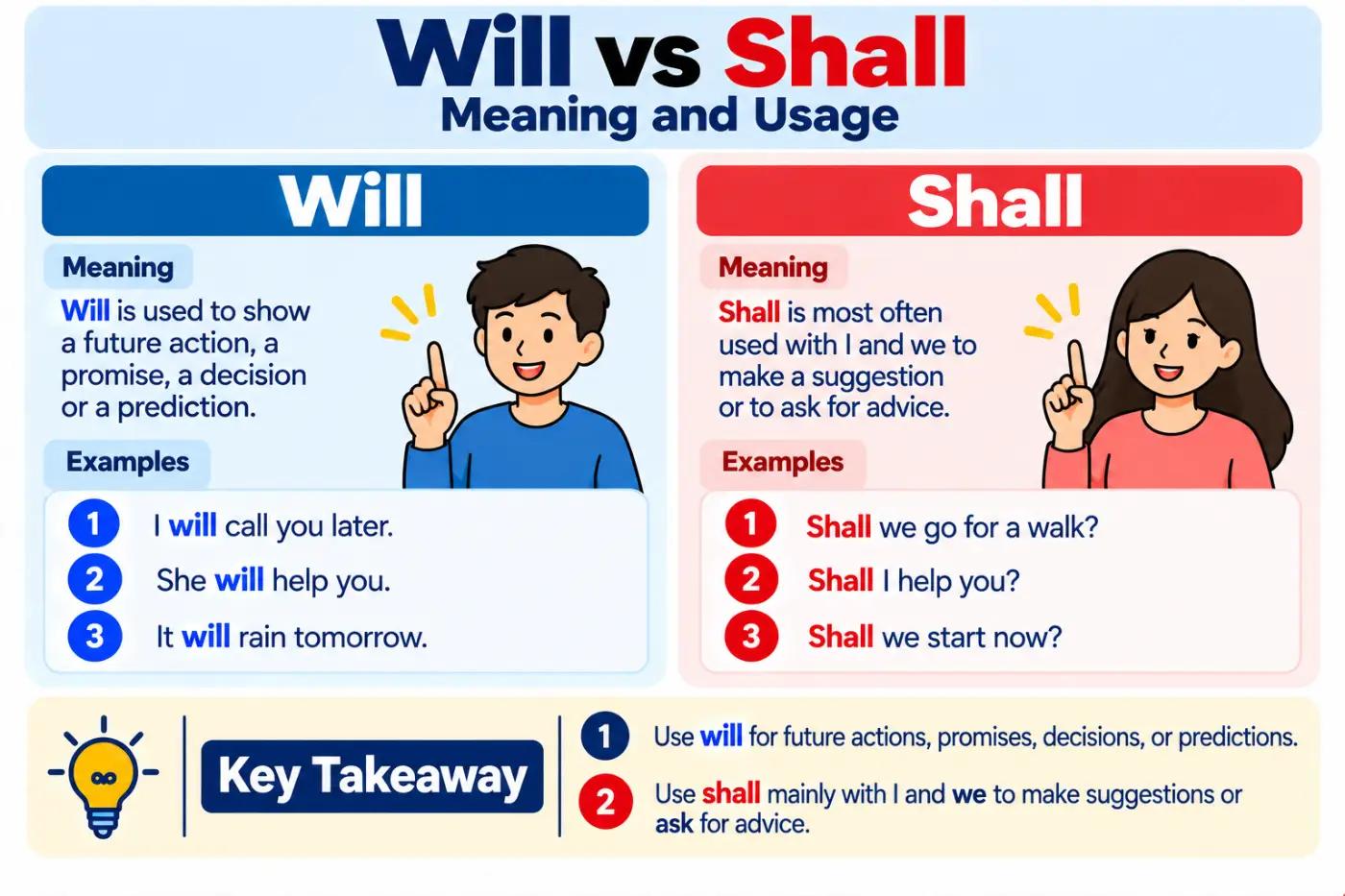
Will vs shall can seem confusing because both modal verbs can talk about the future. In modern American English, will is the normal choice in most statements about future events. You can say I will call you tomorrow or She will arrive at six. You usually don’t need shall in these situations.
Still, shall hasn’t disappeared from English. It remains useful in questions that make suggestions or offers. Shall we start? and Shall I open the window? sound natural and polite. The word also appears in formal rules, contracts, regulations, and some legal writing. That gives shall a special role even though ordinary speakers use it far less often than will.
The key is to understand the context instead of trying to memorize one rigid rule. English has changed over time. Older grammar books often presented detailed rules about when speakers should use will or shall based on the person of the subject. Modern English does not follow those rules consistently. Today, meaning, tone, region, and context matter more.
Short Answer
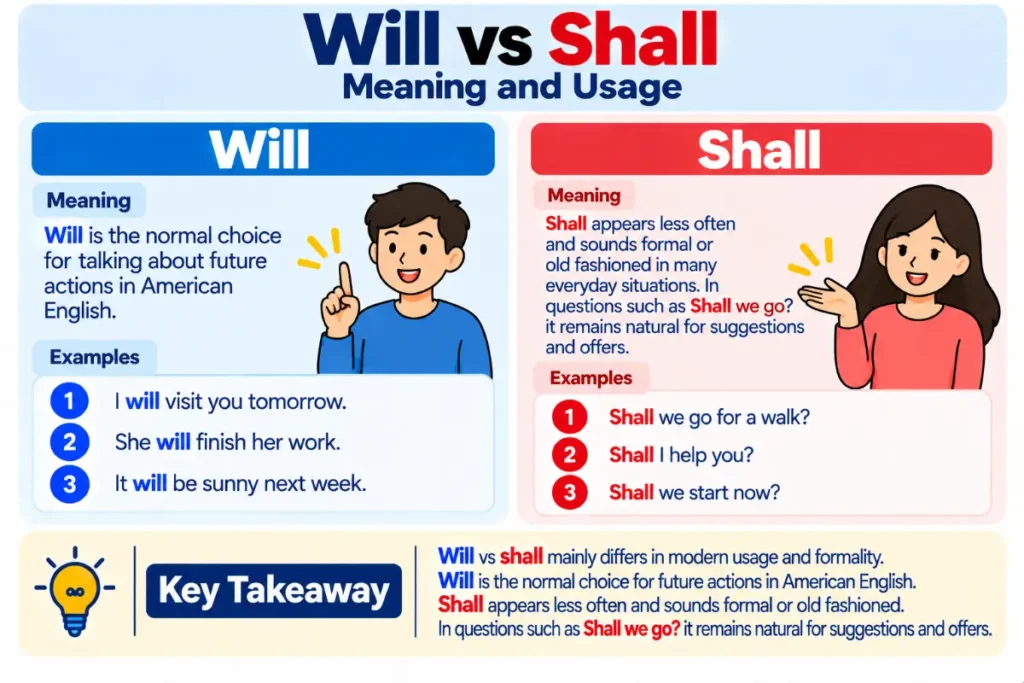
Will vs shall mainly differs in modern usage and formality. Will is the normal choice for talking about future actions in American English. Shall appears less often and sounds formal or old fashioned in many everyday situations. In questions such as Shall we go? it remains natural for suggestions and offers.
Table of Contents
- What Will Means.
- What Shall Means.
- The Main Difference Between Will And Shall.
- Will In American English.
- Shall In American English.
- Will And Shall In British English.
- Will And Shall For Questions.
- Will And Shall In Formal Writing.
- Will And Shall In Legal Writing.
- Common Mistakes.
- Real Life Examples.
- Memory Tips.
- Related Grammar Notes.
- Frequently Asked Questions.
- Key Takeaways.
- Conclusion.
What Will Means
Will is a modal verb that commonly expresses future time. It can also express willingness, intention, prediction, decisions made at the moment of speaking, and repeated behavior in certain contexts.
For example:
- I will call you tonight.
This sentence refers to a future action.
- She will probably pass the exam.
Here will helps express a prediction.
- I will help you with that.
This sentence can express willingness or a promise.
- That will be John at the door.
Here will expresses a confident assumption about the present situation.
Will doesn’t always mean simple future time. Context determines the exact meaning.
In everyday American English, will is the safest general choice for future statements. Native speakers commonly use it with all subjects.
I will go.
You will go.
He will go.
She will go.
We will go.
They will go.
The verb stays the same. You don’t need to change it according to the subject.
What Shall Means
Shall is also a modal verb. It has several uses, but modern everyday English uses it much less than will.
One common use appears in questions that offer an idea or ask for a decision.
Shall we order dinner?
Shall I send the email now?
These questions don’t simply ask about the future. They invite another person to agree to an action or help decide what happens next.
Shall can also appear in formal rules and official documents.
The tenant shall pay the fee by the first day of each month.
The applicant shall provide the required documents.
In these sentences, shall expresses a requirement. This use is especially common in legal and regulatory language.
Shall can also appear in some varieties of British English in ordinary future statements. However, this use sounds formal to many American speakers.
The Main Difference Between Will And Shall
The easiest way to understand the difference is to look at modern usage rather than older grammar rules.
| Feature | Will | Shall |
|---|---|---|
| Common in American English | Very common | Less common |
| Future statements | Normal choice | Formal or unusual |
| Predictions | Common | Rare |
| Promises | Common | Possible but formal |
| Offers | Common | Very natural in questions |
| Suggestions | Common through other structures | Very natural in questions |
| Legal documents | Common | Traditionally common |
| Everyday conversation | Very common | Limited |
| Formal tone | Possible | Often more formal |
| British English | Common | More traditional in some uses |
For most future statements, use will.
I will see you tomorrow.
They will arrive soon.
We will finish the project next week.
Use shall mainly for offers and suggestions in questions.
Shall I help you?
Shall we take a taxi?
This simple distinction handles most everyday situations.
Will In American English
American English strongly favors will for future statements.
You can use it with every grammatical subject.
I will be there.
You will enjoy the movie.
He will call later.
She will finish the report.
We will discuss it tomorrow.
They will arrive tonight.
You may also use the contraction forms in informal writing and speech.
I’ll call you later.
You’ll like this restaurant.
He’ll be here soon.
We’ll talk tomorrow.
They’ll understand.
These forms sound natural in conversation and casual writing.
In formal writing, writers may choose the full form for emphasis or clarity.
I will respond to your request by Friday.
The manager will review the application.
The committee will meet next Tuesday.
Will can also show a strong decision.
I will not give up.
We will solve this problem.
She will finish what she started.
It can express willingness as well.
I’ll help you move.
I’ll speak with the manager.
In each case, will does more than mark future time. It tells the reader something about the speaker’s intention or attitude.
Shall In American English
Shall has a narrower role in American English.
Its most natural everyday use appears in questions with I or we.
Shall I open the door?
Shall I make some coffee?
These questions can sound polite and slightly formal. Still, they aren’t necessarily stiff or unnatural.
Shall we dance?
Shall I help you?
These expressions have remained common because they perform a useful conversational function. The speaker isn’t simply predicting a future event. The speaker is asking for guidance, agreement, or permission to take an action.
American English also uses shall in formal documents.
The company shall maintain accurate records.
The employee shall comply with all applicable policies.
The parties shall provide written notice.
This style can sound more official than ordinary conversation. In some documents, writers now prefer must because it can state an obligation more directly.
For example:
The applicant must provide proof of identity.
This sentence is often easier for a general reader to understand than a formal sentence using shall.
Will And Shall In British English
British English traditionally gives shall a larger role than American English does.
Older British grammar often taught that shall belonged with I and we for ordinary future statements while will belonged with you, he, she, and they.
For example:
I shall return tomorrow.
We shall see.
You will receive a letter.
They will arrive soon.
However, modern British English doesn’t follow this traditional pattern as strictly as older grammar books suggest. Will is now extremely common with all subjects.
A British speaker can naturally say:
I will call you tomorrow.
We will see you soon.
I will finish the work tonight.
Shall still appears in British English in suggestions and offers.
Shall I open the window?
It can also add a formal or emphatic tone.
You shall have your answer tomorrow.
In this kind of sentence, shall can sound stronger and more formal than ordinary future language.
Will And Shall For Questions
Questions create one of the clearest differences between the two words.
Use shall with I or we when you want to make a suggestion or offer.
Shall I close the window?
The speaker offers to close it.
Shall we order pizza?
The speaker suggests ordering pizza.
Shall we meet after work?
The speaker proposes a plan.
Will you close the window?
This question has a different function. It normally asks someone to perform an action.
Will you help me?
The speaker asks about willingness or requests assistance.
Will you call me later?
The speaker asks about a future action.
Compare these sentences:
Shall we leave now?
Will we leave now?
The first sentence suggests leaving and invites a decision.
The second asks about the future. It sounds like the speaker wants information about the plan.
That small difference can change the entire purpose of the question.
Will And Shall In Offers
Shall works particularly well when you offer to do something.
Shall I carry your bag?
The speaker presents an action and asks for approval.
You can also use will to express willingness.
I’ll carry your bag.
I’ll make some tea.
The difference is subtle but useful.
Shall I carry your bag? asks the other person to decide.
I’ll carry your bag. states the speaker’s decision.
Will And Shall In Suggestions
Shall is especially useful for suggestions involving I or we.
Shall we watch a movie?
These sentences invite cooperation. They don’t force a decision.
You can also make suggestions with other structures.
Why don’t we take a break?
How about taking a break?
Let’s take a break.
Do you want to take a break?
Because these forms are so common, speakers don’t need to use shall every time they make a suggestion.
Still, Shall we…? remains a short and natural option.
Will And Shall In Formal Writing
Formal writing requires more attention to tone and meaning.
Will often works well when you simply want to describe a future event.
The meeting will begin at nine.
The report will be available next week.
The company will publish the results tomorrow.
Shall can appear when a document creates a formal duty or requirement.
The supplier shall provide the materials within thirty days.
The tenant shall keep the property in good condition.
The organization shall maintain complete records.
However, writers should not automatically assume that shall is more professional. Clear writing matters more than sounding formal.
If a document says The customer shall submit the form within ten days, a reader may understand it as a requirement. But the exact legal effect of shall can depend on the document, jurisdiction, and drafting rules.
For general business writing, plain language is usually easier to read.
The customer must submit the form within ten days.
The team will review the application.
The manager will approve the request.
Choose the word that communicates the intended meaning. Don’t choose shall simply because it sounds official.
Will And Shall In Legal Writing
Legal writing has a long history of using shall. In contracts and regulations, shall has traditionally expressed duties, obligations, or required actions.
For example:
The buyer shall pay the purchase price within thirty days.
The seller shall provide written notice.
The parties shall keep confidential information private.
Modern legal drafting has questioned some uses of shall because the word can create ambiguity. Many modern style guides encourage writers to use must when they mean a mandatory requirement.
For example:
The buyer must pay the purchase price within thirty days.
The seller must provide written notice.
The parties must keep confidential information private.
Must makes the obligation direct and easy to identify.
That doesn’t mean every legal document should eliminate shall. Its use depends on the drafting convention, jurisdiction, institution, and purpose of the document. The important point is that writers should understand the intended legal function before choosing the modal verb.
Common Mistakes
Many mistakes come from applying old grammar rules to modern English.
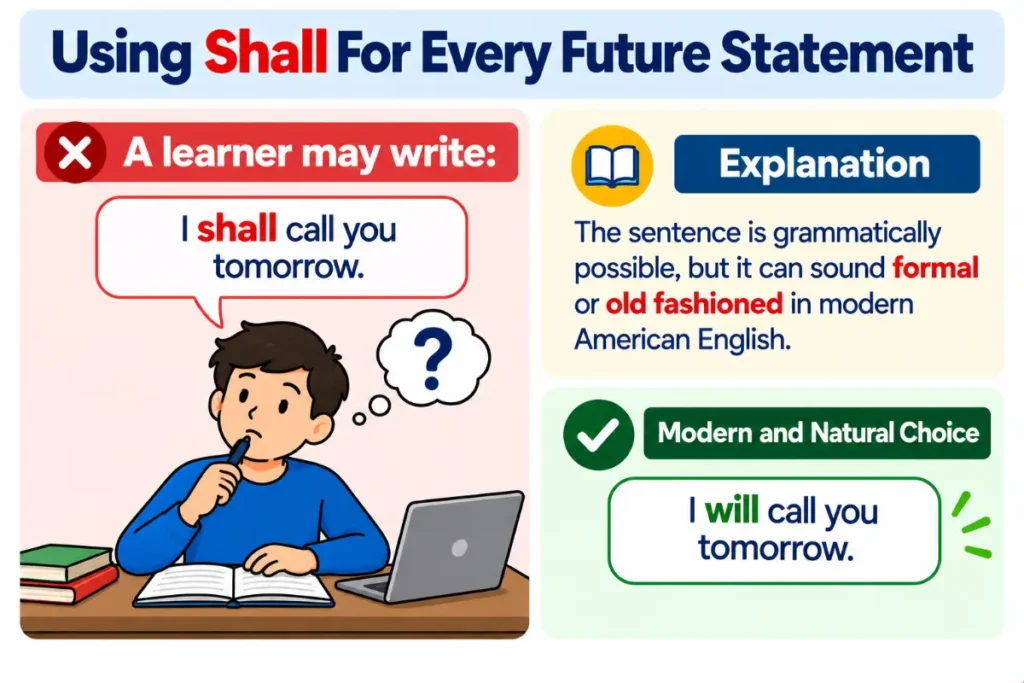
Using Shall For Every Future Statement
A learner may write:
I shall call you tomorrow.
The sentence is grammatically possible, but it can sound formal or old fashioned in modern American English.
A more natural American sentence is:
I will call you tomorrow.
Shall isn’t wrong simply because it sounds formal. The context determines its suitability.
Thinking Shall Is Required With I And We
Traditional grammar books often taught a rule based on the subject.
That rule doesn’t describe normal modern American English.
Modern speakers commonly say:
I will go.
We will arrive soon.
I will call you.
We will discuss it tomorrow.
There is no general requirement to replace will with shall in these sentences.
Using Shall When You Mean A Simple Prediction
Consider this sentence:
We shall probably arrive at eight.
It isn’t necessarily grammatically wrong. However, most American speakers would naturally say:
We will probably arrive at eight.
Will fits ordinary modern conversation better.
Using Will When A Suggestion Is Intended
Compare:
Will we start?
Shall we start?
The first asks for information about the future.
The second suggests starting and asks for agreement.
If you want to invite someone to make a decision with you, shall can be the better choice.
Assuming Shall Always Means Must
Shall can express an obligation in formal documents, but it doesn’t always mean must.
In Shall we leave? the speaker isn’t creating an obligation.
In Shall I help you? the speaker is making an offer.
Meaning comes from context.
Using Legal Style In Everyday Conversation
A sentence such as The customer shall pay by Friday can sound unnecessarily formal in an ordinary conversation.
A simpler version is:
The customer must pay by Friday.
Or:
The customer needs to pay by Friday.
Choose language that fits the situation.
Real Life Examples
The easiest way to understand the difference is to see the verbs working in natural situations.
At Home
Shall I make some coffee?
This is an offer. The speaker asks for the other person’s preference.
I’ll make some coffee.
This is a decision or offer stated directly.
Shall we watch a movie?
This is a suggestion.
We’ll watch a movie tonight.
This describes a future plan or expected action.
At Work
I will send the report this afternoon.
The speaker states a future action.
Shall we discuss the budget first?
The speaker suggests an action and invites agreement.
The manager will review the report tomorrow.
The sentence predicts or states a future event.
The employee shall provide all required documents.
This formal sentence expresses an obligation in an official context.
While Making Plans
Shall we meet at six?
The speaker suggests a meeting time.
We will meet at six.
The speaker states the agreed plan or future event.
Will we meet at six?
The speaker asks for information about the planned time.
These three sentences look similar, but their purposes differ.
In Customer Service
I will check your account.
The speaker promises or states an immediate future action.
Shall I transfer you to another department?
The speaker offers an action.
You will receive an email shortly.
The speaker gives information about a future event.
The applicant shall submit the required form.
This sentence belongs to formal written instructions.
Pronunciation And Contractions
Will is pronounced with a short vowel sound in normal speech. In connected speech, the word can become less prominent.
Its common contractions include I’ll, you’ll, he’ll, she’ll, we’ll, and they’ll.
Shall has one common contraction with not in informal usage, shan’t. This form exists in British English but is uncommon in modern American English.
Because shall appears less often in everyday American speech, learners may hear it less frequently than will.
The pronunciation itself isn’t usually the difficult part. The bigger challenge is recognizing the intended function.
When you hear Shall we…? think suggestion.
When you hear Shall I…? think offer.
When you hear will in a normal future statement, think future action, prediction, decision, or willingness depending on context.
Word Origin And Language Change
Will and shall have deep roots in the history of English.
Will developed from an Old English verb connected with wanting or wishing. This history helps explain why modern will can express willingness as well as future time.
Shall developed from an Old English verb associated with obligation and becoming obligated. Over centuries, both words changed in meaning and function.
Older English used these verbs in ways that don’t match modern everyday speech perfectly. Grammar traditions later created rules about which subject should take which verb. Those rules became especially influential in formal English teaching.
Modern English has moved toward a simpler pattern. Will now works naturally with all persons for ordinary future statements. Shall has kept some special functions, especially suggestions, offers, formal requirements, and certain traditional expressions.
Language changes because speakers change how they use words. Grammar descriptions need to account for actual modern usage rather than treating older rules as universal.
Formal And Informal Usage
The choice between will and shall can affect tone.
Will is neutral and flexible.
I will contact you tomorrow.
Shall can sound more formal.
I shall contact you tomorrow.
In American English, the second sentence may sound unusually formal outside a specific context.
However, shall becomes completely natural in certain questions.
Shall we begin?
Shall I open the door?
These don’t usually sound strange because English speakers have kept these patterns alive.
Formal writing creates another context where shall can appear.
The contractor shall complete the work by June.
The organization shall maintain accurate records.
For everyday communication, don’t use a formal modal simply to make your writing sound sophisticated. Clear language usually has more impact.
Memory Tips
You don’t need to memorize a long list of historical rules.
Remember these simple patterns.
- Use will for most future statements.
I will call you tomorrow.
- Use shall for many suggestions with I or we.
Shall we go?
- Use shall for many offers with I.
Shall I help you?
- Look for formal obligations in official documents.
The applicant shall provide the documents.
- Remember that modern American English strongly favors will in ordinary future statements.
A useful mental shortcut is this:
Will tells. Shall asks.
That isn’t a complete grammar rule, but it works as a practical memory aid for common conversation.
Will often tells someone about a future action.
I will call you.
Shall often asks someone to agree to an action.
Shall we call them?
Related Grammar Notes
Will and shall belong to the group of modal auxiliary verbs. They work with the base form of another verb.
I will go.
She will arrive.
We shall begin.
They shall provide the documents.
Don’t add to after will or shall when another verb follows.
Correct:
I will call you.
Incorrect:
I will to call you.
The same pattern applies to shall.
Correct:
Shall we leave?
Incorrect:
Shall we to leave?
Modal verbs also don’t take the normal third person singular ending.
Correct:
He will arrive.
Incorrect:
He wills arrive.
Shall follows the same basic pattern.
The negative form of will is will not. The common contraction is won’t.
I won’t go.
She won’t agree.
We won’t wait.
The negative form of shall is shall not. The contraction shan’t exists but is uncommon in American English.
Shall not can sound formal.
The company shall not disclose confidential information.
In ordinary speech, speakers usually choose other forms depending on the intended meaning.
Choosing The Right Verb
When you’re unsure which word to use, ask yourself what you want the sentence to do.
If you’re stating a future action, will is usually the right choice.
I will email you tonight.
If you’re making a suggestion involving I or we, shall can work naturally.
Shall we email them tonight?
If you’re offering to do something, shall can work well.
Shall I email them for you?
If you’re asking about someone’s willingness, use will.
Will you email them for me?
If you’re writing a formal requirement, check the style rules for the document. Shall may appear, but must can often make the obligation clearer.
This approach is more useful than memorizing an old subject based rule.
Will And Shall In Professional Writing
Professional writing should communicate clearly before it tries to sound formal.
Use will for ordinary future statements.
The team will complete the review by Friday.
The director will announce the results tomorrow.
The company will contact successful applicants.
Use shall when the context calls for a formal rule or obligation and the relevant style supports that choice.
The applicant shall provide proof of identity.
The supplier shall maintain accurate records.
The contractor shall comply with the stated requirements.
If you’re writing a contract, policy, regulation, or official document, follow the drafting rules that apply to that document. A legal editor may recommend a specific approach to modal verbs.
For emails, reports, presentations, and ordinary business communication, plain language is usually the stronger choice.
Key Takeaways
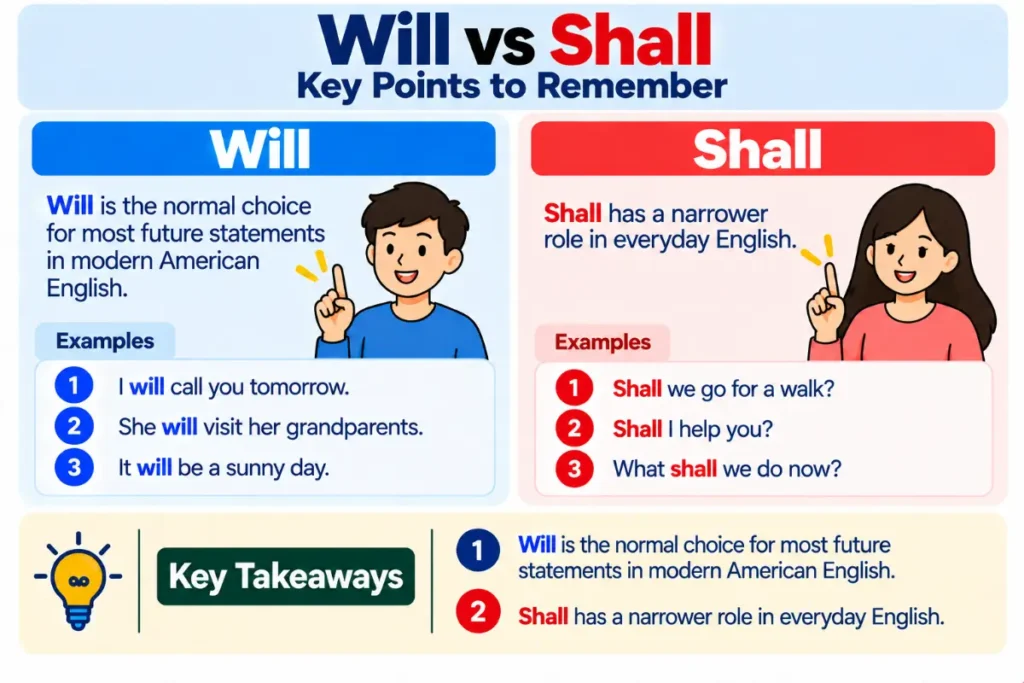
- Will is the normal choice for most future statements in modern American English.
- Shall has a narrower role in everyday English.
- Shall I…? commonly makes an offer.
- Shall we…? commonly makes a suggestion.
- Will you…? often asks about willingness or requests an action.
- Will works naturally with I, you, he, she, we, and they.
- Older grammar rules about shall and will don’t fully describe modern English.
- British English retains more traditional uses of shall than American English.
- Shall can appear in formal rules, contracts, and regulations.
- Must can sometimes state a formal obligation more directly than shall.
- Context matters more than memorizing an old subject based rule.
- For everyday American English, will is usually the safest future form.
Conclusion
Will vs shall becomes much easier once you stop treating the two words as interchangeable future markers. In modern American English, will handles most future statements, predictions, promises, decisions, and expressions of willingness. Shall has a smaller but useful role, especially in questions that make suggestions or offers.
The simplest practical rule is to use will for ordinary future statements and remember shall for common patterns such as Shall I…? and Shall we…? You may also see shall in formal documents where it expresses a duty or requirement. Modern British English keeps some additional traditional uses, but will remains widely used there too.
Good grammar isn’t about forcing every sentence into an old rule. It means choosing the form that matches your meaning, audience, and context. Once you recognize the difference between stating a future action and inviting someone to decide on an action, choosing between will and shall becomes much more natural.
Frequently Asked Questions
Is will or shall more common in American English?
Will is much more common in modern American English. Speakers use it for ordinary future statements, predictions, decisions, promises, and expressions of willingness. Shall remains common in certain questions such as Shall we go? and Shall I help?
Is will vs shall still an important grammar difference?
Yes, but the difference isn’t as broad as older grammar books sometimes suggest. Modern English generally uses will for future statements. Shall has more specialized uses, especially suggestions, offers, formal language, and some legal writing.
Should I say I will or I shall?
In ordinary American English, I will is the natural choice. I shall is grammatically possible but often sounds formal or old fashioned. Use shall when the context specifically calls for its traditional or formal tone.
Is shall more formal than will?
Often, yes. Shall can sound formal in ordinary statements such as I shall return tomorrow. However, Shall we…? and Shall I…? are natural expressions and don’t necessarily sound stiff.
Can I use shall in American English?
Yes. American English hasn’t eliminated shall. You can use it naturally in questions such as Shall we begin? and Shall I open the window? It also appears in formal and legal documents.
Do British speakers use shall more than Americans?
Traditionally, yes. British English has maintained more uses of shall, especially in formal and traditional styles. Modern British English still uses will very widely, so the traditional rule isn’t a complete description of current usage.
Does shall mean must?
Sometimes it can express an obligation in formal writing, but it doesn’t always mean must. In Shall we leave? it expresses a suggestion. In Shall I help? it expresses an offer. Context determines the meaning.
Is shall we a question?
Yes. Shall we…? is a question form that usually makes a suggestion or invites agreement about an action.
Is shall I a question?
Yes. Shall I…? commonly makes an offer or asks for guidance about an action.
Can I use shall for a future prediction?
You can, but it usually sounds formal or traditional in American English. Will is the normal choice for most future predictions.
Is shall better for formal writing?
Not automatically. Formal writing still needs to be clear. Shall can work well for certain rules and obligations, but writers often choose must when they want to state a requirement directly.

English Grammar & Usage
Nathan Holloway is an American grammar writer and language researcher who specializes in English grammar, sentence structure, verb usage, and common writing mistakes. He enjoys breaking down confusing grammar rules into practical explanations with clear examples, making English easier for students, professionals, and everyday writers.