
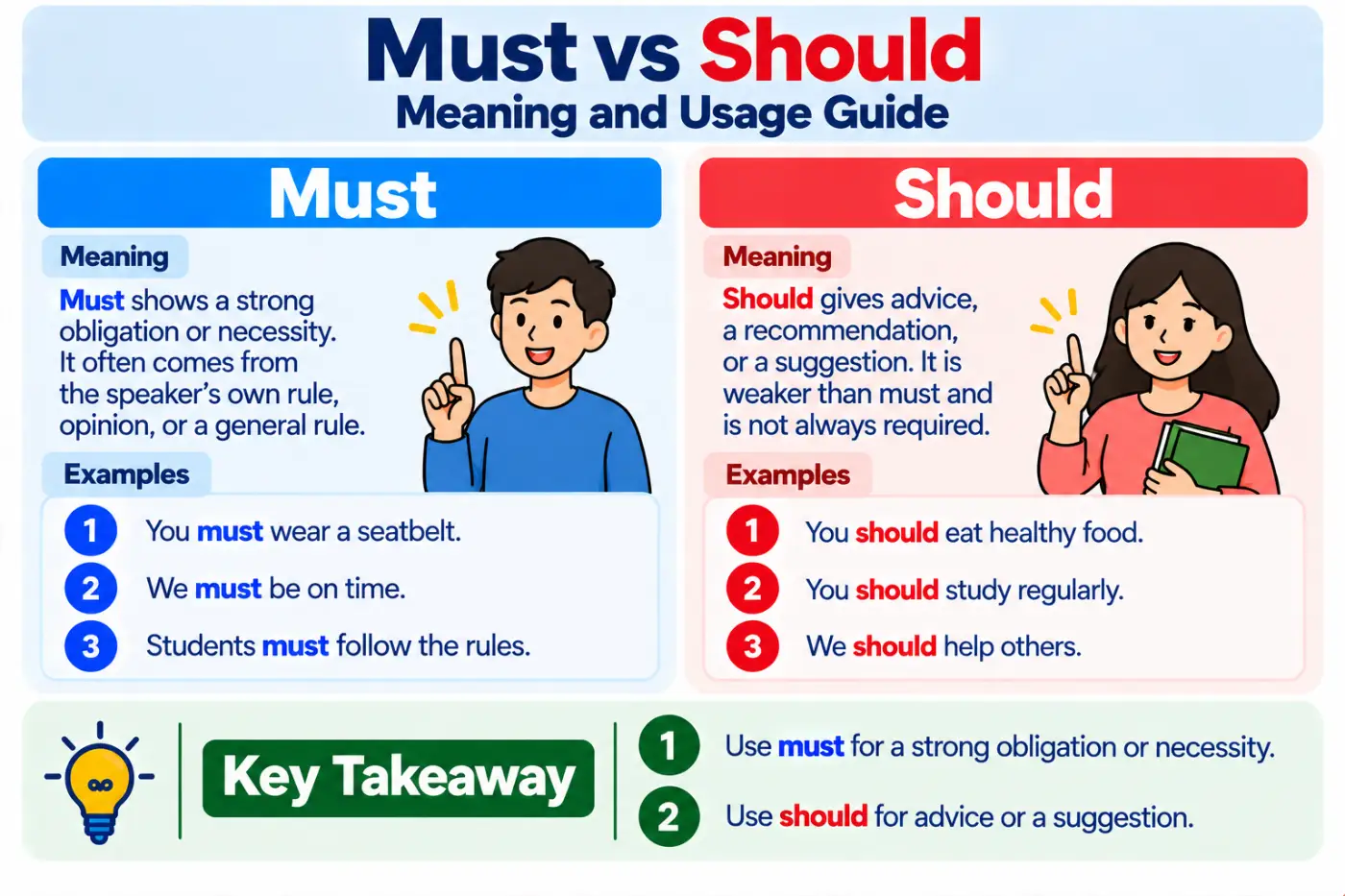
Must vs should can confuse English learners because both modal verbs can tell someone what to do. The difference becomes clear when you look at the strength and source of the idea. Must usually presents something as necessary or required. Should usually presents something as a good idea expected action or reasonable choice.
Think of must as a firm sign that says this action is required. Should sounds more like helpful guidance from someone who wants you to make a sensible choice. If a doctor says You must take this medicine exactly as prescribed the statement expresses a strong requirement. If the doctor says You should get more sleep the statement gives advice.
Both words can also express ideas about probability and expectation. Must can show a strong conclusion based on evidence. Should can show that something is expected to happen. The meaning depends on the sentence and the context.
Short Answer
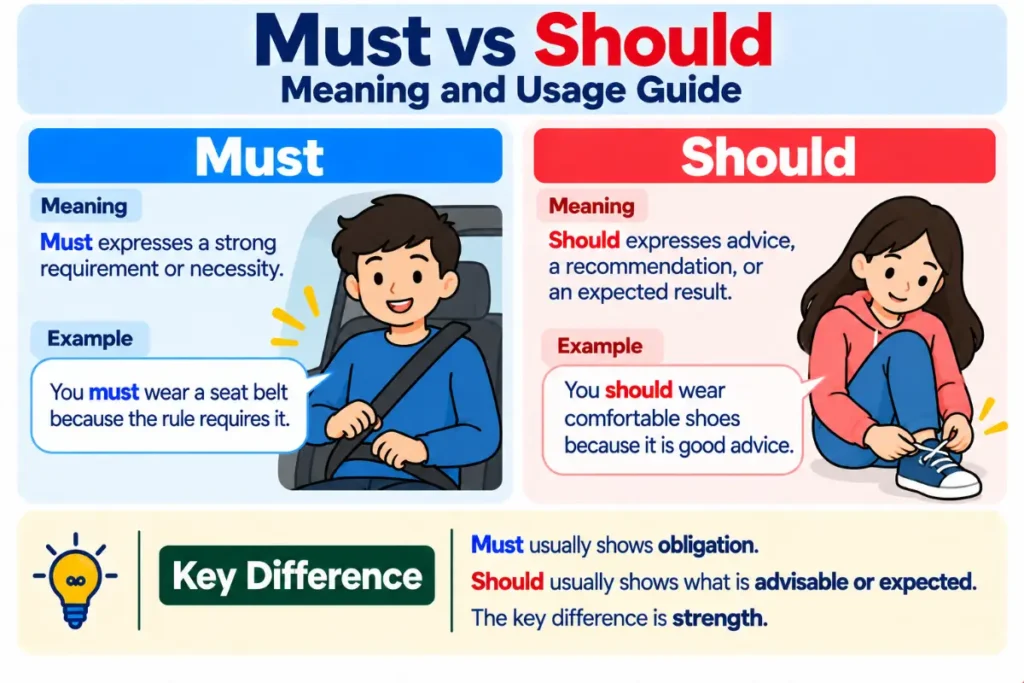
Must expresses a strong requirement or necessity. Should expresses advice recommendation or an expected result. For example you can say You must wear a seat belt because the rule requires it. You should wear comfortable shoes because it is good advice. The key difference is strength. Must usually shows obligation while should usually shows what is advisable or expected.
Table of Contents
- What Must Means.
- What Should Means.
- The Main Difference Between Must And Should.
- Must For Strong Obligation.
- Should For Advice.
- Must And Should For Rules.
- Must And Should For Personal Choices.
- Must And Should For Expectations.
- Must For Logical Conclusions.
- Should For Expected Results.
- Grammar Rules For Must.
- Grammar Rules For Should.
- Must Not And Should Not.
- Must Have And Should Have.
- Must And Should In Questions.
- Must And Should In Professional Writing.
- Common Mistakes.
- Real Life Examples.
- Memory Tips.
- Related Grammar Notes.
- Frequently Asked Questions.
- Key Takeaways.
- Conclusion.
What Must Means
Must is a modal verb that usually expresses strong necessity obligation or certainty. It tells the reader or listener that something is required or that the speaker sees something as necessary.
Consider these examples.
You must submit the form by Friday.
Employees must wear identification badges.
You must slow down near the school.
I must remember to call my mother.
The first three examples describe strong requirements. The fourth describes a personal sense of necessity.
Must can also express a strong logical conclusion.
She must be tired after working all night.
They must know the answer.
He must be at home because his car is outside.
In these examples must does not mean someone has imposed a rule. Instead it shows that the speaker feels highly confident about a conclusion.
This gives must two major uses.
- Strong obligation or necessity.
- Strong deduction based on evidence.
The context tells you which meaning applies.
What Should Means
Should usually expresses advice recommendation expectation or something that the speaker considers appropriate.
You should drink more water.
You should call your parents.
Students should review their notes before the exam.
You should check the address before sending the package.
These sentences don’t normally create the same force as must. They suggest a sensible action rather than an absolute requirement.
Should can also describe an expected result.
The train should arrive soon.
The package should reach you tomorrow.
She should be home by now.
The word should can therefore carry several related meanings.
- Advice.
- Recommendation.
- Duty or appropriate behavior.
- Expectation.
- A likely result.
Should can also appear in polite and formal expressions.
You should contact the office for more information.
The report should include the final figures.
Applicants should provide two forms of identification.
In these cases the exact force depends on context. A workplace policy may use should to express a strong expectation while everyday conversation may use it as simple advice.
The Main Difference Between Must And Should
The clearest difference between must and should is the level of obligation.
Must usually signals that the action is necessary.
Should usually signals that the action is advisable.
Compare these sentences.
You must wear a helmet.
You should wear a helmet.
The first sentence presents helmet use as a requirement. The second recommends helmet use but does not automatically create a rule.
Another comparison makes the difference even clearer.
You must finish the report today.
You should finish the report today.
The first sentence says completion today is necessary. The second says completing it today is the sensible or preferred choice.
That distinction matters in everyday communication. Using must can make your statement sound firm and authoritative. Using should can make the same idea sound more like guidance.
| Modal verb | Main meaning | Strength | Example |
|---|---|---|---|
| Must | Strong necessity or obligation | Very strong | You must show your ID. |
| Should | Advice or recommendation | Moderate | You should bring your ID. |
| Must | Strong conclusion | Very strong confidence | She must be busy. |
| Should | Expected result | Reasonable expectation | She should arrive soon. |
The table shows why these words aren’t always interchangeable. Their grammatical form looks similar but their practical meaning can change significantly.
Must For Strong Obligation
Must is appropriate when an action is required.
Rules often use must because the writer wants to make the requirement clear.
Visitors must sign in at the front desk.
Passengers must remain seated during takeoff.
You must provide accurate information on the application.
Employees must follow the safety procedure.
These statements communicate requirements rather than casual suggestions.
Must can also express an internal obligation.
I must finish this work before I leave.
I must remember her birthday.
We must find a solution.
Here the speaker may not be describing an official rule. The speaker simply feels that the action is necessary.
This distinction between external and internal obligation is useful because must can cover both situations.
Should For Advice
Use should when you want to recommend an action without presenting it as an absolute requirement.
You should save a copy of the document.
You should back up your files.
These sentences give useful guidance. The listener still has some freedom to decide.
Should is common in friendly conversations because it usually sounds less forceful than must.
Compare these statements.
You must see a doctor.
You should see a doctor.
The first sentence sounds urgent or strongly necessary. The second sounds like advice.
The difference can become especially important in professional communication. If you tell a customer that they must complete a step then the customer may understand it as mandatory. If you tell them that they should complete the step then they may understand it as a recommendation.
Choose the modal carefully so your tone matches your intention.
Must And Should For Rules
Rules can use both words but they don’t always communicate the same level of force.
A school might say Students must wear uniforms.
That wording tells students that uniforms are required.
A school might instead say Students should wear appropriate clothing.
That wording sounds less absolute and leaves room for interpretation.
Official documents often choose stronger language when they need to create a clear requirement. Everyday instructions often use should when the writer wants to guide behavior without sounding overly strict.
Context can also change the practical force of should. For example a workplace handbook might say Employees should arrive ten minutes before their scheduled start time. In that setting should could communicate a strong workplace expectation even though it is grammatically softer than must.
For precise writing ask yourself one simple question.
Is this action required or recommended.
If it is required must may fit. If it is recommended should may fit.
Must And Should For Personal Choices
Personal decisions often work naturally with should because advice leaves room for choice.
I think you should take a break.
You should try the new restaurant.
You should get some rest.
Must can also describe personal decisions but it sounds stronger.
I must finish this book tonight.
I must get more sleep.
The speaker is presenting the action as necessary rather than simply advisable.
The difference can affect personality and tone. Someone who says I should exercise is giving themselves advice. Someone who says I must exercise is expressing a stronger personal commitment.
Neither sentence is automatically better. The right choice depends on the intended meaning.
Must And Should For Expectations
Should often expresses an expectation about something that is likely to happen.
The bus should arrive in ten minutes.
Your package should arrive tomorrow.
The meeting should finish by noon.
She should be here soon.
These sentences don’t describe rules. They describe what the speaker expects.
Must can sometimes express a strong conclusion instead.
The bus must have left already.
She must be at work.
They must have forgotten the appointment.
The speaker reaches a conclusion from available evidence.
Compare these two examples.
She should be at home by now.
She must be at home because her car is in the driveway.
The first sentence expresses an expectation. The second expresses a stronger conclusion based on evidence.
This is one of the most useful differences to understand because learners often assume that must always means obligation.
It doesn’t.
Must For Logical Conclusions
Must can show that the speaker believes something is almost certainly true.
You must be hungry after that long hike.
He must be exhausted after the flight.
They must know what happened.
The speaker isn’t ordering anyone to be hungry or tired. Must expresses a conclusion.
You can often test this meaning by replacing must with I strongly conclude that.
She must be tired.
I strongly conclude that she is tired.
The second version sounds unnatural in everyday conversation but it reveals the basic logic.
Evidence leads to a strong conclusion.
The same pattern appears with past events.
They must have missed the train.
He must have forgotten the meeting.
She must have left early.
Here must have followed by a past participle expresses a strong conclusion about something that happened before now.
Should For Expected Results
Should can also express probability but it usually communicates a reasonable expectation rather than near certainty.
The results should arrive next week.
The food should be ready soon.
He should know the answer.
The weather should improve tomorrow.
The speaker expects these things to happen but doesn’t claim complete certainty.
This use appears frequently in everyday speech and professional communication.
Your payment should appear in your account within two business days.
The updated file should be available later today.
The repair should take about an hour.
These statements set expectations without making an absolute promise.
That makes should useful when you want to communicate a likely result while leaving room for normal uncertainty.
Grammar Rules For Must
Must is a modal auxiliary verb. It follows the base form of the main verb.
You must leave now.
She must study harder.
They must follow the instructions.
Do not add to after must when you use the main verb.
Incorrect: You must to leave now.
Correct: You must leave now.
Must does not change form for different subjects.
I must go.
You must go.
He must go.
She must go.
They must go.
You don’t write musts or mustes as a third person form.
Another important point is that must does not normally use do or does to form questions.
Incorrect: Do you must leave now.
Correct: Must you leave now.
However must you can sound formal or somewhat old fashioned in ordinary conversation. Many speakers choose Do you have to instead.
Do you have to leave now.
That question sounds more natural in many everyday situations.
Grammar Rules For Should
Should also works as a modal auxiliary verb and takes the base form of the main verb.
You should study.
She should study.
They should study.
He should study.
Never add to after should.
Incorrect: You should to call him.
Correct: You should call him.
Should also stays the same with every subject.
I should go.
You should go.
He should go.
She should go.
We should go.
They should go.
For questions place should before the subject.
Should I call her.
Should I bring anything.
These forms are common and natural.
Must Not And Should Not
The negative forms must not and should not have very different meanings.
Must not usually means something is prohibited.
You must not enter this room.
Students must not use phones during the exam.
You must not share your password.
These statements communicate a strong prohibition.
Should not usually gives advice against an action.
You should not stay up so late.
You should not spend all your money at once.
The distinction is important.
Must not means the action is forbidden or strictly prohibited.
Should not means the action is discouraged or considered unwise.
Consider this pair.
You must not touch the machine.
You should not touch the machine.
The first sentence sounds like a rule. The second sounds like a warning or recommendation.
Don’t confuse should not with must not. They can produce very different meanings.
Must Have And Should Have
Both words can describe past situations but they don’t mean exactly the same thing.
Must have expresses a strong conclusion about the past.
She must have forgotten the appointment.
He must have taken the wrong train.
They must have left already.
Should have usually expresses an expected action that didn’t happen or a past action that would have been better.
You should have called me.
She should have studied earlier.
We should have left sooner.
The speaker often uses should have to express regret criticism or a missed expectation.
Compare these examples.
He must have missed the bus.
He should have taken the earlier bus.
The first sentence is a conclusion about what probably happened. The second says the speaker thinks a different action would have been better.
Must And Should In Questions
Questions with should are very common.
Should I call now.
Should they wait outside.
These questions ask for advice or guidance.
Questions with must are possible but less common in casual American English.
Must I attend the meeting.
Must he complete the form today.
These forms can sound formal or emphatic.
In everyday American English many speakers use have to instead.
Do I have to attend the meeting.
Do we have to leave now.
Does he have to complete the form today.
This difference is useful when you want your writing to sound natural and modern.
Must And Should In Professional Writing
Professional writers need to think about tone and legal force.
Use must when you need to communicate a clear requirement.
Applicants must complete all required fields.
Employees must protect confidential information.
Users must accept the terms before continuing.
Use should when you want to provide guidance or state a recommended practice.
Applicants should review their information before submitting the form.
Employees should report unusual activity promptly.
Users should keep their account information secure.
The distinction matters because unclear modal verbs can create confusion.
A policy writer shouldn’t use should when a requirement needs to be unmistakable. At the same time a writer shouldn’t use must for every recommendation because constant strong language can make ordinary guidance sound unnecessarily strict.
Good professional writing matches the modal verb to the intended force.
Common Mistakes
Many English learners use must and should as if they were interchangeable. They aren’t.
Using Must For Simple Advice
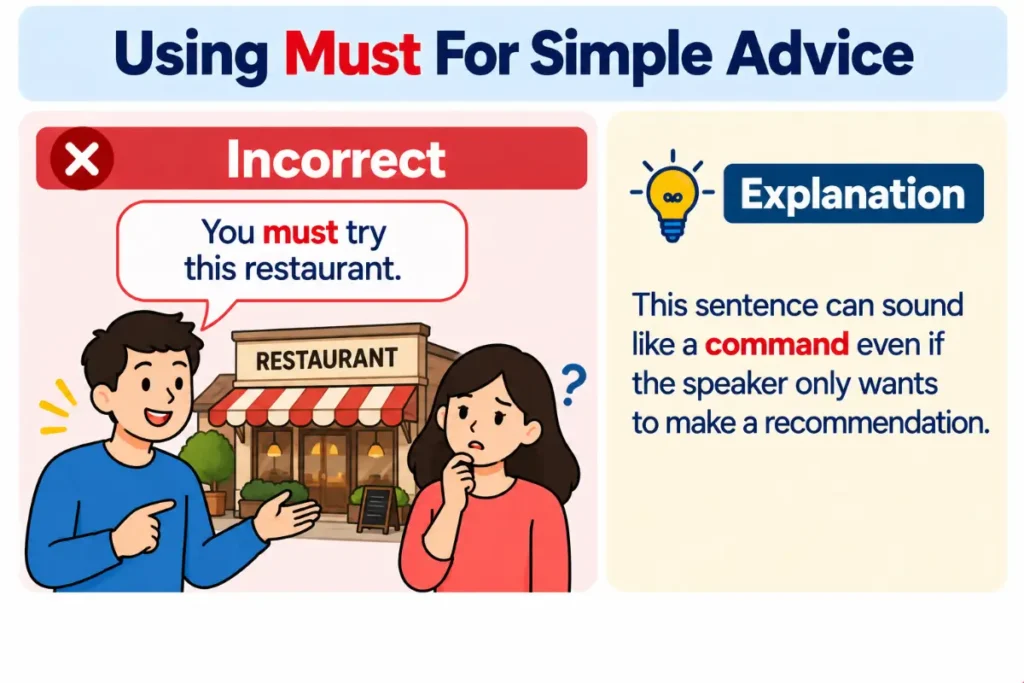
Incorrect: You must try this restaurant.
This sentence can sound like a command even if the speaker only wants to make a recommendation.
Better: You should try this restaurant.
Must can still work if the speaker intentionally wants to sound very enthusiastic or emphatic. Context controls the force.
Using Should For A Strict Requirement
Incorrect: Visitors should show identification to enter the building.
If identification is required then should may sound too weak.
Better: Visitors must show identification to enter the building.
Confusing Must Not With Should Not
These forms aren’t equal.
You must not park here means parking is prohibited.
You should not park here means parking is discouraged or unwise.
The difference can matter in safety instructions policies and legal writing.
Adding To After Must
Incorrect: You must to finish this today.
Correct: You must finish this today.
Modal verbs such as must and should take the base form of the main verb.
Adding To After Should
Incorrect: You should to call her.
Correct: You should call her.
This is another common learner error.
Changing Must For He Or She
Incorrect: She musts leave early.
Correct: She must leave early.
Modal verbs don’t take the usual third person singular ending.
Changing Should For He Or She
Incorrect: He shoulds study.
Correct: He should study.
Should remains unchanged with every subject.
Real Life Examples
The best way to understand modal verbs is to see them in situations people actually face.
At Work
You must submit the report before the deadline.
This means the deadline creates a requirement.
You should proofread the report before sending it.
This means proofreading is recommended.
At School
Students must bring their identification cards.
This describes a requirement.
Students should review the material before the test.
This gives useful advice.
At Home
You must turn off the stove before leaving.
This can communicate a serious safety requirement.
You should clean the kitchen before guests arrive.
This sounds like practical advice.
While Traveling
Passengers must show their passports at the border.
The action is required.
You should keep your passport somewhere safe.
The action is recommended.
At The Doctor
You must take this medicine as directed.
The doctor is presenting the instruction as necessary.
You should drink plenty of water.
The doctor is giving advice.
In Everyday Conversation
You must see this movie.
The speaker strongly recommends the movie and uses must for emphasis.
You should see this movie.
The recommendation sounds more moderate.
Both sentences can be natural. The difference lies in strength and tone.
Memory Tips
A simple memory trick can help you choose the right modal quickly.
Think of must as a red light.
A red light means stop. You have a clear restriction or requirement.
Think of should as a yellow light.
A yellow light suggests caution. It tells you to think carefully and consider the recommended action.
Another useful test is to ask yourself if the action is required.
If yes then must is often the better choice.
If the action is simply a good idea then should is often the better choice.
You can also remember the strength scale.
Must means necessary.
Should means advisable.
This short distinction covers many everyday situations.
For logical conclusions remember another pattern.
Must means the evidence points strongly to the conclusion.
Should means the result is expected.
That distinction will help you understand sentences such as She must be home and She should be home.
Related Grammar Notes
Must and should belong to a larger group called modal verbs. Other common modal verbs include can could may might will would and shall.
Modal verbs help speakers express ideas such as ability permission possibility prediction obligation and advice.
Must is generally stronger than should when both words express obligation.
You must finish the assignment.
You should finish the assignment.
The first statement presents completion as necessary. The second recommends completion.
Have to is another important expression to compare with must.
You have to wear a seat belt.
You must wear a seat belt.
Both can express strong obligation but they can differ in emphasis and context. Have to often presents an obligation as coming from an outside rule or situation. Must can sound more direct and can also express the speaker’s own sense of necessity.
Should also connects with ought to.
You should apologize.
You ought to apologize.
Both can express advice or expectation. Should is much more common in modern American English.
Another useful expression is had better.
You had better leave now.
Had better can sound stronger and more urgent than ordinary should. It often suggests that a negative result may follow if the action doesn’t happen.
Must And Should In American English
Both modal verbs are common in American English.
Must appears frequently in rules instructions formal writing and strong personal statements. It also appears in logical deductions.
Should is extremely common in everyday advice recommendations expectations and polite guidance.
American speakers often use have to instead of must when asking about obligations.
Do I have to go.
This sounds more natural in casual conversation than Must I go.
For recommendations Americans commonly use should.
You should try it.
You should check again.
That makes should especially useful for friendly and conversational advice.
Must And Should In British English
British English uses must and should in many of the same ways as American English.
The basic grammatical distinction remains the same.
Must can express obligation.
Should can express advice or expectation.
British English may use shall more often in some formal contexts but that doesn’t change the core meanings of must and should.
Regional differences usually affect frequency style and preferred expressions more than the central grammar rule.
Pronunciation And Word Form
Must is usually pronounced with a short vowel sound in American English. The final t can become less noticeable in connected speech depending on the surrounding sounds.
Should has a different vowel sound and ends with the sound represented by l in spelling although the pronunciation does not sound like a separate clear l followed by a d.
For learners it helps to focus on the whole word rather than trying to pronounce every letter exactly as it appears.
Both words are short and common. That makes them easy to overlook but very important for meaning.
When Should Can Sound Strong
Should usually sounds softer than must but context can increase its force.
Consider a manager saying Employees should arrive on time.
In a casual conversation that may sound like ordinary advice.
In a workplace policy the same sentence could communicate a serious expectation.
Tone also matters.
You should really talk to your manager about this.
The word really adds emphasis.
You really should talk to your manager about this.
This version can sound even more urgent.
So don’t judge the force of should from the word alone. Look at the speaker’s intention and the situation.
When Must Can Sound Softer
Must usually expresses strong necessity but speakers sometimes use it in friendly or enthusiastic recommendations.
You must try this cake.
You must watch this show.
These sentences don’t necessarily create a formal obligation. The speaker uses must for emphasis.
The listener understands from context that the speaker means something like I strongly recommend it.
This use is common in conversational English and shows why context matters.
Must And Should In Conditional Sentences
Both words can appear in conditional structures.
If you must leave early then let me know.
If you should need help please call the office.
The second pattern is more formal and means something similar to if you happen to need help.
You may also see should in conditional clauses without if.
Should you have any questions please contact the office.
This structure is formal and common in business writing.
The meaning remains connected to possibility or condition rather than ordinary advice.
Must And Should With Passive Voice
Both modal verbs can appear before passive forms.
The form is modal verb plus be plus past participle.
The form should be completed.
The first sentence says completion is required.
The second says completion is expected or recommended.
More examples include these.
All applications must be submitted online.
All applications should be reviewed carefully.
The doors must be locked at night.
The doors should be checked before closing.
This structure is especially useful in instructions policies and professional documents.
How To Choose Between Must And Should
When you’re unsure which word to use follow three simple steps.
- Identify the action.
- Decide if the action is required or recommended.
- Choose must for strong necessity and should for advice or expectation.
For example imagine you’re writing a workplace instruction.
Employees must wear protective equipment.
You choose must because protective equipment is required.
Now imagine you’re giving a suggestion.
Employees should take regular breaks.
You choose should because breaks are being recommended.
The same method works in conversation.
You must call the doctor.
This sounds like a strong necessity.
You should call the doctor.
This sounds like advice.
The difference is small in form but large in meaning.
Why The Difference Matters
Choosing the right modal verb helps people understand your intention.
If you use must when you mean should your advice may sound like an order.
If you use should when you mean must your instruction may sound optional.
That can create problems at work school home and in public instructions.
Imagine a safety notice that says Visitors should wear protective equipment.
A reader might think the equipment is optional.
If the equipment is actually required then must communicates the rule more clearly.
Now imagine a friend says You must try my new recipe.
The sentence probably doesn’t mean you face a serious obligation. The speaker is simply showing strong enthusiasm.
Good English depends on more than grammar rules. Meaning comes from grammar plus context plus tone.
Key Takeaways
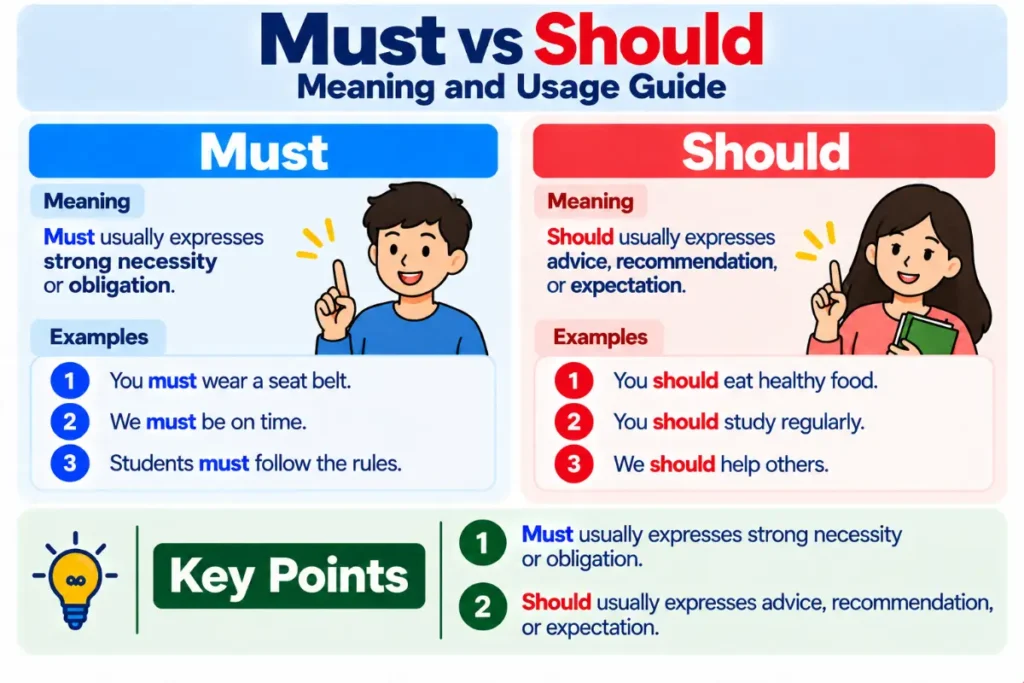
- Must usually expresses strong necessity or obligation.
- Should usually expresses advice recommendation or expectation.
- Must can express a strong logical conclusion.
- Should can express a reasonable expectation.
- Must not usually means an action is prohibited.
- Should not usually means an action is discouraged.
- Must have often expresses a strong conclusion about the past.
- Should have often expresses regret criticism or a missed expectation.
- Both words are modal verbs and take the base form of the main verb.
- Neither modal verb changes form for he she or it.
- Use must when an action is required.
- Use should when an action is recommended or expected.
- Context and tone can change how strong a statement sounds.
Conclusion
Must vs should becomes much easier once you focus on the level of force. Must usually tells someone that an action is necessary or required. Should usually gives advice or describes what you expect to happen. Must can also show a strong conclusion while should can show a reasonable expectation.
The easiest test is to ask what you mean. If you mean this action is necessary then must often fits. If you mean this action is a good idea then should usually fits and If you are making a conclusion from strong evidence then must can express that confidence.
Good modal verb choices make your English clearer and more precise. Once you notice the difference between requirement advice certainty and expectation you can use these two small but powerful words with much more confidence.
Frequently Asked Questions
Is Must Stronger Than Should?
Yes. When both words express obligation must normally communicates a stronger requirement than should. Must presents an action as necessary while should usually presents it as advisable.
Can Must And Should Mean The Same Thing?
They can sometimes point toward the same action but they don’t usually communicate the same level of force. Must makes the need stronger. Should makes the statement more like advice or expectation.
Is Must More Formal Than Should?
Not always. Both words appear in formal and informal English. Must often appears in rules and official instructions because it clearly expresses obligation. Should is common in both everyday speech and professional writing.
Should I Use Must Or Should For Advice?
Use should for ordinary advice. Use must only when you intentionally want to make the advice sound extremely strong or necessary.
What Does Must Not Mean?
Must not usually means that an action is prohibited. For example You must not enter this area means entering the area is forbidden.
What Does Should Not Mean?
Should not usually means that an action is discouraged or considered unwise. For example You should not skip breakfast presents advice rather than an absolute prohibition.
Is Must Have The Same As Should Have?
No. Must have often expresses a strong conclusion about a past event. Should have often expresses regret criticism or an action that was expected but didn’t happen.
Can Must Express Probability?
Yes. Must can express a strong logical conclusion. For example She must be tired means the speaker has strong reasons to believe she is tired.
Can Should Express Probability?
Yes. Should can express a reasonable expectation. For example The package should arrive tomorrow means the speaker expects it to arrive tomorrow.
Is Must I Go Natural In American English?
It is grammatically correct but it can sound formal or emphatic in everyday American conversation. Do I have to go is often more natural for a casual question about obligation.

English Grammar & Usage
Nathan Holloway is an American grammar writer and language researcher who specializes in English grammar, sentence structure, verb usage, and common writing mistakes. He enjoys breaking down confusing grammar rules into practical explanations with clear examples, making English easier for students, professionals, and everyday writers.