
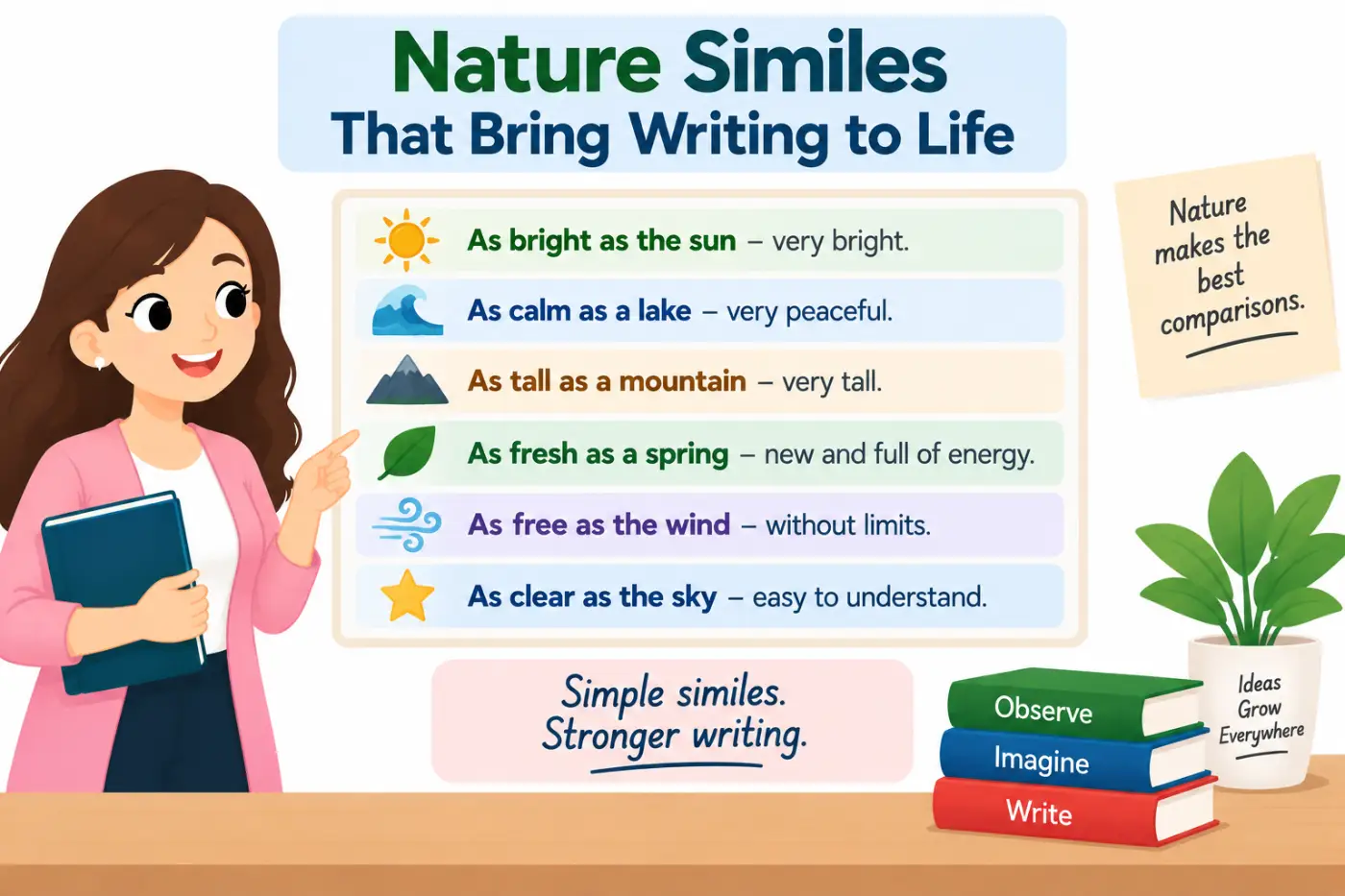
Nature similes can turn a plain description into something readers can see, hear, and feel. Instead of saying that a lake is calm, you can compare it to glass at dawn. Instead of saying that the wind is loud, you can describe it as a restless animal moving through the trees.
The beauty of these comparisons comes from familiarity. Everyone understands rain, sunlight, flowers, forests, rivers, clouds, birds, mountains, and changing seasons. When a writer connects an unfamiliar idea to something from nature, the reader gets an instant mental picture. That makes descriptive writing stronger without making it difficult to understand.
Good comparisons also carry emotion. A storm can suggest anger. A spring morning can suggest hope. A fading leaf can suggest loss. The right image can make a simple sentence linger in the reader’s mind long after they finish reading it. The collection below gives you more than 120 original examples organized by theme, along with explanations and practical guidance for using them well.
Short Answer
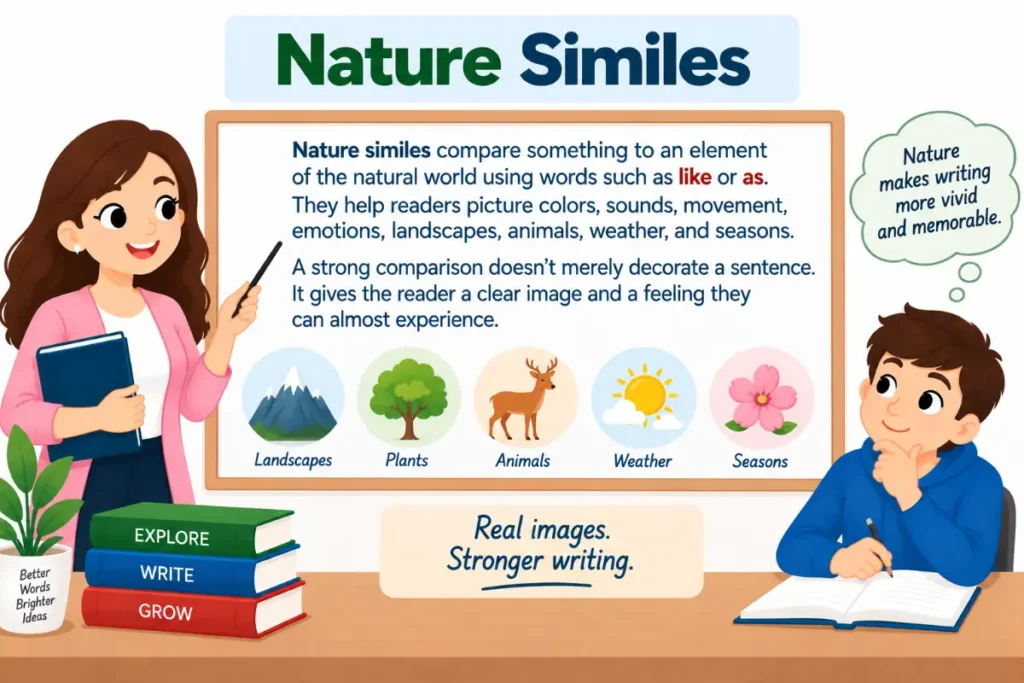
Nature similes compare something to an element of the natural world using words such as like or as. They help readers picture colors, sounds, movement, emotions, landscapes, animals, weather, and seasons. A strong comparison doesn’t merely decorate a sentence. It gives the reader a clear image and a feeling they can almost experience.
Table of Contents
- What Nature Similes Are
- Why Nature Similes Make Writing Stronger
- Nature Similes About Trees and Forests
- Nature Similes About Flowers and Plants
- Nature Similes About Water and Oceans
- Nature Similes About Mountains and Landscapes
- Nature Similes About Weather
- Nature Similes About the Sky and Clouds
- Nature Similes About Animals
- Nature Similes About Seasons
- Nature Similes About Sunlight and Darkness
- Nature Similes About Sounds in Nature
- Nature Similes About Human Feelings
- Nature Similes for Students and Creative Writers
- Common Mistakes
- Memory Tips
- Related Grammar and Usage Notes
- FAQs
- Key Takeaways
- Conclusion
What Nature Similes Are
A simile is a figure of speech that compares two different things using a comparison word. The most common words are like and as.
For example:
The river moved like a silver ribbon.
The river isn’t literally a ribbon. The comparison helps the reader imagine its shape and movement.
Another example is:
Her smile was as warm as morning sunlight.
The smile and sunlight are different things. The comparison connects them through the shared quality of warmth.
Nature provides an enormous supply of images for this kind of writing. A writer can compare a person to a tree, a voice to birdsong, a mood to a storm, a road to a winding river, or a memory to autumn leaves.
The strongest comparisons usually have a clear reason behind them. If you compare something to a storm, the reader should understand what connects the two. Perhaps both are violent, unpredictable, loud, or emotionally overwhelming.
A simile becomes more effective when the comparison adds meaning rather than simply sounding pretty.
Why Nature Similes Make Writing Stronger
A plain sentence gives information. A vivid comparison gives information plus an image.
Consider this sentence:
The boy was very quiet.
It tells us something useful but leaves plenty of room for imagination.
Now consider:
The boy was as quiet as a fox waiting in tall grass.
The second sentence creates tension. You can picture the stillness and sense that the boy may be watching or waiting for something.
This is why comparisons matter in storytelling, poetry, personal essays, school assignments, speeches, and descriptive writing.
They can help you do several things.
- Create a picture. A comparison gives the reader something concrete to imagine.
- Show emotion. Nature can represent fear, peace, excitement, sadness, hope, or anger.
- Make descriptions memorable. A fresh image can stay with the reader.
- Explain difficult ideas. A familiar natural object can make an abstract idea easier to understand.
- Add personality. Original comparisons reveal how a writer sees the world.
The key is restraint. A page packed with comparisons can feel crowded. A carefully chosen image often has more power than five ordinary ones.
Nature Similes About Trees and Forests
Trees offer some of the richest imagery because they can suggest strength, age, patience, loneliness, shelter, or growth.
- The old oak stood like a patient guardian beside the road.
The comparison makes the tree seem protective and watchful. - The pine trees rose like green spears against the sky.
This emphasizes their tall and pointed shape. - Her hair fell like willow branches around her shoulders.
The image suggests softness and graceful movement. - The forest was as quiet as a sleeping village.
The comparison emphasizes deep silence. - The branches twisted like ancient fingers above the path.
This creates an eerie image. - The young trees stood as straight as soldiers.
The comparison focuses on their upright shape. - The leaves trembled like tiny coins in the wind.
This highlights their small movement and flickering appearance. - The forest floor was soft like a thick green carpet.
The comparison helps the reader imagine its texture. - The roots spread like buried rivers beneath the soil.
This emphasizes their branching structure. - The bare branches reached upward like desperate hands.
The comparison gives the trees an emotional quality. - The cedar smelled as fresh as rain soaked earth.
This connects the scent to another familiar natural experience. - The forest looked like a green ocean from the hilltop.
The comparison emphasizes the vast moving canopy. - The moss covered the stones like a soft blanket.
This suggests thickness and softness. - The sunlight slipped through the branches like golden thread.
The image focuses on narrow beams of light. - The autumn trees burned like quiet flames.
The comparison captures vivid red and orange leaves.
Nature Similes About Flowers and Plants
Flowers can suggest beauty, youth, fragility, growth, affection, or change.
- The roses opened like small red lanterns.
The image focuses on their shape and color. - The daisy was as bright as a tiny star.
This emphasizes its white petals against a darker background. - The sunflower stood like a golden wheel in the garden.
The comparison highlights its round center and bright petals. - The lavender moved like purple waves in the breeze.
The image makes the flower field seem fluid. - The wildflowers scattered across the hill like confetti.
This suggests a cheerful spread of many colors. - The petals were as soft as feathers.
The comparison focuses on delicate texture. - The vines climbed the wall like curious snakes.
The image emphasizes their twisting movement. - The grass shimmered like green silk after the rain.
This highlights smoothness and shine. - The leaves were as fresh as newly washed glass.
The comparison captures their clean appearance after rain. - The little plant pushed through the soil like a determined child.
The image suggests persistence. - The garden bloomed like a colorful painting.
This gives the scene an artistic quality. - The tulips stood like bright cups beneath the morning sun.
The comparison highlights their shape. - The petals floated like tiny boats on the pond.
This works especially well for fallen petals drifting on water. - The seedling was as fragile as a newborn bird.
The comparison emphasizes vulnerability. - The climbing rose wrapped around the fence like a green ribbon.
The image focuses on its long winding shape.
Nature Similes About Water and Oceans
Water can represent calmness, danger, freedom, movement, mystery, or change.
- The lake was as smooth as polished glass.
The comparison shows how still the surface was. - The river twisted like a silver snake through the valley.
The image emphasizes its winding path. - The waves crashed like drums against the rocks.
This focuses on the repeated powerful sound. - The stream moved as quietly as a whispered secret.
The comparison creates a peaceful mood. - The ocean stretched like an endless blue blanket.
The image emphasizes its enormous surface. - The waterfall fell like a white curtain from the cliff.
This highlights its vertical shape. - The water sparkled like scattered diamonds beneath the sun.
The comparison captures bright reflections. - The pond was as calm as a sleeping child.
The image creates a gentle peaceful mood. - The waves rose like mountains around the boat.
This emphasizes their size and danger. - The rainwater ran down the window like tiny rivers.
The comparison makes individual streams of water easy to picture. - The creek curled through the meadow like a blue ribbon.
The image focuses on its narrow winding path. - The tide moved like a slow breathing creature.
This gives the sea an organic rhythm. - The waterfall sounded like applause from the valley below.
The comparison focuses on its continuous roar. - The ocean looked as dark as ink beneath the storm clouds.
The image creates a dramatic mood. - The shallow water was clear like a sheet of crystal.
The comparison emphasizes transparency.
Nature Similes About Mountains and Landscapes
Mountains and landscapes can help writers communicate scale, strength, distance, loneliness, and beauty.
- The mountain rose like a giant sleeping beast.
The comparison gives the landscape a powerful presence. - The cliffs stood as tall as ancient walls.
The image emphasizes their height. - The valley spread like a green bowl between the hills.
The comparison describes its shape. - The hills rolled like waves across the horizon.
The image emphasizes their gentle curves. - The desert stretched like a golden ocean.
This captures the enormous open landscape. - The rocks were as sharp as broken glass.
The comparison suggests danger. - The canyon opened like a giant wound in the earth.
This creates a dramatic and unsettling image. - The meadow looked like a green blanket beneath the mountains.
The comparison emphasizes the contrast between flat land and peaks. - The mountain path twisted like a thread through the rocks.
The image focuses on the narrow winding trail. - The valley was as quiet as an empty church.
This gives the landscape a solemn mood. - The snowy peaks shone like white candles in the distance.
The image highlights their brightness. - The desert wind moved like an invisible hand across the sand.
The comparison makes the unseen force easier to imagine. - The stones were scattered like sleeping animals across the hillside.
The comparison gives the landscape an unusual sense of life. - The horizon stretched like a line drawn across the world.
This emphasizes distance. - The mountain stood as steady as an old friend.
The comparison suggests reliability and permanence.
Nature Similes About Weather
Weather is especially useful because it can mirror human emotion.
- The thunder sounded like a giant knocking on the sky.
The image makes the distant sound feel physical. - The rain fell like silver strings from the clouds.
The comparison focuses on the appearance of falling rain. - The wind howled like a lonely wolf.
This emphasizes its wild sound. - The storm arrived as suddenly as a slammed door.
The comparison captures abruptness. - The snow covered the streets like a white blanket.
The image emphasizes complete coverage. - The hail struck the roof like handfuls of stones.
This highlights the force of the storm. - The mist moved like a ghost across the fields.
The comparison creates a mysterious mood. - The drizzle was as gentle as a whisper.
This describes very light rain. - The cold air felt like needles against my skin.
The image communicates sharp discomfort. - The summer heat pressed down like a heavy hand.
The comparison gives heat a physical presence. - The storm clouds gathered like dark armies above the town.
The image suggests approaching danger. - The frost covered the grass like a layer of powdered sugar.
The comparison creates a delicate visual image. - The wind rushed through the valley like a wild horse.
The image emphasizes speed and energy. - The rain tapped against the roof like impatient fingers.
This gives the weather a human quality. - The lightning flashed like a blade across the sky.
The comparison captures its sudden sharp appearance.
Nature Similes About the Sky and Clouds
The sky gives writers endless opportunities to describe color, distance, light, and movement.
- The clouds floated like ships across the blue sky.
The comparison emphasizes slow movement. - The sunset spread like spilled paint across the horizon.
The image highlights the wide range of colors. - The morning sky was as pale as a seashell.
The comparison creates a soft delicate image. - The stars glittered like scattered grains of sugar.
The image focuses on many tiny points of light. - The moon hung like a silver lantern above the trees.
The comparison describes its brightness and position. - The clouds gathered like cotton around the mountain peaks.
The image emphasizes their soft appearance. - The evening sky burned like a field of orange fire.
This creates a vivid sunset image. - The stars appeared like tiny windows in the darkness.
The comparison makes the night sky feel almost architectural. - The blue sky stretched as wide as an open sea.
The image communicates enormous space. - The dawn arrived like a quiet visitor.
This suggests a gentle gradual beginning. - The moon was as bright as a lamp in the dark.
The comparison focuses on its light. - The clouds moved like slow ships over the town.
The image gives the sky a sense of calm movement. - The sunset faded like a dying ember.
The comparison captures the gradual loss of light. - The first stars appeared like shy sparks.
The comparison gives them a delicate quality. - The night sky looked like black velvet sprinkled with silver.
The image emphasizes darkness and scattered stars.
Nature Similes About Animals
Animals offer comparisons for movement, behavior, appearance, and personality.
- The horse ran like the wind.
The comparison emphasizes speed. - The fox moved as quietly as falling snow.
The image highlights stealth. - The eagle soared like a leaf carried by the breeze.
The comparison focuses on effortless movement. - The rabbit was as quick as a spark.
The image suggests sudden speed. - The bear was as large as a fallen tree.
The comparison emphasizes size. - The deer stood like a statue among the trees.
The image captures complete stillness. - The owl watched like a silent guard.
The comparison suggests careful observation. - The fish moved like silver arrows through the water.
The image emphasizes speed and shape. - The butterfly floated like a piece of colored paper in the wind.
The comparison focuses on light movement. - The wolf’s howl rose like a lonely song through the valley.
The image connects the sound with loneliness. - The squirrel darted like a tiny flash of lightning.
The comparison emphasizes quick movement. - The swans moved as gracefully as dancers.
The comparison highlights smooth motion. - The bees hummed like tiny engines among the flowers.
The image emphasizes their continuous sound. - The cat slipped through the grass like a shadow.
The comparison highlights quiet movement. - The birds scattered like leaves in a sudden wind.
The image captures their rapid movement in different directions.
Nature Similes About Seasons
Each season has its own emotional language. Spring often suggests renewal. Summer can suggest energy. Autumn can suggest change. Winter can suggest stillness or hardship.
- Spring arrived like a fresh breath after a long winter.
The comparison emphasizes renewal. - The spring flowers appeared like small smiles across the garden.
The image creates a cheerful mood. - Summer stretched as long as a golden afternoon.
The comparison creates a relaxed feeling. - The summer sun burned like a bright furnace.
This emphasizes intense heat. - Autumn leaves fell like colorful rain.
The comparison captures the movement and colors of falling leaves. - The autumn forest glowed like a bowl of warm firelight.
The image emphasizes rich seasonal colors. - Winter settled over the town like a quiet blanket.
The comparison creates a peaceful image. - The snow fell as softly as feathers.
This emphasizes gentle movement. - The first spring rain sounded like applause from the earth.
The comparison suggests celebration and renewal. - Summer fields shimmered like waves beneath the heat.
The image captures movement caused by warm air. - Autumn arrived like an old storyteller carrying memories.
The comparison gives the season an emotional character. - Winter trees stood like black sketches against the snow.
The image emphasizes their bare branches. - Spring sunlight felt like a warm hand on my face.
The comparison gives sunlight a comforting quality. - The winter wind howled like an angry animal.
The image creates a harsh mood. - The final leaves clung to the branches like tired travelers.
The comparison suggests the end of autumn.
Nature Similes About Sunlight and Darkness
Light and darkness are powerful tools for setting mood.
- The morning sunlight spilled like honey across the floor.
The comparison creates a warm golden image. - The moonlight rested on the lake like a silver blanket.
The image connects light with stillness. - The shadows stretched like long fingers across the road.
The comparison creates an eerie feeling. - The dawn was as gentle as a whispered greeting.
The image suggests a quiet beginning. - The sunlight flashed like gold between the branches.
The comparison highlights brief bright patches. - The darkness wrapped around the house like a thick cloak.
The image creates a sense of isolation. - The evening light faded like water disappearing into sand.
The comparison emphasizes gradual disappearance. - The sun hung above the fields like a glowing coin.
The comparison focuses on its round shape. - The stars looked like sparks scattered across black cloth.
The image emphasizes contrast. - The moon appeared as pale as an old pearl.
The comparison gives it a soft muted appearance.
Nature Similes About Sounds
Nature doesn’t only create visual imagery. Its sounds can make writing feel alive.
- The leaves whispered like children sharing a secret.
The comparison makes the sound feel soft and private. - The river murmured like someone speaking in their sleep.
The image emphasizes its low continuous sound. - The birds sang like a morning choir.
The comparison highlights many voices working together. - The thunder rolled like heavy furniture across the sky.
The image suggests deep movement and sound. - The rain drummed like fingers on a table.
The comparison describes repeated tapping. - The waterfall roared like a crowd cheering.
The image emphasizes volume. - The crickets chirped like tiny bells in the grass.
The comparison captures their repeated high sounds. - The wind sighed like an exhausted traveler.
The image gives the wind a tired emotional quality. - The branches creaked like old doors.
The comparison describes their rough movement and sound. - The waves whispered like secrets along the shore.
The image creates a peaceful mood.
Nature Similes About Human Feelings
Nature can describe emotions without naming them directly. This is one of the most powerful uses of comparison.
- His anger rose like a storm over the sea.
The image suggests growing intensity. - Her happiness spread like sunlight through the room.
The comparison suggests warmth reaching everyone nearby. - Fear moved through him like winter water.
The image communicates a sudden cold sensation. - Her sadness hung over her like a gray cloud.
The comparison suggests a heavy lingering mood. - His hope burned like a small candle in the darkness.
The image suggests fragile but persistent optimism. - Jealousy grew like weeds in an abandoned garden.
The comparison suggests unwanted gradual growth. - Her laughter was as bright as birdsong at sunrise.
The image connects happiness with a lively natural sound. - His thoughts raced like wild horses.
The comparison suggests uncontrolled mental activity. - My nerves shook like leaves in a strong wind.
The image communicates anxiety. - Their friendship grew like a tree from a tiny seed.
The comparison suggests gradual development. - Her confidence stood as tall as a mountain.
The image communicates strength. - His loneliness spread like fog across an empty field.
The comparison suggests isolation gradually taking over. - Relief washed over me like rain after a long drought.
The image emphasizes release after hardship. - Her anger flashed like lightning.
The comparison suggests sudden intensity. - His memory faded like mist beneath the morning sun.
The image communicates gradual disappearance.
Nature Similes for Students and Creative Writers
Students often need comparisons for essays stories poems and descriptive paragraphs. The best choice depends on the subject.
For a forest description, you might write:
The forest stood like a green cathedral beneath the morning sky.
For a character description, try:
She was as patient as an old oak waiting through winter.
For a storm scene, try:
Thunder rolled like drums across the valley.
For a peaceful scene, try:
The lake rested like glass beneath the pale moon.
For sadness, try:
His sadness followed him like a cloud that refused to move.
For hope, try:
Hope flickered like the first star after sunset.
For anger, try:
Her anger rose like a summer storm.
For speed, try:
He ran like a deer startled in the forest.
For beauty, try:
The garden looked like a painting brought to life.
For silence, try:
The room was as quiet as a forest before dawn.
These examples show an important principle. The comparison should support the mood of the scene. A cheerful spring image may weaken a frightening paragraph, while a dark storm image may overpower a peaceful one.
How to Create Your Own Nature Similes
You don’t need to memorize a huge list to write strong comparisons. You can create your own by following a simple process.
- Decide what quality you want to describe.
Maybe you want to show speed, softness, fear, brightness, loneliness, strength, or calm.
- Think of something in nature that strongly shows that quality.
For speed you might choose lightning, a hawk, a river, or a running deer.
- Connect the two with like or as.
For example:
The runner moved like a deer through the trees.
- Make the comparison specific.
Instead of saying:
The sky was like a painting.
Try:
The evening sky looked like a watercolor painted in orange and violet.
The second version gives the reader more information.
- Check the emotional effect.
Ask yourself what the comparison makes the reader feel. If the image creates the wrong mood, choose another natural object.
A useful test is to imagine the sentence without the comparison. If the sentence becomes much weaker after removing it, the image is probably doing useful work.
Common Mistakes With Similes
Using A Comparison That Doesn’t Add Meaning
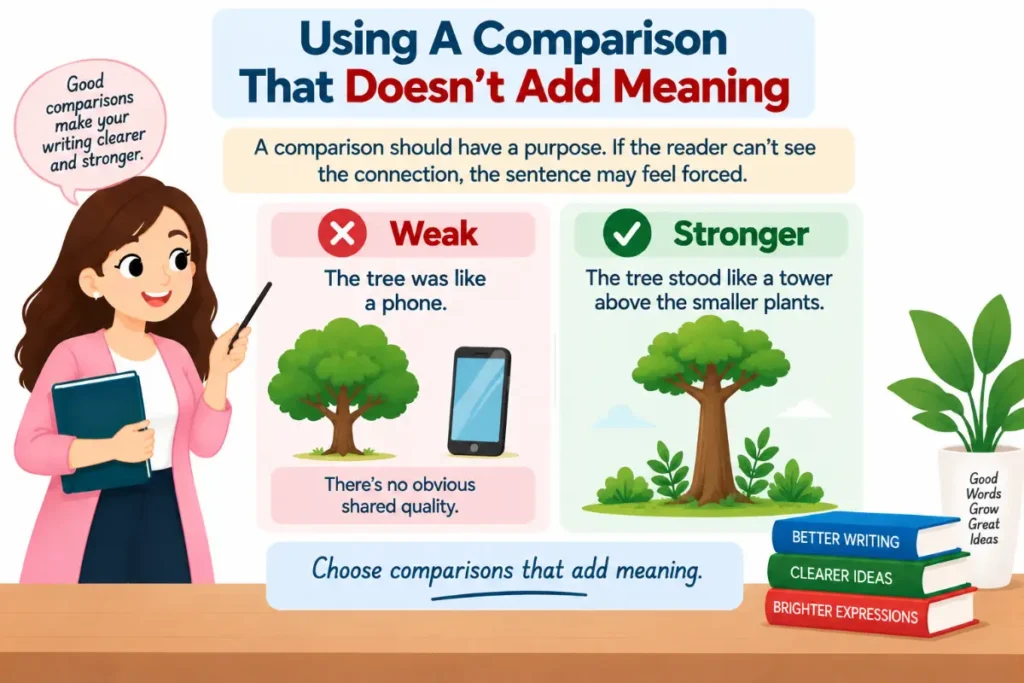
A comparison should have a purpose. If the reader can’t see the connection, the sentence may feel forced.
Weak:
The tree was like a phone.
There’s no obvious shared quality.
Stronger:
The tree stood like a tower above the smaller plants.
Now the comparison gives the reader information about height.
Mixing Metaphors and Similes
A simile normally uses an explicit comparison such as like or as.
The river moved like a snake.
A metaphor makes the comparison directly.
The river was a silver snake.
Both can be effective but mixing their structures carelessly can make a sentence awkward.
Choosing A Tired Comparison
Some comparisons have become so common that they may not create a fresh image.
For example comparisons involving snow being white as snow or someone running like the wind are familiar. They can still work in the right context but original writing often benefits from a more specific image.
Making The Comparison Too Long
A simile should support the sentence rather than bury it.
If a comparison needs several lines of explanation before the reader understands it, simplify it.
Using Too Many Similes
One strong comparison can make a paragraph memorable. Ten comparisons in three sentences can make the writing feel crowded.
Give your best images room to breathe.
Memory Tips
The easiest way to remember how similes work is to think of them as bridges.
One side is your subject.
The other side is the natural image.
The comparison word builds the bridge.
For example:
The child was as quiet as falling snow.
The child is one side.
Falling snow is the other.
As connects them.
Another useful formula is:
Subject + like + nature image.
For example:
The clouds moved like ships.
You can also use:
Subject + as + quality + as + nature image.
For example:
The water was as clear as glass.
When creating your own examples focus first on the quality you want to communicate. Then search your memory for something in nature that expresses that quality strongly.
Related Grammar and Usage Notes
A simile is different from an ordinary comparison.
The tree is taller than the house.
This is a factual comparison.
The tree stands like a giant beside the house.
This is figurative language.
The second sentence doesn’t claim that the tree is literally a giant. It creates an image.
Similes also differ from metaphors.
The clouds were like ships.
This is a simile.
The clouds were ships.
This is a metaphor.
Both devices can create vivid writing but they produce slightly different effects.
The words like and as often signal similes but not every sentence containing those words is a simile.
For example:
She works like her mother.
This can be a straightforward comparison rather than a figurative image.
Similarly:
He is as tall as his brother.
This is a literal comparison.
Context matters.
How Nature Similes Work in Different Types of Writing
Fiction
Fiction writers use comparisons to establish setting and character.
A storm described as an angry beast feels threatening. A river described as a silver ribbon feels peaceful. The image helps readers experience the setting instead of simply receiving facts about it.
Poetry
Poetry often pushes comparisons further. A poet may compare a fading flower to a memory or the moon to an old lantern.
Because poetry depends heavily on imagery, fresh comparisons can carry emotional meaning in very few words.
School Essays
Students can use similes to make descriptive paragraphs stronger. The best examples are specific and relevant to the topic.
Instead of adding a comparison to every sentence, choose one or two moments where imagery can make the description clearer.
Personal Writing
Personal essays and memoirs can use nature to express emotions.
A difficult period might feel like a winter that refuses to end. A new opportunity might feel like spring after months of cold.
These comparisons can communicate emotion without explaining every feeling directly.
Speeches
Speakers can use simple comparisons to make ideas easier to remember.
A person explaining patience might compare it to a tree growing slowly through changing seasons. The audience already understands the natural process so the abstract idea becomes easier to grasp.
How To Choose Better Nature Imagery
Not every natural object works equally well for every sentence.
If you want to describe fragility, consider petals, spider webs, seedlings, feathers, or thin ice.
If you want to describe hope, consider sunrise, spring flowers, new leaves, stars appearing at night, or seedlings breaking through soil.
This approach makes your comparisons more intentional. You aren’t choosing an image simply because it sounds attractive. You’re choosing it because the natural object carries the exact quality your sentence needs.
Key Takeaways
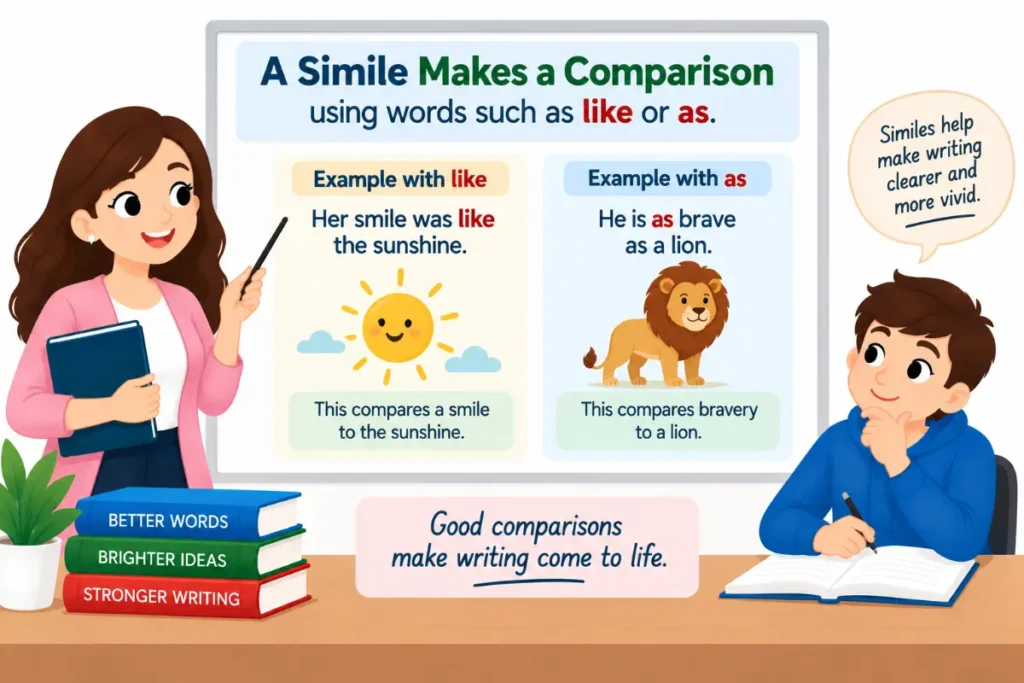
- A simile makes a comparison using words such as like or as.
- Natural objects provide familiar images for describing people, places, emotions, actions, and ideas.
- The strongest comparisons have a clear purpose.
- Trees can suggest strength, age, shelter, or loneliness.
- Flowers can suggest beauty, fragility, growth, or affection.
- Water can suggest peace, movement, danger, freedom, or change.
- Weather can mirror emotions such as anger, fear, sadness, or excitement.
- Seasons can represent stages of life, change, renewal, or loss.
- Animals can help describe speed, silence, strength, grace, or behavior.
- Original comparisons are usually more memorable than familiar clichés.
- Avoid filling every sentence with figurative language.
- Choose a natural image that matches the quality and mood you want to communicate.
Conclusion
Nature similes give ordinary descriptions a stronger pulse. They let readers picture a scene, sense an emotion, and connect an unfamiliar idea with something they already know. A river can become a silver ribbon, a storm can mirror anger, and a small seedling can represent hope without requiring a long explanation.
The best comparisons aren’t chosen simply because they sound beautiful. They fit the subject, match the mood, and reveal something meaningful. That’s why a simple image can sometimes do more work than an entire paragraph of explanation.
When writing your own Nature Similes, start with one quality you want to show. Find something in nature that captures it clearly, connect the two with like or as, and then read the sentence aloud. If the image feels natural and useful, keep it. If it feels forced, replace it with a sharper one.
FAQs
What is a nature simile?
A nature simile is a comparison that uses something from the natural world to describe another person, object, place, feeling, action, or idea. Common natural images include trees, flowers, animals, oceans, mountains, clouds, weather, sunlight, and seasons. Most similes use like or as to make the comparison clear.
What are some easy nature similes?
Easy examples include as quiet as falling snow, like a river through the valley, as bright as sunlight, like a leaf in the wind, and as steady as a mountain. These work because the natural images are familiar and the shared qualities are easy to understand. For stronger writing, make the comparison more specific and connected to your scene.
Why do writers use nature similes?
Writers use them to create vivid mental pictures and communicate emotions quickly. A comparison to a storm can suggest anger or danger while a comparison to spring can suggest renewal. Natural images are especially useful because readers already have experiences with weather, landscapes, plants, animals, and changing seasons.
What is the difference between a simile and a metaphor?
A simile makes an explicit comparison, usually with like or as. For example, The lake was like glass is a simile. A metaphor makes the comparison directly by saying the lake was glass. Both forms create imagery but a metaphor often sounds more direct while a simile gives the reader a clearer comparison.
Can I use nature similes in academic writing?
Yes, but use them carefully. Academic writing usually values precision and direct explanation, so figurative language should support the point rather than replace evidence. A well chosen comparison can clarify an abstract idea or make an explanation easier to understand. In highly technical writing, a direct statement is often better when exact meaning matters.
How do I make my own similes?
Start with the quality you want to describe. Then think of something in nature that strongly represents that quality. Connect your subject to that image with like or as. Finally, check the result for clarity. The comparison should help the reader understand something rather than simply add decorative language.
What are good nature similes for creative writing?
Good choices depend on the scene. A quiet lake can represent peace, a storm can represent anger, falling leaves can suggest change, a seedling can represent hope, and an old tree can represent strength or endurance. The strongest creative comparisons usually match the emotional tone of the scene and give readers a specific image.
How many similes should I use in one paragraph?
There is no fixed number, but quality matters more than quantity. One strong comparison can be enough for a short paragraph. Several similes can work in poetry or highly descriptive prose, but too many can make writing feel crowded. Read the paragraph aloud and remove comparisons that don’t add a new image or emotion.
What are the best nature similes for students?
Students can use simple comparisons such as the river moved like a silver ribbon, the trees stood like soldiers, the snow fell as softly as feathers, or the sky looked like a painted canvas. The best school writing doesn’t use complicated language just to sound impressive. Clear and original imagery usually works better.
Are nature similes the same as personification?
No. A simile compares two things using like or as. Personification gives human qualities to something nonhuman. The wind howled like a wolf is a simile. The wind complained through the trees is personification. A writer can use both devices in the same passage but they serve different purposes.

Idioms, Expressions & Figurative Language
Mason Ellsworth is an American language writer with a passion for English expressions, figurative language, and everyday communication. He explains idioms, similes, popular phrases, and commonly misunderstood expressions in a straightforward, engaging style that helps readers improve both their writing and spoken English.