
Disfunction or Dysfunction can be confusing because both forms look reasonable at first glance. The correct spelling is dysfunction. The form disfunction is generally a spelling error in standard modern English when you mean something that is not working properly or is operating in an unhealthy way.
The confusion comes partly from the familiar prefix dis. English uses dis in many words to express separation, reversal, or negation. It’s easy to assume that adding dis to function should produce disfunction. However, the established English word uses dys instead. The spelling reflects the historical form of the word rather than a simple modern spelling rule.
You’ll see dysfunction in medical writing, psychology, business, sociology, family discussions, technology, and everyday conversation. The word can describe a poorly working organ, an unhealthy relationship, a troubled workplace, or a system that fails to operate normally. This guide explains the spelling, meaning, pronunciation, grammar, history, common mistakes, related terms, and practical usage so you can choose the right form with confidence.
Short Answer
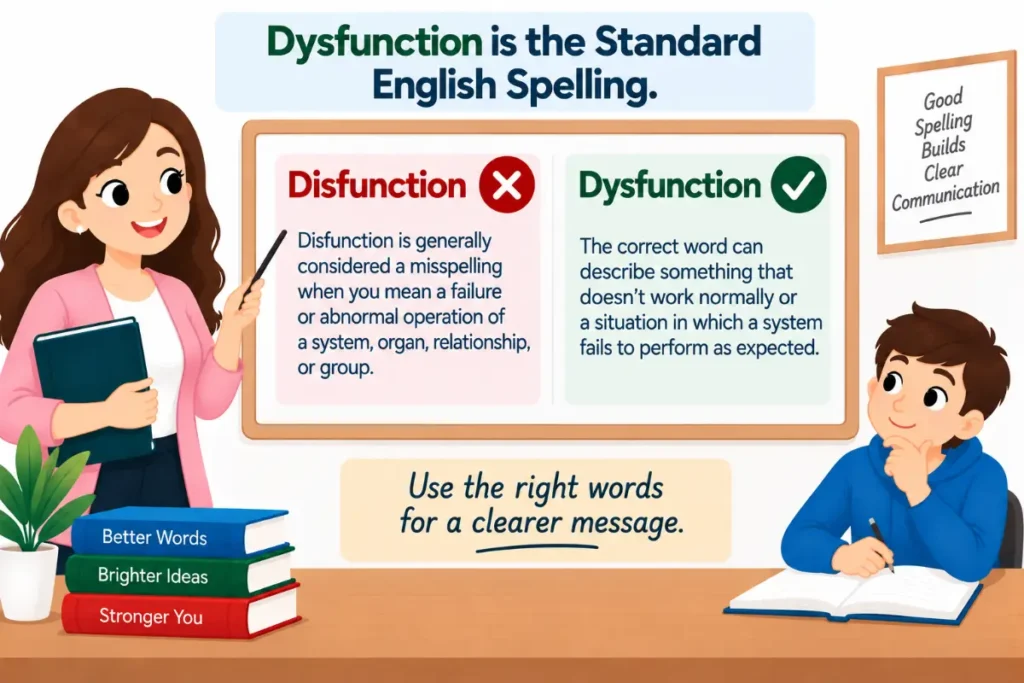
Dysfunction is the standard English spelling. Disfunction is generally considered a misspelling when you mean a failure or abnormal operation of a system, organ, relationship, or group. The correct word can describe something that doesn’t work normally or a situation in which a system fails to perform as expected.
Table of Contents
- Quick answer.
- Meaning of each form.
- Comparison of the two spellings.
- Why the spelling causes confusion.
- Correct usage in different contexts.
- Sentence examples.
- Common mistakes.
- Pronunciation.
- Word origin.
- Regional usage.
- Grammar and word forms.
- Related words.
- Expert editor insight.
- FAQs.
- Key takeaways.
- Conclusion.
Meaning and Definition
Meaning of the Incorrect Form
Disfunction is generally not the standard spelling used in modern English for the noun meaning faulty or abnormal functioning.
You may encounter it online, in informal writing, in older material, or as a simple typing mistake. The fact that people sometimes use a particular spelling doesn’t automatically make that spelling standard. English contains many recurring errors that become familiar simply because people make them often.
For polished writing, the standard form is dysfunction.
Consider this sentence:
The company has serious disfunction between its departments.
A professional editor would normally change it to:
The company has serious dysfunction between its departments.
The second version uses the established English noun.
There is an additional reason to be careful with this word. Function and dysfunction are closely related in meaning, so writers often build the second word mentally from function plus the familiar prefix dis. That feels logical but doesn’t match the standard spelling.
Meaning of the Correct Form
Dysfunction is a noun that describes a failure to function normally or a condition in which something operates poorly.
The word can apply to physical systems.
For example, a medical professional might discuss dysfunction involving an organ or body system.
It can also describe human behavior and relationships.
A family may experience dysfunction when communication, trust, boundaries, or other parts of the relationship system become seriously unhealthy.
The term also works in organizations.
A workplace can have dysfunction if poor communication, unclear responsibilities, internal conflict, or ineffective leadership prevents people from working properly.
The word has a broad meaning because function itself has a broad meaning. Anything that normally performs a function can potentially be described in terms of dysfunction when that performance breaks down.
The adjective is dysfunctional.
For example:
The team has a dysfunctional communication pattern.
The noun describes the condition or problem. The adjective describes something characterized by that condition.
This distinction is useful in everyday writing because dysfunction and dysfunctional don’t perform the same grammatical job.
Comparison Table
| Form | Standard Status | Meaning | Part of Speech | Common Contexts | Formality | Example |
|---|---|---|---|---|---|---|
| Dysfunction | Standard English | Failure or abnormal operation | Noun | Medicine, psychology, relationships, organizations, systems | Neutral to formal | The system developed a serious dysfunction. |
| Disfunction | Generally nonstandard in this meaning | Usually intended to mean dysfunction | Nonstandard spelling | Typing errors and informal writing | Not recommended | Disfunction should normally be corrected to dysfunction. |
Why the Spelling Causes Confusion
The spelling looks unusual because dys is less familiar to many English speakers than dis.
You probably already know many words beginning with dis.
Disable.
Disagree.
Disappear.
Disconnect.
Disorder.
Because the prefix is so common, a writer may naturally expect function to become disfunction.
English doesn’t always build words in a perfectly predictable way. Some words preserve forms that developed through older languages. Others entered English as complete words rather than being created by modern speakers from scratch.
Dysfunction belongs to that second group of historically shaped vocabulary. Its dys spelling is not simply a random exception. It reflects the Greek element dys, which carries the idea of bad, difficult, abnormal, or impaired functioning.
That historical detail gives the spelling a useful clue.
The prefix dys appears in other English words connected with abnormal or impaired conditions.
Examples include dyslexia, dysphagia, dysplasia, and dystonia.
The exact meaning of dys changes slightly depending on the word, but the general idea of abnormality, difficulty, or impairment remains relevant.
So instead of thinking:
dis + function = disfunction
think:
dys + function = dysfunction
That small change is the key to remembering the standard spelling.
The Difference Between Dys and Dis
Understanding the two prefixes makes the spelling much easier.
The Prefix Dis
Dis is a productive English prefix with several meanings. It can express ideas such as reversal, removal, separation, or lack of agreement.
Examples include disagree, disconnect, dislike, and dishonest.
However, that doesn’t mean dis can be placed before every English word to create a valid new word.
The Prefix Dys
Dys comes from Greek and is associated with something bad, difficult, abnormal, or impaired.
You can see this pattern in words connected with medicine and human conditions.
Dysfunction therefore fits its historical word formation. The word refers to abnormal or impaired functioning.
This is why replacing dys with dis changes the standard spelling even though the resulting form looks perfectly understandable.
What Does Dysfunction Mean in Different Contexts?
The meaning becomes clearer when you look at the field in which the word appears.
Medical Context
In medicine, dysfunction refers to abnormal or impaired functioning of a body part, organ, or biological system.
For example, a doctor might discuss kidney dysfunction or nervous system dysfunction.
The term doesn’t necessarily mean complete failure. Something can still work but fail to perform normally.
That distinction matters.
If a system stops working entirely, failure may be the more precise word. Dysfunction can describe a broader range of problems involving reduced, abnormal, or impaired performance.
Psychological Context
In psychology and mental health discussions, dysfunction can describe patterns that interfere with normal daily life or healthy behavior.
The word should be used carefully because it can sound broad or judgmental when applied to people.
For example, a professional might discuss dysfunctional behavior within a specific context rather than labeling a person as dysfunctional without explanation.
Precise language is usually better.
Family Relationships
The word often appears in discussions of family relationships.
Family dysfunction can describe recurring patterns such as poor communication, unhealthy boundaries, persistent conflict, or harmful behavior.
The term is broad, so a strong writer should explain the specific behavior involved rather than relying on the label alone.
Workplace Context
Dysfunction is also common in business writing.
A workplace can experience dysfunction when communication breaks down, responsibilities remain unclear, or employees work against one another instead of toward shared goals.
For example:
The department’s dysfunction delayed several important projects.
Here the word refers to a problem in how the group operates.
Technology and Systems
The word can also describe technical systems.
For example:
The device developed a software dysfunction after the update.
However, technical writers often choose more precise terms such as malfunction, failure, error, or defect when they know exactly what went wrong.
Good writing doesn’t use a broad word when a precise one is available.
Which Spelling Is Correct?
Dysfunction is the standard spelling.
The spelling follows the established word form derived through Greek and later English development. The dys element is associated with abnormal, difficult, or impaired conditions. Function provides the second part of the word.
The standard noun is dysfunction.
The adjective is dysfunctional.
The verb form is generally not simply dysfunction. Depending on the intended meaning, writers may use phrases such as function poorly, impair functioning, or cause a system to malfunction.
This matters because writers sometimes try to create forms that look grammatically logical but aren’t standard English.
For example:
The system dysfunctioned.
That sentence may be understandable, but it sounds unnatural in standard English. A clearer alternative would be:
The system malfunctioned.
Or:
The system stopped functioning properly.
The best vocabulary choice depends on the exact idea you want to express.
Sentence Examples
Here are natural examples using the standard form.
- The doctor found evidence of kidney dysfunction.
- Poor communication created dysfunction within the team.
- The report examines how organizational dysfunction affects productivity.
- The family sought counseling because of long standing dysfunction at home.
- The software showed signs of dysfunction after the update.
- The study explored the relationship between stress and physical dysfunction.
- Leadership changes helped reduce dysfunction within the department.
- The therapist discussed patterns of dysfunction that were affecting the relationship.
- The machine developed a mechanical problem that caused system dysfunction.
- The committee struggled with internal dysfunction throughout the project.
Here are examples that show the common spelling mistake.
- Incorrect: The company suffered from serious disfunction.Correct: The company suffered from serious dysfunction.
- Incorrect: The doctor was concerned about organ disfunction.Correct: The doctor was concerned about organ dysfunction.
- Incorrect: Poor communication caused disfunction within the group.Correct: Poor communication caused dysfunction within the group.
- Incorrect: The report discusses family disfunction.Correct: The report discusses family dysfunction.
- Incorrect: The software experienced unexpected disfunction.Correct: The software experienced unexpected dysfunction.
The incorrect examples help you recognize the error. They shouldn’t be used as models for standard writing.
Common Mistakes and Misspellings
Writing Disfunction
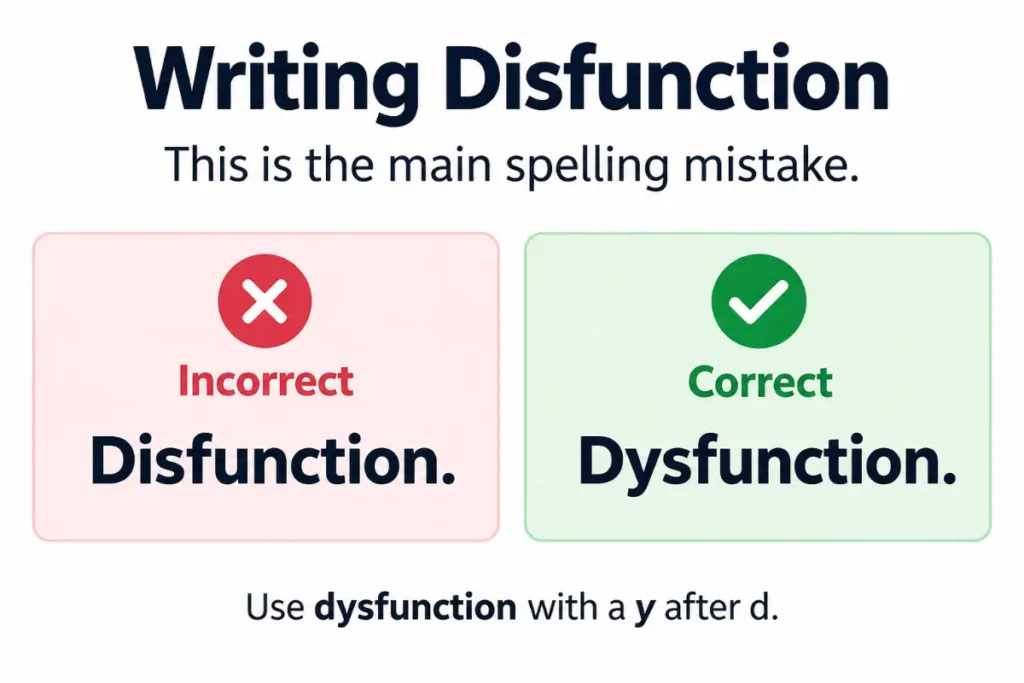
This is the main spelling mistake.
Incorrect: Disfunction.
Correct: Dysfunction.
The error usually happens because dis is a much more familiar prefix than dys.
Using Dysfunction as a Verb
Dysfunction is normally a noun.
Avoid sentences such as:
The machine dysfunctioned yesterday.
A better choice is:
The machine malfunctioned yesterday.
Or:
The machine stopped functioning properly yesterday.
Confusing Dysfunction With Malfunction
These words overlap but aren’t always interchangeable.
Malfunction usually refers to something failing to work properly, especially a machine, device, or technical system.
Dysfunction has a broader meaning and can describe biological systems, relationships, organizations, social structures, and other systems.
Confusing Dysfunction With Failure
Failure can suggest that something has stopped working or has not achieved its intended result.
Dysfunction can describe impaired operation without complete failure.
A system can therefore be dysfunctional while still operating.
Using Dysfunction as a Personal Label
Calling a person dysfunctional can sound vague or judgmental.
Professional writing is usually stronger when it identifies the specific behavior or pattern.
Instead of saying:
He is dysfunctional.
You might say:
His behavior creates repeated communication problems within the team.
Specific language gives the reader something useful to understand.
Pronunciation Guide
Dysfunction is commonly pronounced /dɪsˈfʌŋkʃən/ in American English.
It has three syllables:
dis FUNK shun
The strongest stress falls on the second syllable.
The first part sounds similar to dis.
The middle syllable contains the main stress and uses the sound found in words such as function.
The final syllable sounds like shun.
The spelling can look more complicated than the pronunciation. That’s another reason writers may focus on the familiar dis pattern and accidentally omit the y.
The related adjective dysfunctional is commonly pronounced with the same opening sound:
dis FUNK shun uhl
Learning the noun and adjective together can help reinforce the spelling.
Etymology and Word Origin
The history of dysfunction explains much of the spelling confusion.
The word combines the Greek derived element dys with function.
The Greek prefix dys carries meanings connected with badness, difficulty, abnormality, or impaired conditions. Function ultimately traces back through Latin functio and related forms associated with performing or carrying out something.
English later brought these elements together in dysfunction.
The important point for spelling is that dys is not an arbitrary replacement for dis. It belongs to the historical structure of the word.
This also explains why the same spelling pattern appears in several scientific and medical terms.
Dyslexia.
Dysphagia.
Dysplasia.
Dystonia.
These words aren’t identical in meaning, but they share the Greek dys element.
Understanding the origin gives you a strong memory aid. If the word describes an abnormal or impaired function, the dys spelling makes historical sense.
Regional Usage
American English
American English uses dysfunction as the standard spelling.
The word appears in medical, psychological, organizational, social, and technical contexts. American speakers may also use it casually to describe a group or system that seems unable to operate effectively.
For example:
There’s a lot of dysfunction in that organization.
This informal use is common enough to feel natural in everyday speech.
British English
British English also uses dysfunction as the standard form.
There is no major British spelling difference for this word. British writers use the same noun and adjective forms found in American English.
Australian English
Australian English likewise uses dysfunction.
The spelling remains the same in professional, academic, medical, and everyday writing.
There is no established Australian spelling that changes the word to disfunction.
Canadian English
Canadian English also follows the standard form dysfunction.
The word has the same basic meaning and grammatical function across Canadian usage.
The spelling issue is therefore not an American versus British difference. It is mainly a question of standard spelling versus a common nonstandard form.
Grammar and Part of Speech
Dysfunction is primarily a noun.
It can refer to a condition, problem, or state involving abnormal functioning.
A common pattern is:
Subject + has + dysfunction
For example:
The system has a dysfunction.
However, native speakers often choose a more natural construction depending on context.
The system has serious dysfunction.
The organization suffers from dysfunction.
The relationship is affected by dysfunction.
The word can also function as part of a noun phrase.
Organizational dysfunction can affect decision making.
Family dysfunction can influence relationships.
Muscle dysfunction may affect movement.
The adjective dysfunctional describes something characterized by dysfunction.
For example:
The team has a dysfunctional communication pattern.
The adjective can modify a noun directly.
The two forms should not be confused.
Dysfunction is the noun.
Dysfunctional is the adjective.
This difference becomes especially important in formal writing.
Instead of saying:
The organization is dysfunction.
Say:
The organization is dysfunctional.
Or:
The organization has serious dysfunction.
That small grammatical distinction can make a sentence sound much more natural.
Dysfunction and Malfunction
These two words deserve a closer comparison because writers often use them interchangeably.
Malfunction usually suggests that something fails to operate correctly. The word is especially common for machines, devices, software, and technical equipment.
The printer malfunctioned during the meeting.
Dysfunction has a wider range.
You can discuss dysfunction in a relationship, organization, biological system, social structure, or technical system.
The committee suffers from internal dysfunction.
So the easiest distinction is this:
Malfunction focuses strongly on something failing to work correctly.
Dysfunction focuses on abnormal or impaired functioning more broadly.
The difference isn’t absolute. Context determines the best word.
Dysfunction and Disorder
Dysfunction and disorder can overlap in medical and psychological contexts but they don’t mean exactly the same thing.
Disorder can refer to a recognized condition involving a disturbance in normal structure or function.
A writer shouldn’t automatically replace one with the other.
In medical contexts especially, terminology should match the specific condition being discussed.
That is one reason professional writing benefits from precise word choice rather than relying on near synonyms.
Formal and Informal Usage
Dysfunction is suitable for formal writing.
You can use it in academic papers, professional reports, medical discussions, workplace documents, and serious journalism.
The word is also common in casual speech.
For example:
Their family has a lot of dysfunction.
That sentence sounds conversational.
A more formal version might be:
The family exhibits persistent patterns of unhealthy interaction.
The second sentence is more specific and may be better for professional writing.
This doesn’t mean dysfunction is too informal. It simply means that the level of precision should match the context.
In formal writing, define broad terms when they could be interpreted in several ways.
Real Life Usage Examples
Daily Conversation
People sometimes use dysfunction to describe a group that constantly struggles to work together.
- There’s a lot of dysfunction in that family.
- The team has some serious dysfunction right now.
These sentences are casual and broad.
Workplace Communication
The word can describe organizational problems.
- The department’s dysfunction is slowing down several projects.
- The new manager wants to address the communication problems behind the team’s dysfunction.
The second example is stronger because it identifies the specific issue instead of relying only on the label.
Academic Writing
Academic writers can use the term when discussing systems or behavior.
- The researchers examined how organizational dysfunction affects employee cooperation.
- The paper explores patterns of family dysfunction and their social effects.
News Writing
Journalists may use dysfunction when describing problems within institutions.
- Internal dysfunction delayed the organization’s response.
- Officials blamed administrative dysfunction for the repeated delays.
The word can summarize a complex problem but strong reporting should still explain what caused the dysfunction.
Storytelling
The term can also appear in fiction.
- Years of family dysfunction had shaped the way the brothers spoke to each other.
- The office was full of quiet dysfunction that nobody wanted to discuss.
In storytelling, the word can efficiently describe a troubled system without explaining every detail immediately.
Related Words and Expressions
Function
Function is the base concept. It refers to the purpose or activity something performs or the way something operates.
Dysfunctional
Dysfunctional is the adjective form. It describes something that functions poorly or displays unhealthy patterns.
Malfunction
Malfunction usually describes something that fails to work properly, especially a machine or technical system.
Impairment
Impairment refers to reduced or damaged ability or function.
Failure
Failure describes a lack of success or the inability of something to perform as intended.
Disorder
Disorder can describe a disturbance in normal structure or function and has important specialized meanings in medicine and psychology.
Breakdown
Breakdown can describe the failure of a system, process, relationship, or machine.
Inefficiency
Inefficiency means a system or process doesn’t use time, effort, or resources effectively.
These words overlap in some contexts, but they aren’t perfect substitutes. The best choice depends on what has gone wrong and how specific you need to be.
Memory Tips
The spelling becomes much easier when you stop treating it as a random exception.
Remember The Greek Prefix
Think of dys as meaning something abnormal, difficult, or impaired.
Then connect it with function.
Dys + function = dysfunction.
Connect It With Related Words
Remember other familiar words that use dys.
Dyslexia.
Dysplasia.
Dysphagia.
Dystonia.
This doesn’t mean every word beginning with dys has exactly the same meaning. It simply reinforces the spelling pattern.
Remember The Adjective
If you know dysfunctional, the noun becomes easier to remember.
Dysfunction → dysfunctional.
Seeing the y in the adjective can help you recall the noun.
Don’t Build It From Dis
The biggest trap is mentally adding dis to function.
Instead, remember that this established word uses dys.
That’s enough to solve the spelling problem.
Professional Writing Tip
If you’re proofreading a document and see disfunction, don’t correct it automatically without checking the intended meaning. In almost every ordinary sentence about impaired operation, the writer probably means dysfunction. Then check the surrounding sentence to make sure dysfunction is actually the best word.
For example, if a sentence discusses a broken printer, malfunction may be more precise.
If it discusses repeated conflict inside an organization, dysfunction may fit better.
If it describes a complete inability to perform a task, failure may be clearer.
Good editing goes beyond spelling. The goal is to choose the word that communicates the exact idea.
Expert Editor Insight
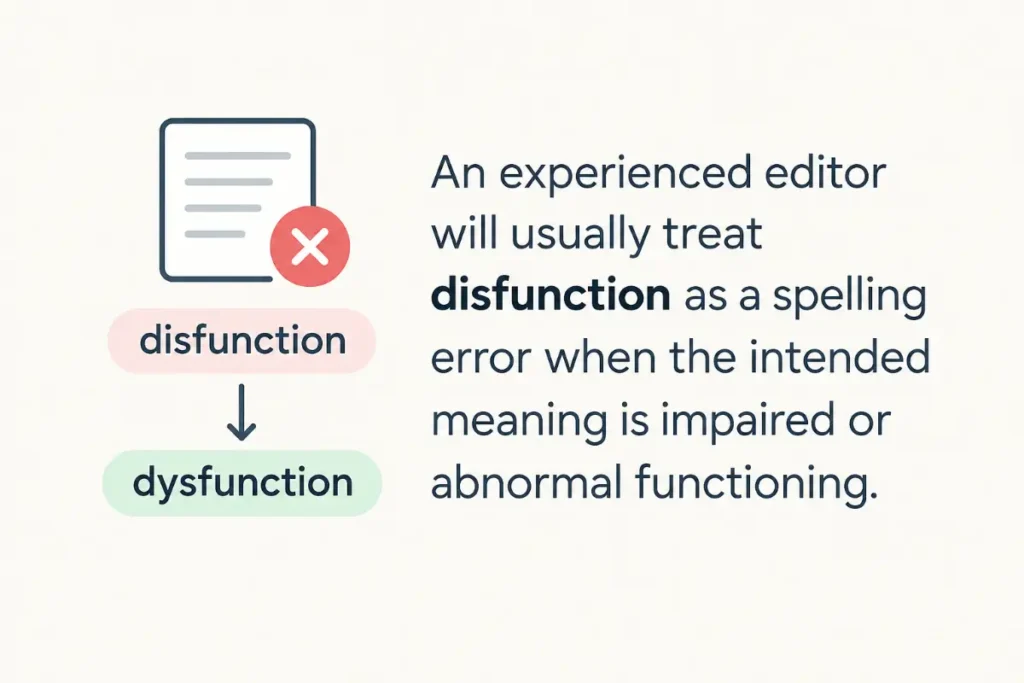
An experienced editor will usually treat disfunction as a spelling error when the intended meaning is impaired or abnormal functioning. The confusion is understandable because dis is a familiar English prefix and function naturally follows it. Still, standard usage favors dysfunction, which reflects the historical dys element. Editors also look beyond the spelling and ask if the noun is actually the best choice. In technical or professional writing, terms such as malfunction, impairment, failure, or breakdown may communicate the specific problem more accurately.
Conclusion
Dysfunction is the correct spelling, while disfunction is generally considered a misspelling in standard English. The word dysfunction refers to a problem with the normal way something works or operates. You’ll see it used in medical, psychological, technical, and everyday contexts.
Remember the correct form by focusing on the beginning of the word. Dysfunction is spelled with dys followed by function. If you’re writing an essay, professional document, medical explanation, or everyday message, use dysfunction to keep your spelling accurate and clear.
Once you remember dysfunction as the standard spelling, this commonly confused word becomes much easier to use correctly. A simple spelling check can help you avoid the mistake and make your writing more polished.
FAQs
Is disfunction a real word?
Disfunction can appear in English texts, but it is generally not the standard spelling used for the noun meaning impaired or abnormal functioning. In modern standard English, dysfunction is the preferred form. If you’re writing an essay, report, professional email, medical document, or published article, use dysfunction unless a specific proper name or historical source requires another form.
What does dysfunction mean?
Dysfunction means abnormal, impaired, or ineffective functioning. It can describe a physical system, relationship, family, organization, institution, or technical system. The exact meaning depends on context. A body system can have impaired function, while a workplace can experience dysfunction because of poor communication or internal conflict. The word is broad and should be made more specific when possible.
Which spelling is correct?
Dysfunction is the standard spelling. The spelling uses dys rather than dis because the word developed from the Greek element dys, which relates to abnormality, difficulty, or impairment. Disfunction commonly appears as a spelling mistake because dis is a familiar English prefix. For standard writing, choose dysfunction when you mean abnormal or impaired functioning.
Why do people spell dysfunction with dis?
The mistake happens because dis is a very familiar prefix in English. Words such as disagree, disconnect, dislike, and disorder make dis feel like the natural choice before function. However, dysfunction has a different historical formation. It uses dys, an element associated with abnormal or impaired conditions. Remembering that pattern can prevent the spelling mistake.
Is dysfunction a noun or adjective?
Dysfunction is a noun. It names a condition or problem involving abnormal functioning. Dysfunctional is the related adjective and describes something characterized by dysfunction. For example, you can say the organization has dysfunction or the organization has a dysfunctional structure. Keeping the noun and adjective separate helps avoid common grammar errors in professional writing.
Is dysfunction the same as malfunction?
Not exactly. Malfunction usually refers to something failing to work correctly, especially a machine, device, or technical system. Dysfunction has a broader meaning and can describe impaired functioning in biological systems, relationships, organizations, and other structures. The two words can overlap, but dysfunction is often more useful when the problem involves a broader pattern rather than a specific mechanical failure.
Can dysfunction be used in formal writing?
Yes. Dysfunction is appropriate in formal writing, including academic, medical, professional, and journalistic contexts. The word itself is not informal. However, formal writing benefits from precision. If you use the term to describe an organization or relationship, explain the specific behavior or process involved when readers need more detail. A precise explanation is stronger than a vague label.
What is the opposite of dysfunction?
The closest general opposite is normal or proper functioning. Depending on the sentence, you might also use functionality, healthy functioning, effective operation, or normal operation. There isn’t one universal opposite that works in every context. For example, the opposite of organizational dysfunction might be effective cooperation, while the opposite of physical dysfunction might be normal function.

Confusing Words, Spelling & Word Choice
Claire Whitmore is a U.S.-based English editor who writes about commonly confused words, spelling differences, and word choice. Her work helps readers understand subtle distinctions between similar-looking words through simple definitions, practical examples, and modern usage guidance in both American and British English.