
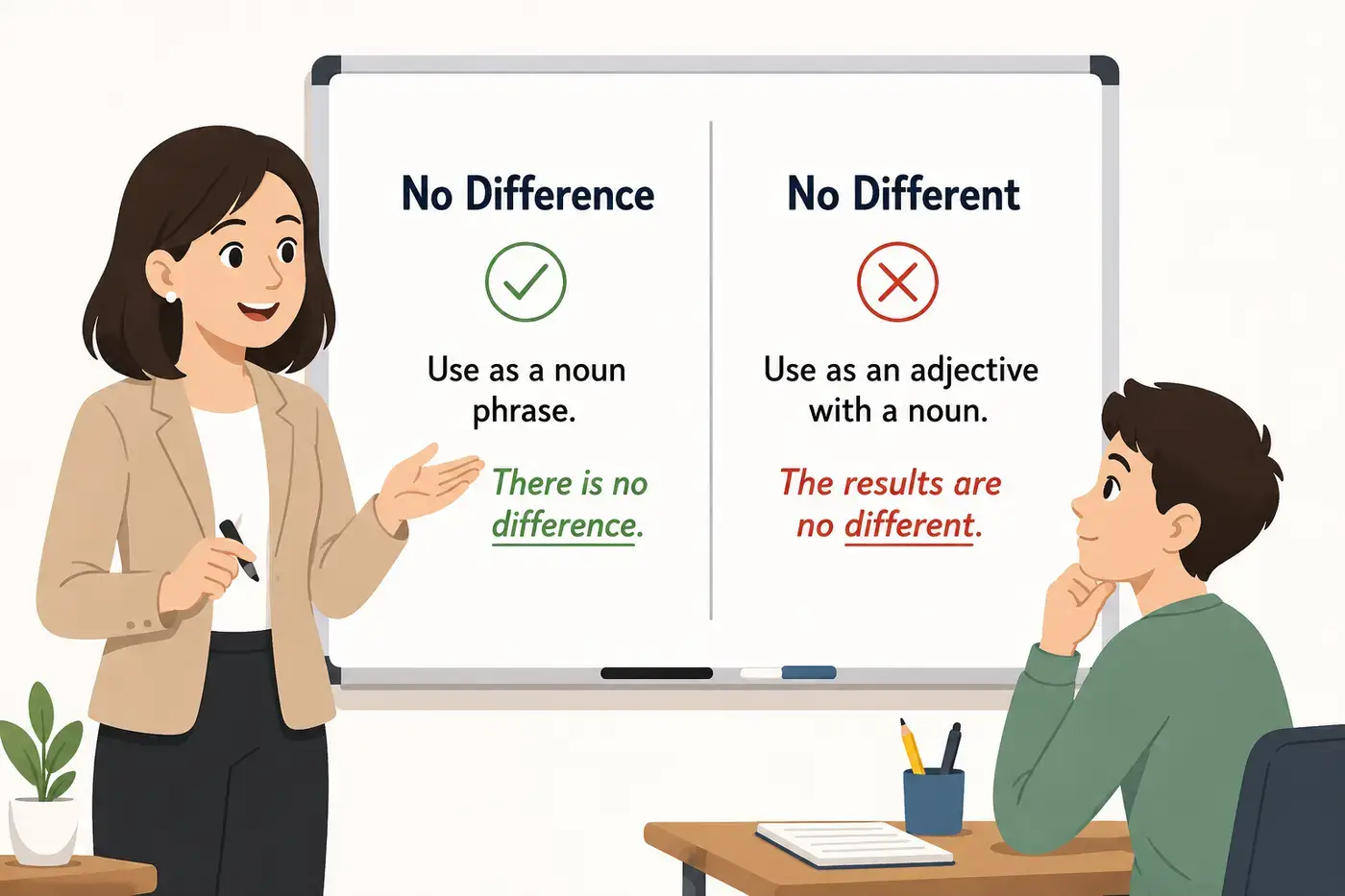
No Difference vs No Different confuses many English learners and even native speakers because both expressions seem to communicate the same idea. In everyday conversation, people often hear sentences like There is no difference between the two products and The second product is no different from the first. Since both sentences express similarity, many assume the phrases can always replace each other.
The reality is more precise. Although the meanings are closely related, difference and different belong to different parts of speech and follow different grammar rules. Choosing the wrong one can make a sentence sound unnatural or grammatically incorrect.
The good news is that the distinction is straightforward once you understand how English uses nouns and adjectives. After learning a few simple patterns, you’ll know which expression fits naturally in any situation.
This guide explains the meanings, grammar rules, pronunciation, common mistakes, real-world examples, professional writing tips, American and British usage, memory tricks, and related expressions so you can use both phrases with confidence.
Short Answer
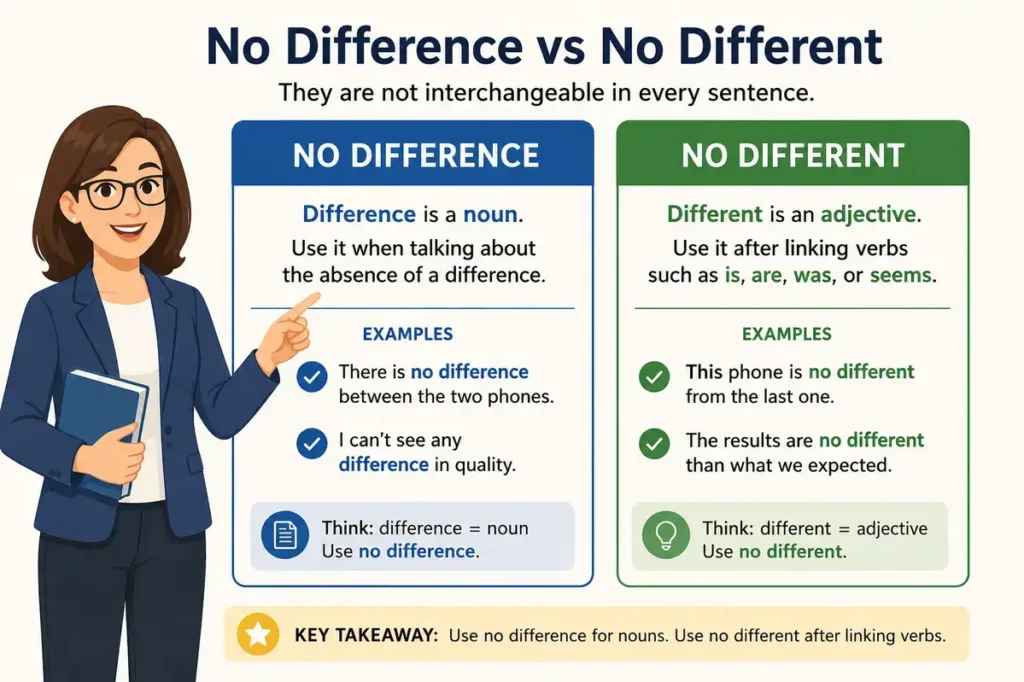
No Difference vs No Different is a common phrase comparison. No difference is the standard expression because difference functions as a noun. Use no different when the sentence needs an adjective after a linking verb such as is, are, was, or seems. They are not interchangeable in every sentence
Table of Contents
- Short Answer
- What Does No Difference Mean?
- What Does No Different Mean?
- The Main Difference Between the Two
- Comparison Table
- When to Use No Difference
- When to Use No Different
- Grammar Rule Explained
- Real-Life Examples
- Common Mistakes
- Formal and Informal Usage
- American vs British English
- Professional Writing Tips
- Memory Tricks
- Related Expressions
- Frequently Asked Questions
- Key Takeaways
- Conclusion
What Does No Difference Mean?
No difference means that two or more people, objects, ideas, or situations are the same in the way being discussed. It indicates that there is zero meaningful distinction.
Because difference is a noun, it usually follows words like there is, make, see, notice, or find.
Examples:
- There is no difference between the two phones.
- I can see no difference in their performance.
- The update made no difference to the results.
- We noticed no difference after changing the settings.
In each sentence, difference functions as a noun naming th
What Does No Different Mean?
No different also expresses similarity, but it does so using an adjective.
It usually follows a linking verb.
Examples include:
- is
- are
- was
- were
- seems
- looks
- feels
- remains
- becomes
Examples:
- This phone is no different from the previous model.
- Our experience was no different from yours.
- Her opinion seems no different today.
- The results are no different this year.
Here, different describes the subject rather than naming a thing.
The Main Difference Between No Difference and No Different
The easiest way to remember the distinction is to identify the part of speech.
| Phrase | Part of Speech | Main Function |
|---|---|---|
| No difference | Noun phrase | Names the lack of distinction |
| No different | Adjective phrase | Describes something as similar |
Although both phrases express similarity, they fit into different sentence structures.
Compare these examples.
Correct:
- There is no difference between the two plans.
Correct:
- The two plans are no different from each other.
Both sentences communicate the same idea, but the grammar is different.
Quick Comparison Table
| Situation | No Difference | No Different |
|---|---|---|
| After there is | ✓ | ✗ |
| After make | ✓ | ✗ |
| After see | ✓ | ✗ |
| After notice | ✓ | ✗ |
| After is | ✗ | ✓ |
| After are | ✗ | ✓ |
| After was | ✗ | ✓ |
| Before between | ✓ | Rare |
| Before from | Rare | ✓ |
This table covers the most common sentence patterns you’ll encounter.
Understanding the Grammar Rule
The grammar becomes much easier when you recognize the difference between nouns and adjectives.
A noun names a person, place, thing, or idea.
An adjective describes a noun.
Consider these examples.
Noun Example
There is no difference between the two reports.
Here, difference names the lack of distinction.
Adjective Example
The second report is no different from the first.
Here, different describes the report.
This simple distinction explains almost every correct use of these expressions.
When to Use No Difference
Use no difference when referring to the absence of a distinction.
It commonly appears after verbs such as:
- make
- notice
- see
- find
- detect
- observe
- identify
It also appears after expressions like:
- there is
- there was
- there seems to be
Examples:
Example 1
There is no difference between the original and the copy.
Explanation:
The sentence states that no distinction exists.
Example 2
I noticed no difference in taste.
Explanation:
The speaker observed no change
Example 3
The software update made no difference.
Explanation:
The update produced no measurable effect.
Example 4
Scientists found no difference in the results.
Explanation:
The researchers detected no variation.
Example 5
Can you see no difference between these two images?
Explanation:
The speaker asks if any distinction can be identified.
Common Sentence Patterns with No Difference
These patterns appear frequently in both spoken and written English.
There is no difference…
- There is no difference between the two versions.
- There is no difference in quality.
Make no difference
- It makes no difference to me.
- Your decision makes no difference now.
This expression means something has no effect on the outcome.
See no difference
- I see no difference between them.
- Most customers saw no difference.
This pattern is common when discussing opinions or observations.
Notice no differenc
- We noticed no difference after the repair.
- The reviewers noticed no difference in performance.
Find no difference
- Doctors found no difference between the test groups.
- Researchers found no difference in accuracy.
When to Use No Different
Use no different after a linking verb to describe something as being the same as something else.
The phrase is usually followed by from.
Examples:
Example 1
This solution is no different from the previous one.
Explanation:
The adjective describes the solution.
Example
Their experience was no different from ours.
Explanation:
The experience is being described.
Example 3
Today’s weather seems no different from yesterday’s.
Explanation:
The adjective follows the linking verb seems.
Example 4
Her answer was no different from mine.
Explanation:
The two answers are equally similar.
Example 5
Life here is no different from life elsewhere.
Explanation:
The sentence compares two situations.
Common Sentence Patterns with No Different
Certain patterns appear repeatedly in natural English.
Is no different from
- This model is no different from the older version.
- The process is no different from last year’s.
Was no different from
- His response was no different from everyone else’s.
- The outcome was no different from before.
Seems no different
- Everything seems no different today.
- The city seems no different after the renovation.
Looks no different
- The replacement looks no different from the original.
- The painting looks no different after restoration.
Feels no different
- The new keyboard feels no different from the old one.
- The medicine feels no different after several days.
Can They Express the Same Meaning?
Yes. In many situations, no difference and no different communicate nearly identical ideas, but they require different sentence structures.
Compare these examples.
Using a noun
- There is no difference between the two proposals.
Using an adjective
- The two proposals are no different from each other.
Both sentences mean the proposals are essentially the same, yet one uses a noun phrase and the other uses an adjective phrase. Understanding this structural difference is the key to using each expression naturally.
Real-Life Examples
Seeing these expressions in everyday situations makes the grammar much easier to remember.
At Work
Correct:
- There is no difference between the two reports.
Explanation:
The sentence refers to the absence of any distinction between the reports.
Correct:
- The revised report is no different from the original.
Explanation:
The adjective different describes the report.
Shopping
Correct:
- I noticed no difference in the price.
Explanation:
The speaker did not observe any change.
Correct:
- This store is no different from the one across town.
Explanation:
The store is being described as similar.
Technology
Correct:
- Users reported no difference in battery life.
Explanation:
No measurable change was found.
Correct:
- The updated software is no different from the previous version.
Explanation:
The software is described as essentially the same.
School
Correct:
- The teacher found no difference between the two essays.
Explanation:
The teacher found no distinction.
Correct:
- His explanation was no different from mine.
Explanation:
The explanations were alike.
Sports
Correct:
- The referee saw no difference between the two fouls.
Explanation:
The referee judged them equally.
Correct:
- This season is no different from last season.
Explanation:
The season is being described as similar.
Common Mistakes
Many learners mix these expressions because they have similar meanings.
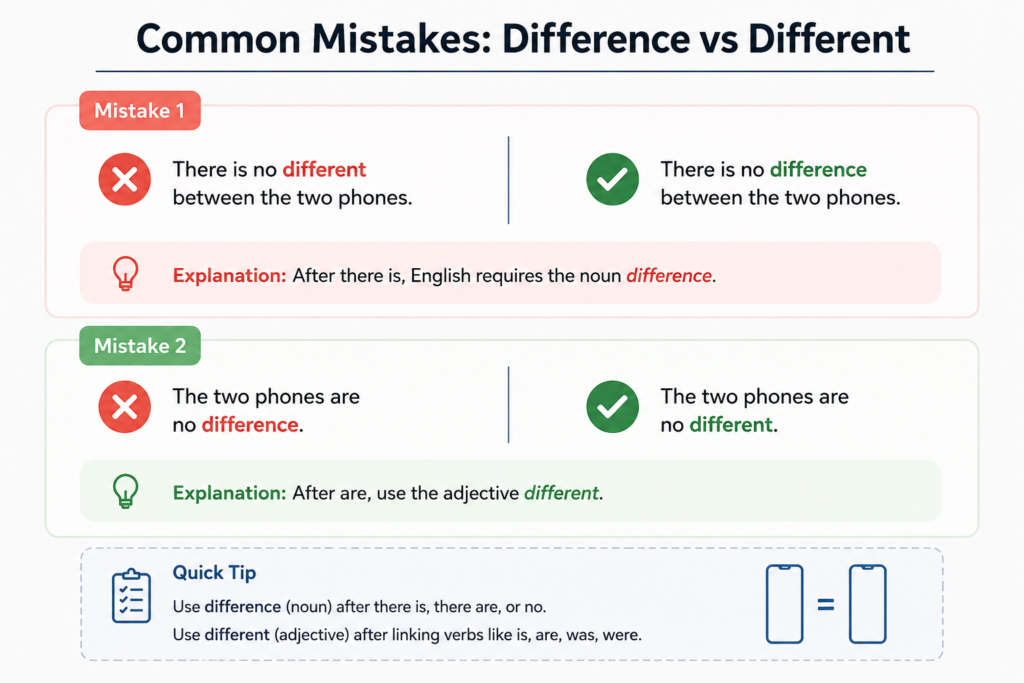
Mistake 1
❌ There is no different between the two phones.
✅ There is no difference between the two phones.
Explanation:
After there is, English requires the noun difference.
Mistake 2
❌ The two phones are no difference.
✅ The two phones are no different.
Explanation:
After are, use the adjective different.
Mistake 3
❌ It made no different.
✅ It made no difference.
Explanation:
The verb make takes the noun difference.
Mistake 4
❌ She is no difference from her sister.
✅ She is no different from her sister.
Explanation:
The linking verb is requires an adjective.
Mistake 5
❌ I noticed no different.
✅ I noticed no difference.
Explanation:
The verb noticed takes the noun phrase.
Mistake 6
❌ They seem no difference.
✅ They seem no different.
Explanation:
The linking verb seem requires an adjective.
Why People Confuse These Expressions
The confusion happens because both expressions communicate nearly the same idea.
Compare these sentences.
- There is no difference between the results.
- The results are no different from each other.
Although the grammar changes, the meaning stays almost identical.
Many learners focus on the meaning instead of the sentence structure, which leads to mistakes.
The Easy Grammar Test
If you’re unsure which phrase to use, ask yourself one simple question.
Are you naming a thing?
Use no difference.
Example:
- We found no difference.
The lack of distinction is the “thing” being discussed.
Are you describing something?
Use no different.
Example:
- The results are no different.
The adjective describes the results.
This quick test works in almost every sentence.
Formal and Informal Usage
Both expressions are perfectly acceptable in formal and informal English.
Formal Writing
- The committee found no difference between the two proposals.
- The revised policy is no different from the previous version.
These sentences are suitable for reports, research papers, and business documents.
Informal Conversation
- I see no difference.
- This movie is no different from the first one.
Native speakers use both expressions naturally in everyday conversation.
American vs British English
There is virtually no grammatical difference between American English and British English regarding these expressions.
Both varieties use them in the same way.
American English
- There is no difference between these models.
- The new model is no different from the old one.
British English
- There is no difference between these models.
- The new model is no different from the old one.
The grammar remains identical.
Pronunciation
No Difference
IPA
/noʊ ˈdɪfərəns/
Natural pronunciation:
NO DIF-er-ence
The first syllable receives the strongest stress.
No Different
IPA
/noʊ ˈdɪfrənt/
Natural pronunciation:
NO DIF-rent
Notice that many native speakers pronounce different with two clear syllables in fast speech:
DIF-rent
Word Origin
Difference
The noun difference comes from the Latin differentia, meaning distinction or variation.
It entered English through Old French and has referred to distinctions between people or things for centuries.
Different
The adjective different comes from the Latin differens, meaning differing or unlike.
Although both words share the same root, English assigns them different grammatical roles.
Professional Writing Tips
Professional editors use several techniques to choose the correct expression instantly.
1. Look at the Verb
If the sentence contains a linking verb such as:
- is
- are
- was
- were
- seems
- appears
- becomes
- remains
The adjective no different is usually correct.
Example:
- The proposal is no different from last year’s.
2. Look for “There Is”
If the sentence begins with:
- There is
- There was
- There seems to be
You almost always need no difference.
Examples:
- There is no difference.
- There was no difference.
- There seems to be no difference.
3. Watch for Common Verbs
These verbs usually take no difference.
- make
- notice
- see
- detect
- observe
- identify
- find
- discover
Examples:
- We noticed no difference.
- Scientists found no difference.
4. Remember the Common Pair
The adjective usually appears with from.
Examples:
- no different from
- no different than (less common and often regional)
The noun usually appears with between or in.
Examples:
- no difference between
- no difference in
Memory Tricks
Trick 1
Difference = Noun
Think:
A difference
Since you can place a before it, it’s a noun.
Example:
- There isn’t a difference.
Trick 2
Different = Adjective
Think:
Something is different.
Adjectives describe nouns.
Example:
- The cars are different.
Now add no.
- The cars are no different.
Trick 3
Remember These Two Frames
Frame 1
There is no difference…
Frame 2
It is no different…
These two sentence patterns cover most real-world situations.
Related Expressions
Understanding similar expressions helps reinforce the grammar.
Make No Difference
Examples:
- It makes no difference to me.
- Your opinion makes no difference now.
Meaning:
It has no effect or importance.
Tell the Difference
Examples:
- I can’t tell the difference.
- Can you tell the difference between these colors?
Meaning:
To recognize distinctions.
Different From
Examples:
- This phone is different from mine.
- Their approach is different from ours.
This is the standard form in American English.
Different Than
Examples:
- Life today is different than it was twenty years ago.
Although common in American English, many editors still prefer different from, especially in formal writing.
Different To
Examples:
- This tastes different to me.
This construction appears more often in British English than in American English, although different from remains widely accepted in both.
Practice Exercises
Test your understanding by choosing the correct expression before looking at the answer.
1. There is _____ between the two contracts.
✅ no difference
Explanation:
The phrase follows there is, so the noun difference is required.
2. The revised contract is _____ from the original.
✅ no different
Explanation:
The linking verb is requires the adjective different.
3. We noticed _____ after installing the update.
✅ no difference
Explanation:
The verb noticed takes the noun phrase no difference.
4. Their new policy seems _____ from the old one.
✅ no different
Explanation:
After the linking verb seems, use the adjective differe
5. Scientists found _____ between the two groups.
✅ no difference
Explanation:
The verb found is followed by the noun difference.
6. The replacement looks _____ from the original.
✅ no different
Explanation:
The linking verb looks requires an adjective.
7. It makes _____ to me.
✅ no difference
Explanation:
The fixed expression is make no difference.
8. His explanation was _____ from hers.
✅ no different
Explanation:
The adjective describes explanation.
9. Can you see _____ in quality?
✅ no difference
Explanation:
The verb see is followed by the noun difference.
10. This restaurant is _____ from the one we visited last week.
✅ no different
Explanation:
The sentence describes the restaurant, so the adjective is correct.
Advanced Usage Notes
Although no difference and no different often communicate the same idea, experienced writers choose the one that produces the clearest sentence.
Compare these examples.
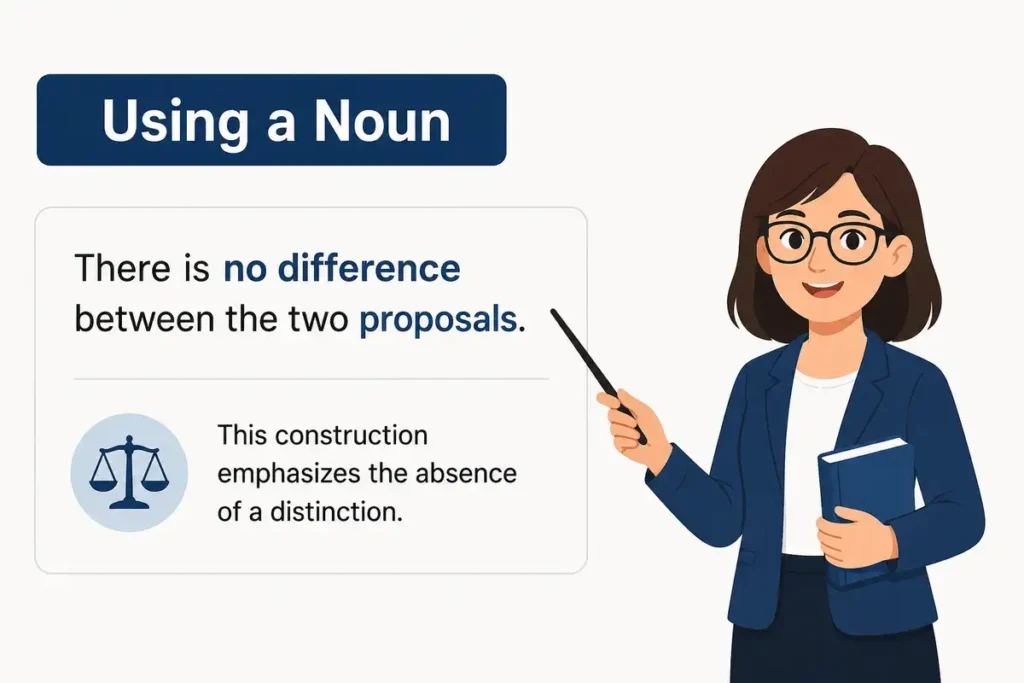
Using a Noun
There is no difference between the two proposals.
This construction emphasizes the absence of a distinction.
Using an Adjective
The two proposals are no different from each other.
This construction emphasizes the similarity of the proposals themselves.
Both are correct, but the focus changes slightly.
Which Expression Is More Common?
Both are common, but they appear in different sentence patterns.
No difference is especially frequent with:
- there is
- make
- see
- notice
- find
- tell
Examples:
- There is no difference.
- I see no difference.
- It makes no difference.
No different is especially common with:
- is
- are
- was
- seems
- looks
- feels
- remains
Examples:
- It is no different.
- They are no different.
- It seems no different.
Neither expression is replacing the other. English simply uses each where its grammar requires.
Key Takeaways
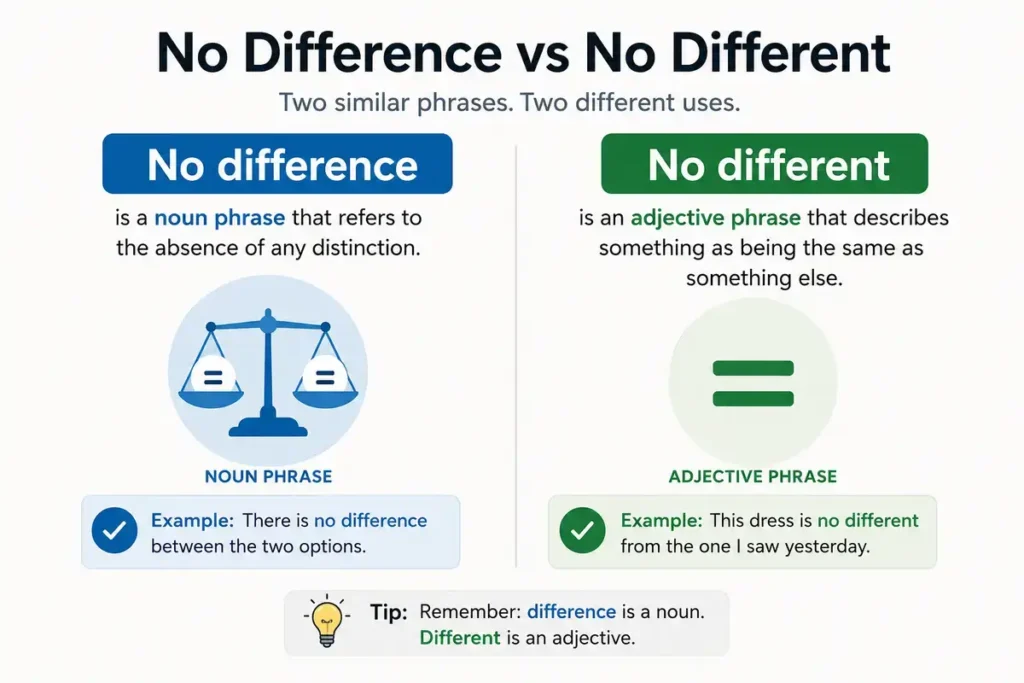
- No difference is a noun phrase that refers to the absence of any distinction.
- No different is an adjective phrase that describes something as being the same as something else.
- Use no difference after expressions like there is, make, find, notice, see, and tell.
- Use no different after linking verbs such as is, are, was, were, seems, looks, feels, and remains.
- Although both expressions often communicate the same idea, they are not interchangeable without changing the sentence structure.
- American English and British English follow the same basic grammar rule.
- The most common patterns are there is no difference and is no different from.
- Learning the difference between nouns and adjectives makes choosing the correct expression much easier.
Conclusion
Understanding No Difference vs No Different becomes simple once you recognize the grammatical role of each phrase. No difference is a noun phrase used to state that no distinction exists, while no different is an adjective phrase used to describe something as being the same as another thing. Although they often express nearly identical meanings, they belong in different sentence structures.
A reliable way to choose the correct expression is to look at the sentence pattern. If you’re naming the absence of a distinction, use no difference. If you’re describing a person, object, or situation after a linking verb, use no different. This distinction applies in everyday conversations, professional writing, academic work, and formal communication.
As you practice these patterns, they become second nature. Remember the two most useful sentence frames: There is no difference and It is no different from. Mastering these structures will help you write and speak with greater accuracy, confidence, and clarity.
FAQs
Is no difference grammatically correct?
Yes. It is the standard noun phrase used to express that no distinction exists between two or more things.
Is no different grammatically correct?
Yes. It is an adjective phrase used after linking verbs to describe something as being the same as something else.
Can no difference and no different be used interchangeably?
Not always. They often express the same meaning, but they follow different grammar patterns. Replace one with the other only by changing the sentence structure.
Why do people confuse these expressions?
Because both communicate similarity. The confusion comes from overlooking the difference between a noun (difference) and an adjective (different).
Is there is no different correct?
No. After there is, use the noun difference.
Correct:
- There is no difference.
Is it is no difference correct?
Usually no.
Correct:
- It is no different.
If you want to use the noun, rewrite the sentence.
Correct:
- There is no difference.
Which expression is more formal?
Neither. Both are equally appropriate in formal and informal English when used correctly.
Does American English prefer different from or different than?
American English accepts both, but different from is generally preferred in formal writing because it is more widely accepted by style guides.
Can I say make no different?
No.
The correct expression is:
- make no difference
What’s the easiest way to remember the rule?
Remember this simple pattern:
- There is no difference.
- It is no different.
If you can remember those two sentence frames, you’ll use both expressions correctly most of the time.

English Grammar & Usage
Nathan Holloway is an American grammar writer and language researcher who specializes in English grammar, sentence structure, verb usage, and common writing mistakes. He enjoys breaking down confusing grammar rules into practical explanations with clear examples, making English easier for students, professionals, and everyday writers.