
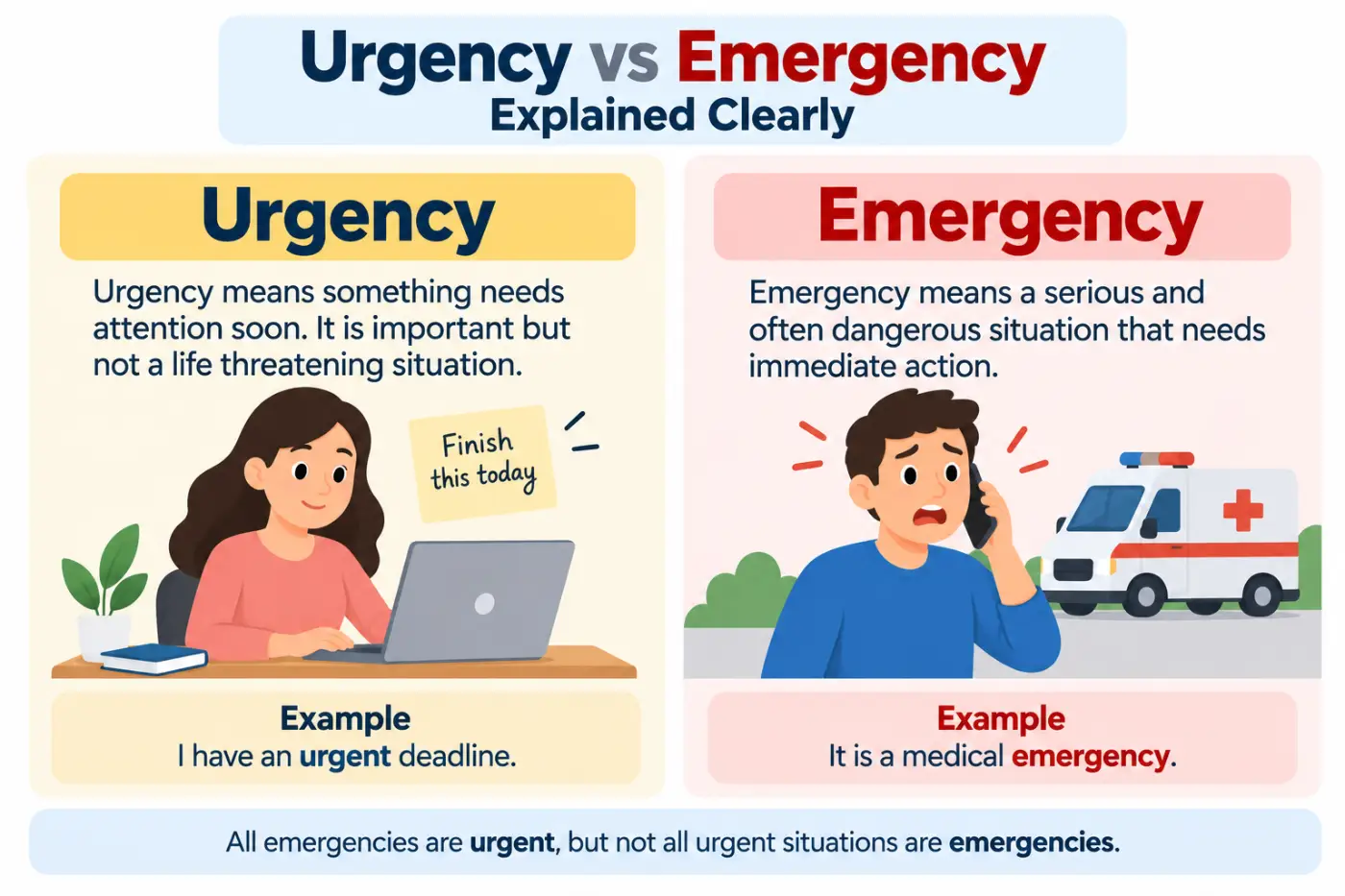
Urgency vs. Emergency comes down to how quickly a situation needs attention and how serious the consequences of waiting could be. An urgent matter requires prompt action, while an emergency usually involves immediate danger or a serious threat that calls for an immediate response.
For example, a work deadline due today may be urgent because you need to act quickly to avoid missing it. However, a fire in the same building is an emergency because it threatens lives and property. Both situations require action, but the level of risk and the response they demand are very different.
Understanding this distinction is important in everyday conversation and professional communication. Doctors use these terms to describe patient needs, businesses use them to prioritize problems, schools rely on them for safety procedures, and customer service teams use them to determine which issues need immediate attention. This guide explains the difference between urgency and emergency in plain American English, with clear examples to help you use both words correctly.
Short Answer
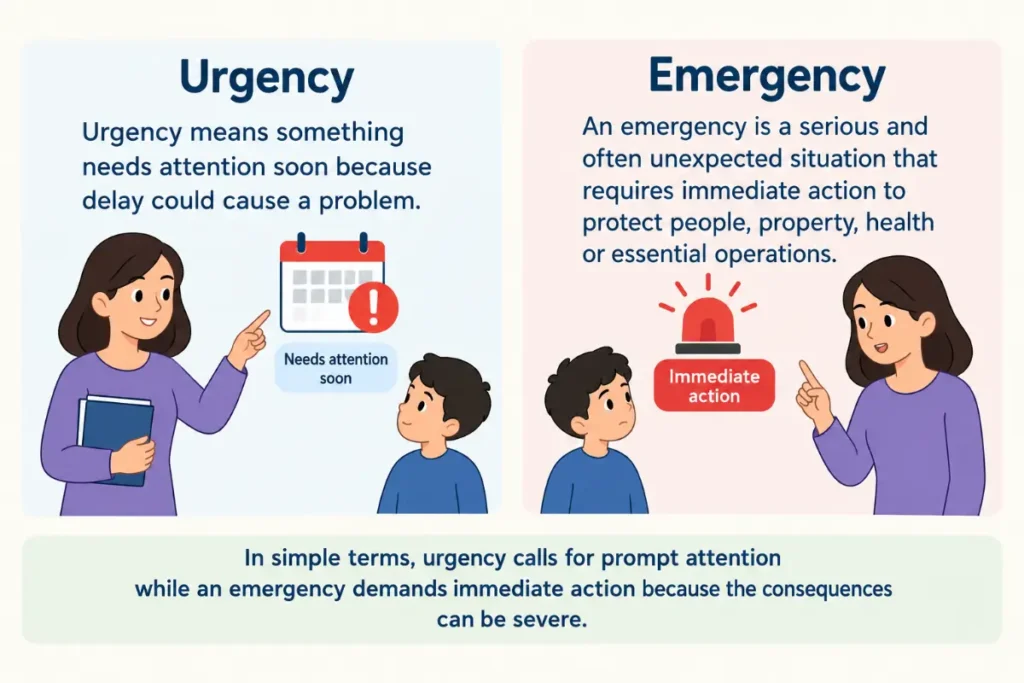
Urgency means something needs attention soon because delay could cause a problem. An emergency is a serious and often unexpected situation that requires immediate action to protect people property health or essential operations. In simple terms urgency calls for prompt attention while an emergency demands immediate action because the consequences can be severe.
Table Of Contents
- What urgency means.
- What emergency means.
- The main difference between the terms.
- How urgency becomes an emergency.
- Examples in everyday situations.
- Examples in professional settings.
- Grammar and word forms.
- Common mistakes.
- Related words and expressions.
- Memory tips.
- Expert usage advice.
- Frequently asked questions.
- Key takeaways.
- Conclusion.
What Urgency Means
Urgency describes the need to deal with something quickly. The situation may not involve immediate danger but waiting too long could create a problem.
For example a company may need to submit an important document before the end of the day. The task has urgency because delay could lead to missed deadlines or financial consequences. Still it isn’t necessarily an emergency.
The noun urgency comes from the adjective urgent. If something is urgent it needs attention soon.
Consider these examples.
- The manager stressed the urgency of the request.
- We need to handle this issue with some urgency.
- The patient needs urgent medical attention.
The word can describe a feeling as well. Someone may speak with urgency when they want another person to act quickly.
Urgency doesn’t automatically mean danger. That’s the point many people miss.
A leaking pipe in a house could be urgent because ignoring it may cause expensive damage. A fire spreading through the same house would be an emergency because people could be in immediate danger.
The level of risk changes the classification.
What Emergency Means
An emergency is a serious situation that requires immediate action. It often involves danger to people health property safety or essential services.
Emergency is a noun and can also work as part of a compound expression such as emergency room emergency services or emergency response.
Here are simple examples.
- The hospital declared an emergency.
- Call emergency services if someone is in immediate danger.
- The power failure created an emergency for the facility.
An emergency usually has a stronger sense of severity than an urgent matter. The word suggests that normal procedures may not be enough and that people may need to act immediately.
That doesn’t mean every emergency looks dramatic. Some emergencies are quiet but serious. A major computer security incident could be an emergency for a company even if nobody sees physical danger. A sudden medical crisis can also become an emergency even when the situation begins with only one person feeling unwell.
The central idea is immediate action in response to serious circumstances.
The Main Difference Between The Terms
The simplest distinction is this.
Urgency means act soon. Emergency means act now because serious harm may occur.
That difference helps you choose the right word in most situations.
| Feature | Urgency | Emergency |
|---|---|---|
| Basic meaning | A need for prompt attention | A serious situation requiring immediate action |
| Typical time pressure | Soon | Immediately |
| Level of danger | May involve little or no immediate danger | Often involves serious danger or major harm |
| Expected response | Prioritize the matter | Activate an immediate response |
| Common setting | Work deadlines medical needs customer requests repairs | Fires accidents medical crises security incidents disasters |
| Emotional tone | Concern and pressure | Alarm and immediate concern |
| Example | This report has high urgency. | The building fire is an emergency. |
The words can overlap. An emergency is normally urgent but an urgent situation isn’t always an emergency.
This is similar to the difference between a warning and a crisis. A warning tells you that action matters. A crisis tells you that the situation has already reached a level where immediate response is necessary.
Urgency vs Emergency In Real Situations
The easiest way to understand the difference is to look at situations people actually encounter.
A Workplace Deadline
Your supervisor tells you that a report must be completed before a major meeting tomorrow morning.
That’s urgent.
You need to prioritize the task because delaying it could cause problems. However nobody is necessarily in danger.
Now imagine the building’s fire alarm activates and smoke fills a hallway.
That’s an emergency.
Employees need to follow safety procedures immediately. The situation involves a potential threat to life and property.
A Medical Situation
A person may need to schedule an appointment soon because of a health concern. That can involve urgency without being an emergency.
A person who suddenly has severe symptoms that could indicate a life threatening condition may need emergency care.
Healthcare professionals use specific clinical criteria to determine the appropriate level of care. Ordinary speakers should avoid diagnosing a medical condition based only on the word urgent or emergency.
A Home Repair
A broken air conditioner during a mild week may be inconvenient. If temperatures become dangerously high and a vulnerable person is inside the home the situation can become urgent.
A gas leak is different. It may create an immediate safety threat and require emergency action.
A Business System Failure
A slow website can create an urgent business problem if customers can’t complete purchases.
A major system failure that stops critical operations may become an emergency. The response could involve technical teams management security personnel and outside specialists.
The lesson is simple. Don’t judge the situation only by how stressful it feels. Consider the potential consequences of delay.
How Urgency Can Become An Emergency
An urgent situation can become an emergency when the consequences become more serious or the available response time becomes extremely short.
Imagine a small water leak in an office ceiling. At first the issue may be urgent. Someone should arrange a repair quickly.
Now imagine the leak reaches electrical equipment and creates a risk of electrical shock or fire. The situation has changed. What began as a repair problem may now require emergency action.
This progression happens in many settings.
- A minor technical problem can become a major outage.
- A missed maintenance issue can become a safety hazard.
- A manageable medical concern can become a serious health crisis.
- A small security warning can become a major incident.
- A delayed business decision can create severe financial or operational consequences.
The important factor is not simply speed. It’s the relationship between time and potential harm.
If waiting another hour is inconvenient the matter may be urgent.
If waiting another hour could cause serious harm the matter may qualify as an emergency.
How Professionals Use These Words
Different professions use the terms in slightly different ways.
Healthcare
Healthcare settings often distinguish urgent care from emergency care.
Urgent care generally refers to medical problems that need prompt attention but don’t appear to require immediate emergency treatment. Emergency care addresses serious or potentially life threatening conditions.
The exact classification depends on the medical situation and professional assessment.
Business
Businesses often use urgency to prioritize tasks.
A legal deadline may be urgent. A customer complaint may be urgent. A contract issue may be urgent.
An emergency usually involves an event that threatens people operations assets security or the ability to continue essential business functions.
Companies may have formal emergency response plans for these situations.
Information Technology
Technology teams frequently use severity and urgency together.
A system affecting one employee may need attention but have limited business impact. A failure affecting thousands of customers may require immediate escalation.
IT teams often use their own incident classification systems. The exact definitions vary between organizations.
Grammar And Word Forms
Understanding the grammar of these terms helps you use them naturally.
Urgency As A Noun
Urgency is a noun.
You can talk about the urgency of something.
The urgency of the situation became clear.
You can also use it after verbs such as emphasize recognize or understand.
The director emphasized the urgency of the repair.
Urgent As An Adjective
Urgent is the adjective related to urgency.
We received an urgent request.
She needs urgent attention.
An urgent matter needs quick attention.
Emergency As A Noun
Emergency is normally a noun.
The hospital handled the emergency quickly.
The company has an emergency plan.
The word can also appear in compound terms.
Emergency response teams arrived quickly.
This use is common in professional and public safety language.
The emergency team arrived at the scene.
Pronunciation Guide
The pronunciation of these words is straightforward once you separate their syllables.
Urgency
American English pronunciation is commonly represented as /ˈɝːdʒənsi/.
A simple learner friendly approximation is:
UR jen see
The first syllable receives the main stress.
Emergency
American English pronunciation is commonly represented as /ɪˈmɝːdʒənsi/.
A simple approximation is:
ih MER jen see
The main stress falls on the second syllable.
A common mistake is placing too much stress on the first syllable of emergency. In natural American English the middle syllable carries the strongest stress.
Formal And Informal Usage
Both words are appropriate in formal and informal English.
Urgency works well in professional writing.
The urgency of the matter requires immediate review.
Emergency is also standard in formal communication.
The organization activated its emergency response procedure.
In casual conversation people often use urgent to describe something that needs attention quickly.
Can you call me back. It’s urgent.
Emergency usually carries more weight.
Call for help. This is an emergency.
One practical writing tip is to avoid calling every problem an emergency. If every issue receives the same label the word loses its force. Professional communication becomes clearer when urgent requests and true emergencies receive different levels of attention.
Real Life Examples
Daily Conversation
- I need an answer soon because this is urgent.
The speaker needs a quick response but doesn’t necessarily face a dangerous situation.
- There’s smoke coming from the kitchen. This is an emergency.
The speaker identifies an immediate safety threat.
Workplace Communication
- Please review this request today because it has a high level of urgency.
The message asks for fast action because delay matters.
- The building has lost power and the backup system isn’t working. We have an emergency.
The situation threatens essential operations and needs immediate attention.
Academic Writing
- The report highlights the urgency of addressing the problem.
The sentence presents the issue as requiring prompt action.
- The study examines how communities respond during an emergency.
The word refers to a serious event requiring an immediate response.
Customer Service
- I’ve marked your request as urgent because the issue is affecting your account.
The problem deserves faster attention.
- The payment system is down for every customer. We’re treating this as an emergency.
The wider impact changes the level of response.
Storytelling
- She heard the urgency in his voice and reached for the phone.
Urgency describes the pressure communicated through his voice.
- The alarm turned the quiet evening into an emergency.
Emergency describes the serious situation created by the alarm.
Common Mistakes
Treating The Words As Exact Synonyms
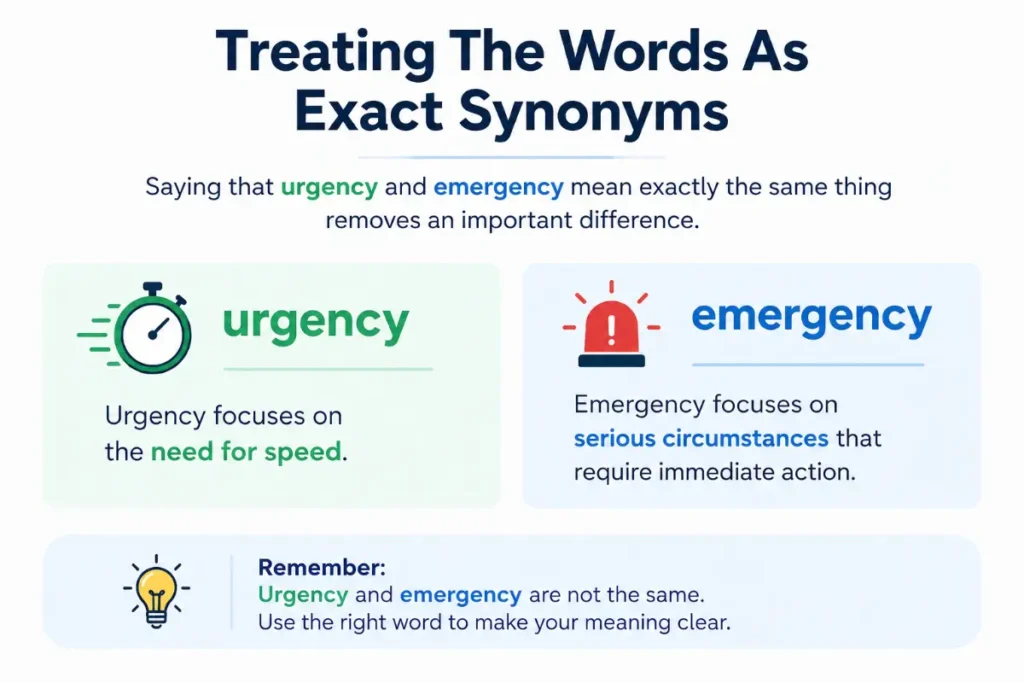
Saying that urgency and emergency mean exactly the same thing removes an important difference.
Urgency focuses on the need for speed. Emergency focuses on serious circumstances that require immediate action.
Calling Every Urgent Task An Emergency
A deadline can be urgent without being an emergency.
Calling routine business problems emergencies can create confusion and cause people to ignore genuine emergencies.
Assuming Emergency Always Means Physical Danger
Physical danger is common but not required in every use.
A major cybersecurity incident or critical infrastructure failure may be described as an emergency because of the potential consequences.
Confusing Urgent With Important
Something can be important without being urgent.
For example a long term business strategy may be extremely important but may not require action today.
Likewise a minor administrative task may be urgent because it has a deadline even though it has little long term importance.
Using Urgency When You Mean An Emergency
If a situation involves immediate danger you may weaken the message by calling it merely urgent.
Compare these sentences.
The situation is urgent.
The situation is an emergency.
The second sentence communicates a much stronger need for immediate action.
Urgency And Importance Are Not The Same
This distinction deserves special attention because people often mix these ideas.
Urgency concerns time.
Importance concerns value or consequence.
A task can be highly important but not urgent. Another task can be urgent but relatively unimportant in the long term.
Imagine you need to prepare a major business presentation next month. The presentation may be extremely important but it isn’t urgent today.
Now imagine your manager asks you to correct a small error before a client meeting in thirty minutes. That task may be urgent even though the underlying issue isn’t highly important.
This distinction helps with prioritization.
A useful mental model is:
Important asks how much the outcome matters.
Urgent asks how quickly action is needed.
Emergency asks how serious the immediate situation has become.
These concepts often interact but they aren’t interchangeable.
Related Words And Expressions
Several words are closely connected to this topic.
- Urgent. Something that requires quick attention.
- Immediate. Something that needs to happen without delay.
- Critical. Something extremely important or potentially decisive.
- Crisis. A serious situation that requires difficult or rapid decisions.
- Danger. The possibility of harm or injury.
- Priority. Something given greater attention than other matters.
- Prompt. Done quickly or without unnecessary delay.
- Emergency response. The organized action taken during a serious emergency.
These terms overlap but each carries its own meaning. A request can be urgent without being critical. A situation can be critical without technically being an emergency. A crisis may continue for days or weeks while an emergency can develop and require action within minutes.
Urgency vs Emergency In Professional Writing
Professional writing benefits from precise language.
If you’re sending an email to a colleague you might write:
Please review this today because the request is urgent.
That tells the reader to prioritize the matter.
If the situation involves immediate danger you need stronger wording.
Please activate the emergency procedure immediately.
The distinction helps people understand the expected response.
Legal teams can use urgency when discussing filing deadlines or business decisions. Human resources teams may use it for sensitive employee matters. IT teams may use it to prioritize incidents. Operations teams may use it for equipment failures.
Emergency language should be reserved for situations that genuinely justify an emergency response.
That makes communication more credible.
How To Choose The Right Word
When you’re unsure which word fits ask yourself three questions.
- Does this need attention soon.
If yes then urgent or urgency may fit
You can also think about the expected response.
If you’re asking someone to move your request ahead of other work you are probably describing urgency.
If you’re telling people to stop normal activities and follow an emergency procedure you are describing an emergency.
That simple test works in most everyday contexts.
Memory Tips
A good memory trick is to connect urgency with time and emergency with danger or serious consequences.
Think:
Urgency means hurry.
Emergency means immediate action because something serious is happening.
Another useful comparison is a deadline and a fire.
A deadline can be urgent.
A fire is an emergency.
You don’t need a complicated rule. Picture those two situations and the distinction becomes easier to remember.
You can also remember the phrase urgent but not an emergency. For example a work deadline can be urgent but doesn’t necessarily require emergency action.
Related Grammar And Usage Notes
The adjective urgent describes a person thing request or situation.
The noun urgency describes the quality or level of needing quick attention.
The noun emergency describes the serious event itself.
This creates useful patterns.
Urgent request.
High urgency.
Emergency situation.
Emergency response.
Urgent medical attention.
Notice that urgency normally describes a quality while emergency identifies an event or situation.
You wouldn’t normally say an urgency happened. You can say an emergency happened because emergency functions as a noun for the event itself.
This difference can make your writing sound more natural.
American English Usage
In American English both terms are common and standard.
Urgent appears frequently in workplace communication healthcare customer service and everyday conversation. Emergency is common in medical public safety business technology and disaster related contexts.
American speakers also use emergency in familiar phrases such as emergency room emergency services emergency exit emergency contact and emergency plan.
There isn’t a major American English spelling difference between these terms and their British counterparts.
British English Usage
British English uses the same basic distinction.
Urgent describes something needing prompt attention. Emergency describes a serious situation requiring immediate action.
The biggest differences between American and British usage usually arise from specific institutional terms rather than from the core meanings of these two words.
The underlying contrast remains clear in both varieties of English.
Australian And Canadian English
Australian and Canadian English also maintain the same basic distinction.
An urgent matter requires prompt attention. An emergency requires immediate action in response to a serious situation.
Specific professional systems may define the terms differently for their own purposes. Still everyday English speakers in these varieties generally understand the difference in much the same way.
Expert Editor Insight
An experienced editor looks at the consequence of delay before choosing between these words. If a sentence only needs to communicate speed then urgent or urgency is often enough. If it describes a serious event that requires immediate intervention then emergency usually carries the right force. Editors also watch for overuse because labeling every difficult task an emergency makes professional communication less precise. Strong writing doesn’t simply sound urgent. It tells the reader exactly why action needs to happen and how quickly it matters.
Key Takeaways
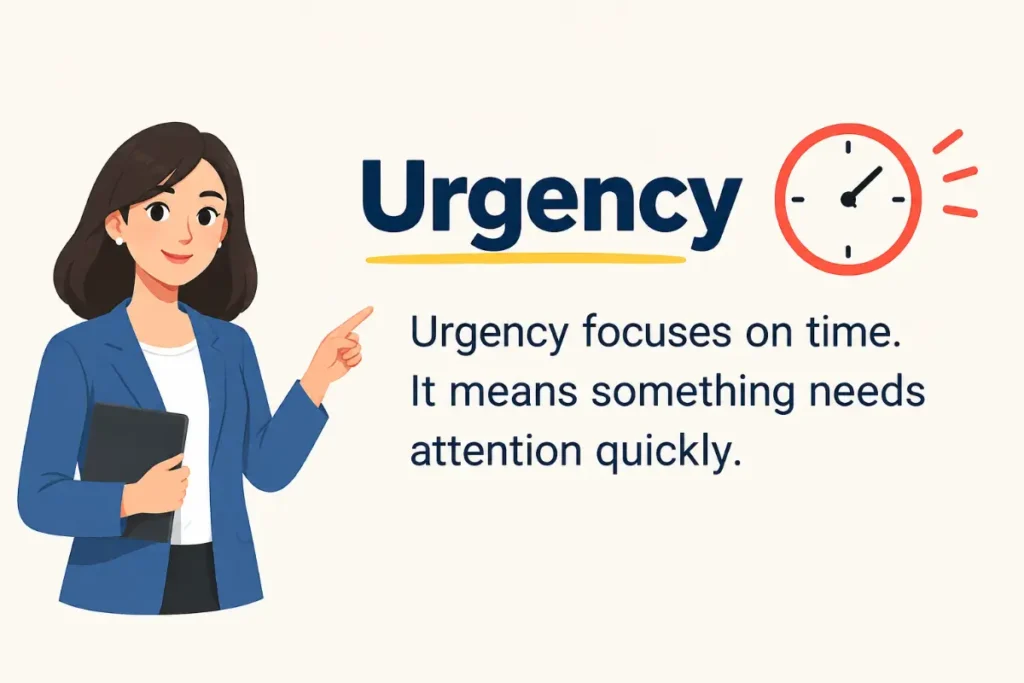
- Urgency focuses on time. It means something needs attention quickly.
- Emergency focuses on seriousness. It describes a situation that requires immediate action because the consequences may be severe.
- An urgent matter isn’t automatically an emergency. A deadline can be urgent without creating a serious threat.
- An emergency is normally urgent. Serious situations usually require immediate attention.
- Importance is different from urgency. Something can matter greatly without requiring action right away.
- Use the stronger word carefully. Calling routine problems emergencies can weaken the meaning and create confusion.
- Think about the consequences of delay. If delay is inconvenient the matter may be urgent. If delay could cause serious harm the situation may be an emergency.
Conclusion
Understanding urgency vs. emergency is easier when you distinguish time pressure from serious, immediate danger. Urgency means something needs prompt attention because a delay could cause problems. An emergency involves a serious situation that requires immediate action to protect people, property, essential services, or other important interests.
Although the two terms can overlap, they aren’t interchangeable. A work deadline may be urgent without being an emergency. A fire, medical crisis, or serious security incident is an emergency because delaying action could lead to severe consequences. Choosing the right word helps communicate the seriousness of a situation clearly.
An easy way to remember the difference is to associate urgency with hurry and emergency with immediate action in a serious situation. This simple distinction can help you use both terms correctly in everyday conversations, professional writing, and high pressure situations.
Frequently Asked Questions
What Is the Difference Between Urgency and Emergency?
Urgency means something needs attention quickly because a delay could cause problems. An emergency is a serious situation that requires immediate action and may involve danger or major consequences. An urgent task can often be handled through normal procedures with higher priority, while an emergency may require special action or an immediate response.
Is Urgency More Serious Than Emergency?
No. An emergency generally describes a more serious situation than urgency alone. Urgency focuses on how quickly something needs attention, while an emergency involves circumstances that demand immediate action. For example, a report due within an hour is urgent, but a fire in a workplace is an emergency because it can put lives at risk.
Can Something Be Urgent but Not an Emergency?
Yes. A missed deadline, an important customer request, or a time sensitive repair can be urgent without being an emergency. These situations need prompt attention, but they may not involve immediate danger or a serious threat to essential operations. Urgency is mainly about time pressure and the consequences of delay.
Can an Emergency Also Be Urgent?
Yes. An emergency is usually urgent because it requires immediate attention. However, the word emergency communicates more than a need to act quickly. It signals a serious situation that may require special procedures or a rapid response. A medical crisis, a fire, or a major safety incident can be both urgent and an emergency.
Is Urgency a Noun or an Adjective?
Urgency is a noun that describes the need for quick action. Its related adjective is urgent. For example, you can say, This request has a sense of urgency or This is an urgent request. Emergency is also a noun, as in The team responded to an emergency. Understanding these word forms helps you use them correctly in everyday and professional writing.
What Is a Synonym for Urgency?
Common synonyms for urgency include immediacy, promptness, necessity, and time pressure. The best choice depends on the meaning you want to express. Immediacy emphasizes the need for action right away, while time pressure highlights a limited period for completing something. Time sensitive is another useful expression when a delay could affect the outcome.
Should I Use Urgency or Emergency in a Work Email?
Use urgency when you need someone to prioritize a task or respond quickly. Use emergency when a serious situation requires immediate action or a specific response procedure. For example, a deadline approaching today may create urgency, while a serious workplace safety incident may be an emergency. Choosing the right word helps coworkers understand how quickly they need to respond.
What Is a Good Way to Remember the Difference?
Remember this simple distinction: urgency is about time, while an emergency involves a serious situation requiring immediate action. A deadline may be urgent because there is little time left to finish a task. A fire is an emergency because it can cause immediate harm. This comparison makes it easier to choose the right word in everyday conversations and professional situations.
Is Urgency the Same as Importance?
No. Urgency describes how quickly something needs attention, while importance describes how much the outcome matters. A task can be important without needing immediate action. Another task may require a quick response but have little long term impact. Understanding the difference helps you prioritize tasks based on both their deadlines and their overall value.
Is an Emergency Always Related to Danger?
No. Emergencies often involve physical danger, but they can also affect essential services, security, or business operations. For example, a major computer system failure could become an operational emergency if it interrupts critical services. The key distinction is that an emergency involves a serious situation that requires immediate action, even when no one faces direct physical danger.

Confusing Words, Spelling & Word Choice
Claire Whitmore is a U.S.-based English editor who writes about commonly confused words, spelling differences, and word choice. Her work helps readers understand subtle distinctions between similar-looking words through simple definitions, practical examples, and modern usage guidance in both American and British English.