
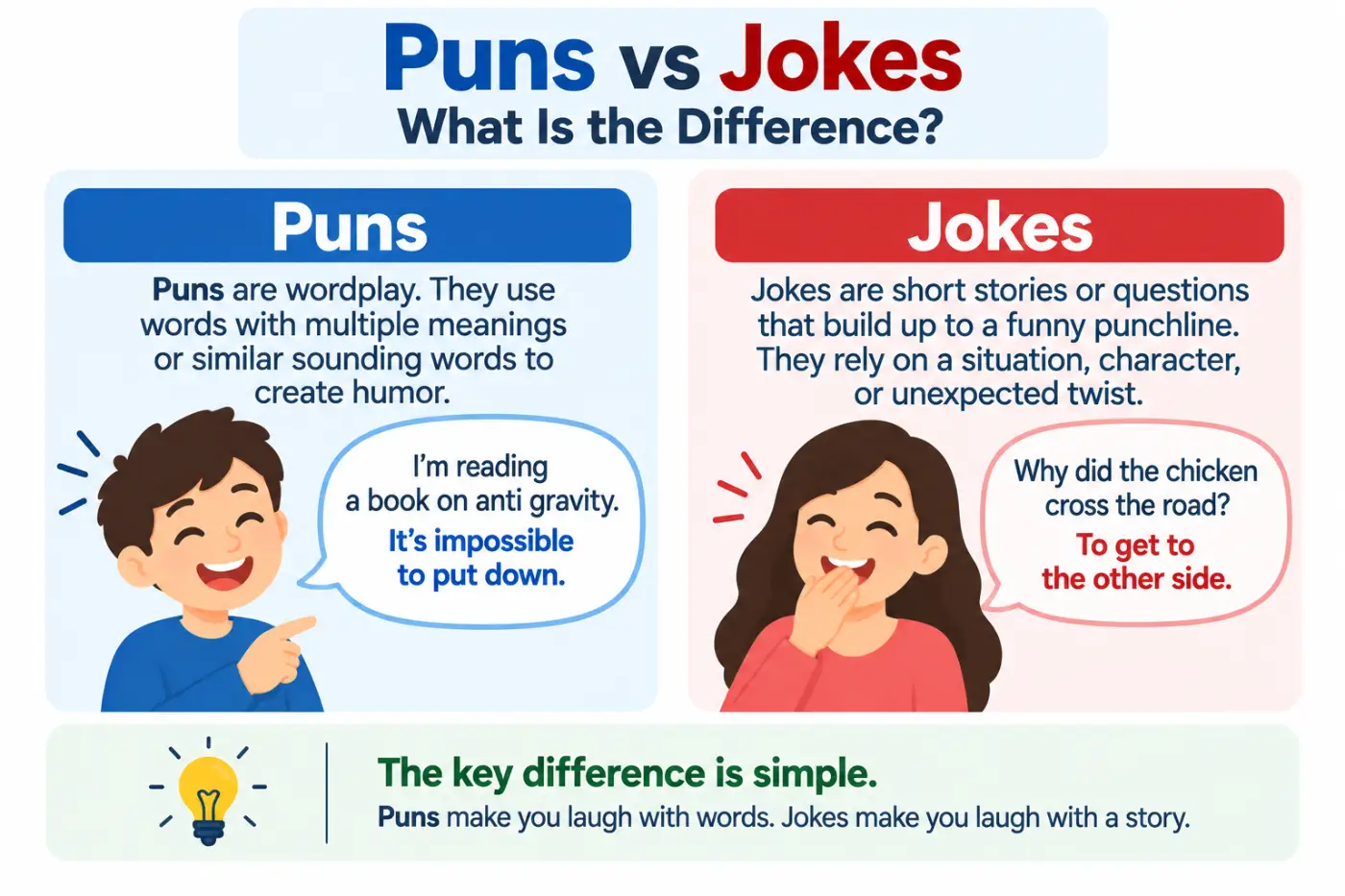
Puns vs Jokes is a common search because the two forms of humor often overlap. You may hear a clever line and wonder if it should be called a pun or simply a joke. The answer depends on how the humor works. A pun relies on language itself while a joke can create laughter through many different methods.
That distinction sounds simple but real examples can make it less clear. A short funny sentence might contain a double meaning and a punchline at the same time. A longer joke might also contain several puns. The two categories can sit side by side without being exact opposites.
The easiest way to understand the difference is to look at the mechanism behind the humor. Puns play with words meanings sounds spelling or sentence structure. Jokes create an expectation and then often change direction with an unexpected ending. Once you see that difference you can identify each type much more easily.
Short Answer
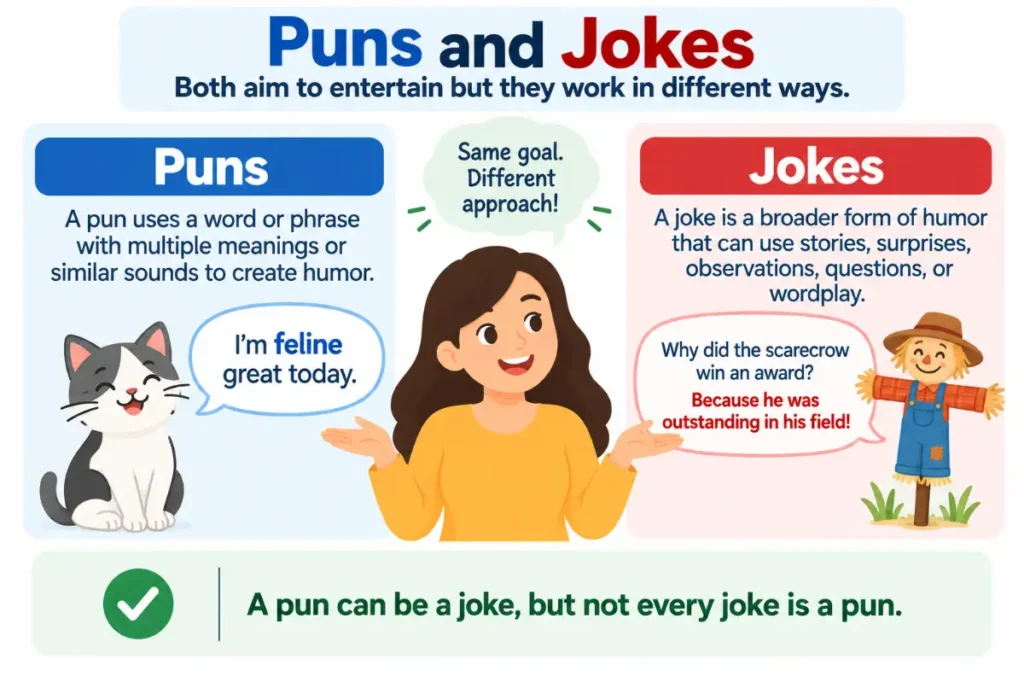
Puns and jokes both aim to entertain but they work in different ways. A pun uses a word or phrase with multiple meanings or similar sounds to create humor. A joke is a broader form of humor that can use stories surprises observations questions or wordplay. A pun can be a joke but not every joke is a pun.
Table Of Contents
- The Basic Difference
- What A Pun Means
- What A Joke Means
- How Wordplay Creates Humor
- How A Punchline Works
- Comparison Table
- Examples You Can Recognize
- Common Confusion
- Types Of Puns
- Types Of Jokes
- Why Some Humor Fits Both Categories
- Formal And Informal Usage
- American English Usage
- Memory Tips
- Related Terms
- Expert Editor Insight
- FAQs
- Key Takeaways
- Conclusion
The Basic Difference
The simplest distinction is this.
A pun is a type of wordplay. A joke is a broader form of humor.
A pun usually depends on two or more meanings of a word or on words that sound alike or nearly alike. The humor comes from the connection between those meanings or sounds.
A joke doesn’t need that language based mechanism. It can rely on an unusual situation a surprising answer an exaggerated story a funny observation or a clever setup and punchline.
Consider this simple example.
The bicycle couldn’t stand up because it was two tired.
The humor depends on the similarity between tired and the phrase two tired. The line plays with language. That makes it a pun.
Now consider this example.
A man walks into a library and asks for books about paranoia. The librarian whispers that they’re right behind him.
This is a joke. The humor comes from the unexpected interpretation of paranoia and the surprise in the librarian’s response. It doesn’t depend on a double meaning within a single word in the same way as the bicycle example.
The key question is therefore not simply whether something makes you laugh. Ask what creates the humor.
If word meaning or sound creates the central comic effect it is likely a pun.
If the humor comes mainly from a setup and unexpected payoff it is likely a joke.
What A Pun Means
A pun is a form of wordplay that creates humor or a clever effect by using words that have multiple meanings or words that sound similar.
Puns can be very short. Sometimes only one word does all the work.
For example.
I used to be a baker but I couldn’t make enough dough.
The word dough has its literal connection to baking and its informal connection to money. The humor comes from those two meanings.
Another example is:
I wondered why the baseball kept getting bigger. Then it hit me.
The phrase hit me has a literal connection with the ball and a figurative meaning connected with understanding something. The humor comes from the double interpretation.
Puns don’t always have to be laugh out loud funny. Some are deliberately clever rather than hilarious. Writers use them in advertising headlines fiction speeches newspapers social posts and casual conversation.
A pun can also depend on sound.
For example a writer might use two words that sound alike but have different meanings. This is called a homophonic pun. The audience recognizes the sound and then notices the difference in meaning.
Spelling can also play a role. Written puns sometimes depend on words that look similar even though their pronunciations differ.
The central feature remains word based ambiguity.
What A Joke Means
A joke is an expression or piece of communication designed to create amusement or laughter.
Unlike a pun a joke doesn’t have one required structure.
A joke can be a single sentence. It can be a question and answer. It can be a short story. It can be an observation about everyday life. It can even be a long performance with several humorous moments.
A traditional joke often has three basic parts.
- The setup introduces a situation or expectation.
- The development gives the audience enough information to follow the situation.
- The punchline changes the expected direction and creates the humorous effect.
For example.
A customer asks a waiter if the restaurant serves breakfast all day.
The waiter says yes.
The customer says great. I’ll have pancakes at 6 PM.
The humor comes from the expectation created by the phrase breakfast all day and the customer’s unusual interpretation of it.
This example involves a language based misunderstanding but it doesn’t have to depend on a classic double meaning. The joke can work because the audience recognizes the absurdity of the situation.
That flexibility makes the word joke much broader than pun.
How Wordplay Creates Humor
Language gives humor an enormous number of possibilities.
Words can have multiple meanings. Some words sound alike. Some phrases can be interpreted in different ways. Sentence structure can also create ambiguity.
Puns take advantage of these features.
Imagine someone says:
The math teacher has too many problems.
The word problems can mean mathematical exercises and difficult situations. The humor appears because the sentence allows both meanings.
The joke is short but the mechanism is specific. The audience mentally switches from one meaning to another.
That mental switch creates the surprise.
Good wordplay often works because the audience first interprets a phrase in one way and then suddenly recognizes another interpretation.
This is one reason puns can be satisfying even when they aren’t particularly sophisticated. The brain enjoys noticing the connection.
How A Punchline Works
A punchline usually depends on surprise.
The setup gives you one path to follow. The punchline suddenly takes another path.
That change can come from an unexpected fact a misunderstanding exaggeration contradiction or clever interpretation.
Consider this example.
My doctor told me I needed to stop eating cheese.
I asked him if that was a grate idea.
The final word creates the joke because grate sounds like great and also connects with cheese preparation. The punchline contains a pun.
Now the distinction becomes clear. The joke is the whole humorous exchange. The pun is the wordplay inside it.
This is why saying that a pun and a joke are always separate categories can be misleading. A joke can contain a pun as its central device.
Puns Inside Jokes
A joke can contain one pun or several.
For example a comedian might tell a story about a person who starts working at a clock store. The story could include several lines based on time related expressions.
The overall piece is a joke or comedic story.
Individual lines may be puns.
This relationship is similar to the difference between a story and a sentence. A sentence can exist inside a story but doesn’t describe the whole story.
The same idea applies to humor.
A pun can function as the punchline of a joke.
A pun can also stand alone.
A joke can contain wordplay without being primarily a pun.
This overlap explains much of the confusion people have when classifying humorous language.
Jokes Without Puns
Many jokes have no pun at all.
Observational humor is a good example. A comedian might point out an awkward habit people share and exaggerate it.
Physical comedy can also create humor without wordplay. A character slipping on a banana peel doesn’t require a linguistic trick.
Situational humor works the same way. A person might enter the wrong room and confidently begin talking to strangers who assume the person belongs there. The humor comes from the situation and the growing misunderstanding.
Satire can also work without puns. A writer might imitate a serious political announcement to expose an absurd idea.
Dark humor absurd humor slapstick observational comedy and many forms of storytelling can operate without wordplay.
That is why pun is a narrower term.
Comparison Table
| Feature | Pun | Joke |
|---|---|---|
| Main idea | Wordplay based humor | Broad humorous expression |
| Scope | Narrower category | Broader category |
| Main mechanism | Multiple meanings similar sounds or linguistic ambiguity | Surprise setup punchline situation observation or wordplay |
| Requires wordplay | Usually yes | No |
| Can stand alone | Yes | Yes |
| Can contain another form | Can appear inside a joke | Can contain one or more puns |
| Typical length | Often short | Can be short or extended |
| Common settings | Conversation advertising writing comedy | Conversation comedy storytelling media writing |
| Main effect | Clever language based surprise | Amusement or laughter |
| Example type | A baker making enough dough | A story ending with an unexpected punchline |
Examples You Can Recognize
The easiest way to understand the distinction is through examples.
Example One
I wanted to learn how to make a bicycle but I couldn’t find the right cycle.
This depends on a playful interpretation of cycle. The line is built around language. It works as a pun.
Example Two
A person tells a friend that they started a new job at a calendar company. The friend asks how it’s going. The person says there are a few dates I need to work out.
The word dates creates the wordplay. The line can function as a pun based joke.
Example Three
A child asks a parent why the dog is sitting in the corner. The parent says because it has been grounded.
The humor comes from two meanings of grounded. It is therefore a pun based joke.
Example Four
A comedian tells a story about going to the gym for the first time and spending twenty minutes trying to understand how one machine works. The punchline reveals that the machine was an air conditioner.
This is mainly a situational joke. No pun is required.
Example Five
A student says the teacher asked for a final draft. The student says they submitted one because they were tired of writing.
The humor comes from the double sense of final. This can function as wordplay.
Example Six
A father tells his child that he knows every word in the dictionary. The child asks him to prove it. He points to the dictionary and says there they are.
This is a joke based on an unexpected interpretation. It doesn’t need a pun.
The lesson from these examples is simple. Look for the source of the humor rather than the length or format.
Common Confusion
People often use the terms interchangeably because both involve humor and both can be very short.
Another reason is that dictionaries and everyday speakers don’t always divide humor into perfectly separate boxes. Language categories describe patterns but real communication can overlap.
A one line pun may also be called a joke.
A joke containing wordplay may also be called a pun.
A comedian may describe a pun as a joke because the audience understands the larger purpose rather than the technical mechanism.
This isn’t necessarily a problem. In casual conversation you don’t need to classify every funny sentence with scientific precision.
The distinction becomes more useful when you’re studying language writing comedy or analyzing humor.
If someone asks you to identify the type of humor, focus on the mechanism.
A pun depends on wordplay.
A joke has a broader definition.
Types Of Puns
Puns come in several forms.
Homophonic Puns
These use words that sound alike but have different meanings.
The humor comes from the sound connection.
English provides many opportunities for this because several unrelated words can share a pronunciation.
Homographic Puns
These use words that share spelling but have different meanings or pronunciations.
The written form creates the connection.
This type can be especially effective in written comedy because the reader can see the ambiguity.
Semantic Puns
These depend on multiple meanings of the same word.
For example a word might have a literal meaning and a figurative meaning. The writer creates a sentence that makes both meanings relevant.
Visual Puns
A visual pun combines language with an image or visual arrangement.
Advertisers and cartoonists often use this approach because the audience can understand two ideas at once.
Contextual Puns
These depend heavily on the surrounding situation. A word might have an ordinary meaning but become funny because the context creates another interpretation.
The exact labels used to classify puns can vary among writers and scholars. The central idea stays the same. The humor depends on a relationship between meanings sounds words or visual forms.
Types Of Jokes
Jokes come in many forms because the category is much broader.
Knock Knock Jokes
These use a familiar question and response pattern. The humor usually appears in the final response.
One Liners
These are short jokes designed to deliver an immediate comic effect.
Observational Jokes
These focus on ordinary experiences and point out something strange familiar or exaggerated.
Anecdotal Jokes
These use a short story or personal style narrative before reaching the humorous point.
Question And Answer Jokes
These begin with a question and use the answer as the punchline.
Situational Jokes
These create humor through an unusual event misunderstanding or social situation.
Practical Humor
This creates amusement through actions rather than words. It can include harmless tricks comic timing or physical situations.
Satirical Humor
Satire uses humor to criticize or expose problems in people institutions ideas or social behavior.
Not every joke has a punchline in the traditional sense. Modern comedy often uses stories observations and extended setups where humor appears throughout the performance.
Why Some Humor Fits Both Categories
The overlap becomes easiest to understand when you separate the whole joke from the technique used inside it.
Imagine a comedian tells a short story about a dentist.
The story builds toward a final line.
The final line uses the word filling in both a dental sense and an emotional sense.
The entire piece can be called a joke.
The final wordplay can be called a pun.
Both descriptions can be accurate because they describe different levels of the same humorous piece.
This is common in comedy writing. A writer might use exaggeration as the main device and add a pun at the end. Another writer might build an entire joke around a single ambiguous word.
So the categories aren’t competitors. One describes a broad form of humor while the other describes a specific linguistic technique.
Formal And Informal Usage
Both terms are common in everyday American English.
Joke is a very general word. You can use it in casual conversation professional discussions about communication or academic writing about humor.
Pun is more specific.
You might say that a headline contains a pun. You might also describe a comedian’s line as a pun because its humor depends on wordplay.
In formal writing it’s useful to choose the more precise term when precision matters.
If you’re discussing a humorous sentence based on two meanings of a word call it a pun.
If you’re discussing a humorous story or performance more generally call it a joke.
You can also use both terms together when appropriate.
For example you might describe something as a joke built around a pun.
That phrasing makes the relationship clear.
American English Usage
American English uses both words frequently and treats them as ordinary vocabulary.
The pronunciation of pun is short and straightforward. Joke is equally common and appears in many expressions such as tell a joke make a joke play a joke and joke around.
Pun is often used in phrases connected with wordplay. Writers may talk about making a pun or using a pun.
There is no major American English spelling difference between the two terms and no special regional form that changes their basic meanings.
The main distinction remains semantic. Pun identifies a particular kind of wordplay while joke identifies a much wider category of humorous communication.
Memory Tips
A simple memory trick can help.
Think of pun as play with words.
The two ideas are closely connected. A pun makes language itself part of the joke.
Think of joke as the bigger umbrella.
A joke can use words but it can also use situations stories surprises characters exaggeration or observations.
Another useful test is to remove the wordplay.
If the humor disappears because the double meaning disappears you probably have a pun at the center.
If the humor still works because the situation or surprise remains funny you probably have a broader joke.
You can also ask one question.
What makes this funny?
If the answer is a word or phrase with two meanings or a similar sound you are looking at a pun.
If the answer involves a story situation surprise or observation you are probably looking at a joke.
Related Terms
Several terms are closely connected with this topic.
Wordplay
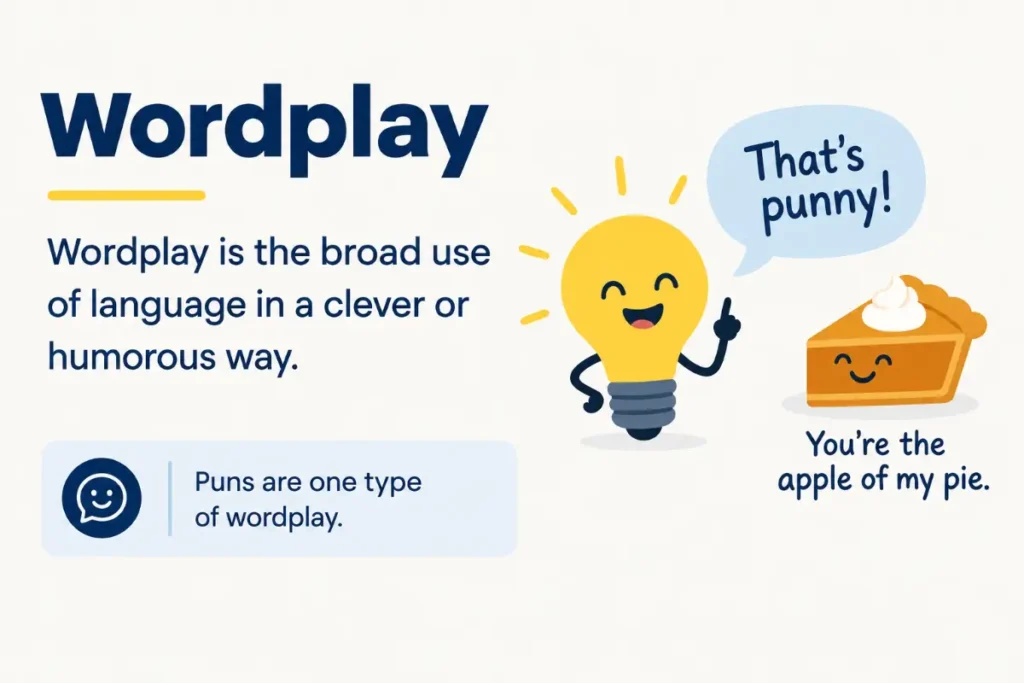
Wordplay is the broad use of language in a clever or humorous way. Puns are one type of wordplay.
Punchline
A punchline is the part of a joke that delivers the main comic effect. A pun can serve as a punchline.
Double Meaning
A double meaning occurs when an expression can reasonably be understood in two different ways. Puns often use this feature.
Homophone
A homophone is a word that sounds like another word but has a different meaning and often a different spelling. Homophones can support puns.
Wit
Wit refers to clever and quick verbal humor. A witty statement can contain a pun but doesn’t have to.
Humor
Humor is the broader concept involving things that create amusement or laughter. Jokes or puns can both be forms of humor.
Wordplay Joke
A wordplay joke uses language as a central source of humor. It may include a pun or another form of linguistic trick.
One Liner
A one liner is a very short humorous statement. It can be a pun but many one liners use other forms of comedy.
When To Call Something A Pun
Call something a pun when its humor depends strongly on a linguistic connection.
Look for a word with two meanings.
Look for words that sound alike.
Look for similar spellings.
Look for a phrase that can be understood in two ways.
Look for a deliberate twist based on language.
For example:
The fisherman was hooked on his job.
The word hooked can connect with fishing and the idea of becoming strongly interested in something. That double meaning creates the humor.
The sentence is short but its comic mechanism is clearly linguistic.
When To Call Something A Joke
Call something a joke when you’re talking about a humorous expression more generally.
A joke can be a story a question a one liner a situation or a series of lines.
It may contain a pun but it doesn’t need one.
For example a comedian might tell a story about accidentally sending a private message to the wrong group chat. The humor could come entirely from the escalating embarrassment.
That’s a joke even if no word has two meanings.
This broader definition makes joke the safer general term when you’re talking about comedy without focusing on its specific technique.
Can A Pun Be A Joke
Yes.
A pun can function as a joke when it creates the main humorous effect.
For example:
I stayed up all night wondering where the sun went. Then it dawned on me.
The line is built around dawned as both a literal connection to daylight and a figurative connection to understanding.
It’s a pun and it can also be described as a joke.
The two labels aren’t contradictory.
Can A Joke Be A Pun
Not every joke is a pun.
A joke becomes a pun when wordplay drives the humor.
Consider a joke about someone arriving late to a meeting because they couldn’t find their shoes. If the humor comes from the person’s behavior and the surprising explanation there may be no pun.
Calling every joke a pun would make the word pun too broad.
A pun needs that language based element.
Are Puns Always Funny
No.
A pun can be clever without producing a strong laugh. Some puns are intentionally corny. Others are designed to make the audience groan and smile rather than laugh loudly.
This is why people sometimes use expressions such as bad pun or dad joke.
A pun can still be linguistically effective even if the humor is intentionally silly.
Comedy depends heavily on context audience timing delivery and expectations. A line that falls flat in one setting can work perfectly in another.
The quality of a pun doesn’t determine its classification.
A clever pun is still a pun.
A terrible pun is still a pun.
Are Dad Jokes Usually Puns
Many dad jokes use puns but the terms don’t mean the same thing.
A dad joke is usually a deliberately simple joke often based on predictable wordplay a corny punchline or an obvious setup.
Some dad jokes are puns.
Others rely on exaggeration misunderstanding or simple absurdity.
The defining feature of a dad joke is more about style and cultural expectation than one specific linguistic structure.
So you shouldn’t treat dad joke as another word for pun.
Puns and Jokes In Writing
Writers use both forms for different reasons.
Puns are useful when a writer wants to make language itself noticeable. They can add cleverness to headlines advertising slogans character names dialogue and short social content.
Jokes are useful when a writer wants to create a larger humorous moment.
A good writer also considers the audience. A complicated pun may confuse readers who don’t recognize the two meanings. A joke with a long setup may lose an audience that prefers quick humor.
Strong humor depends on clarity.
If readers need several explanations before they understand the joke the wording probably needs work.
The best wordplay often feels effortless. The reader notices the connection and gets the payoff without needing a lecture.
Common Mistakes
Calling Every Funny Sentence A Pun
Not every funny sentence uses wordplay. Some are simply observations or jokes.
Calling Every Pun A Separate Type Of Joke
A pun can be the main joke or part of a larger joke. The terms can overlap.
Confusing Wordplay With A Punchline
Wordplay describes a technique. A punchline describes a position or function within a joke. A pun can serve as a punchline but the concepts aren’t identical.
Assuming A Joke Must Have A Traditional Punchline
Modern humor can rely on stories observations timing and situations. Not every humorous piece follows the classic setup and punchline pattern.
Explaining The Humor Too Much
A pun usually works best when the audience recognizes the wordplay naturally. Explaining every layer can remove the surprise.
Expert Editor Insight
From an editor’s perspective the cleanest distinction is functional rather than rigid. A pun describes how language creates humor while a joke describes a broader humorous expression. That’s why a single line can reasonably be called both. When editing humor I look first at the intended effect and then at the mechanism behind it. If the wording depends on ambiguity sound or multiple meanings I identify the wordplay. If the larger piece depends on setup and payoff I treat it as a joke.
Key Takeaways
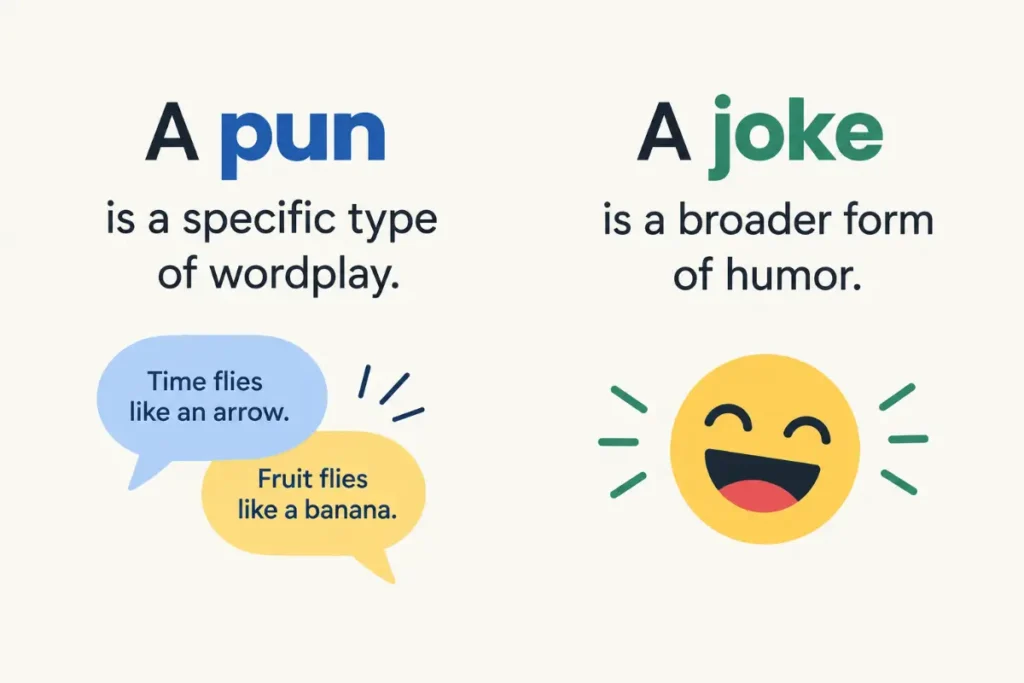
- A pun is a specific type of wordplay.
- A joke is a broader form of humor.
- A pun usually depends on multiple meanings similar sounds or another linguistic connection.
- A joke can use a pun but doesn’t need one.
- A pun can function as a joke when it creates the main humorous effect.
- A punchline is the part of a joke that delivers the main comic payoff.
- Wordplay and humor aren’t identical concepts.
- The easiest way to identify the difference is to ask what creates the humor.
- If language itself creates the surprise you likely have a pun.
- If the humor comes from a story situation observation or unexpected outcome you likely have a broader joke.
Conclusion
Puns and Jokes aren’t competing terms that always require one winner. A pun is a specific form of wordplay while a joke is a much broader form of humor. A pun can stand alone or appear inside a joke as its punchline. A joke can also work perfectly well without any wordplay at all.
The most useful distinction is to focus on the source of the humor. If multiple meanings similar sounds or clever language create the effect you’re probably dealing with a pun. If the humor comes from a setup surprise story situation or observation you’re looking at a joke. Sometimes both descriptions are accurate because one describes the technique and the other describes the larger humorous piece.
When you’re unsure use one simple test. Ask what makes the audience laugh. If the answer is the language itself you have a strong clue that a pun is involved.
FAQs
What is the main difference between a pun and a joke?
A pun is a specific type of wordplay while a joke is a broader form of humor. A pun usually depends on multiple meanings similar sounds or another linguistic connection. A joke can use those techniques but can also rely on stories situations observations exaggeration or surprise. In simple terms a pun describes a humor technique while a joke describes the broader humorous expression.
Can a pun also be a joke?
Yes. A pun can work as a complete joke when its wordplay creates the humorous effect. It can also appear inside a longer joke as the punchline or as one humorous line. The terms describe different aspects of humor so they can overlap. Calling something a pun identifies the wordplay while calling it a joke identifies its broader humorous function.
Are puns considered wordplay?
Yes. Puns are one of the clearest forms of wordplay because they manipulate meanings sounds spellings or linguistic ambiguity. The humor usually appears when the audience recognizes two possible interpretations. Other types of wordplay can include clever phrasing verbal ambiguity and playful sentence structure. So wordplay is the broader category and pun is one important type within it.
What makes a joke a pun?
A joke becomes a pun when word based ambiguity creates the central humorous effect. The line may use a word with multiple meanings or two words that sound alike. It may also exploit spelling or another feature of language. If removing the wordplay removes the main source of humor the joke likely depends on a pun.
Why do people confuse puns vs jokes?
People confuse the terms because puns vs jokes frequently appear together. A short pun can function as a joke and a longer joke can contain several puns. Everyday speakers also use joke as a general term for something funny. The distinction becomes clearer when you focus on the mechanism. A pun relies on wordplay while a joke can use many different forms of humor.
Are dad jokes the same as puns?
No. Dad joke describes a style of humor rather than one specific linguistic technique. Many dad jokes use puns because simple wordplay fits their intentionally corny style. However some dad jokes rely on absurd situations misunderstandings or predictable punchlines without using a true pun. The categories overlap often but they aren’t synonyms.
Are puns appropriate in formal writing?
Puns can be appropriate in formal writing when the purpose and audience support them. They often appear in creative writing advertising headlines speeches journalism and opinion writing. However technical reports legal documents and academic work may require more direct language. The issue isn’t that puns are grammatically wrong. The real question is whether the wordplay supports the purpose and remains clear to the reader.
What is another word for a pun?
There isn’t one perfect synonym for pun because the term identifies a specific kind of wordplay. Related expressions include wordplay verbal play and play on words. These terms can overlap but they don’t always carry exactly the same meaning. A play on words is often the closest everyday expression when someone wants to describe the same basic idea without using the word pun.

Confusing Words, Spelling & Word Choice
Claire Whitmore is a U.S.-based English editor who writes about commonly confused words, spelling differences, and word choice. Her work helps readers understand subtle distinctions between similar-looking words through simple definitions, practical examples, and modern usage guidance in both American and British English.