
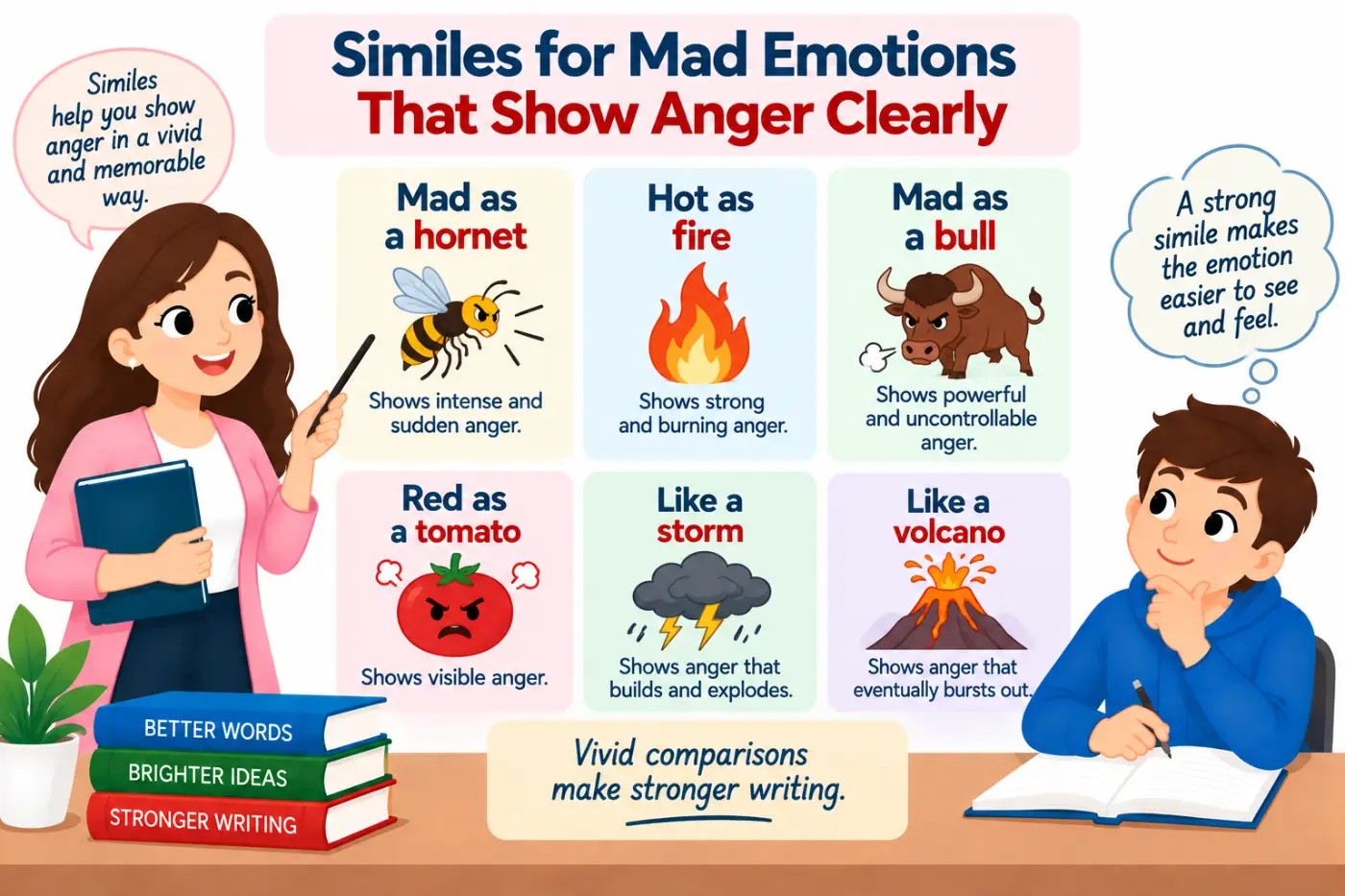
Similes for mad emotions can turn a plain sentence about anger into something readers can see and feel. Saying that someone was angry tells us the emotion. Saying that someone was as furious as a storm gives the reader an image, a mood, and a sense of force. That small change can make writing much more memorable.
The best comparisons don’t simply pile on dramatic words. They show how anger behaves. It might burn slowly like a coal, explode like a firework, shake like a thunderstorm, or sit quietly like a volcano waiting to erupt. The comparison you choose should match the kind of anger you want to show.
This collection gives you 120 original similes arranged by emotional intensity and situation. You’ll find comparisons for mild irritation, growing frustration, strong anger, explosive rage, silent resentment, physical reactions, facial expressions, speech, storytelling, poetry, school writing, and everyday conversation. Each example includes a short explanation so you can choose an image that fits instead of grabbing the first comparison that comes to mind.
Short Answer
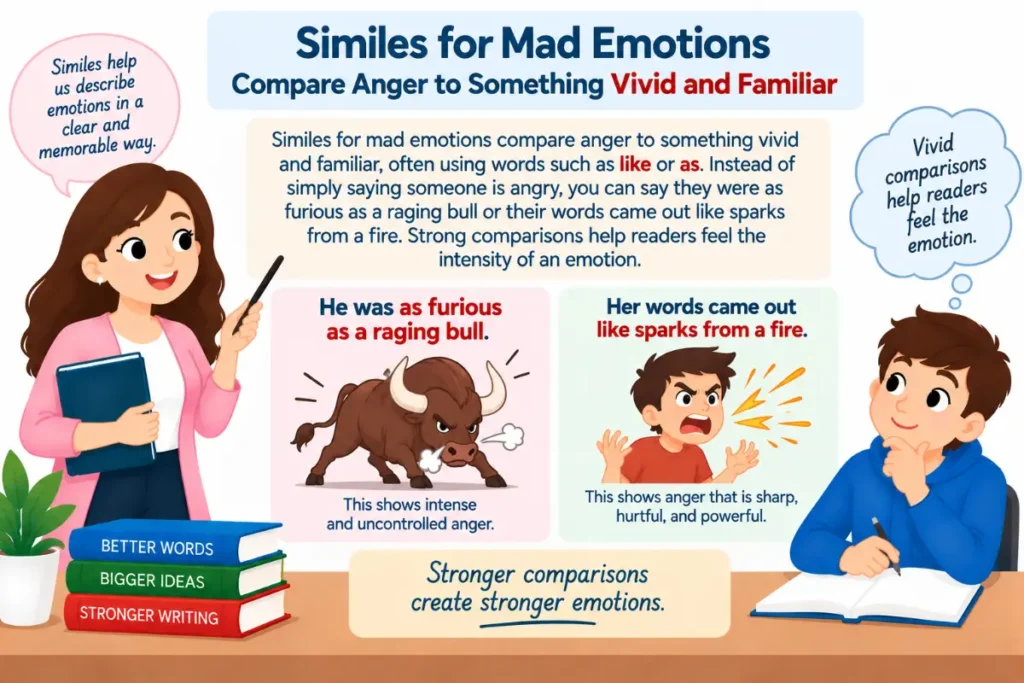
Similes for mad emotions compare anger to something vivid and familiar, often using words such as like or as. Instead of simply saying someone is angry, you can say they were as furious as a raging bull or their words came out like sparks from a fire. Strong comparisons help readers feel the intensity of an emotion.
What Makes A Good Simile For Anger
A good simile does more than decorate a sentence. It gives the reader a mental picture of an emotion that can otherwise be difficult to describe.
Anger has many levels. A person can be slightly annoyed, deeply frustrated, openly furious, or completely overwhelmed by rage. Treating every angry character like an erupting volcano can make your writing predictable. Strong writing gives each emotional state its own image.
A useful comparison usually has three parts. First, you identify the emotion. Next, you connect it to a familiar image. Finally, you make sure the image fits the intensity and situation.
For example:
Her anger was like a kettle beginning to whistle.
This suggests irritation that is building.
His rage was like a wildfire racing through dry grass.
This suggests an emotion that has become difficult to contain.
The images work because readers already understand what kettles and wildfires do. You don’t need to explain every detail. The comparison carries some of the emotional weight for you.
Mild Anger And Irritation
Not every angry feeling is explosive. Sometimes irritation is small but persistent. These comparisons work well when a character is bothered, annoyed, impatient, or quietly frustrated.
- She was as irritated as a fly trapped behind a window.
This shows frustration caused by something small but persistent.
- His annoyance was like a pebble stuck inside his shoe.
The image suggests a minor problem that becomes increasingly difficult to ignore.
- She was as grumpy as a cat disturbed from a warm nap.
This gives mild anger a playful quality.
- His irritation buzzed like a mosquito near his ear.
The comparison works well for an annoying thought or situation that refuses to disappear.
- Her temper was like a candle flickering in a cold draft.
The emotion is unstable but not yet overwhelming.
- He looked as annoyed as a child told to stop playing.
This creates a familiar image of reluctant frustration.
- Her patience was as thin as old paper.
This suggests that only a little more pressure could cause an angry reaction.
- His frustration scratched at him like a rough tag inside a shirt.
The anger is uncomfortable rather than explosive.
- She was as bothered as a dog hearing a strange noise outside.
This comparison suggests alertness mixed with irritation.
- His mood was like a cloudy sky that refused to clear.
The anger feels lingering and gloomy.
- Her annoyance was as sharp as a tiny thorn.
The emotion is small but unpleasant.
- He was as restless as a bee trapped in a jar.
The image suggests growing agitation.
Growing Frustration
Frustration often develops slowly. A person tries to remain calm but repeated problems push them closer to losing control. These comparisons are useful for showing that emotional buildup.
- His frustration was like water rising behind a dam.
The comparison suggests pressure that keeps increasing.
- Her anger grew like a storm gathering beyond the hills.
The emotion is approaching but hasn’t fully broken loose.
- His temper simmered like soup left too long on the stove.
This shows anger developing beneath a controlled surface.
- She was as tense as a bow pulled tight.
The image suggests that release is coming soon.
- His patience shrank like ice beneath the summer sun.
The comparison shows patience disappearing little by little.
- Her irritation built like pressure inside a sealed bottle.
The emotion has nowhere to escape.
- His anger crept upward like smoke under a door.
This creates a quiet but unsettling image.
- She was as frustrated as a runner blocked just before the finish line.
The comparison connects anger with disappointment.
- His temper was like a match waiting for a rough strike.
The emotion is ready to ignite.
- Her frustration rattled like loose coins in a pocket.
This gives the feeling a restless physical quality.
- His anger grew like weeds after heavy rain.
The comparison suggests rapid unwanted growth.
- She was as impatient as a child waiting for a locked door to open.
The image makes the frustration easy to understand.
- His mood darkened like a sunny afternoon before a storm.
The comparison shows a clear shift in emotional atmosphere.
- Her temper stretched like a rubber band pulled too far.
This suggests that continued pressure could lead to an outburst.
Strong Anger
These comparisons fit situations where irritation has moved into clear anger. They work well for characters, speeches, essays, and descriptive writing.
- He was as angry as a bull charging a red gate.
The image gives the anger strength and forward motion.
- Her anger burned like a fire fed with dry wood.
The comparison suggests an emotion that keeps getting stronger.
- His voice was as hard as a hammer striking stone.
This makes his speech sound forceful and severe.
- She glared like a hawk watching its prey.
The image conveys sharp focus and hostility.
- His anger rolled through him like thunder across the plains.
The comparison gives the emotion size and power.
- Her words struck like stones thrown against glass.
This suggests speech that feels harsh and damaging.
- He was as furious as a storm tearing through the trees.
The image presents anger as powerful and destructive.
- Her face was hot like a stove left burning.
The physical image makes the emotion visible.
- His temper flared like dry grass catching a spark.
This shows how quickly anger can rise.
- She was as fierce as a lion protecting its young.
The comparison gives anger a protective quality.
- His anger pounded like heavy rain against a roof.
The emotion feels constant and difficult to escape.
- Her eyes flashed like lightning across a dark sky.
This works especially well for facial expression.
- He was as mad as a hornet disturbed from its nest.
The image suggests sudden and dangerous irritation.
- Her anger was like a drum beating faster and faster.
The comparison gives the emotion a rising rhythm.
- His temper cracked like ice under a heavy boot.
This shows the moment restraint begins to fail.
- She was as fierce as a wildfire moving through a forest.
The image conveys intensity and speed.
Explosive Anger And Rage
These comparisons are best reserved for extreme situations. They create a stronger emotional effect and should be used carefully so the writing doesn’t become melodramatic.
- His rage exploded like a volcano breaking through the earth.
The comparison shows anger erupting after pressure has built.
- Her temper burst like a firework in a closed room.
The image suggests sudden force and chaos.
- His fury spread like wildfire across dry grass.
This suggests an emotion that moves rapidly and becomes difficult to contain.
- She was as furious as thunder cracking directly overhead.
The comparison makes the anger loud and immediate.
- His rage roared like a river crashing through a broken dam.
The image combines pressure, movement, and unstoppable force.
- Her anger erupted like a mountain splitting open.
This creates a dramatic image for an extreme outburst.
- His fury struck like lightning from a cloudless sky.
The comparison emphasizes suddenness.
- She was as enraged as a storm ripping through a coastal town.
The image gives the emotion tremendous destructive energy.
- His temper detonated like a bomb dropped into silence.
The contrast between silence and sudden force makes the comparison striking.
- Her rage burned like a furnace with no door.
The image suggests heat that cannot escape.
- His anger thundered like a waterfall crashing over rocks.
This gives the emotion loudness and movement.
- She exploded like a shaken bottle suddenly uncorked.
The comparison shows pressure being released all at once.
- His fury was like a wildfire with the wind behind it.
The image suggests an emotion that becomes stronger because outside forces feed it.
- Her anger struck like a hammer against a bell.
The comparison emphasizes a forceful reaction with an immediate effect.
Silent Anger
Anger doesn’t always shout. Some of the most powerful emotional scenes involve a character who says very little. These comparisons can help you show resentment, disappointment, and controlled fury.
- Her anger sat like a stone beneath her ribs.
The emotion feels heavy and contained.
- His silence was as cold as winter glass.
This suggests anger expressed through distance rather than shouting.
- Her resentment lingered like smoke after a fire.
The original event may be over but the feeling remains.
- His anger rested like a sleeping dog that might wake suddenly.
The image suggests controlled danger.
- She was as quiet as a locked room filled with thunder.
The contradiction creates tension.
- His bitterness clung like mud to a boot.
The comparison shows a feeling that refuses to leave.
- Her anger stayed beneath the surface like dark water under thin ice.
The emotion is present but concealed.
- He looked as cold as a frozen lake.
This suggests emotional withdrawal.
- Her resentment was like a bruise touched by an old memory.
The comparison connects anger with lingering hurt.
- His silence hung like a heavy curtain.
The image shows how anger can change the atmosphere without a single shout.
- She carried her anger like a stone in her pocket.
The feeling is constant and burdensome.
- His disappointment sat like ash after a burned letter.
This suggests anger mixed with sadness and loss.
- Her expression was as still as a statue in a storm.
The comparison shows controlled emotion.
- His resentment spread quietly like rust beneath paint.
The anger develops gradually and remains partly hidden.
Angry Facial Expressions
A reader cannot directly see a character’s emotion. You need physical clues. Similes can help transform a facial expression into something visual.
- Her eyes were as sharp as needles.
This suggests an intense angry stare.
- His face was red like a ripe tomato.
The comparison shows visible heat and embarrassment mixed with anger.
- Her eyebrows pressed together like two storm clouds.
The image clearly signals displeasure.
- His jaw was tight like a locked door.
The comparison suggests restraint and tension.
- Her eyes flashed like sparks from a fire.
This gives her expression energy and danger.
- His forehead creased like a road map.
The image shows deep lines caused by tension.
- Her glare was as cold as winter rain.
This suggests controlled hostility.
- His face looked hard like carved stone.
The comparison conveys emotional stiffness.
- Her nostrils flared like a horse before a race.
This gives the character a strong physical reaction.
- His lips were tight like a sealed envelope.
The image suggests that he is holding back words.
- Her stare burned like sunlight through a magnifying glass.
The comparison makes the gaze feel intense.
- His expression darkened like the sky before a storm.
The image signals a shift toward anger.
Angry Voices And Words
Anger often changes how a person speaks. The voice may become louder, sharper, faster, lower, or more controlled. These comparisons focus on sound and language.
- Her voice cracked like a branch under heavy snow.
This suggests strain and emotional pressure.
- His words came out like bullets from a machine.
The comparison conveys rapid and forceful speech.
- Her voice was as sharp as broken glass.
This suggests language that hurts.
- His shout roared like a lion across the valley.
The image gives his voice strength and reach.
- Her words burned like hot coals.
The comparison suggests that her speech leaves an emotional sting.
- His voice rumbled like thunder beneath the ground.
This works well for controlled but powerful anger.
- Her accusations flew like arrows.
The image shows words aimed directly at another person.
- His speech snapped like a whip.
The comparison conveys a short harsh tone.
- Her voice hissed like steam escaping from a pipe.
This suggests controlled anger finally finding an outlet.
- His words fell like heavy stones.
The comparison makes his speech feel weighty and painful.
- Her warning was as cold as steel.
This suggests anger without shouting.
- His voice shook like a window during a storm.
The physical instability shows that his anger is affecting him deeply.
Anger That Feels Like Heat
Heat is one of the most natural ways to describe anger because strong emotion can produce a physical sense of warmth. These comparisons work particularly well in descriptive prose.
- Her anger burned like a coal beneath ashes.
The feeling appears quiet but remains alive.
- His face felt hot like a pan over a flame.
The comparison makes his physical reaction clear.
- Her temper was as hot as summer pavement.
This suggests intense irritation.
- His anger spread like heat through metal.
The image shows an emotion moving steadily through the body.
- Her cheeks burned like embers.
The comparison works well for visible anger.
- His fury glowed like a furnace behind a closed door.
The emotion is powerful but partly contained.
- Her irritation warmed like a spark held between dry leaves.
This suggests anger that could grow quickly.
- His temper was like a stove turned too high.
The comparison shows a situation becoming too intense.
- Her anger simmered like water just below a boil.
This is useful for controlled frustration.
- His resentment burned like a coal that never cooled.
The image suggests long lasting anger.
Anger In Stories And Creative Writing
Storytelling gives you more room to build an emotional image. Instead of describing a character as simply furious, you can connect the anger to the setting and action around them.
- His anger rose like a storm behind the mountains.
The comparison gives the emotion a sense of approaching danger.
- Her fury moved through the room like a sudden gust of winter wind.
This shows how one person’s anger can affect everyone nearby.
- His temper was like a cracked dam waiting for one more drop.
The image creates suspense.
- Her anger curled around her thoughts like smoke.
This suggests that the emotion is affecting her ability to think clearly.
- His rage shook him like a tree caught in a hurricane.
The comparison shows that the emotion affects his whole body.
- Her resentment followed her like a shadow.
The image suggests an emotion that remains present over time.
- His anger was as restless as waves beating against a seawall.
The comparison shows repeated emotional pressure.
- Her fury rushed through her like a river after heavy rain.
This creates a sense of sudden emotional movement.
- His temper flickered like a faulty streetlight.
The image suggests an unstable mood that keeps threatening to flare.
- Her anger stood between them like a wall of fire.
This shows how resentment can separate people.
- His frustration was like a storm trapped inside a small room.
The comparison suggests that there is too much emotion for the situation to contain.
- Her fury hung over the conversation like thunder waiting to break.
This creates suspense without describing an actual outburst.
- His anger spread through the room like the smell of smoke.
The comparison shows that everyone notices the emotional change.
- Her resentment was like a locked box rattling from the inside.
This suggests strong emotion hidden beneath self control.
- His rage crashed through his thoughts like waves against a cliff.
The comparison shows how anger can overwhelm clear thinking.
- Her temper was like a match held beside dry paper.
The image captures the danger of one small trigger causing a much larger reaction.
How To Choose The Right Comparison
The strongest similes for mad emotions match the exact kind of anger you want to describe. Start by asking yourself what the character is actually feeling.
If the emotion is mild irritation choose a small image. A buzzing mosquito or a pebble in a shoe can work better than a volcano because the comparison matches the emotional level.
If the character is becoming frustrated use an image that suggests pressure. A rising tide a stretched rubber band or a dam beginning to fill can show that the emotion is building.
If the character is openly furious choose an image with movement and force. Thunder fire storms and crashing waves can communicate intensity without explaining it in several sentences.
For silent anger choose still or heavy images. Stones shadows locked rooms and cold glass work well because they suggest restraint.
For rage use powerful images sparingly. Volcanoes wildfires hurricanes and explosions can create a strong effect but become predictable if every angry character receives the same treatment.
The goal isn’t to find the biggest comparison. The goal is to find the most accurate one.
How To Avoid Cliche Anger Similes
Some comparisons are so familiar that readers barely notice them. Fire and storms are useful but they shouldn’t become your only tools.
A more interesting approach is to connect anger with ordinary objects.
Imagine someone whose patience is wearing thin. Instead of saying their anger was like a volcano you could compare it to a zipper being pulled too hard. The reader immediately understands that something is close to breaking.
You can also use unexpected natural images.
A character might carry resentment like a pebble hidden in a shoe. Another might hold anger like water behind a clogged drain. Someone else might speak with the sharpness of a paper cut.
These images feel fresh because they come from ordinary experiences.
A good comparison also respects the character. A quiet professor may not need the same imagery as an impulsive teenager. A disappointed parent may express anger differently from a rival in a sports story.
Think about personality before choosing the image.
Similes For Different Levels Of Anger
It helps to imagine anger as a scale rather than one single emotion.
Mild Irritation
Use comparisons involving small discomforts.
A mosquito.
A pebble.
A rough shirt tag.
A flickering candle.
A cloudy sky.
These images show that something is wrong but not dangerous.
Growing Frustration
Use comparisons involving pressure.
A rising tide.
A stretched rubber band.
A filling dam.
A kettle.
A storm approaching.
These images tell readers that the emotion is getting stronger.
Strong Anger
Use comparisons involving heat movement and force.
Fire.
Thunder.
Lightning.
Strong waves.
A charging animal.
These images communicate obvious anger.
Extreme Rage
Use comparisons involving destruction or uncontrolled energy.
A wildfire.
A hurricane.
An eruption.
A broken dam.
A powerful explosion.
These images should appear at the right moment. If you use them for every emotional scene they lose their force.
How To Use Anger Similes In School Writing
Teachers often want students to show emotion rather than simply name it. A well chosen comparison can help you do that.
Weak:
The character was very angry.
Stronger:
The character’s anger was like a storm gathering over the town.
The second sentence gives the reader an image. It also creates a mood that can support the rest of the paragraph.
You can make the comparison even more effective by connecting it to the character’s actions.
His anger was like a storm gathering over the town, and every word he spoke sounded like distant thunder.
Now the comparison develops across two sentences instead of appearing as a single decorative phrase.
Avoid adding several unrelated similes to the same sentence. One clear image usually has more power than three competing ones.
Using Anger Similes In Poetry
Poetry gives you greater freedom with emotional comparisons. You can focus on sound rhythm and imagery.
For example:
Her anger burned like an ember in the dark.
The comparison is short but creates a strong visual image.
You can also extend the image.
Her anger burned like an ember in the dark, small enough to hide but hot enough to hurt.
This works because the second part develops the first image rather than replacing it.
In poetry a simile can also connect an internal emotion with the natural world. Storms waves fire wind ice and shadows can all become useful images when the comparison fits the poem’s emotional direction.
Using Anger Similes In Professional Writing
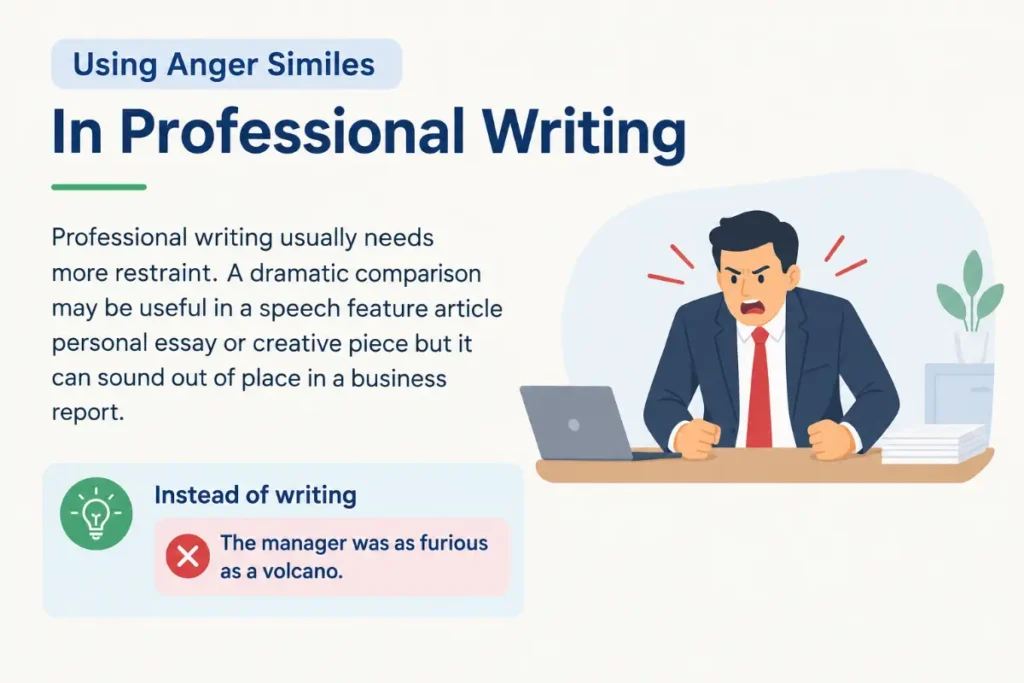
Professional writing usually needs more restraint. A dramatic comparison may be useful in a speech feature article personal essay or creative piece but it can sound out of place in a business report.
Instead of writing:
The manager was as furious as a volcano.
You might write:
The manager’s frustration was clear during the meeting.
If the writing is personal or persuasive you can use a carefully chosen comparison.
The team’s frustration had become like pressure inside a sealed container.
The image adds personality without becoming overly dramatic.
The key is audience and purpose. Creative language should support the message rather than compete with it.
Common Mistakes When Writing Similes About Anger
Using The Same Image Repeatedly
If every angry character becomes a volcano your writing quickly feels predictable. Try matching the image to the specific kind of anger.
Choosing An Image That Is Too Strong
Calling mild irritation a hurricane makes the emotion seem larger than it is. Keep the intensity of the comparison close to the intensity of the character’s feeling.
Explaining The Simile Too Much
If you write that someone was as angry as a storm then spend three sentences explaining that storms are powerful you weaken the image. Trust the reader to understand familiar comparisons.
Mixing Unrelated Images
Avoid sentences such as his anger was like a volcano and a frozen lake and a speeding train. The images compete instead of working together.
Forgetting The Character
A comparison should feel connected to the scene. A sports story might naturally use a comparison involving competition or pressure. A quiet family scene may need something more subtle.
Confusing A Simile With A Metaphor
A simile usually makes an explicit comparison using words such as like or as.
Her anger was like fire.
A metaphor makes the comparison directly.
Her anger was fire.
Both can be effective but they create slightly different effects.
Memory Tips For Creating Your Own Comparisons
You don’t need to memorize hundreds of phrases. You can create strong comparisons yourself by thinking about what anger does.
Ask these questions.
- Does the anger grow?
Think of rising water growing fire or a stretched object.
2.Does the anger make noise?
Think of thunder crashing waves breaking branches or rattling windows.
You’re not memorizing phrases. You’re matching an emotional quality with a physical image.
Related Words And Expressions For Anger
A strong vocabulary gives you more choices than angry and mad.
Annoyed usually describes mild anger or irritation.
Irritated often suggests that something has become bothersome.
Frustrated focuses on difficulty or blocked progress.
Upset is broader and can include sadness disappointment or anger.
Furious describes very strong anger.
Enraged suggests extreme anger.
Infuriated means extremely angered by something.
Resentful describes anger or bitterness that continues over time.
Irate is a formal sounding word for very angry.
Livid can describe intense anger and is common in expressions about someone being extremely upset.
Choosing the right word before adding a simile helps you control the emotional level.
For example:
She was irritated like a mosquito trapped in a room.
Each sentence creates a different emotional picture.
Key Takeaways
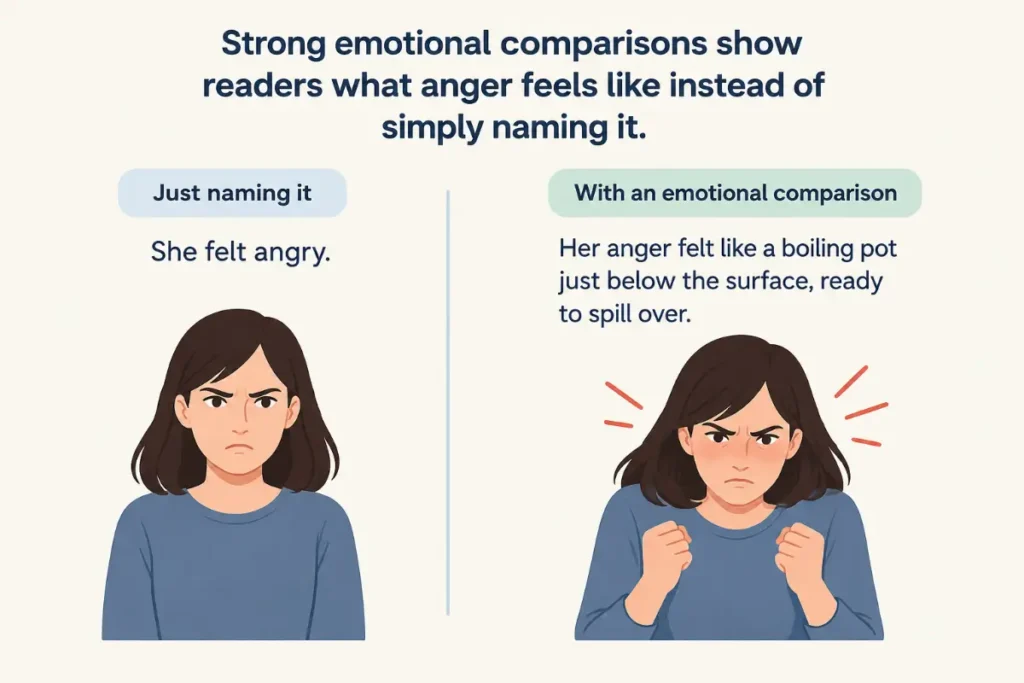
- Strong emotional comparisons show readers what anger feels like instead of simply naming it.
- Mild irritation works best with small uncomfortable images such as pebbles mosquitoes and flickering candles.
- Growing frustration can be compared with rising water stretched objects filling containers or approaching storms.
- Strong anger can use images involving fire thunder lightning waves and powerful animals.
- Extreme rage needs stronger comparisons such as wildfires hurricanes eruptions and broken dams.
- Silent anger works well with images involving shadows stones ice smoke locked rooms and hidden heat.
- The best comparison matches the character’s personality and the intensity of the emotion.
- Avoid using the same familiar image every time. Original comparisons from ordinary experiences can make writing feel much fresher.
- Don’t overload a sentence with several unrelated comparisons. One clear image usually carries more weight.
- A good simile should help the reader feel the emotion rather than merely make the sentence sound dramatic.
Conclusion
Similes for mad emotions give anger a physical shape that readers can understand immediately. A mild annoyance can feel like a pebble in a shoe while growing frustration can rise like water behind a dam. Strong fury might burn like wildfire or crash like thunder. The comparison should always match the emotional intensity.
The most effective choices also reveal something about the character. Silent resentment needs a different image from explosive rage. A thoughtful character may carry anger like a hidden stone while an impulsive character may erupt like a shaken bottle. That difference makes descriptions feel more personal and believable.
When you create your own comparisons think about what the anger does. Does it burn grow shake spread hide or explode? Find something in the physical world that behaves the same way and build your image around it. That simple method can turn an ordinary description into writing readers remember.
FAQs
What are good similes for mad emotions?
Good similes depend on the kind of anger you want to describe. For mild irritation you might compare anger to a mosquito or pebble. The best comparison matches the emotion’s intensity.
How do you describe anger with a simile?
Describe anger by comparing it with something that shares its physical or emotional quality. For example anger can be compared to fire because both can grow hotter and become difficult to control. It can also resemble thunder because both can be loud and powerful. Choose an image that helps readers experience the emotion rather than simply naming it.
What is a simile for being extremely angry?
A strong option is as furious as a wildfire racing through dry grass. This comparison suggests speed intensity and a lack of control. Another choice is as angry as thunder cracking across the sky. For a quieter form of extreme anger you could compare the feeling to a furnace behind a closed door.
What are some creative comparisons for anger?
Creative comparisons often come from ordinary objects instead of familiar dramatic images. Anger can be like a zipper pulled too hard a pebble in a shoe a locked box rattling from inside or steam escaping through a tiny opening. These comparisons can feel fresh because they describe pressure discomfort and tension in unexpected ways.
What are similes for silent anger?
Silent anger can be compared to a stone beneath the ribs a locked room filled with thunder smoke after a fire or dark water beneath thin ice. These images suggest that the emotion is powerful but controlled. They work particularly well for characters who refuse to shout yet clearly carry resentment or frustration.
What simile describes growing anger?
A useful comparison is anger like water rising behind a dam. It shows that the emotion is building while restraint is still holding it back. Other options include a storm gathering beyond the hills a rubber band being stretched or a kettle beginning to whistle. Each image suggests pressure that is moving toward a possible release.
Can similes make angry writing more powerful?
Yes. A well chosen simile gives readers a concrete image instead of asking them to imagine an abstract emotion. The comparison can also establish mood and reveal character. The key is restraint. One strong image can be more effective than several dramatic comparisons placed together. Choose a comparison that fits the character and the emotional intensity.
What is the difference between a simile and a metaphor for anger?
A simile makes a direct comparison using words such as like or as. For example anger can be described as being like fire. A metaphor makes the comparison directly by saying the anger is fire. Both devices create imagery but a simile usually signals the comparison more openly while a metaphor can feel more immediate.

Idioms, Expressions & Figurative Language
Mason Ellsworth is an American language writer with a passion for English expressions, figurative language, and everyday communication. He explains idioms, similes, popular phrases, and commonly misunderstood expressions in a straightforward, engaging style that helps readers improve both their writing and spoken English.