
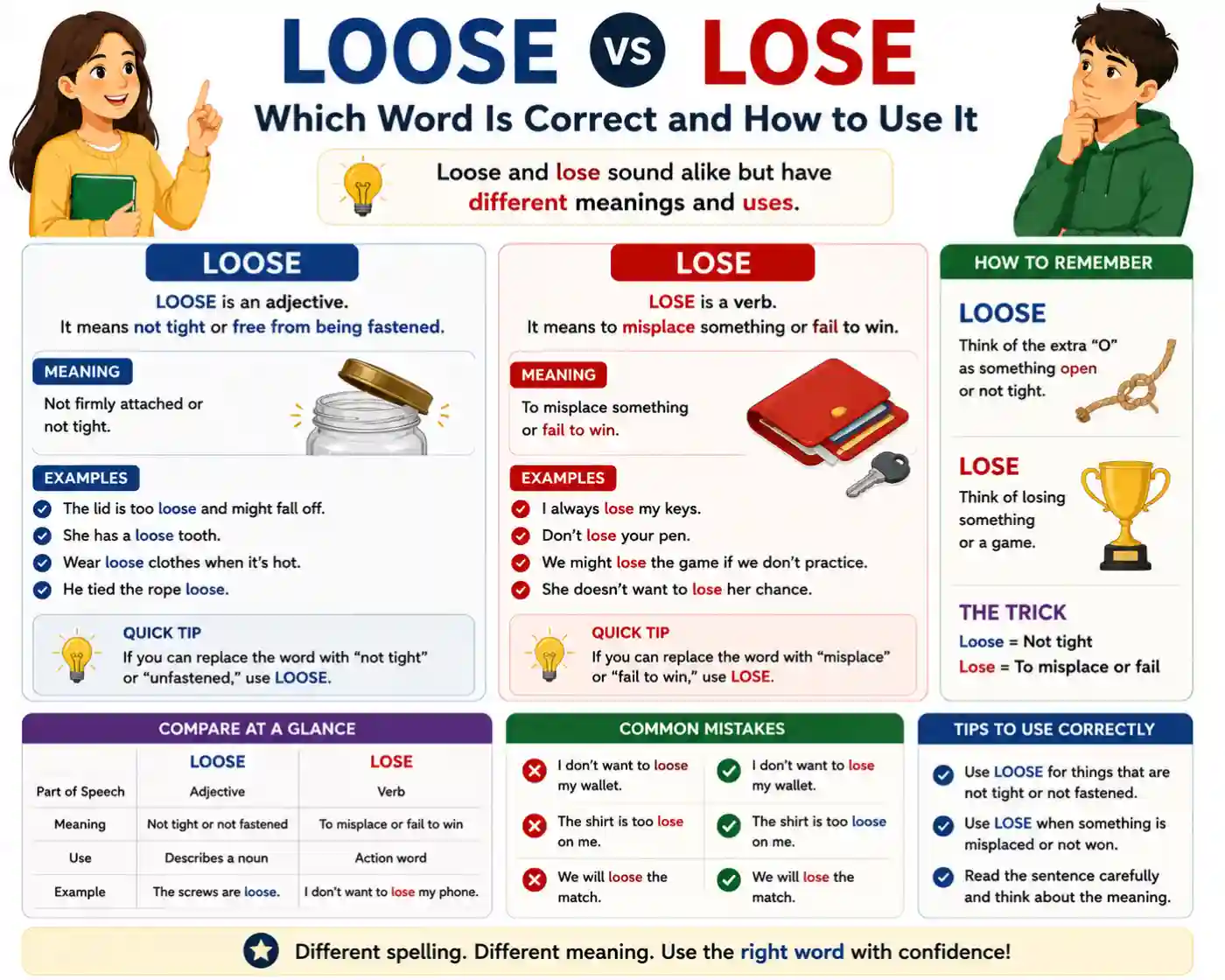
Loose vs Lose is a confusing word pair that trips up students, professionals, and even native English speakers. Since the words differ by only one letter, many people accidentally use one in place of the other. That small spelling difference completely changes the meaning of a sentence.
The good news is that learning the difference is simple once you understand how each word works. Loose describes something that is not tight or securely fastened, while lose refers to losing possession of something, failing to win, or becoming separated from someone or something.
In this guide, you’ll learn the meanings of both words, their pronunciation, grammar rules, real life examples, common mistakes, memory tricks, and practical writing tips. By the end, you’ll know exactly when to use loose and when to use lose with confidence.
Short Answer
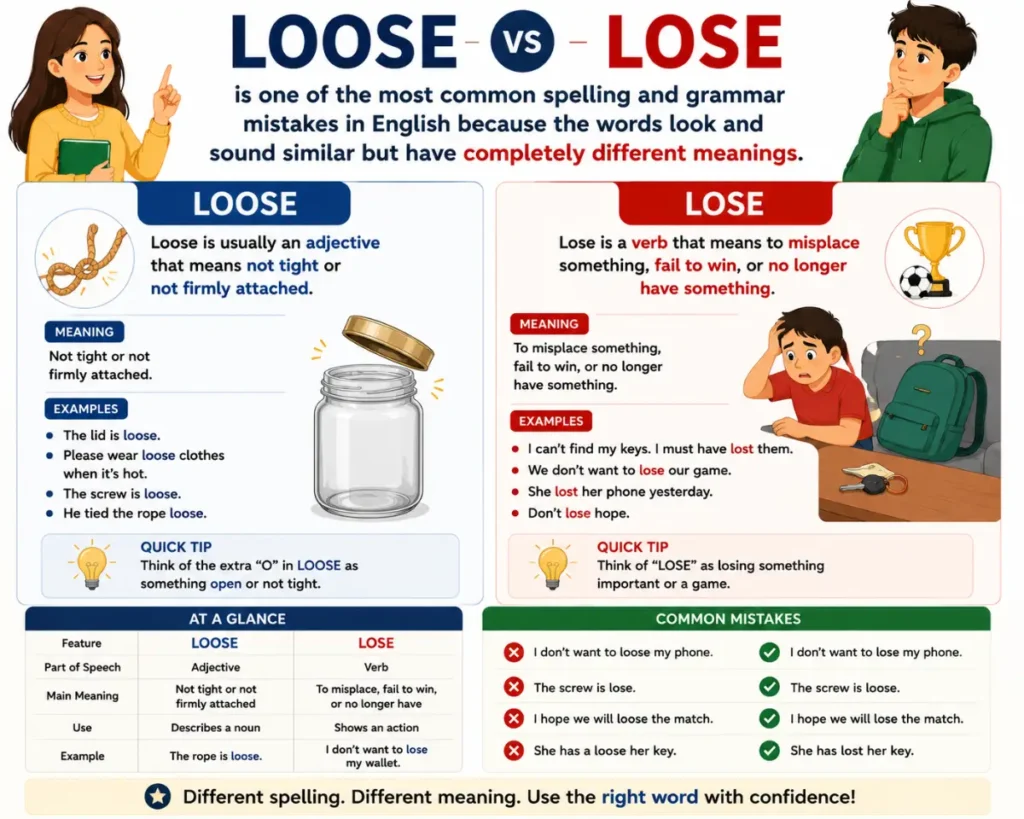
Loose vs Lose is one of the most common spelling and grammar mistakes in English because the words look and sound similar but have completely different meanings. Loose is usually an adjective that means not tight or not firmly attached. Lose is a verb that means to misplace something, fail to win, or no longer have something.
Table of Contents
- What Do Loose and Lose Mean
- Loose vs Lose Comparison Table
- The Main Difference Between Loose and Lose
- When to Use Loose
- When to Use Lose
- Pronunciation Differences
- Examples in Everyday English
- Common Mistakes
- Memory Tricks
- Professional Writing Tips
What Do Loose and Lose Mean
Although these words look similar, they belong to different parts of speech and express completely different ideas.
What Does Loose Mean
Loose usually functions as an adjective.
It describes something that is:
- Not tight.
- Not firmly attached.
- Free from restraint.
- Not fixed securely.
Examples include clothing, ropes, buttons, screws, animals, hair, and objects that are not securely held in place.
Example:
- My jacket feels loose around the shoulders.
Explanation:
The jacket does not fit tightly.
Another example:
- One of the wheels is loose.
Explanation:
The wheel is not firmly attached.
What Does Lose Mean
Lose is a verb.
It means:
- To misplace something.
- To fail to win.
- To no longer have something.
- To become separated from someone.
- To decrease or reduce something.
Examples include money, games, keys, weight, opportunities, confidence, and relationships.
Example:
- I don’t want to lose my wallet.
Explanation:
The wallet may no longer be in your possession.
Another example:
- Our team might lose the championship.
Explanation:
The team may fail to win.
Loose vs Lose Comparison Table
| Feature | Loose | Lose |
|---|---|---|
| Part of speech | Usually adjective | Verb |
| Main meaning | Not tight | Misplace or fail to win |
| Indicates action | No | Yes |
| Indicates description | Yes | No |
| Used with clothing | Yes | No |
| Used with games | No | Yes |
| Used with possessions | Sometimes | Yes |
| Used with weight | No | Yes |
| Common spelling mistake | Yes | Yes |
The Main Difference Between Loose and Lose
The simplest way to remember the difference is this.
Loose describes something.
Lose describes an action.
Ask yourself these questions.
- Am I describing an object?
Use loose.
- Am I talking about an action?
Use lose.
Examples:
- My shoelaces are loose.
- Don’t lose your keys.
- The screw became loose.
- We could lose the match.
- His shirt is loose.
- She doesn’t want to lose her job.
This simple test works in most situations.
Why People Confuse Loose and Lose
There are several reasons this mistake happens so often.
- The spellings differ by only one letter.
- Their pronunciations are similar.
- Many people type quickly and overlook the extra o.
- Spellcheck may not catch the mistake because both words are correctly spelled.
- English pronunciation does not always match spelling.
Because both words are common, confusing them can make writing look careless.
When to Use Loose
Choose loose when describing something that is not tight, fixed, or secure.
Common situations include:
- Clothing.
- Shoes.
- Belts.
- Buttons.
- Screws.
- Ropes.
- Animals.
- Hair.
- Teeth.
- Furniture parts.
Examples
- My shoes are too loose.
Explanation:
The shoes do not fit tightly.
- The dog got loose from the yard.
Explanation:
The dog escaped because it was no longer restrained.
- This screw is loose.
Explanation:
The screw needs tightening.
- Her ponytail became loose.
Explanation:
The hair is no longer held tightly.
- The door handle feels loose.
Explanation:
The handle is not firmly attached.
- His tie looks loose.
Explanation:
The tie is not tightened properly.
- The fence has several loose boards.
Explanation:
The boards are no longer secure.
- Wear loose clothing during hot weather.
Explanation:
Loose clothing provides comfort and airflow.
Common Expressions Using Loose
Many everyday expressions use loose.
- Loose change.
- Loose ends.
- Loose clothing.
- Loose grip.
- Loose knot.
- Loose connection.
- Loose screw.
- Loose pages.
- Loose soil.
- Loose fit.
Example:
- I found some loose change in my pocket.
Explanation:
The coins are not stored in a wallet or container.
When to Use Lose
Use lose whenever you describe an action involving losing something.
Common situations include:
- Games.
- Competitions.
- Money.
- Keys.
- Phones.
- Weight.
- Time.
- Confidence.
- Interest.
- Opportunities.
Examples
- Don’t lose your passport.
Explanation:
You should avoid misplacing it.
- We might lose today’s game.
Explanation:
The team may not win.
- She hopes to lose ten pounds.
Explanation:
She wants to reduce her weight.
- I often lose my glasses.
Explanation:
The glasses become misplaced.
- He doesn’t want to lose his job.
Explanation:
He wants to keep his employment.
- Don’t lose hope.
Explanation:
Hope refers to an emotional state.
- The company could lose customers.
Explanation:
Customers may stop buying from the business.
- She didn’t want to lose the opportunity.
Explanation:
The opportunity could disappear.
Common Expressions Using Lose
These phrases always use lose.
- Lose weight.
- Lose money.
- Lose interest.
- Lose patience.
- Lose control.
- Lose confidence.
- Lose your temper.
- Lose your balance.
- Lose your mind.
- Lose your chance.
Each expression describes an action rather than a description.
Pronunciation Differences
One reason people confuse these words is that their spellings look alike, but their pronunciations are different.
| Word | IPA | Simple Pronunciation |
|---|---|---|
| Loose | /luːs/ | LOOS |
| Lose | /luːz/ | LOOZ |
Notice the final sound.
- Loose ends with an s sound.
- Lose ends with a z sound.
Reading the words aloud helps reinforce the difference.
Easy Pronunciation Tip
Think of these sounds.
- Loose sounds like moose.
- Lose sounds like choose.
This comparison makes the pronunciation much easier to remember.
Real Life Examples
At Home
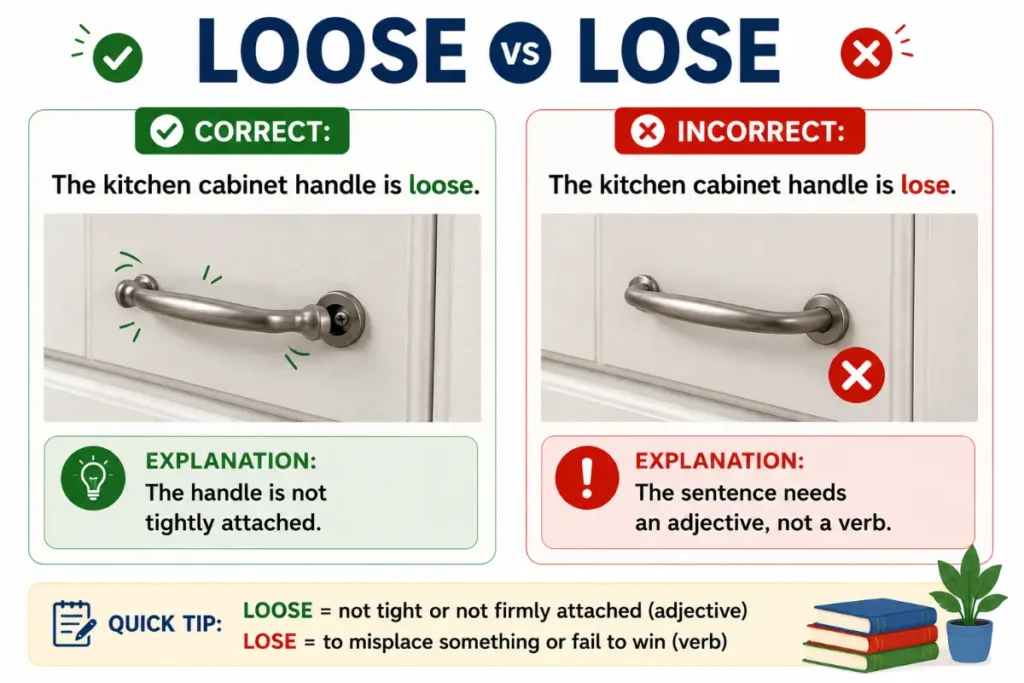
Correct:
- The kitchen cabinet handle is loose.
Explanation:
The handle is not tightly attached.
Incorrect:
- The kitchen cabinet handle is lose.
The sentence needs an adjective, not a verb.
At School
Correct:
- Don’t lose your homework.
Explanation:
Homework can be misplaced.
Incorrect:
- Don’t loose your homework.
Loose does not mean misplace.
At the Gym
Correct:
- He wants to lose weight.
Explanation:
He hopes to reduce his body weight.
Incorrect:
- He wants to loose weight.
The sentence requires the verb lose.
During Shopping
Correct:
- These jeans are too loose.
Explanation:
The jeans are larger than needed.
During Sports
Correct:
- Our team could lose tonight.
Explanation:
The team might not win.
At Work
Correct:
- The manager doesn’t want to lose experienced employees.
Explanation:
The company hopes to keep its workers.
Loose as an Adjective
Most of the time, loose functions as an adjective because it describes a noun.
Examples
- A loose wire.
- Loose shoes.
- A loose chain.
- Loose papers.
- Loose bricks.
- Loose soil.
- Loose fabric.
- Loose hair.
Each phrase describes the condition of the noun.
Loose as a Verb
Although uncommon, loose can also be a verb in literary or formal writing.
It means:
- To release.
- To set free.
- To let go.
Examples
- The soldiers loosed the arrows.
- They loosed the dogs after the signal.
This usage is rare in modern everyday English.
Lose as a Verb
Unlike loose, lose is always a verb.
It expresses an action.
Examples
- Lose a game.
- Lose your wallet.
- Lose confidence.
- Lose your balance.
- Lose your voice.
- Lose your phone.
- Lose your way.
- Lose a customer.
Each example describes something disappearing, ending, or no longer being possessed.
Common Mistakes
Many writers repeat the same errors.
- Using loose instead of lose.
Incorrect:
- I don’t want to loose my phone.
Correct:
- I don’t want to lose my phone.
Reason:
The sentence needs a verb.
- Using lose instead of loose.
Incorrect:
- My backpack strap is lose.
Correct:
- My backpack strap is loose.
Reason:
The sentence describes the strap.
- Confusing pronunciation with spelling.
Because the words sound similar, people often spell them incorrectly.
Memory Tricks
These simple tricks can help you remember the difference.
Trick One
Loose has two O’s.
Imagine the extra O gives the word extra room, making something less tight.
Trick Two
Lose has only one O.
Think of it as losing one O.
Trick Three
Ask yourself one question.
- Am I describing something?
Use loose.
- Am I describing an action?
Use lose.
Professional Writing Tips
Editors often notice this mistake immediately because it changes the meaning of a sentence.
Follow these habits.
- Use loose only to describe something.
- Use lose only for actions.
- Read your sentence aloud if you’re unsure.
- Double check words ending with lose before publishing.
- Remember that spellcheck may not catch this mistake because both words are correctly spelled.
- Proofread carefully, especially in emails, reports, and academic writing.
Using the correct spelling makes your writing clearer, more accurate, and more professional.
Word Origin
Understanding the history of these words makes it easier to remember why they have different meanings.
Origin of Loose
The word loose comes from the Old Norse word lauss, meaning free, unfastened, or not bound. Over time, it became the English adjective we use today to describe something that is not tight or securely attached.
Origin of Lose
The word lose comes from the Old English word losian, meaning to perish, to be destroyed, or to cease to possess. As English evolved, the meaning expanded to include misplacing something, failing to win, or no longer having something.
Although the two words have similar spellings today, they come from different historical roots and developed different meanings.
Loose vs Lose in American and British English
The meanings of loose and lose are the same in both American and British English.
There is no regional difference in grammar or spelling.
Examples used in both varieties of English include:
- Wear loose clothing in hot weather.
- Try not to lose your passport.
- The team doesn’t want to lose the final.
- That bolt has become loose.
No matter which variety of English you write, the same rules apply.
Formal and Informal Usage
Both words are appropriate in formal and informal writing.
Formal Writing
Examples:
- The committee does not want to lose valuable records.
- Engineers discovered several loose connections during the inspection.
- Researchers should not lose sight of the original objective.
- The technician tightened every loose bolt.
Informal Writing
Examples:
- Don’t lose your phone again.
- My hoodie feels loose now.
- We might lose this game.
- Your shoelace is loose.
The meanings stay the same regardless of the writing style.
Loose vs Lose in Everyday Situations
Clothing
Correct:
- This sweater is too loose.
Explanation:
The sweater does not fit tightly.
Sports
Correct:
- We don’t want to lose today’s match.
Explanation:
The team hopes to win.
Technology
Correct:
- The charging cable is loose.
Explanation:
The cable is not securely connected.
Travel
Correct:
- Don’t lose your boarding pass.
Explanation:
The boarding pass should remain in your possession.
Health
Correct:
- She hopes to lose twenty pounds.
Explanation:
She wants to reduce her body weight.
Home Repairs
Correct:
- The kitchen faucet feels loose.
Explanation:
The faucet is not firmly attached.
School
Correct:
- Don’t lose your notebook before class.
Explanation:
The notebook should not be misplaced.
Business
Correct:
- The company could lose several major clients.
Explanation:
The clients may stop doing business with the company.
Common Expressions with Loose
Many familiar English expressions include loose.
- Loose cannon.
- Loose lips sink ships.
- Loose ends.
- Loose fit.
- Loose grip.
- Loose connection.
- Loose thread.
- Loose soil.
- Loose pages.
- Loose change.
Example
- We need to tie up the loose ends before launching the project.
Explanation:
“Loose ends” refers to unfinished tasks.
Common Expressions with Lose
These expressions always use lose.
- Lose your temper.
- Lose your voice.
- Lose your balance.
- Lose your mind.
- Lose sleep.
- Lose focus.
- Lose faith.
- Lose sight of.
- Lose track of time.
- Lose control.
Example
- Don’t lose sight of your goals.
Explanation:
It means not to forget or ignore your objectives.
Quick Practice Quiz
Choose the correct word before checking the answer.
1. My backpack strap is ______.
Answer:
Loose
Reason:
The sentence describes the strap.
2. I don’t want to ______ my keys.
Answer:
Lose
Reason:
The sentence describes an action.
3. Your shoelaces are ______.
Answer:
Loose
Reason:
They are not tied tightly.
4. Our team could ______ tonight.
Answer:
Lose
Reason:
The team may fail to win.
5. The cabinet door feels ______.
Answer:
Loose
Reason:
It is not securely attached.
6. Don’t ______ your ticket.
Answer:
Lose
Reason:
The ticket could be misplaced.
7. His shirt became ______ after he lost weight.
Answer:
Loose
Reason:
The shirt no longer fits tightly.
8. She doesn’t want to ______ her confidence.
Answer:
Lose
Reason:
Confidence can disappear.
Related Grammar Notes
Many English words cause confusion because they have similar spellings or pronunciations.
Examples include:
- Accept vs Except.
- Affect vs Effect.
- Advice vs Advise.
- Then vs Than.
- Principal vs Principle.
- Compliment vs Complement.
- Stationary vs Stationery.
- Breath vs Breathe.
- Farther vs Further.
- Lay vs Lie.
Learning these word pairs improves both grammar and spelling accuracy.
People Also Ask
Is it “loose weight” or “lose weight”?
The correct phrase is lose weight because lose is the verb that means to reduce body weight. Loose weight is a common spelling mistake.
Why do people confuse loose and lose?
The words have similar spellings, nearly similar pronunciations, and only one letter separates them. Fast typing and autocorrect can also contribute to the confusion.
Can loose be used as a verb?
Yes, but only in limited and mostly literary contexts, where it means to release or set free. In everyday English, loose is almost always an adjective.
Is lose ever an adjective?
No. Lose is a verb. It describes an action rather than a quality.
Which mistake is more common?
Writing loose when lose is intended is one of the most common spelling mistakes in English, especially in online posts, emails, and text messages.
Key Takeaways
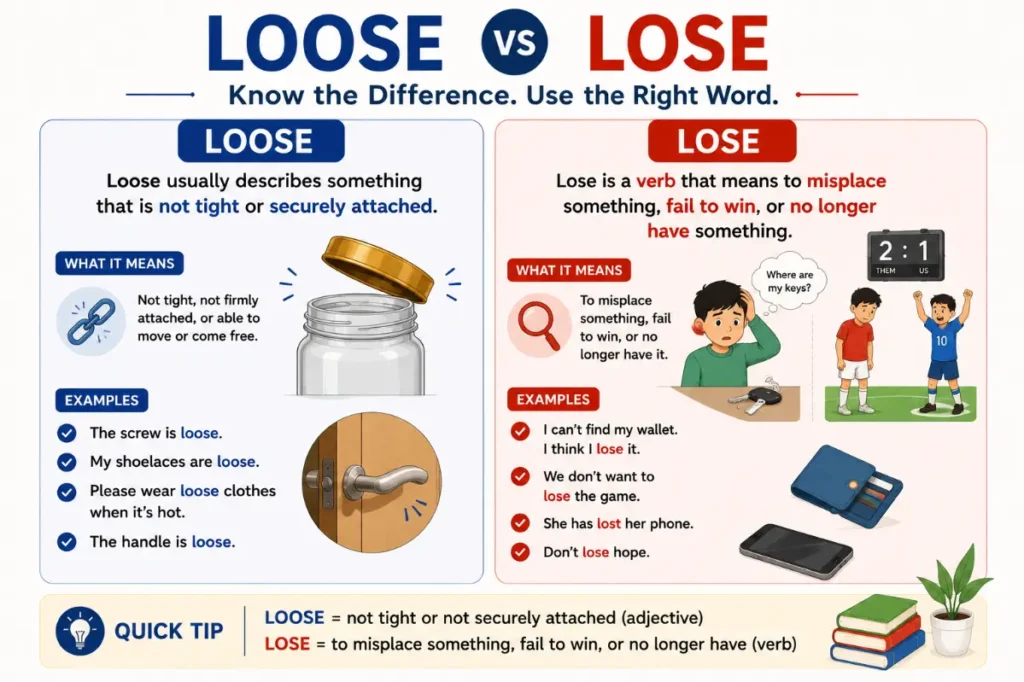
- Loose usually describes something that is not tight or securely attached.
- Lose is a verb that means to misplace something, fail to win, or no longer have something.
- Loose is commonly used with clothing, ropes, screws, and other physical objects.
- Lose is commonly used with games, money, keys, confidence, weight, and opportunities.
- Loose ends with an s sound, while lose ends with a z sound.
- The two words have different meanings, different grammatical roles, and different origins.
- Remember that lose has one O, while loose has two O’s.
Conclusion
Understanding Loose vs Lose is easier once you remember that the two words have different jobs in English. Loose describes something that is not tight, secure, or firmly attached, while lose describes the action of misplacing something, failing to win, or no longer having it.
Although the spellings differ by only one letter, their meanings, pronunciation, and grammar are completely different. A simple memory trick can help you avoid mistakes: loose has two O’s, leaving extra room, while lose has one O, as if it has already lost one. By applying this rule and paying attention to context, you’ll choose the correct word with confidence in everyday conversations, academic writing, business communication, and professional documents.
Frequently Asked Questions
What is the difference between Loose vs Lose?
The difference is simple. Loose is usually an adjective meaning not tight, while lose is a verb meaning to misplace something, fail to win, or no longer have something.
Which is correct, “loose my keys” or “lose my keys”?
The correct phrase is lose my keys because losing your keys is an action. Loose my keys is incorrect.
Is loose a verb?
Usually no. In modern English, loose is almost always an adjective. It can be a verb in literary language, but that usage is rare.
Why is “lose weight” correct?
Because lose means to reduce or no longer have something. Weight is something you reduce, so lose weight is the correct expression.
How do I remember the difference between loose and lose?
Remember that loose has two O’s, giving it extra room, while lose has one O, as if it has already lost one.
Do loose and lose sound the same?
No. Loose ends with an s sound, while lose ends with a z sound. The difference is subtle but noticeable.
Are the rules different in American and British English?
No. Both American and British English use loose and lose in the same way.
Can spellcheck detect this mistake?
Not always. Since both loose and lose are correctly spelled words, spellcheck may not recognize that the wrong one has been used in a sentence.
Is “loose change” correct?
Yes. Loose change refers to coins that are not kept in a wallet, purse, or other container.
Why does this mistake matter?
Using the wrong word changes the meaning of a sentence and can make your writing appear less polished. Choosing the correct spelling improves clarity and professionalism.

Confusing Words, Spelling & Word Choice
Claire Whitmore is a U.S.-based English editor who writes about commonly confused words, spelling differences, and word choice. Her work helps readers understand subtle distinctions between similar-looking words through simple definitions, practical examples, and modern usage guidance in both American and British English.