
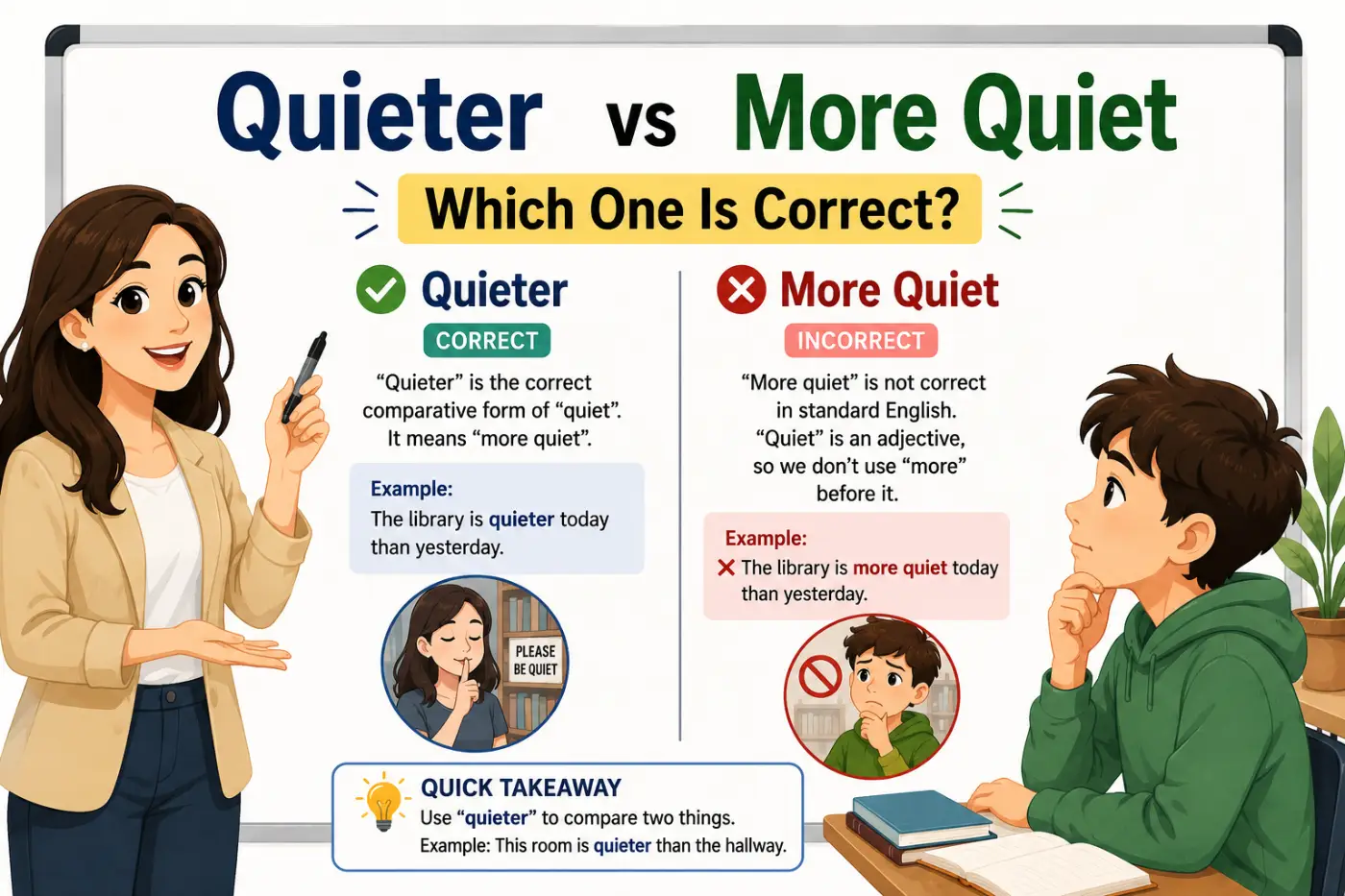
Quieter vs More Quiet is a question many English learners and even native speakers ask. Both expressions seem correct because English often forms comparatives in two different ways. Some adjectives add er, while others use more before the adjective. Since quiet can appear with both forms, it’s easy to wonder which one sounds right.
The simple answer is that quieter is the preferred comparative in everyday English. It is shorter, smoother, and recommended in dictionaries, grammar books, schools, and professional writing. However, more quiet is not wrong. Native speakers sometimes use it to create emphasis, improve the rhythm of a sentence, or match a particular writing style.
Understanding the difference matters because choosing the natural comparative makes your English sound more fluent. It also helps you write with confidence in emails, essays, reports, conversations, and exams.
Short Answer
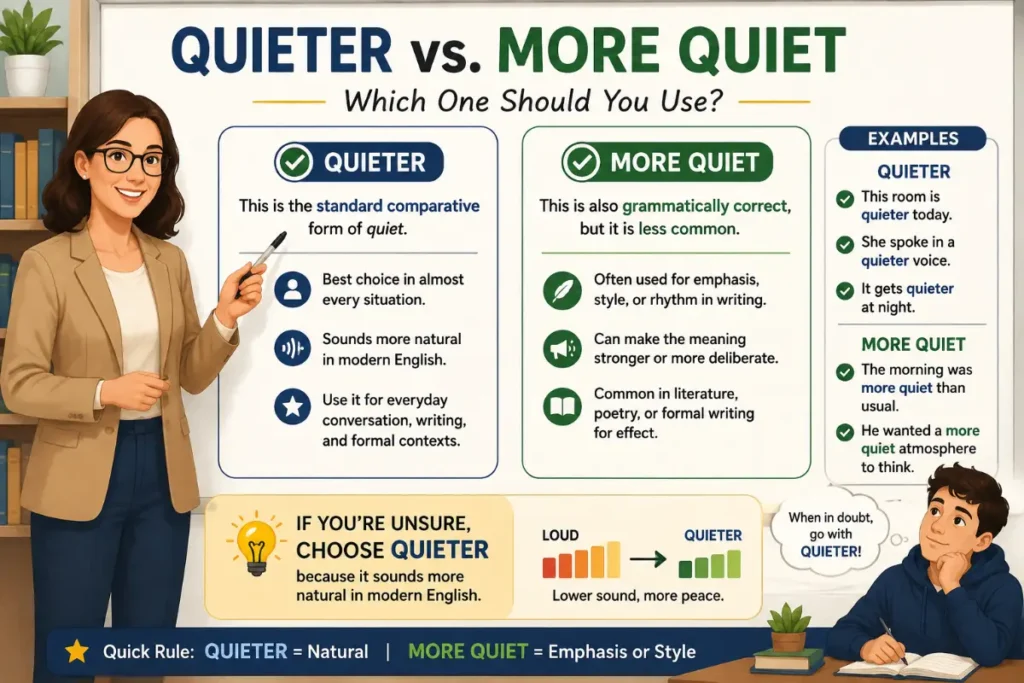
Quieter is the standard comparative form of quiet and is the best choice in almost every situation. More quiet is also grammatically correct, but it is less common and is usually used for emphasis, style, or rhythm in writing. If you’re unsure which to use, choose quieter because it sounds more natural in modern English.
Table of Contents
- What Does Quieter vs More Quiet Mean
- Is Quieter or More Quiet Correct
- Why English Has Two Comparative Forms
- When to Use Quieter
- When More Quiet Sounds Better
- Comparison Table
- Grammar Rule Behind Quieter and More Quiet
- Quieter vs More Quiet in American and British English
- Formal and Informal Usage
- Real Life Examples
- Common Mistakes
- Memory Tips
- Related Grammar Notes
- Key Takeaways
- Frequently Asked Questions
- Conclusion
What Does Quieter vs More Quiet Mean
The comparison Quieter vs More Quiet is about two ways of expressing a higher degree of silence or reduced noise. Both phrases compare one person, place, or thing with another.
For example:
- This library is quieter than the cafeteria.
- This library is more quiet than the cafeteria.
Both sentences communicate the same basic meaning. The difference is not grammatical correctness but natural usage.
In modern English, people almost always choose quieter because it is simpler and more idiomatic.
Is Quieter or More Quiet Correct
The direct answer is simple. Both are grammatically correct. However, quieter is far more common and is considered the standard comparative form of quiet. Compare these examples.
✅ The neighborhood became quieter after midnight.
✅ The engine is quieter than the old one.
Now compare them with the alternative.
✓ The neighborhood became more quiet after midnight.
✓ The engine is more quiet than the old one.
These versions are still correct, but they sound less natural in everyday English. For most situations, grammar experts, editors, and teachers recommend using quieter.
Why English Has Two Comparative Forms
One reason people become confused about Quieter vs More Quiet is that English uses two different ways to form comparatives.
Method One
Add er to the adjective.
Examples include:
| Base Adjective | Comparative |
|---|---|
| small | smaller |
| tall | taller |
| fast | faster |
| bright | brighter |
| quiet | quieter |
Method Two
Place more before the adjective.
Examples include:
| Base Adjective | Comparative |
|---|---|
| beautiful | more beautiful |
| comfortable | more comfortable |
| expensive | more expensive |
| interesting | more interesting |
Most one-syllable adjectives take er. Longer adjectives usually use more. The adjective quiet is unusual because it has two syllables but ends with a simple sound that comfortably accepts er. That is why quieter became the preferred comparative over time.
Why Quieter Became the Standard Form
Language changes through usage. People naturally prefer words that are shorter and easier to pronounce.
Consider these examples.
- quieter
- more quiet
The first expression is shorter and flows more smoothly in conversation. Over hundreds of years, native speakers gradually favored quieter, making it the normal comparative form. Major dictionaries list quieter as the primary comparative of quiet. That does not make more quiet incorrect. It simply means it is less common.
Grammar Rule Behind Quieter
The adjective quiet follows the regular comparative pattern by adding er.
Positive Degree
quiet
Comparative Degree
quieter
Superlative Degree
quietest
Examples:
- The baby is quiet.
- The baby became quieter.
- Today was the quietest day of the week.
This pattern matches many other adjectives.
| Positive | Comparative | Superlative |
|---|---|---|
| kind | kinder | kindest |
| bright | brighter | brightest |
| sweet | sweeter | sweetest |
| quiet | quieter | quietest |
Since this follows a regular grammar pattern, quieter is generally the safest choice.
When to Use Quieter
Use quieter whenever you compare two people, places, sounds, or situations. It fits naturally in conversation, academic writing, journalism, business communication, and creative writing.
Examples:
- This office is quieter than the last one.
- The children became quieter after lunch.
- Please speak quieter during the meeting.
- Winter mornings are quieter than summer mornings.
- My new laptop is much quieter than the old one.
- The hotel room was quieter than we expected.
- The second restaurant was quieter and more relaxing.
- Our street becomes quieter after sunset.
Why These Examples Sound Natural
Each sentence compares two things. The adjective directly follows standard English grammar. Native speakers immediately recognize quieter as the expected comparative form.
When More Quiet Can Sound Better
Although quieter is preferred, there are situations where writers intentionally choose more quiet.
For Emphasis
Sometimes the writer wants readers to focus on the adjective itself.
Example:
The forest became more quiet with every passing minute.
Here, the slower rhythm creates a stronger feeling of silence.
For Literary Style
Novelists and poets occasionally choose more quiet because it fits the rhythm of a sentence.
Example:
As the snow continued to fall, the valley grew more quiet than anyone remembered.
The longer phrase creates a softer pace.
To Match Nearby Comparatives
Sometimes several adjectives use more together.
Example:
The new office feels more organized, more comfortable, and more quiet than the old building.
For Personal Preference
Some speakers simply prefer the sound of more quiet in certain sentences.
English allows this flexibility.
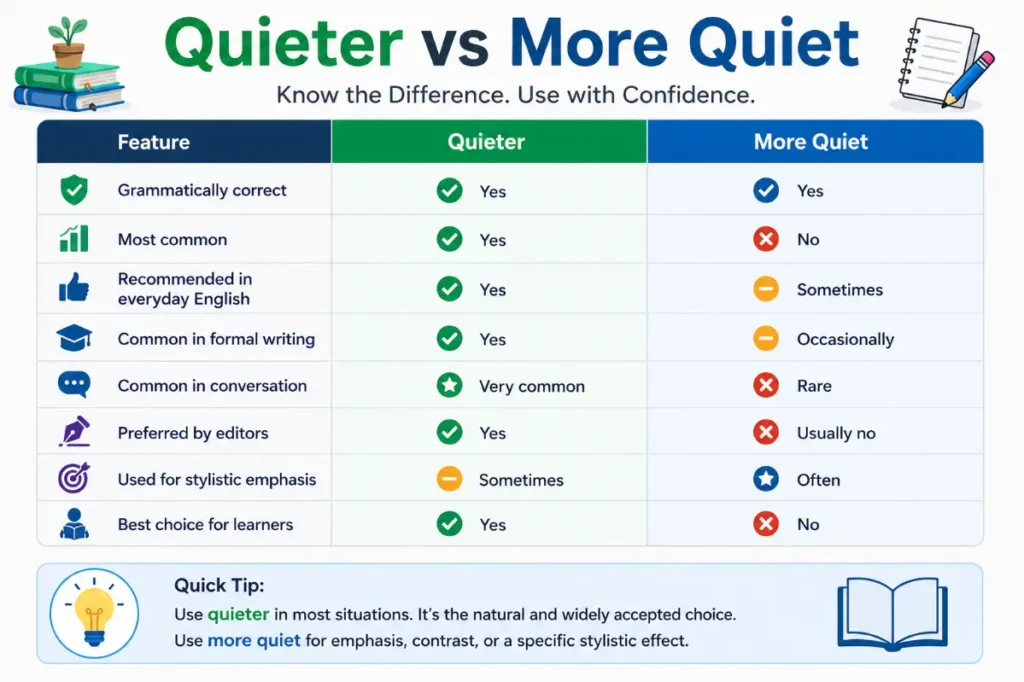
Quieter vs More Quiet Comparison Table
| Feature | Quieter | More Quiet |
|---|---|---|
| Grammatically correct | Yes | Yes |
| Most common | Yes | No |
| Recommended in everyday English | Yes | Sometimes |
| Common in formal writing | Yes | Occasionally |
| Common in conversation | Very common | Rare |
| Preferred by editors | Yes | Usually no |
| Used for stylistic emphasis | Sometimes | Often |
| Best choice for learners | Yes | No |
Why Native Speakers Usually Say Quieter
Languages naturally favor efficiency. Native English speakers often choose shorter forms because they are quicker to say and easier to understand.
Compare these sentences aloud.
- The classroom became quieter.
- The classroom became more quiet.
Most people find the first sentence smoother and more natural.
Does More Quiet Sound Wrong
No. It may sound unusual because people hear quieter far more often. That difference in frequency causes some learners to think more quiet is incorrect. It is not. Grammar accepts both forms. Usage strongly favors quieter. Understanding this distinction is one of the easiest ways to master Quieter vs More Quiet and avoid unnecessary confusion while speaking or writing English.
Quieter vs More Quiet in American and British English
Many learners wonder if Quieter vs More Quiet is a difference between American and British English. The answer is no. Both American English and British English prefer quieter in everyday speech and writing. You’ll find it in newspapers, novels, business documents, classrooms, and professional communication on both sides of the Atlantic.
For example:
| American English | British English |
|---|---|
| This neighborhood is quieter than ours. | This neighbourhood is quieter than ours. |
| The office became quieter after lunch. | The office became quieter after lunch. |
| My new car is quieter than the old one. | My new car is quieter than the old one. |
Notice that the only spelling difference above is neighborhood and neighbourhood. The comparative adjective remains quieter in both varieties. Although more quiet appears occasionally in British and American writing, it is uncommon and usually reflects an author’s style rather than a regional grammar rule.
Formal vs Informal Usage
Many people assume more quiet sounds more formal because it contains an extra word. That isn’t true. In professional writing, editors generally prefer quieter because it is concise and natural.
Formal Writing
Examples include:
- scientific reports
- academic essays
- business emails
- legal writing
- newspaper articles
Examples:
- The revised design is quieter than the previous model.
- The second proposal offers a quieter working environment.
- The updated software runs quieter than before.
Informal Writing
Conversation, text messages, and social media also favor quieter.
Examples:
- Can we find somewhere quieter?
- This café is much quieter today.
- I wish my neighbors were quieter.
Creative Writing
Novelists sometimes choose more quiet when they want a slower rhythm.
Example:
The mountain became more quiet as darkness settled over the valley.
The longer wording creates a gentle pace that suits descriptive writing.
Pronunciation
Understanding pronunciation makes these words easier to remember.
Quiet
Pronunciation:
KWY uht
Quieter
Pronunciation:
KWY uh tuhr
Some learners mistakenly pronounce it as if the letters were separated. Instead, the sounds flow together naturally.
Practice these sentences aloud.
- The room is quieter now.
- Please speak quieter.
- Our hotel was quieter than expected.
Repeated practice helps the comparative form become automatic.
Real Life Examples
The best way to understand Quieter vs More Quiet is to see it used in everyday situations.
At Home
The upstairs bedroom is quieter than the living room.
Explanation: The sentence compares two locations inside the house.
At School
Students became quieter after the principal entered the classroom.
Explanation: Their noise level decreased.
At Work
This office is quieter than our old building.
Explanation: The speaker compares two workplaces.
In a Library
Please keep your voice quieter.
Explanation: A request to reduce noise.
During Travel
The train became quieter after most passengers left.
Explanation: Fewer people created less noise.
Shopping
This supermarket is quieter early in the morning.
Explanation: It compares different times of day.
Technology
My new computer is much quieter than the previous one.
Explanation: The new computer produces less sound.
Nature
The forest became quieter after the rain stopped.
Explanation: The environment grew calmer.
Examples Using More Quiet
Although less common, these sentences remain grammatically correct.
- The village seemed more quiet after the tourists left.
- The evening became more quiet as the wind faded.
- She hoped for a more quiet place to study.
- The atmosphere felt more quiet than anyone expected.
These examples work because the writer emphasizes the peaceful mood rather than simply making a comparison.
Which Sounds More Natural
Read these pairs aloud.
Pair One
The office became quieter. The office became more quiet. Most speakers naturally prefer the first sentence.
Pair Two
The park is quieter today. The park is more quiet today. Again, quieter sounds smoother.
Pair Three
This fan is quieter than mine. This fan is more quiet than mine. The shorter comparative sounds more conversational.
Common Mistakes
Understanding common errors helps you avoid them.
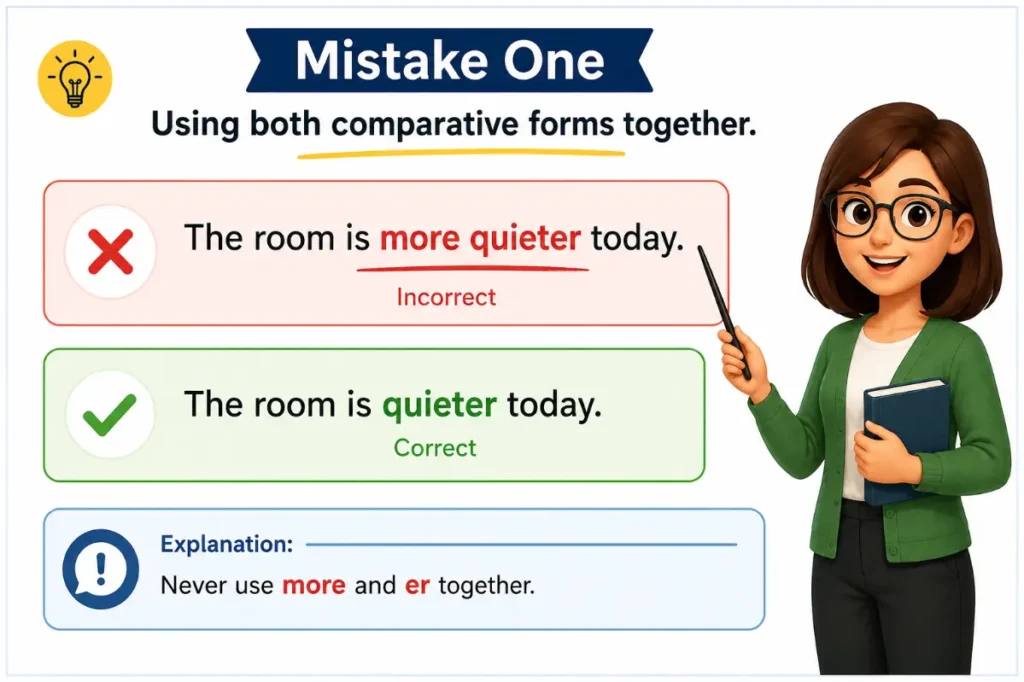
Mistake One
Using both comparative forms together.
❌ The room is more quieter today.
✅ The room is quieter today.
Explanation: Never use more and er together.
Mistake Two
Using the positive form instead of the comparative.
❌ This classroom is quiet than that one.
✅ This classroom is quieter than that one.
Explanation: Comparisons require the comparative adjective.
Mistake Three
Thinking more quiet is always wrong.
❌ More quiet is incorrect English.
✅ More quiet is grammatically correct but much less common.
Explanation: Grammar and usage are different. A form can be grammatically correct but less natural.
Mistake Four
Using the superlative incorrectly.
❌ This is the quieter place in town.
✅ This is the quietest place in town.
Explanation: When comparing more than two things, use the superlative.
Mistake Five
Choosing the longer form without a reason.
Instead of automatically writing more quiet, choose quieter unless you have a stylistic purpose.
Memory Tips
Simple tricks make this comparison easy to remember.
Tip One
Think of other common adjectives.
- tall → taller
- small → smaller
- bright → brighter
- quiet → quieter
If those adjectives use er, quiet usually does too.
Tip Two
Remember the newspaper test.
Imagine reading a newspaper headline.
“The Streets Are Quieter Today.”
That sounds completely natural.
“The Streets Are More Quiet Today.”
This sounds less typical.
Tip Three
Choose the shorter form. English often prefers shorter comparative adjectives. Shorter usually sounds more natural.
Tip Four
Remember this sentence. Quiet becomes quieter. Repeat it several times. It helps the pattern stay in your memory.
Related Grammar and Usage Notes
Learning related grammar strengthens your understanding.
Quiet vs Quietly
Quiet is an adjective.
Example:
The classroom is quiet.
Quietly is an adverb.
Example:
The students spoke quietly.
Quiet vs Silent
These words are similar but not identical.
| Quiet | Silent |
|---|---|
| Little noise | No noise |
| Can include soft sounds | Complete absence of sound |
| More common | Stronger meaning |
Example:
The room became quieter after lunch.
The room became completely silent after the announcement.
Quiet vs Calm
These words describe different ideas.
Quiet refers mainly to sound.
Calm refers mainly to emotions, weather, or behavior.
Example:
The classroom became quieter.
The teacher remained calm.
Professional Writing Tips
If you write professionally, consistency matters.
Editors generally recommend:
- Use quieter in reports.
- Use quieter in academic writing.
- Use quieter in business communication.
- Use quieter in website content.
- Use quieter in marketing copy.
Reserve more quiet for occasions where rhythm or emphasis genuinely improves the sentence.
When in doubt, choose quieter.
People Also Ask
Is quieter a real word?
Yes. Quieter is the standard comparative form of quiet and appears in all major English dictionaries.
Why do people say more quiet?
Some speakers use more quiet for emphasis, rhythm, or personal preference, especially in creative writing.
Which sounds more natural?
Quieter sounds more natural in almost every situation.
Can I use more quiet in an essay?
Yes. It is grammatically correct, although many teachers and editors will recommend quieter unless you have a stylistic reason.
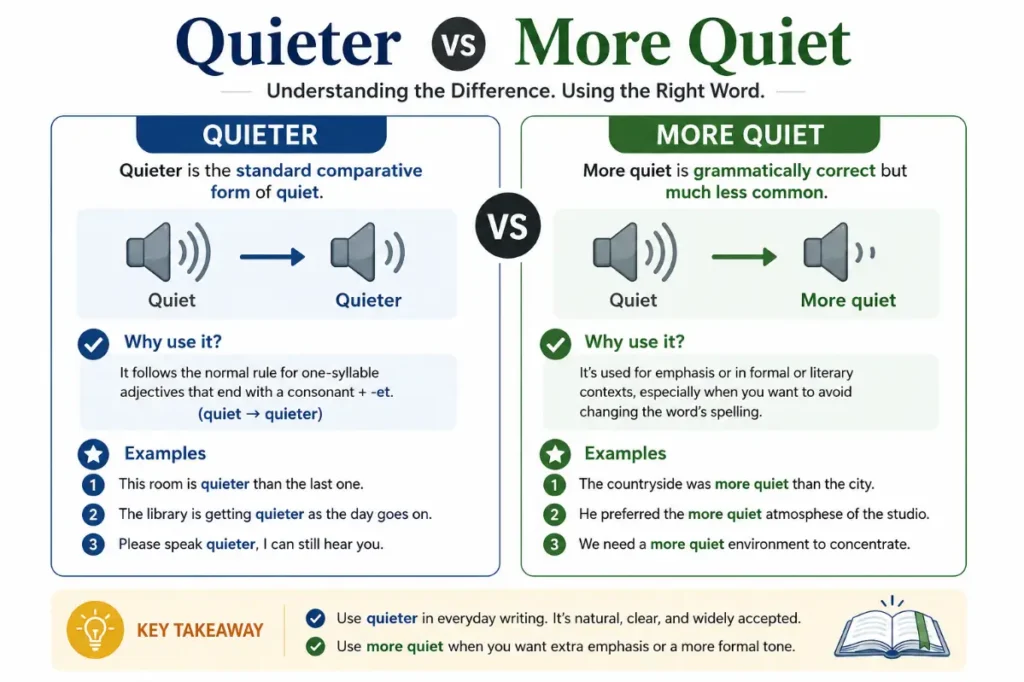
Key Takeaways
- Quieter is the standard comparative form of quiet.
- More quiet is grammatically correct but much less common.
- Both American and British English prefer quieter.
- Never write more quieter.
- Use quieter in business, academic, and everyday writing.
- Use more quiet only when emphasis or rhythm improves the sentence.
- Remember that grammar and natural usage are not always the same.
- If you’re uncertain, quieter is almost always the best choice.
Conclusion
The debate over Quieter vs More Quiet is easier to solve than many people expect. Both expressions are grammatically acceptable, but they are not equally common. Quieter is the standard comparative form and the one you’ll hear most often in conversations, classrooms, workplaces, books, and professional writing. It is concise, natural, and recommended by grammar experts and editors.
More quiet is not incorrect. It occasionally appears in literature or descriptive writing when an author wants a slower rhythm or added emphasis. Still, these situations are the exception rather than the rule.
For everyday English, essays, emails, presentations, and business communication, quieter is almost always the best choice. By understanding the grammar behind comparative adjectives and recognizing when stylistic variation is appropriate, you’ll use both forms with confidence and sound more fluent in spoken and written English.
Frequently Asked Questions
Is quieter or more quiet grammatically correct?
Both are grammatically correct. However, quieter is the standard comparative form and is preferred in most situations.
Which is more common in everyday English?
Quieter is far more common in conversation, writing, and published material.
Can I say more quiet instead of quieter?
Yes. Native speakers occasionally use more quiet, especially for emphasis or stylistic effect, but quieter is usually the better choice.
Is quieter used in American English?
Yes. American English strongly favors quieter, just like British English.
Why is quieter preferred?
It follows the normal comparative pattern, sounds smoother, and is the form most native speakers naturally choose.
Is more quieter correct?
No. Never combine more with a comparative adjective ending in er.
What is the superlative form of quiet?
The superlative form is quietest.
Example:
This is the quietest room in the building.
How can I remember the correct form?
Think of similar adjectives like small, tall, and bright. They become smaller, taller, and brighter. Likewise, quiet becomes quieter.

English Grammar & Usage
Nathan Holloway is an American grammar writer and language researcher who specializes in English grammar, sentence structure, verb usage, and common writing mistakes. He enjoys breaking down confusing grammar rules into practical explanations with clear examples, making English easier for students, professionals, and everyday writers.