
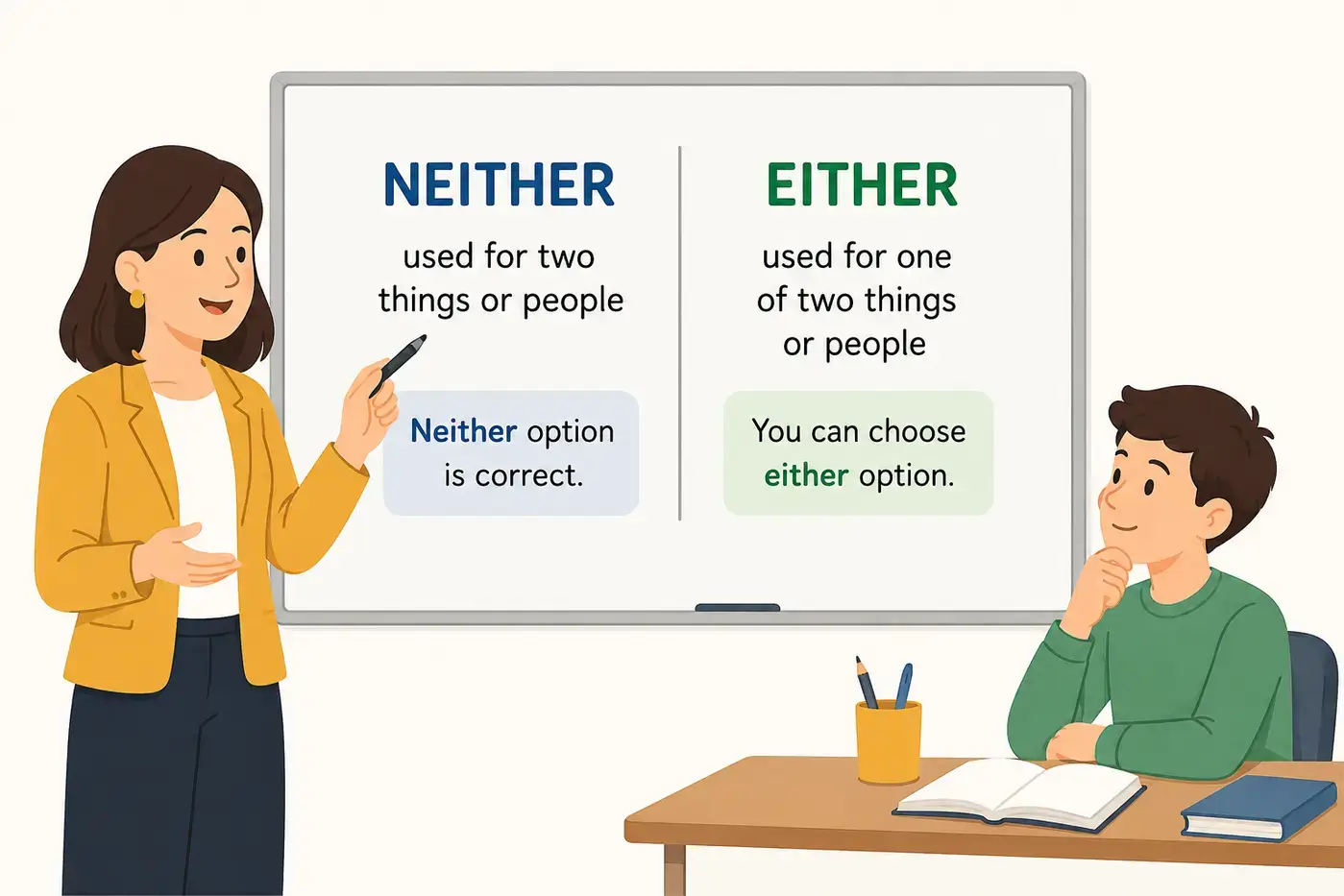
Neither vs Either confuses many English learners because both words deal with two choices and often appear in similar sentence patterns. They look related, but they do opposite jobs. The good news is that the difference is simple once you understand the basic rule. Either points to one choice from two possibilities. Neither rejects both choices.
Learning how these words work improves your grammar, makes your writing clearer, and helps you avoid common mistakes in conversations, emails, academic writing, and professional communication.
This guide explains everything you need to know. You will learn the meanings, grammar rules, pronunciation, sentence patterns, common errors, memory tricks, and plenty of real examples that show exactly when each word is correct.
Short Answer
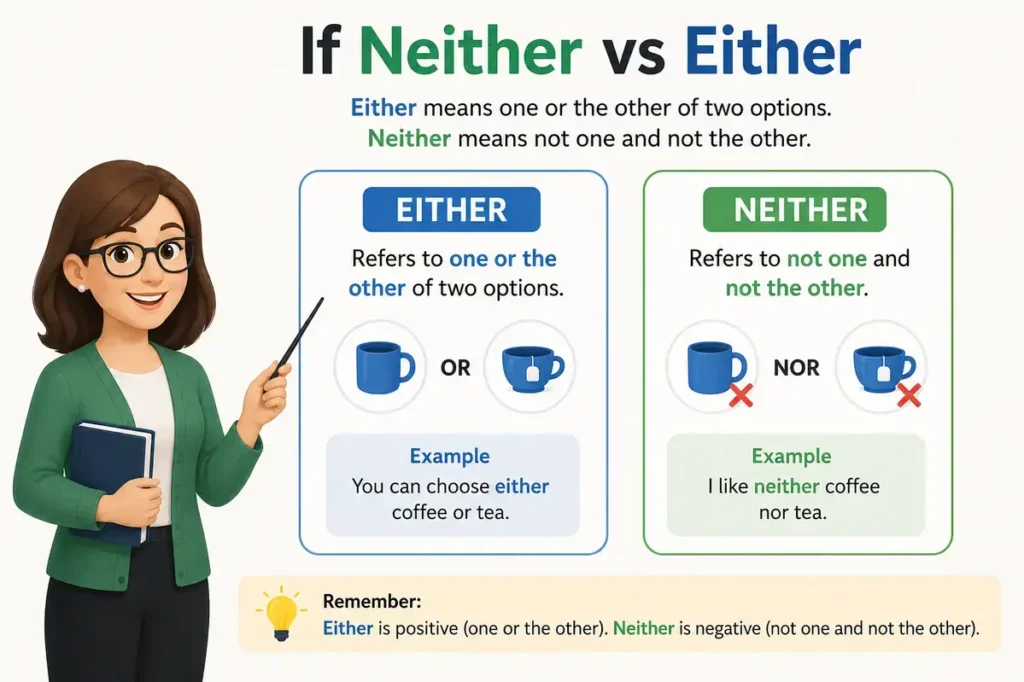
Neither vs Either is a common grammar comparison because both words refer to two people, things, or choices. Either means one or the other of two options, while neither means not one and not the other. Choosing the correct word depends on the meaning of your sentence, especially if it expresses a positive or negative idea.
Type of Content
- What Is the Difference Between Neither and Either
- Comparison Table
- Meaning of Either
- Meaning of Neither
- Pronunciation
- Parts of Speech
- Grammar Rules
- Sentence Patterns
- Word Origins
- When to Use Either
- When to Use Neither
- Real Life Examples
- Common Mistakes
- Memory Tips
- Related Grammar Notes
- Frequently Asked Questions
- Key Takeaways
- Conclusion
What Is the Difference Between Neither and Either
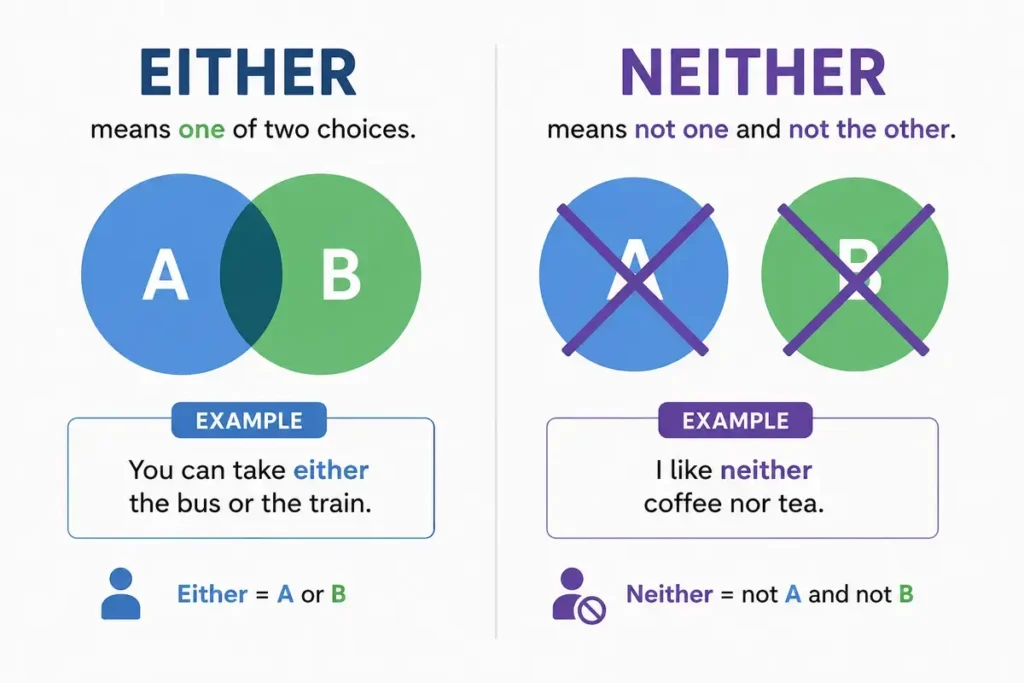
The biggest difference between Neither vs Either is their meaning.
Either refers to one of two choices.
Neither means not one and not the other.
Think of them as opposites. Compare these sentences.
You may choose either book.
The speaker allows one of the two books.
You may choose neither book.
The speaker allows neither option. Although both words involve two choices, the message changes completely depending on the word you choose.
Comparison Table
| Feature | Either | Neither |
|---|---|---|
| Basic meaning | One or the other | Not one and not the other |
| Number involved | Two | Two |
| Positive or negative | Positive | Negative |
| Common part of speech | Determiner, pronoun, adverb, conjunction | Determiner, pronoun, adverb, conjunction |
| Verb agreement | Usually singular | Usually singular |
| Opposite word | Neither | Either |
| Common phrase | Either one | Neither one |
| Used with nor | No | Yes |
Meaning of Either
Either refers to one choice from two possibilities.
It tells the reader or listener that both options are available, but only one is selected.
Definition
One or the other of two people, things, or ideas.
Examples
You can sit in either chair.
Explanation: Both chairs are available. The listener may choose one.
Either answer is acceptable.
Explanation: Both answers are correct, but only one is needed.
You may call either office.
Explanation: Calling one office is enough.
Meaning of Neither
Neither expresses a negative meaning.
It tells us that both choices are rejected.
Definition
Not one and not the other.
Examples
Neither answer is correct.
Explanation: Both answers are wrong.
Neither child wanted to leave.
Explanation: Both children wanted to stay.
Neither restaurant was open.
Explanation: Both restaurants were closed.
Pronunciation
Correct pronunciation helps avoid confusion.
| Word | IPA | Simple Pronunciation |
|---|---|---|
| Either | /ˈiːðər/ or /ˈaɪðər/ | EE ther or EYE ther |
| Neither | /ˈniːðər/ or /ˈnaɪðər/ | NEE ther or NYE ther |
Both pronunciations are correct in American and British English.
Some speakers prefer EE ther and NEE ther.
Others naturally say EYE ther and NYE ther.
Consistency is more important than choosing one pronunciation over the other.
Parts of Speech
One reason these words confuse learners is that they perform several grammar functions.
Either as a Determiner
Either option will work.
Explanation: It modifies the noun option.
Either as a Pronoun
Either is acceptable.
Explanation: The noun is understood without being repeated.
Either as an Adverb
I don’t like spinach either.
Explanation: Here it means also in a negative sentence.
Either as a Conjunction
You can either walk or take the bus.
Explanation: It introduces two alternatives.
Neither as a Determiner
Neither answer is correct.
Explanation: It modifies the noun answer.
Neither as a Pronoun
Neither was available.
Explanation: The noun is omitted because it is already understood.
Neither as an Adverb
She doesn’t sing, and neither do I.
Explanation: It shows agreement with a negative statement.
Neither as a Conjunction
Neither John nor Emily attended the meeting.
Explanation: It joins two negative alternatives.
Grammar Rules
Understanding these grammar rules makes using Neither vs Either much easier.
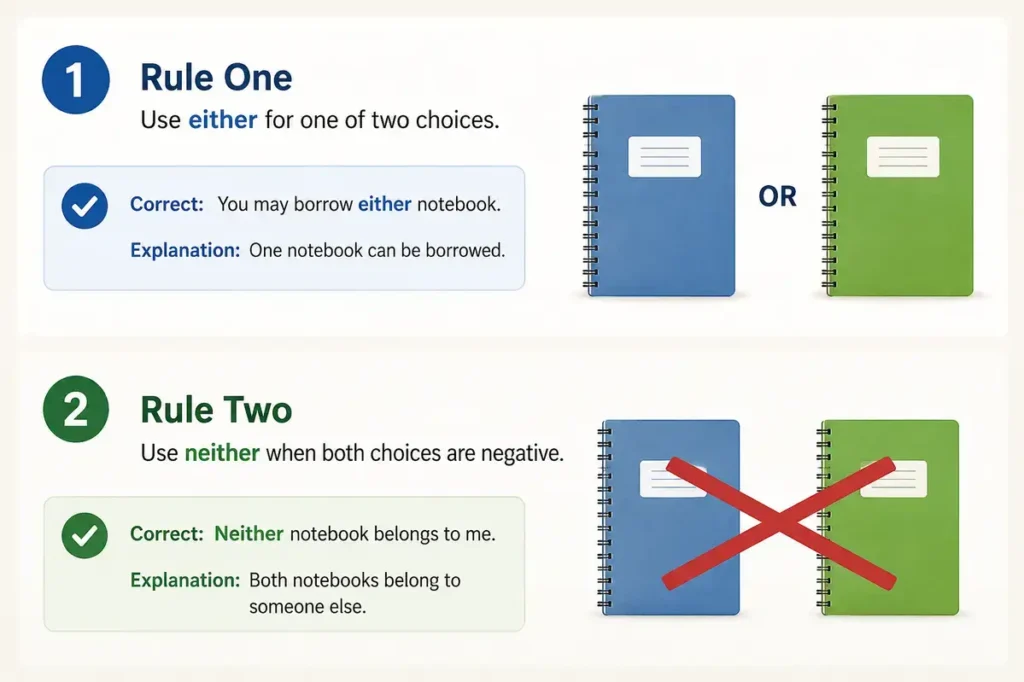
Rule One
Use either for one of two choices.
Correct: You may borrow either notebook.
Explanation: One notebook can be borrowed.
Rule Two
Use neither when both choices are negative.
Correct: Neither notebook belongs to me.
Explanation: Both notebooks belong to someone else.
Rule Three
Use either…or to connect two alternatives.
Correct: Either David or Sarah will lead the meeting.
Explanation: Only one person will lead.
Rule Four
Use neither…nor to connect two negative alternatives.
Correct: Neither David nor Sarah attended the meeting.
Explanation: Both people were absent.
Rule Five
Avoid double negatives.
Incorrect: I don’t want neither option.
Correct: I don’t want either option.
Correct: I want neither option.
Explanation: English normally uses only one negative in standard writing.
Sentence Patterns
These patterns appear frequently in spoken and written English.
Pattern One
Either + singular noun
Example: Either road leads to the lake.
Pattern Two
Neither + singular noun
Example: Neither road is safe after the storm.
Pattern Three
Either…or
Example: Either we leave now or we miss the train.
Pattern Four
Neither…nor
Example: Neither the manager nor the assistant was available.
Pattern Five
Not…either
Example: He didn’t finish the report either.
Explanation: The speaker adds another negative idea.
Word Origins
The history of these words explains why they are closely connected.
Origin of Either
Either comes from Old English. It originally meant one of two or each of two. Over time, its meaning became more specific, referring to one choice from two possibilities.
Origin of Neither
Neither developed from Old English as the negative form of either. It literally carried the idea of not either, which explains why it means not one and not the other today. Because both words share the same linguistic roots, they still appear in similar grammar structures even though their meanings are opposite.
When to Use Either
Choose either when your sentence offers a choice between two options.
Common situations include:
- Giving someone a choice.
- Offering two alternatives.
- Comparing two acceptable options.
- Explaining that one option is enough.
Examples
Either key opens the front door.
Explanation: Both keys work, but only one is needed.
You can visit either museum this afternoon.
Explanation: The listener may choose one museum.
Either solution will solve the problem.
Explanation: Both solutions are acceptable.
When to Use Neither
Use neither when both choices are excluded.
Common situations include:
- Rejecting two options.
- Expressing a negative idea.
- Showing that two statements are false.
- Saying two people did not do something.
Examples
Neither solution fixed the issue.
Explanation: Both solutions failed.
Neither candidate received enough votes.
Explanation: Both candidates fell short.
Neither road was open after the flood.
Explanation: Both roads were closed.
This simple contrast is the foundation of using Neither vs Either correctly. Once you identify if your sentence expresses a positive choice or a negative one, selecting the right word becomes much easier
Advanced Grammar Rules for Neither vs Either
Once you understand the basic meanings, the next step is learning how these words behave in different grammar patterns.
Using Either With Singular Nouns
When either comes before a singular noun, it refers to one of two possible choices.
Examples: Either student can answer the question.
Explanation: Both students are capable, but only one needs to answer.
Either route takes about thirty minutes.
Explanation: Both routes work, and the speaker is referring to one of them.
Using Neither With Singular Nouns
Neither also takes a singular noun.
Examples: Neither solution seems practical.
Explanation: Both solutions are considered impractical.
Neither employee was available.
Explanation: Both employees were unavailable.
Subject and Verb Agreement
In most cases, either and neither take singular verbs because they refer to one person or one thing at a time.
Correct: Either answer is acceptable.
Correct: Neither answer is correct.
Although many native speakers use plural verbs in casual conversation, singular verbs remain the standard choice in formal English.
Using Either Or
The expression either…or presents two alternatives.
Structure: Either + option one + or + option two
Examples: Either Emma or Liam will give the presentation.
Explanation: Only one person will present.
You can either stay home or join us for dinner.
Explanation: The listener has two possible choices.
Either we finish today or we continue tomorrow.
Explanation: Only one outcome will happen.
Using Neither Nor
The expression neither…nor joins two negative alternatives.
Structure: Neither + option one + nor + option two
Examples: Neither Emma nor Liam attended the meeting.
Explanation: Both people were absent.
Neither coffee nor tea sounds good right now. Explanation:
The speaker does not want either drink.
Neither the blue shirt nor the black one fits me.
Explanation: Both shirts are unsuitable.
Verb Agreement With Neither Nor
This topic often causes confusion.
When subjects connected by neither…nor have different numbers, the verb usually agrees with the subject closest to it.
Examples:
Neither the teacher nor the students were ready.
Explanation:
The plural noun students is closest to the verb, so were is correct.
Neither the students nor the teacher was ready.
Explanation:
The singular noun teacher comes closest to the verb, so was is correct.
This rule applies in both American and British English.
Either and Neither as Pronouns
Sometimes these words replace nouns completely.
Examples of either:
I don’t mind. Either is fine.
Explanation:
The noun is understood from the earlier sentence.
Which jacket do you prefer? Either looks great.
Explanation:
The speaker means either jacket.
Examples of neither:
I invited both neighbors, but neither came.
Explanation:
Neither neighbor attended.
Both books were interesting, but neither was easy to read.
Explanation:
Both books were difficult.
Either and Neither as Adverbs
These words also function as adverbs.
Either
In negative sentences, either means also.
Examples:
I don’t enjoy spicy food either.
Explanation:
The speaker shares the same negative opinion.
She didn’t call me either.
Explanation:
Another person also failed to call.
Neither
Neither can introduce agreement with a negative statement.
Examples:
I don’t like horror movies.
Neither do I.
Explanation:
The second speaker agrees with the negative statement.
Another example:
He wasn’t invited.
Neither were his coworkers.
Explanation:
The coworkers were not invited either.
Real Life Examples of Neither and Either
The following examples show how these words appear in everyday English.
Example One
Either restaurant serves excellent seafood.
Explanation:
Both restaurants are good choices.
Example Two
Neither restaurant has outdoor seating.
Explanation:
Both restaurants lack outdoor seating.
Example Three
You can either email me or call my office.
Explanation:
The speaker offers two contact methods.
Example Four
Neither my brother nor my sister enjoys skiing.
Explanation:
Both siblings dislike skiing.
Example Five
Either answer earns full credit.
Explanation:
Students may choose one correct answer.
Example Six
Neither explanation answered the question.
Explanation:
Both explanations failed.
Example Seven
Either path leads to the waterfall.
Explanation:
Both paths reach the same destination.
Example Eight
Neither path is safe after heavy rain.
Explanation:
Both paths are unsafe.
Common Mistakes
Many learners make the same errors when using Neither vs Either.
Mistake One
Using neither in a positive sentence.
Incorrect:
Neither book is available, so you may choose one.
Correct:
Either book is available, so you may choose one.
Explanation:
The sentence offers a choice, not a rejection.
Mistake Two
Using either to reject both options.
Incorrect:
Either answer is wrong.
Correct:
Neither answer is correct.
Explanation:
Both answers are incorrect.
Mistake Three
Creating a double negative.
Incorrect:
I don’t want neither shirt.
Correct:
I don’t want either shirt.
Correct:
I want neither shirt.
Explanation:
Standard English avoids double negatives.
Mistake Four
Mixing conjunctions.
Incorrect:
Either David nor Mia will help.
Correct:
Either David or Mia will help.
Correct:
Neither David nor Mia will help.
Explanation:
Use either…or together and neither…nor together.
Mistake Five
Using plural verbs unnecessarily.
Less formal:
Neither answer are correct.
Correct:
Neither answer is correct.
Explanation:
The subject is singular.
Memory Tips
Simple memory tricks make these words much easier to remember.
Memory Trick One
Either begins with E.
Think of E for Election.
You choose one option.
Memory Trick Two
Neither begins with N.
Think of N for No.
No option is accepted.
Memory Trick Three
Remember this simple pattern.
Either equals one choice.
Neither equals no choice.
Memory Trick Four
Picture two doors.
If one door can be opened, think either.
If both doors remain closed, think neither.
Professional Writing Tips
Professional writers use these words carefully because a single mistake can change the meaning of a sentence.
Tip One
Use either only when one of two options is possible.
Tip Two
Use neither only when rejecting both options.
Tip Three
Read the sentence aloud.
If the sentence sounds negative, neither is often the better choice.
If it offers a choice, either is usually correct.
Tip Four
Avoid repeating negatives.
Clear writing is easier to understand.
Tip Five
In formal writing, prefer singular verbs with either and neither, except when the standard proximity rule applies after neither…nor.
Related Grammar and Usage Notes
Several words are closely related to either and neither.
Both
Both includes two people or things.
Example:
Both students passed the exam.
Either
Either selects one from two.
Example:
Either student may answer first.
Neither
Neither excludes both.
Example:
Neither student arrived on time.
Any
Any usually refers to more than two choices or an unlimited number.
Example:
Choose any seat you like.
None
None means not one from a larger group.
Example:
None of the answers was correct.
Understanding these related words helps you choose the most precise expression for every situation.
American and British English
The grammar rules for either and neither are almost identical in American and British English. The main differences involve pronunciation and occasional preferences in speech.
Both varieties accept:
Either option is acceptable.
Neither solution worked.
Some British speakers are slightly more likely to use traditional pronunciations such as EYE ther and NYE ther, while American speakers commonly use both accepted pronunciations.
Formal and Informal Usage
These words are appropriate in every level of English.
Formal Writing
They are common in academic papers, business communication, legal documents, and professional reports.
Example:
Neither proposal met the committee’s requirements.
Informal Conversation
They also appear naturally in everyday speech.
Example:
Either movie sounds fun.
Example:
Neither one looks expensive.
Because they are standard English words, they fit almost every writing style and speaking situation.
Key Takeaways
- Either means one of two choices.
- Neither means not one and not the other.
- Both words usually refer to exactly two people, things, or ideas.
- Use either…or to present two alternatives.
- Use neither…nor to reject two alternatives.
- Either and neither normally take singular verbs, although proximity rules apply in either…or and neither…nor constructions with mixed-number subjects.
- Avoid double negatives such as I don’t want neither in standard English.
- Either can also mean also in negative sentences.
Example:
I don’t watch television either.
- Neither can express agreement with a negative statement.
Example:
Neither do I.
- Remember the simple rule:
Either = one.
Neither = none of the two.
Frequently Asked Questions
Is either always singular?
In most cases, yes. Either usually takes a singular noun and a singular verb because it refers to one of two choices.
Correct:
Either answer is acceptable.
However, verb agreement can change in either…or constructions when the subjects have different numbers.
Example:
Either the teacher or the students are presenting today.
The verb agrees with students, the subject closest to it.
Is neither always singular?
Usually, yes. Neither normally takes a singular verb in standard English.
Correct:
Neither option is available.
In neither…nor constructions, the verb generally agrees with the subject closest to it.
Example:
Neither the manager nor the employees were available.
What is the difference between either and neither?
The main difference is their meaning.
Either means one of two choices.
Neither means not one and not the other.
Examples:
You can choose either dessert.
One dessert may be chosen.
Neither dessert contains sugar.
Both desserts are sugar free.
Can I say me either?
Many native speakers say Me either in casual conversation.
In formal English, Neither do I is considered more grammatically correct.
Informal:
I don’t like broccoli.
Me either.
Formal:
I don’t like broccoli.
Neither do I.
Is either…or grammatically correct?
Yes. Either…or is a standard English correlative conjunction used to present two alternatives.
Example:
You can either study tonight or finish the assignment tomorrow morning.
Is neither…nor grammatically correct?
Yes. Neither…nor is also a standard correlative conjunction.
Example:
Neither the printer nor the computer is working.
It connects two negative alternatives.
Can either refer to more than two things?
Traditionally, either refers to two choices only.
When talking about three or more options, words like any, one of the, or one among are usually better choices.
Example:
Instead of:
Either of the five books is interesting.
Use:
Any of the five books is interesting.
Can neither refer to more than two things?
Traditionally, neither refers to two people or things.
For larger groups, none is usually the correct choice.
Example:
Instead of:
Neither of the six students passed.
Use:
None of the six students passed.
Which is more formal, either or neither?
Neither word is more formal than the other. Both are standard English and appear naturally in:
- Academic writing.
- Business communication.
- Journalism.
- Books.
- Everyday conversation.
The correct choice depends on the meaning of your sentence rather than the level of formality.
Why do people confuse Neither vs Either?
Many learners confuse these words because they often appear in similar sentence patterns and both refer to two choices.
The easiest way to remember the difference is this:
Either = one choice.
Neither = no choice.
Conclusion
Understanding Neither vs Either becomes much easier once you remember that the two words express opposite ideas. Either offers one choice from two possibilities, while neither rejects both. This simple distinction helps you choose the correct word in everyday conversations, professional writing, academic work, and exams.
These words also appear in important grammar patterns such as either…or and neither…nor. Learning how these structures work, along with the correct rules for verb agreement, makes your English more accurate and natural. Paying attention to common mistakes, such as double negatives or mixing the two constructions, will help you write with greater confidence.
Whenever you are unsure, ask yourself a simple question. Does the sentence offer one of two choices? If the answer is yes, use either. Does it reject both choices? If the answer is yes, use neither. Keeping that rule in mind will help you use Neither vs Either correctly in almost every situation.

Confusing Words, Spelling & Word Choice
Claire Whitmore is a U.S.-based English editor who writes about commonly confused words, spelling differences, and word choice. Her work helps readers understand subtle distinctions between similar-looking words through simple definitions, practical examples, and modern usage guidance in both American and British English.