
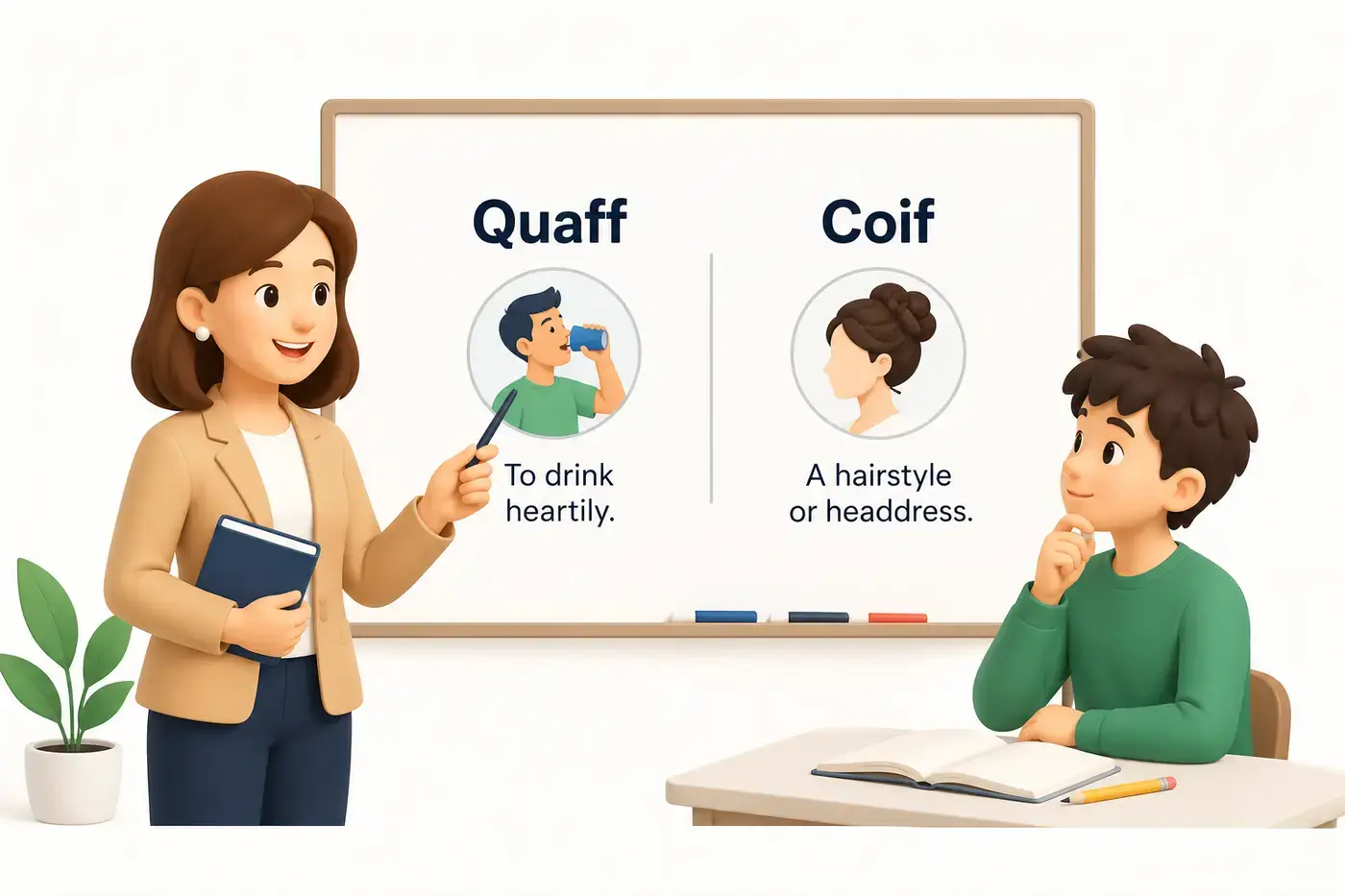
Quaff or Coif is a confusing word comparison because the two words look somewhat alike but have entirely different meanings, pronunciations, origins, and uses. Choosing the wrong one can change the meaning of your sentence and make your writing inaccurate.
The confusion usually happens because both words are uncommon in everyday conversation. Many people recognize them from books, historical writing, fashion articles, or descriptive storytelling instead of casual speech. The good news is that distinguishing them is simple once you understand what each word represents. One belongs to the vocabulary of drinking, while the other belongs to hairstyles and historical headwear.
This guide explains every important detail, including definitions, pronunciation, grammar, origins, usage rules, examples, professional writing tips, common mistakes, and memory tricks. By the end, you will know exactly when to use each word with confidence.

The Difference Between Quaff and Coif
The difference between Quaff or Coif is straightforward. Quaff is a verb that means to drink enthusiastically, deeply, or in generous amounts. Coif is primarily a noun referring to a close fitting cap or a hairstyle. It can also be used as a verb meaning to arrange or style someone’s hair. These words are unrelated in meaning, even though they share a somewhat similar spelling.
Quick Comparison Table
| Feature | Quaff | Coif |
|---|---|---|
| Meaning | To drink heartily | A close fitting cap or hairstyle |
| Part of Speech | Verb | Noun and Verb |
| Pronunciation | Kwaf | Koyf |
| Common Topic | Drinking | Hair and Clothing |
| Modern Usage | Literary and descriptive | Fashion, beauty, and history |
| Can Replace the Other | No | No |
What Does Quaff Mean
Quaff is a verb meaning to drink a liquid eagerly, deeply, or with obvious enjoyment. It is more expressive than the everyday verb drink and often appears in descriptive writing.
Dictionary Style Definition
To drink a beverage heartily or in large gulps.
Typical Situations
- Historical fiction.
- Fantasy novels.
- Restaurant reviews.
- Beverage descriptions.
- Travel writing.
- Food journalism.
- Celebration scenes.
- Adventure stories.
Example Sentences
The hikers quaffed cold water after reaching the summit.
Explanation:
The sentence emphasizes enthusiastic drinking after physical activity.
The guests quaffed sparkling cider during the celebration.
Explanation:
The verb creates a lively image instead of simply saying they drank cider.
He quaffed hot chocolate beside the fireplace.
Explanation:
The word highlights enjoyment rather than merely describing the action.
What Does Coif Mean
Coif has multiple meanings depending on the context.
As a noun, it refers to a close fitting cap or a carefully arranged hairstyle.
As a verb, it means to arrange or style hair.
Dictionary Style Definition
A fitted head covering, a hairstyle, or the act of styling hair.
Example Sentences
The queen wore an embroidered coif.
Explanation:
The word refers to a historical cap.
Her elegant coif received many compliments.
Explanation:
Here the word means hairstyle.
The stylist coiffed the bride’s hair before the ceremony.
Explanation:
The verb form means styled or arranged the hair professionally.
Pronunciation
Correct pronunciation helps prevent confusion.
| Word | IPA | Easy Pronunciation |
|---|---|---|
| Quaff | /kwɑːf/ or /kwɒf/ | Kwaf |
| Coif | /kɔɪf/ | Koyf |
Notice that the vowel sounds are completely different.
Quaff begins with the same sound as quick.
Coif contains the same vowel sound found in boy.
Parts of Speech
Grammar also distinguishes these words.
| Word | Part of Speech | Example |
|---|---|---|
| Quaff | Verb | They quaffed lemonade. |
| Coif | Noun | She admired the elegant coif. |
| Coif | Verb | The stylist coiffed the actor’s hair. |
Unlike coif, quaff functions only as a verb.
Word Origins
Understanding where these words came from makes them easier to remember.
Origin of Quaff
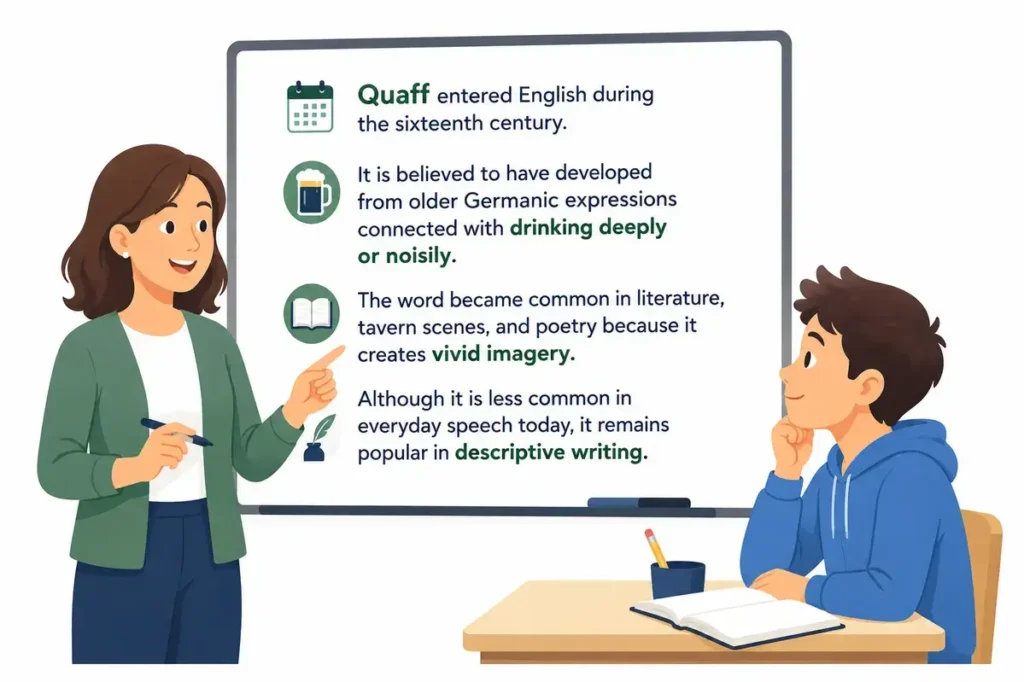
Quaff entered English during the sixteenth century. It is believed to have developed from older Germanic expressions connected with drinking deeply or noisily. The word became common in literature, tavern scenes, and poetry because it creates vivid imagery. Although it is less common in everyday speech today, it remains popular in descriptive writing.
Origin of Coif
Coif entered English through Old French. Originally, it described a close fitting cap worn by men, women, infants, judges, and members of the clergy. As hairstyles became more elaborate, the word gradually expanded to include carefully arranged hair. The related verb produced the familiar form coiffed, which remains common in fashion and beauty writing.
When to Use Quaff
Use quaff when describing enthusiastic drinking rather than ordinary drinking.
It works best when the action is energetic or expressive.
Appropriate Contexts
- Drinking after exercise.
- Celebrations.
- Restaurant reviews.
- Historical novels.
- Fantasy stories.
- Beverage advertising.
- Travel articles.
- Food blogs.
Examples
The athletes quaffed sports drinks after the race.
Explanation:
The sentence emphasizes refreshment after intense activity.
Friends quaffed iced tea on the porch.
Explanation:
The word adds vivid imagery.
Visitors quaffed fresh apple cider during the autumn festival.
Explanation:
Food and travel writers often prefer this verb because it creates a stronger mental picture.
When to Use Coif
Use coif when discussing hairstyles, historical clothing, beauty, or professional hair styling. It appears frequently in fashion journalism and historical writing.
Appropriate Contexts
- Beauty salons.
- Fashion magazines.
- Bridal styling.
- Museum exhibits.
- Historical fiction.
- Costume design.
- Medieval history.
- Celebrity fashion coverage.
Examples
Her bridal coif perfectly matched the elegant gown.
Explanation:
The word refers to a hairstyle.
The museum displayed an authentic medieval coif.
Explanation:
The word means a historical head covering.
The stylist coiffed the actress before the photo shoot.
Explanation:
The verb means arranged or styled the hair.
Can Quaff and Coif Replace Each Other
No.
Although the words share a somewhat similar spelling, they have completely unrelated meanings.
Correct:
The travelers quaffed cool water after the long hike.
Incorrect:
The travelers coifed cool water after the long hike.
The second sentence is incorrect because coif has nothing to do with drinking.
Likewise:
Correct:
The stylist created a beautiful coif for the wedding.
Incorrect:
The stylist created a beautiful quaff for the wedding.
This sentence is incorrect because quaff refers only to drinking. The easiest way to remember the distinction is this simple rule. If the sentence is about a beverage, choose quaff. If the sentence is about hair or a head covering, choose coif.
Key Takeaways
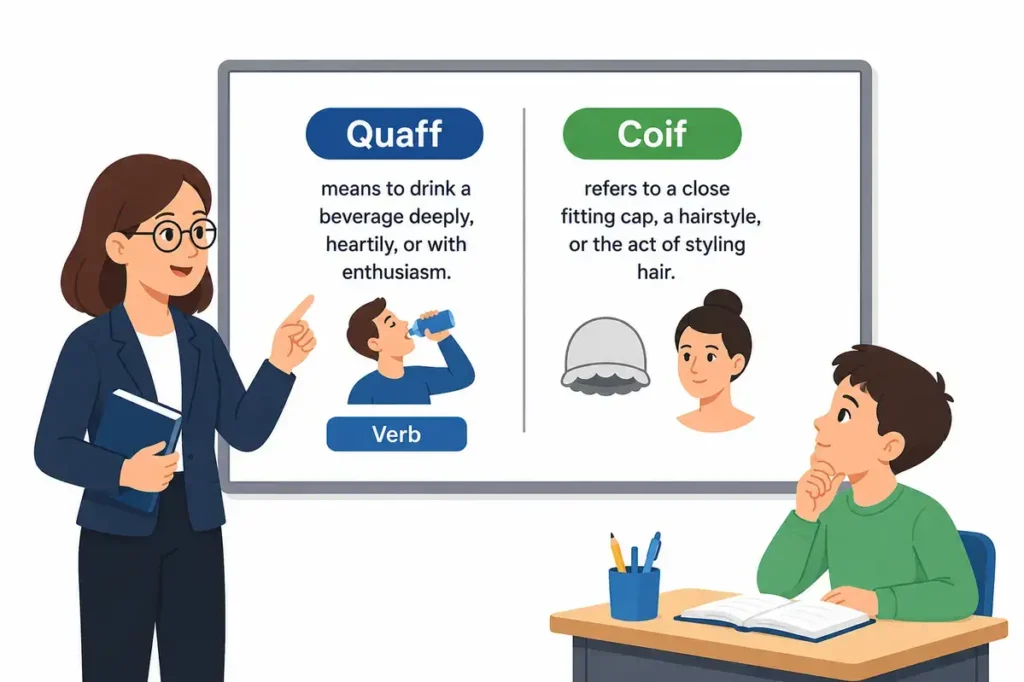
- Quaff means to drink a beverage deeply, heartily, or with enthusiasm.
- Coif refers to a close fitting cap, a hairstyle, or the act of styling hair.
- The two words have completely different meanings and should never be used interchangeably.
- Quaff is always used as a verb.
- Coif can be both a noun and a verb.
- Quaffed is the past tense of quaff.
- Coiffed is the past tense and past participle of coif.
- Quaff commonly appears in literature, travel writing, restaurant reviews, and historical fiction.
- Coif is most common in fashion, beauty, costume design, and historical writing.
- Remember the simple rule: quaff is for drinks, coif is for hair or headwear.
Frequently Asked Questions
Is quaff a real English word?
Yes. Quaff is a standard English verb that means to drink a beverage heartily or with enjoyment. Although it is less common than drink, it is widely recognized and appears in dictionaries, literature, and descriptive writing.
Is coif a real English word?
Yes. Coif is both a noun and a verb. As a noun, it refers to a close fitting cap or a hairstyle. As a verb, it means to arrange or style someone’s hair.
Which is correct, quaff or coif?
Both are correct English words, but they have different meanings.
Use quaff when talking about drinking.
Use coif when referring to hairstyles, hair styling, or historical head coverings.
Can quaff and coif be used interchangeably?
No.
They describe completely different things.
Correct:
The guests quaffed sparkling cider during dinner.
Correct:
The stylist created a beautiful coif for the bride.
Using one in place of the other makes the sentence incorrect.
What is the pronunciation of quaff?
Quaff is pronounced kwaf.
Its IPA pronunciation is /kwɑːf/ or /kwɒf/, depending on the accent.
What is the pronunciation of coif?
Coif is pronounced koyf.
Its IPA pronunciation is /kɔɪf/.
The vowel sound is the same as the word boy.
What is the past tense of quaff?
The past tense is quaffed.
Example:
They quaffed lemonade after the softball game.
What is the past tense of coif?
The past tense is coiffed.
Example:
The stylist coiffed the actor’s hair before filming began.
Is coiffed related to coif?
Yes.
Coiffed is the past tense and past participle of the verb coif. It means someone’s hair has been carefully styled or arranged.
Is quaff formal or informal?
Quaff is generally considered a literary or descriptive verb. It is appropriate in novels, travel writing, restaurant reviews, and articles about food and beverages. In everyday conversation, most people simply say drink.
What words are similar to quaff?
Depending on the context, similar words include:
- Drink.
- Sip.
- Gulp.
- Swallow.
- Chug.
- Imbibe.
- Consume.
Each word has its own nuance. For example, sip suggests drinking slowly, while quaff suggests drinking eagerly or in generous amounts.
What words are similar to coif?
Related words include:
- Hairstyle.
- Hairdo.
- Coiffure.
- Style.
- Head covering.
- Cap.
- Bonnet.
The best choice depends on the context and level of formality.
Conclusion
Understanding Quaff or Coif is easier once you focus on what each word represents rather than how they look. Quaff belongs to the language of drinking and describes enjoying a beverage with enthusiasm or in generous gulps. Coif, by contrast, belongs to the language of fashion and history, referring to a fitted cap, a carefully arranged hairstyle, or the act of styling hair.
Although these words are less common than drink and hairstyle, they remain valuable because they add precision and vivid detail to writing. Authors, journalists, historians, fashion writers, and travel writers continue to use them to create richer descriptions and more engaging sentences.
The simplest way to remember the difference is to connect each word with its natural context. If your sentence is about drinking, choose quaff. If it is about hair, hairstyling, or a historical head covering, choose coif. Following that rule will help you use both words accurately and confidently in every piece of writing.

Confusing Words, Spelling & Word Choice
Claire Whitmore is a U.S.-based English editor who writes about commonly confused words, spelling differences, and word choice. Her work helps readers understand subtle distinctions between similar-looking words through simple definitions, practical examples, and modern usage guidance in both American and British English.