
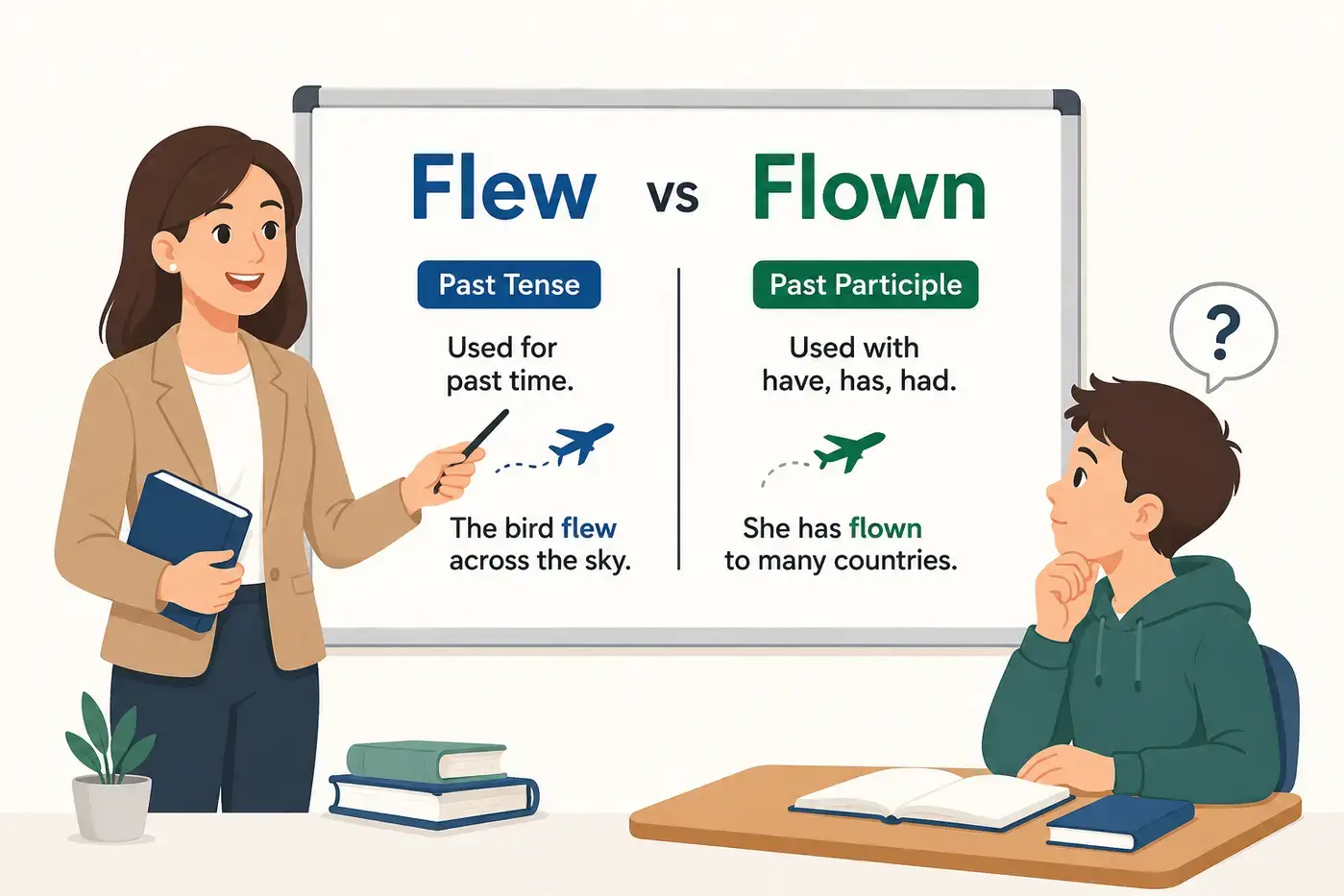
Flew or Flown is a question that confuses many English learners and even native speakers. The reason is simple. Both words come from the same verb, both describe flying, and both are correct. The difference comes from grammar, not meaning. If you remember one rule, you’ll avoid this mistake every time. Use flew when talking about a completed action in the past. Use flown after a helping verb.
Many people write sentences like I have flew to New York or She has flew home. Those sentences sound natural to some ears, but they’re grammatically incorrect. The correct form is I have flown to New York and She has flown home.
This guide explains the difference in plain English. You’ll learn the grammar rule, see dozens of real examples, understand common mistakes, discover memory tricks, and gain the confidence to choose the right word every time.

Short Answer
Flew and flown are both correct, but they serve different jobs in English grammar. Flew is the simple past tense of fly. Flown is the past participle and needs a helping verb such as has have had was were is or been. If you say Yesterday I flew to Chicago use flew. If you say I have flown to Chicago many times use flown.
Table Of Contents
- Flew Or Flown Short Answer.
- What Is The Difference Between Flew And Flown.
- Understanding The Verb Fly.
- When To Use Flew.
- When To Use Flown.
- Flew Vs Flown Comparison Table.
- Real World Examples.
- Common Mistakes.
- Easy Memory Tricks.
- Related Grammar Rules.
- Frequently Asked Questions.
- Key Takeaways.
- Conclusion.
What Is The Difference Between Flew And Flown
The biggest difference between flew and flown is their grammatical role.
Flew is the simple past tense.
Flown is the past participle.
The meaning stays almost the same. The sentence structure changes. Compare these examples.
I flew to Boston last week.
I have flown to Boston many times.
Both sentences talk about flying. The first describes a completed action in the past. The second connects past experiences to the present. Many English verbs work the same way.
Eat becomes ate and eaten.
Drive becomes drove and driven.
Write becomes wrote and written.
Fly follows the same pattern.
Fly.
Flew.
Flown.
Once you recognize this pattern, choosing the correct word becomes much easier.
Understanding The Verb Fly
Fly is an irregular verb. Regular verbs simply add ed to form the past tense.
Walk becomes walked.
Jump becomes jumped.
Clean becomes cleaned.
Fly doesn’t follow that pattern.
Instead, it changes completely.
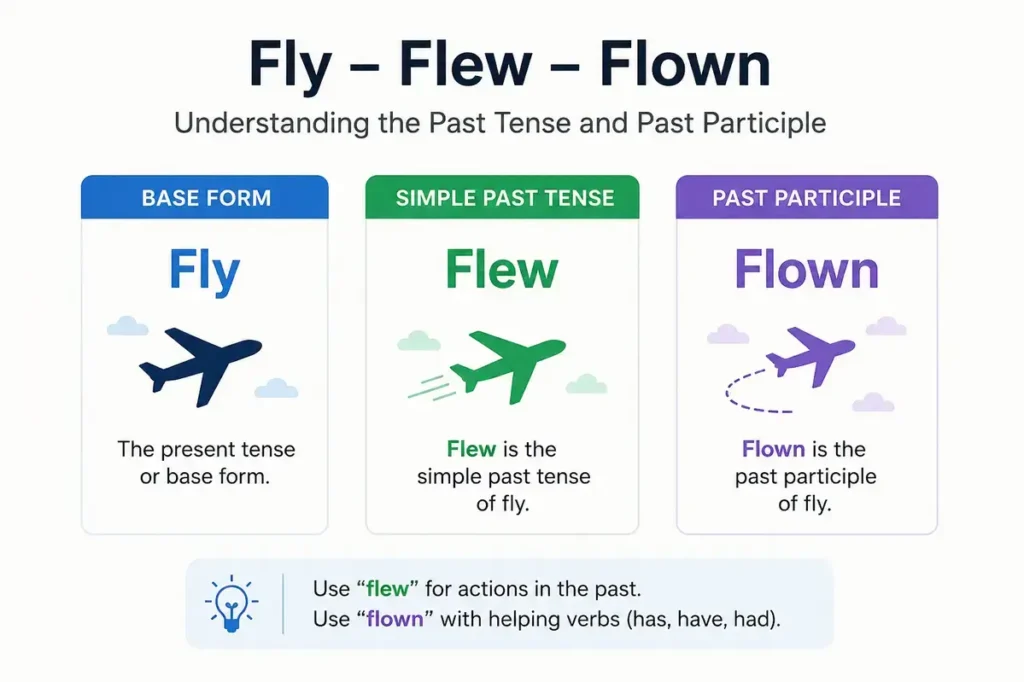
| Verb Form | Word | Example |
|---|---|---|
| Base form | Fly | Birds fly south every winter. |
| Simple past | Flew | The birds flew south last winter. |
| Past participle | Flown | The birds have flown south already. |
This pattern has existed in English for centuries. It comes from older forms of the language that kept strong verb changes instead of adding ed. Today, fly remains one of the most common irregular verbs in everyday English.
When To Use Flew
Use flew when describing an action that happened and was completed in the past. It is the simple past tense of fly.
In these sentences, no helping verb comes before flew. You will often see it with time expressions such as yesterday, last night, last year, this morning, two days ago, or in 2024, all of which point to a finished event.
Examples
- I flew to Seattle yesterday.
- She flew across the country for a conference.
- They flew home after the wedding.
- The eagle flew over the mountains.
- Our drone flew perfectly during the test.
Each sentence describes a completed action. The event began in the past, ended in the past, and is now finished. That is exactly how the simple past tense works.
Flew vs Have Flew
Compare these examples.
Correct:
We flew to Florida last summer.
Incorrect:
We have flew to Florida last summer.
The second sentence is incorrect because it combines two different grammar patterns.
After have, has, or had, English requires the past participle, not the simple past tense. The correct past participle of fly is flown, not flew.
Correct:
We have flown to Florida several times.
More Everyday Examples of Flew
- The soccer ball flew into the crowd.
- The airplane flew through heavy clouds.
- My grandfather flew military aircraft for many years.
- The kite flew higher than I expected.
- The baseball flew over the fence.
Notice something interesting. Flew is not used only for airplanes. It can describe any person, animal, or object that moves through the air.
For example, birds, insects, drones, kites, balloons, sports equipment, and even thrown objects can all be described as flew when referring to a completed action in the past.
Common Time Expressions That Usually Use Flew
Certain time markers almost always signal the simple past tense.
Yesterday.
A few days ago.
A month ago.
Last year.
An hour ago.
In 2023.
Earlier today.
This morning.
Last night.
For example.
My parents flew to Miami last month.
The helicopter flew over the city yesterday.
She flew to London in April.
These time expressions point to completed actions, making flew the natural choice.
When Flew Sounds Natural But Is Still Wrong
Many speakers accidentally use flew after helping verbs because the sentence sounds familiar.
For example.
I have flew there before.
She has flew across the Atlantic.
They had flew home already.
Every sentence above is incorrect.
The correct versions are.
I have flown there before.
She has flown across the Atlantic.
They had flown home already.
This mistake happens because people remember the past tense more easily than the past participle.
English has many verbs that cause the same confusion.
Saw and seen.
Broke and broken.
Took and taken.
Wrote and written.
Flew and flown belong to the same group.
Learning one pattern helps you master dozens of irregular verbs.
Why English Uses Different Verb Forms
English uses different verb forms to show both time and sentence structure.
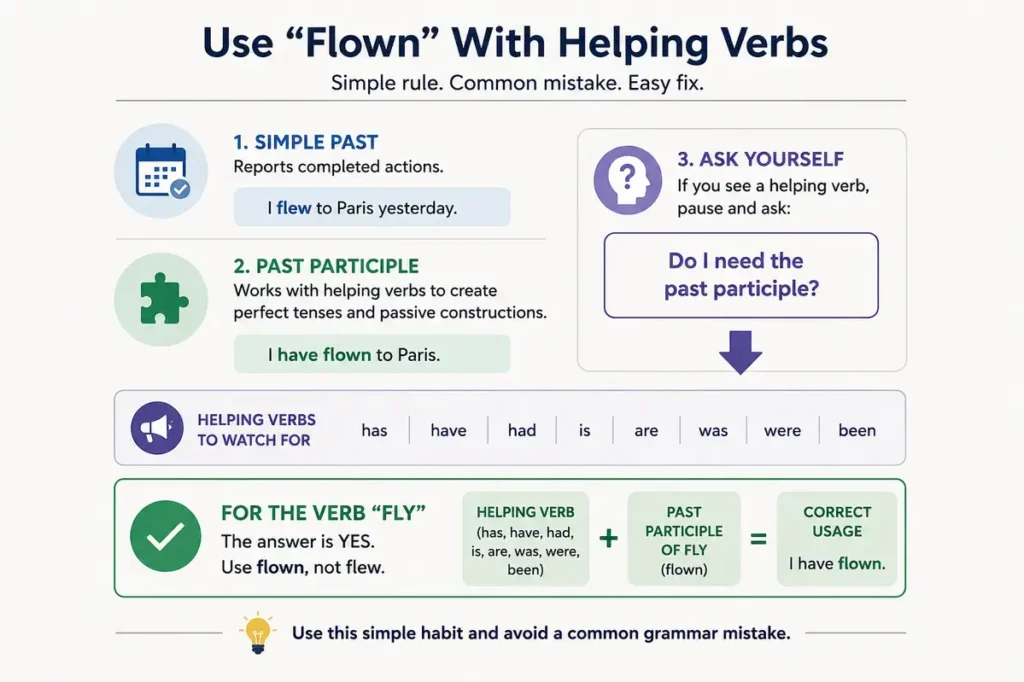
The simple past tense describes actions that started and finished in the past. The past participle is used with helping verbs to form perfect tenses and passive voice.
A simple trick can help you choose the correct form.
When you see a helping verb such as has, have, had, is, are, was, were, or been, stop and ask yourself one question.
Do I need the past participle?
For the verb fly, the answer is yes.
That means you should use flown, not flew.
Building this habit makes it much easier to choose the correct verb form and helps you avoid one of the most common grammar mistakes in everyday English.
Professional Writing Tip
Professional editors rarely confuse flew and flown because they check the helping verb first instead of looking only at the main verb. That’s a useful habit for anyone who writes emails, reports, articles, academic papers, or business documents. When you proofread, scan each sentence for words like has, have, and had. If one appears before fly, the correct choice is almost always flown. This quick check takes only a few seconds, yet it catches a mistake that many writers overlook.
When To Use Flown
Use flown after a helping verb. It never stands alone as the main verb in a complete sentence.
Helping verbs include:
- Has.
- Have.
- Had.
- Is.
- Are.
- Was.
- Were.
- Be.
- Been.
- Being.
These helping verbs tell you that the sentence needs the past participle. For the verb fly, the past participle is flown.
Look at these examples.
I have flown to Los Angeles several times.
She has flown across the Pacific.
They had flown home before the storm arrived.
The package was flown by helicopter.
Our team has flown on every major airline in the country.
In each sentence, flown follows a helping verb. That makes the grammar correct.
A simple trick works almost every time.
If you can remove the helping verb and the sentence still makes sense, you probably need flew instead of flown.
Compare these examples.
Correct. She flew to Denver yesterday.
Correct. She has flown to Denver many times.
Incorrect. She flown to Denver yesterday.
Incorrect. She has flew to Denver many times.
The helping verb changes everything.
Flew Vs Flown Comparison Table
| Feature | Flew | Flown |
|---|---|---|
| Verb form | Simple past | Past participle |
| Needs a helping verb | No | Yes |
| Describes | A completed past action | A completed action connected to another verb |
| Common partners | Yesterday last week last year | Has have had was were been |
| Correct example | We flew to Texas yesterday. | We have flown to Texas many times. |
This table gives you the quickest way to remember the difference.
Flew And Flown In Different Tenses
The verb fly appears in several common tenses.
| Tense | Example |
|---|---|
| Simple present | I fly to work every Monday. |
| Simple past | I flew to work yesterday. |
| Present perfect | I have flown to work before. |
| Past perfect | I had flown there before the meeting started. |
| Future perfect | By next year I will have flown to every state. |
| Passive voice | The patient was flown to the hospital. |
Notice that every perfect tense uses flown.
Only the simple past uses flew.
Real Life Examples
Reading real examples helps grammar stick in your memory.
Travel
I flew to New York last weekend.
My parents have flown to Hawaii three times.
She had flown across Europe before turning thirty.
The rescue team was flown to the island.
Business
Our CEO flew to Chicago for the conference.
Several executives have flown overseas this year.
The documents were flown to the client overnight.
School
Our class flew to Washington for an educational trip.
Many students have flown for the first time during school programs.
Sports
The baseball flew over the wall.
The football has flown farther than anyone expected.
The golf ball flew straight down the fairway.
Nature
The eagle flew above the canyon.
The birds have flown south for the winter.
A butterfly flew through the open window.
Emergency Services
The injured climber was flown to the nearest hospital.
Doctors have flown to remote villages during natural disasters.
Flew Or Flown In Everyday Expressions
The verb fly appears in many common expressions.
Time flew by.
The rumor flew across town.
The colors flew off the shelves.
The news has flown around the office.
His temper flew out of control.
Even in figurative language, the grammar rule stays the same.
Simple past uses flew.
Perfect tenses use flown.
Common Mistakes
Many mistakes appear because writers focus on meaning instead of grammar.
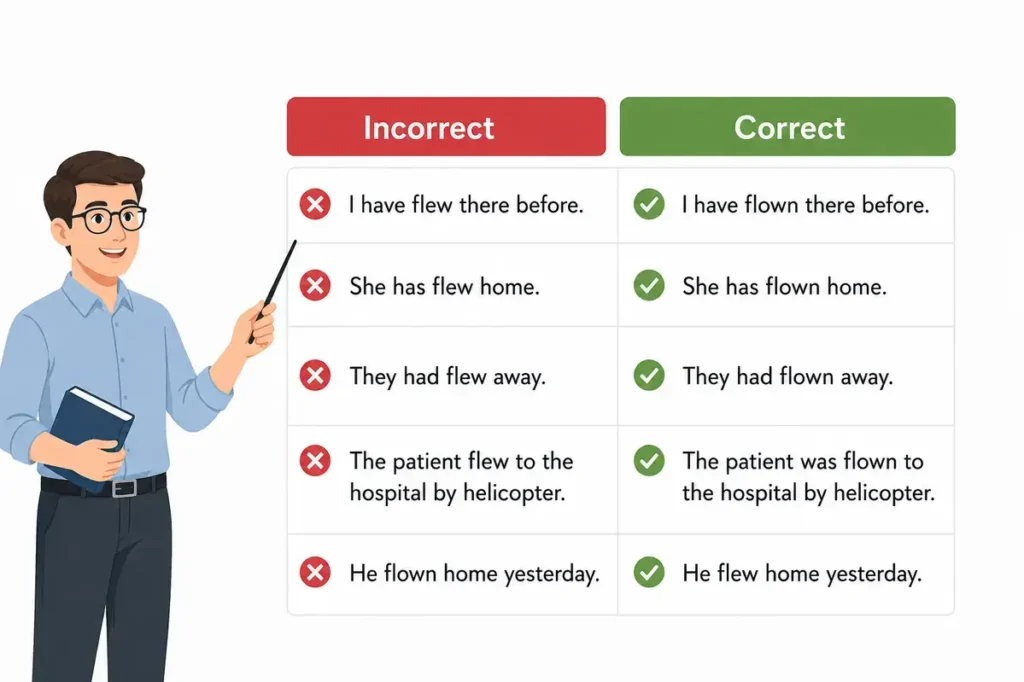
Here are some of the most common errors.
| Incorrect | Correct |
|---|---|
| I have flew there before. | I have flown there before. |
| She has flew home. | She has flown home. |
| They had flew away. | They had flown away. |
| The patient flew to the hospital by helicopter. | The patient was flown to the hospital by helicopter. |
| He flown home yesterday. | He flew home yesterday. |
Read the helping verb first.
That habit catches almost every mistake.
Why This Mistake Happens
English learners often memorize verb lists without using them in real sentences.
Native speakers make a different mistake.
They hear flew much more often than flown in daily conversation. As a result, they sometimes use the familiar form everywhere.
Irregular verbs also refuse to follow one simple pattern.
Compare these pairs.
Go became went and gone.
Break became broke and broken.
Speak became spoke and spoken.
Drive became drove and driven.
Fly became flew and flown.
Once you recognize this family of irregular verbs, the grammar starts to feel much more natural.
Memory Tips
You do not need to memorize long grammar rules.
Remember these simple ideas instead.
- Yesterday means flew.
Yesterday I flew to Boston.
- Has have or had means flown.
I have flown to Boston.
- If you see a helping verb, look for the past participle.
- Think of flown as the partner that never works alone.
That image makes the rule much easier to remember.
Pronunciation
Many learners also wonder how these words sound.
Fly
Sounds like fly.
Flew
Rhymes with blue.
Flown
Rhymes with stone.
Clear pronunciation helps you recognize these forms during conversations and while listening to native speakers.
American And British English
American English and British English follow the same grammar rule.
Americans say:
I flew to California last week. I have flown to California several times. British speakers use the same forms. I flew to London yesterday. I have flown to London many times. The spelling and grammar do not change across these two major varieties of English. That makes this rule easy to apply no matter which style of English you use.
Related Grammar Notes
Learning one irregular verb often helps you learn many others.
Compare these patterns.
| Base Verb | Simple Past | Past Participle |
|---|---|---|
| Fly | Flew | Flown |
| Write | Wrote | Written |
| Drive | Drove | Driven |
| Break | Broke | Broken |
| Speak | Spoke | Spoken |
| Eat | Ate | Eaten |
| Take | Took | Taken |
| See | Saw | Seen |
Notice the pattern.
The simple past and the past participle are different forms.
Confusing them creates one of the most common grammar mistakes in English writing.
Key Takeaways
- Both flew and flown are correct English words.
- Flew is the simple past tense of fly.
- Flown is the past participle.
- Flown follows helping verbs such as has have had was and were.
- Never write have flew or has flew.
- Look for the helping verb before choosing the correct form.
- The grammar rule is the same in American English and British English.
- Reading and writing complete sentences is the fastest way to build confidence with irregular verbs.
Conclusion
Understanding Flew Or Flown becomes much easier once you know the job each word performs. The meaning stays the same, but the grammar changes. Use flew for a completed action in the past. Use flown after a helping verb to form perfect tenses or the passive voice.
A simple habit can save you from this common mistake. Before choosing the verb, look for a helping verb. If you see has have had is are was were or been, the correct choice is almost always flown. If no helping verb appears and the action happened in the past, flew is usually the right answer.
Like many irregular verbs in English, this pair becomes easier with practice. Read good writing, pay attention to sentence structure, and use these forms in your own conversations and writing. Before long, choosing between flew and flown will feel natural instead of confusing. The next time you pause to decide between Flew Or Flown, remember one simple rule. Flew stands alone as the simple past tense. Flown works with a helping verb. That single rule will help you write with greater accuracy and confidence every time.
Frequently Asked Questions
Is Flew Or Flown Correct?
Both words are correct. The right choice depends on the sentence. Use flew as the simple past tense. Use flown as the past participle after a helping verb.
Examples.
I flew to Dallas last weekend.
I have flown to Dallas many times.
Is It I Have Flew Or I Have Flown?
The correct sentence is I have flown. The helping verb have requires the past participle.
Correct.
I have flown across the country.
Incorrect.
I have flew across the country.
Is It Has Flew Or Has Flown?
The correct form is has flown.
Examples.
She has flown to Miami twice.
The pilot has flown this route for years.
Using has flew is always incorrect.
Can Flown Be Used Without A Helping Verb?
No. Flown needs a helping verb in standard English.
Correct.
The supplies were flown to the island.
Incorrect.
The supplies flown to the island yesterday.
The second sentence is missing a helping verb.
Is Flew A Past Tense Verb?
Yes. Flew is the simple past tense of fly. It describes an action that started and finished in the past.
Example.
The bird flew out of the tree.
Is Flown A Past Participle?
Yes. Flown is the past participle of fly. It appears in perfect tenses and passive voice.
Examples.
They have flown together many times.
The patient was flown to the hospital.
Why Do People Mix Up Flew And Flown?
Most people remember the simple past tense first because they hear it more often in everyday conversation. They also forget that helping verbs change the verb form. Looking for words like has have and had helps you avoid this mistake.
Does American English Use Flew And Flown Differently?
No. American English and British English use the same grammar rule. The spelling stays the same. The verb forms stay the same. Only the context changes.
Is Flew Or Flown Used In Formal Writing?
Yes. Both forms appear regularly in business writing academic papers news reports books and professional communication. The key is using the correct form for the sentence. Formal writing values grammatical accuracy. Choosing the correct verb form makes your writing clearer and more professional.
How Can I Remember Flew And Flown?
Think about one simple pattern. If the sentence includes a helping verb such as has have or had choose flown. If the sentence talks about a completed action in the past without a helping verb choose flew. This quick check works almost every time.

English Grammar & Usage
Nathan Holloway is an American grammar writer and language researcher who specializes in English grammar, sentence structure, verb usage, and common writing mistakes. He enjoys breaking down confusing grammar rules into practical explanations with clear examples, making English easier for students, professionals, and everyday writers.