
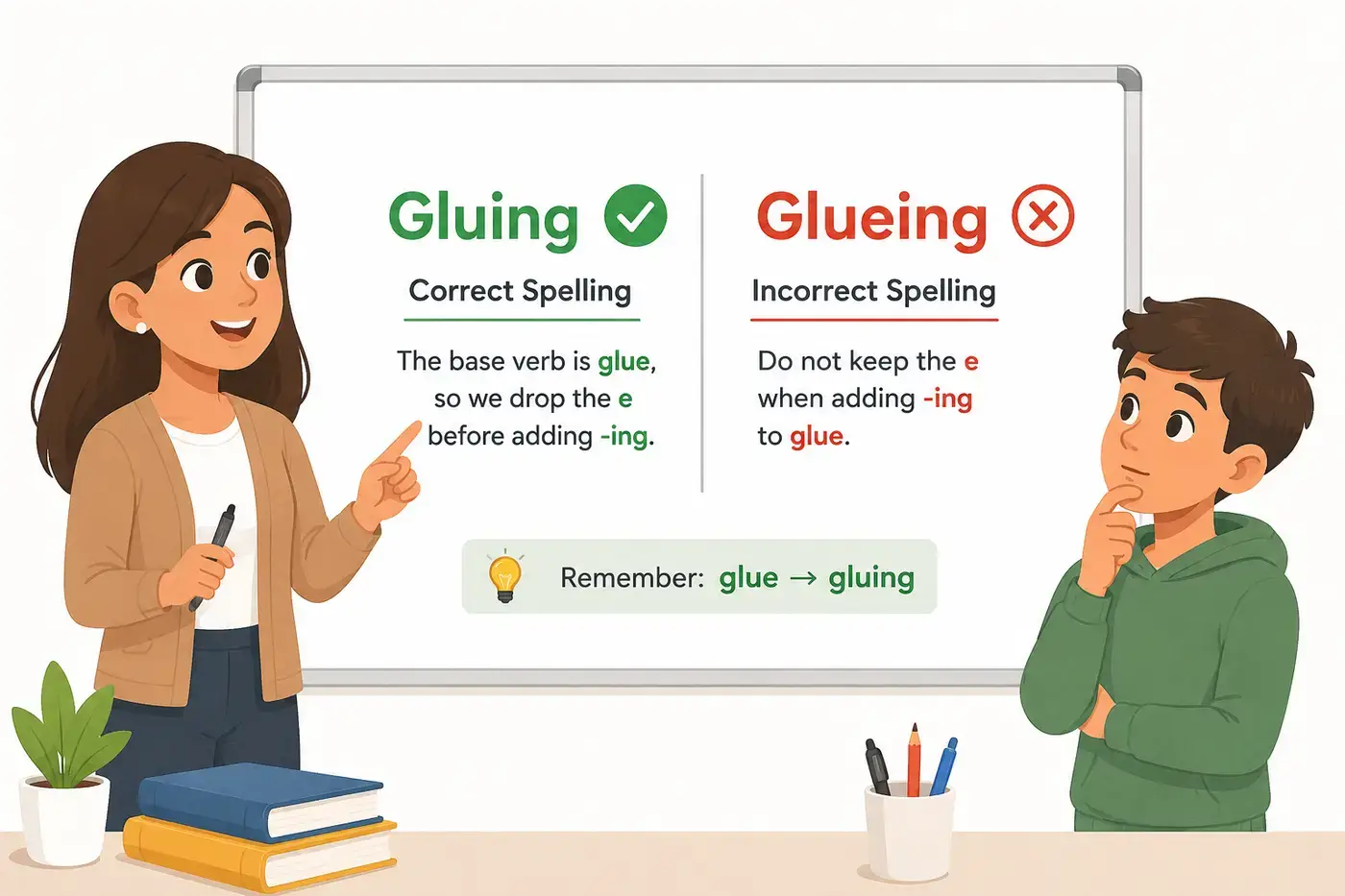
Gluing vs Glueing is a question that surprises many English learners and even experienced writers. At first glance, both spellings seem reasonable. After all, the base word ends with the letter E, so keeping that letter before adding ING feels natural.
English does not always work that way. When a verb ends with a silent E, English usually drops the final E before adding ING. That simple rule turns glue into gluing, just as make becomes making and write becomes writing.
The confusion comes from appearance rather than grammar. Many people type glueing because they expect the original spelling of glue to stay unchanged. Modern dictionaries, style guides, publishers, and professional editors all prefer gluing instead. This guide explains the grammar rule, the reason behind the spelling, the difference between the two forms, common mistakes, pronunciation, examples, and expert writing advice. By the end, you’ll know exactly which spelling belongs in every situation.
Short Answer
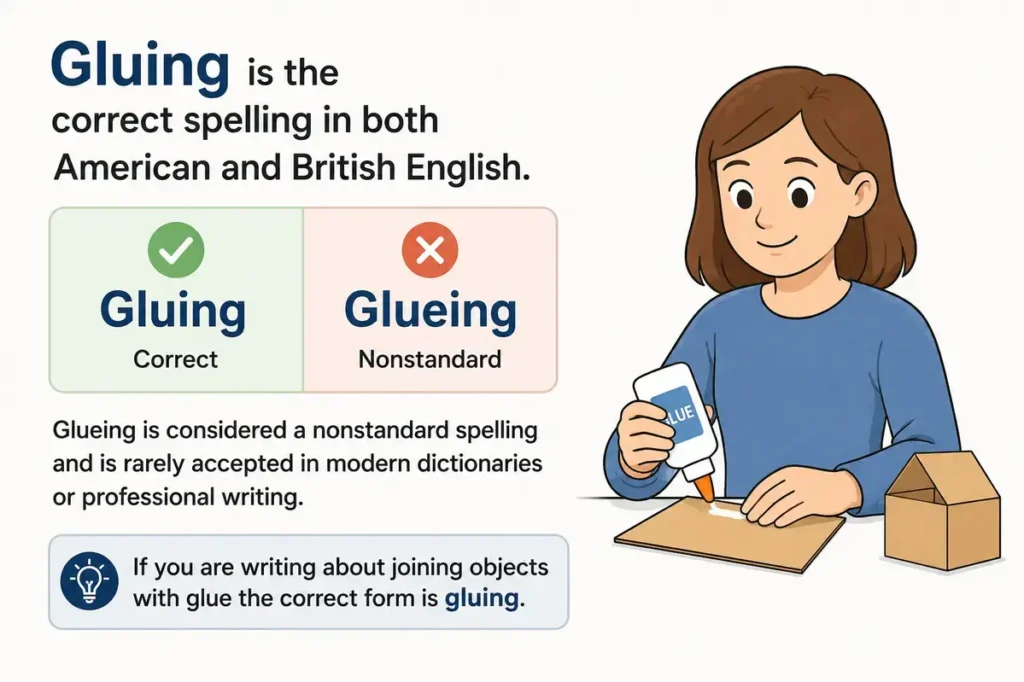
Gluing is the correct spelling in both American and British English. Glueing is considered a nonstandard spelling and is rarely accepted in modern dictionaries or professional writing. If you are writing about joining objects with glue the correct form is gluing.
Table Of Contents
- Gluing Vs Glueing At A Glance.
- Is Gluing Or Glueing Correct.
- Why Gluing Is The Standard Spelling.
- Meaning Of Gluing.
- Why People Write Glueing.
- Gluing Vs Glueing Comparison Table.
- Grammar Rule Behind Gluing.
- Why English Drops The Final E.
- Examples Of Gluing In Everyday Writing.
Gluing Vs Glueing At A Glance
| Feature | Gluing | Glueing |
|---|---|---|
| Correct spelling | Yes | No in standard English |
| American English | Standard | Nonstandard |
| British English | Standard | Rare and generally avoided |
| Found in modern dictionaries | Yes | Rarely |
| Recommended by editors | Yes | No |
| Suitable for professional writing | Yes | Avoid |
The table tells the whole story. Gluing is the accepted spelling across modern English. Glueing appears only occasionally in older texts or informal writing and is not recommended for professional use.
Is Gluing Or Glueing Correct
The correct spelling is gluing.
The verb glue follows the standard English spelling rule for verbs ending in a silent E. Before adding ING, the final E disappears.
Glue becomes gluing.
This pattern appears in thousands of English sentences every day.
Examples.
The carpenter is gluing the wooden panels together.
She spent the afternoon gluing family photos into a scrapbook.
The children are gluing colored paper onto the poster.
Each sentence follows standard English spelling.
Writing glueing instead of gluing is considered a spelling mistake in modern English.
Why Gluing Is The Standard Spelling
English spelling often looks unpredictable, but many common patterns stay surprisingly consistent.
One of those patterns applies to verbs ending in a silent E.
The rule is simple.
Drop the silent E before adding ING.
That gives us these familiar words.
| Base Verb | Correct -ing Form |
|---|---|
| Make | Making |
| Bake | Baking |
| Write | Writing |
| Save | Saving |
| Smile | Smiling |
| Shine | Shining |
| Glue | Gluing |
Notice that glue behaves just like the other verbs.
Nothing special happens because the word ends with UE.
The silent E still disappears.
Professional editors rarely stop to think about this rule because they have seen gluing thousands of times in books, newspapers, websites, manuals, and academic writing.
Correct spelling eventually becomes automatic.
Meaning Of Gluing
The word gluing is the present participle and gerund form of the verb glue.
It describes the action of joining two or more things together with an adhesive.
Examples.
The technician is gluing the broken plastic pieces together.
Gluing small parts requires patience.
The artist enjoys gluing shells onto handmade picture frames.
The engineer recommended gluing the loose section before painting it.
In every example, gluing describes an action involving adhesive materials.
The spelling never changes.
Why People Write Glueing
The mistake makes perfect sense.
People often expect English words to keep their original spelling when endings are added.
Since the base word is glue, many assume the new form should simply become glueing.
That assumption feels logical.
English spelling follows historical patterns instead of visual consistency.
The silent E disappears because it no longer serves a purpose before ING.
The pronunciation stays exactly the same.
Glue.
Gluing.
The sound does not change after removing the final E.
This surprises many learners because they expect spelling changes to affect pronunciation.
In this case, they do not.
Gluing Vs Glueing Comparison Table
| Category | Gluing | Glueing |
|---|---|---|
| Modern spelling | Correct | Incorrect |
| Dictionary approval | Yes | Rarely accepted |
| Grammar | Correct | Incorrect |
| School writing | Recommended | Avoid |
| Academic papers | Recommended | Avoid |
| Business writing | Recommended | Avoid |
| Professional editing | Correct | Corrected to gluing |
| Search popularity | Much higher | Very low |
Professional proofreaders routinely replace glueing with gluing during editing.
That small correction improves accuracy and keeps writing aligned with modern English standards.
Grammar Rule Behind Gluing
The spelling rule comes from one of the most common patterns in English.
When a verb ends with a silent E, remove that E before adding ING.
Examples include.
| Verb | -ing Form |
|---|---|
| Dance | Dancing |
| Drive | Driving |
| Love | Loving |
| Move | Moving |
| Bake | Baking |
| Smile | Smiling |
| Use | Using |
| Glue | Gluing |
Notice how every word follows the same pattern. Learning this single rule helps eliminate dozens of spelling mistakes at once. Instead of memorizing every word separately, you remember one spelling principle. That approach is exactly how experienced editors work.
Why English Drops The Final E
The final E in many English verbs is silent. Its main job is to influence the pronunciation of the vowel that comes before it. Once ING is added, that silent E no longer serves an important purpose. English removes it to keep spelling efficient. Think about these examples. Hope becomes hoping. Love becomes loving. Write becomes writing. Shine becomes shining. Glue becomes gluing. Each follows the same spelling pattern. Although English has exceptions, glue is not one of them.
Examples Of Gluing In Everyday Writing
Seeing real examples makes the rule much easier to remember.
The teacher is gluing pictures onto the classroom wall.
My father spent the evening gluing the broken chair back together.
She enjoys gluing dried flowers into handmade greeting cards.
The repair shop recommended gluing the loose trim before replacing it.
The children practiced gluing shapes onto colorful paper.
The designer was gluing fabric samples into a presentation book.
The model builder spent hours gluing tiny plastic pieces together.
The museum conservator carefully restored the damaged frame by gluing loose sections into place.
Every sentence uses gluing naturally and correctly.
None of them require the spelling glueing.
Pronunciation Of Gluing
One reason people write glueing is that they assume removing the final E will change the pronunciation.
It does not.
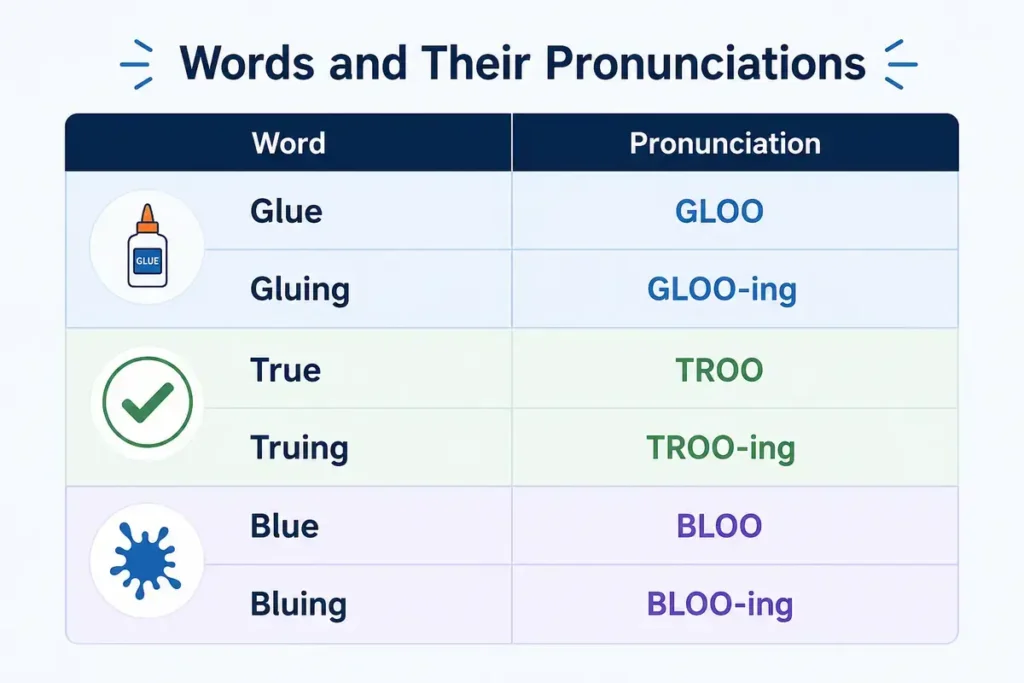
Glue is pronounced as GLOO.
Gluing is pronounced as GLOO ING.
The pronunciation stays smooth and natural. The missing E has no effect on how the word sounds.
Think about these words.
| Word | Pronunciation |
|---|---|
| Glue | GLOO |
| Gluing | GLOO-ing |
| True | TROO |
| Truing | TROO-ing |
| Blue | BLOO |
| Bluing | BLOO-ing |
The spelling changes. The pronunciation remains almost the same.
That is why native English speakers rarely notice the spelling rule while reading.
Is Glueing Ever Correct
In modern English, gluing is the accepted spelling.
You may occasionally see glueing in old books, archived documents, personal blogs, or informal online posts.
That does not make it the preferred spelling.
Language changes over time. Many spellings that appeared in older publications have disappeared as dictionaries and style guides became more consistent.
Today, editors almost always replace glueing with gluing.
If your goal is clear and professional writing, always choose gluing.
American And British English
Some English words have different spellings in the United States and the United Kingdom.
Examples include.
| American English | British English |
|---|---|
| Color | Colour |
| Favorite | Favourite |
| Organize | Organise |
| Traveling | Travelling |
Many writers assume gluing follows a similar pattern.
It does not.
Both American English and British English use gluing.
There is no regional spelling difference.
This makes the word easy to remember because you never need to change it for your audience.
Why Dictionaries Prefer Gluing
Modern dictionaries are based on actual language use.
Editors study millions of published books, newspapers, journals, magazines, websites, and academic papers.
The evidence is clear.
Gluing appears overwhelmingly more often than glueing.
That widespread usage explains why dictionaries list gluing as the standard form.
Professional writers follow the same convention because consistency helps readers trust the text.
Common Mistakes People Make
Many spelling mistakes happen because people rely on appearance instead of grammar.
Here are the most common errors.
Keeping The Silent E
Incorrect.
The children are glueing decorations onto the poster.
Correct.
The children are gluing decorations onto the poster.
The silent E disappears before adding ING.
Assuming Both Spellings Are Equal
Some writers believe both forms are acceptable.
They are not.
Modern English strongly prefers gluing.
Copying Older Sources
Older books sometimes contain spellings that no longer match current standards.
Modern writing should follow current dictionaries instead of outdated examples.
Guessing Instead Of Checking
Many spelling mistakes disappear after a quick dictionary check.
Professional editors verify uncertain words instead of relying on memory alone.
Real Life Examples
Reading complete sentences helps the correct spelling become familiar.
The volunteers spent the morning gluing labels onto donation boxes.
My daughter enjoys gluing colorful buttons onto handmade cards.
The artist is gluing tiny beads onto the sculpture.
The repair technician recommended gluing the loose corner instead of replacing the entire panel.
The science class practiced gluing different materials together during the experiment.
She learned that gluing works better after cleaning the surface.
The craft instructor demonstrated the safest way of gluing foam pieces together.
The furniture maker finished gluing the final joint before sanding the table.
Every sentence uses the same spelling because the grammar rule never changes.
Gluing In Different Types Of Writing
The word appears in many kinds of writing.
Everyday Conversation
I am gluing the broken mug.
She is gluing the decorations now.
Academic Writing
Researchers examined the strength of different gluing methods.
Students compared several gluing techniques during the laboratory exercise.
Business Writing
The instructions recommend gluing both surfaces before assembly.
Workers should avoid moving the product until the gluing process is complete.
Technical Writing
Proper gluing increases structural stability.
Surface preparation improves gluing performance.
No matter the writing style, the spelling remains gluing.
Memory Trick
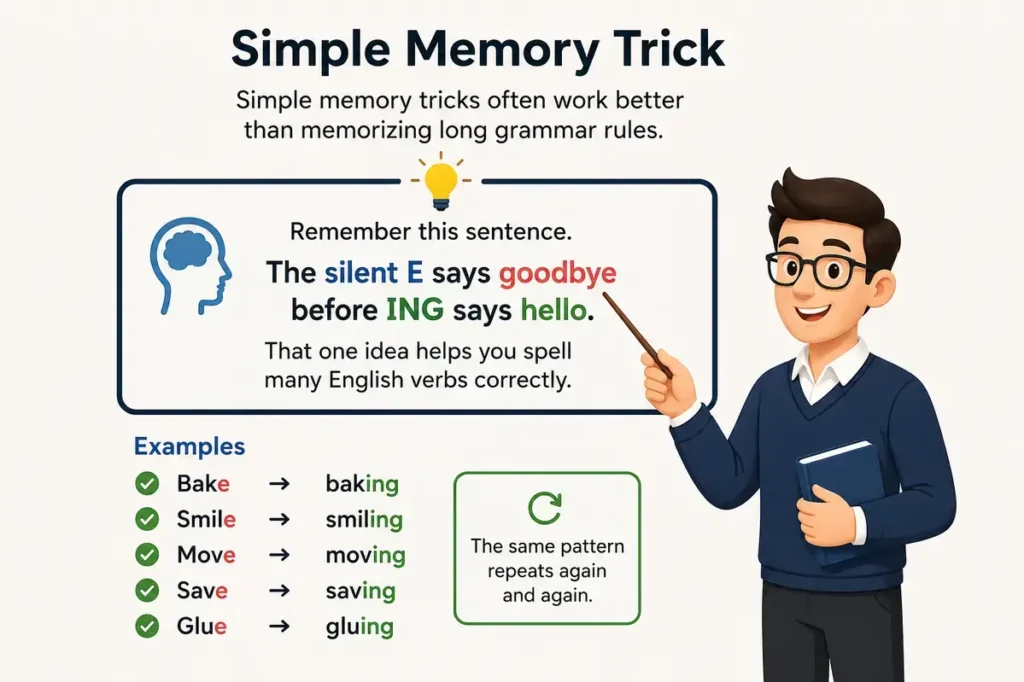
Simple memory tricks often work better than memorizing long grammar rules.
Remember this sentence.
The silent E says goodbye before ING says hello.
That one idea helps you spell many English verbs correctly.
Examples include.
Bake becomes baking.
Smile becomes smiling.
Move becomes moving.
Save becomes saving.
Glue becomes gluing.
The same pattern repeats again and again.
Related Grammar Rule
Learning one spelling rule usually helps with many other words.
Here are several verbs that behave exactly like glue.
| Base Verb | Correct -ing Form |
|---|---|
| Use | Using |
| Live | Living |
| Hope | Hoping |
| Shape | Shaping |
| Share | Sharing |
| Store | Storing |
| Create | Creating |
| Glue | Gluing |
Notice that every silent E disappears before ING.
This is one of the most reliable spelling patterns in English.
Similar Words That Cause Confusion
English contains many words that create the same kind of uncertainty.
Ageing And Aging
American English prefers aging.
British English commonly uses ageing.
Unlike gluing, this word has regional variation.
Dyeing And Dying
These two words have different meanings.
Dyeing means coloring fabric or hair.
Dying means approaching death.
The extra E prevents confusion.
Singeing And Singing
Singeing means lightly burning something.
Singing means making musical sounds.
Again, the spelling helps separate two different meanings.
Glue has no competing word that creates confusion.
That is another reason gluing keeps the simpler spelling.
Professional Editing Advice
Experienced editors look for patterns instead of isolated mistakes.
If they notice glueing, they immediately recognize it as a spelling error because it breaks a familiar rule.
Most editing software also identifies glueing as incorrect.
That makes gluing the safer choice for school assignments, business reports, books, articles, websites, technical manuals, and professional communication.
Good writing is not about using complicated words.
It is about using the correct ones consistently.
Why Native Speakers Rarely Make This Mistake
Native speakers usually learn words through repeated exposure.
They read gluing thousands of times in books, instructions, magazines, websites, product labels, and classroom materials. Eventually, the spelling becomes automatic. They may never consciously think about the grammar rule. That is one reason experienced writers trust familiar spelling patterns instead of guessing. The more you read, the more natural correct spelling becomes.
Key Takeaways
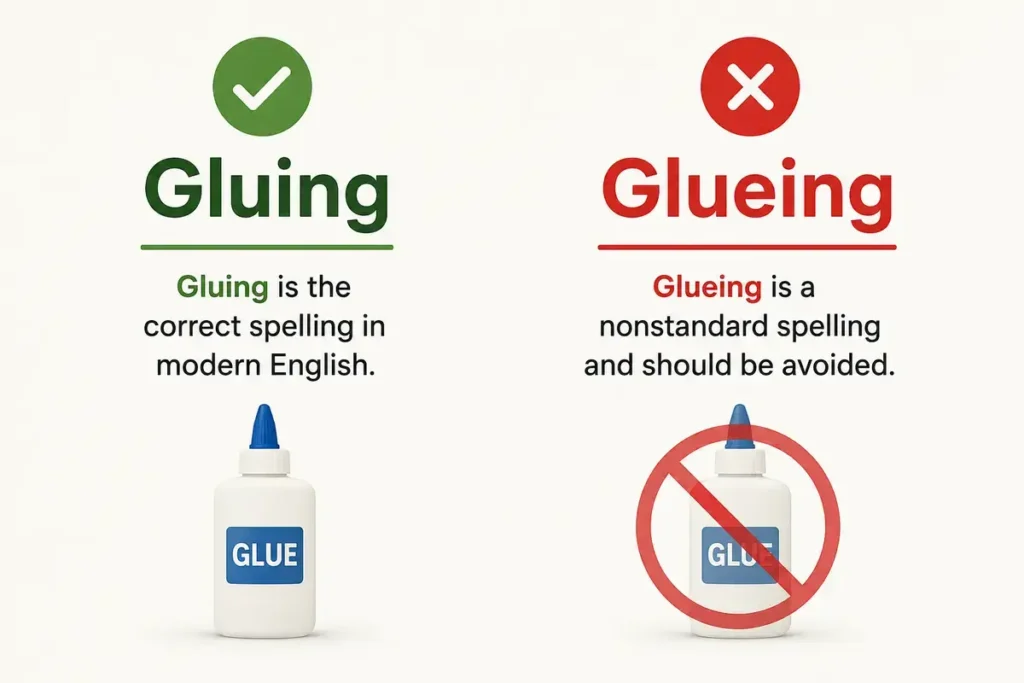
- Gluing is the correct spelling in modern English.
- Glueing is a nonstandard spelling and should be avoided.
- The silent E disappears before adding ING.
- The pronunciation does not change after removing the final E.
- American English and British English both use gluing.
- Professional editors and modern dictionaries recommend gluing.
- Learning the silent E rule also helps you spell many other verbs correctly.
Frequently Asked Questions
Is Gluing Or Glueing Correct?
Gluing is the correct spelling. It follows the standard English rule that removes the silent E before adding ING. Glueing is considered a nonstandard spelling and should be avoided in modern writing.
Why Does Glue Lose The Final E?
The final E is silent. English usually drops a silent E before adding ING to a verb. That is why glue becomes gluing.
Is Glueing A Real Word?
You may find glueing in some older publications or informal writing. Modern dictionaries and style guides recommend gluing, making it the correct choice today.
Do American And British English Use Different Spellings?
No. Both American English and British English use gluing. There is no regional spelling difference for this word.
Why Does Gluing Look Strange?
Many people expect the original spelling of glue to stay the same after adding ING. English spelling does not always follow appearance. The silent E disappears because it is no longer needed.
Is Gluing A Verb Or A Noun?
It can be both.
As a verb it describes an action.
Example.
She is gluing the broken vase together.
As a gerund it acts like a noun.
Example.
Gluing requires patience and steady hands.
The spelling stays the same in both cases.
How Can I Remember The Correct Spelling?
Remember this simple rule.
Drop the silent E before adding ING.
If you can spell making, writing, smiling, and saving, you can also spell gluing correctly.
Does Spell Check Catch Glueing?
Most modern spelling and grammar checkers recognize glueing as incorrect and suggest gluing instead. Still, proofreading your work is always a good habit because no tool catches every mistake.
Can I Use Gluing In Formal Writing?
Yes. Gluing is the accepted spelling for business documents, academic papers, technical manuals, books, websites, and professional communication.
What Is The Difference Between Glue And Gluing?
Glue is the base verb and can also be a noun that refers to the adhesive itself.
Examples.
Please glue the two pieces together.
The glue dried quickly.
Gluing describes the action or process of using glue.
Example.
The workers are gluing the wooden panels together.
Conclusion
The answer to Gluing vs Glueing is straightforward. Gluing is the correct spelling in modern English and the only form recommended by dictionaries, publishers, educators, and professional editors.
The confusion comes from the appearance of the base word glue. It feels natural to keep every letter when adding ING. English follows a different pattern. Like making, writing, saving, and smiling, the silent E disappears before the new ending is added. That single rule solves more than this one spelling question. It helps you spell dozens of common English verbs with confidence and accuracy.
If you remember one lesson from this guide, make it this. When a verb ends with a silent E, remove the E before adding ING. Once that pattern becomes familiar, gluing will look as natural as writing or making, and glueing will immediately stand out as a spelling mistake.

Confusing Words, Spelling & Word Choice
Claire Whitmore is a U.S.-based English editor who writes about commonly confused words, spelling differences, and word choice. Her work helps readers understand subtle distinctions between similar-looking words through simple definitions, practical examples, and modern usage guidance in both American and British English.