
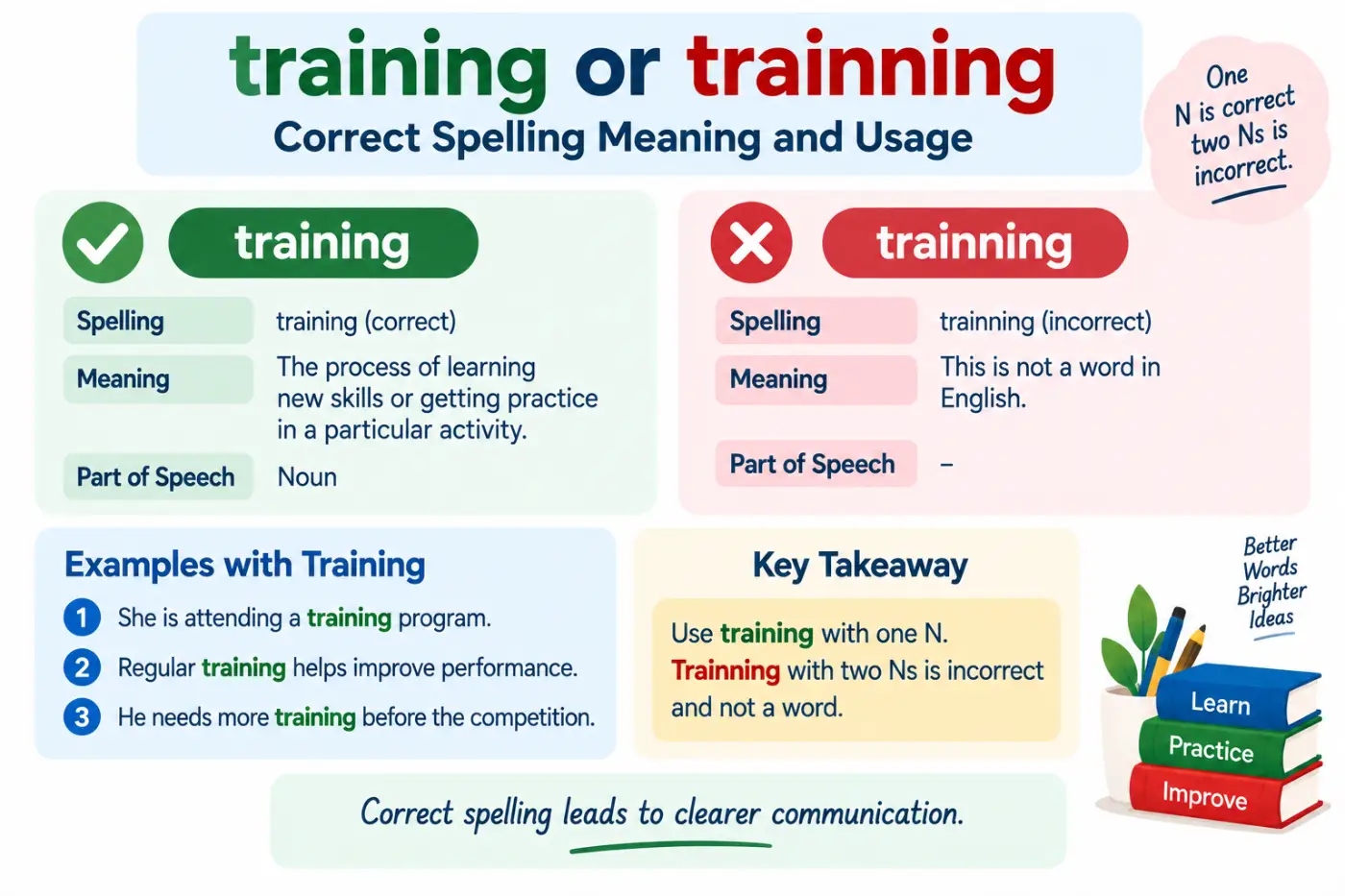
Training or trainning can be confusing because English spelling rules sometimes require doubling the final consonant before adding an ending. However, the word training follows a different pattern. The correct spelling keeps the original e in the word train out of the final form and uses one n before ing.
The word training is a noun that describes the process of learning skills, gaining knowledge, or preparing for a particular task. For example, a new employee may receive training before starting a job, and an athlete may follow a training plan to improve performance. In both cases, the word refers to preparation through learning or practice.
The easiest way to remember the spelling is to connect training with the base word train. When you add ing to train, you remove the final e and keep the single n. Once you understand this rule, you can confidently use training in emails, school assignments, business documents, resumes, and everyday writing.
Short Answer
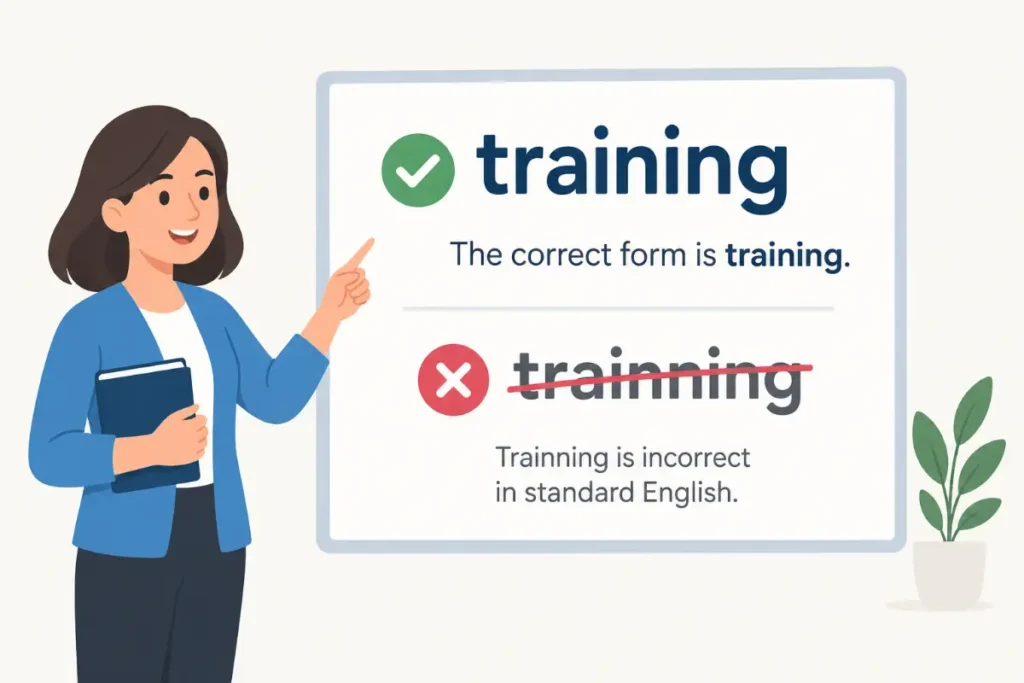
Training or trainning is a common spelling question, but training is the correct spelling in standard American English. The word has one n before the ending ing. Trainning is a misspelling. Training refers to the process of learning or practicing skills to improve performance. You can use it for education, workplace instruction, sports, fitness, and personal development.
Table of Contents
- The Correct Spelling of Training.
- Why Trainning Is Incorrect.
- The Spelling Rule Behind Training.
- The Meaning of Training.
- Training vs Trainning at a Glance.
- How to Use Training in a Sentence.
- Training in Different Contexts.
- Common Spelling Mistakes.
- Easy Ways to Remember the Correct Spelling.
- Related Words and Grammar Rules.
- Professional Writing Tips.
- Frequently Asked Questions.
- Key Takeaways.
- Conclusion.
The Correct Spelling of Training
Training is the correct spelling. Trainning is not accepted as the standard spelling of this word in American English or British English.
The word comes from the verb train. When you add the ending ing, you remove the final e and write training. You do not double the letter n.
Correct: The company provides training for new employees.
Incorrect: The company provides trainning for new employees.
The correct example uses training because the word names an organized process of learning. The incorrect example adds an extra n that the standard spelling does not require.
This spelling stays the same across common uses of the word. You write training program, employee training, job training, sports training, and professional training with one n.
Why the Correct Spelling Matters
Correct spelling helps readers understand your message without distraction. A misspelled word can also make a resume, job application, school assignment, or business report look less polished.
For example, imagine applying for a position and writing that you completed safety trainning on your resume. The reader will probably understand your meaning, but the spelling error may weaken the impression you want to make.
Using training correctly shows attention to detail. That matters most in professional documents, educational writing, and other situations where accuracy affects credibility.
Why Trainning Is Incorrect
Trainning is incorrect because it adds an unnecessary n to the word training. The mistake often happens because writers remember that some English words double their final consonant before adding ing.
For example, the verb run becomes running, and the verb swim becomes swimming. Those words follow a consonant doubling rule. However, train does not follow the same pattern because its final consonant is not doubled when the ending is added.
The correct spelling is training, not trainning.
Why People Make This Mistake
English spelling can feel inconsistent because different words follow different rules. Some verbs double their final consonant, some drop a final e, and others keep their spelling mostly unchanged.
Writers may also type trainning because they associate training with words such as running or planning. Frequent typing habits can reinforce the error, especially when someone writes quickly without proofreading.
Another reason is that the double n may look visually familiar. However, a spelling that looks plausible is not always correct. Learning the base word and the rule behind its ending provides a more reliable solution than guessing from appearance.
Is Trainning Ever Correct
In standard English, trainning is a misspelling when you intend to write the word that means instruction or practice. It is not a recognized alternative spelling of training.
You may occasionally encounter the incorrect form in informal posts, unedited documents, or online comments. Its appearance in published or user generated content does not make it correct.
For formal and informal writing alike, use training.
The Spelling Rule Behind Training
The spelling of training becomes easier to understand when you look at the base verb train and the ending ing. The verb train ends in a silent e. When you add ing to this type of verb, you usually drop the final e before adding the ending.
The spelling changes from train to training. The final n stays single because the verb does not require consonant doubling.
The Drop the Final E Rule
Many English verbs lose their final e when you add ing. This rule helps prevent an unnecessary e from appearing before the ending.
| Base verb | Correct form | Example |
|---|---|---|
| Train | Training | She is training for a new role. |
| Make | Making | He is making dinner. |
| Write | Writing | I am writing an email. |
| Dance | Dancing | They are dancing together. |
| Drive | Driving | She is driving to work. |
| Hope | Hoping | We are hoping for good results. |
Each example follows the same general spelling pattern. The final e disappears before ing is added. In the sentence about writing an email, for instance, write becomes writing rather than writeing.
Why You Do Not Double the N
English usually doubles the final consonant in certain short verbs when adding ing. This commonly happens when a one syllable verb ends in a single consonant preceded by a single vowel.
Consider these examples.
| Base verb | Correct form | Spelling change |
|---|---|---|
| Run | Running | The n doubles. |
| Sit | Sitting | The t doubles. |
| Swim | Swimming | The m doubles. |
| Plan | Planning | The n doubles. |
| Stop | Stopping | The p doubles. |
| Train | Training | The final e disappears. |
The key difference is the ending of the base verb. Run and plan end in consonants that follow the consonant doubling pattern. Train ends in a silent e, so you remove that e before adding ing.
This explains why training contains one n rather than two. You do not need to memorize every example separately if you understand the spelling pattern.
How the Rule Works in Other Words
The same spelling pattern appears in several common English words. Seeing it in different examples makes it easier to recognize when you write.
1. Teach becomes teaching. The final letter h stays in place because teach does not end in a silent e.
2. Learn becomes learning. The final n remains single because the base verb does not end in a silent e that needs to be dropped.
3. Practice becomes practicing. In American English, the final e is removed before ing is added.
4. Improve becomes improving. The final e disappears, and the word keeps its other letters.
5. Prepare becomes preparing. The spelling drops the final e before adding ing.
These examples show why it helps to look at the complete base verb instead of focusing only on the last consonant. The correct spelling depends on the word’s structure.
The Meaning of Training
Training is the process of learning knowledge or developing a skill through instruction, repetition, practice, or experience. It can prepare someone to perform a task more effectively, safely, or confidently.
People receive training in schools, workplaces, sports clubs, medical settings, and many other environments. The methods differ, but the central idea stays the same. Training helps people prepare for an activity or improve their ability to perform it.
Training as a Noun
It is commonly used as a noun. It names an activity or process rather than a person or a single action.
Examples include the following.
1. The new employees completed their training on Friday.
The sentence refers to a learning process that the employees finished.
2. My brother needs more training before he operates the equipment.
Training means instruction and practice that can help him use the equipment correctly.
3. The school offers computer training for beginners.
The word describes a course or organized learning activity.
4. Her athletic training includes strength exercises and running.
Training refers to the planned activities she uses to improve her physical performance.
5. The hospital provides emergency training for its staff.
The word describes preparation for responding to urgent situations.
In each sentence, training names a process or program. It does not describe the person who receives the instruction.
Training as Part of a Verb Phrase
Training can also appear in a verb phrase when the main verb is train. In this case, it functions as the present participle.
For example, consider the sentence, The coach is training the team for the tournament. The words is training form the present continuous verb phrase. They describe an action that is happening now.
Here are more examples.
1. She is training to become a nurse.
The phrase is training describes an ongoing process of preparation.
2. They were training when the storm began.
The phrase were training describes an activity that was in progress at a past time.
3. I have been training for the competition for three months.
The phrase have been training emphasizes an activity that began earlier and has continued over time.
The grammatical role depends on the sentence. Training can name a process as a noun or help form a verb phrase.
Training and the Verb Train
The verb train means to teach, prepare, coach, or practice for a particular purpose. It can describe what a person does to help someone else develop a skill or what a person does to improve their own performance.
For example, a manager may train new staff to use a computer system. A runner may train for a marathon. A teacher may train students to perform a laboratory procedure safely.
The noun training names the process, while the verb train describes the action. This distinction helps you choose the right word structure when writing.
Training vs Trainning at a Glance
The difference between these two forms is straightforward. Training is the accepted spelling, while trainning is an incorrect spelling when used with the intended meaning of instruction or practice.
| Feature | Training | Trainning |
|---|---|---|
| Standard spelling | Correct | Incorrect |
| Meaning | Instruction or practice | No standard meaning intended here |
| Part of speech | Noun or verb form | Misspelling |
| American English | Accepted | Not accepted |
| British English | Accepted | Not accepted |
| Formal writing | Appropriate | Should be corrected |
| Resume use | Correct choice | Spelling error |
| School assignments | Correct choice | Spelling error |
The table highlights the central distinction. Both forms may look understandable, but only training follows standard English spelling.
Correct and Incorrect Examples
Compare the following sentences to see how the spelling works in everyday situations.
1. Correct: The company provides training for all new employees.
Incorrect: The company provides trainning for all new employees.
The correct sentence uses the standard spelling of the noun.
2. Correct: She is training for her first marathon.
Incorrect: She is trainning for her first marathon.
The correct sentence uses training as part of a present continuous verb phrase.
3. Correct: I completed my safety training last week.
Incorrect: I completed my safety trainning last week.
The correct sentence describes an educational activity completed in the past.
4. Correct: The manager scheduled customer service training for Monday.
Incorrect: The manager scheduled customer service trainning for Monday.
The correct form names a planned workplace learning session.
5. Correct: Daily training can help athletes improve their technique.
Incorrect: Daily trainning can help athletes improve their technique.
The correct spelling refers to regular practice intended to improve performance.
The meaning remains understandable in most incorrect examples, but the spelling still needs correction. When writing for school, work, or publication, choose the standard form.
How to Use Training in a Sentence
The word training fits many everyday situations. You can use it to describe learning a new skill, preparing for a job, practicing a sport, or developing knowledge in a specific field.
The following examples show how it works in different sentence structures.
Everyday Examples
1. My sister is taking a training course in graphic design.
The sentence uses training as a noun that describes a course focused on developing a skill.
2. The training starts at nine in the morning.
Training refers to a scheduled learning session.
3. He needs more training before he can work independently.
The sentence describes preparation needed to perform a task without supervision.
4. Our school offers training in public speaking.
Training names an organized activity that helps students develop communication skills.
5. I learned a lot during my first week of training.
The word refers to the instruction and experience the speaker received.
6. The trainer adjusted the program after reviewing the team’s progress.
This sentence uses trainer for the person who provides instruction and program for the planned activities.
7. Her training helped her feel more confident during the presentation.
The sentence explains how preparation improved her confidence.
8. The company requires annual safety training.
Annual safety training means instruction that employees receive each year to help them work safely.
Examples in Professional Writing
In the workplace, training often appears alongside words such as employee, staff, technical, safety, leadership, and professional. These combinations describe different kinds of instruction.
1. The department will provide technical training next month.
Technical training refers to instruction in specialized tools, systems, or procedures.
2. All employees must complete workplace safety training.
The sentence identifies a requirement intended to help employees understand safe working practices.
3. The organization introduced a leadership training program for new managers.
Leadership training helps managers develop skills such as communication, planning, and team management.
4. The applicant has completed customer service training.
This sentence indicates that the applicant has received instruction related to customer service tasks.
5. The team needs additional training on the updated software.
The sentence identifies a learning need caused by a change in the software.
These examples work in reports, emails, job applications, and internal business documents. The word remains the same regardless of the type of training being discussed.
Examples in Academic Writing
Students and teachers often use training when discussing practical instruction or the development of specific skills.
1. The program includes training in research methods.
The sentence describes instruction that prepares students to conduct research.
2. Medical training requires both theoretical knowledge and practical experience.
The sentence explains that professional preparation includes more than reading or classroom study.
3. The study examined the effects of teacher training on classroom performance.
Training refers to preparation intended to improve teaching skills.
4. Students received laboratory training before beginning the experiment.
The sentence explains that students learned the procedures before performing the experiment.
These examples demonstrate how training can appear in formal writing without sounding unnatural. Choose the word when you mean a process of instruction or skill development.
Training in Different Contexts
Training has a broad meaning, so the surrounding words often tell readers what kind of preparation you mean. Understanding these contexts helps you use the word more precisely.
Workplace Training
Workplace training helps employees learn the knowledge and skills needed to perform their jobs. It may take place during onboarding, after a change in company procedures, or when employees need to develop new abilities.
Common forms include safety training, technical training, customer service training, and management training. Each type serves a different purpose, but all focus on preparing people to perform work related tasks.
For example, a retail employee may receive training on handling customer complaints. A warehouse worker may learn how to operate equipment safely. A new manager may attend leadership training to improve decision making and communication.
Sports and Fitness Training
In sports and fitness, training usually means planned physical practice designed to improve strength, endurance, speed, flexibility, coordination, or technique.
For example, a swimmer may train several times a week to improve performance. A person preparing for a marathon may follow a running schedule that gradually increases distance. In these cases, training involves repeated effort and a clear goal.
The spelling does not change in fitness related expressions. You write strength training, weight training, endurance training, and athletic training with one n in training.
Technical and Professional Training
Technical and professional training helps people develop specialized knowledge. It may cover computer systems, machinery, healthcare procedures, financial software, or other skills required for a particular profession.
For example, an office worker may receive training on a new accounting system. A technician may practice equipment maintenance under supervision. A healthcare professional may complete instruction on updated procedures.
These examples show that training can include demonstrations, guided practice, assessments, and feedback. The exact method depends on the skill being taught.
Personal Development
Training can also refer to activities that help people improve personal abilities. Examples include public speaking, time management, communication, and conflict resolution.
A person who wants to speak confidently in front of a group might join a public speaking training course. Someone who wants to improve communication at work might attend a workshop that includes role playing and practical exercises.
In these situations, training helps turn information into usable skills. Reading about a skill can provide knowledge, but guided practice often helps people apply that knowledge more effectively.
Animal Training
The word also applies to teaching animals to respond to commands or develop particular behaviors. Dog training, for example, may teach a dog to sit, stay, walk calmly on a leash, or respond to a recall command.
A sentence such as The puppy is receiving obedience training uses training as a noun. It refers to the process of teaching the puppy particular responses and behaviors.
The same spelling rule applies in this context. The word remains training regardless of the subject or activity involved.
Common Spelling Mistakes
Many spelling errors happen because writers apply a familiar rule to a word that follows a different pattern. Learning to recognize these errors helps you proofread more accurately.
Adding an Extra N
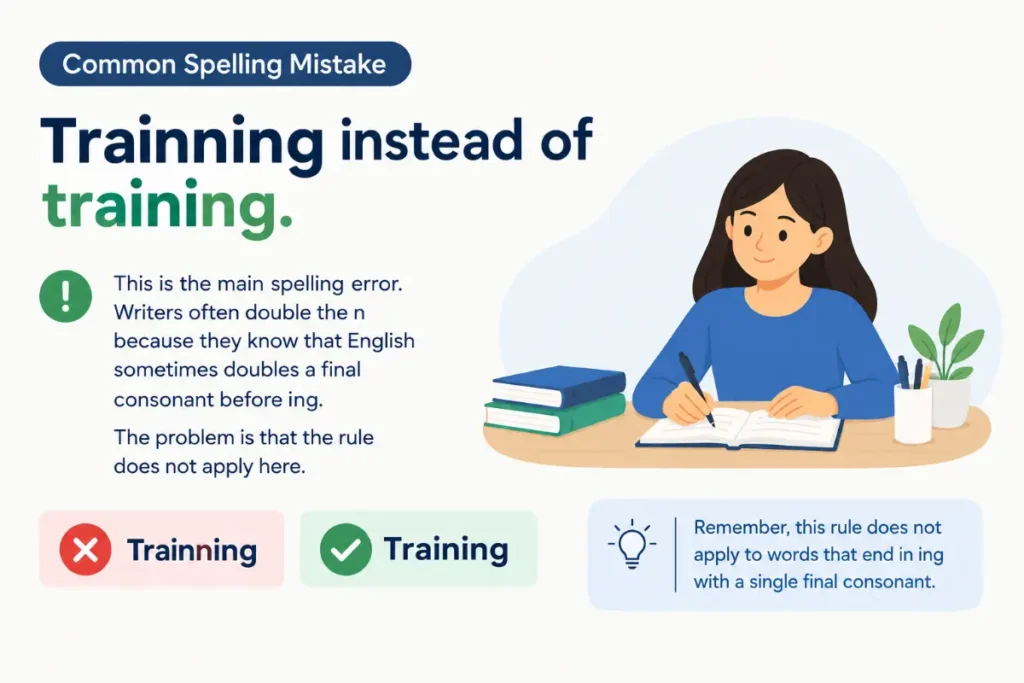
The most direct mistake is writing trainning instead of training. This usually happens when writers double the final consonant without checking the base verb.
Incorrect: The staff completed their trainning yesterday.
Correct: The staff completed their training yesterday.
The corrected sentence uses the standard spelling of the noun. You can prevent this error by remembering that train loses its final e before ing is added.
Confusing Training With Trainer
Training and trainer are related words, but they have different meanings.
Training refers to the process of learning or practicing. A trainer is a person who provides instruction or coaching.
For example, The trainer organized the training session contains both words correctly. Trainer identifies the person, while training identifies the activity.
Using one word in place of the other can make a sentence confusing. If you mean the person teaching a skill, use trainer. If you mean the process of learning that skill, use training.
Confusing Training With Trained
Training and trained are different forms of the verb train.
Training often describes an ongoing action or serves as a noun. Trained commonly describes someone who has received instruction or an action completed in the past.
Compare these examples.
1. The staff are training for the new system.
Training describes an activity currently in progress.
2. The staff are trained to use the new system.
Trained describes the staff’s preparation or ability.
3. The company trained its staff last month.
Trained describes an action that took place in the past.
Choose the form that matches the meaning and grammar of your sentence.
Confusing Training With Teaching
Training and teaching overlap in meaning, but they are not always interchangeable.
Teaching often involves explaining information, ideas, or concepts. Training commonly emphasizes developing the ability to perform a particular task through instruction and practice.
For example, a teacher may explain the principles of computer security, while a training session may guide employees through the steps they must follow to protect company data.
The distinction depends on the context. Teaching can include practical exercises, and training can include explanations. Still, training often suggests preparation for a specific activity or responsibility.
Trusting Spellcheck Without Reviewing the Sentence
Spellcheck tools can catch many errors, but they do not always identify the intended meaning. A tool may overlook a mistake if an incorrect form resembles a recognized word or appears in an unusual context.
Read the complete sentence after using spellcheck. Check that the spelling is correct and that the word fits the meaning you intend.
For example, if you write trainning in a document, a spelling checker may flag it. If it does not, you still need to recognize that the standard form is training.
Proofreading remains useful because spelling tools cannot replace your understanding of English usage.
Easy Ways to Remember the Correct Spelling
A simple memory trick can help you avoid spelling mistakes without checking a dictionary every time.
Remember the Base Word
Start with the word train. Remove its final e, then add ing.
Train becomes training.
This is the most reliable method because it connects the spelling to a familiar English rule. You do not need to guess how many times to write the letter n.
Use a Simple Mental Picture
Think of the word train moving forward with one n before the ending ing. The final e leaves the word, but the n does not multiply.
This mental image gives you a quick reminder when you write an email, assignment, or report.
Practice With Related Words
Write a few words that follow the same final e rule.
- Make becomes making.
- Write becomes writing.
- Dance becomes dancing.
- Improve becomes improving.
- Train becomes training.
Practicing these examples helps you recognize the pattern. Over time, the correct spelling becomes easier to recall.
Create a Short Practice Sentence
Use training in a sentence that connects to your daily life.
For example, I need more training to improve my writing skills.
Write the sentence a few times while focusing on the single n. You can also create sentences about your studies, work, fitness goals, or hobbies.
The goal is not to memorize a long list. It is to build a reliable spelling habit that you can use whenever the word appears.
Proofread the Ending
When checking a document, pay attention to words that end in ing. Ask yourself if the base verb loses a final e or doubles a consonant.
For example, running doubles the n, while training drops the e. Recognizing this distinction will help you catch errors before you submit your work.
Related Words and Grammar Rules
Understanding related word forms helps you use training accurately in different sentence structures. It also makes the word easier to recognize when it appears in longer expressions.
Train
Train is the base verb. It can mean to teach someone, prepare for a task, or practice to improve a skill.
Examples include I train new employees and She trains every morning. In the first sentence, train means to teach employees. In the second, trains describes regular practice.
Train can also be a noun referring to a railway vehicle. Context tells readers which meaning you intend.
Trainer
Trainer is a noun for someone who teaches or coaches another person. It can describe a workplace instructor, a sports coach, or a person who teaches animals.
For example, The trainer showed the team a new exercise. The word identifies the person providing guidance.
In American English, trainer can also refer to a type of athletic shoe in certain contexts, although sneakers is more common in everyday US conversation.
Trained
Trained is the past tense and past participle of train. It can describe an action that occurred in the past or a person who has received preparation.
For example, The company trained its employees last year describes a completed action. The phrase trained professionals describes people who have received the required instruction or preparation.
Training
Training can be a noun or the present participle of train.
As a noun, it appears in sentences such as The training was helpful. As part of a verb phrase, it appears in The coach is training the players.
The sentence structure determines its grammatical role. The spelling stays the same in both uses.
Retraining
Retraining means receiving training again or learning new skills for a different task. It often appears in discussions about career changes, new technology, or changing job responsibilities.
For example, The company offered retraining to employees who needed to learn the new software. The word describes additional preparation to help employees adapt to a change.
Retraining follows the same spelling pattern as training. You remove the final e from retrain before adding ing.
Training Program
A training program is an organized set of learning activities designed to develop particular skills or knowledge.
For example, The hospital introduced a training program for new nurses describes a planned approach to professional preparation.
The expression is written as two words. Training functions as a modifier that describes the kind of program.
Training Course
A training course is a structured series of lessons or activities focused on learning a skill or subject.
For example, She enrolled in a training course on digital marketing. The phrase identifies the type of course she chose.
Training course is usually written as two words in standard American English.
On the Job Training
On the job training refers to learning while performing actual work tasks, often with guidance from an experienced employee or supervisor.
For example, New staff receive on the job training during their first week. The sentence describes learning that takes place in the workplace rather than only in a classroom.
In standard American writing, the expression is often written as on the job training when used as a noun phrase. When it appears before another noun as a compound modifier, writers may use hyphens in forms such as on the job training program depending on the style guide and sentence structure. Since your goal is to avoid unnecessary punctuation, you can often rewrite the sentence to keep the meaning clear without relying on a hyphenated modifier.
Further Training
Further training means additional instruction or practice beyond what someone has already received.
For example, The employee needs further training before taking on the new responsibility. The sentence indicates that the employee needs more preparation.
This expression is useful in professional reviews, development plans, and discussions about improving performance.
American and British English Usage
The spelling of training is the same in American and British English. Both varieties use training rather than trainning.
There are differences between American and British spelling in some words. For example, American English commonly uses color, while British English commonly uses colour. However, training does not have a regional spelling variation.
Is Training More Formal Than Trainning
Training is the correct form in both formal and informal writing. The choice between formal and informal language affects the surrounding sentence rather than the spelling of the word.
In a formal report, you might write, Employees must complete the required training before using the equipment. In a casual message, you might write, I have training tomorrow morning.
Both sentences use the standard spelling. The first has a formal tone because it describes a workplace requirement, while the second sounds conversational.
Is Training One Word or Two
Training is written as one word. You should not separate it into train ing or write it as two words.
When combined with another word, it can form a longer expression. Examples include training session, training manual, training center, and training materials. In these expressions, training remains a single word.
Does Training Need a Capital Letter
Training does not normally need a capital letter unless it appears at the beginning of a sentence or forms part of a proper name or official title.
For example, Employee Training Begins Monday uses a capital T if it is formatted as a title with title case. In an ordinary sentence, you would write Employee training begins Monday.
Standard capitalization rules apply regardless of the spelling.
Professional Writing Tips
Correct spelling is only one part of effective writing. Choosing precise expressions and using them consistently can make your message easier to understand.
Choose Specific Terms
The word training can describe many different activities. When you need to give readers more information, add a word that identifies the purpose.
For example, safety training tells readers that the instruction focuses on safe work practices. Leadership training indicates preparation for leadership responsibilities. Technical training suggests instruction in specialized knowledge or tools.
These combinations communicate more than the general word alone. They help readers understand the subject without needing a lengthy explanation.
Avoid Repetition
Repeating training in every sentence can make a paragraph feel awkward. Use a suitable alternative when the meaning remains clear.
For example, instead of writing, The training starts Monday. The training lasts three days. The training covers workplace safety, you could write, The training starts Monday and lasts three days. It covers workplace safety.
The revised version removes unnecessary repetition while preserving the information. You can also use terms such as course, session, instruction, or preparation when they accurately describe the activity.
Keep Workplace Documents Consistent
If you are writing a handbook, policy, or training plan, use consistent terms throughout the document. For example, if you call an activity a training session in one section, avoid switching randomly among several labels that could confuse readers.
Consistency helps readers follow instructions and understand how different parts of a document relate to one another. It also makes proofreading easier.
Proofread High Visibility Content
Pay particular attention to spelling in resumes, cover letters, professional profiles, course descriptions, and public facing webpages. Readers may use these documents to judge your attention to detail.
Search for the word training during your final review. If you find trainning, correct it to training unless you are discussing the misspelling itself.
A quick review can prevent a small typing error from distracting readers from your main message.
Expert Editor Insight
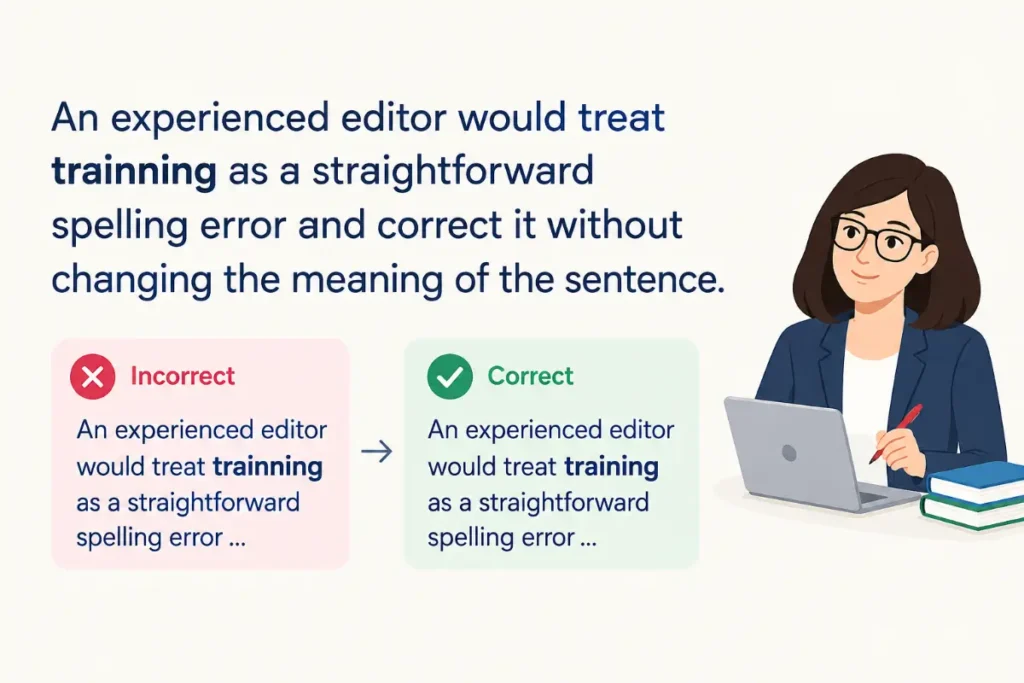
An experienced editor would treat trainning as a straightforward spelling error and correct it without changing the meaning of the sentence. The confusion is understandable because English has genuine consonant doubling patterns before ing. Professional editing focuses on the structure of the base word rather than simply counting letters. Spellcheck tools can catch the common error but understanding why training is correct gives you a stronger long term solution. A simple editing habit is to remove the ending ing mentally and check the base word first. If the base is train the standard result is training.
Key Takeaways
- Training is the correct spelling in American and British English.
- Trainning is a misspelling when you mean instruction or practice.
- The word train loses its final e before ing is added.
- The letter n does not double in training.
- Training can function as a noun or as part of a verb phrase.
- Common expressions include employee training, safety training, sports training, and professional training.
- The related words train, trainer, trained, and retraining have different grammatical roles.
- Proofreading and understanding the base word can help you avoid spelling errors.
Conclusion
Training or trainning has a simple answer. Training is the correct spelling, and trainning is a misspelling. The correct form uses one n because the base verb train loses its final e before the ending ing is added.
You can use training as a noun to describe instruction or practice, or as part of a verb phrase to describe an ongoing activity. The word appears in many contexts, including education, workplace development, sports, fitness, and professional learning. Its spelling stays the same in American and British English.
Remember the base word train, remove the final e, and add ing. Once you understand this pattern, you can spell training confidently in emails, reports, resumes, assignments, and everyday conversations.
Frequently Asked Questions
1. Is training or trainning the correct spelling?
Training is the correct spelling in standard English. Trainning is a misspelling because it adds an unnecessary n. Use training in schoolwork, professional documents, emails, and everyday writing.
2. Why does training have only one n?
The base verb train ends in a silent e. When you add ing, you remove that final e and keep the single n. The correct spelling is training.
3. Is trainning ever acceptable in English?
Trainning is not a standard alternative spelling of training. You may see it in informal writing or typing errors, but you should correct it when you mean instruction or practice.
4. Is training spelled the same in American and British English?
Yes. American and British English both use training. Neither variety uses trainning as the standard spelling.
5. What does training mean?
Training means learning or practicing to develop knowledge, skills, or abilities. It can refer to workplace instruction, sports practice, professional preparation, or personal skill development.
6. Is training a noun or a verb?
Training can function as a noun or as the present participle of the verb train. In The training was useful, it is a noun. In She is training for a race, it forms part of a verb phrase.
7. What is the difference between training and trainer?
Training refers to the process of learning or practicing a skill. Trainer refers to a person who provides instruction or coaching. For example, The trainer led the training session uses both words correctly.
8. What is the past tense of train?
The simple past tense of train is trained. For example, The company trained its staff last month describes an action that happened in the past.
9. How can I remember the spelling of training?
Remember the base word train. Remove the final e and add ing to form training. This method helps you avoid adding an extra n.
10. Is training correct for a resume?
Yes. Training is the correct spelling for resumes and job applications. You might write Completed customer service training or Professional training in workplace safety. Choose wording that accurately describes your experience.
11. Is training the same as teaching?
The meanings overlap, but they are not always identical. Teaching often focuses on explaining knowledge or concepts, while training often emphasizes preparing someone to perform a task. Both can involve explanations and practical exercises.
12. How do you use training in a sentence?
You can write, The company provides training for new employees. In this sentence, training refers to the instruction employees receive to prepare for their jobs.

Confusing Words, Spelling & Word Choice
Claire Whitmore is a U.S.-based English editor who writes about commonly confused words, spelling differences, and word choice. Her work helps readers understand subtle distinctions between similar-looking words through simple definitions, practical examples, and modern usage guidance in both American and British English.