
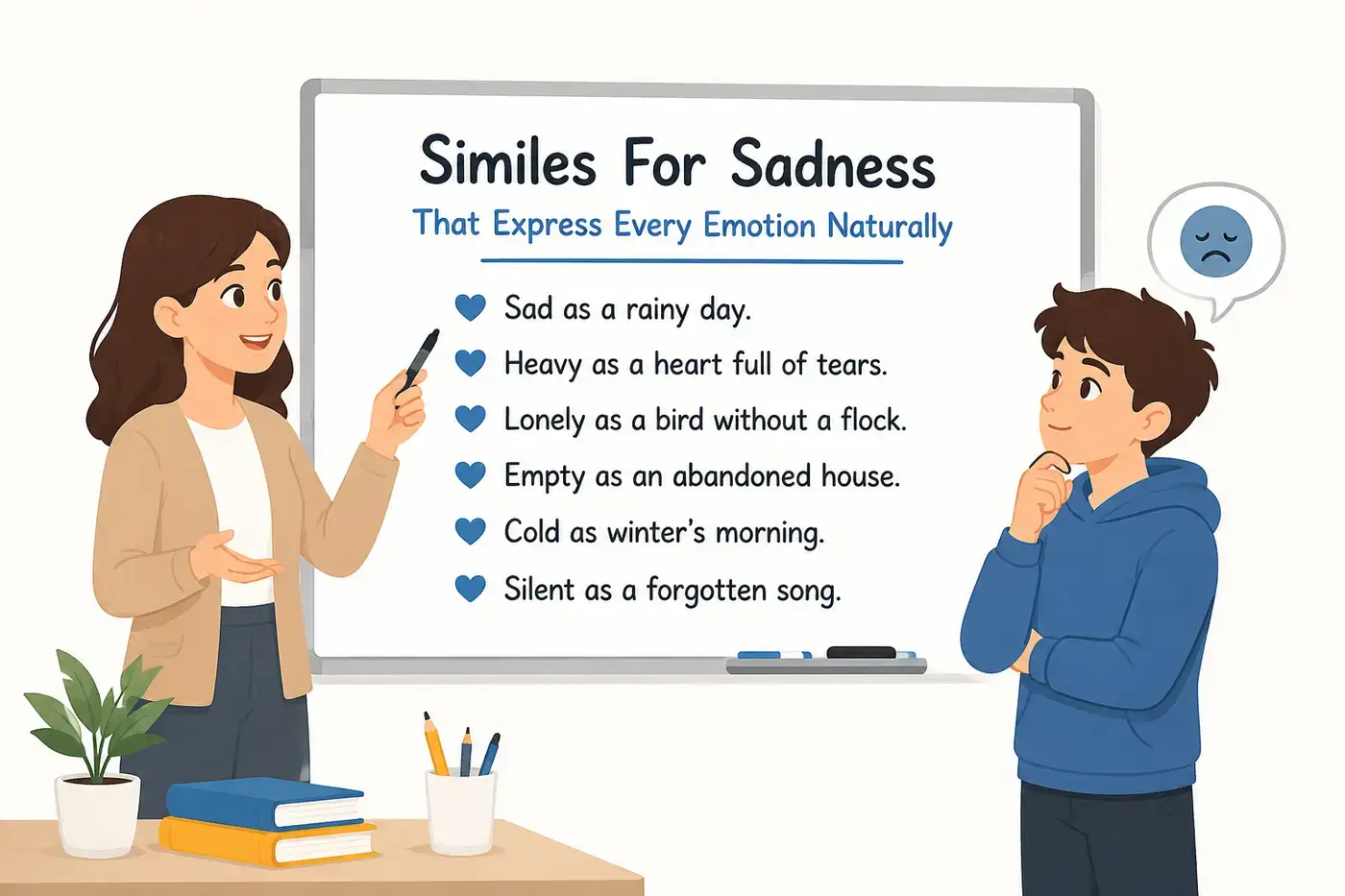
Sadness is one of the most familiar human emotions. Everyone experiences it at some point. Yet finding the right words to describe it is often difficult. Saying someone is sad works in everyday conversation. Good writing demands something stronger. That is where Similes for Sadness become valuable. A well chosen simile turns an ordinary sentence into one readers can picture and feel. It transforms emotion into an image. Instead of telling readers that a character feels unhappy you can show that sadness through comparisons that feel natural and memorable.
Writers use similes in novels poems speeches songs essays and everyday conversation because they make emotions easier to understand. Teachers use them to improve descriptive writing. Students use them to create stronger assignments. Professional authors rely on them to bring characters and stories to life.
This guide brings together more than 120 original and useful similes for sadness. You will also learn what they mean when to use them common mistakes to avoid and practical tips that make descriptive writing more effective.
Short Answer
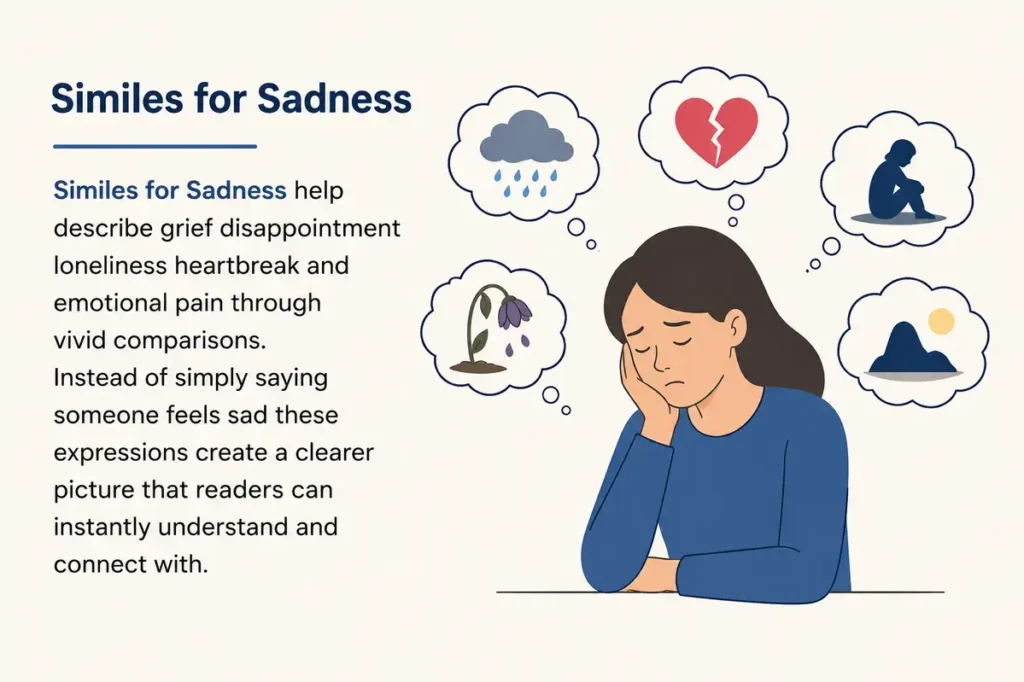
Similes for Sadness help describe grief disappointment loneliness heartbreak and emotional pain through vivid comparisons. Instead of simply saying someone feels sad these expressions create a clearer picture that readers can instantly understand and connect with.
Table Of Contents
- What Are Similes For Sadness
- Why Writers Use Similes For Sadness
- How Similes Create Stronger Emotional Writing
- Simple Similes For Sadness
- Similes For Deep Grief
- Similes For Loneliness
- Similes For Heartbreak
- Similes For Quiet Sadness
- Similes For Hopelessness
- Similes For Tears
- Similes For Emotional Pain
- Similes For Children
- Creative Similes For Stories
- Common Mistakes
- Memory Tips
- Frequently Asked Questions
- Key Takeaways
- Conclusion
What Are Similes For Sadness
Instead of describing sadness directly a simile compares it with something familiar. Readers instantly recognize the image and understand the feeling.
For example
She felt as lonely as a forgotten house.
The sentence does not simply describe loneliness. It creates a picture that makes the emotion stronger.
Another example is
His heart felt like a tree stripped of every leaf.
The comparison helps readers imagine emptiness and loss without explaining every detail.
This is why similes remain one of the most powerful tools in English writing.
Why Writers Use Similes For Sadness
People understand emotions through experiences. A comparison connects an unfamiliar feeling with something readers already know.
Think about the difference between these sentences.
He was sad.
He was as silent as winter after the last bird had flown.
The second sentence creates an emotional picture. Readers experience the sadness instead of simply reading about it.
Good similes also make writing more memorable. A strong comparison stays in the reader’s mind long after the sentence ends.
Professional writers use similes to
- Create emotional connection.
- Make descriptions more vivid.
- Show emotions instead of explaining them.
- Improve storytelling.
- Add beauty and rhythm to writing.
How Similes Create Stronger Emotional Writing
The best similes do more than decorate a sentence. They reveal personality mood and atmosphere.
Imagine a child losing a favorite toy.
You could write
The little boy looked sad.
Or you could write
The little boy looked as lost as a balloon drifting into the clouds.
The second version tells readers much more. It creates emotion through imagination.
Strong similes also help readers remember scenes because the human brain naturally remembers pictures better than plain statements.
That is why novels speeches and poems often rely on comparisons instead of direct explanations.
Simple Similes For Sadness
These easy comparisons work well in everyday writing school assignments and conversations.
| Simile | Meaning | Example |
|---|---|---|
| As sad as a rainy afternoon. | Quiet unhappiness. | She felt as sad as a rainy afternoon after saying goodbye. |
| As sad as an empty chair. | Missing someone. | The dining room looked as sad as an empty chair. |
| Like a flower without sunlight. | Losing happiness. | He looked like a flower without sunlight after hearing the news. |
| As lonely as a single cloud. | Feeling isolated. | She stood as lonely as a single cloud. |
| Like a fading photograph. | Slowly disappearing happiness. | His memories felt like a fading photograph. |
| As quiet as falling snow. | Silent sadness. | She remained as quiet as falling snow. |
| Like a broken kite. | Lost direction. | He wandered like a broken kite. |
| As empty as an abandoned room. | Emotional emptiness. | Her heart felt as empty as an abandoned room. |
| Like a candle losing its flame. | Hope fading away. | His confidence faded like a candle losing its flame. |
| As pale as winter skies. | Deep disappointment. | She looked as pale as winter skies. |
These similes use familiar images. Readers understand them immediately without stopping to think.
Similes For Deep Grief
Grief reaches beyond ordinary sadness. It often follows the loss of someone important or a life changing event.
These similes express powerful sorrow.
| Simile | Meaning | Example |
|---|---|---|
| Like a tree struck by lightning. | Sudden emotional devastation. | He stood like a tree struck by lightning after hearing the news. |
| As broken as shattered glass. | Completely devastated. | She felt as broken as shattered glass. |
| Like an empty church. | Profound silence and loss. | The house felt like an empty church. |
| As heavy as a mountain. | Overwhelming sorrow. | His grief rested as heavy as a mountain. |
| Like waves crashing without end. | Never ending sadness. | Her emotions came like waves crashing without end. |
| As dark as a moonless night. | Deep emotional pain. | His thoughts became as dark as a moonless night. |
| Like a bird with broken wings. | Unable to move forward. | She felt like a bird with broken wings. |
| As cold as forgotten stone. | Emotionally numb. | His heart became as cold as forgotten stone. |
| Like a river that never stops flowing. | Endless grief. | Tears came like a river that never stops flowing. |
| As hollow as an abandoned shell. | Feeling empty inside. | She felt as hollow as an abandoned shell. |
Notice that these comparisons focus on weight silence darkness and emptiness because those images naturally match deep grief.
Similes For Loneliness
Loneliness is different from sadness. A person can feel lonely even in a crowded room.
These similes describe isolation effectively.
| Simile | Meaning | Example |
|---|---|---|
| As lonely as the last leaf on a tree. | Completely alone. | He felt as lonely as the last leaf on a tree. |
| Like an island in the ocean. | Cut off from others. | She lived like an island in the ocean. |
| As distant as the evening stars. | Emotionally separated. | Friends suddenly seemed as distant as the evening stars. |
| Like a lighthouse without ships. | Waiting for connection. | He waited like a lighthouse without ships. |
| As forgotten as yesterday’s footprints. | Feeling ignored. | She felt as forgotten as yesterday’s footprints. |
| Like an unopened letter. | Never understood. | His feelings remained like an unopened letter. |
| As silent as an empty theater. | No companionship. | The apartment felt as silent as an empty theater. |
| Like a path no one walks. | Neglected. | She felt like a path no one walks anymore. |
| As isolated as a snow covered cabin. | Complete separation. | He became as isolated as a snow covered cabin. |
| Like a bench in an empty park. | Waiting without company. | She sat like a bench in an empty park. |
These images are simple enough for students yet expressive enough for professional writing.
Similes For Heartbreak
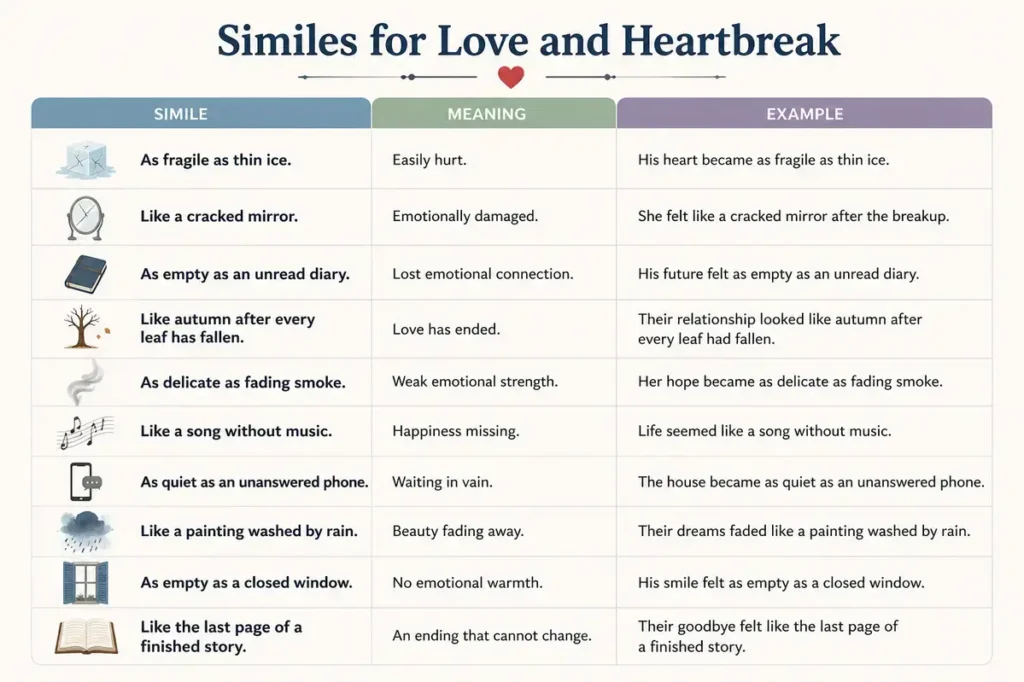
Heartbreak carries disappointment loss and emotional pain at the same time.
The following comparisons describe that feeling naturally.
| Simile | Meaning | Example |
|---|---|---|
| As fragile as thin ice. | Easily hurt. | His heart became as fragile as thin ice. |
| Like a cracked mirror. | Emotionally damaged. | She felt like a cracked mirror after the breakup. |
| As empty as an unread diary. | Lost emotional connection. | His future felt as empty as an unread diary. |
| Like autumn after every leaf has fallen. | Love has ended. | Their relationship looked like autumn after every leaf had fallen. |
| As delicate as fading smoke. | Weak emotional strength. | Her hope became as delicate as fading smoke. |
| Like a song without music. | Happiness missing. | Life seemed like a song without music. |
| As quiet as an unanswered phone. | Waiting in vain. | The house became as quiet as an unanswered phone. |
| Like a painting washed by rain. | Beauty fading away. | Their dreams faded like a painting washed by rain. |
| As empty as a closed window. | No emotional warmth. | His smile felt as empty as a closed window. |
| Like the last page of a finished story. | An ending that cannot change. | Their goodbye felt like the last page of a finished story. |
These similes fit reflective writing journals memoirs and emotional fiction.
Similes For Hopelessness
Hopelessness often feels heavier than sadness because it removes the expectation that things will improve. These comparisons capture that emotion clearly.
| Simile | Meaning | Example |
|---|---|---|
| As empty as a dried river. | No hope left. | His heart felt as empty as a dried river. |
| Like a boat without oars. | No direction. | She felt like a boat without oars. |
| As dark as a cave without light. | Complete despair. | The future seemed as dark as a cave without light. |
| Like a clock that has stopped. | Life feels frozen. | Time passed like a clock that had stopped. |
| As hopeless as a bird trapped indoors. | Unable to find freedom. | He looked as hopeless as a bird trapped indoors. |
| Like ashes after a fire. | Everything has ended. | Their plans became like ashes after a fire. |
| As lost as a traveler without a map. | No clear path forward. | She felt as lost as a traveler without a map. |
| Like a bridge that leads nowhere. | No meaningful future. | His efforts felt like a bridge that leads nowhere. |
| As dim as the last star before sunrise. | Hope almost gone. | Her confidence became as dim as the last star before sunrise. |
| Like an empty nest after winter. | Feeling abandoned. | The old house stood like an empty nest after winter. |
These images create a strong emotional atmosphere without sounding dramatic or exaggerated.
Similes For Tears
Tears can express sadness relief frustration or grief. These similes describe crying with vivid but natural comparisons.
| Simile | Meaning | Example |
|---|---|---|
| Like rain falling from heavy clouds. | Continuous tears. | Tears fell like rain from heavy clouds. |
| As steady as a gentle stream. | Quiet crying. | Her tears flowed as steady as a gentle stream. |
| Like drops from a leaking roof. | Slow repeated tears. | His tears came like drops from a leaking roof. |
| As endless as ocean waves. | Constant crying. | She cried as endlessly as ocean waves. |
| Like morning dew on grass. | Small quiet tears. | Tears rested like morning dew on her cheeks. |
| As sudden as summer rain. | Unexpected crying. | His tears arrived as sudden as summer rain. |
| Like melting snow. | Tears after holding emotions inside. | Her tears came like melting snow. |
| As clear as fresh rainwater. | Honest emotion. | The tears were as clear as fresh rainwater. |
| Like pearls slipping from a necklace. | Beautiful flowing tears. | Tears rolled like pearls slipping from a necklace. |
| As silent as raindrops at dawn. | Quiet emotional release. | She cried as silently as raindrops at dawn. |
A good simile should support the emotion instead of distracting from it. Simple images usually leave the strongest impression.
Similes For Emotional Pain
Emotional pain cannot be seen, yet people understand it through comparisons with physical experiences or familiar objects.
| Simile | Meaning | Example |
|---|---|---|
| As sharp as broken glass. | Intense emotional pain. | His disappointment felt as sharp as broken glass. |
| Like carrying a heavy backpack every day. | Constant emotional burden. | Grief stayed with her like carrying a heavy backpack every day. |
| As deep as the ocean. | Powerful inner pain. | Her sorrow ran as deep as the ocean. |
| Like walking through thick mud. | Life becomes difficult. | Every day felt like walking through thick mud. |
| As tight as a knot. | Emotional pressure. | His chest felt as tight as a knot. |
| Like thorns beneath every step. | Constant hurt. | Moving forward felt like thorns beneath every step. |
| As cold as winter rain. | Pain without comfort. | Loneliness felt as cold as winter rain. |
| Like a window cracked in every corner. | Permanent emotional damage. | Trust became like a window cracked in every corner. |
| As heavy as wet clothes. | Emotional exhaustion. | Sadness hung on her as heavy as wet clothes. |
| Like carrying stones in your pockets. | Burden that never disappears. | Regret felt like carrying stones in his pockets. |
These comparisons work well because readers can imagine the physical feeling and connect it with the emotional one.
Similes For Children
Children understand comparisons best when they involve familiar objects and everyday experiences. These similes are simple, clear, and easy to remember.
| Simile | Meaning | Example |
|---|---|---|
| As sad as a puppy left alone. | Feeling lonely. | He looked as sad as a puppy left alone. |
| Like a balloon with no air. | Losing excitement. | She became like a balloon with no air. |
| As droopy as a flower without water. | Looking unhappy. | The child stood as droopy as a flower without water. |
| Like an ice cream dropped on the ground. | Small disappointment. | He felt like an ice cream dropped on the ground. |
| As quiet as a sleeping kitten. | Silent sadness. | She became as quiet as a sleeping kitten. |
| Like a toy missing its favorite part. | Feeling incomplete. | He looked like a toy missing its favorite part. |
| As slow as a turtle on a rainy day. | Sad and unmotivated. | She walked as slow as a turtle on a rainy day. |
| Like a bird looking for its nest. | Missing home or family. | He wandered like a bird looking for its nest. |
| As gray as a cloudy sky. | Looking unhappy. | Her face became as gray as a cloudy sky. |
| Like a cookie without chocolate chips. | Missing something important. | The day felt like a cookie without chocolate chips. |
Teachers often use these comparisons to help students improve descriptive writing without making language too difficult.
Creative Similes For Stories
Creative writing gives you more freedom. These similes add atmosphere and personality while staying easy to understand.
| Simile | Meaning | Example |
|---|---|---|
| Like a candle forgotten in an empty room. | Quiet loneliness. | She waited like a candle forgotten in an empty room. |
| As lonely as the last page of an old journal. | Forgotten memories. | He felt as lonely as the last page of an old journal. |
| Like music with every note missing. | Life has lost joy. | The celebration felt like music with every note missing. |
| As faded as footprints after rain. | Happiness disappearing. | Their laughter became as faded as footprints after rain. |
| Like a star hidden behind endless clouds. | Hope buried beneath sadness. | Her confidence stayed like a star hidden behind endless clouds. |
| As quiet as a museum after closing time. | Complete silence. | The school hallway became as quiet as a museum after closing time. |
| Like an old photograph left in the attic. | Forgotten happiness. | His childhood memories rested like an old photograph left in the attic. |
| As empty as a stage after the audience leaves. | Emotional emptiness. | Her heart felt as empty as a stage after the audience leaves. |
| Like a violin with broken strings. | Unable to express feelings. | He seemed like a violin with broken strings. |
| As distant as mountains behind fog. | Emotionally unreachable. | She felt as distant as mountains behind fog. |
Fresh comparisons make writing memorable. Readers enjoy images they have not seen hundreds of times before.
Common Mistakes When Using Similes For Sadness
Even experienced writers sometimes weaken their descriptions by choosing the wrong comparison. A strong simile should make the emotion clearer, not more confusing.
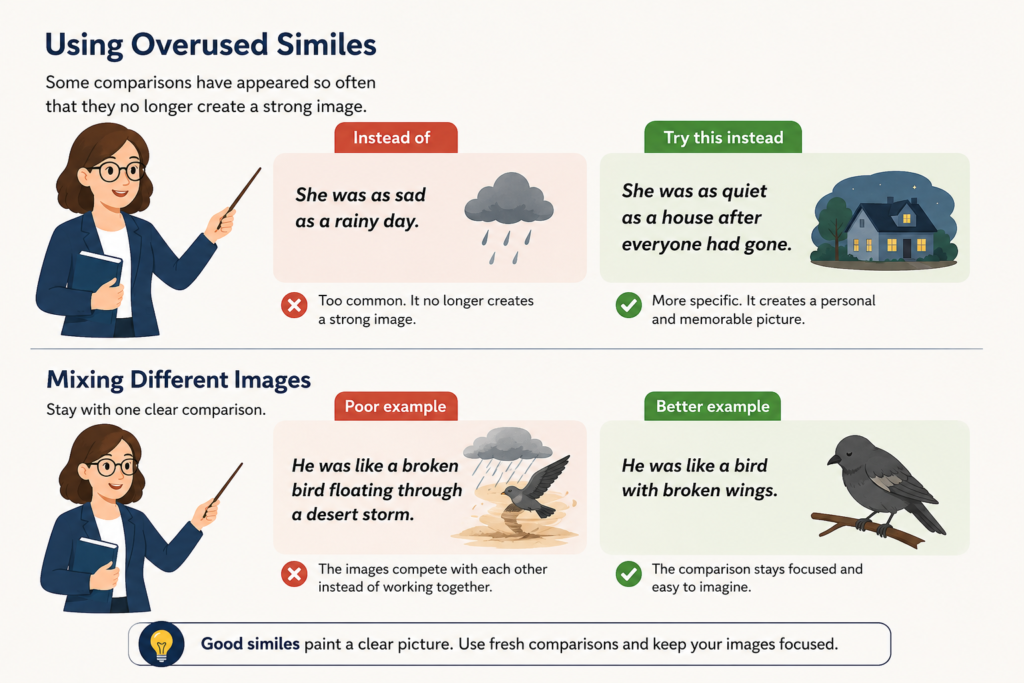
Using Overused Similes
Some comparisons have appeared so often that they no longer create a strong image.
Instead of writing
She was as sad as a rainy day.
Try creating a fresher picture.
She was as quiet as a house after everyone had gone.
The second version feels more personal and memorable.
Mixing Different Images
Stay with one clear comparison.
Poor example.
He was like a broken bird floating through a desert storm.
The images compete with each other instead of working together.
Better example.
He was like a bird with broken wings.
The comparison stays focused and easy to imagine.
Making Similes Too Complicated
Readers should understand the comparison immediately.
Simple images often leave a stronger impression than complicated ones.
Choosing Images That Do Not Match The Emotion
A comparison should support the feeling.
If the emotion is quiet sadness, avoid images that suggest excitement or action.
Consistency helps readers stay connected to the scene.
Memory Tips
Remembering Similes for Sadness becomes much easier when you connect each emotion with an image you already know. Instead of memorizing dozens of comparisons, learn the pattern behind them.
Match The Image To The Emotion
Different images naturally represent different kinds of sadness.
| Emotion | Images That Work Well |
|---|---|
| Quiet sadness | Fog snow fading light empty rooms. |
| Grief | Mountains storms broken trees dark nights. |
| Loneliness | Empty parks abandoned houses distant stars islands. |
| Heartbreak | Broken mirrors falling leaves cracked windows. |
| Hopelessness | Dry rivers stopped clocks ashes empty nests. |
When you picture the emotion first, the right simile often comes naturally.
Think About Everyday Experiences
The strongest similes usually come from ordinary life.
People understand empty chairs, rainy afternoons, forgotten photographs, silent houses, and broken toys because they have seen them before.
Simple images often create stronger emotions than complicated ones.
Avoid Forced Comparisons
A simile should sound natural.
Ask yourself one question.
Does this comparison help someone picture the emotion immediately?
If the answer is yes, it is probably a good simile.
Related Grammar And Usage Notes
Learning Similes for Sadness also helps you understand several related parts of English.
Simile Versus Metaphor
A simile compares two things by using like or as.
Example.
She was as quiet as falling snow.
A metaphor makes the comparison directly.
Example.
She was falling snow.
Both create vivid descriptions, but similes are usually easier for readers to understand.
Similes Versus Idioms
An idiom has a meaning that cannot always be understood from the individual words.
Example.
Feeling under the weather.
A simile creates a direct comparison.
Example.
He looked like a flower without sunlight.
The two forms have different purposes, even though both make writing more expressive.
Similes Versus Personification
Personification gives human qualities to nonhuman things.
Example.
The rain cried all afternoon.
A simile compares two different things.
Example.
Her tears fell like gentle rain.
Understanding the difference helps you choose the best figure of speech for each sentence.
Key Takeaways
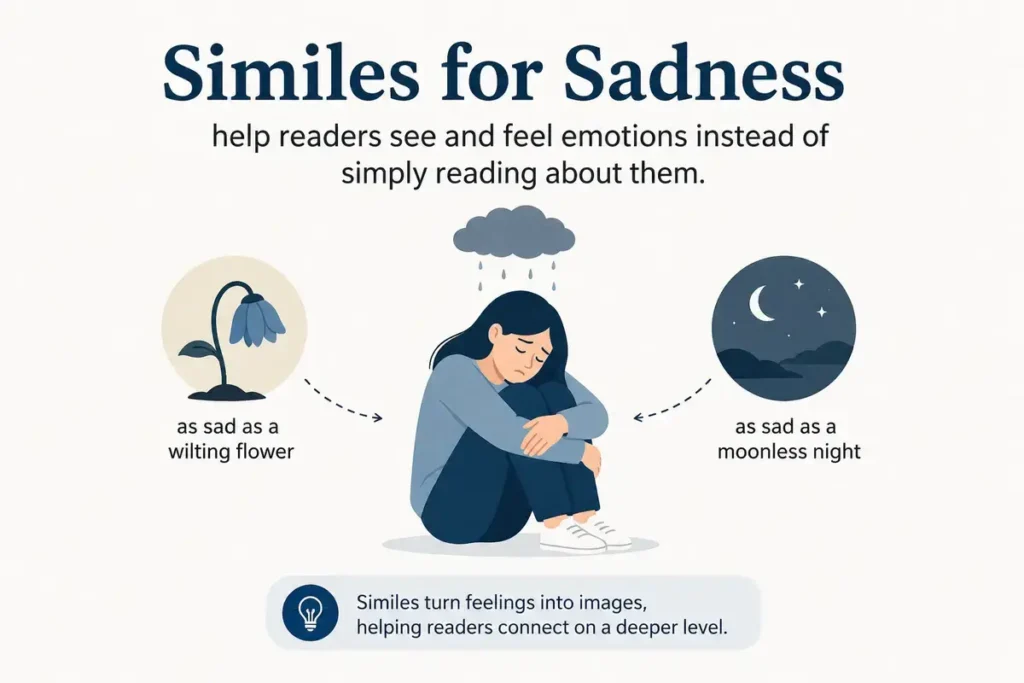
- Similes for Sadness help readers see and feel emotions instead of simply reading about them.
- Strong similes use familiar images that readers understand immediately.
- Keep comparisons simple, natural, and connected to the emotion.
- Avoid clichés and mixed images because they weaken descriptive writing.
- Original comparisons make stories, essays, speeches, and poems more memorable.
- The best similes create emotion without needing long explanations.
More Similes For Sadness
Below are additional original Similes for Sadness to expand your vocabulary. Together with the earlier sections, these provide well over 120 ideas that writers can adapt for different situations.
Nature Inspired Similes
- As lonely as a tree standing after the forest disappeared.
- Like frost covering a forgotten garden.
- As pale as the first winter morning.
- Like a river searching for the sea.
- As empty as a nest after spring.
- Like clouds hiding every ray of sunlight.
- As still as a pond without ripples.
- Like the last flower before autumn.
- As quiet as snow covering old footsteps.
- Like mist drifting across silent fields.
- As cold as a mountain stream in winter.
- Like branches reaching into an empty sky.
- As faded as grass after a long drought.
- Like waves returning to an empty shore.
- As lonely as a single stone on a hillside.
Home And Everyday Life Similes
- Like an empty rocking chair.
- As silent as a hallway after midnight.
- Like a cup left untouched on the table.
- As forgotten as an old key.
- Like curtains that never open.
- As empty as a cold fireplace.
- Like a clock ticking through an empty house.
- As lonely as one light in a dark neighborhood.
- Like shoes waiting by a closed door.
- As quiet as a room after everyone leaves.
- Like dust settling on forgotten memories.
- As still as a picture hanging on the wall.
- Like a mailbox that never receives a letter.
- As lonely as an unused porch swing.
- Like a window looking into darkness.
Creative Writing Similes
- Like a melody that lost its chorus.
- As faded as ink in an old notebook.
- Like a theater after the final curtain.
- As empty as a castle without voices.
- Like a lantern running out of light.
- As distant as forgotten dreams.
- Like a road ending at the edge of silence.
- As quiet as a library before sunrise.
- Like a puzzle missing its center piece.
- As lonely as a lighthouse before dawn.
- Like a violin waiting for its player.
- As faded as chalk after rain.
- Like a page torn from a favorite book.
- As empty as a forgotten song.
- Like an echo that never returns.
Conclusion
Similes for Sadness give ordinary writing greater depth and emotional impact. A thoughtful comparison can express loneliness, grief, disappointment, or heartbreak more clearly than a simple adjective ever could.
The strongest similes are not the longest or the most dramatic. They are the ones that feel true. Readers connect with familiar images because they have lived similar moments. An empty chair, a fading photograph, a quiet snowfall, or a forgotten house can say more about sadness than a long explanation.
As you build your writing skills, collect comparisons that feel fresh and meaningful. Read novels, poems, and essays with an eye for vivid language. Notice how experienced writers turn ordinary scenes into powerful emotional moments. Then practice creating your own similes from everyday life.
Over time, you will find that the best Similes for Sadness are the ones that help readers pause, picture the moment, and feel exactly what the words are trying to say.
Frequently Asked Questions
What Are Similes For Sadness?
Similes for sadness compare sadness with another object, place, or experience by using like or as. They help readers picture emotions instead of simply reading about them.
Why Do Writers Use Similes For Sadness?
They make emotional writing more vivid, memorable, and relatable. Readers connect with images more easily than plain descriptions.
What Makes A Good Simile For Sadness?
A good simile is simple, clear, original, and easy to picture. It should match the emotion naturally without confusing the reader.
Can Similes For Sadness Be Used In School Writing?
Yes. They improve descriptive essays, stories, poems, journal writing, and creative assignments. Teachers often encourage students to use them because they strengthen vocabulary and imagination.
Are Similes Better Than Adjectives?
They serve different purposes. Adjectives describe emotions directly, while similes create an image that makes the feeling stronger.
Can Similes Be Used In Professional Writing?
Yes. Novelists, journalists, speechwriters, and copywriters all use similes when they fit the audience and the message.
How Can I Create My Own Similes For Sadness?
Start with the emotion. Then think about an object or experience that creates the same feeling. Keep the comparison simple and easy to imagine.
What Should I Avoid When Writing Similes?
Avoid mixed images, overused comparisons, confusing language, and comparisons that do not match the emotion.
Are Similes Only Used In Poetry?
No. Similes appear in novels, speeches, blogs, songs, classroom writing, advertising, and everyday conversation.
What Is The Difference Between A Simile And A Cliché?
A simile becomes a cliché when it has been used so often that it no longer creates a fresh image. Original comparisons usually leave a stronger impression.

Idioms, Expressions & Figurative Language
Mason Ellsworth is an American language writer with a passion for English expressions, figurative language, and everyday communication. He explains idioms, similes, popular phrases, and commonly misunderstood expressions in a straightforward, engaging style that helps readers improve both their writing and spoken English.