
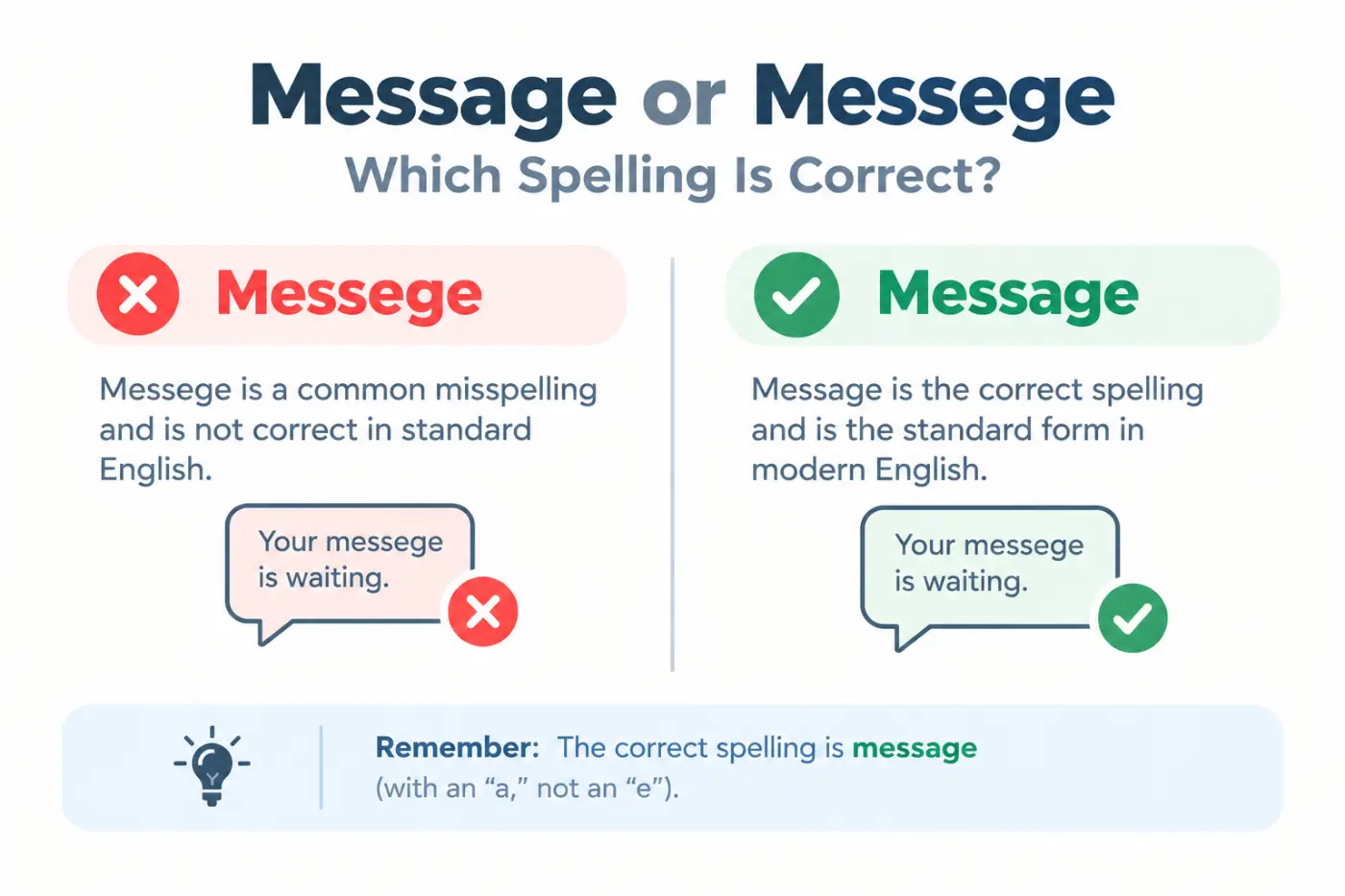
Message or messege can be confusing because both spellings look similar and the word does not sound exactly as its spelling might suggest. The correct spelling is message, which refers to information communicated to another person through speech, writing, text, or another form of communication. Messege is a common spelling error and is not accepted as the standard spelling of this word.
You probably use the word message every day. You might send a text to a friend, leave a message for a coworker, write a message to a teacher, or share an important announcement with a group. Since the word appears so often in everyday communication, learning to spell it correctly can help you write more clearly and avoid unnecessary mistakes.
The easiest way to remember the spelling is to focus on the final three letters. Message ends in age, just like several other familiar English words, including package, passage, and damage. Once you recognize that pattern, you can spot the mistake more easily and write with greater confidence.
Short Answer
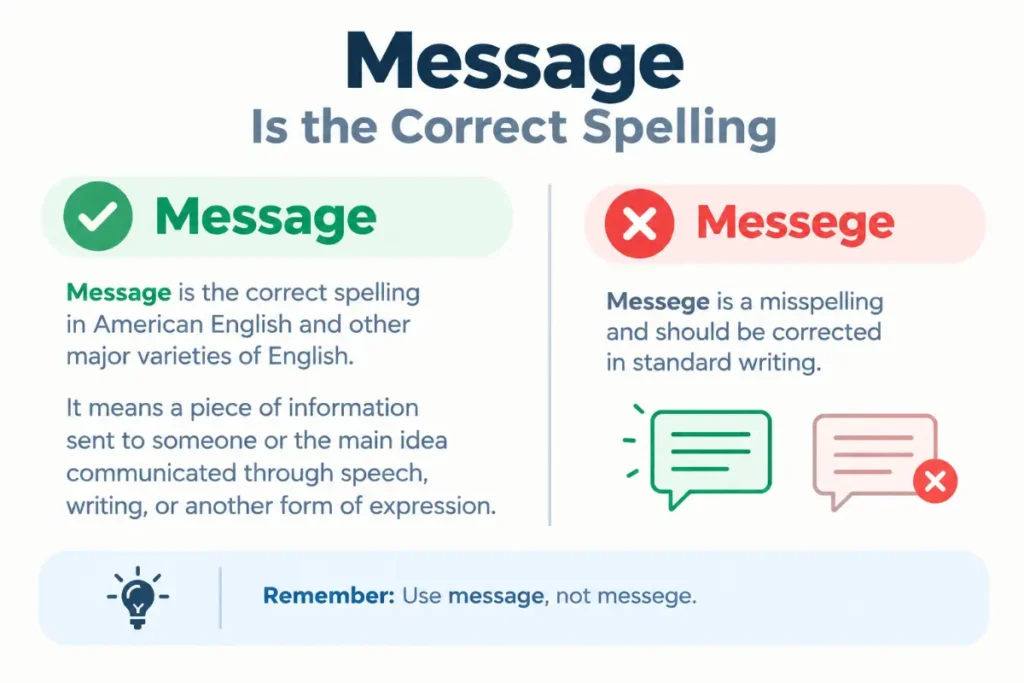
Message or messege is a common spelling question, but only one is the standard spelling in English. Message is correct. Messege is a misspelling and should be corrected in school assignments, emails, text messages, business documents, and other forms of writing. Remember the correct spelling by focusing on the ending: message uses age, not ege.
Table of Contents
- The Correct Spelling of Message.
- What Message Means.
- Why Messege Is Incorrect.
- Message vs Messege Comparison.
- How to Use Message in a Sentence.
- Different Types of Messages.
- Message as a Noun and a Verb.
- Message Pronunciation and Word Origin.
- Common Spelling Mistakes.
- Easy Ways to Remember the Spelling.
- Message in American and British English.
- Professional Writing Tips.
- Related Words and Expressions.
- Frequently Asked Questions.
- Key Takeaways.
- Conclusion.
The Correct Spelling of Message
The correct spelling is message. The spelling messege is incorrect when you intend to use the standard English word for a piece of information sent or communicated to someone.
The confusion often comes from the way people hear and remember words. English spelling does not always follow a simple rule in which every sound corresponds to one obvious letter. As a result, writers sometimes substitute one vowel for another, especially when two spellings look similar.
Here is the correct form.
| Spelling | Status | Explanation |
|---|---|---|
| Message | Correct | The standard English spelling. |
| Messege | Incorrect | A misspelling of message. |
For example, you might write, I received your message this morning. This sentence is correct because message uses the standard spelling and refers to information the speaker received.
By contrast, writing I received your messege this morning introduces a spelling error. The intended meaning remains understandable, but the word should be corrected.
In schoolwork, professional emails, formal letters, and published content, always use message. Spellcheck tools may catch the mistake, but knowing the correct form yourself is more reliable than depending entirely on software.
What Message Means
A message is a piece of information, an idea, or a thought communicated from one person or source to another. It can be spoken, written, recorded, or transmitted through a digital platform.
The word has several related uses. Understanding them makes it easier to recognize the word in different contexts.
Message as Information
A message can communicate news, instructions, requests, reminders, or personal thoughts.
For example, consider this sentence.
The manager left a message about tomorrow’s meeting.
The word message refers to the information the manager communicated. The sentence suggests that the manager shared details that the recipient needs to know.
Another example is, Her message explained why she would arrive late. Here, message refers to a written or spoken explanation.
Message as a Text
In everyday conversation, message often refers to a text sent through a phone or digital application.
For example, I sent you a message after lunch.
In this sentence, message refers to a digital communication sent to another person. The sentence does not specify the platform because the meaning is clear from the context.
You can also say, Please check your messages. The plural form messages refers to two or more communications.
Message as a Main Idea
The word can also refer to the central idea or lesson that a speaker, writer, film, book, or advertisement communicates.
For example, The film’s message is that honesty matters.
Here, message does not mean a text or a note. It refers to the main idea the film expresses.
Another example is, The speaker delivered a powerful message about kindness. The word describes the idea the speaker wanted the audience to understand.
Message as a Request or Instruction
Sometimes a message contains a specific request or instruction.
For example, The teacher sent a message asking students to bring their notebooks.
The message communicates an action the students should take. It gives them information and explains what they need to do.
These examples show that message has a broad meaning. It can describe a simple text, an important announcement, or an idea that stays with an audience long after the communication ends.
Why Messege Is Incorrect
Messege is incorrect because the standard English spelling uses the letters a and g in the ending age. The correct word is message, not messege.
A common reason for this error is that English vowel sounds can be difficult to connect with their written forms. When people learn a word mainly by hearing it, they may remember its general sound but choose the wrong vowel when writing it.
The ending of message can also cause confusion because English has many words with different spelling patterns. Writers may remember the sound of the word but accidentally replace the correct letter a with e.
Consider these examples.
1. Incorrect. Please read my messege before the meeting.
Correct. Please read my message before the meeting.
The corrected sentence uses the standard spelling for the information the reader needs to review.
2. Incorrect. I left a messege on your phone.
Correct. I left a message on your phone.
The word message refers to information left for another person.
3. Incorrect. Her messege was very helpful.
Correct. Her message was very helpful.
The corrected version uses the right spelling while keeping the original meaning.
The key point is simple. Messege is not an alternative spelling of message in standard modern English. It should be treated as a spelling mistake rather than a regional or informal variation.
Message vs Messege Comparison
The difference between message and messege is straightforward. One is the correct English word, while the other is a misspelling.
| Feature | Message | Messege |
|---|---|---|
| Spelling status | Correct | Incorrect |
| Standard English | Yes | No |
| Meaning | Information or an idea communicated to someone | No standard meaning as a spelling of message |
| Suitable for formal writing | Yes | No |
| Suitable for informal writing | Yes | No |
| Accepted spelling in standard dictionaries | Yes | Not as a standard spelling of message |
| Example | I received your message. | I received your messege. |
The table highlights the central distinction. Message is suitable for everyday communication and formal documents. Messege should be corrected wherever it appears as an attempt to spell the same word.
Which Spelling Should You Use
Use message whenever you refer to a piece of information, a text, a communication, or the main idea behind something.
For example, write I will send a message to the team. The sentence correctly describes a planned act of communication.
Do not use messege just because it looks or feels familiar. Repeated exposure to a misspelling can make it seem correct, but familiarity does not make a spelling standard.
If you are editing an article, checking a school assignment, or proofreading an email, look carefully at the ending. The correct spelling contains a after the s and before the final g and e.
How to Use Message in a Sentence
The word message appears in many everyday situations. You can use it to describe a text, an instruction, a piece of news, or an idea that someone wants to communicate.
The following examples explain how the word works in context.
Everyday Communication
1. I sent a message to my brother this morning.
Message refers to a communication sent to another person. The sentence describes an ordinary action.
2. She received a message from her best friend.
Here, message describes information that someone sent to her.
3. Please leave a message after the tone.
This sentence is a common type of instruction used by voicemail systems. It asks the caller to record information for the recipient.
4. Did you get my message yesterday.
This asks someone if they received a previous communication. In standard punctuation, the sentence should end with a question mark.
School and Education
1. The teacher sent a message to the parents.
Message refers to information shared with parents about a school matter.
2. I wrote a message to my classmate about the homework.
The word describes a written communication about an assignment.
3. The principal’s message encouraged students to work hard.
Here, message refers to the central idea or advice communicated by the principal.
These examples show that the same spelling works across different educational situations.
Business and Professional Writing
1. Please send me a message when the report is ready.
Message refers to a communication that will notify the recipient about the report.
2. I received your message and will respond shortly.
This is a polite professional response that confirms receipt of a communication.
3. The client left a message requesting an update.
The word describes information the client communicated, including a request.
4. The company’s message focused on customer service.
In this example, message means the central idea the company communicated to its audience.
Personal and Emotional Communication
1. Her message made me smile.
Message refers to something another person wrote or communicated that caused happiness.
2. He sent a heartfelt message to his parents.
The adjective heartfelt describes a sincere and emotional communication.
3. The message gave her hope during a difficult time.
Here, message refers to words or ideas that helped someone feel more hopeful.
Media and Public Communication
1. The advertisement delivered a clear message about safety.
Message refers to the main point the advertisement communicated.
2. The president addressed the nation with a message of unity.
The word describes the central idea expressed in a public speech.
3. The book carries a message about the value of friendship.
Message refers to a theme or lesson that readers can take from the book.
In each example, the spelling remains the same. The surrounding words help readers understand the intended meaning.
Different Types of Messages
A message can take several forms. Recognizing these forms helps you use the word naturally and precisely.
Text Messages
A text message is a short written communication sent through a mobile phone or messaging service.
For example, I sent a text message to confirm the appointment.
The phrase text message identifies the type of communication. In casual conversation, people often shorten it to text.
Voice Messages
A voice message is a recorded spoken communication that someone can listen to later.
For example, She left a voice message explaining the change in plans.
The phrase voice message makes it clear that the communication uses recorded speech rather than written words.
Email Messages
An email message is an electronic communication sent through an email service.
For example, The email message contained the updated schedule.
In many situations, people simply say email because the type of communication is already clear.
Direct Messages
A direct message is a private communication sent to another user through a digital platform.
For example, The customer sent a direct message to the company.
The phrase direct message often appears in online communication. People may also use the abbreviation DM in informal settings.
Warning Messages
A warning message alerts someone to a possible problem, danger, or mistake.
For example, The computer displayed a warning message before shutting down.
Here, message refers to information shown by a device or software system.
Error Messages
An error message explains that something has gone wrong or that an action cannot be completed.
For example, The website displayed an error message when I tried to submit the form.
The phrase error message is common in technology. It describes information that helps a user understand a problem.
Inspirational Messages
An inspirational message aims to encourage, motivate, or give hope.
For example, The coach shared an inspirational message before the game.
The word message refers to the encouraging idea the coach communicated.
Hidden Messages
A hidden message is an idea or piece of information that is not stated directly.
For example, The story contains a hidden message about greed.
The phrase describes an idea readers may need to interpret rather than a communication they receive directly.
These categories demonstrate how flexible the word is. The meaning changes with context, but the spelling does not.
Message as a Noun and a Verb
Message can function as both a noun and a verb. Understanding the difference helps you construct sentences correctly.
Message as a Noun
A noun names a person, place, thing, or idea. As a noun, message refers to the information or communication itself.
For example, Your message arrived this afternoon.
In this sentence, message is the subject of the sentence. It identifies the communication that arrived.
Another example is, I saved the message for later. Here, message is the object of the verb saved.
You can also use the plural form messages when referring to more than one communication.
For example, I answered three messages before lunch.
The word messages adds the regular plural ending s to message.
Message as a Verb
Message can also describe the action of sending someone a written or digital communication.
For example, Please message me when you arrive.
In this sentence, message is a verb because it describes the action the speaker wants someone to perform.
Another example is, I messaged my coworker about the schedule. The past tense form messaged describes an action that has already happened.
The verb can also take the ending ing.
For example, She is messaging her friend now.
Here, messaging describes an action that is currently in progress.
Forms of the Word Message
| Form | Example |
|---|---|
| Singular noun | I received a message. |
| Plural noun | I received two messages. |
| Base verb | Please message me. |
| Past tense | I messaged her yesterday. |
| Present participle | He is messaging his teacher. |
| Third person singular | She messages me every week. |
The noun and verb forms all come from the same spelling. When you add an ending, keep the original word intact and follow the usual English rules for plurals and verb forms.
Message Pronunciation and Word Origin
Correct spelling becomes easier to remember when you understand how a word sounds and how it developed.
How to Pronounce Message
In American English, message is commonly pronounced /ˈmes.ɪdʒ/. It has two syllables, with the stress on the first syllable.
The first syllable sounds like the word mess. The second has a short, unstressed vowel followed by the sound at the end of words such as age and bridge.
The spelling can seem confusing because the final letters age do not sound exactly like the word age when it stands alone. In message, the final sound is /ɪdʒ/, which helps explain why some writers find the spelling less obvious than they expect.
Pronunciation can help you recognize the word, but it cannot always tell you which letters to write. English has many words whose sounds and spellings do not match in a simple, predictable way.
Where the Word Comes From
The English word message came through Old French and ultimately from Late Latin missaticum, a term associated with something sent. Its history reflects the idea of sending information from one person to another.
That background connects naturally with the word’s modern meaning. A message is something communicated or sent to a recipient, whether it takes the form of a handwritten note, a phone notification, or an important announcement.
The word’s origin can help you understand its meaning, but it is not the most useful way to remember its spelling. For everyday writing, focusing on the letters in message is simpler and more practical.
Does Pronunciation Explain the Misspelling
Pronunciation may contribute to the confusion, but it does not establish messege as a valid spelling.
People often learn words through conversation before they become confident writers. When they later try to spell a familiar word, they may choose letters that seem reasonable based on its sound.
This is one reason spelling practice matters. Reading the correct form regularly and using it in sentences builds a stronger visual memory of the word.
Common Spelling Mistakes
Even familiar words can cause problems when writers rely on memory alone. Recognizing common errors helps you catch them before they reach a reader.
Using Messege Instead of Message
This is the central spelling error addressed in this article.
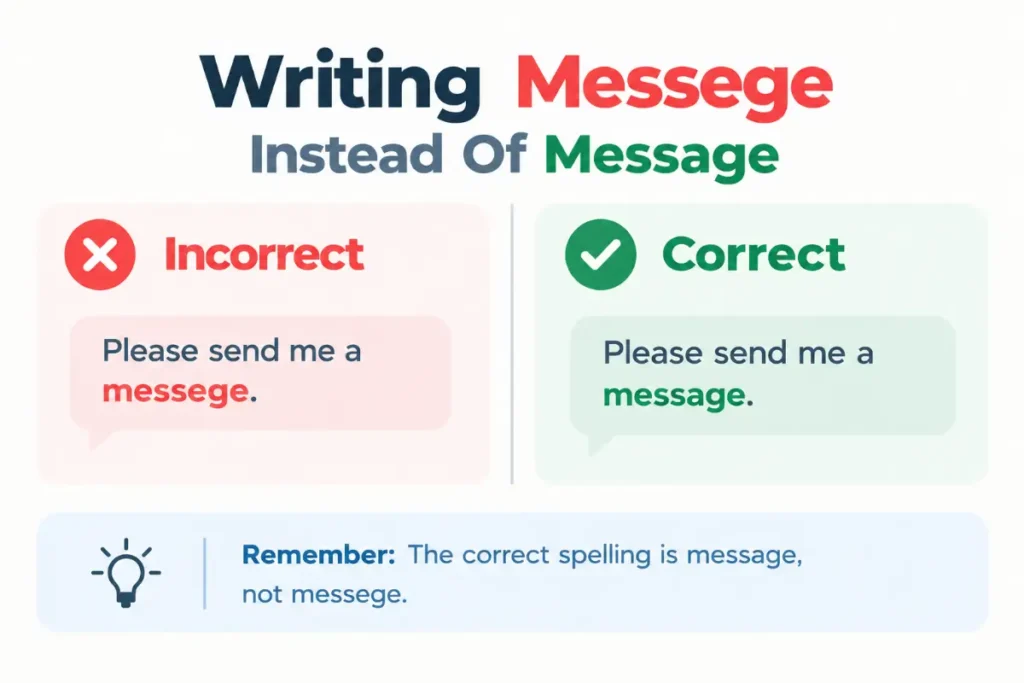
Incorrect. I sent you a messege last night.
Correct. I sent you a message last night.
The corrected sentence uses the standard spelling. The meaning stays the same, but the writing becomes accurate.
Adding an Unnecessary Letter
Some writers may accidentally type an extra letter because they are unsure of the word’s spelling.
Incorrect. Please send me a messsage.
Correct. Please send me a message.
The incorrect version contains three consecutive s letters. The correct spelling has two s letters in the middle and no extra s.
Confusing Message With Messenger
Message and messenger are related words, but they have different meanings.
A message is the information communicated. A messenger is a person or service that delivers it.
For example, The messenger delivered the message.
The sentence uses both words correctly. The messenger performs the delivery, while the message is what gets delivered.
Confusing Message With Messaging
Message can name a single communication or describe the act of sending one. Messaging refers to the activity or process of exchanging messages.
For example, Messaging helps the team communicate quickly.
In this sentence, messaging refers to the broader activity rather than one specific communication.
Using the Wrong Plural Form
The standard plural of message is messages.
Incorrect. I received several message yesterday.
Correct. I received several messages yesterday.
The word several requires a plural noun because it refers to more than one item. Adding s to message creates the correct plural form.
Forgetting the Final E
The final e is part of the standard spelling. Leaving it out creates an error.
Incorrect. I left a messag for you.
Correct. I left a message for you.
The final e completes the correct spelling. Remember to include it even when typing quickly.
Trusting Spellcheck Without Reviewing the Sentence
Spellcheck tools can catch many spelling errors, but they do not replace careful proofreading. Some errors may go unnoticed, especially if the incorrect form resembles a word the software recognizes.
For example, a basic spelling tool might flag messege immediately. However, writers should still review the complete sentence for grammar, punctuation, and clarity.
A useful proofreading habit is to reread important messages before sending them. Pay special attention to names, dates, instructions, and words you commonly misspell.
Easy Ways to Remember the Spelling
The best memory trick is one you can recall quickly when writing. You do not need a complicated rule to remember message.
Remember the Ending Age
The correct word ends in age, not ege.
Think of other familiar words such as package, passage, and damage. These words share the same final letter pattern, even though their meanings differ.
When you write message, picture the ending age in your mind. This small visual reminder can help prevent the common vowel substitution.
Break the Word Into Parts
You can divide message into two parts for practice.
Mess + age = message.
This is a spelling aid rather than a claim about the word’s historical construction. It lets you remember the familiar word mess followed by age.
Write the word a few times while saying each part quietly. Then write it in a complete sentence without looking at the example.
Use a Short Memory Sentence
Try this reminder.
Send a message at any age.
The sentence connects the correct spelling to a simple idea. It may help you remember the ending when you are writing quickly.
The goal is not to memorize a long explanation. It is to create a small reminder that comes to mind at the right moment.
Practice With Correct Sentences
Writing a word in context helps reinforce its spelling.
- I received your message.
- Please send me a message.
- The message was clear.
- She messaged me yesterday.
- I answered all my messages.
Read each sentence and notice how message keeps the same spelling when it functions as a noun. The verb forms change only when you add the appropriate grammatical ending.
Use a Quick Self Test
Cover the correct spelling and write the word from memory. Then compare your answer with message.
If you write messege, look at the two forms side by side and identify the vowel that differs. Repeating this comparison helps you focus on the exact part of the word that causes trouble.
You can also test yourself by filling in the missing letter.
M _ ssage.
The missing letter is e.
Now try this version.
M e s s _ g e.
The missing letter is a.
This simple exercise encourages you to pay attention to the internal letters rather than guessing from the overall shape of the word.
Read More to Build Visual Memory
Regular reading exposes you to correct spelling in context. Books, newspapers, well edited articles, and professional documents can help strengthen your recognition of common words.
When you notice a word you often misspell, pause for a moment and look at its letter pattern. You do not need to stop for every familiar word. Focus on the ones that repeatedly cause errors.
Over time, repeated exposure makes the correct form easier to recognize and recall.
Message in American and British English
English has many spelling differences between American and British usage. Words such as color and colour, center and centre, and traveled and travelled illustrate familiar regional patterns.
Message does not follow that pattern. Message is the standard spelling in both American and British English.
| Context | Standard spelling |
|---|---|
| American English | Message |
| British English | Message |
| Canadian English | Message |
| Australian English | Message |
Although vocabulary and usage can differ across these varieties of English, there is no standard regional spelling distinction between message and messege.
For example, an American writer might say, I sent a message to my neighbor. A British writer could use the same spelling in the same situation.
The word neighbor may be spelled neighbour in British English, but message remains unchanged. This distinction matters when proofreading for an international audience because not every apparent spelling variation is a genuine regional difference.
If you are writing for an American audience, use message in emails, school assignments, website content, and business documents. If you are writing for a British audience, use the same spelling.
Professional Writing Tips
Correct spelling helps readers focus on your meaning instead of getting distracted by errors. In professional communication, small details can influence how carefully readers perceive a document.
Proofread Before Sending
Before sending an important email or message, review the text once from beginning to end. Look for spelling mistakes, missing words, unclear instructions, and punctuation errors.
For example, I sent the message to the wrong person communicates a clear situation. If the sentence contains spelling mistakes, the reader may still understand it, but the errors can make the communication look rushed.
A quick review can prevent avoidable problems.
Choose Clear Words
Message is a useful general term, but you can sometimes choose a more specific word to make your meaning clearer.
For example, use announcement when referring to information shared publicly. Use reminder when the purpose is to help someone remember something. Use instruction when telling someone how to complete a task.
These words are not interchangeable in every situation. Selecting the right one makes professional writing more precise.
Keep Digital Messages Easy to Read
Short digital messages work best when the purpose is clear. State the main point early, include any necessary details, and make the requested action easy to identify.
For example, Please send the revised report by Friday is clearer than a long message that hides the deadline near the end.
Spelling is only one part of effective communication. Clear wording, appropriate tone, and accurate details also matter.
Match the Tone to the Reader
A message to a close friend can sound casual. A message to a client or supervisor may need a more professional tone.
For example, Can you send me the file when you have a chance sounds friendly and polite. Please send the file by 3 p.m. today communicates a more specific deadline.
Both sentences can work well, depending on the situation. The right choice depends on your relationship with the reader and the purpose of the communication.
Avoid Overusing the Word
Message is common and useful, but repeating it several times in a short paragraph can make writing sound awkward.
For example, instead of writing, I sent a message about the meeting, and the message explained the message schedule, write, I sent a message about the meeting and included the schedule.
The revised sentence removes repetition while preserving the meaning.
Use alternatives only when they fit the context. A note, announcement, text, and instruction can all be forms of communication, but each word carries a slightly different meaning.
Related Words and Expressions
Learning words related to message can help you choose the most accurate term for a particular situation. Some words describe the communication itself, while others describe the person who sends it or the way it reaches the recipient.
Message and Messenger
A message is information that someone communicates. A messenger is a person or service that carries or delivers that information.
For example, The messenger brought an important message to the office.
The sentence uses both words correctly because the messenger delivers the information contained in the message.
Message and Note
A note is usually a short piece of written information. A message can be written or spoken and may be short or detailed.
For example, I left a note on the kitchen table.
The word note works well because the communication is a short written reminder. You could also call it a message, but note gives the reader a more specific picture of the communication.
Message and Announcement
An announcement communicates information to a group or audience. A message can be intended for one person or many people.
For example, The school made an announcement about the holiday schedule.
Announcement is more precise because the information was shared publicly with the school community.
Message and Notification
A notification is an alert that informs someone about an event, update, or action. A message may contain more detailed information.
For example, I received a notification that a new message had arrived.
The sentence uses notification for the alert and message for the communication itself.
Message and Communication
Communication is the broader process of sharing information, ideas, or feelings. A message is the particular information being communicated.
For example, Clear communication helps prevent misunderstandings.
Here, communication refers to the overall exchange of information rather than one specific message.
Message and Memo
A memo is a short written communication used mainly in an organization or workplace. A message is a broader term that applies to many kinds of communication.
For example, The director sent a memo about the new office policy.
Memo is appropriate because the communication is a workplace document about an internal matter.
Message and Text
Text can refer to written words or to a text message sent electronically. Message can refer to a wider range of communication.
For example, I received a text from my friend.
This sentence is natural when the writer specifically means a text sent to a phone. The word message would also work in many similar situations.
Expert Editor Insight
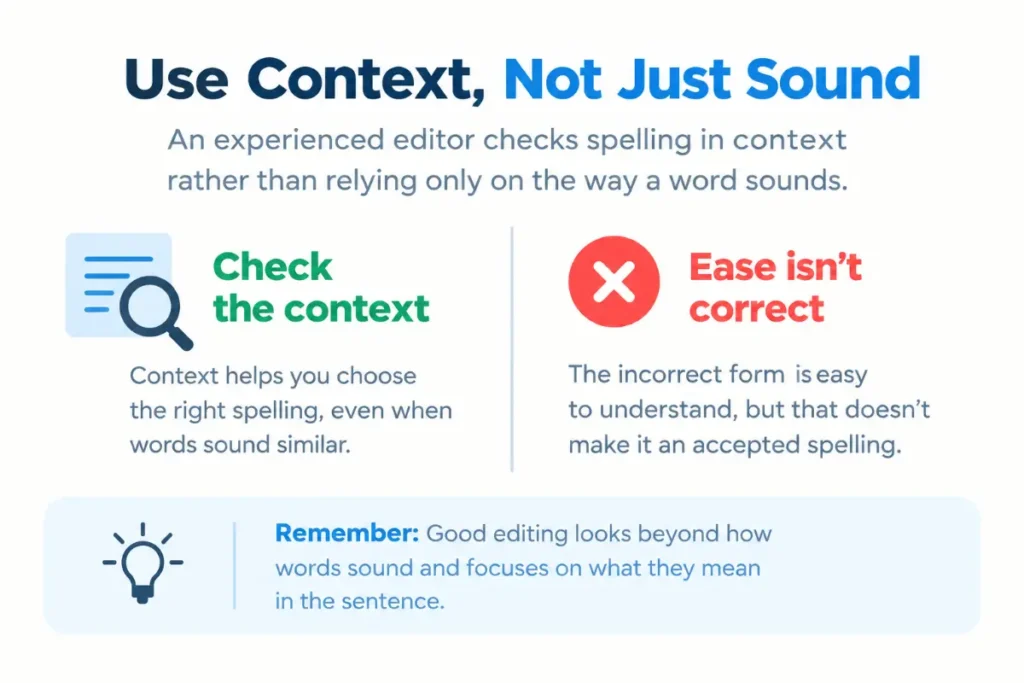
An experienced editor checks spelling in context rather than relying only on the way a word sounds. The incorrect form is easy to understand, but that doesn’t make it an accepted spelling. Editors look for the established letter pattern, the word’s grammatical role, and the needs of the audience. Automated tools can help, but a final human review remains useful because spelling software doesn’t always understand the intended meaning. For an everyday word like this one, remembering the correct form and proofreading carefully are usually enough to prevent the error.
Key Takeaways
1. Message is the correct spelling. Messege is a misspelling in standard English.
2. Message has several meanings. It can refer to a text, a voicemail, an instruction, an announcement, or the main idea behind a speech or story.
3. The word can function as a noun or a verb. You can receive a message or message someone directly.
4. The plural is messages. The past tense verb form is messaged.
5. American and British English use the same spelling. There is no standard regional variation between message and messege.
6. The easiest memory trick is to focus on age. Remember the correct ending and check the middle vowel when proofreading.
7. Careful proofreading helps prevent errors. Spellcheck tools are useful, but reviewing your writing is still worthwhile.
Conclusion
Message or messege is a common spelling question with a simple answer. Message is the correct spelling, while messege is an error in standard English. Use message whenever you refer to information sent to someone, a written communication, or the main idea behind a speech, book, or film.
The easiest way to remember the correct form is to focus on the ending age. Message keeps the same standard spelling in American and British English, and you can use it as both a noun and a verb. Reading the word in context and checking your writing before sending it can help you avoid this mistake.
Good spelling makes your writing clearer and helps readers focus on your ideas. Keep message in mind as the correct form, and correct messege whenever it appears as a misspelling.
Frequently Asked Questions
Is message or messege correct?
Message is correct. Messege is a common misspelling and should not be used as the standard English spelling. Write message in school assignments, emails, text conversations, and professional documents.
Why do people spell message as messege?
People may confuse the vowels because the spelling is not always obvious from pronunciation. The correct word ends in age, so remembering that letter pattern can help prevent the error.
How do you spell message correctly?
Spell it M E S S A G E. The word begins with m, contains two s letters, and ends with age. Checking the a in the middle is a simple way to catch the common misspelling.
What does message mean?
A message is information, an idea, or a thought communicated to someone. It can be a text, a voicemail, an instruction, an announcement, or the central idea of a speech, story, or film.
Is messege an accepted alternative spelling?
No. Messege is not an accepted standard spelling of message in modern English. It is an error when used to refer to a piece of communication.
What is the plural of message?
The plural is messages. Add s to the singular word to refer to more than one communication. For example, I answered five messages this morning.
Can message be used as a verb?
Yes. Message can be a verb meaning to send someone a written or digital communication. For example, I will message you after work. The past tense is messaged.
Is message spelled the same way in American and British English?
Yes. Both American and British English use message. Unlike words such as color and colour, this word does not have a standard American and British spelling difference.
What is the difference between message and messenger?
A message is the information being communicated. A messenger is a person or service that delivers it. For example, a messenger can deliver a message to someone.
What is an easy trick to remember message?
Remember that message ends in age, not ege. You can also practice the word in a short sentence such as I received your message. Repeated exposure to the correct spelling can help you recall it more easily.
How do you use message in a professional email?
Use message to refer to information you send or receive. For example, Thank you for your message. I will review the details and respond by Friday. This wording acknowledges the communication and explains the next step.
What should I do if I keep misspelling message?
Write the correct spelling several times, read it in complete sentences, and check the ending whenever you proofread. If you often type the incorrect form, use a spelling checker as an extra safeguard rather than your only method of checking.

Confusing Words, Spelling & Word Choice
Claire Whitmore is a U.S.-based English editor who writes about commonly confused words, spelling differences, and word choice. Her work helps readers understand subtle distinctions between similar-looking words through simple definitions, practical examples, and modern usage guidance in both American and British English.