
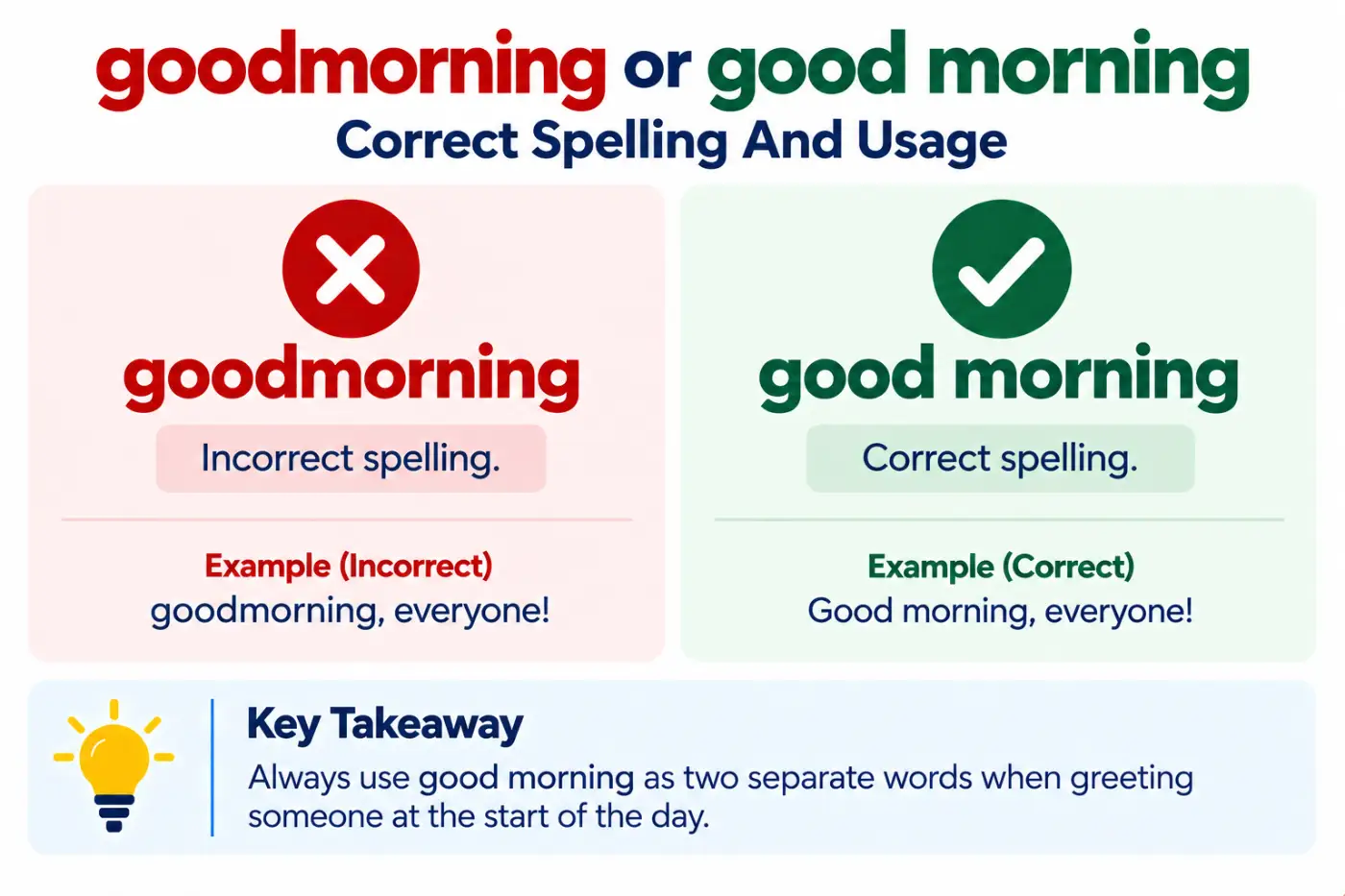
Goodmorning or good morning is a common spelling question because people often say the greeting as one connected phrase. However, standard English treats it as two words. The correct form is good morning, and you should use it when greeting someone early in the day.
The phrase is simple, friendly, and useful in almost every part of daily life. You can say it to a coworker, write it in an email, use it in a classroom, or send it in a text message. Although people may type the combined form by mistake, goodmorning is not the standard spelling.
Understanding this small difference helps you write more clearly and professionally. Once you learn why the phrase stays separate, you can apply the same thinking to other greetings and common expressions. You will also know how to capitalize it, punctuate it, and use it naturally in different situations.
Quick Answer
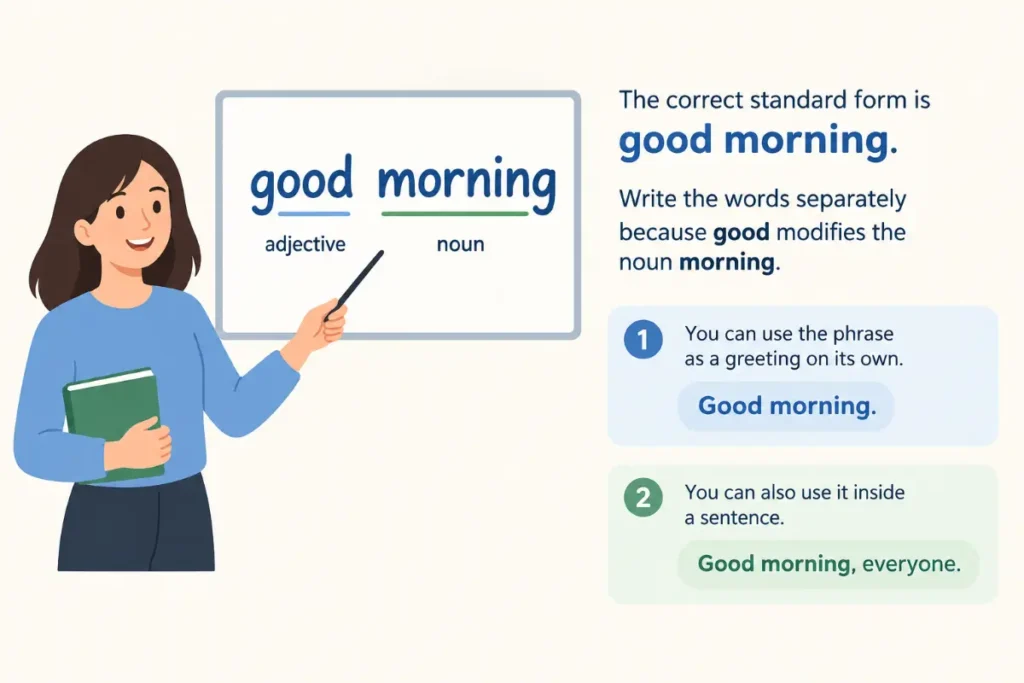
Good morning is the correct spelling in standard English. Write it as two separate words when greeting someone at the start of the day. Goodmorning is not the standard spelling and should be corrected in formal writing and professional communication. For example, write Good morning, Sarah. The same rule applies to emails, text messages, school assignments, and business letters.
Table of Contents
- The Correct Spelling of Good Morning.
- Why Good Morning Is Written as Two Words.
- The Difference Between Good Morning and Goodmorning.
- Grammar Rules for Using Good Morning.
- How to Capitalize Good Morning.
- How to Punctuate Good Morning.
- Good Morning in Emails and Professional Writing.
- Good Morning in Text Messages and Social Media.
- Common Spelling Mistakes to Avoid.
- Real Life Examples of Good Morning.
- Memory Tips for Remembering the Correct Spelling.
- Related Greetings and Expressions.
- Frequently Asked Questions.
- Key Takeaways.
- Conclusion.
The Correct Spelling of Good Morning
The correct spelling is good morning, written as two separate words. The first word is an adjective that describes something as positive or pleasant, while the second word is a noun referring to the early part of the day. Together, they form a greeting used when meeting someone in the morning.
For example.
- Good morning, everyone. The speaker greets a group of people at the beginning of the day.
- Good morning, Mom. The speaker offers a friendly greeting to their mother.
- I wished my neighbor good morning. The sentence describes someone greeting a neighbor.
- Good morning, team. A manager welcomes the team at the start of the workday.
In each example, the two words remain separate. You should not combine them into one word when writing standard English.
The spelling question about goodmorning or good morning often comes up in online messages because people type quickly and may not notice the missing space. However, a familiar expression still needs the correct spelling when clarity and accuracy matter.
Is Goodmorning Ever Correct.
Goodmorning is not the standard spelling of the everyday English greeting. Although you might see it in usernames, brand names, social media handles, or informal messages, those uses do not make it the accepted spelling in ordinary writing.
For example, a business might choose Goodmorning Cafe as its name. In that case, the combined spelling is a deliberate branding choice rather than the standard grammatical form of the greeting.
In schoolwork, professional emails, articles, and other edited writing, use good morning. This choice follows conventional English usage and helps your writing look polished.
Why Good Morning Is Written as Two Words
English contains many expressions made up of two words that work together to communicate one idea. Good morning is one of them. Each word contributes to the meaning, but the phrase functions as a complete greeting.
The word good describes something favorable, pleasant, or desirable. The word morning refers to the early part of the day, generally the period between waking up and noon in everyday usage. When people combine these words as a greeting, they express friendliness and acknowledge the time of day.
The Grammar Behind the Greeting
Good morning is a conventional greeting rather than a complete sentence in the usual grammatical sense. It can stand alone because English speakers recognize it as a complete social expression.
Consider this example.
Good morning, everyone.
The phrase greets the audience. It does not need a subject and verb to communicate its purpose.
Now consider a different sentence.
I hope you have a good morning.
Here, good morning appears within a complete sentence. The subject is I, and the verb is hope. The phrase a good morning refers to a pleasant morning experience.
Both examples use two separate words, but they serve slightly different grammatical functions.
Why the Space Matters
A space separates words in standard English writing. Removing that space can create a nonstandard spelling or produce a different word.
For example, good morning is a recognized greeting. Goodmorning is not the standard written form of that greeting.
The distinction is similar to other familiar expressions that retain separate words, such as good afternoon and good evening. Their meanings are easy to understand, but familiarity does not mean the words should be joined together.
Remember that a phrase can express one complete idea without becoming a single word. Good morning works perfectly well as two words.
The Difference Between Good Morning and Goodmorning
The main difference is spelling. Good morning is the standard form, while goodmorning is a nonstandard combination that you should avoid in ordinary writing.
| Feature | Good Morning | Goodmorning |
|---|---|---|
| Spelling | Correct standard form | Nonstandard form |
| Word count | Two words | One word |
| Grammar and usage | Accepted greeting | Not accepted as the standard greeting |
| Professional emails | Recommended | Avoid |
| School assignments | Recommended | Incorrect for standard usage |
| Social media | Correct choice | May appear as a username or stylistic choice |
| Everyday conversation | Natural greeting | Not a spelling used in speech |
Good Morning or Goodmorning in Everyday Writing
When deciding between goodmorning or good morning, choose the two word form. This applies to everyday communication as well as formal documents.
For example, write Good morning, John, instead of Goodmorning, John. The first version follows standard spelling conventions and looks natural to English readers.
The same principle applies when the greeting appears in a longer sentence. You might write, I said good morning to the receptionist before entering the office. There is no reason to combine the words.
Why People Combine the Words
Several habits can lead people to write goodmorning.
- Typing quickly. People sometimes omit spaces when sending messages in a hurry.
- Following informal examples. Seeing a misspelling online can make it appear more familiar than it really is.
- Thinking of the phrase as one idea. Because the greeting expresses a single message, writers may assume it should be one word.
- Using usernames or hashtags. Social platforms often combine words in account names or hashtags because spaces are not always permitted.
These habits explain the mistake, but they do not change the standard spelling. The safest choice is to write good morning as two words in every ordinary sentence.
Grammar Rules for Using Good Morning
Good morning is easy to use once you understand its role in a sentence. The phrase can work as a standalone greeting, appear at the beginning of a message, or form part of a longer sentence.
Use Good Morning as a Greeting
When you meet someone in the morning, you can use the phrase by itself.
Good morning.
This is a complete and natural social expression. You do not need to add a subject or verb.
You can also greet several people at once.
Good morning, class.
The greeting addresses the class directly. The comma separates the greeting from the people being addressed.
Use Good Morning in a Complete Sentence
The phrase can also appear inside a sentence.
I wished my teacher good morning before class started.
In this example, good morning is the greeting that the speaker offered. The sentence explains what happened and when it happened.
Another example is, We had a good morning at the park.
Here, good morning describes a pleasant experience. It is not a direct greeting because the speaker is talking about the morning rather than addressing someone.
This difference matters because the same words can perform different functions depending on the sentence.
Can You Say Good Mornings.
Good mornings is possible in certain contexts, but it is not the usual greeting. English speakers normally say good morning when greeting someone, regardless of the number of people involved.
For example, say Good morning, everyone rather than Good mornings, everyone.
The plural form can appear in sentences discussing repeated or pleasant morning experiences. A writer might say, Those were good mornings spent with family. In this sentence, the plural refers to multiple mornings rather than a greeting.
Can You Write Very Good Morning.
Very good morning is understandable, but it is not the most natural greeting in everyday American English. People generally say Good morning or use a warmer variation such as Good morning, everyone. You can also say I hope you have a very good morning when you want to express a fuller wish.
For example.
Good morning, everyone. I hope you have a wonderful day.
This wording sounds natural and friendly. It also avoids adding an unnecessary modifier to the greeting itself.
How to Capitalize Good Morning
Capitalization depends on where the greeting appears. The words remain separate in every case, but the first letter may change according to sentence position and title style.
Capitalization at the Beginning of a Sentence
Capitalize the first word when the greeting starts a sentence.
Good morning, everyone.
Good morning. How are you today.
In these examples, Good begins with a capital letter because it starts the sentence. Morning remains lowercase unless another capitalization rule applies.
Capitalization in the Middle of a Sentence
When the phrase appears within a sentence, use lowercase unless it is part of a title or another proper name.
I wished her good morning before leaving.
He said good morning to the security guard.
The receptionist greeted us with a cheerful good morning.
Each example uses lowercase because the phrase appears in the middle of a sentence and is not a proper noun.
Capitalization in Email Subject Lines
Email subject lines often use title case or sentence case, depending on personal preference and workplace style.
Examples include the following.
- Good Morning From the Marketing Team.
- Good morning from the marketing team.
- A Good Morning Message for Everyone.
The exact capitalization can vary according to the style you follow. However, the spelling remains two words in every example.
If your workplace uses sentence case for subject lines, capitalize only the first word and any proper nouns. If it uses title case, follow the organization’s established rules.
How to Punctuate Good Morning
Correct punctuation makes greetings easier to read. The most common issue involves deciding when to use a comma, a period, or an exclamation point.
Use a Comma When Addressing Someone
When you greet a person by name, place a comma between the greeting and the name.
Good morning, Sarah.
Good morning, Dr. Wilson.
The comma separates the greeting from the person or group being addressed. This is standard punctuation for direct address.
Use a Period for a Simple Greeting
A period works well when you want a calm and professional tone.
Good morning.
This is appropriate for workplace conversations, formal messages, and ordinary written communication. You can follow the greeting with another sentence if you have more to say.
Good morning. I hope your meeting goes well.
The period keeps the greeting clear and allows the next sentence to express your message.
Use an Exclamation Point for Extra Enthusiasm
An exclamation point can make a greeting sound energetic or excited.
Good morning, team.
In writing, an exclamation point can replace the period when you want more excitement. For example, Good morning, team! sounds more enthusiastic than Good morning, team.
Use exclamation points thoughtfully in professional communication. A single one can convey warmth, but repeated exclamation points may make a message look overly excited or less formal.
Should Good Morning Have a Comma After It.
The answer depends on the sentence. Use a comma when a name or other direct address follows the greeting, as in Good morning, Alex. Do not automatically add a comma after good morning when the phrase stands alone.
For example, Good morning is correct as a standalone greeting. Good morning, Alex is correct when addressing Alex directly.
Good Morning in Emails and Professional Writing
A greeting sets the tone for an email. Good morning is a common choice when writing to coworkers, clients, teachers, supervisors, and other professional contacts.
The best greeting depends on the relationship, the time you send the message, and the level of formality you need.
How to Start a Professional Email
You can use good morning when you know the recipient will receive the message early in the day or when the greeting suits the time of the interaction.
For example.
Good morning, Ms. Davis.
I am writing to confirm our meeting scheduled for Thursday. Please let me know if you need any additional information before then.
This opening is polite and direct. It acknowledges the recipient before moving to the main purpose of the email.
For a message to a group, you can write Good morning, team. This sounds friendly without being too casual.
Is Good Morning Formal or Informal.
Good morning works in both formal and informal situations. It is polite enough for professional emails and ordinary enough for conversations with friends or family.
In a formal email, you might write Good morning, Professor Lee. In a casual message to a friend, you might write Good morning! Hope you slept well.
The phrase itself does not determine the entire tone. The wording that follows, the punctuation, and your relationship with the recipient all contribute to how the message feels.
Should You Use Good Morning in Every Email.
You do not need to use a time based greeting in every email. If you communicate frequently with someone, a simple Hello or Hi may be more practical. For a formal first contact, Good morning can sound courteous when it matches the context.
Keep in mind that email recipients may read your message hours after you send it. If you are writing to people in different time zones, a neutral greeting such as Hello may be more suitable.
The goal is to make the message feel natural rather than forcing a greeting that may not fit the recipient’s situation.
Good Morning in Text Messages and Social Media
Text messages and social media encourage quick communication, but correct spelling still helps your message look clear and intentional.
You can use good morning in a message to a friend, a family member, a colleague, or a group chat. The level of warmth depends on the words you add.
Good Morning Messages for Friends
Here are a few natural examples.
- Good morning, Emma. Hope you have a great day.
- Good morning. Did you sleep well.
- Good morning, everyone. What are your plans for today.
Each message uses the correct spelling. The first offers a friendly wish, the second asks a question, and the third opens a group conversation.
Good Morning Messages for Family
The greeting also works naturally in family conversations.
Good morning, Mom. I hope you have a peaceful day.
Good morning, Dad. I’ll call you after work.
Good morning, everyone. Breakfast is ready.
These examples show that good morning can be warm and personal without changing its spelling.
Good Morning on Social Media
People often post morning greetings on social platforms. A caption might say Good morning, friends, or Good morning to everyone starting a new day.
You may also see a combined form in a username or hashtag. Such forms can be chosen for convenience or style, but they do not replace the standard spelling in ordinary prose.
For a caption, use Good morning as two words. You can then add a personal thought, a photo description, or a positive message.
Common Spelling Mistakes to Avoid
Even simple phrases can cause confusion when writers rely on memory rather than standard usage. The following mistakes are easy to correct once you know the rules.
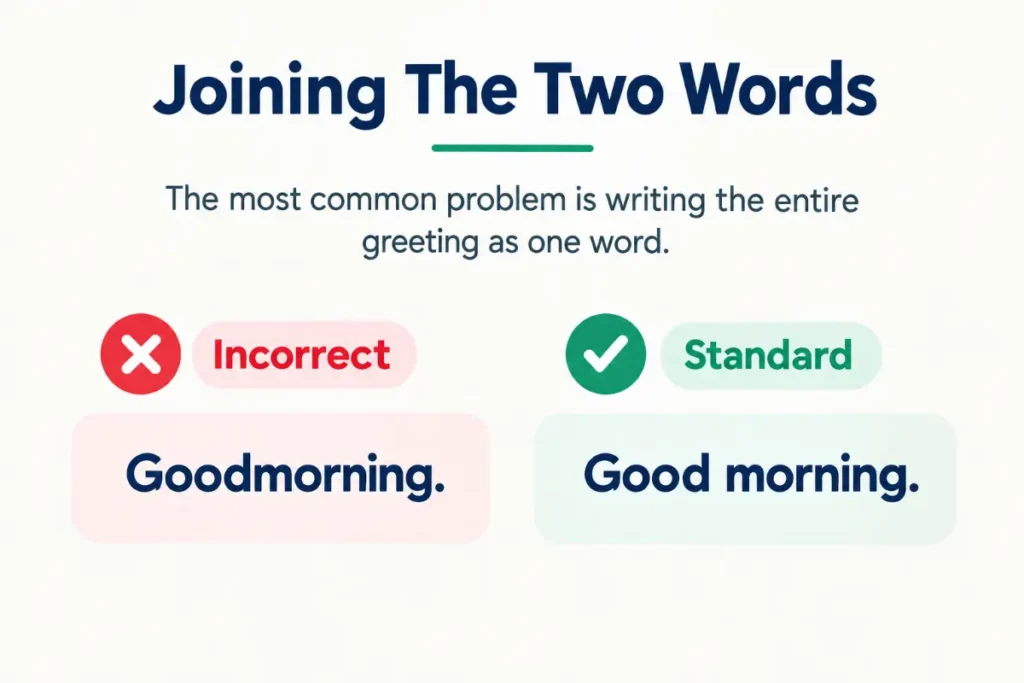
Writing Goodmorning as One Word
Incorrect: Goodmorning, everyone.
Correct: Good morning, everyone.
The corrected version separates the adjective good from the noun morning. This is the standard spelling used in everyday English.
Writing Good Morning as One Capitalized Phrase Everywhere
Incorrect: I wished my coworker Good Morning before the meeting.
Correct: I wished my coworker good morning before the meeting.
When the phrase appears in the middle of a sentence, lowercase is normally appropriate. Capitalize Good when the phrase begins a sentence or follows a title style that calls for it.
Forgetting the Comma Before a Name
Incorrect: Good morning Sarah.
Correct: Good morning, Sarah.
The comma marks direct address. It helps readers recognize that Sarah is the person being greeted.
Using the Greeting as a Question Without a Reason
Incorrect: Good morning?
Correct: Good morning.
A question mark may make sense if you are expressing surprise or asking for confirmation in a particular conversation. However, a standard greeting normally ends with a period or an exclamation point.
Adding Unnecessary Words
Awkward: A very good morning to you all.
More natural: Good morning, everyone. I hope you have a wonderful day.
The longer version is not necessarily grammatically impossible, but the simpler wording is more natural in most American English conversations.
Confusing Good Morning With Good Night
Good morning is used to greet people in the morning. Good night is generally used when parting for the evening or going to bed.
For example, Good morning, everyone welcomes people at the start of the day. Good night, everyone usually signals that the speaker is leaving or ending the day.
These expressions have different social functions, so choose the one that matches the situation.
Real Life Examples of Good Morning
Examples make spelling rules easier to remember because they show how the phrase works in everyday situations.
At School
Good morning, teacher.
A student uses the phrase to greet a teacher at the beginning of the school day. In many American classrooms, students would more naturally address the teacher by name or title, such as Good morning, Ms. Brown.
At Work
Good morning, team. Our meeting starts in ten minutes.
A manager greets the team and provides useful information. The comma separates the greeting from the group being addressed.
In a Personal Message
Good morning, brother. I hope everything goes well today.
This message sounds warm and familiar. The greeting remains two words even though the tone is informal.
In a Business Email
Good morning, Mr. Carter.
Thank you for sending the updated report. I will review it and share my feedback this afternoon.
The greeting establishes a polite tone before the writer explains the purpose of the email. The message stays professional without sounding stiff.
In a Sentence About the Past
She said good morning to everyone as she entered the room.
Here, the phrase describes an action that took place in the past. It is not being used to greet the reader directly.
In a Sentence About a Pleasant Experience
We had a good morning at the beach.
In this sentence, good morning refers to a pleasant period of time. It does not function as a greeting, but the spelling remains unchanged.
In a Morning Announcement
Good morning, passengers. The train will depart in five minutes.
The announcement addresses a group of passengers. The greeting is followed by the information they need.
In a Friendly Group Chat
Good morning, friends. Who is free for coffee today.
The greeting opens the conversation and introduces a question. In standard punctuation, the question should end with a question mark.
These examples show that the correct form works across different situations. The meaning and tone can change, but the two word spelling remains consistent.
Memory Tips for Remembering the Correct Spelling
A simple memory trick can help you avoid this mistake permanently.
Think of Two Separate Ideas
The phrase contains two familiar words. Good describes something pleasant, and morning identifies a part of the day. Since both words retain their individual forms, keep a space between them.
Compare It With Other Greetings
Think about good afternoon and good evening. These common expressions also use two words.
Remembering this pattern makes the spelling easier. If you write good morning as one word, ask yourself why you would combine it when you keep the words separate in other greetings.
Read the Phrase Slowly
When checking your writing, read the phrase as two distinct words. This small habit can help you catch a missing space before you send an email or submit an assignment.
Use a Simple Sentence
Practice with a sentence such as Good morning, everyone. Once you become familiar with the correct form, you are less likely to type the combined version by accident.
Remember the Main Rule
The easiest rule is this. Good morning is always two words in standard English. You do not need a complicated grammar rule to remember it.
Related Grammar and Usage Notes
Understanding related expressions helps you use greetings correctly in different situations.
Good Afternoon
Good afternoon is the standard greeting used during the afternoon. Like good morning, it consists of two words.
Example: Good afternoon, everyone. Thank you for joining the meeting.
The speaker greets the audience and then begins the meeting. The spelling stays separate.
Good Evening
Good evening is used as a greeting later in the day. It is also written as two words.
The greeting sounds polite and appropriate for a formal gathering.
Good Night
Good night differs slightly from good morning, good afternoon, and good evening. People generally use it when saying goodbye at night or wishing someone a restful night.
Example: Good night, Mom. I’ll see you tomorrow.
The phrase is still two words, but its usual function is different from a greeting used to begin a conversation.
Morning Greeting Versus a Description
The phrase good morning can function as a greeting or appear as part of a description.
Greeting: Good morning, Alex.
Description: We enjoyed a good morning outdoors.
In the first example, the speaker addresses Alex. In the second, the speaker describes a pleasant experience.
Is Good Morning One Word or Two
Good morning is two words. The fact that the phrase expresses one greeting does not make it a single word.
English has many expressions that communicate one idea while containing multiple words. Good morning follows that pattern.
Is Good Morning Correct in American English
Yes. Good morning is standard in American English and is widely understood in other varieties of English. The spelling does not change between American and British English.
Can Good Morning Be Used at Any Time
People generally use good morning during the morning. In practice, the exact cutoff can depend on the context, location, and personal habits. Some people continue using it late in the morning, while others switch to good afternoon around noon.
For written messages sent across time zones, a neutral greeting can help you avoid confusion. Hello is a practical option when you do not know what time it will be for the recipient.
Expert Editor Insight
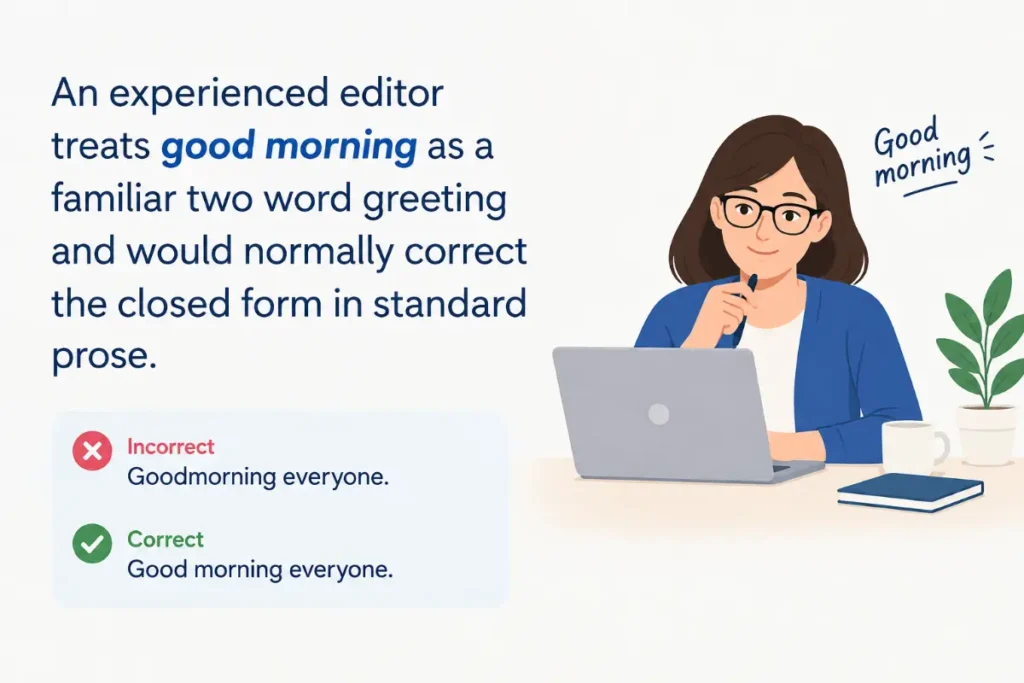
An experienced editor treats good morning as a familiar two word greeting and would normally correct the closed form in standard prose. The confusion usually comes from speech because the two words flow together so naturally that they can feel like one unit. Spelling tools may flag the closed form because it does not match the standard lexical pattern. A practical editing tip is to remember the related phrases good afternoon and good evening. Seeing the same structure across all three greetings makes the spacing rule easy to remember.
Key Takeaways
- Good morning is the correct spelling in standard English.
- Goodmorning is a nonstandard spelling of the everyday greeting.
- Keep the words separate in emails, essays, text messages, and professional documents.
- Capitalize Good at the beginning of a sentence and use lowercase when the phrase appears in the middle of ordinary prose.
- Place a comma before a person’s name when using direct address.
- Good morning works as a greeting and can also appear in sentences describing a pleasant morning.
- Good afternoon and good evening follow the same two word pattern.
- A business or username may use a stylized combined form, but that does not change the standard spelling.
Conclusion
Goodmorning or good morning is a spelling question with a straightforward answer. Good morning is the correct standard form, and it should always be written as two separate words when you use it as an ordinary English greeting. The combined form is nonstandard and should be avoided in schoolwork, professional emails, and other edited writing.
The phrase is easy to use once you remember its basic structure. Write Good morning, Sarah when greeting someone directly, and use good morning in lowercase when it appears naturally within a sentence. Add a comma before a name when needed, and choose punctuation that matches the tone of your message.
With this simple rule in mind, you can write the greeting confidently in everyday conversations, business communication, and formal documents. Keep the two words separate, use capitalization thoughtfully, and your writing will follow standard English conventions.
Frequently Asked Questions
1. Is Goodmorning Correct or Is Good Morning Correct?
Good morning is correct in standard English. It must be written as two separate words when used as a greeting. Goodmorning is a nonstandard spelling and should be avoided in formal writing, professional emails, and school assignments.
2. Why Is Good Morning Written as Two Words?
Good and morning are separate words that work together as a greeting. The phrase communicates one idea, but that does not mean the words should be combined. Standard English preserves the space between them.
3. Should Good Morning Be One Word or Two?
Good morning should be written as two words. Use this form in emails, text messages, essays, business letters, and everyday conversations.
4. Is Goodmorning or Good Morning the Correct Spelling?
Good morning is the correct standard spelling. If you are deciding between goodmorning or good morning for a message, choose the two word version. It follows standard English spelling conventions.
5. Should I Capitalize Both Words in Good Morning?
Not always. Capitalize Good when the greeting starts a sentence, but normally keep morning lowercase. In a title or email subject line, capitalization depends on the style you follow.
6. Do You Put a Comma After Good Morning?
Use a comma when you address someone by name or title. For example, Good morning, Sarah is correct. If the greeting stands alone, Good morning is sufficient.
7. Can I Write Good Morning in a Formal Email?
Yes. Good morning is polite and appropriate for professional emails. You can write Good morning, Mr. Johnson before stating the purpose of your message. A neutral greeting such as Hello may be more practical when the recipient’s time zone is unknown.
8. Is Good Morning the Same in American and British English?
Yes. The standard spelling is good morning in both American and British English. There is no regional spelling difference in this phrase.
9. Can I Say Good Mornings?
Good mornings is not the usual form of the greeting. Use good morning when greeting someone. The plural can appear in sentences about several mornings, such as We spent many good mornings together.
10. Is Good Morning a Complete Sentence?
As a conventional greeting, Good morning can stand alone and communicate a complete social message. It does not need a subject or verb. In a longer sentence, the phrase can also describe a morning or refer to a greeting someone gave.
11. Can Goodmorning Be Used as a Brand Name?
Yes. A business or social media account can choose Goodmorning as a name or stylistic label. That choice does not make it the standard spelling of the everyday greeting.
12. What Is the Easiest Way to Remember Good Morning?
Remember the related expressions good afternoon and good evening. All three greetings use two separate words. When you write good morning, leave a space between good and morning.

English Grammar & Usage
Nathan Holloway is an American grammar writer and language researcher who specializes in English grammar, sentence structure, verb usage, and common writing mistakes. He enjoys breaking down confusing grammar rules into practical explanations with clear examples, making English easier for students, professionals, and everyday writers.