
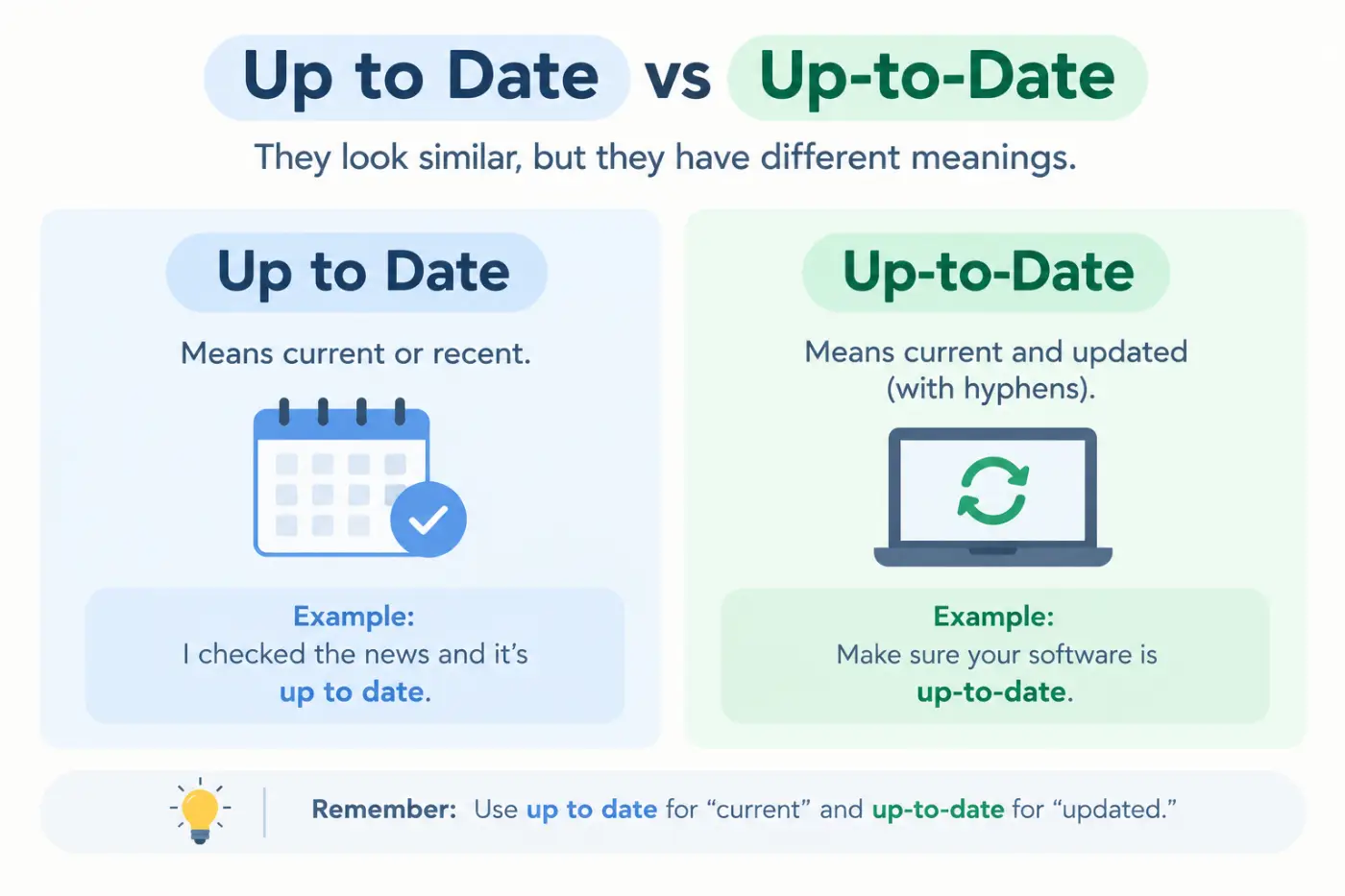
Up to date vs up-to-date is a common spelling question in American English. Both forms are correct, but they serve different grammatical purposes. The main difference depends on the phrase’s position and function in a sentence. Once you understand this simple rule, you can choose the right form without second guessing yourself.
The phrase refers to information or something that reflects the latest available facts, changes, or developments. You might use it when discussing updated records, current software, recent research, financial reports, or the latest company policies. In everyday writing, the phrase appears in emails, business documents, school assignments, websites, and professional reports.
The easiest way to remember the rule is to look at the word that follows the phrase. When it comes before a noun and describes that noun, use a hyphen. When it follows a linking verb and describes a state or condition, leave the hyphen out. This guide explains the difference with practical examples, common mistakes, memory tips, and answers to frequently asked questions.
Short Answer
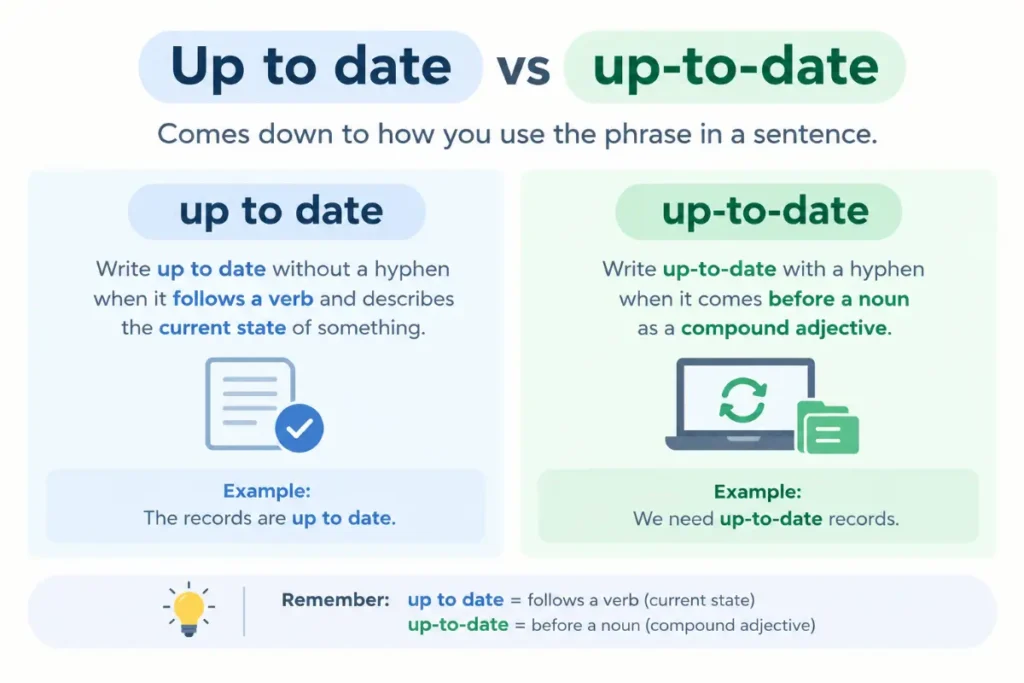
Up to date vs up-to-date comes down to how you use the phrase in a sentence. Write up to date without a hyphen when it follows a verb and describes the current state of something. Write up-to-date with a hyphen when it comes before a noun as a compound adjective. For example, “The records are up to date” and “We need up-to-date records” are both correct.
Table of Contents
- The Main Difference Between the Two Forms.
- When to Use Up to Date Without a Hyphen.
- When to Use Up-to-Date With a Hyphen.
- Comparison Table With Examples.
- Real Life Examples in Everyday Writing.
- Common Grammar and Spelling Mistakes.
- How to Remember the Rule.
- Related Grammar and Usage Notes.
- American English and British English Usage.
- Frequently Asked Questions.
- Key Takeaways.
- Conclusion.
The Main Difference Between the Two Forms
The distinction between these forms comes from their grammatical roles. English sometimes combines words with a hyphen to show that they work together as one modifier. However, the same words may remain separate when they perform another grammatical function.
Up to date is an adjective phrase that describes something as current or recently updated. It usually appears after a linking verb such as be, remain, stay, or keep.
Example: The employee database is up to date.
This sentence means that the database contains the latest necessary information. The phrase describes the database’s current condition, so it doesn’t need a hyphen.
Up-to-date is a compound adjective. It usually appears before a noun that it modifies.
Example: The company maintains an up-to-date employee database.
Here, the hyphen connects the words into a single modifier describing the database. The meaning remains the same, but the grammatical structure changes.
Why Does the Hyphen Matter?
A hyphen helps readers recognize that two or more words work together to describe a noun. It can make a sentence easier to read and prevent confusion about how the words relate to each other.
Consider these examples.
- The information is up to date. The phrase describes the current condition of the information.
- We reviewed the up-to-date information. The hyphenated phrase directly modifies the noun information.
Both sentences communicate that the information reflects current facts. The hyphen simply helps show the phrase’s grammatical role.
Is One Form More Correct Than the Other?
Neither form is universally more correct. The right choice depends on how you use the phrase.
Writers sometimes assume that a hyphen always belongs in this expression because dictionaries often list the compound adjective as up-to-date. However, the unhyphenated phrase is also standard when it functions as a predicate adjective.
The best approach is to consider the entire sentence instead of memorizing one spelling as the only correct option.
When to Use Up to Date Without a Hyphen
Use the unhyphenated form when the phrase describes the condition or status of something. It often appears after a linking verb or as part of a sentence that explains how current something is.
After the Verb Be
The verb be commonly connects the subject to a description of its condition.
Examples.
- The customer information is up to date. This means the customer information reflects the latest available details.
- My resume is up to date. This means the resume includes the latest relevant information about my experience.
- The website is up to date. This means the website’s information or content has been updated as needed.
In each example, the phrase follows the verb is. It describes the subject rather than appearing directly before a noun.
After Verbs Such as Remain and Stay
Other verbs can also introduce the unhyphenated phrase.
Examples.
- Please make sure the contact list remains up to date. The phrase describes the list’s continuing condition.
- Our records must stay up to date. This means the records need regular updates to remain current.
- The employee files are kept up to date. This means someone regularly updates the files.
These sentences focus on maintaining a current state. The phrase doesn’t directly modify a noun from the position before it.
After the Verb Keep
The verb keep often describes the act of maintaining a condition.
Example: We keep our customer records up to date.
The phrase describes the state the records should maintain. It follows the object our customer records and completes the meaning of the verb keep.
Another example is, “Please keep your account information up to date.” The sentence asks the reader to maintain current account details.
In Questions and Negative Sentences
The same rule applies in questions and negative sentences.
Examples.
- Are your contact details up to date? The phrase asks about the current condition of the details.
- My software isn’t up to date. The sentence says the software needs an update.
- Why aren’t these records up to date? The question asks why the records don’t contain current information.
Changing the sentence structure doesn’t change the spelling rule.
In Professional and Academic Writing
The unhyphenated form works well in business emails, reports, academic papers, and other formal documents.
Examples.
- The figures are up to date as of September 30. The sentence states that the figures reflect the information available through that date.
- Please confirm that the policy remains up to date. The sentence asks someone to verify the policy’s current status.
- Our research data is up to date. The sentence describes the current state of the research data.
For formal writing, make sure the statement accurately reflects the information’s actual freshness. A phrase can be grammatically correct even when the information itself is outdated.
When to Use Up-to-Date With a Hyphen
Use the hyphenated form when the phrase comes before a noun and describes it. In this position, the words work together as a compound adjective.
Before a Noun
This is the most familiar use of the hyphenated form.
Examples.
- We need up-to-date records. The phrase describes the records as current.
- She reads up-to-date medical research. The phrase describes the research as reflecting recent findings.
- The company provides up-to-date training materials. The phrase describes the materials as current and revised as needed.
In each example, the phrase appears directly before a noun. The hyphen connects the words so readers can understand them as one modifier.
In Business Documents
Professional writing often uses the hyphenated form to describe information, reports, systems, and procedures.
Examples.
- Please send me an up-to-date sales report. The phrase describes the report as containing current sales information.
- We need an up-to-date list of suppliers. The phrase describes the list as reflecting current supplier details.
- The manager requested up-to-date financial statements. The phrase describes the statements as current.
These constructions are common in emails, internal documents, proposals, and presentations.
In Technology and Digital Content
The phrase also appears in writing about websites, applications, databases, and digital tools.
Examples.
- Install the up-to-date version of the application. The phrase describes the version as current.
- The team maintains an up-to-date database. The phrase describes the database as regularly updated.
- Readers expect up-to-date information on the website. The phrase describes the information as current.
One detail matters here. Up-to-date doesn’t automatically mean that software has every available feature or that a database has been updated within the last few minutes. The intended level of freshness depends on the subject and context.
Before Singular and Plural Nouns
The hyphenated form works with both singular and plural nouns.
Examples.
- We received an up-to-date report. The phrase modifies the singular noun report.
- We received up-to-date reports. The phrase modifies the plural noun reports.
- They use up-to-date methods. The phrase describes the methods as current.
The number of the noun doesn’t determine the hyphen. The phrase’s grammatical function does.
When Another Adjective Appears Before the Noun
The phrase can also appear alongside other modifiers.
Example: The team prepared a detailed and up-to-date project report.
Here, detailed and up-to-date both describe the report. The hyphen remains part of the compound adjective.
Another example is, “We purchased several reliable, up-to-date reference books.” The sentence uses two adjectives to describe the books.
Comparison Table With Examples
| Sentence | Correct form | Reason |
|---|---|---|
| The records are up to date. | Up to date | The phrase follows a linking verb. |
| We need up-to-date records. | Up-to-date | The phrase comes before a noun. |
| Keep your profile up to date. | Up to date | The phrase describes the profile’s condition. |
| Read an up-to-date report. | Up-to-date | The phrase modifies the noun report. |
| The website remains up to date. | Up to date | The phrase follows the linking verb remains. |
| They published up-to-date research findings. | Up-to-date | The phrase modifies the noun phrase research findings. |
| Is your software up to date? | Up to date | The phrase describes the software’s status. |
| We need up-to-date software. | Up-to-date | The phrase comes before the noun software. |
| The policy is up to date. | Up to date | The phrase follows the verb is. |
| This is an up-to-date policy. | Up-to-date | The phrase modifies the noun policy. |
The pattern is consistent. Look at the phrase’s position and role in the sentence before deciding to use a hyphen.
Real Life Examples in Everyday Writing
Understanding grammar rules becomes easier when you see how they work in real situations. The following examples show how to use both forms naturally.
Emails and Workplace Communication
People often use this expression when asking colleagues to review documents or maintain records.
Example one: Please make sure the contact list is up to date before the meeting.
The phrase follows is and describes the contact list’s condition. No hyphen is needed.
Example two: Please share the up-to-date contact list before the meeting.
The phrase comes before contact list and describes it. The hyphen connects the words into one modifier.
Example three: Our team needs up-to-date pricing information.
The phrase describes the pricing information. The hyphenated form is correct because it appears before the noun phrase.
Example four: The pricing information should remain up to date throughout the project.
The phrase follows remain and describes the information’s continuing state.
School and Academic Writing
Students and researchers often need to describe current facts, sources, and findings.
Example one: The textbook contains up-to-date scientific information.
The hyphenated phrase modifies scientific information. It tells readers that the information reflects current knowledge.
Example two: Make sure your bibliography is up to date.
The unhyphenated phrase follows is and describes the bibliography’s condition.
Example three: Researchers rely on up-to-date evidence when evaluating a theory.
The phrase modifies evidence. The sentence emphasizes the value of using current research.
Example four: The references in this paper are up to date.
The phrase follows the linking verb are. It describes the references rather than directly modifying a noun.
Websites and Online Content
Website owners often use the phrase to describe published material, product details, and online resources.
Example one: The website provides up-to-date travel information.
The phrase modifies travel information. The hyphenated form is appropriate because the phrase appears before the noun.
Example two: The travel information on the website is up to date.
The phrase follows is and describes the current condition of the information.
Example three: We publish up-to-date product descriptions.
The phrase modifies product descriptions and indicates that the descriptions reflect current product details.
Example four: Our product catalog stays up to date throughout the year.
The phrase follows stays and describes the catalog’s condition.
Personal and Everyday Use
You can also use both forms when discussing resumes, accounts, subscriptions, and personal information.
Example one: My resume is up to date.
The phrase describes the resume’s current condition.
Example two: I created an up-to-date resume for my job application.
The hyphenated phrase modifies the noun resume.
Example three: Please keep your payment information up to date.
The phrase describes the condition that the payment information should maintain.
Example four: The bank requires up-to-date account information.
The phrase modifies account information and indicates that the details need to be current.
Common Grammar and Spelling Mistakes
Even experienced writers sometimes confuse the two forms. Most errors happen when someone memorizes a spelling without considering the sentence structure.
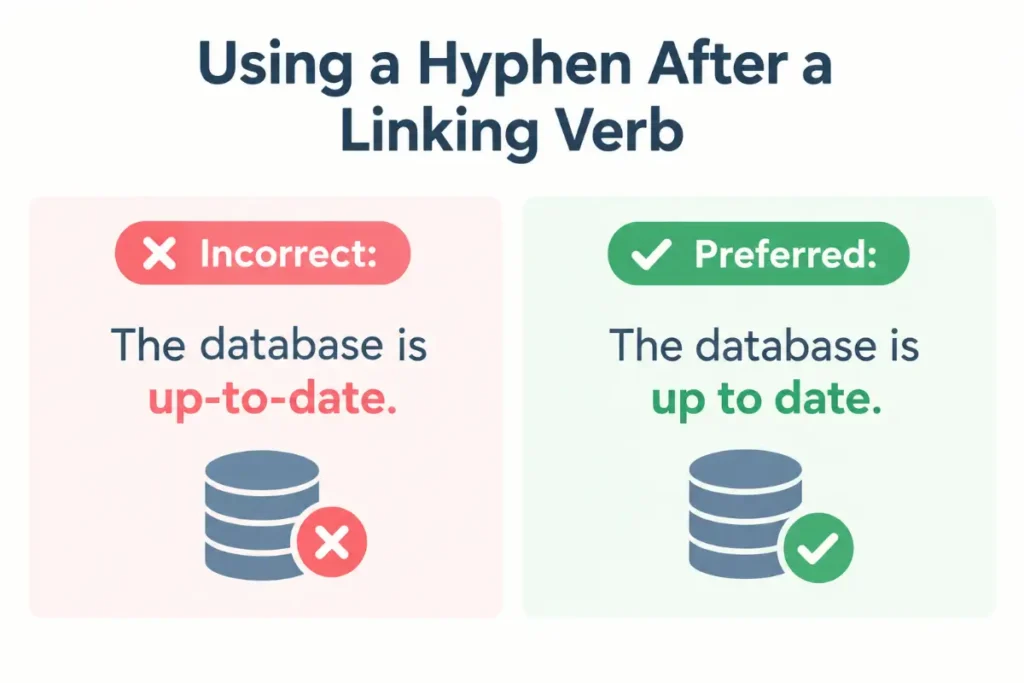
Using a Hyphen After a Linking Verb
Incorrect: The database is up-to-date.
Preferred: The database is up to date.
In standard usage, the phrase follows the linking verb is and describes the database’s condition. The unhyphenated form is the conventional choice.
Leaving Out the Hyphen Before a Noun
Incorrect: We need up to date information.
Preferred: We need up-to-date information.
The phrase comes before information and functions as a compound adjective. The hyphen helps connect the words into one modifier.
Assuming the Phrase Always Needs a Hyphen
Some writers use the hyphenated form everywhere because they recognize it as a dictionary entry. However, English spelling often changes according to grammatical function.
Correct: The records are up to date.
Correct: We reviewed the up-to-date records.
Both sentences are correct because the phrase performs a different role in each one.
Assuming the Phrase Always Needs Two Separate Words
The opposite mistake happens when writers avoid the hyphen in every situation.
Incorrect: The company published an up to date report.
Preferred: The company published an up-to-date report.
The phrase modifies the noun report, so the hyphenated form is the standard choice.
Confusing Up to Date With Updated
These expressions have related meanings, but they don’t always communicate exactly the same thing.
Example: The software is up to date.
This statement means the software reflects the current version or required updates in the relevant context.
Example: The software was updated yesterday.
This statement tells readers that someone updated the software yesterday. It doesn’t guarantee that the software remains current today.
Use up to date to describe a current state. Use updated to describe a change or the result of making a change.
Confusing Up-to-Date With Current
The words current and up-to-date often express similar ideas, but context matters.
Example: The report contains current sales figures.
Example: The report contains up-to-date sales figures.
Both sentences suggest that the figures reflect recent information. However, up-to-date can place greater emphasis on the information having been brought current through updates.
Choose the expression that best fits your intended meaning.
How to Remember the Rule
You don’t need to memorize a long list of grammar terms to use this phrase correctly. A quick sentence check will usually solve the problem.
Use the Before a Noun Test
Ask yourself if the phrase comes directly before a noun that it describes.
If the answer is yes, use the hyphenated form.
Examples.
- Up-to-date records.
- Up-to-date research.
- Up-to-date software.
- Up-to-date information.
The hyphen connects the words because they work together as a modifier.
Use the After a Verb Test
Next, check if the phrase follows a linking verb and describes a condition.
If it does, leave out the hyphen.
Examples.
- The records are up to date.
- The research remains up to date.
- The software is up to date.
- The information stays up to date.
The phrase describes the subject’s condition rather than appearing before a noun.
Try the Sentence Switch Trick
A helpful memory trick is to rewrite the same idea in two different ways.
Version one: The files are up to date.
Version two: We have up-to-date files.
The meaning stays nearly the same, but the grammar changes. In the first sentence, the phrase follows a linking verb. In the second, it modifies the noun files.
Practicing this switch helps you recognize the correct form more quickly.
Remember the Two Word Roles
Think of the hyphen as a small connector that joins words when they work together before a noun.
- Before a noun, connect the words with a hyphen.
- After a linking verb, leave the words separate.
This simple distinction will help you handle most everyday uses of the phrase.
Related Grammar and Usage Notes
The rules for this expression connect to a broader pattern in English. Compound adjectives often use hyphens before nouns, while similar phrases may remain open when they appear after linking verbs.
Compound Adjectives in English
A compound adjective contains two or more words that work together to describe a noun. Writers often use hyphens to make the relationship between those words clear.
Examples include well-known author, long-term plan, high-quality product, and up-to-date information.
In these examples, the hyphen helps readers interpret the words as one descriptive unit.
However, not every compound adjective needs a hyphen in every position. Usage depends on the expression, the grammatical structure, and the style guide being followed.
Similar Expressions With Hyphens
The same general pattern appears in several familiar expressions.
| Before a noun | After a linking verb |
|---|---|
| A well-known writer | The writer is well known |
| A long-term goal | The goal is long term |
| A high-quality product | The product is high quality |
| An up-to-date report | The report is up to date |
| A full-time position | The position is full time |
These examples illustrate a common convention rather than an absolute rule for every compound expression. Established usage and individual style guides may treat some expressions differently.
Up to Date Versus Updated
The phrase up to date describes a state of currency. The word updated usually describes something that has received a change.
Consider the difference.
- The address book is up to date. This means its entries are current.
- The address book was updated this morning. This means someone changed or refreshed its contents this morning.
The second sentence doesn’t necessarily prove that the address book is fully current. Someone might have updated only one entry.
Up to Date Versus Latest
The word latest refers to the most recent item or version in a sequence. The phrase up to date refers to the state of being current.
Example: This is the latest version of the application.
The sentence identifies the most recent version available in the relevant context.
Example: My application is up to date.
The sentence says the application has the current version or required updates.
These meanings overlap, but they aren’t identical. A document can be up to date without being the latest document in a series.
Up to Date Versus Current
Both expressions are useful when discussing facts, records, and information.
Example: The policy is current.
Example: The policy is up to date.
Both sentences suggest that the policy reflects the present situation. The best choice depends on the context and the emphasis you want to create.
In some contexts, current can simply mean valid or in effect. Up to date often suggests that someone has reviewed or updated the material to reflect recent changes.
Is Up to Date an Adjective or an Adverb?
The expression generally functions as an adjective phrase when it describes the state of a person, object, or body of information.
Example: The records are up to date.
Here, the phrase describes the records.
In a sentence such as “Keep up to date with the latest guidance,” the expression appears in a different grammatical construction. It describes the state a person should maintain and forms part of the expression keep up to date with.
The phrase can serve different grammatical roles in larger sentences, so it’s best to examine how the entire construction works rather than assign one label to every use.
Can You Use Up to Date at the End of a Sentence?
Yes. The unhyphenated form commonly appears at the end of a sentence.
Examples.
- Please make sure the database is up to date.
- I need to get my passport information up to date.
- The records should remain up to date.
The phrase doesn’t need a hyphen simply because it appears at the end of a sentence.
Can You Use Up-to-Date in Formal Writing?
Yes. The hyphenated form is appropriate in formal writing when it modifies a noun.
Examples include up-to-date regulations, up-to-date medical evidence, and up-to-date financial records.
The unhyphenated form is equally appropriate when the phrase describes a state or condition, as in “The financial records are up to date.”
Formal writing benefits from consistency. If you follow a particular style guide, apply its rules throughout your document.
What About a Phrase Such as Keep Up to Date?
The expression keep up to date is common in everyday and professional English.
Example: Employees must keep up to date with changes to company policy.
The phrase means that employees should stay informed about new developments.
Another example is, “I read industry publications to keep up to date with new research.” The phrase describes the ongoing effort to remain informed.
The hyphenated form may still appear before a noun in a related sentence, as in “We send an up-to-date policy summary to every employee.”
American English and British English Usage
American and British English both use up to date and up-to-date. The basic distinction between the unhyphenated phrase after a linking verb and the hyphenated compound adjective before a noun is widely recognized in both varieties.
Examples in American English.
- The employee handbook is up to date.
- We distributed an up-to-date employee handbook.
Examples in British English.
- The website is up to date.
- The organization published an up-to-date website guide.
The grammatical pattern remains the same in these examples.
Are There Differences in Spelling?
The phrase itself doesn’t have a major American and British spelling difference. Both varieties use the same words and commonly follow the same hyphenation pattern.
Other English expressions can have different spellings across regions, such as color and colour. This phrase isn’t one of those common regional spelling contrasts.
Which Form Should American Writers Use?
American writers should use up to date after a linking verb and up-to-date before a noun when the phrase functions as a compound adjective.
For example, write “Our records are up to date” and “We maintain up-to-date records.”
If you’re preparing a formal report, academic paper, or publication, check the relevant style guide for any additional house rules. Consistency matters, especially in documents with many compound adjectives.
Key Takeaways
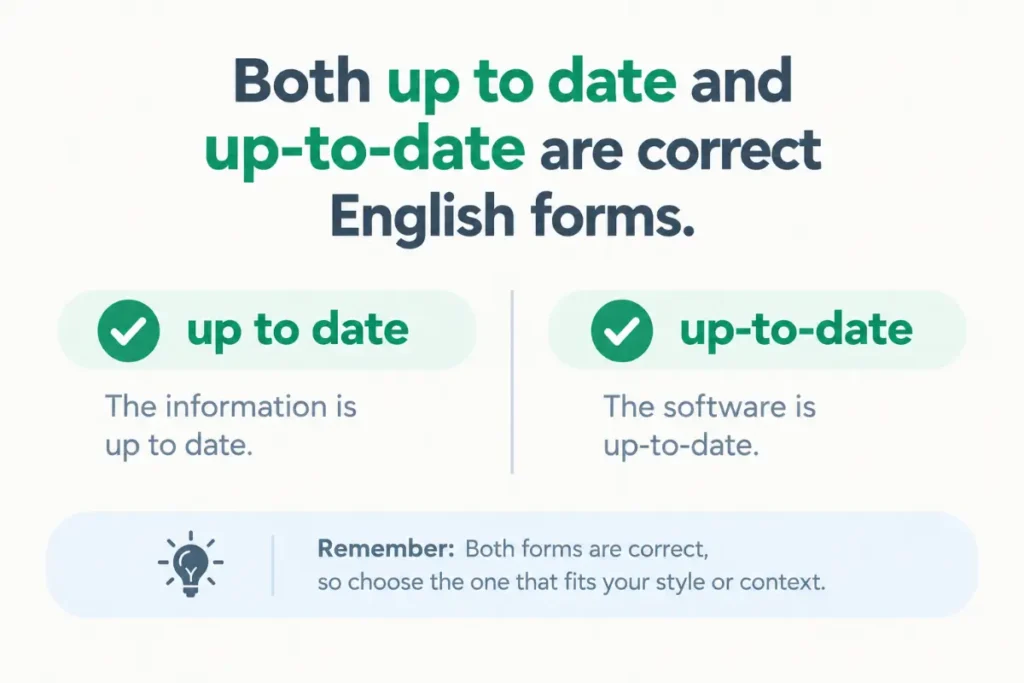
- Both up to date and up-to-date are correct English forms.
- Use up to date after linking verbs such as is, remain, and stay.
- Use up-to-date before a noun when the phrase works as a compound adjective.
- The hyphen helps readers recognize that the words work together as one modifier.
- American and British English generally follow the same pattern.
- Up to date describes a current state, while updated describes a change.
- Always check the phrase’s grammatical role instead of assuming one spelling works in every sentence.
Conclusion
Up to date vs up-to-date is easier to understand once you focus on grammar instead of memorizing spellings. Use the unhyphenated form when you describe a current condition, as in “The records are up to date.” Use the hyphenated form when the phrase comes before a noun, as in “We need up-to-date records.”
This rule applies to everyday conversations, professional emails, academic writing, website content, and business documents. Both forms communicate the idea of current information, but their grammatical roles determine the spelling. When in doubt, look at the words around the phrase and identify what it modifies.
With a little practice, you’ll recognize the correct form naturally. Keep the simple rule in mind: up to date after a linking verb and up-to-date before a noun. That one distinction will help you write more clearly and confidently.
Frequently Asked Questions
1. Is It Up to Date or Up-to-Date?
Both forms are correct. Use up to date when the phrase describes a condition after a linking verb, as in “The report is up to date.” Use up-to-date before a noun, as in “an up-to-date report.”
2. Does Up to Date Need a Hyphen?
It doesn’t always need a hyphen. Use the unhyphenated form when it follows a linking verb and describes a state. Use the hyphenated form when it works as a compound adjective before a noun.
3. Is Up-to-Date One Word or Two Words?
The expression contains three words when written with spaces and hyphens. The hyphenated form is up-to-date, while the unhyphenated form is up to date. Neither form is a single word.
4. Is Up to Date Grammatically Correct?
Yes. The phrase is grammatically correct when it describes a current condition. For example, “My account information is up to date” uses the standard unhyphenated form after the linking verb is.
5. Is Up-to-Date Grammatically Correct?
Yes. The hyphenated form is standard when the phrase modifies a noun. For example, “The company provides up-to-date information” uses the hyphen correctly because the phrase describes information.
6. Should I Write My Resume Is Up to Date or Up-to-Date?
Write “My resume is up to date.” The phrase follows the linking verb is and describes the resume’s condition. However, write “I prepared an up-to-date resume” because the phrase appears before the noun resume.
7. Is Up to Date the Same as Updated?
Not exactly. Up to date describes something that is current. Updated indicates that someone has changed or refreshed it. An updated document might still contain incomplete or outdated information.
8. Is Up-to-Date Formal or Informal?
Both forms work in formal and informal writing. You can use up-to-date information in a professional report and up to date in a business email. The grammatical role determines the hyphen, not the level of formality.
9. Do American and British Writers Use the Same Rule?
Generally, yes. American and British English both use the hyphenated form before a noun and the unhyphenated form when the phrase describes a state after a linking verb. Individual style guides may offer additional preferences.
10. What Is the Easiest Way to Remember the Difference?
Look at the phrase’s position in the sentence. If it comes before a noun and describes that noun, use up-to-date. If it follows a linking verb and describes a condition, use up to date.

English Grammar & Usage
Nathan Holloway is an American grammar writer and language researcher who specializes in English grammar, sentence structure, verb usage, and common writing mistakes. He enjoys breaking down confusing grammar rules into practical explanations with clear examples, making English easier for students, professionals, and everyday writers.