
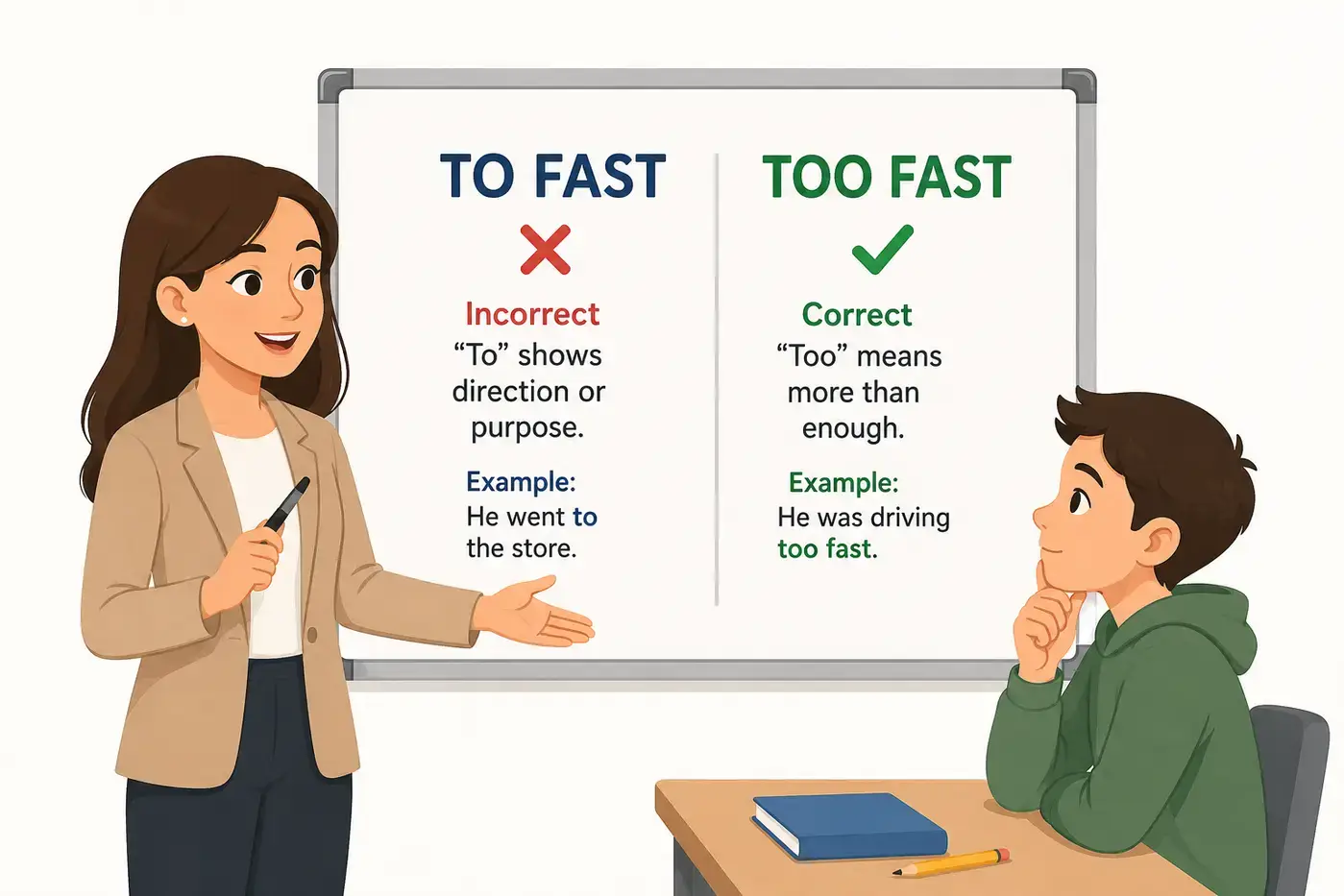
To Fast or Too Fast is one of those English questions that catches even experienced writers. The words to and too sound identical. Because of that many people type the wrong one without noticing the mistake. Spellcheck does not always help because both words are correct English words. The problem is not spelling. It is grammar.
The good news is that the difference is simple once you understand the job each word performs. Too fast describes something happening at an excessive speed. It is the phrase you will use in most conversations emails school assignments articles and business writing.
To fast appears much less often. It is only correct when to introduces a verb. One example is to fast before surgery. Here fast is not an adjective. It is a verb that means to avoid food for a certain period. By the end of this guide you will know the correct form instantly. You will also learn why people confuse these expressions how to avoid the mistake and how professional editors recognize the right choice in seconds.
Short Answer
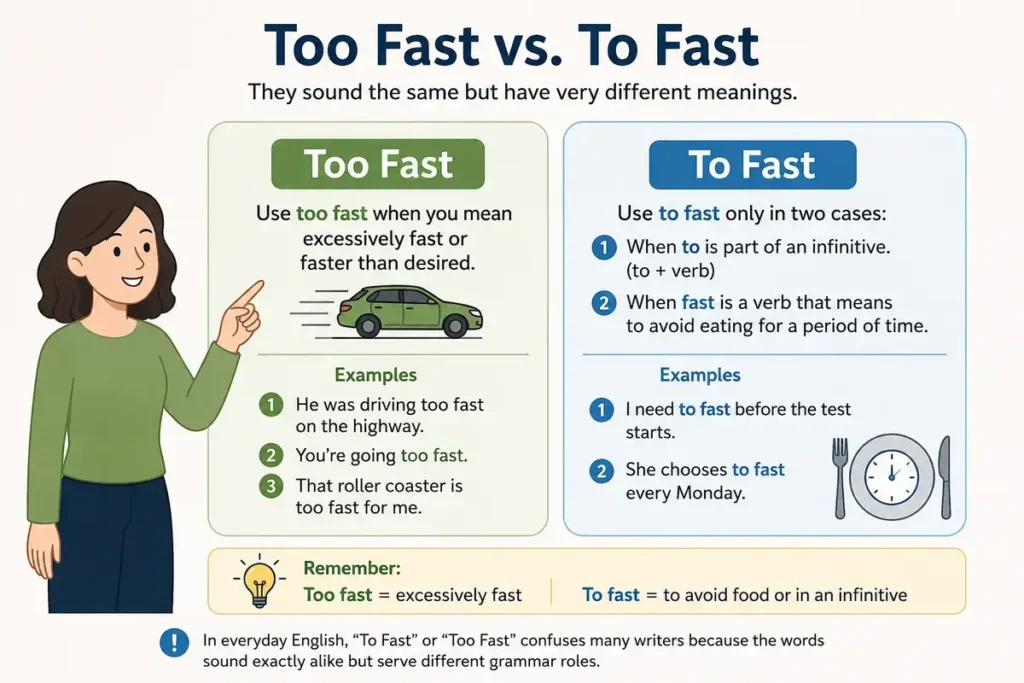
Too fast is correct when you mean excessively fast or faster than desired. To fast is only correct when to is part of an infinitive or when fast is used as a verb that means to avoid eating for a period of time. In everyday English the phrase To Fast or Too Fast confuses many writers because the words sound exactly alike but serve different grammar roles.
Table Of Contents
- To Fast Or Too Fast At A Glance.
- The Quick Answer.
- Why People Confuse To And Too.
- Meaning Of Too Fast.
- Meaning Of To Fast.
- Grammar Rule That Solves The Problem.
- Comparison Table.
- Real World Examples.
- Common Mistakes.
- Memory Tricks.
- Professional Writing Tips.
- Related Grammar Notes.
- Frequently Asked Questions.
- Key Takeaways.
- Conclusion.
The Quick Answer
If you are talking about speed the correct phrase is almost always too fast.
Examples.
She drove too fast.
The movie ended too fast.
You are talking too fast.
Use to fast only when fast is functioning as a verb.
Examples.
The doctor told me to fast before the blood test.
Many people choose to fast for religious reasons.
One tiny extra letter completely changes the meaning.
Why People Confuse To And Too
English has many words that sound the same but have different meanings. These are called homophones. To and too belong to that group. The confusion grows because both words appear thousands of times in everyday writing. Most people learn their meanings early in school. Even so typing quickly often leads to mistakes.
Professional editors notice another pattern. Writers usually know the correct word. The error happens because the fingers move faster than the brain checks the sentence. That is why this mistake appears in emails text messages blog posts and even published articles. Reading the sentence aloud does not help because both words have the same pronunciation. You must understand the grammar instead.
Meaning Of Too Fast
The phrase too fast means more quickly than is appropriate necessary comfortable or safe. The word too means excessively or more than desired. When combined with fast it tells readers that the speed has crossed an acceptable limit.
Examples.
The car was moving too fast to stop safely.
She finished the presentation too fast.
The internet connection became too fast for the old equipment to handle.
The child was growing too fast according to his grandparents.
In every example the speaker believes the speed is greater than expected.
Meaning Of To Fast
The phrase to fast has a completely different meaning. Here to introduces an infinitive. The word fast works as a verb instead of an adjective or adverb. As a verb fast means to avoid eating food for a period. People often fast for religious medical or personal reasons.
Examples.
My doctor asked me to fast for twelve hours.
Some athletes choose to fast before certain health tests.
Many people decide to fast during religious observances.
Notice that none of these examples discuss speed.
Instead they describe the action of avoiding food.
This difference explains why confusing the two phrases changes the meaning of an entire sentence.
Grammar Rule That Solves The Problem
This rule is easier than many people expect. Ask yourself one question. Are you talking about speed or about avoiding food. If the answer is speed use too fast. If the answer is avoiding food use to fast.
Examples.
He was walking too fast.
We finished too fast.
The teacher spoke too fast.
The nurse instructed patients to fast overnight.
Many people prefer to fast before surgery.
This single question eliminates almost every mistake.
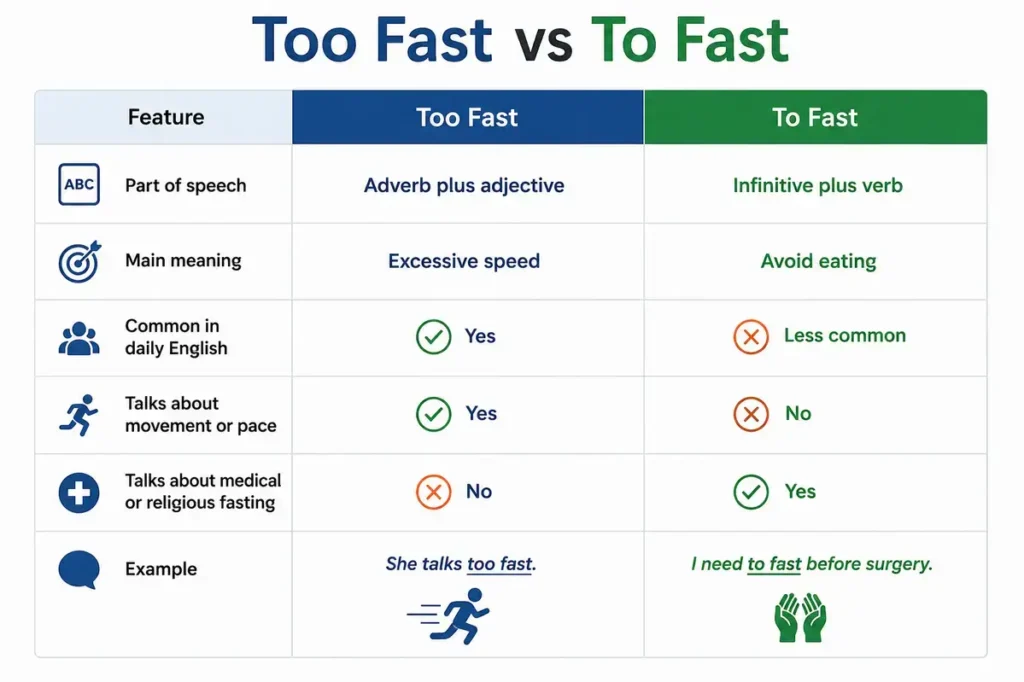
Comparison Table
| Feature | Too Fast | To Fast |
|---|---|---|
| Part of speech | Adverb plus adjective | Infinitive plus verb |
| Main meaning | Excessive speed | Avoid eating |
| Common in daily English | Yes | Less common |
| Talks about movement or pace | Yes | No |
| Talks about medical or religious fasting | No | Yes |
| Example | She talks too fast. | I need to fast before surgery. |
The meanings never overlap. That makes choosing the correct phrase much easier once you know the context.
How Editors Decide Instantly
Professional editors rarely pause over To Fast or Too Fast because they focus on meaning instead of appearance.
Editors ask simple questions.
Is the sentence describing speed.
Or is it describing fasting.
That quick check immediately reveals the correct choice.
Consider these examples.
The children ran too fast across the wet grass.
The doctor instructed patients to fast before the examination.
Both sentences are correct. The grammar changes because the meaning changes.
Many grammar mistakes disappear once you focus on what the sentence is trying to communicate instead of how similar the words look.
Real Life Examples In Everyday English
You probably see too fast every day without thinking about it.
Parents say.
You are growing too fast.
Teachers say.
Please do not read too fast.
Managers say.
The project moved too fast for proper review.
Drivers hear.
You were driving too fast.
On the other hand to fast appears mostly in medical health and religious settings.
The hospital asked patients to fast after midnight.
Some people choose to fast during special religious periods.
Researchers required volunteers to fast before testing.
That difference in frequency explains why too fast is the phrase most English learners need far more often.
Common Mistakes With To Fast Or Too Fast
Professional editors see the same mistakes again and again. Most of them happen because writers rely on sound instead of grammar. Since to and too are pronounced the same way the error slips through easily.
Understanding the meaning of the sentence fixes almost every mistake.
Mistake One Using To Fast For Speed
Incorrect.
She was driving to fast.
Correct.
She was driving too fast.
Explanation.
The sentence talks about speed. The word too means excessively. That makes too fast the only correct choice.
Mistake Two Using Too Fast For Fasting
Incorrect.
The doctor told me too fast before surgery.
Correct.
The doctor told me to fast before surgery.
Explanation.
The sentence describes the action of avoiding food. Here fast is a verb. The word to introduces the infinitive.
Mistake Three Assuming Spellcheck Will Catch It
Many writers depend on spellcheck. That creates another problem. Both to and too are correctly spelled words. Grammar checkers may miss the mistake because they cannot always understand the intended meaning. Always read the sentence for context instead of trusting software alone.
Real World Examples With Explanations
Looking at complete sentences makes the rule much easier to remember.
Speed Examples
The train arrived too fast to stop at the small station.
The speed exceeded what was safe.
He answered too fast and misunderstood the question.
The reply came before careful thinking.
The meeting ended too fast for everyone to ask questions.
The time felt shorter than expected.
She speaks too fast during presentations.
Her speaking speed is excessive.
The cake baked too fast because the oven temperature was too high.
The cooking happened more quickly than intended.
Fasting Examples
The doctor asked me to fast before the blood test.
Avoiding food is the action.
Many people decide to fast during religious holidays.
The sentence describes a personal choice.
Patients usually need to fast for several hours before surgery.
The hospital requires no food before the procedure.
Athletes sometimes choose to fast before specific medical evaluations.
Again the sentence talks about eating not speed.
To Fast Or Too Fast In American English
American English strongly favors too fast when discussing speed.
You will find it in newspapers.
Books.
Business documents.
School textbooks.
Government publications.
Everyday conversations.
The phrase to fast appears mainly in health care religious writing and discussions about nutrition. That difference is useful because context quickly tells you which meaning is intended.
Formal And Informal Usage
Both expressions are correct when used in the right context.
Formal examples.
The vehicle was traveling too fast for the road conditions.
Patients are instructed to fast for eight hours before the examination.
Informal examples.
You walk too fast.
I have to fast tomorrow morning.
The grammar stays the same regardless of the writing style.
Pronunciation
This pair causes confusion because both expressions sound exactly alike.
To and too share the same pronunciation in standard American English.
That makes this a spelling and grammar issue instead of a pronunciation issue. Native speakers make this mistake too especially while typing quickly.
Word Origin
Understanding the history adds another layer of clarity. The word too comes from an older English word meaning in addition or more than enough. Over time it developed the meaning excessively. The word to has existed in English for centuries as a function word. It connects ideas and also introduces infinitive verbs.
The verb fast comes from an Old English word meaning to abstain from food. Although these words now appear together in some sentences they developed independently.
Memory Trick That Actually Works
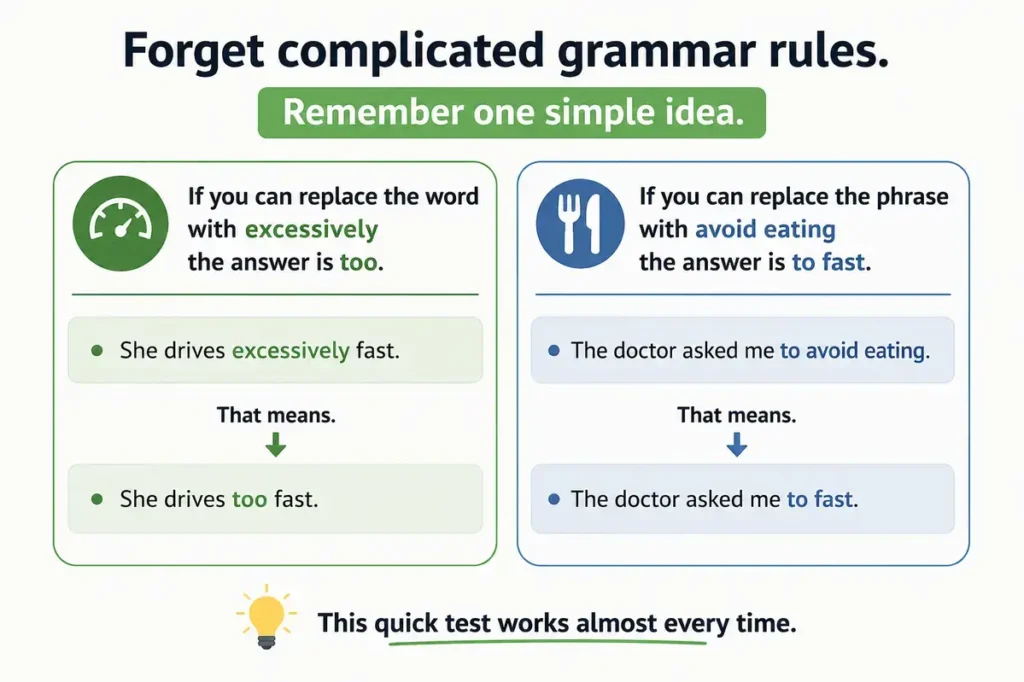
Forget complicated grammar rules.
Remember one simple idea.
If you can replace the word with excessively the answer is too.
She drives excessively fast.
That means.
She drives too fast.
If you can replace the phrase with avoid eating the answer is to fast.
The doctor asked me to avoid eating.
That means.
The doctor asked me to fast.
This quick test works almost every time.
Similar Word Pairs People Confuse
The English language contains many pairs that create the same kind of confusion.
| Incorrect Pair | Correct Understanding |
|---|---|
| To and Too | Direction versus excessive amount. |
| Your and Youre | Possession versus you are. |
| Their There Theyre | Possession place and contraction. |
| Then and Than | Time versus comparison. |
| Accept and Except | Receive versus excluding. |
| Affect and Effect | Usually verb versus noun. |
| Its and Its | Possession versus it is. |
| Lose and Loose | Misplace versus not tight. |
Learning one confusing pair makes the next one easier.
You begin recognizing grammar patterns instead of memorizing isolated rules.
Professional Writing Tips
Professional writers rarely guess. They pause for one second and ask what the sentence actually means. That habit prevents thousands of grammar mistakes every year. If you are editing your own work follow this simple routine.
- Read the complete sentence instead of focusing on one word.
- Decide if the sentence discusses speed or fasting.
- Replace too with excessively to test the meaning.
- Replace to fast with avoid eating if the sentence seems related to health or religion.
- Read the sentence one final time before publishing.
These small habits improve accuracy far beyond this single grammar question.
Related Grammar Notes
This topic also connects with several important grammar rules.
Too Versus Very
Many writers confuse these words.
Very fast simply increases the degree.
Too fast means more than acceptable.
Examples.
She is very fast.
This is a neutral description.
She is too fast.
This suggests a problem.
Too Versus So
These words are not interchangeable.
He ran so fast that everyone cheered.
The sentence simply describes the result.
He ran too fast and injured himself.
The sentence shows excessive speed.
Fast As Different Parts Of Speech
One interesting feature of English is that fast can serve several grammar roles.
Adjective.
A fast runner won the race.
Adverb.
She runs fast.
Verb.
Many people fast for health reasons.
Noun.
He broke his fast with fruit.
Recognizing the role of fast makes choosing between to fast and too fast much easier.
Key Takeaways
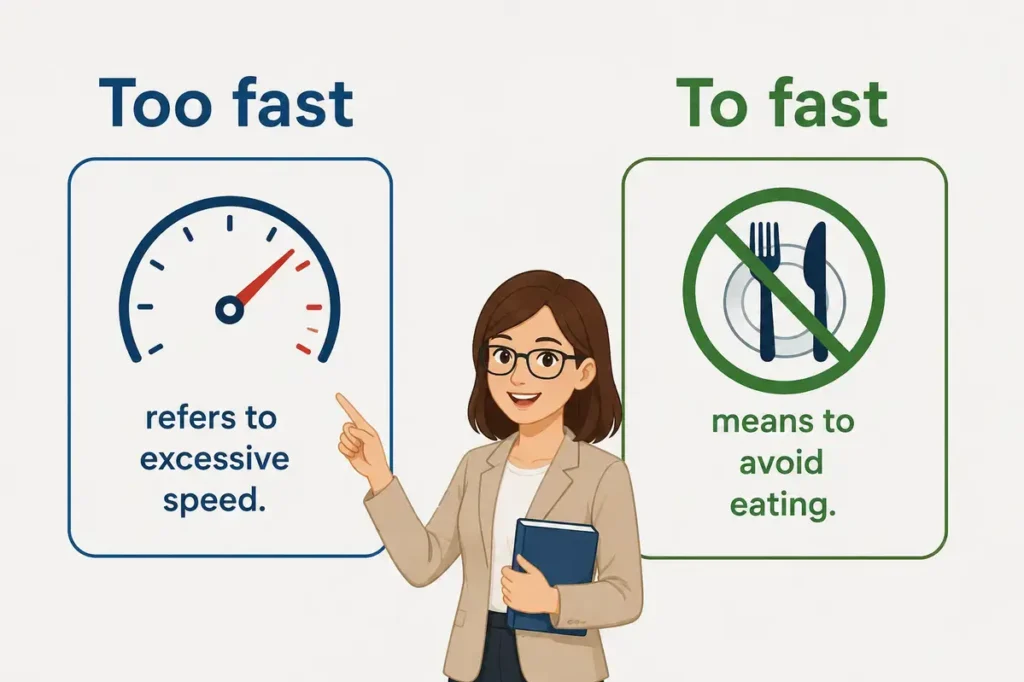
- Too fast refers to excessive speed.
- To fast means to avoid eating.
- The expressions sound identical but have different grammar functions.
- Most everyday situations require too fast.
- Medical and religious contexts often require to fast.
- Replace too with excessively as a quick grammar check.
- Replace to fast with avoid eating to confirm the meaning.
- Focus on the meaning of the sentence instead of the sound of the words.
Conclusion
The answer to To Fast or Too Fast becomes simple once you look at the meaning instead of the sound. If the sentence describes excessive speed the correct phrase is too fast. This is the form you will use in almost every conversation email article and everyday piece of writing.
If the sentence describes avoiding food before a medical procedure for religious reasons or for another specific purpose the correct expression is to fast because fast functions as a verb. A single extra letter changes the meaning completely. That is why experienced editors always read for context instead of relying on pronunciation or spellcheck.
The next time you pause over To Fast or Too Fast ask one question.
Am I talking about speed or about avoiding food.
If the answer is speed choose too fast.
If the answer is avoiding food choose to fast.
That simple habit will help you make the correct choice every time.
Frequently Asked Questions
Is Too Fast Correct?
Yes. Too fast is correct when something happens at a speed that is greater than desired expected or safe.
Example.
The car was moving too fast to stop.
Is To Fast Ever Correct?
Yes. To fast is correct when fast is a verb that means to avoid eating for a period.
Example.
The doctor told me to fast before the procedure.
How Do I Know Which One To Use?
Think about the meaning of the sentence.
If it talks about speed use too fast.
If it talks about avoiding food use to fast.
This simple test works in almost every situation.
Why Do So Many People Confuse To Fast Or Too Fast?
The words to and too sound exactly alike in spoken English. Since both are real words the mistake often slips past spellcheck. The best way to catch the error is to focus on the meaning of the sentence.
Is Too Fast Grammatically Correct?
Yes. It is completely correct when describing excessive speed.
Examples.
You are walking too fast.
The music started too fast.
Can Fast Be A Verb?
Yes. Although many people know fast as an adjective or adverb it is also a verb.
Example.
Some people fast for religious reasons.
When used as a verb the correct infinitive form is to fast.
Can I Say Very Fast Instead Of Too Fast?
Yes. Both expressions are correct but they do not mean the same thing.
Very fast simply describes high speed.
Too fast means the speed is excessive or creates a problem.
Example.
She is very fast.
This is a neutral description.
She is too fast for the beginner group.
This suggests her speed exceeds what is suitable.
Is To Fast Common In Everyday English?
Not as common as too fast.
Most people use too fast far more often because conversations about speed happen every day. To fast usually appears in medical religious and health related contexts.
Does American English Use Too Fast?
Yes. American English uses too fast exactly the same way as other major varieties of English when describing excessive speed.
Can Native English Speakers Make This Mistake?
Absolutely.
Native speakers confuse to and too more often than many people realize. The mistake usually happens while typing quickly instead of from a lack of grammar knowledge.

Confusing Words, Spelling & Word Choice
Claire Whitmore is a U.S.-based English editor who writes about commonly confused words, spelling differences, and word choice. Her work helps readers understand subtle distinctions between similar-looking words through simple definitions, practical examples, and modern usage guidance in both American and British English.