
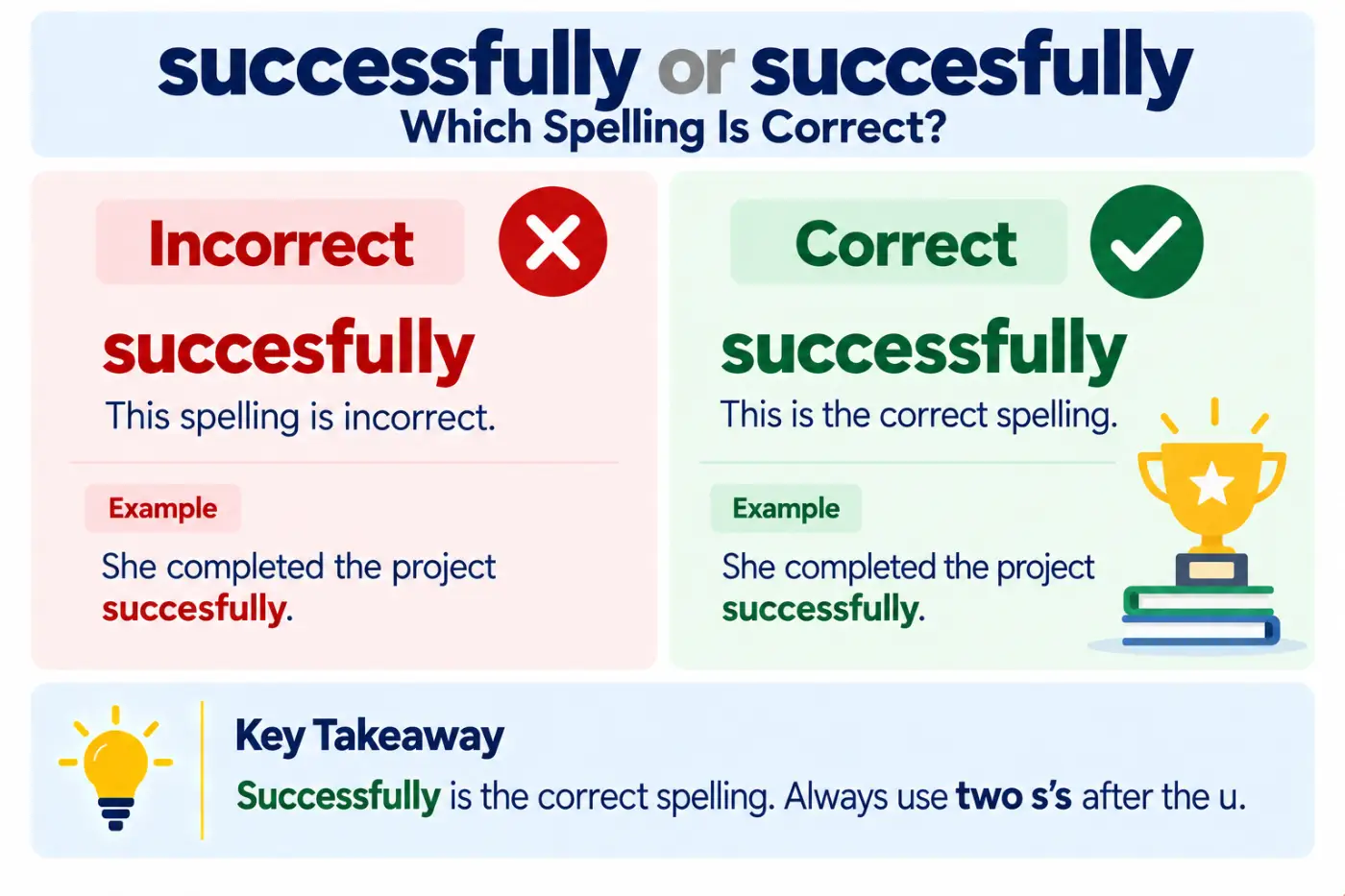
successfully or succesfully can be confusing because the two forms look almost identical when you read them quickly. The correct spelling is successfully. The form succesfully is a misspelling and should be corrected in school assignments professional writing emails reports and published content.
The main problem comes from the spelling of successful. The word contains two c letters in the middle. When you turn successful into its adverb form you keep that spelling and add ly. The result is successfully. You can think of the word as successful plus ly rather than trying to remember every letter separately.
This spelling matters because successfully is a very common adverb. You can use it to describe an action that achieves a wanted or expected result. You might say that a student successfully completed an assignment or that a company successfully launched a product. This guide explains the spelling rule meaning grammar pronunciation word formation common mistakes regional usage and practical examples so you can use the word with confidence.
Short Answer
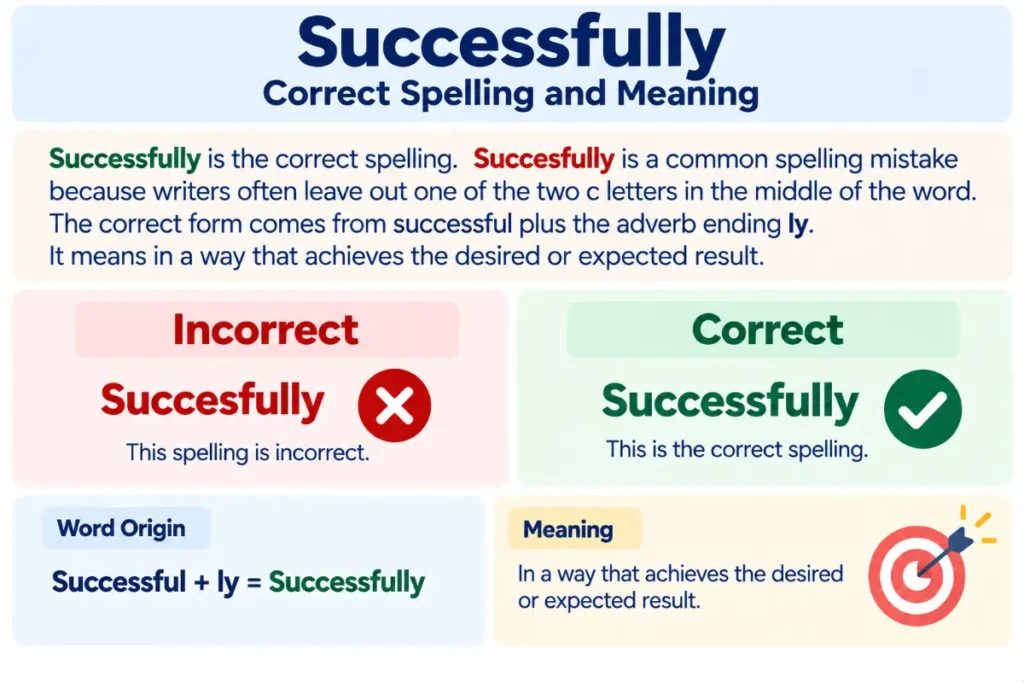
Successfully is the correct spelling. Succesfully is a common spelling mistake because writers often leave out one of the two c letters in the middle of the word. The correct form comes from successful plus the adverb ending ly. It means in a way that achieves the desired or expected result.
Table of Contents
- Quick answer.
- Meaning and definition.
- The spelling difference.
- Why the misspelling happens.
- How the word is formed.
- Grammar and part of speech.
- Sentence examples.
- Common mistakes.
- Pronunciation.
- Word origin.
- American and British usage.
- Formal and informal writing.
- Memory tips.
- Related words.
- Real life usage.
- Expert editor insight.
- FAQs.
- Key takeaways.
- Conclusion.
Meaning and Definition
Successfully is an adverb. It describes an action that achieves the result someone wanted or hoped for. Cambridge Dictionary defines it as doing something in a way that achieves the desired or expected result.
For example:
She successfully completed the project.
The word successfully tells us how the project was completed. The project reached the intended result.
You can also use the word for events that produce a good outcome.
The team successfully repaired the system.
The students successfully passed the final examination.
The company successfully entered a new market.
In each sentence the adverb connects the action with a positive or desired result.
The misspelled form does not have a separate meaning. It is simply an incorrect spelling of the standard word. If you see succesfully in an essay or document you should change it to successfully.
Successfully or Succesfully
The correct form contains two c letters.
Correct: successfully.
Incorrect: succesfully.
The easiest way to see the difference is to look at the middle of the word.
successfully
succesfully
The incorrect form drops one c. That small omission creates the spelling error.
The word begins with success. That part itself contains two c letters. Since successfully comes from successful the spelling keeps those letters.
Compare these related forms.
success.
successful.
successfully.
unsuccessful.
unsuccessfully.
The repeated c pattern appears throughout this word family. Learning the family makes the spelling much easier than memorizing one word in isolation.
The Spelling Rule
The spelling becomes clearer when you build the word in stages.
Start with the noun:
success.
Add ful:
successful.
Then add ly:
successfully.
The important point is that the base spelling does not lose one of its c letters when the adverb is formed.
This gives you a simple word family.
success → successful → successfully
The same pattern helps with other related forms.
unsuccessful → unsuccessfully
The prefix un changes the meaning but does not change the spelling of successful.
For example:
The first attempt was unsuccessful.
The team worked unsuccessfully for several hours.
The first sentence uses the adjective. The second uses the related adverb.
This word building method is useful because English spelling becomes easier when you recognize related forms. Instead of treating every word as a separate puzzle you can look at the base word and its family.
Why People Write The Misspelled Form
The missing c is an easy mistake to make. Several factors can contribute to it.
First the word is fairly long. Longer words naturally create more opportunities for spelling errors.
Second the repeated c letters do not produce two separate sounds. You hear the word as a smooth sequence rather than hearing one distinct sound for each written c.
Third writers may remember the sound more clearly than the spelling. When they type quickly they may write what seems natural from pronunciation and leave out a repeated letter.
Fourth the word contains several familiar endings. Success, successful, and successfully look related but the added letters can make the full word feel visually crowded.
Finally typing speed can play a role. When someone is writing quickly the hand may skip a repeated letter even when the writer knows the correct spelling.
The best solution is not to slow down every time you write the word. Instead learn the word family so the spelling becomes automatic.
How The Word Is Formed
Successfully comes from successful plus the adverb ending ly.
Successful is an adjective. It describes someone or something that achieves a desired result or has achieved a high level of success. Cambridge Dictionary also gives uses connected with achievement popularity and financial success.
Successfully changes the adjective into an adverb.
Compare:
She was successful.
She completed the task successfully.
Successful describes she.
Successfully describes completed.
This is a standard grammatical relationship in English. Many adjectives can form adverbs by adding ly.
For example:
careful becomes carefully.
quick becomes quickly.
successful becomes successfully.
The exact spelling changes can vary from word to word but the basic grammatical idea remains the same.
Grammar and Part of Speech
Successfully is an adverb.
An adverb can modify a verb by telling us how an action happens. In this case successfully tells us that the action produced the intended result.
Consider:
The engineers successfully fixed the machine.
Fixed is the main verb. Successfully describes the result of that action.
You can also place the adverb at different points in a sentence.
The engineers successfully fixed the machine.
The engineers fixed the machine successfully.
Successfully the engineers fixed the machine.
The first sentence is the most natural of these three in ordinary American English. The second is grammatical but can sound slightly more formal or emphatic depending on context. The third is unusual and generally not the natural choice for everyday writing.
The position of an adverb can affect emphasis and rhythm. Good writers choose the position that makes the sentence easiest to understand.
Using The Word With Different Verbs
Successfully works with many action verbs.
The student successfully completed the assignment.
The doctor successfully performed the procedure.
The company successfully launched the product.
The team successfully solved the problem.
The researchers successfully tested the theory.
The technician successfully repaired the device.
The organization successfully raised enough money.
The applicant successfully passed the interview.
The athlete successfully finished the race.
The pilot successfully landed the aircraft.
The pattern is consistent. The adverb tells the reader that the action reached the intended outcome.
It does not necessarily mean the process was easy. Something can be completed successfully after many difficult attempts.
For example:
After several failed attempts the team successfully repaired the system.
Here successfully focuses on the final result.
Sentence Examples
The following examples show how the word works in natural American English.
- She successfully completed her college application.
- The students successfully finished the science project.
- The company successfully introduced its new service.
- The technician successfully repaired my laptop.
- He successfully passed the driving test.
- The team successfully solved the technical problem.
- The researchers successfully tested the new method.
- The doctor successfully completed the operation.
- We successfully reached our destination before sunset.
- The school successfully organized the annual event.
Each example connects successfully with an action that produced the intended outcome. That connection is central to the meaning of the word.
You can also use it in negative sentences.
The team did not successfully complete the task.
The project was not successfully implemented.
In these sentences the adverb still describes the result of the action. The negative structure changes the outcome.
Common Mistakes
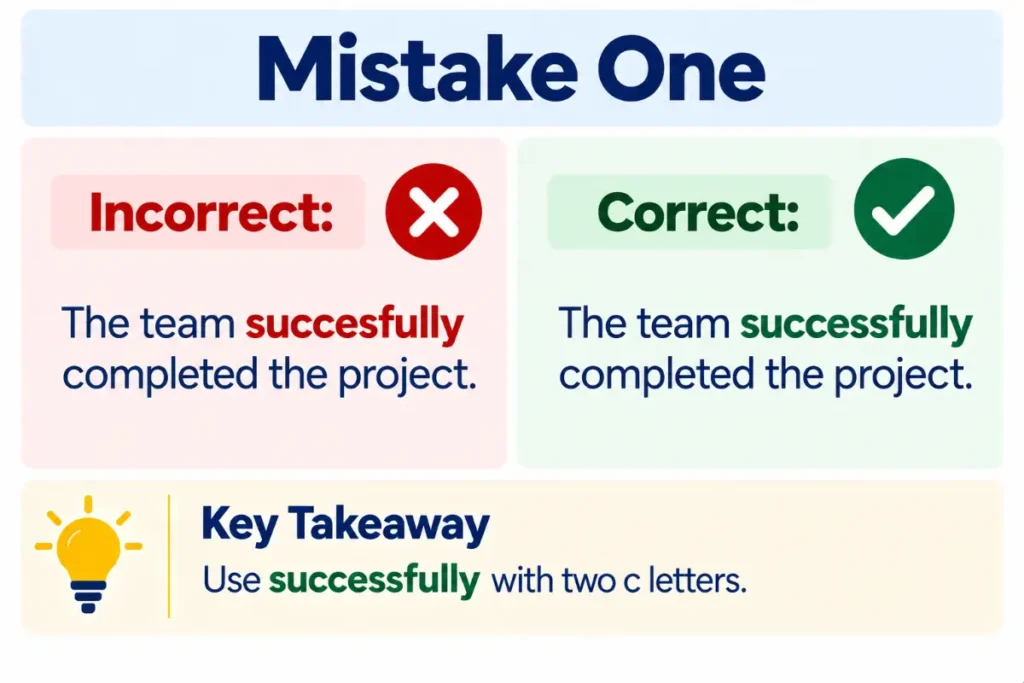
Mistake One
Incorrect: The team succesfully completed the project.
Correct: The team successfully completed the project.
The incorrect form drops one c.
Mistake Two
Incorrect: She succesfully passed the exam.
Correct: She successfully passed the exam.
The word comes from successful. Remembering the base adjective helps prevent the mistake.
Mistake Three
Incorrect: He completed the task succesfully.
Correct: He completed the task successfully.
The spelling stays the same regardless of where the adverb appears in the sentence.
Mistake Four
Incorrect: The experiment was succesful.
Correct: The experiment was successful.
This mistake involves the related adjective rather than the adverb. Successful has two c letters.
Mistake Five
Incorrect: The project was completed successful.
Correct: The project was completed successfully.
Successful is an adjective. Successfully is an adverb. Since the word describes how the project was completed the adverb is needed.
These errors show that spelling and grammar can overlap. A writer may know the meaning but still choose the wrong form.
Pronunciation Guide
The American English pronunciation is commonly represented as:
/səkˈsesfəli/
The word has several syllables and the main stress falls on the syllable containing the second part of success.
The beginning has a reduced vowel sound. The middle contains the clear stress associated with success. The ending has the familiar ly sound found in many English adverbs.
A simple way to practice is to first say success and then add the rest of the word slowly. Once the spelling and pronunciation feel familiar you can say the complete word at a natural speed.
One common mistake is trying to pronounce every written letter with equal force. English does not work that way. Some vowels become weaker in unstressed syllables and repeated consonants do not always produce separate spoken sounds.
Pronunciation can help you recognize the word but it should not be your only spelling guide. The written word contains information that speech does not make obvious.
Word Origin
The word family begins with success. English success ultimately comes through French from Latin successus. The Latin word is connected with the idea of following after or succeeding.
The modern English family developed around the idea of achieving a desired result.
Success is the noun.
Successful is the adjective.
Successfully is the adverb.
This progression is useful because it shows how the forms are connected.
The historical development also explains why the modern spelling preserves the double c in the word family. You do not need to memorize the Latin history to spell the word correctly but understanding the related forms can make the spelling easier to remember.
American English
Successfully is standard in American English. The spelling does not change in American writing.
American speakers and writers use it in everyday conversation formal documents academic work journalism business communication and technical writing.
For example:
The company successfully completed the merger.
The student successfully defended her research.
The system successfully processed the request.
There is no special American spelling that removes one of the c letters. The same standard form applies across ordinary American usage.
British English
British English also uses successfully as the standard spelling. There is no major spelling difference between American and British English for this word.
You may see it in academic papers business reports newspapers books and everyday communication.
For example:
The team successfully completed the project.
The researchers successfully tested the new treatment.
The spelling remains the same.
This is a useful point for learners who often expect every English word to have an American and British spelling difference. Many words are spelled exactly the same in both varieties.
Australian English
Australian English also uses successfully. The standard spelling keeps both c letters.
The word appears naturally in education business journalism government writing and ordinary conversation.
For example:
The program was successfully completed.
The company successfully expanded into regional markets.
There is no standard Australian spelling that changes the middle of the word.
Canadian English
Canadian English uses the same spelling as American and British English.
Successfully remains the standard form in Canadian school work professional writing journalism and everyday communication.
The spelling issue therefore has nothing to do with regional English. It is a general spelling problem that can occur in any English variety.
Formal And Informal Usage
Successfully works well in both formal and informal writing.
In a casual message you might write:
I successfully fixed the issue.
In a professional email you might write:
We successfully completed the requested update.
In academic writing you might write:
The researchers successfully reproduced the original findings.
The word itself does not sound excessively formal. It is a normal part of standard English.
Still you should avoid using it when it adds no useful information. Strong writing is often clearer when the result is stated directly.
For example:
The team successfully won the game.
This sentence can sound unnecessary because winning already implies success.
A cleaner sentence may be:
The team won the game.
But there are situations where successfully adds useful information.
The team successfully completed all required safety checks.
Here the adverb emphasizes that the checks were completed as intended.
The best editing choice depends on what the reader needs to know.
When Successfully Adds Meaning
Successfully is most useful when the outcome matters.
Compare:
The technician repaired the computer.
The technician successfully repaired the computer.
The second sentence emphasizes that the repair worked. The first simply states that the technician performed the repair.
Another example:
The company launched the product.
The company successfully launched the product.
The second version highlights the result. It tells the reader that the launch achieved its intended goal.
This makes the word especially common in reports and descriptions of completed tasks.
However repetition can weaken your writing.
The team successfully completed the project successfully.
Only one use is needed.
Better:
The team successfully completed the project.
Or:
The team completed the project successfully.
Good editing removes repeated information.
Successfully In Passive Sentences
Successfully also works naturally in passive constructions.
The application was successfully submitted.
The payment was successfully processed.
The device was successfully installed.
The experiment was successfully completed.
This structure is common in business communication and technical writing because it focuses attention on the completed action rather than the person who performed it.
For example:
Your application was successfully submitted.
This sentence tells the reader that the desired action has been completed. It is especially common in automated notifications and service messages.
Commonly Confused Related Words
Success
Success is a noun.
The project was a success.
It names the favorable result or achievement.
Successful
Successful is an adjective.
The project was successful.
It describes the project.
Successfully
Successfully is an adverb.
The team completed the project successfully.
It describes how the action was completed.
Succeed
Succeed is a verb.
The team succeeded in completing the project.
It describes the act of achieving a desired result.
These four words belong to the same family but they do different jobs.
A simple comparison is:
Success is the result.
Successful describes the person or thing connected with that result.
Successfully describes the action.
Succeed is the verb for achieving the result.
Related Words And Expressions
Several words have meanings close to successfully.
- Effectively. This emphasizes producing the intended effect or working well.
- Successfully. This emphasizes achieving the desired result.
- Successfully completed. This phrase highlights completion with the intended outcome.
- Efficiently. This emphasizes completing something with little waste of time effort or resources.
- Properly. This emphasizes doing something correctly or according to expectations.
- Successfully achieved. This emphasizes reaching a specific goal.
- Accomplished. This can describe something completed or a goal reached.
- Effectively carried out. This emphasizes that an action was performed in a useful and successful way.
These terms overlap but they are not interchangeable in every sentence.
For example:
The machine worked efficiently.
This tells us about the use of resources or time.
The machine worked successfully.
This tells us that it achieved the desired result.
That small difference can matter in technical and professional writing.
Real Life Usage Examples
Daily Conversation
I finally successfully fixed the shelf.
The recipe worked successfully the first time.
In everyday speech people often use successfully to emphasize that an attempt worked.
Workplace Communication
We successfully completed the system update yesterday.
The client successfully received the revised documents.
These sentences are useful in progress reports and professional emails because they clearly communicate an outcome.
Academic Writing
The study successfully tested the proposed method.
The researchers successfully identified the main pattern in the data.
Academic writers often use the word when reporting completed procedures or results.
News Writing
Emergency crews successfully rescued the passengers.
Officials successfully completed the inspection.
News writing often uses the word to highlight that an action achieved its intended outcome.
Technical Writing
The software successfully installed the required update.
The system successfully transferred the requested data.
Technical writing uses successfully to confirm that a process reached the expected result.
Memory Tips
The strongest memory trick is to remember the word family.
success
successful
successfully
All three keep the double c.
Another useful trick is to break the spelling into familiar parts.
success + ful + ly
You can see the two c letters clearly in success.
Then add ful.
Then add ly.
This is more reliable than trying to memorize the entire word as one long string.
You can also connect the spelling with the adjective successful. If you know how to spell successful you already know the main spelling of successfully. Just add ly.
Try writing the family together:
success → successful → successfully.
Seeing the relationship makes the spelling easier to recall during an exam or while writing quickly.
How To Proofread The Word
When proofreading your work look for the word family rather than only the individual word.
If you see succesfully ask yourself what adjective sits underneath it.
The answer is successful.
Then check the base spelling.
success + ful + ly.
This method catches more than one spelling problem because it also helps you notice incorrect forms such as succesful and unsuccesfully.
A useful editing habit is to search your document for the sequence succes. If you find a form such as succesfully you can inspect it and add the missing c.
This technique works especially well for long essays reports and applications where repeated spelling errors can be easy to miss during a normal read.
Expert Editor Insight
An experienced editor would treat this as a word family problem rather than an isolated spelling problem. The fastest correction is to trace the adverb back to successful and then to success. That immediately reveals the double c pattern. Grammar tools and spellcheckers can often flag the misspelled form but writers should still understand the reason for the correction. A useful professional habit is to check the root word whenever a long adverb looks unfamiliar.
Key Takeaways
- Successfully is the correct spelling.
- Succesfully is a common spelling mistake.
- The correct form contains two c letters.
- Successfully is an adverb.
- It describes an action that achieves a desired or expected result.
- The related word family is success successful successfully.
- The spelling is the same in American British Australian and Canadian English.
- The best memory trick is to remember success before adding ful and ly.
- Successful is an adjective while successfully is an adverb.
- Use the word when the successful outcome adds useful information to the sentence.
Conclusion
successfully or succesfully has a clear answer. Successfully is the correct spelling and succesfully is a misspelling. The easiest way to remember the correct form is to connect it with the word family success and successful. All three forms keep the double c in the middle.
The word is an adverb that describes an action that achieves a desired or expected result. You can use it naturally in everyday conversation academic writing business communication technical documents and formal reports. It works across major English varieties without a regional spelling change.
For a quick editing trick remember success first. Then think successful and finally add ly. That simple pattern keeps the two c letters in place and makes the spelling much easier to recall when you are writing quickly.
Frequently Asked Questions
Is successfully the correct spelling?
Yes. Successfully is the standard spelling. It is the adverb related to successful and success. The spelling contains two c letters in the middle. The form succesfully leaves out one c and is therefore a common spelling mistake. Use successfully in school assignments professional documents emails reports academic writing and other standard English contexts.
Is succesfully a real English word?
Succesfully is not the standard spelling of the adverb. It is normally treated as a misspelling of successfully. The mistake usually happens because writers remember the pronunciation but do not notice the repeated c in the written form. If you see succesfully in your writing change it to successfully.
What does successfully mean?
Successfully means in a way that achieves the desired or expected result. It is an adverb that describes an action. For example the sentence she successfully completed the assignment tells us that she completed it and achieved the intended result. Cambridge Dictionary lists successfully as an adverb with this general meaning.
Why does successfully have two c letters?
The spelling comes from the related word family success successful and successfully. The base noun success contains two c letters. The adjective successful keeps them and the adverb successfully keeps them as well. Remembering this family is easier than trying to memorize the long adverb one letter at a time.
How do you pronounce successfully?
The word is commonly pronounced with the main stress in the middle part of the word and with reduced vowel sounds in unstressed syllables. The American English pronunciation is commonly represented as /səkˈsesfəli/. The final ly has the familiar adverb ending sound. The pronunciation does not clearly signal the repeated c letters so spelling needs to be learned separately.
Is successfully an adverb?
Yes. Successfully is an adverb. It usually modifies a verb and tells the reader that an action achieved the intended result. For example the sentence the team successfully completed the task uses successfully to describe completed. The related adjective is successful while the noun is success.
What is the difference between successful and successfully?
Successful is an adjective while successfully is an adverb. Successful describes a person thing event or result. Successfully describes an action. Compare the project was successful with the team completed the project successfully. The first describes the project. The second describes how the team completed the project.
Can successfully be used in formal writing?
Yes. Successfully is appropriate for formal and informal English. It appears naturally in academic writing business communication technical documents reports journalism and everyday conversation. The word is especially useful when you need to emphasize that an action produced the intended result. Still avoid adding it when the surrounding verb already makes the successful outcome obvious.
Is successfully the same in American and British English?
Yes. The spelling is standard in both American and British English. Australian and Canadian English also use the same form. Unlike some English words that have regional spelling differences this word does not normally change between these varieties. The main spelling issue is the common omission of one c.
What is an easy way to remember the spelling?
Remember the word family success successful successfully. The double c appears in all three forms. You can also build the word mentally as success plus ful plus ly. If you remember successful first the adverb becomes much easier because you simply add ly without removing either c.

Confusing Words, Spelling & Word Choice
Claire Whitmore is a U.S.-based English editor who writes about commonly confused words, spelling differences, and word choice. Her work helps readers understand subtle distinctions between similar-looking words through simple definitions, practical examples, and modern usage guidance in both American and British English.