
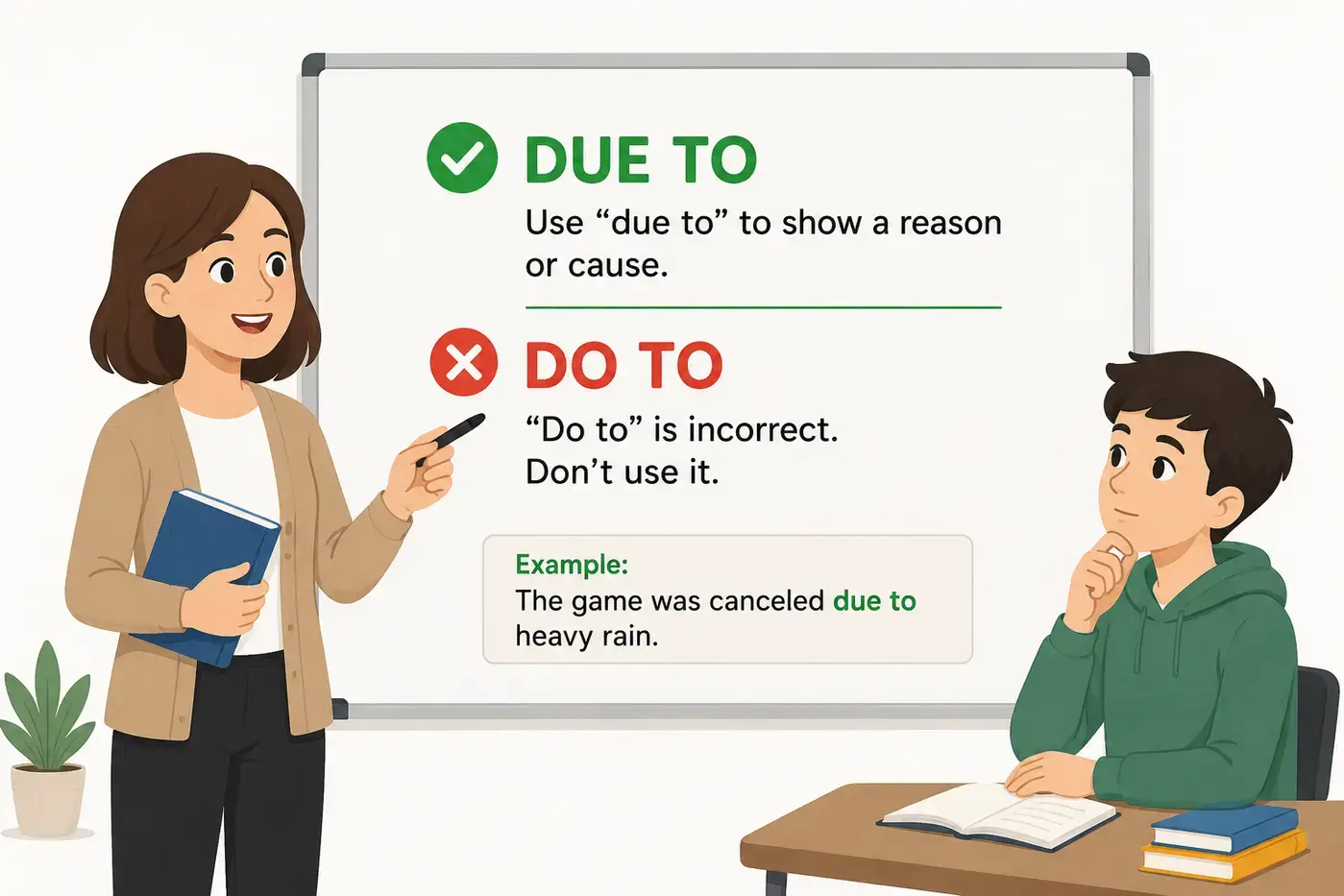
Due To vs Do To is one of the easiest pairs of English phrases to confuse because they are perfect homophones. They sound exactly alike, but they serve entirely different grammatical functions.
Most people searching for this topic want to know which phrase is correct in sentences like The game was canceled due to the weather or What did you do to my computer? The answer depends on meaning, not pronunciation.
Once you understand how each phrase works, you’ll rarely make this mistake again. The key is recognizing that due to expresses a reason or cause, while do to describes an action performed on someone or something. This guide explains the difference in clear American English with grammar rules, comparison tables, real-world examples, professional writing tips, memory tricks, and common mistakes to help you use both phrases confidently.
Short Answer
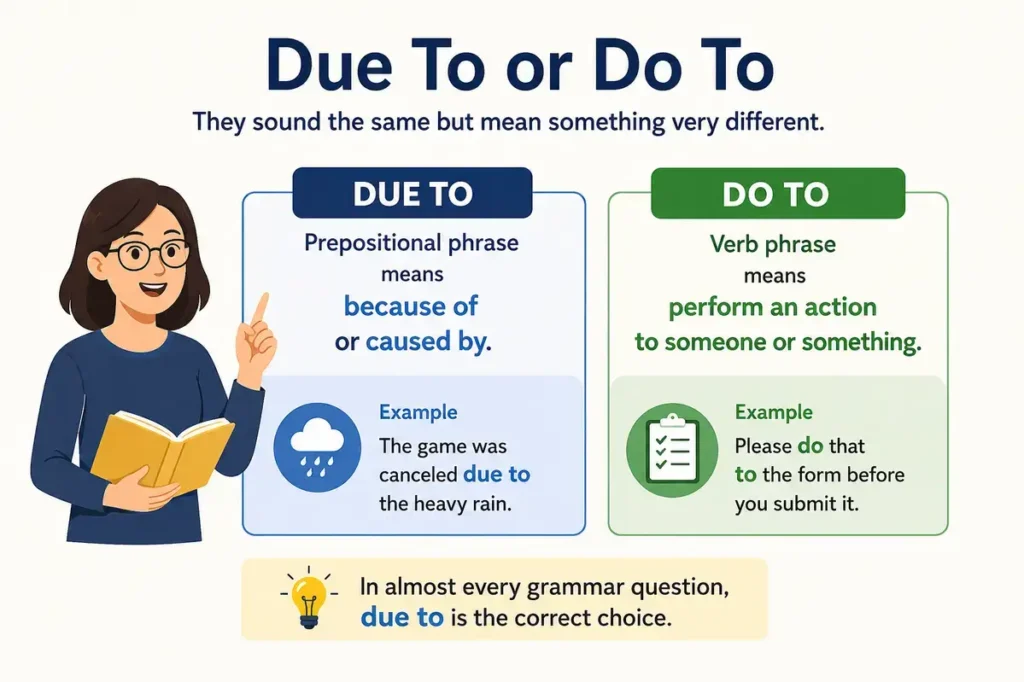
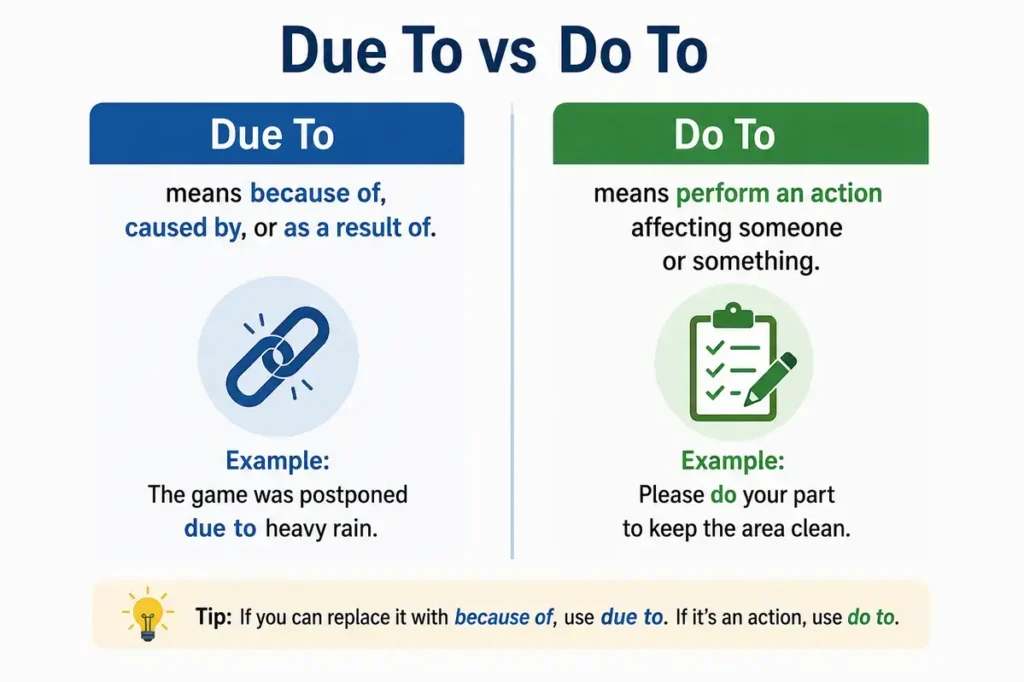
Due To vs Do To is a common source of confusion because the phrases sound identical but have completely different meanings. Due to is a prepositional phrase that means because of or caused by. Do to is a verb phrase that means perform an action to someone or something. In almost every grammar question, due to is the correct choice.
Table of Contents
- Short Answer
- Why People Confuse Due To and Do To
- The Main Difference
- Comparison Table
- What Does Due To Mean?
- What Does Do To Mean?
- Grammar Rules
- When to Use Due To
- When to Use Do To
- Real-Life Examples
- Common Mistakes
- Professional Writing Tips
- Memory Tricks
- Related Grammar Notes
- Frequently Asked Questions
- Key Takeaways
- Conclusion
What Type of Grammar Question Is This?
This keyword belongs to several grammar categories because it involves more than one language concept.
| Category | Does It Apply? | Explanation |
|---|---|---|
| Confusing Words | Yes | The phrases sound the same but have different meanings. |
| Phrase Comparison | Yes | The article compares two similar-looking phrases. |
| Common Mistake | Yes | Writers often choose the wrong phrase because of pronunciation. |
| Word Usage | Yes | Each phrase has its own grammatical function. |
| Homophone | Yes | Both phrases are pronounced the same. |
Understanding these categories helps explain why so many English learners and native speakers search for this topic.
Why People Confuse Due To and Do To
The confusion comes from pronunciation.
Both phrases are pronounced exactly the same in everyday English.
- due to
- do to
Because they sound identical, many writers choose the wrong spelling when typing.
Another reason is that due to appears much more often in books, articles, emails, and business writing. As a result, some people mistakenly use it even when they actually mean do to.
Others make the opposite mistake by writing do to when they mean because of.
Fortunately, the meanings are completely different, making the correct choice much easier once you know the grammar.
The Main Difference
The simplest way to remember the distinction is this:
- Due to explains why something happened.
- Do to explains what action someone performs.
Compare these sentences.
Due to
The picnic was canceled due to heavy rain.
The rain caused the cancellation.
Do to
What did you do to my bicycle?
Someone performed an action affecting the bicycle.
One phrase expresses a cause.
The other expresses an action.
Comparison Table
| Feature | Due To | Do To |
|---|---|---|
| Part of speech | Prepositional phrase | Verb phrase |
| Meaning | Because of, caused by | Perform an action to |
| Expresses | Cause or reason | Action |
| Common in formal writing | Yes | Yes |
| Common in conversation | Yes | Yes |
| Example | Due to traffic, we arrived late. | What did you do to my phone? |
This table summarizes the core difference between the two phrases.
What Does Due To Mean?
Due to means:
- because of
- as a result of
- caused by
- attributable to
It introduces the reason something happened.
Examples:
- The flight was delayed due to fog.
- School closed due to snow.
- The meeting ended early due to technical problems.
- Sales increased due to strong customer demand.
In every sentence, due to introduces the cause.
Dictionary Meaning
Modern dictionaries define due to as meaning because of or caused by.
It connects an event with its reason.
Examples:
- The mistake occurred due to human error.
- The road remains closed due to flooding.
Both examples explain why something happened.
What Does Do To Mean?
Do to is much less common.
It combines the verb do with the preposition to.
It simply means:
perform an action affecting someone or something.
Examples:
- What did you do to the printer?
- Don’t do that to your little brother.
- What has stress done to your health?
- Please don’t do this to yourself.
Notice that every sentence involves an action directed toward someone or something.
Grammar Rule for Due To
Due to functions as a prepositional phrase.
It introduces a noun or noun phrase that explains the cause.
Pattern:
due to + noun
Examples:
- due to rain
- due to illness
- due to construction
- due to heavy traffic
- due to poor planning
Correct:
The concert was canceled due to bad weather.
Explanation:
Bad weather caused the cancellation.
Correct:
The company expanded due to increased demand.
Explanation:
Increased demand explains why the company expanded.
Grammar Rule for Do To
Do to consists of two separate words.
The verb do changes form depending on tense.
Examples include:
- do to
- does to
- did to
- doing to
- done to
Examples:
What did you do to my laptop?
Explanation:
The verb did performs the action.
She keeps doing terrible things to her friends.
Explanation:
The action affects the friends.
When to Use Due To
Use due to whenever you explain the reason for something.
Example 1
The match was postponed due to rain.
Explanation:
Rain caused the postponement.
Example 2
Traffic slowed due to an accident.
Explanation:
The accident caused the delay.
Example 3
Production stopped due to a power outage.
Explanation:
The outage explains why production stopped.
Example 4
The event was successful due to excellent planning.
Explanation:
Planning was the reason for success.
Example 5
The patient recovered quickly due to early treatment.
Explanation:
Early treatment caused the improvement.
When to Use Do To
Use do to whenever someone performs an action affecting another person or object.
Example 1
What did you do to my glasses?
Explanation:
Someone changed or damaged the glasses.
Example 2
Please don’t do that to your dog.
Explanation:
The action affects the dog.
Example 3
Stress can do terrible things to your body.
Explanation:
Stress affects the body.
Example 4
What have they done to this building?
Explanation:
Someone changed the building.
Example 5
Don’t do this to yourself.
Explanation:
The action affects the speaker.
The Adjective Versus Verb Difference
One reason these phrases differ so much is their grammatical role.
Due to behaves as a phrase expressing a cause.
Example:
The cancellation was due to heavy snow.
The phrase explains the reason.
Do to always contains the verb do.
Example:
What did you do to the painting?
The verb describes an action.
One explains why.
The other explains what happened.
A Quick Test
Ask yourself one question.
Am I explaining a reason or describing an action?
If you’re explaining a reason, use due to.
Example:
The delay happened due to heavy traffic.
If you’re describing an action, use do to.
Example:
What did you do to the car?
This simple question solves nearly every Due To or Do To problem in everyday writing.
Real-Life Examples of Due To
Seeing due to in everyday situations makes the grammar rule easier to remember.
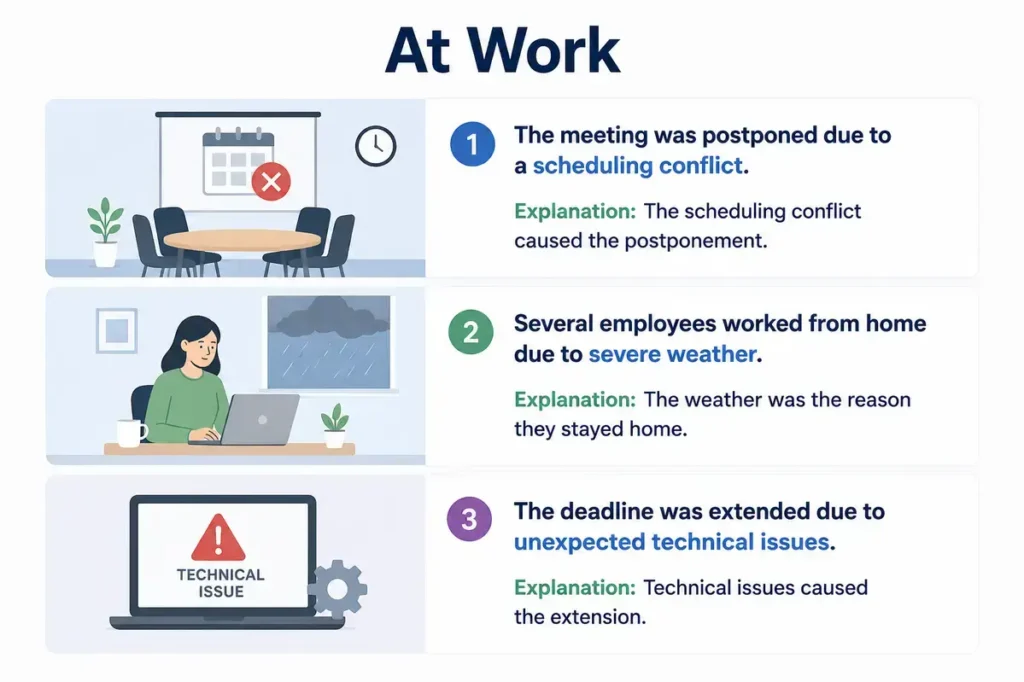
At Work
The meeting was postponed due to a scheduling conflict.
Explanation:
The scheduling conflict caused the postponement.
Several employees worked from home due to severe weather.
Explanation:
The weather was the reason they stayed home.
The deadline was extended due to unexpected technical issues.
Explanation:
Technical issues caused the extension.
At School
Classes were canceled due to heavy snowfall.
Explanation:
The snowfall caused the cancellation.
The student missed class due to illness.
Explanation:
Illness explains the absence.
The science fair moved indoors due to rain.
Explanation:
Rain was the reason for the location change.
During Travel
Our flight was delayed due to dense fog.
Explanation:
The fog caused the delay.
The highway was closed due to flooding.
Explanation:
Flooding explains why the road closed.
The cruise changed its route due to rough seas.
Explanation:
The sea conditions caused the change.
Everyday Life
The picnic ended early due to strong winds.
Explanation:
Strong winds caused the early ending.
The store closed early due to a power outage.
Explanation:
The outage was the reason.
The concert sold out due to high demand.
Explanation:
High demand explains why no tickets remained.
Real-Life Examples of Do To
Unlike due to, do to always involves an action performed on someone or something.
Around the House
What did you do to the television?
Explanation:
Someone changed, damaged, or repaired the television.
Don’t do that to the walls.
Explanation:
The action affects the walls.
Technology
What did you do to my computer?
Explanation:
The computer has been altered somehow.
Someone did something to the software.
Explanation:
An action affected the software.
Relationships
Please don’t do this to your family.
Explanation:
The action affects family members.
Why would you do that to your best friend?
Explanation:
Someone’s behavior affects another person.
Health
Stress can do serious damage to your heart.
Explanation:
Stress affects the heart.
Poor sleep can do a lot to your mood.
Explanation:
Lack of sleep changes your emotional state.
Due To Versus Because Of
Many writers wonder if due to and because of always mean the same thing.
Most of the time, they do.
Compare these sentences.
Due to
The game was canceled due to rain.
Because of
The game was canceled because of rain.
Both sentences communicate the same idea.
However, some editors prefer because of in certain situations because it often sounds more natural in everyday English.
Comparison Table
| Phrase | Meaning | Example |
|---|---|---|
| Due to | Caused by | The delay was due to traffic. |
| Because of | As a result of | The delay happened because of traffic. |
In modern English, both are widely accepted when they are used correctly.
Due To Versus Owing To
Another phrase that often appears alongside due to is owing to.
Both introduce a reason.
Examples:
Due to heavy rain, the game was canceled.
Owing to heavy rain, the game was canceled.
Both are grammatically correct.
The difference is mainly style.
- Due to is more common.
- Owing to often sounds slightly more formal.
Due To Versus Thanks To
Although these phrases all introduce a cause, they are not interchangeable.
Due To
Neutral.
The flight was delayed due to fog.
Thanks To
Usually expresses a positive result.
We finished early thanks to everyone’s hard work.
Compare these:
✅ We won thanks to excellent teamwork.
✅ The meeting ended late due to technical problems.
Using thanks to for something negative may sound sarcastic.
Common Mistakes
Here are the errors editors see most often.
Mistake 1
❌ What is due to my phone?
✅ What did you do to my phone?
Explanation:
The sentence describes an action, not a reason.
Mistake 2
❌ The game was canceled do to rain.
✅ The game was canceled due to rain.
Explanation:
The sentence explains a cause.
Mistake 3
❌ School closed do to snow.
✅ School closed due to snow.
Explanation:
Snow caused the closure.
Mistake 4
❌ What due you do to the printer?
✅ What did you do to the printer?
Explanation:
This sentence needs the verb did, not due.
Mistake 5
❌ My headache happened do to stress.
✅ My headache happened due to stress.
Explanation:
Stress explains the cause.
Why Native Speakers Still Make This Mistake
Even native English speakers confuse these phrases because they sound identical.
When speaking, there is no pronunciation difference between:
- due to
- do to
As a result, many writers choose the spelling that “looks right” rather than the one that matches the meaning.
Spell-check software may not catch the mistake because both phrases are correctly spelled.
Only understanding the grammar prevents the error.
Formal and Informal Usage
Both phrases are appropriate in formal and informal English.
Formal Examples
The ceremony was postponed due to severe weather.
What did the contractor do to the foundation?
Both sentences are suitable for reports, business writing, and academic papers.
Informal Examples
The party ended early due to rain.
What did you do to my bike?
These sound perfectly natural in everyday conversation.
The difference is grammatical, not stylistic.
American and British English
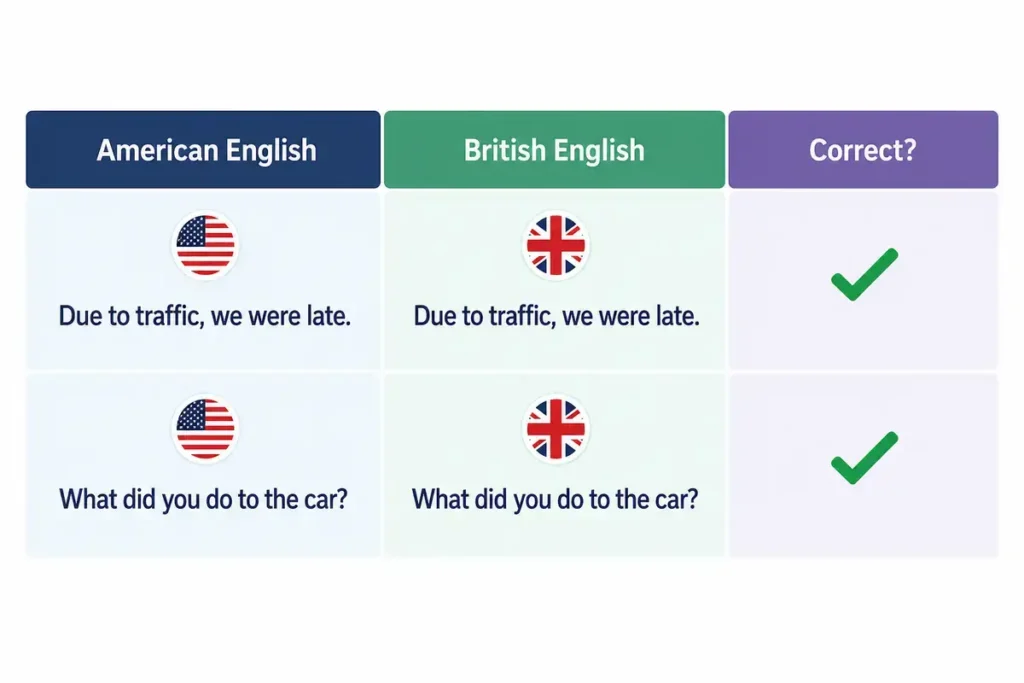
There is no meaningful difference between American English and British English regarding these phrases.
Both varieties use them the same way.
| American English | British English | Correct? |
|---|---|---|
| Due to traffic, we were late. | Due to traffic, we were late. | ✓ |
| What did you do to the car? | What did you do to the car? | ✓ |
You do not need to learn separate rules for American and British usage.
Pronunciation
These phrases are perfect homophones.
Due To
IPA:
/duː tuː/
Do To
IPA:
/duː tuː/
Because they sound identical, context determines the meaning.
Readers rely on spelling to distinguish them in writing.
Word Origin
Due
The word due comes from Latin debere, meaning to owe. Over time, it developed meanings related to something that is expected, appropriate, or caused by.
The phrase due to eventually became a standard way to express cause.
Do
The verb do comes from Old English dōn, meaning to perform, make, or carry out an action.
Its meaning has remained remarkably consistent for centuries.
Understanding these origins makes the difference easier to remember.
One word relates to cause.
The other relates to action.
Professional Writing Tips
Experienced editors use several techniques to avoid confusing these phrases.
1. Replace It with “Because Of”
If because of fits naturally, due to is almost certainly correct.
Example:
The flight was canceled because of fog.
Therefore:
The flight was canceled due to fog.
2. Look for an Action
If someone performs an action affecting another person or object, you probably need do to.
Example:
What did you do to the keyboard?
3. Read the Sentence Aloud
Ask yourself:
Am I explaining a reason?
Or am I describing an action?
The answer usually becomes obvious.
4. Check the Verb
If the sentence already contains forms like did, does, doing, or done, you’re probably dealing with do to, not due to.
Examples:
- What did you do to my files?
- What has stress done to your sleep?
Memory Tricks
These simple tricks help most learners remember the difference immediately.
Trick 1
Due = Reason
Think:
Due to = Because of
Trick 2
Do = Action
Ask yourself:
“What did someone do?”
If that’s the question, use do to.
Trick 3
Replace the phrase.
If because of works, write due to.
If it doesn’t, you probably need do to.
Trick 4
Remember one sentence for each phrase.
Due to
The event ended due to rain.
Do to
What did you do to my car?
These two examples cover almost every situation.
Related Grammar Notes
Understanding similar expressions strengthens your overall grammar.
Due To vs Since
Both can express a reason.
Due to introduces a noun.
- The delay was due to fog.
Since introduces a clause.
- Since it was foggy, the flight was delayed.
Due To vs As a Result Of
These phrases are often interchangeable.
- The project succeeded due to careful planning.
- The project succeeded as a result of careful planning.
Choose the version that sounds most natural for your audience.
Practice Exercises
Test your understanding before checking the answers.
1. The flight was delayed _____ heavy snow.
Answer: due to
Explanation: The phrase explains the reason for the delay.
2. What did you _____ my laptop?
Answer: do to
Explanation: The sentence asks about an action performed on the laptop.
3. School closed early _____ a water leak.
Answer: due to
Explanation: The water leak caused the closure.
4. What have they _____ the garden?
Answer: done to
Explanation: The sentence describes an action affecting the garden.
5. The event was canceled _____ bad weather.
Answer: due to
Explanation: Bad weather explains why the event was canceled.
6. Please don’t _____ your little sister.
Answer: do that to
Explanation: The sentence refers to an action directed toward another person.
7. Sales increased _____ strong customer demand.
Answer: due to
Explanation: Customer demand caused the increase.
8. What did the puppy _____ your shoes?
Answer: do to
Explanation: The puppy performed an action affecting the shoes.
9. The store remained closed _____ flooding.
Answer: due to
Explanation: Flooding caused the closure.
10. What has stress _____ your health?
Answer: done to
Explanation: The sentence asks about the effect of stress on health.
Quick Reference Table
| If the sentence… | Use | Example |
|---|---|---|
| Explains a reason | Due to | The game ended due to rain. |
| Describes an action | Do to | What did you do to the game? |
| Means “because of” | Due to | The delay was due to traffic. |
| Means “perform an action” | Do to | Don’t do that to the computer. |
| Introduces a cause | Due to | The road closed due to ice. |
| Follows the verb do | Do to | What did you do to the files? |
Professional Editing Checklist
Before you publish or send your writing, ask yourself these questions:
- Am I explaining why something happened?
- Use due to.
- Am I describing what someone did?
- Use do to.
- Can I replace the phrase with because of?
- If yes, due to is almost certainly correct.
- Does the sentence contain did, does, doing, or done?
- If yes, you may need do to.
This simple checklist catches almost every mistake.
Key Takeaways
- Due to means because of, caused by, or as a result of.
- Do to means perform an action affecting someone or something.
- The two phrases are pronounced exactly the same but have completely different meanings.
- If you can replace the phrase with because of, due to is the correct choice.
- If the sentence asks what someone did, use do to.
- Due to is much more common than do to in everyday writing.
- American English and British English follow the same grammar rules.
- Understanding the meaning of the sentence is the easiest way to choose the correct phrase.
Conclusion
Choosing between Due To vs Do To becomes easy once you focus on meaning instead of pronunciation. Although the two phrases sound identical, they serve very different purposes in English. Due to introduces a cause or reason and often means because of, while do to describes an action performed on someone or something.
A simple substitution test can help whenever you’re unsure. If because of fits naturally, due to is almost always the right choice. If the sentence asks what someone did or describes an action affecting a person or object, use do to.
By remembering that due points to a reason and do points to an action, you’ll avoid one of the most common homophone mistakes in English. This small distinction makes your writing clearer, more accurate, and more professional in emails, school assignments, business documents, and everyday communication.
FAQs
Is it due to or do to?
Use due to when you mean because of or caused by. Use do to when you are talking about an action performed on someone or something.
Why do due to and do to sound the same?
They are homophones. Both are pronounced /duː tuː/, but they have different meanings and grammatical functions.
Is do to ever correct?
Yes. Although it is less common, do to is correct when it combines the verb do with the preposition to, as in What did you do to my phone?
Can I replace due to with because of?
In most sentences, yes. If because of sounds natural, due to is usually the correct choice.
Is due to formal English?
No. Due to is appropriate in both formal and informal writing. It appears frequently in business communication, journalism, academic writing, and everyday conversation.
Is there a difference between American and British English?
No. Both varieties of English use due to and do to in the same way.
What part of speech is due to?
Due to is a prepositional phrase that introduces the cause or reason for something.
What part of speech is do to?
Do to is a verb phrase made up of the verb do and the preposition to.
Which phrase is more common?
Due to is far more common because writers frequently explain causes and reasons. Do to appears mainly in questions and sentences describing actions.
How can I remember the difference?
Remember this simple rule:
- Due = Reason
- Do = Action
If you’re explaining why, choose due to. If you’re describing what someone did, choose do to.

Confusing Words, Spelling & Word Choice
Claire Whitmore is a U.S.-based English editor who writes about commonly confused words, spelling differences, and word choice. Her work helps readers understand subtle distinctions between similar-looking words through simple definitions, practical examples, and modern usage guidance in both American and British English.