
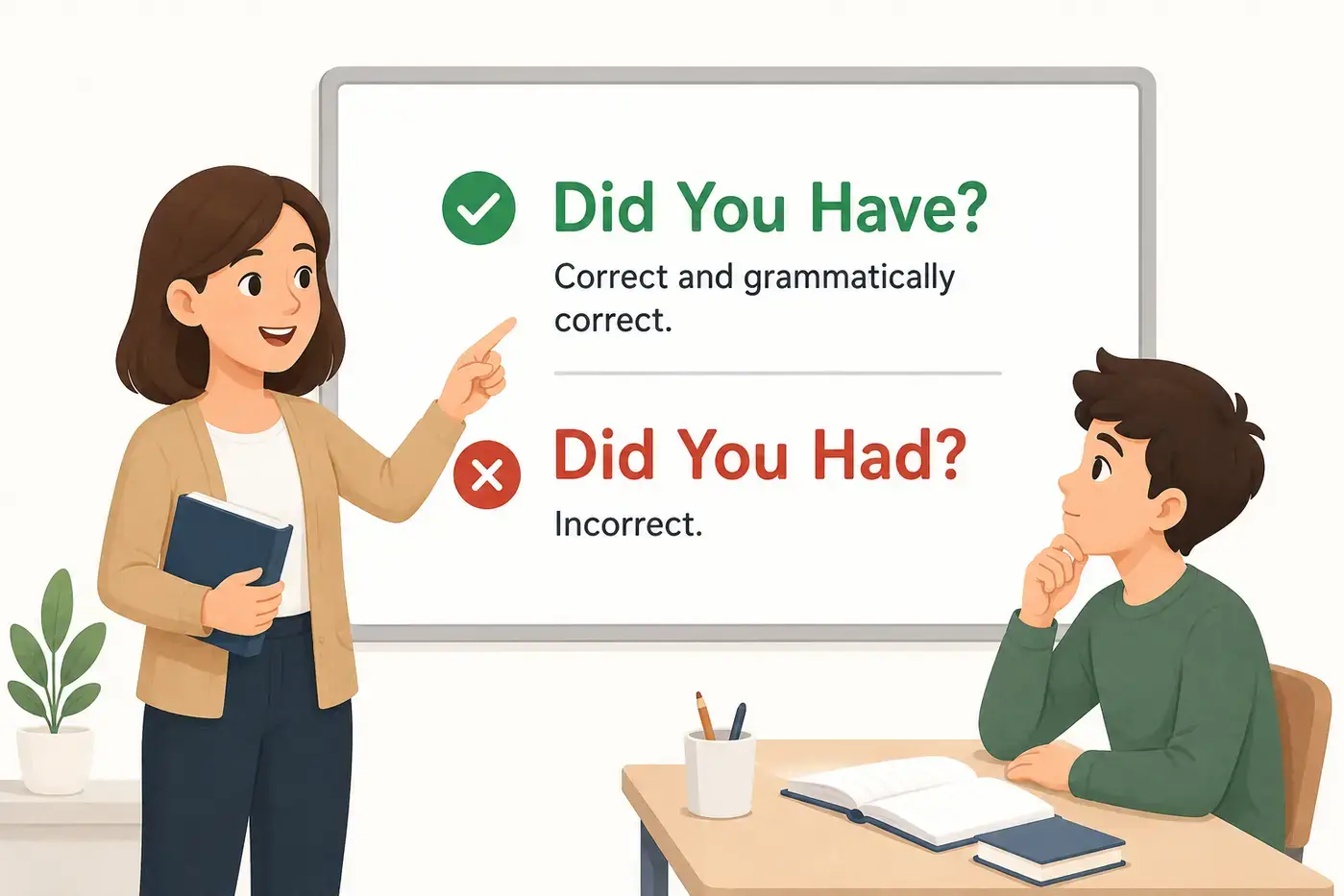
Did You Had or Did You Have is a common grammar question for English learners and even some native speakers. The confusion happens because both did and had refer to the past, making it seem logical to combine them. However, English grammar follows a different rule.
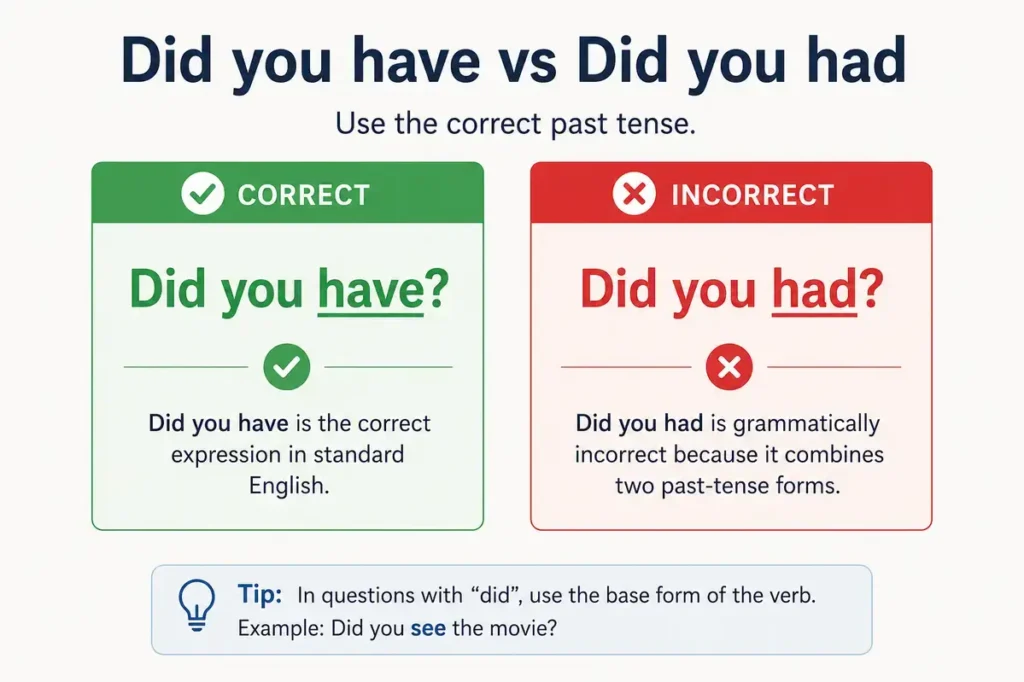
The correct expression is did you have because the auxiliary verb did already marks the sentence as past tense. The main verb must remain in its base form.
Once you understand how auxiliary verbs work, you’ll never have to guess again. This guide explains the grammar rule, provides dozens of examples, highlights common mistakes, and shares practical tips you can use in everyday speaking and writing.
Short Answer
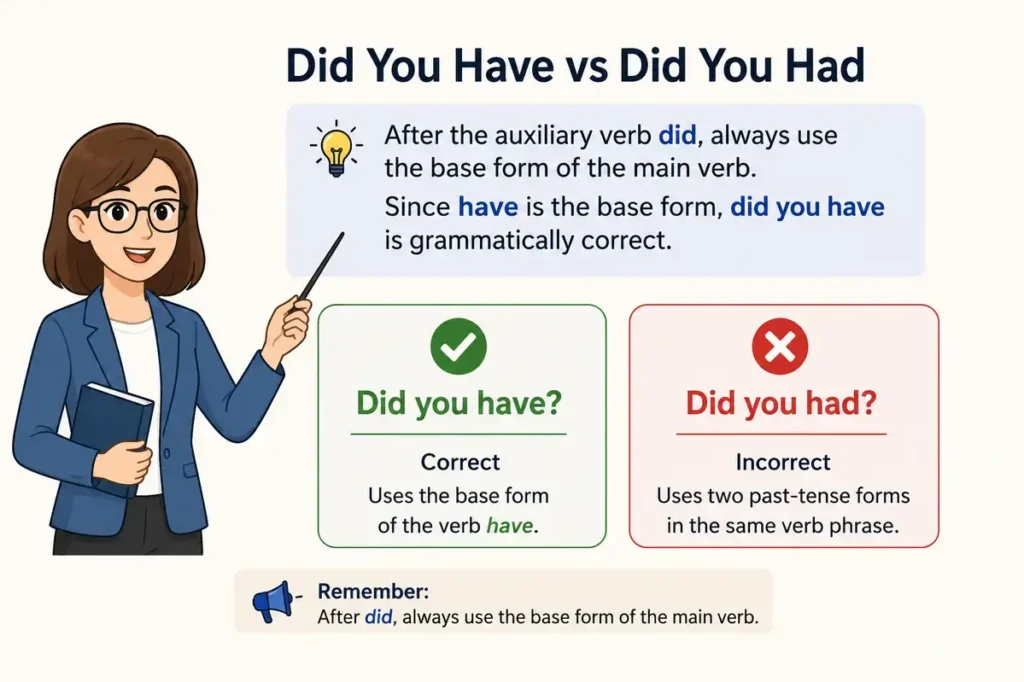
Did You Have vs Did You Had The correct phrase is did you have. After the auxiliary verb did, always use the base form of the main verb. Since have is the base form, did you have is grammatically correct. Did you had is incorrect in standard English because it uses two past-tense forms in the same verb phrase.
Table of Contents
- Short Answer
- Why People Get Confused
- The Main Grammar Rule
- Did You Had vs Did You Have Comparison Table
- Why Did You Have Is Correct
- Why Did You Had Is Incorrect
- How Auxiliary Verbs Work
- Examples in Everyday English
- Common Mistakes
- Memory Tricks
- Related Grammar Rules
- Frequently Asked Questions
- Key Takeaways
- Conclusion
Why People Get Confused
Many people assume that because they are talking about the past, every verb in the sentence should also be in the past tense.
For example, someone might think:
Did + had = past + past = correct.
Unfortunately, English does not work this way.
When a sentence contains the auxiliary verb did, the past tense is already expressed. The main verb stays in its original base form.
This is why native speakers naturally say:
- Did you have breakfast?
- Did you finish your homework?
- Did you see the movie?
They do not say:
- Did you had breakfast?
- Did you finished your homework?
- Did you saw the movie?
The same grammar rule applies to every regular and irregular verb.
The Main Grammar Rule
The rule is simple.
After the auxiliary verb did, always use the base form of the main verb.
Formula:
Did + subject + base verb
Examples:
- Did you have enough time?
- Did she call yesterday?
- Did they arrive early?
- Did he eat lunch?
- Did we make a mistake?
Notice that have, call, arrive, eat, and make are all in their base forms.
Comparison Table
| Phrase | Correct? | Reason |
|---|---|---|
| Did you have? | ✓ Yes | Have is the base verb after did. |
| Did you had? | ✗ No | Uses two past-tense forms together. |
| Did she go? | ✓ Yes | Base verb follows did. |
| Did they eat? | ✓ Yes | Base verb follows did. |
| Did he finish? | ✓ Yes | Base verb follows did. |
| Did we see? | ✓ Yes | Base verb follows did. |
Why Did You Have Is Correct
The word did already tells the reader or listener that the action happened in the past.
Because of this, the main verb does not change.
Look at these examples.
Present:
- You have a question.
Past question:
- Did you have a question?
Notice that have stays the same.
Another example:
Present:
- They play soccer.
Past question:
- Did they play soccer?
Again, the main verb remains in its base form.
More Correct Examples
- Did you have fun?
- Did you have any questions?
- Did you have enough money?
- Did you have dinner already?
- Did you have a good weekend?
- Did you have time to read the report?
- Did you have trouble finding the address?
- Did you have a chance to meet everyone?
Each sentence follows the same grammatical pattern.
Why Did You Had Is Incorrect
The phrase did you had breaks a basic rule of English grammar.
The auxiliary verb did already marks the sentence as past tense.
Adding had creates two past-tense markers in the same verb phrase.
Incorrect:
❌ Did you had breakfast?
Correct:
✅ Did you have breakfast?
Incorrect:
❌ Did she had enough experience?
Correct:
✅ Did she have enough experience?
Incorrect:
❌ Did they had tickets?
Correct:
✅ Did they have tickets?
Once did appears, the main verb returns to its base form.
Understanding Auxiliary Verbs
An auxiliary verb is a helping verb. It works together with the main verb to express tense, questions, negatives, or emphasis.
Common auxiliary verbs include:
- do
- does
- did
- have
- has
- had
- will
- shall
- can
- could
- may
- might
- should
- would
In questions about the simple past, English normally uses did as the auxiliary verb.
Examples:
- Did you call your mother?
- Did he buy a new car?
- Did they finish the project?
- Did we miss the train?
Notice that every main verb stays in its base form.
How Questions Are Formed in the Simple Past
The sentence pattern is easy to remember.
| Sentence Part | Example |
|---|---|
| Auxiliary verb | Did |
| Subject | you |
| Base verb | have |
| Rest of sentence | any coffee this morning? |
Complete question:
Did you have any coffee this morning?
Here are more examples.
| Question | Correct? |
|---|---|
| Did you have breakfast? | ✓ |
| Did she finish the report? | ✓ |
| Did they arrive on time? | ✓ |
| Did he write the email? | ✓ |
| Did we forget something? | ✓ |
Every question uses the same structure.
Did You Have vs Had You
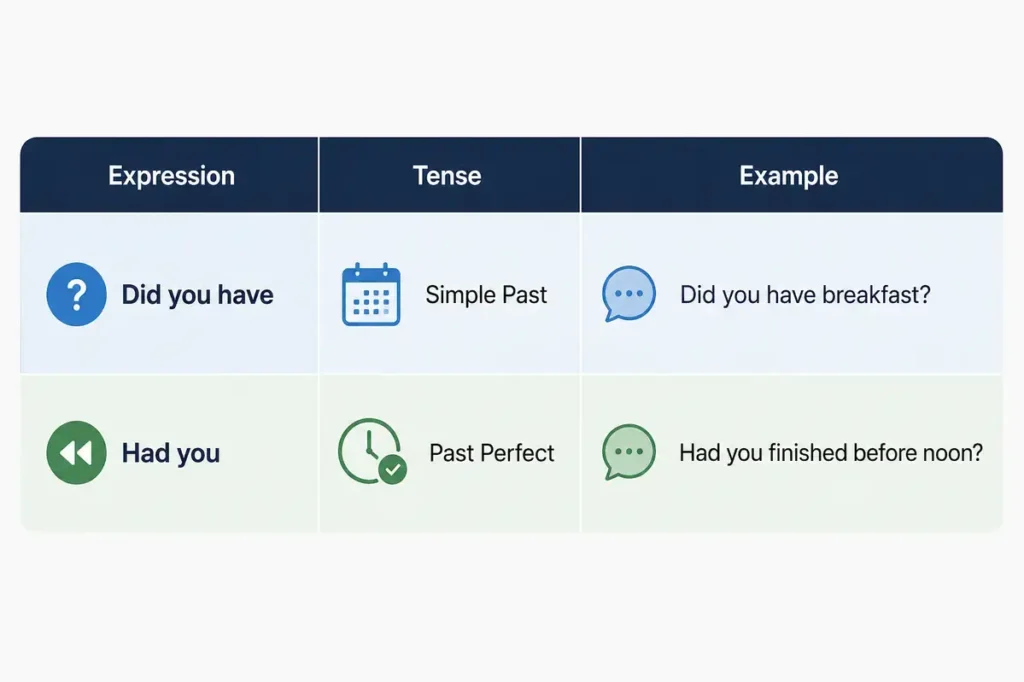
Another point of confusion is the difference between did you have and had you. Although both refer to the past, they are used in different tenses.
| Expression | Tense | Example |
|---|---|---|
| Did you have | Simple Past | Did you have breakfast? |
| Had you | Past Perfect | Had you finished before noon? |
Compare these examples.
Simple Past:
- Did you have enough money yesterday?
Past Perfect:
- Had you saved enough money before the trip?
The second sentence describes an action completed before another past event.
Real-Life Examples
At School
Correct:
- Did you have homework last night?
Explanation:
The speaker asks about homework in the simple past.
At Work
Correct:
- Did you have the meeting this morning?
Explanation:
The meeting happened in the past.
At a Restaurant
Correct:
- Did you have the chicken or the pasta?
Explanation:
The speaker asks what someone ordered earlier
At the Doctor’s Office
Correct:
- Did you have any pain after the surgery?
Explanation:
The question refers to a completed period in the past.
During Travel
Correct:
- Did you have a good flight?
Explanation:
The flight is already over, making the simple past the correct tense.
Common Situations That Use Did You Have
You’ll hear did you have in many everyday conversations.
Examples include:
- Did you have breakfast?
- Did you have lunch?
- Did you have dinner?
- Did you have fun?
- Did you have enough sleep?
- Did you have any luck?
- Did you have time?
- Did you have a chance to talk to her?
- Did you have any problems?
- Did you have any questions?
These are all natural, grammatical, and widely used in both spoken and written English.
More Real Life Examples
Seeing the rule in everyday situations makes it much easier to remember.
At Home
Correct:
- Did you have breakfast before work?
Explanation:
The speaker asks about a completed action earlier in the day.
Correct:
- Did you have enough sleep last night?
Explanation:
The question refers to a finished period of time.
At School
Correct:
- Did you have a math test today?
Explanation:
The test happened earlier today.
Correct:
- Did you have time to finish your assignment?
Explanation:
The speaker asks about a completed opportunity.
At Work
Correct:
- Did you have a meeting with the client?
Explanation:
The meeting took place in the past.
Correct:
- Did you have any questions after the presentation?
Explanation:
The question refers to a past event.
While Traveling
Correct:
- Did you have a comfortable flight?
Explanation:
The flight has already ended.
Correct:
- Did you have any trouble finding the hotel?
Explanation:
The speaker asks about a completed experience.
Visiting Friends
Correct:
- Did you have fun at the party?
Explanation:
The party is over, so the simple past is appropriate.
Correct:
- Did you have a chance to meet everyone?
Explanation:
The speaker asks about an opportunity during a completed event.
Negative Sentences
The same grammar rule applies to negative sentences.
Use this structure:
Did + not + base verb
Correct examples:
- I did not have enough time.
- She did not have any questions.
- They did not have breakfast.
- We did not have much money.
- He did not have the opportunity to speak.
Incorrect examples:
- ❌ I did not had enough time.
- ❌ She did not had any questions.
- ❌ They did not had breakfast.
The auxiliary verb did already expresses the past tense, so have remains in its base form.
Short Answers
Questions with did often have short answers.
Examples:
Question:
Did you have a good weekend?
Answer:
- Yes, I did.
- No, I didn’t.
Notice that we do not answer:
- ❌ Yes, I had.
Although I had a good weekend is a complete sentence, the standard short answer to a did question uses did.
Questions Using Other Verbs
The same grammar rule applies to every verb.
| Correct | Incorrect |
|---|---|
| Did you go? | Did you went? |
| Did she write? | Did she wrote? |
| Did they eat? | Did they ate? |
| Did he buy? | Did he bought? |
| Did we see? | Did we saw? |
| Did you make? | Did you made? |
| Did she come? | Did she came? |
| Did they take? | Did they took? |
Notice the pattern.
After did, every main verb returns to its base form.
Common Mistakes
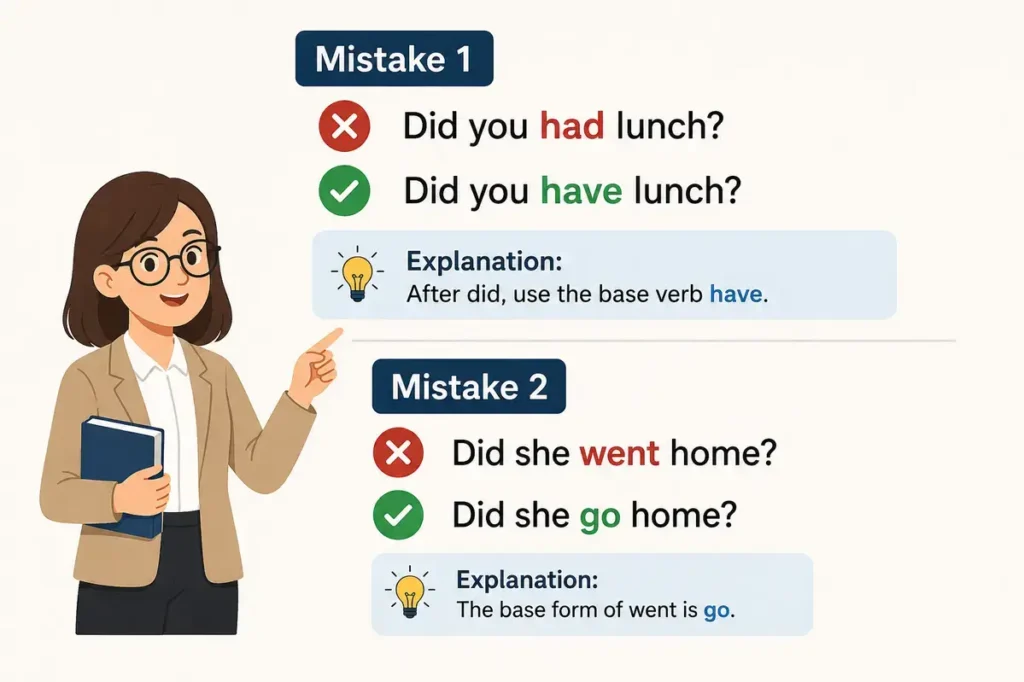
Many learners repeat the same grammar mistakes. Understanding why they’re incorrect will help you avoid them.
Mistake 1
❌ Did you had lunch?
✅ Did you have lunch?
Explanation:
After did, use the base verb have.
Mistake 2
❌ Did she went home?
✅ Did she go home?
Explanation:
The base form of went is go.
Mistake 3
❌ Did they saw the movie?
✅ Did they see the movie?
Explanation:
The base form of saw is see.
Mistake 4
❌ Did he wrote the report?
✅ Did he write the report?
Explanation:
The base form of wrote is write.
Mistake 5
❌ Did we ate already?
✅ Did we eat already?
Explanation:
The base form of ate is eat.
Mistake 6
❌ Did you had enough money?
✅ Did you have enough money?
Explanation:
Only the auxiliary verb carries the past tense.
Why This Mistake Happens
There are several reasons learners write did you had.
1. Double Past Tense
People know the sentence is about the past. They mistakenly think every verb should also be in the past tense. English does not work that way.
2. Translating from Another Language
Some languages keep the main verb in the past tense even after an auxiliary verb.
English does not.
The auxiliary verb did carries the past tense.
3. Memorizing Instead of Understanding
Some learners memorize phrases without learning the grammar behind them. Once you understand the role of auxiliary verbs, the rule becomes much easier to remember.
Professional Writing Tips
Editors rarely memorize every grammar rule. Instead, they use quick editing techniques.
Tip 1
Look for did first.
If you see did, immediately check that the next verb is in its base form.
Tip 2
Ask yourself this question.
“Is the main verb already in the past tense?”
If the answer is yes, change it back to the base form.
Tip 3
Read the sentence aloud.
Incorrect:
- Did you had breakfast?
Most native speakers immediately notice that it sounds unnatural.
Correct:
- Did you have breakfast?
The sentence flows naturally.
Tip 4
Remember one simple formula.
Did + base verb
That formula works for almost every simple past question.
Memory Tricks
Simple memory aids make this grammar rule easy to remember.
Trick 1
Think of did as carrying the past tense.
The main verb no longer needs a past ending.
Trick 2
Remember this formula.
Did = past
Verb = base form
Examples:
- Did + have
- Did + go
- Did + eat
- Did + write
- Did + see
Trick 3
Never put two past-tense verbs together.
Incorrect:
- Did had
- Did went
- Did wrote
- Did saw
Correct:
- Did have
- Did go
- Did write
- Did see
Trick 4
Practice with common questions.
- Did you have breakfast?
- Did you sleep well?
- Did you call your parents?
- Did you finish your work?
- Did you enjoy the movie?
After enough repetition, the correct pattern becomes automatic
American and British English
There is no difference between American English and British English for this grammar rule. Both varieties use the same structure.
American English:
- Did you have a good vacation?
British English:
- Did you have a good holiday?
The vocabulary changes, but the grammar stays exactly the same.
Formal and Informal Usage
Did you have is correct in every context.
It is appropriate for:
- Academic writing
- Business emails
- Job interviews
- Newspapers
- Books
- Everyday conversations
- Professional presentations
Examples:
Formal:
- Did you have an opportunity to review the proposal?
Informal:
- Did you have fun?
Both follow the same grammar rule.
Related Grammar Rules
Learning related grammar patterns reinforces the same concept.
Did You Go or Did You Went
Correct:
- Did you go?
Incorrect:
- Did you went?
Did You See or Did You Saw
Correct:
- Did you see?
Incorrect:
- Did you saw?
Did You Write or Did You Wrote
Correct:
- Did you write?
Incorrect:
- Did you wrote?
Did You Eat or Did You Ate
Correct:
- Did you eat?
Incorrect:
- Did you ate?
Did You Come or Did You Came
Correct:
- Did you come?
Incorrect:
- Did you came?
Every one of these follows the same rule:
Did + base verb
Exceptions
The grammar rule itself has no exceptions in standard English. Whenever did functions as the auxiliary verb in the simple past, the following verb must be in its base form. However, don’t confuse did with the verb had when had is the main verb in a different tense.
Examples:
- I had breakfast before I left.
- She had already finished her homework.
- They had gone home before we arrived.
These sentences do not use did, so different grammar rules apply.
Practice Quiz
Test your understanding by choosing the correct option before reading the answer.
1. _____ breakfast before school?
- Did you have
- Did you had
✅ Answer: Did you have
Explanation: After did, use the base verb have.
2. _____ enough time to finish the project?
- Did she have
- Did she had
✅ Answer: Did she have
Explanation: The auxiliary verb did already shows the past tense.
3. _____ the movie last night?
- Did they see
- Did they saw
✅ Answer: Did they see
Explanation: See is the base form of saw
4. _____ your parents yesterday?
- Did you call
- Did you called
✅ Answer: Did you call
Explanation: Use the base verb call after did.
5. _____ a wonderful vacation?
- Did you have
- Did you had
✅ Answer: Did you have
Explanation: The correct structure is did + base verb.
6. _____ dinner before the meeting?
- Did he have
- Did he had
✅ Answer: Did he have
Explanation: Only did carries the past tense.
7. _____ the answer?
- Did she know
- Did she knew
✅ Answer: Did she know
Explanation: Know is the base form of knew.
8. _____ to the concert?
- Did they go
- Did they went
✅ Answer: Did they go
Explanation: After did, always use the base form.
9. _____ any questions after class?
- Did you have
- Did you had
✅ Answer: Did you have
Explanation: This follows the standard simple past question pattern.
10. _____ your keys this morning?
- Did you find
- Did you found
✅ Answer: Did you find
Explanation: Find is the base form of found.
Key Takeaways
- Did you have is the correct expression in standard English.
- Did you had is grammatically incorrect because it combines two past-tense forms.
- After did, always use the base form of the main verb.
- This rule applies to both regular and irregular verbs.
- The correct structure is Did + subject + base verb.
- The same rule applies in negative sentences: did not + base verb.
- American English and British English follow the same grammar rule.
- The easiest way to remember the rule is that did already expresses the past tense.
Conclusion
The answer to Did You Had or Did You Have is simple once you understand how English forms questions in the simple past. The correct phrase is did you have because the auxiliary verb did already indicates that the action happened in the past. The main verb must remain in its base form, making have the only correct choice.
This same pattern applies to every verb in English. You say did you go, not did you went; did she write, not did she wrote; and did they eat, not did they ate. Learning this single rule will help you avoid one of the most common grammar mistakes made by English learners. Whenever you’re unsure, remember the formula Did + base verb. It works in questions, negative sentences, and everyday conversations, giving you a reliable way to speak and write with confidence.
FAQS
Why is did you have correct instead of did you had?
The auxiliary verb did already marks the sentence as past tense. The main verb must stay in its base form, so have is correct.
Is did you had ever correct?
No. In standard English, did you had is grammatically incorrect because it combines two past-tense forms in the same verb phrase.
Why do people say did you had?
Many English learners assume both verbs should be in the past tense. Others translate directly from languages that follow different grammar patterns.
Is did you have formal or informal?
It is correct in both formal and informal English. You can use it in conversations, emails, reports, academic writing, and business communication.
Does British English use did you had?
No. Both American and British English use did you have.
Can I say had you instead of did you have?
Sometimes, but the meanings are different. Had you is commonly used in the past perfect tense, while did you have is used in the simple past.
Compare:
- Did you have enough time? (Simple Past)
- Had you finished before noon? (Past Perfect)
Does this rule apply to all verbs?
Yes. After did, always use the base form of the verb.
Examples:
- Did you go?
- Did she eat?
- Did they write?
- Did he come?
- Did we make?
What is the easiest way to remember this rule?
Remember this simple formula:
Did + base verb
Never use a past-tense verb immediately after did.
Can I use contractions with did?
Yes. In negative sentences, did not is often shortened to didn’t.
Examples:
- I didn’t have time.
- She didn’t see the message.
- They didn’t finish the project.
The verb after didn’t also remains in its base form.
What is the most common mistake with did?
The most common mistake is using the past tense twice.
Incorrect:
- Did you went?
- Did she wrote?
- Did they ate?
- Did you had?
Correct:
- Did you go?
- Did she write?
- Did they eat?
- Did you have?

English Grammar & Usage
Nathan Holloway is an American grammar writer and language researcher who specializes in English grammar, sentence structure, verb usage, and common writing mistakes. He enjoys breaking down confusing grammar rules into practical explanations with clear examples, making English easier for students, professionals, and everyday writers.