
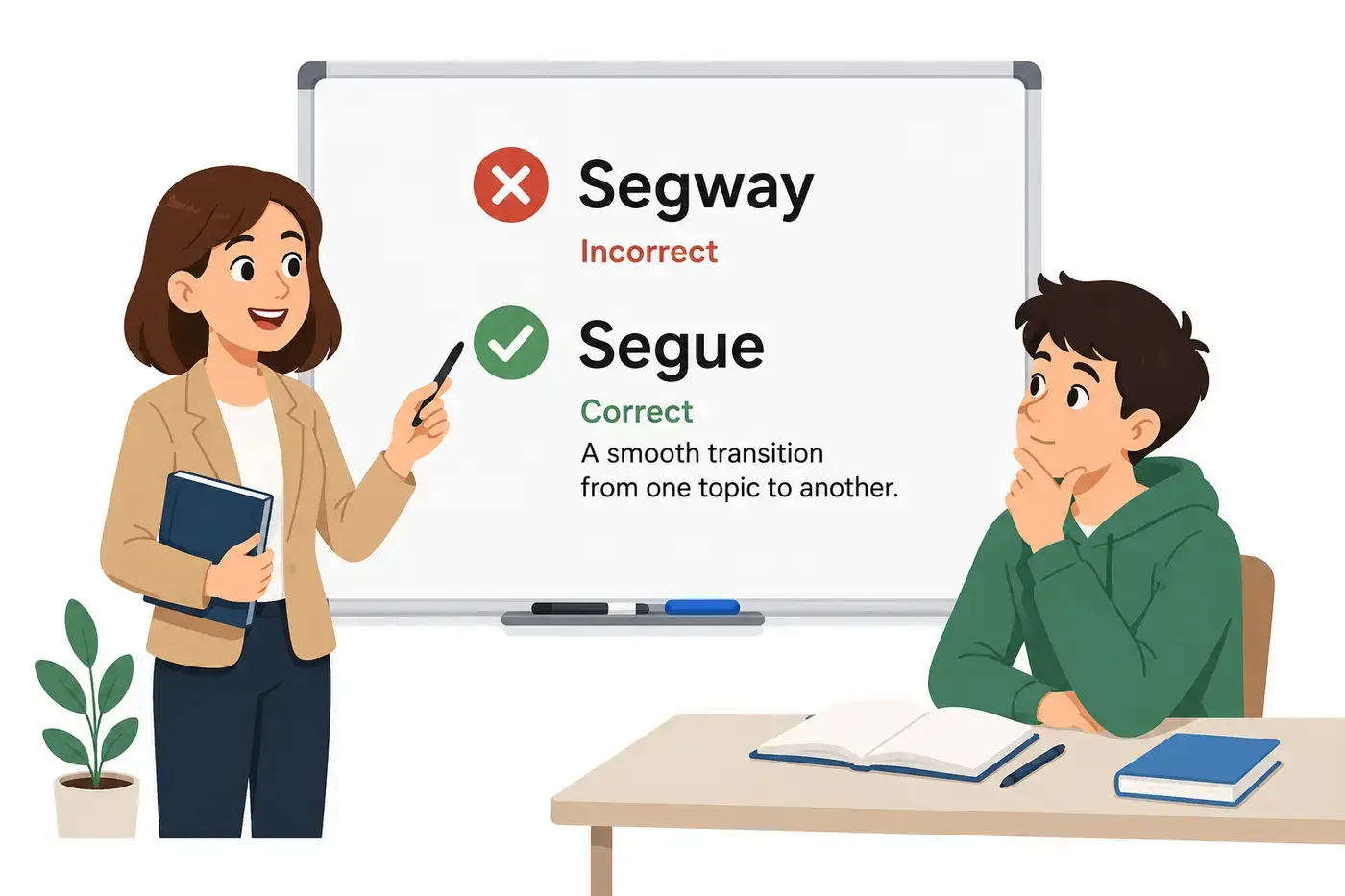
You have probably seen someone write segway into the next topic in an email article social media post or business presentation. At first glance it looks perfectly reasonable. After all the spelling matches the pronunciation. The problem is that English follows history more than logic and this is one of those cases. The confusion between Segway or Segue has become one of the most common word choice mistakes in modern English. Spell checkers do not always catch it because Segway is a real word. That makes the mistake easy to miss and surprisingly common even among experienced writers.
The good news is that the distinction is simple once you understand the meaning behind each word. One belongs to everyday English vocabulary. The other belongs to a famous transportation brand. They share a sound but not a purpose. This guide explains the difference in plain English. You will learn the meaning of each word the correct grammar pronunciation history common mistakes professional writing tips memory tricks and plenty of real examples so you never confuse them again.
Short Answer
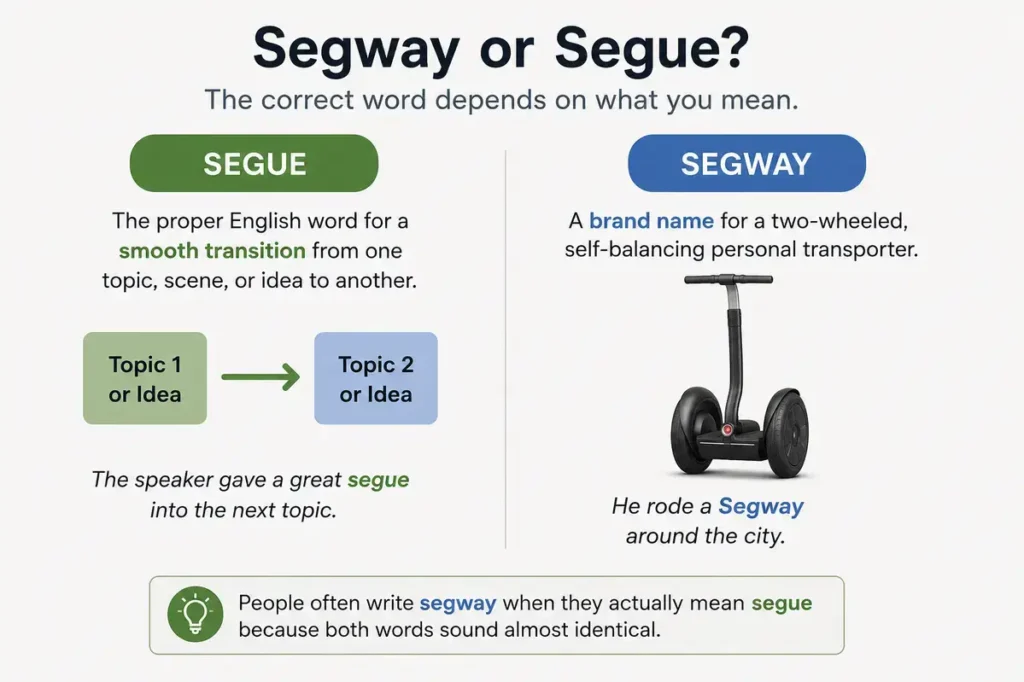
If you are choosing between Segway or Segue the correct word depends on what you mean. Segue is the proper English word for a smooth transition from one topic scene or idea to another. Segway is a brand name for a two wheeled self balancing personal transporter. People often write segway when they actually mean segue because both words sound almost identical.
Table Of Contents
- What Is The Difference Between Segway Or Segue.
- What Does Segue Mean.
- What Does Segway Mean.
- Why People Confuse These Words.
- Segway Or Segue Comparison Table.
- When To Use Segue.
- When To Use Segway.
- Real Life Examples.
- Common Mistakes To Avoid.
- Memory Tricks.
- Related Grammar Notes.
- Frequently Asked Questions.
- Key Takeaways.
- Conclusion.
What Is The Difference Between Segway Or Segue
The difference comes down to meaning.
Segue is a standard English word. It describes a smooth movement from one subject activity scene or idea into another without interruption.
Segway is a trademarked brand name. It refers to the electric personal transporter introduced in the early twenty first century.
Although they sound alike they belong to completely different categories. One is part of everyday language. The other identifies a specific product.
| Feature | Segue | Segway |
|---|---|---|
| Meaning | Smooth transition | Personal transportation device |
| Part of speech | Verb and noun | Proper noun |
| Used in writing | Yes | Only when referring to the brand |
| Pronunciation | Seg way | Seg way |
| Correct in transition sentences | Yes | No |
| Correct for the vehicle | No | Yes |
This single comparison answers most questions people have about Segway or Segue.
What Does Segue Mean
The word segue means to move smoothly from one thing into another.
People use it most often in speaking writing broadcasting teaching presentations and conversations. It helps describe a natural shift without an awkward pause or sudden break.
Examples include moving from one discussion topic into another introducing a new section of a speech or connecting two musical pieces.
Examples.
The speaker smoothly segued into the final topic.
The documentary segues from history into modern science.
She used a personal story to segue into her main argument.
Each sentence shows movement without interruption. That idea sits at the heart of the word.
Segue As A Verb
Most people use segue as a verb.
Examples.
The meeting segued into a budget discussion.
His introduction segues naturally into the next chapter.
Can you segue into the next question.
In every example the action involves changing direction smoothly.
Segue As A Noun
Less commonly segue can also function as a noun.
Examples.
The transition was a perfect segue between scenes.
The editor created a smooth segue from one interview to the next.
Professional writers often use the noun form when discussing storytelling film editing broadcasting journalism and public speaking.
What Does Segway Mean
Segway is a proper noun. It is the name of a self balancing electric vehicle.
The original machine allows riders to stand while the device balances itself electronically. It became widely known after its public release in the early two thousands.
Examples.
Tourists rented a Segway to explore the city.
He learned to ride a Segway during the vacation.
The company introduced several updated Segway models.
Notice that every example refers to a physical product.
If you replace Segway with transition the sentence no longer makes sense.
Why People Confuse These Words
English has many words that sound alike but have different spellings and meanings. Linguists call these pairs homophones.
Segue and Segway are almost perfect examples.
Several reasons explain the confusion.
Identical Pronunciation
Both words are pronounced exactly the same in standard American English. Most people first hear the word before seeing it written. When they later write it they naturally choose the spelling that looks more familiar.
Brand Recognition
Millions of people recognize the transportation device. Because the brand appears frequently in advertising travel articles and videos many writers remember that spelling more easily than the Italian loanword.
Spell Check Limitations
Modern spelling tools usually accept both words. They cannot identify the mistake because each spelling exists in English. That means only context determines the correct choice.
Rare Everyday Exposure
Many people speak the word regularly but rarely read it in books. As a result they rely on sound instead of spelling. This explains why educated native speakers sometimes write Segway into another topic even though the correct choice is segue.
When To Use Segue
Choose segue anytime you mean a smooth transition.
Common situations include presentations.
The presenter segued into the final section.
Writing.
The author segues between ideas with clear examples.
Podcasts.
The host used a joke to segue into the interview.
Teaching.
The instructor segued from grammar into vocabulary.
Business meetings.
The manager segued into next quarter’s goals.
In every case nothing is being ridden. Something is simply moving naturally from one point to another.
When To Use Segway
Use Segway only when discussing the vehicle or the company.
Correct examples.
Our group rented Segways during the sightseeing tour.
The park offers guided Segway rides.
She bought a new Segway for commuting short distances.
These examples describe transportation instead of communication.
Professional Writing Tip
Editors in newspapers magazines universities and publishing houses almost always replace Segway into the discussion with segue into the discussion during proofreading. The mistake appears frequently because pronunciation encourages the wrong spelling. Professional editors pay attention to meaning instead of sound. That habit can improve your own writing. Before choosing the spelling ask one simple question. Am I talking about a transition or a vehicle. The answer immediately tells you which word belongs in the sentence.
Real Life Examples
The fastest way to master Segway or Segue is to see both words in real situations. Each example below explains why one choice is correct and the other is not.
Examples Using Segue
The presenter used a personal story to segue into the main topic.
Explanation. The speaker moved smoothly from one idea to another.
The teacher segued from grammar to writing practice.
Explanation. The lesson changed naturally without an abrupt break.
The movie segues from comedy to drama surprisingly well.
Explanation. The scenes connect smoothly.
The podcast host segued into the interview after discussing the latest news.
Explanation. The conversation shifted naturally.
She smiled before she segued into a difficult question.
Explanation. The smile created a smooth transition.
The article segues from history into modern research.
Explanation. The writer connected two subjects naturally.
Examples Using Segway
They explored downtown on a Segway.
Explanation. This sentence refers to the electric vehicle.
The tour guide showed everyone how to ride a Segway safely.
Explanation. The brand name identifies the transporter.
He bought a Segway for short trips around the neighborhood.
Explanation. The sentence discusses transportation.
The company released an updated Segway model.
Explanation. This refers to a product instead of a transition.
Pronunciation
One reason people confuse these words is simple.
They sound exactly the same.
Segue.
Pronunciation.
Seg way.
Segway.
Pronunciation.
Seg way.
English contains many words that share pronunciation but differ in spelling and meaning. Native speakers often choose the wrong spelling because they write the word exactly as they hear it.
Word Origin
Learning where a word came from often makes it easier to remember.
Origin Of Segue
The word segue comes from Italian.
It originally meant follows or continues.
Musicians used it as a direction to continue directly into the next section without stopping. Over time English adopted the word and expanded its meaning to include smooth transitions in speech writing broadcasting and everyday conversation.
Origin Of Segway
Segway is a modern brand name.
The company introduced the self balancing personal transporter in the early twenty first century. The name was chosen because it resembles the sound of segue while suggesting movement from one place to another.
The similar pronunciation is intentional. The meanings are not.
Grammar Rules
Understanding the grammar removes almost every mistake.
Segue Functions As A Verb
Most often segue acts as a verb.
Examples.
The speaker segued into the conclusion.
Please segue into your next point.
The discussion segues naturally from education to employment.
Like other verbs it changes form.
Segue.
Segues.
Segueing.
Segued.
Segue Can Also Be A Noun
Sometimes it describes the transition itself.
Example.
That was a smooth segue between chapters.
The noun form appears less often than the verb form but remains correct.
Segway Functions As A Proper Noun
Segway names a specific brand.
Example.
The tourists rented a Segway.
It should never replace segue when discussing ideas conversations or writing.
Common Mistakes
Many writers repeat the same errors.
Understanding them helps you avoid them.
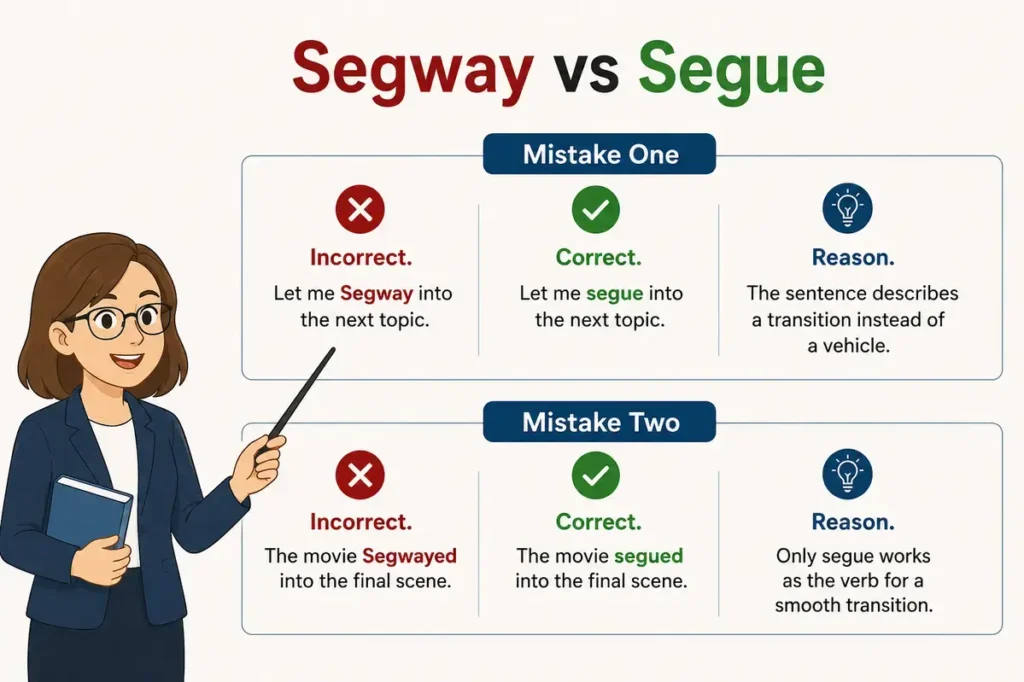
Mistake One
Incorrect.
Let me Segway into the next topic.
Correct.
Let me segue into the next topic.
Reason.
The sentence describes a transition instead of a vehicle.
Mistake Two
Incorrect.
The movie Segwayed into the final scene.
Correct.
The movie segued into the final scene.
Reason.
Only segue works as the verb for a smooth transition.
Mistake Three
Incorrect.
The editor created a perfect Segway between paragraphs.
Correct.
The editor created a perfect segue between paragraphs.
Reason.
No vehicle appears in the sentence.
Mistake Four
Incorrect.
We rented a segue during vacation.
Correct.
We rented a Segway during vacation.
Reason.
The sentence refers to transportation.
Memory Tips
Simple memory tricks make the difference stick.
Think About Motion
If something moves smoothly from one idea to another use segue.
If someone rides it use Segway.
Picture A Meeting
Imagine a business presentation.
The speaker segues between topics.
Nobody rides a transporter across the conference room.
That image is difficult to forget.
Remember The Vehicle
When you see the capital letter at the beginning of Segway think of a product name.
Brand names usually begin with capital letters.
Related Grammar And Usage Notes
English includes many confusing word pairs that resemble Segway or Segue.
Learning them together improves accuracy.
| Confusing Pair | Difference |
|---|---|
| Affect and Effect | Action versus result. |
| Advice and Advise | Noun versus verb. |
| Compliment and Complement | Praise versus complete. |
| Principal and Principle | Person versus rule. |
| Stationary and Stationery | Not moving versus writing paper. |
| Farther and Further | Physical distance versus broader extension. |
| Then and Than | Time versus comparison. |
| Lose and Loose | Misplace versus not tight. |
Most of these mistakes happen because English pronunciation does not always match spelling.
Professional Writing Tips
Editors rely on context instead of sound.
Before choosing the spelling ask yourself one question.
Am I describing a smooth transition.
If the answer is yes use segue.
Am I describing a self balancing transporter.
If the answer is yes use Segway.
This simple habit prevents nearly every mistake.
Key Takeaways
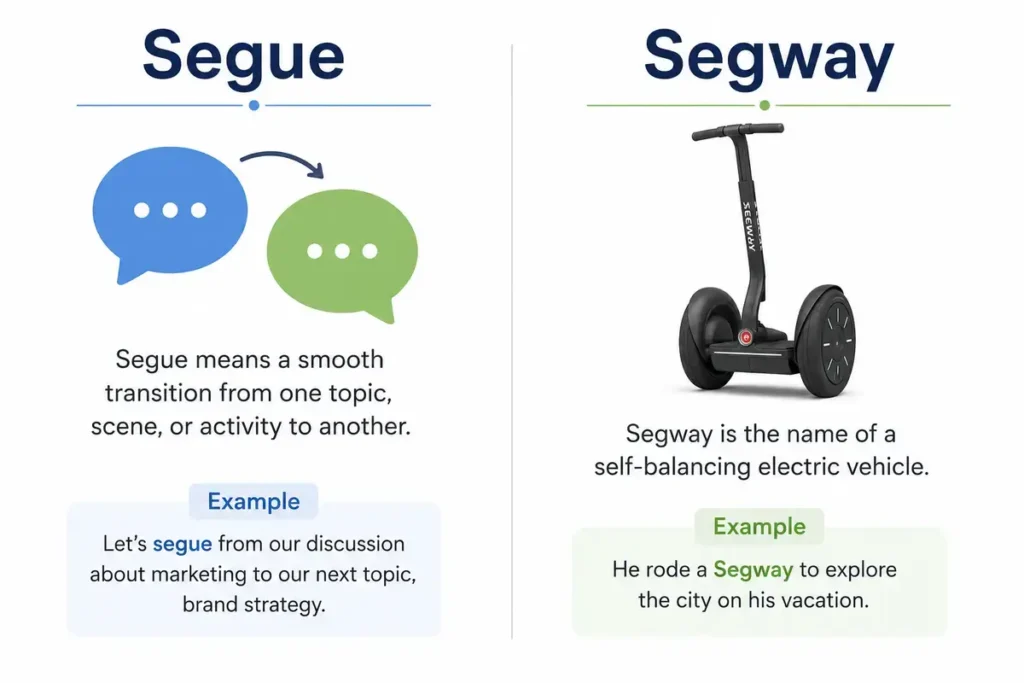
- Segue means a smooth transition from one topic scene or activity to another.
- Segway is the name of a self balancing electric vehicle.
- Both words share the same pronunciation.
- Their meanings are completely different.
- Most writing mistakes happen because people spell the word the way it sounds.
- Think about context instead of pronunciation.
- Professional writers use segue whenever discussing transitions.
Conclusion
The confusion around Segway or Segue comes from pronunciation instead of grammar. Since both words sound the same many people naturally choose the more familiar spelling. The meanings however are entirely different.
Use segue whenever you describe a smooth transition in speaking writing music presentations or conversation. Use Segway only when referring to the well known self balancing personal transporter.
Once you focus on the meaning instead of the sound the correct choice becomes obvious. That small habit will make your writing clearer more professional and more accurate every time.
Frequently Asked Questions
Is Segway Or Segue Correct For A Transition?
Segue is correct. It means to move smoothly from one topic or activity to another.
Why Do People Write Segway Instead Of Segue?
Both words sound identical. Many people recognize the transportation brand first and mistakenly use that spelling.
Is Segway A Real Word?
Yes. It is a registered brand name for a self balancing personal transporter.
Is Segue A Verb?
Yes. It most commonly functions as a verb meaning to transition smoothly.
Can Segue Be A Noun?
Yes. It can refer to the transition itself although the verb form appears more often.
How Do You Pronounce Segue?
It is pronounced exactly like Segway.
Do Spell Checkers Catch This Mistake?
Not always. Both words are correctly spelled. Only the surrounding context determines which one fits.
Is This Mistake Common Among Native Speakers?
Yes. Native English speakers make this mistake regularly because the pronunciation is identical.
Can I Use Segway In Formal Writing?
Only if you are discussing the brand or the vehicle. Otherwise use segue.
What Is The Easiest Way To Remember The Difference?
If you can ride it use Segway. If you move smoothly into another idea use segue.

Confusing Words, Spelling & Word Choice
Claire Whitmore is a U.S.-based English editor who writes about commonly confused words, spelling differences, and word choice. Her work helps readers understand subtle distinctions between similar-looking words through simple definitions, practical examples, and modern usage guidance in both American and British English.