
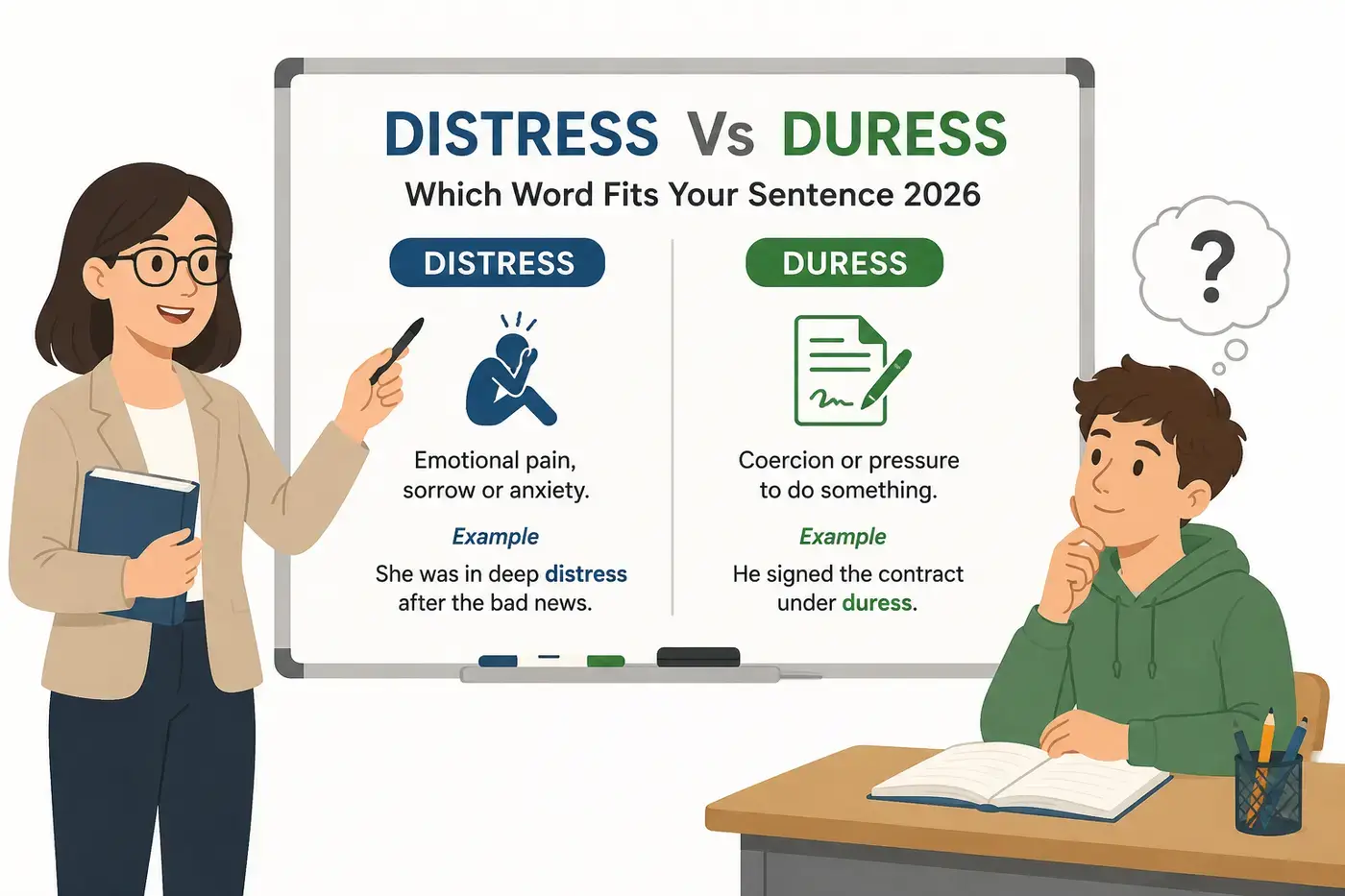
Distress vs duress is a common word comparison because both terms describe difficult situations involving stress, pressure, or suffering. However, they don’t mean the same thing. Distress usually refers to a person’s emotional or physical suffering, while duress refers to pressure that forces or strongly compels someone to act against their wishes.
The difference becomes especially useful when you write about personal experiences, workplace problems, medical conditions, or legal situations. For example, a person may experience distress after losing a job. Another person may sign an agreement under duress because someone threatens to harm them if they refuse. The first example describes suffering, while the second describes coercion.
Once you understand what each word emphasizes, choosing the correct one becomes much easier. Distress focuses on the suffering someone experiences. Duress focuses on the pressure or threat that restricts someone’s freedom to act. Although these situations can overlap, the words serve different purposes in a sentence.
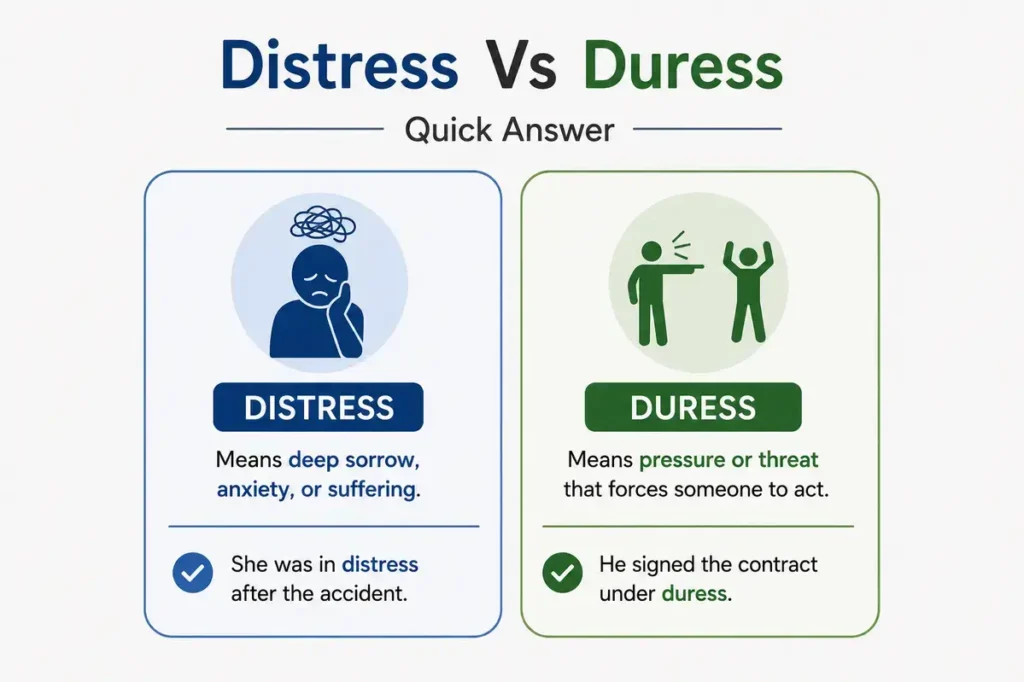
Short Answer
Distress vs duress comes down to emotional suffering versus pressure or coercion. Distress describes severe worry, pain, sadness, or hardship. Duress describes a situation in which someone faces threats, force, or pressure that limits their freedom to choose. You might feel distress after receiving bad news, but you might act under duress if someone threatens you into signing a document.
Table of Contents
- What Distress Means.
- What Duress Means.
- The Main Difference Between Distress and Duress.
- How to Use Distress Correctly.
- How to Use Duress Correctly.
- Distress vs Duress in Legal Contexts.
- Distress vs Duress in Everyday Life.
- Pronunciation and Word Origins.
- Common Mistakes to Avoid.
- Memory Tips for Remembering the Difference.
- Related Words and Expressions.
- Professional Writing Tips.
- Frequently Asked Questions.
- Key Takeaways.
- Conclusion.
What Distress Means
Distress is a noun and a verb that describes suffering, pain, worry, or a difficult condition. It can refer to emotional discomfort, physical suffering, financial hardship, or a situation that causes serious concern.
As a noun, distress describes the condition of suffering or being in trouble. As a verb, to distress means to cause someone worry, sadness, or emotional pain.
Consider this sentence.
The sudden loss of her job caused her considerable distress.
The word distress describes the emotional suffering she experienced after losing her job. It doesn’t automatically suggest that another person threatened or forced her to do something.
The Emotional Meaning of Distress
People commonly use distress to describe feelings such as deep sadness, fear, anxiety, grief, or worry. The word often suggests something more serious than ordinary annoyance or a passing bad mood.
For example, a student might feel distress after receiving an unexpectedly poor grade. A parent might experience distress when a child becomes seriously ill. Someone might also feel distress after a painful argument with a close friend.
In each case, the word describes the suffering itself. The cause may be an event, a personal problem, uncertainty, or something beyond the person’s control.
The Physical Meaning of Distress
Distress can also describe physical discomfort or a dangerous medical condition. In healthcare, professionals may use terms such as respiratory distress to describe difficulty breathing that requires medical attention.
For example.
The patient showed signs of respiratory distress.
Here, distress refers to a serious physical problem rather than emotional upset. The sentence communicates that the patient was struggling to breathe.
The word also appears in descriptions of animals experiencing pain or discomfort. A veterinarian might describe an injured animal as being in distress when it shows signs of serious suffering.
The Financial Meaning of Distress
Distress can describe financial trouble affecting individuals, businesses, or entire industries. Expressions such as financial distress and economic distress refer to situations in which financial problems create serious difficulty.
For example.
The company faced financial distress after losing several major customers.
The sentence describes the company’s financial hardship. It doesn’t necessarily mean that someone threatened the company or forced its leaders to make a decision.
Another common expression is distress sale. This refers to a sale made under difficult financial circumstances, often because the seller needs money quickly. The exact meaning can depend on the market and context.
Distress as a Verb
Distress can also function as a verb when something causes suffering or worry.
For example.
The news of the accident distressed the entire family.
In this sentence, distressed means caused emotional pain or worry. The news is the cause, and the family’s suffering is the result.
The verb can also appear in the passive voice.
She was distressed by the unexpected announcement.
This sentence emphasizes her emotional reaction. It doesn’t necessarily suggest that anyone used threats or coercion.
Common Expressions With Distress
Several familiar expressions use distress in specific ways.
1. Emotional distress. This refers to significant emotional suffering caused by a difficult event or situation.
2. Financial distress. This describes serious money problems affecting a person, business, or organization.
3. Distress signal. This is a signal sent to request help during an emergency. Ships and aircraft may use recognized distress signals when they face danger.
4. In distress. This phrase describes someone or something experiencing serious trouble, suffering, or danger.
5. Distress call. This is a communication requesting urgent help, particularly in aviation, maritime operations, and emergency situations.
These expressions share one central idea. Something is wrong, and the situation involves suffering, danger, or a need for help.
What Duress Means
Duress is a noun that describes pressure, threats, intimidation, or force that compels someone to do something they wouldn’t freely choose to do. The word often appears in legal discussions, but it also applies to everyday situations involving coercion.
For example.
He signed the agreement under duress.
This sentence suggests that he signed because someone threatened him or applied improper pressure. The phrase doesn’t simply mean that he felt worried while signing. It points to circumstances that may have limited his freedom to choose.
The Meaning of Duress in Everyday English
In everyday English, duress describes a situation in which a person feels compelled to act because of threats or serious pressure. The pressure may involve physical harm, intimidation, or threats against someone the person cares about.
Imagine someone threatening to reveal private information unless you hand over money. If you comply because of that threat, you may describe your action as taking place under duress.
The central idea is coercion. A person may appear to agree to something, but the surrounding circumstances can make that agreement far from voluntary.
Not every difficult decision involves duress. A demanding deadline, an uncomfortable conversation, or a strong desire to please someone doesn’t automatically qualify. The nature of the pressure matters, especially when the word appears in a legal context.
The Legal Meaning of Duress
In law, duress generally refers to improper threats or pressure that can affect a person’s ability to make a voluntary decision. It may become relevant when someone signs a contract, makes a payment, agrees to a demand, or participates in an action because of coercion.
For example.
The defendant argued that he had acted under duress.
The sentence means that the defendant claimed he had been forced or improperly pressured into acting. It does not establish that the claim was true. A court would need to consider the evidence and the applicable law.
The legal requirements vary by jurisdiction and situation. A threat that matters in one legal context may not meet the requirements for duress in another. The word therefore has a more specific meaning in legal writing than it sometimes has in casual conversation.
Duress in Contracts
Duress can affect the validity or enforceability of an agreement. For example, someone might claim that they signed a contract after another person threatened them with unlawful harm.
Consider this sentence.
The business owner challenged the agreement because he had signed it under duress.
The sentence explains why the owner questioned the agreement. It doesn’t automatically mean the contract is invalid. The outcome depends on the facts, the relevant legal rules, and the evidence available.
In contract law, pressure alone doesn’t always establish duress. Courts may examine the nature of the threat, its effect on the person’s decision, and other relevant circumstances.
Duress in Criminal Law
Duress may also arise in criminal cases when a person claims that a threat forced them to commit an offense. For example, someone might argue that another person threatened immediate serious harm unless they carried out a particular act.
The legal treatment of this defense varies significantly. The type of offense, the nature of the threat, the person’s response, and the jurisdiction can all affect the analysis. Duress is not a universal defense to every criminal charge.
For ordinary writing, you don’t need to explain every legal detail. You simply need to recognize that duress emphasizes coercion rather than suffering alone.
Common Expressions With Duress
These expressions show how the word commonly appears in sentences.
1. Under duress. This means acting under coercion or serious pressure that compromises free choice.
2. Sign under duress. This describes signing a document because of threats or improper pressure.
3. Act under duress. This means doing something because coercive circumstances compel the action.
4. Consent under duress. This describes apparent agreement given under coercive pressure. In legal settings, the effect depends on the applicable rules and facts.
5. Claim duress. This means asserting that a decision or action resulted from coercion.
The phrase under duress is especially common. In most cases, it communicates that someone did not act entirely of their own free will.
The Main Difference Between Distress and Duress
The main difference is the idea each word emphasizes. Distress describes suffering or trouble. Duress describes coercion that pressures someone into acting against their wishes.
This distinction helps you choose the right word even when both could describe different parts of the same event.
For example, a person who receives a threatening message might experience distress because the message causes fear. If the sender uses that threat to force the person to transfer money, the person may also be acting under duress.
The two words can describe different aspects of one situation, but they aren’t interchangeable.
Distress vs Duress Comparison Table
| Feature | Distress | Duress |
|---|---|---|
| Main meaning | Suffering, pain, worry, or trouble | Coercion or pressure that restricts free choice |
| Part of speech | Noun and verb | Noun |
| Main focus | The suffering or difficult condition | The pressure or threat behind an action |
| Emotional use | Very common | Possible but less central |
| Physical use | Common in medical and emergency language | Mainly associated with coercion |
| Financial use | Common in expressions about hardship | Possible when financial pressure involves legally relevant coercion |
| Legal use | May describe emotional suffering or a difficult condition | May refer to coercion affecting an action or agreement |
| Common expression | In distress | Under duress |
| Example | She felt distress after the accident. | She signed the document under duress. |
| Key question | What suffering or trouble is involved? | What pressure or threat compelled the action? |
Why the Difference Matters
Choosing the wrong word can change the meaning of a sentence. If you say someone signed a document in distress, readers may assume the person was upset or worried. If you say the person signed it under duress, readers may understand that coercion was involved.
That difference matters in news reports, workplace complaints, legal documents, medical descriptions, and personal accounts.
Consider these examples.
Example one. The witness was in distress during the interview.
This sentence describes the witness’s condition. The witness may have felt upset, frightened, or overwhelmed.
Example two. The witness gave the statement under duress.
This sentence suggests that someone forced or improperly pressured the witness into giving the statement. The claim may need investigation, but the meaning is different from simply being upset.
Example three. The employee experienced distress after being threatened by a manager.
This sentence describes the employee’s emotional suffering. It doesn’t by itself establish that the employee performed a particular action under duress.
Example four. The employee signed the resignation letter under duress.
This sentence suggests that coercion influenced the employee’s decision to sign. The actual legal implications depend on the circumstances.
A useful way to remember the distinction is to focus on the role each word plays. Distress tells readers about the trouble or suffering. Duress tells readers about the coercive pressure behind an action.
How to Use Distress Correctly
Use distress when you want to describe emotional pain, physical suffering, financial hardship, or a serious situation that causes concern. The word works in everyday conversation and formal writing.
Use Distress for Emotional Suffering
Distress is a good choice when someone feels deeply upset, frightened, anxious, or saddened.
The child showed signs of distress after becoming separated from her parents.
The sentence describes the child’s emotional state. It doesn’t suggest that someone forced her to do something.
The family experienced distress after hearing the medical news.
Here, distress refers to the worry and sadness caused by the news.
His sudden departure caused considerable distress among his colleagues.
In this example, distress describes the emotional effect of the departure on other people.
Use Distress for Physical Problems
Medical and emergency writing often uses distress to describe a serious physical condition.
The doctor acted quickly when the patient developed respiratory distress.
The phrase describes difficulty breathing and signals a potentially serious medical problem.
The injured bird appeared to be in distress.
This sentence describes the bird’s suffering or discomfort. It doesn’t refer to coercion.
The crew reported that the vessel was in distress.
Here, distress indicates that the vessel faced a dangerous situation and needed assistance.
Use Distress for Financial Hardship
Distress can describe financial problems that place an individual or organization under strain.
The retailer entered a period of financial distress after sales declined sharply.
The word describes the company’s financial difficulties.
The family sought help to avoid further financial distress.
In this sentence, distress refers to money related hardship that could worsen without support.
The lender reviewed the company’s financial position after it reported signs of distress.
This example uses distress to describe a troubled financial condition.
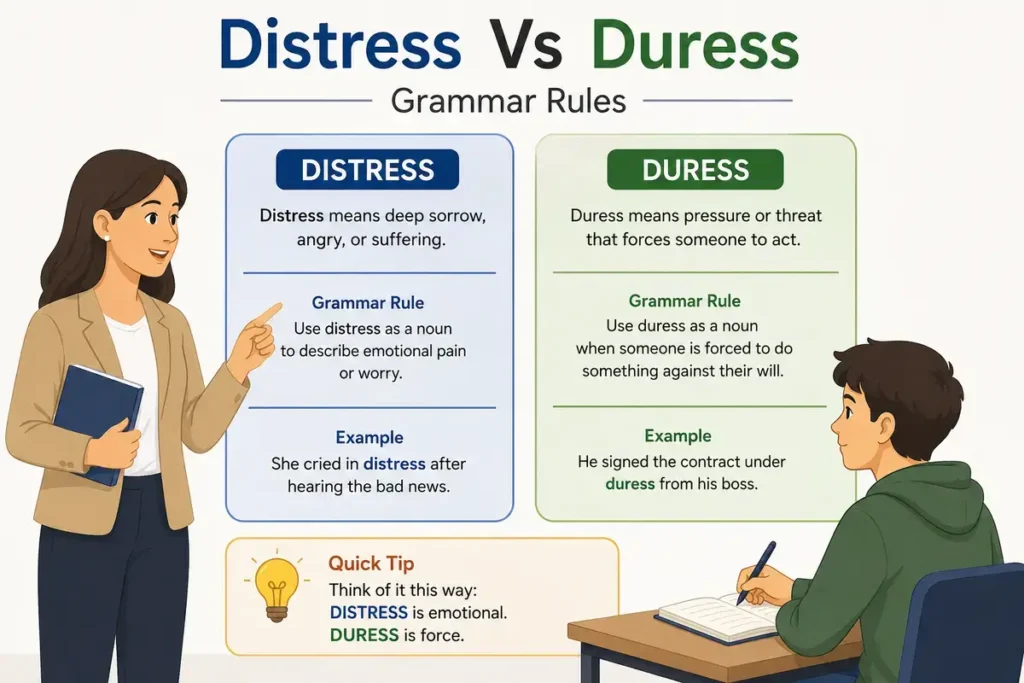
Use Distress as a Verb
When distress functions as a verb, it means to cause someone pain, worry, or emotional suffering.
The possibility of losing their home distressed the family.
The verb identifies the effect of the possibility on the family.
It distressed her to see the injured animal.
Here, distressed means that seeing the animal caused her emotional pain.
The unexpected announcement distressed several employees.
This sentence describes their reaction to the announcement.
Remember that the verb can take different forms. The base form is distress. The present participle is distressing, and the past tense and past participle are distressed.
For example, you might say, The situation is distressing, or The situation distressed everyone involved. Both sentences use the same core idea, but the grammar and timing differ.
Distress as an Adjective
Distress itself is not normally an adjective. However, related forms such as distressed and distressing can describe people, situations, and experiences.
Distressed usually describes someone who is experiencing suffering or worry.
The distressed passenger asked for help.
The passenger is suffering or upset.
Distressing describes something that causes suffering or worry.
The documentary presented a distressing account of the disaster.
The documentary contains material that causes emotional discomfort.
This distinction is useful because people sometimes confuse the person experiencing distress with the event causing it. A distressed person feels the suffering. A distressing event causes it.
How to Use Duress Correctly
Use duress when a person acts because of coercion, threats, intimidation, or pressure that compromises free choice. The word is especially useful when explaining how someone was compelled to sign, agree, pay, speak, or perform an action.
Use Duress When Someone Is Forced to Act
The most common pattern is under duress. It describes an action taken under coercive circumstances.
The manager claimed that he had approved the payment under duress.
The sentence suggests that the manager approved the payment because of coercion. It reports a claim rather than proving that coercion occurred.
She handed over the documents under duress.
This example suggests that she surrendered the documents because someone forced or threatened her.
The employee said he had resigned under duress.
The employee claims that pressure or threats influenced his resignation. The sentence focuses on the circumstances behind the decision rather than his emotional state alone.
Use Duress in Legal and Formal Writing
Duress is particularly useful in legal writing because it identifies a specific type of pressure. It can help explain why a person disputes an agreement or argues that an action was not voluntary.
The defendant argued that threats had compelled him to act under duress.
This sentence describes the defendant’s argument. It doesn’t establish the truth of that argument.
The court examined the claim that the agreement had been signed under duress.
The sentence indicates that the court considered an allegation of coercion.
The contract was challenged on the grounds of duress.
This example explains the basis of the challenge without claiming that the challenge succeeded.
In formal writing, avoid using duress as a dramatic synonym for ordinary stress. A busy schedule or an unpleasant conversation may cause distress, but those situations don’t automatically amount to duress.
Understand What Duress Does Not Mean
Duress doesn’t simply mean feeling pressured, uncomfortable, or nervous. The word generally involves coercive circumstances that interfere with a person’s freedom to choose.
For example, consider these two sentences.
I felt distress because my supervisor criticized my work.
This sentence describes emotional discomfort caused by criticism.
I signed the report under duress because my supervisor threatened to hurt me.
This sentence describes coercion through a threat.
The distinction is substantial. Criticism can be upsetting without being coercive. A threat intended to force an action raises a different issue.
Workplace pressure can sometimes involve duress, but the label depends on the facts and, in legal contexts, the applicable law. Don’t use the term automatically just because a person feels they have no easy options.
Distress vs Duress in Legal Contexts
Legal writing requires particular care because these words can carry different implications. Distress generally describes suffering or hardship. Duress concerns coercion that may affect the voluntary nature of an action or agreement.
When discussing legal matters, it’s best to describe the specific conduct and circumstances rather than assume that a particular legal conclusion follows from a single word.
Distress and Emotional Distress
The expression emotional distress describes significant mental or emotional suffering. It may appear in discussions of personal injury, workplace disputes, negligence, or other legal claims.
For example.
The plaintiff claimed that the incident caused severe emotional distress.
This sentence says the plaintiff alleged significant suffering. It doesn’t establish that the claim meets the legal requirements for compensation.
The legal treatment of emotional distress depends on the claim, jurisdiction, evidence, and circumstances. Ordinary sadness or frustration doesn’t automatically establish a legally actionable injury.
Duress and Voluntary Agreements
Duress can become relevant when someone claims that threats or coercion caused them to enter an agreement or take a particular action.
For example.
The claimant argued that the settlement had been accepted under duress.
The sentence identifies the claimant’s position. It doesn’t mean the settlement has automatically become invalid.
Legal decision makers may examine the nature of the pressure, its effect on the decision, the available alternatives, and other facts that matter under the applicable law.
Can Distress and Duress Occur Together
Yes. A person can experience distress because someone is subjecting them to duress.
Imagine that a person threatens to expose a family’s private information unless a relative transfers money. The relative may experience distress because the threat causes fear and worry. If the threat compels the transfer, the relative may also have acted under duress.
The two words describe different parts of the same event. Distress describes the suffering, while duress describes the coercive circumstances.
This distinction also helps prevent overstatement in reports and professional documents. Describe the person’s emotional condition separately from the alleged threat or pressure. That approach gives readers a clearer account of what happened.
Distress vs Duress in Everyday Life
Although duress is common in legal writing, both words can appear in ordinary conversations. The best choice depends on the situation you want to describe.
At Work
Imagine that an employee receives an unexpected performance review and worries about losing a promotion.
The employee felt distress after receiving the review.
The sentence describes the employee’s emotional reaction.
Now imagine that a supervisor threatens to harm the employee unless they sign a false report.
The employee signed the report under duress.
The sentence describes coercion. The employee may also feel distress, but duress explains why the employee signed.
In Relationships
A difficult conversation can cause distress without involving duress.
She experienced distress after an argument with her partner.
This sentence describes emotional pain following a disagreement.
However, if a partner uses threats to force someone to hand over money or sign a document, duress may be a more appropriate description.
He claimed that he had transferred the money under duress.
The sentence indicates that he alleged coercion. It doesn’t prove that the transfer was legally compelled.
In Financial Situations
Financial hardship commonly causes distress. Bills, debt, reduced income, and unexpected expenses can all create serious worry.
The rising cost of repairs caused financial distress for the homeowner.
This sentence describes money related hardship.
Duress requires a different emphasis. Suppose someone threatens a homeowner to force the sale of a property.
The homeowner alleged that the sale had occurred under duress.
The sentence suggests that coercion influenced the sale. The legal significance would depend on the facts and applicable rules.
In Emergencies
Distress is especially common when describing danger or the need for assistance.
The hikers sent a distress signal after becoming lost.
The sentence indicates that the hikers needed help.
Duress is not the natural choice simply because the hikers were frightened or trapped by bad weather. It would become relevant only if the situation involved coercion that compelled someone to act.
These examples show why context matters. A difficult or dangerous situation doesn’t automatically involve duress.
Pronunciation and Word Origins
Correct pronunciation can help you recognize and remember the words, especially because both contain similar sounds.
How to Pronounce Distress
Distress is pronounced dih STRESS. It has two syllables, and the stress falls on the second syllable.
The first syllable sounds like the beginning of divide. The second syllable rhymes with dress.
In the International Phonetic Alphabet, a common American English pronunciation is /dɪˈstrɛs/.
How to Pronounce Duress
Duress is commonly pronounced doo RESS or dyoo RESS, depending on the speaker and accent. It has two syllables, with the stress on the second syllable.
In American English, /duˈrɛs/ is a common pronunciation.
The opening sound can vary. Both words end with a stressed sound similar to the ending of address when that word is pronounced with stress on its second syllable.
Where Distress Comes From
Distress entered English through Old French, with roots connected to Latin districtus, a form associated with the idea of being constrained or pressed. Over time, its meanings developed to include hardship, suffering, and trouble.
That historical connection to pressure helps explain some overlap between distress and duress. However, their modern meanings have become distinct. Distress now commonly emphasizes suffering or a difficult condition.
Where Duress Comes From
Duress also came into English through Old French and is related to Latin roots associated with hardness, severity, or constraint.
Its modern meaning emphasizes coercion and compulsion. This focus is particularly clear in the established expression under duress.
The shared historical background helps explain why the words sound somewhat alike. It doesn’t make them interchangeable in modern English.
American and British English Usage
The basic distinction between the words remains the same in American and British English. Distress describes suffering or trouble, while duress describes coercion.
Both varieties use emotional distress, financial distress, and under duress. Differences in pronunciation may occur among speakers, but the central meanings don’t change.
For American readers, the simplest approach is to use distress for suffering and duress for coercion. This rule works across everyday, professional, and most general writing contexts.
Common Mistakes to Avoid
Even experienced writers can confuse these words because both relate to difficult experiences. The following mistakes show how to avoid changing the meaning of a sentence.
Using Distress When You Mean Duress
Incorrect: He signed the contract under distress.
Correct: He signed the contract under duress.
The corrected sentence emphasizes coercion that influenced the signing. The first sentence may suggest that he was upset while signing, but it doesn’t clearly communicate that someone forced or pressured him.
If you mean that the person felt upset, you can write, He signed the contract while experiencing emotional distress. This version describes his emotional condition without claiming that coercion occurred.
Using Duress for Ordinary Worry
Incorrect: She felt duress before her job interview.
Better: She felt distress before her job interview.
The second sentence describes anxiety or worry. A job interview may feel intimidating, but ordinary nervousness doesn’t automatically involve coercion.
You could also write, She felt stressed before her job interview. This is a more natural choice for everyday conversation when the pressure isn’t especially severe.
Assuming Every Threat Automatically Proves Duress
Incorrect: He received a warning, so his decision was legally made under duress.
Better: He argued that the warning had forced him to make the decision.
The revised sentence reports the person’s claim without making an unsupported legal conclusion. A warning can be legitimate, unpleasant, or coercive depending on its nature and circumstances.
In legal writing, describe the evidence and distinguish allegations from established findings.
Confusing Distress With Stress
Stress and distress are related, but they aren’t identical.
Stress often refers to the mental or physical strain caused by demands, challenges, or pressure. Distress generally emphasizes suffering, discomfort, or a harmful response to a difficult situation.
For example, Preparing for the examination caused stress describes pressure associated with studying. The unexpected death caused profound distress emphasizes serious emotional suffering.
These words can overlap. The best choice depends on the intensity and nature of the experience.
Treating Duress as a Synonym for Pressure
Incorrect: The tight deadline put the designer under duress.
Better: The tight deadline put the designer under pressure.
The revised sentence is more natural when the deadline creates an ordinary work challenge. Duress carries a stronger sense of coercion and can have specific legal implications.
If someone uses threats to force the designer to complete an unlawful task, duress may be appropriate. The surrounding facts determine the best wording.
Assuming Distress Always Means Emotional Pain
Distress can describe emotional suffering, but it also appears in medical, financial, maritime, and emergency contexts.
For example, The aircraft reported distress refers to an emergency rather than necessarily describing the crew’s emotions.
Similarly, The business entered financial distress describes financial trouble. The context tells readers which kind of hardship the word represents.
Memory Tips for Remembering the Difference
A simple memory trick can help you select the right word without stopping to think about the definition each time.
Remember Suffering and Coercion
Think of distress as suffering and duress as coercion.
Distress tells you that someone or something is experiencing trouble. Duress tells you that pressure or threats are compelling someone to act.
For example, a person who worries about a medical diagnosis may experience distress. A person who signs a document after someone threatens them may act under duress.
Remember the Common Phrases
The expressions in distress and under duress are useful clues.
You might say that a person is in distress, a ship is in distress, or a company is experiencing financial distress. These expressions describe hardship or danger.
You might say that someone signed a contract under duress or acted under duress. These expressions focus on coercion.
The phrases aren’t absolute grammatical rules, but they offer a reliable starting point for choosing the right word.
Ask One Simple Question
Before choosing either word, ask yourself what you want the sentence to emphasize.
1. If the sentence describes suffering, worry, pain, or hardship, choose distress.
2. If the sentence describes someone being compelled to act through threats or coercion, choose duress.
3. If the situation includes both suffering and coercion, use each word for the part it describes.
For example, She experienced distress after someone forced her to sign the document under duress uses both words correctly. Distress describes her suffering, while duress describes the coercive circumstances surrounding the signature.
Related Words and Expressions
Understanding related vocabulary makes it easier to describe difficult situations accurately. These words overlap with distress or duress, but each has its own meaning.
Distress and Stress
Stress refers to strain or pressure. Distress usually emphasizes suffering or an adverse response to a difficult situation.
The new assignment caused stress means the assignment created demands or pressure. The loss caused distress emphasizes emotional suffering.
In some contexts, stress can be positive or motivating. Distress usually carries a more negative meaning.
Distress and Anxiety
Anxiety refers to worry, nervousness, or unease, often about something uncertain or threatening. Distress is broader and can include anxiety, grief, pain, or other forms of suffering.
She experienced anxiety before the presentation identifies a particular emotional response. She experienced distress after receiving the devastating news describes broader suffering.
Anxiety can contribute to distress, but the terms don’t always mean the same thing.
Duress and Coercion
Coercion means forcing or pressuring someone to act through threats, intimidation, or other improper means. Duress describes a situation involving such pressure or compulsion.
The words are closely related. Coercion often names the conduct used to control another person’s actions, while duress often describes the circumstances in which someone acts under that pressure.
Duress and Intimidation
Intimidation involves making someone afraid or less willing to resist through threats, aggressive behavior, or displays of power.Intimidation may contribute to duress, but the terms aren’t identical. Duress emphasizes the coercive circumstances affecting a decision or action.
Duress and Compulsion
Compulsion refers to being driven or forced to do something. It can describe external pressure or an internal urge, depending on context.
Duress generally emphasizes coercive pressure from outside the person, especially in legal contexts.
For example, He felt compelled to respond immediately describes a strong sense of obligation. He responded under duress suggests that coercion influenced his response.
Distressed and Distressing
Distressed describes the person or group experiencing suffering. Distressing describes the event or situation that causes suffering.
For example, The distressed family requested assistance describes the family’s condition. The distressing news upset the family describes the effect of the news.
This distinction follows a familiar pattern in English. Words ending in ed often describe the person experiencing a feeling, while words ending in ing often describe what causes that feeling.
Under Pressure and Under Duress
Under pressure is a broad expression. It can describe ordinary demands, tight deadlines, social expectations, or serious threats.
Under duress is narrower and suggests coercion or compulsion.
For example, The accountant worked under pressure during tax season describes a demanding period. The accountant signed the false statement under duress suggests that coercion forced the action.
Choose the narrower expression only when the circumstances support it.
Professional Writing Tips
Clear word choices matter most when the subject involves personal suffering, workplace conduct, medical emergencies, or legal claims. A precise sentence helps readers understand what happened without confusing emotions with actions.
Describe the Facts Before Drawing Conclusions
If you’re writing about a dispute, explain the conduct that occurred. Instead of saying that someone acted under duress without explanation, identify the threat or pressure they reported.
For example, The employee said the supervisor threatened to fire him unless he signed the statement.
This sentence gives readers concrete information. If the legal classification matters, you can then explain that the employee claimed he signed under duress.
Use the Right Level of Formality
Distress works in casual and formal writing. You can describe a distressed friend, a patient in distress, or a business experiencing financial distress.
Duress is more formal and appears frequently in legal and official discussions. In casual conversation, people often use under pressure when they mean that someone faced demanding circumstances without necessarily facing coercion.
Choose language that fits your audience and the facts.
Avoid Unsupported Legal Claims
A sentence can accurately report an allegation without presenting it as a proven fact.
For example, She alleged that she signed the agreement under duress is more careful than The agreement was invalid because she signed under duress when no legal finding has established that conclusion.
This distinction protects accuracy and makes professional writing more trustworthy. The same principle applies to reports about misconduct, contracts, employment disputes, and criminal cases.
Keep Emotional Descriptions Specific
When writing about distress, name the kind of suffering if you know it. Words such as anxiety, grief, fear, pain, and financial hardship can make a sentence more informative.
For example, The family experienced distress is clear but broad. The family experienced severe emotional distress after the accident gives readers more context.
Don’t add details you can’t support. Specific language works best when it reflects the available facts.
Choose Natural Phrasing
Some expressions are more natural than others. Writers commonly use in distress, emotional distress, financial distress, and under duress.
For ordinary pressure, phrases such as under stress and under pressure often sound more natural than under distress or under duress.
When in doubt, read the sentence aloud. If the word sounds unusually formal or suggests coercion that the situation doesn’t involve, choose a simpler alternative.
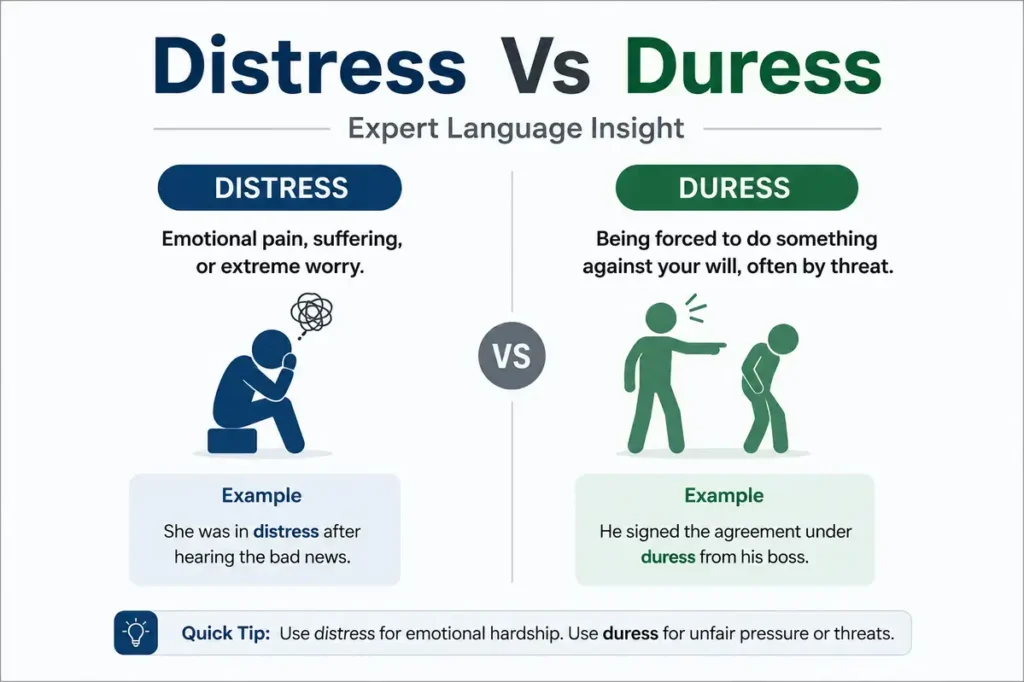
Distress Vs Duress Expert Language Insight
After reviewing years of academic papers legal documents business reports website content and student assignments one editing pattern appears again and again.Most writers don’t misunderstand the definitions. They misunderstand the relationship between the words.The shared ending makes them look like close relatives. Their meanings create the opposite impression because both involve unpleasant situations. That’s enough to cause hesitation.
Key Takeaways
1. Distress means suffering. It can describe emotional pain, physical discomfort, financial hardship, or an emergency.
2. Duress means coercion. It describes pressure or threats that compel someone to act against their wishes.
3. Distress can be a noun or a verb. For example, a person may experience distress, or a troubling event may distress someone.
4. Duress is a noun. It commonly appears in the expression under duress.
5. The two words can describe the same event. A person threatened into signing a document may experience distress while acting under duress.
6. Context determines the correct choice. Use distress for suffering and duress for coercion.
7. Legal claims require care. Saying that someone acted under duress doesn’t automatically prove that a contract is invalid or that a legal defense will succeed.
Conclusion
Distress vs duress becomes easier to understand when you focus on the difference between suffering and coercion. Distress describes emotional pain, physical discomfort, financial hardship, or a difficult situation. Duress describes pressure or threats that compel someone to act against their wishes.
Use distress when you want to explain what someone is experiencing. Use duress when you want to explain the coercive circumstances behind an action. For example, a person may experience distress after receiving a threatening message and act under duress if that threat forces them to sign a document.
The simplest rule is worth remembering. Distress is about suffering, while duress is about coercion. Keep that distinction in mind, and you’ll choose the right word in everyday conversations, professional writing, and legal discussions.
Frequently Asked Questions
What Is the Main Difference Between Distress and Duress?
Distress means suffering, worry, pain, or hardship. Duress means coercive pressure or threats that compel someone to act. A person can experience distress after receiving bad news, while someone who signs a document because of threats may act under duress.
Can Distress and Duress Be Used Interchangeably?
No. Distress describes suffering or a difficult condition, while duress describes coercion. Although a person experiencing duress may also feel distress, the two words communicate different ideas and shouldn’t be substituted for one another.
Is Distress a Noun or a Verb?
Distress can function as both a noun and a verb. As a noun, it describes suffering or trouble. As a verb, it means to cause someone pain, worry, or emotional suffering. For example, The news distressed her uses distress as a verb.
Is Duress a Noun or a Verb?
Duress is a noun. It describes coercive pressure or circumstances that compel someone to act. The common expression under duress describes an action performed under such pressure. For example, He signed the document under duress suggests that coercion influenced his decision.
What Does Under Duress Mean?
Under duress means acting under coercion, threats, or serious pressure that restricts free choice. The expression often appears in legal discussions about contracts, payments, statements, and other decisions. Its precise legal significance depends on the circumstances and applicable law.
What Does In Distress Mean?
In distress means experiencing serious trouble, suffering, or danger. It can describe a person experiencing emotional pain, a patient with a medical problem, a vessel needing assistance, or a business facing serious difficulties.
Is Emotional Distress the Same as Duress?
No. Emotional distress refers to emotional suffering, while duress refers to coercion. Someone can experience emotional distress without being threatened or forced to act. Someone acting under duress may also experience emotional distress because of the threats involved.
Can Someone Sign a Contract Under Duress?
Yes, a person can claim to have signed a contract under duress if threats or coercion compelled the agreement. However, the legal effect depends on the facts, the applicable law, and the evidence. The phrase alone doesn’t establish that a contract is invalid.
Which Word Should I Use for Stress and Worry?
Use distress when you want to emphasize serious worry, emotional pain, or suffering. Use stress when you mean strain or pressure caused by demands or challenges.
What Is an Easy Way to Remember Distress vs Duress?
Remember two key ideas. Distress means suffering, while duress means coercion. A person may be in distress after a frightening experience, but a person who is forced to sign a document because of threats may act under duress.
Is Duress Always a Legal Term?
No. Duress appears most often in formal and legal contexts, but people also use it in everyday English to describe coercive pressure. However, its legal meaning can be more specific than its general conversational use.
What Are the Synonyms for Distress and Duress?
Common alternatives for distress include suffering, anguish, anxiety, hardship, and trouble. Depending on context, alternatives for duress include coercion, compulsion, and force. These words aren’t perfect substitutes in every sentence, so choose the one that best reflects the circumstances.

Confusing Words, Spelling & Word Choice
Claire Whitmore is a U.S.-based English editor who writes about commonly confused words, spelling differences, and word choice. Her work helps readers understand subtle distinctions between similar-looking words through simple definitions, practical examples, and modern usage guidance in both American and British English.