
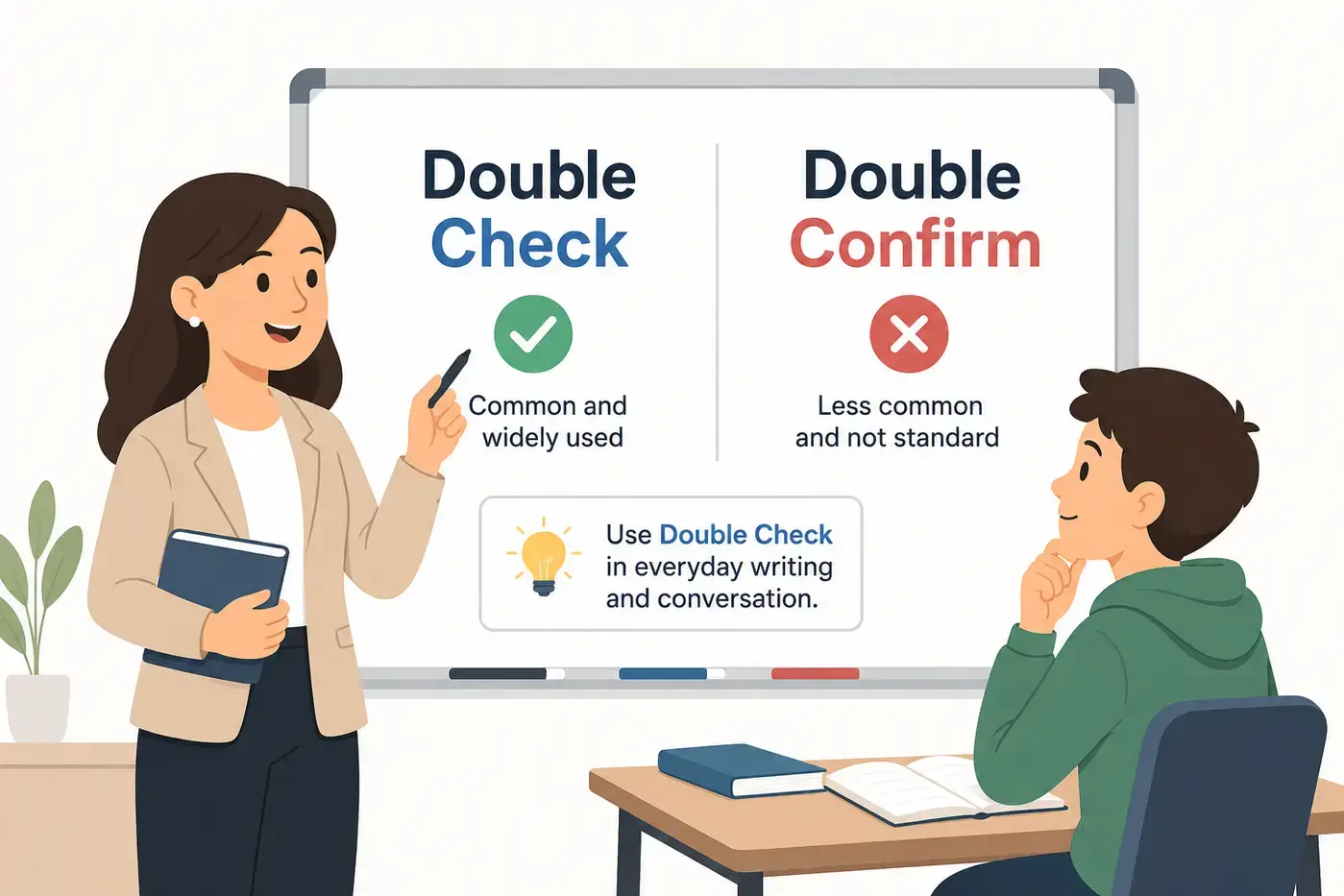
Double Check Vs Double Confirm is a common comparison that confuses many English learners, writers, and professionals. Although both expressions seem to describe the act of verifying information, they do not carry the same meaning or sound equally natural in standard English. One is widely accepted in everyday communication, while the other is far less common and is often considered unnecessary.
The confusion comes from the meanings of the verbs check and confirm. While they are closely related, they serve different purposes. Check means to inspect, review, or verify something for accuracy. Confirm means to establish that something is true, correct, or final. Because of this distinction, one expression has become a natural part of spoken and written English, while the other has remained uncommon.
If you have ever wondered which phrase belongs in an email, business report, workplace conversation, or everyday writing, this guide has the answer. You will learn the meaning of each expression, the grammar behind them, real-world examples, common mistakes, and why professional editors almost always recommend one over the other.
Double Check Vs Double Confirm Short Answer
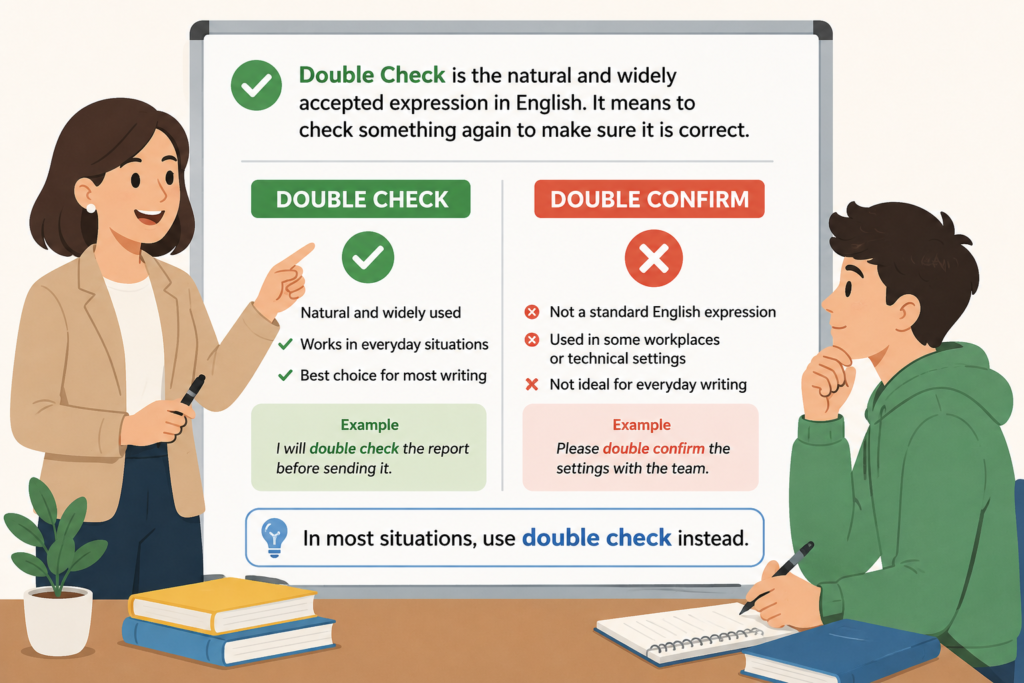
Double Check is the natural and widely accepted expression in English. It means to check something again to make sure it is correct. Double Confirm appears in some workplaces and technical settings, but it is not a standard English expression for everyday writing. In most situations, use double check instead.
Table Of Contents
- Short Answer.
- What This Expression Means.
- Why It Sounds Natural.
- Why People Confuse These Expressions.
- Double Check Vs Double Confirm Comparison.
- Grammar Behind Both Expressions.
- Why It Sounds More Natural.
- Real Life Examples.
- Professional Writing Tips.
- Common Mistakes.
- Memory Trick.
- Frequently Asked Questions.
- Key Takeaways.
- Conclusion.
What This Expression Means
Double check means to examine something again after an initial inspection. The purpose is to catch mistakes or confirm accuracy before moving forward. The phrase has been part of standard English for many years. Native speakers use it naturally in everyday conversation, academic writing, business communication, and professional editing.
Examples include:
- Please double check the address before you send the package.
- I always double check my math before submitting the exam.
- The editor asked the writer to double check every citation.
- Double check the meeting time because it changed yesterday.
In every example, the speaker is asking someone to perform another review. The focus is on careful inspection rather than simply agreeing that something is true.
Why It Sounds Natural.
The verb check already means to inspect something. Adding double simply tells the reader or listener to repeat that inspection one more time. English contains many expressions that use double to emphasize doing something twice.
Examples include:
- Double click.
- Double lock.
- Double wrap.
- Double bag.
Double check follows the same natural pattern. That is why it sounds familiar to native speakers.
The Meaning Explained
Double confirm is far less common. In standard English, confirm already means to verify or establish that something is true. Since the idea of verification already exists inside the word, adding double often feels unnecessary. Imagine someone saying this. Please double confirm the reservation. Many native speakers would immediately rewrite the sentence. Please confirm the reservation. Please double check the reservation. Both alternatives sound smoother because each verb already communicates a clear action. That does not mean double confirm is always wrong. Some companies and technical teams use it internally to mean getting confirmation from two different sources or confirming something one more time.
For example.
- The finance department asked us to double confirm every payment with the client.
Inside that organization, everyone understands the intended meaning. Outside that context, most editors would revise the sentence.
Why People Confuse These Expressions
The confusion happens because check and confirm share similar meanings. Both focus on ensuring accuracy. Each word is used in workplace communication. Both can refer to the process of verification. Still, they are not interchangeable. Think of it like this. Checking is like looking through a window to see if everything is in place. Confirming is like receiving official proof that everything is already in place. One focuses on inspection. The other focuses on verification or acknowledgment. That small difference explains why double check became a standard expression while double confirm never reached the same level of acceptance.
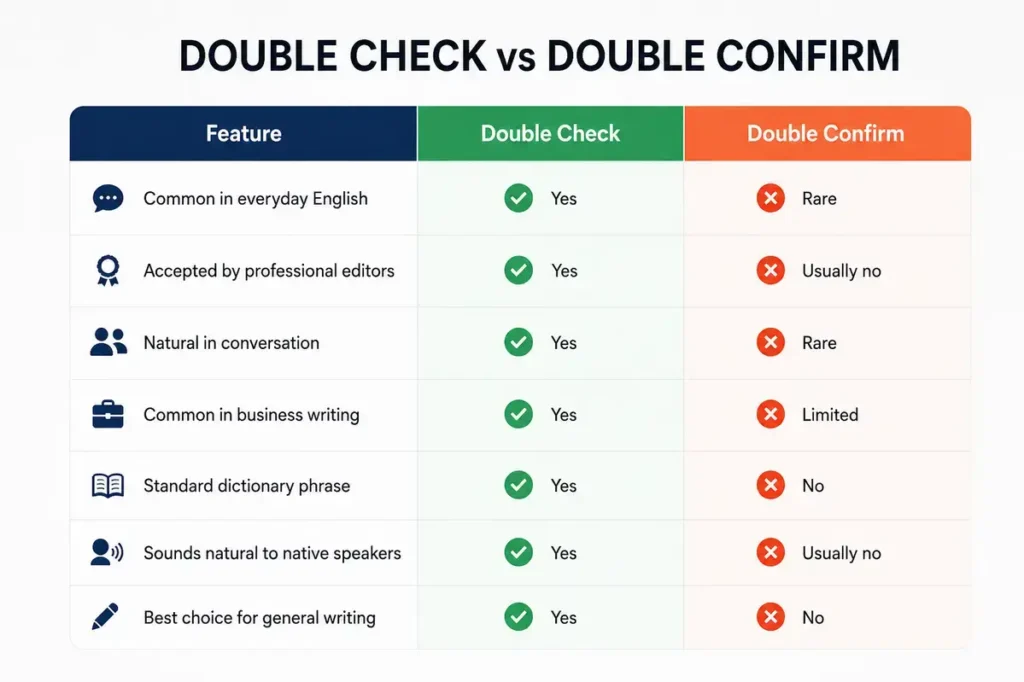
Comparison Table
| Feature | Double Check | Double Confirm |
|---|---|---|
| Common in everyday English | Yes | Rare |
| Accepted by professional editors | Yes | Usually no |
| Natural in conversation | Yes | Rare |
| Common in business writing | Yes | Limited |
| Standard dictionary phrase | Yes | No |
| Sounds natural to native speakers | Yes | Usually no |
| Best choice for general writing | Yes | No |
The comparison makes one point clear. Double check is the expression that belongs in most situations.
Grammar Behind Both Expressions
Understanding the grammar removes almost all confusion. The verb check means to inspect examine or verify.
Examples include.
- Check your homework.
- Check the schedule.
- Check the report.
Adding double creates the meaning of repeating the inspection. Now look at confirm. Confirm means to establish truth verify officially or acknowledge something as correct.
Examples include.
- Confirm your attendance.
- Confirm the appointment.
- Confirm receipt of the email.
Since confirmation already represents verification, adding double often creates unnecessary repetition. Professional editors call this semantic redundancy. Two words communicate almost the same idea, making one of them unnecessary. English naturally avoids this kind of repetition unless it serves a special purpose.
Why It Sounds More Natural.
After years of editing business documents, academic papers, website content, and professional emails, one pattern appears again and again. Native speakers almost always say double check.
You hear it at work.
- Double check the numbers before the meeting.
It is commonly heard in schools.
- Double check your answers before turning in the test.
You hear it at home.
- Can you double check that the door is locked.
The phrase feels effortless because people have heard it throughout their lives. Double confirm does not have that same history in everyday English. It appears occasionally in customer support messages, corporate communication, software documentation, and international workplaces, but it still sounds less natural than double check for general audiences. In professional editing, consistency matters. Choosing the expression that readers instantly recognize improves clarity and makes the writing feel more polished.
Double Check Vs Double Confirm synonyms
If you’re looking for synonyms and alternatives to “Double Check” and “Double Confirm”, here are the best options grouped by meaning.
Synonyms for Double Check
- Verify again.
- Check again.
- Recheck.
- Review.
- Inspect again.
- Cross-check.
- Validate.
- Confirm.
- Examine again.
- Make sure.
- Ensure accuracy.
- Look over again.
- Review carefully.
- Double verify.
- Reinspect.
Alternatives to Double Confirm
Since double confirm is uncommon in standard English, these are more natural replacements:
- Confirm.
- Reconfirm.
- Confirm again.
- Verify.
- Validate.
- Revalidate.
- Authenticate.
- Establish.
- Make certain.
- Ensure.
Professional Alternatives
- Verify the information.
- Confirm the details.
- Cross-check the data.
- Review for accuracy.
- Validate the results.
- Ensure correctness.
- Perform a final review.
- Reconfirm the appointment.
- Conduct a verification.
- Complete a final check.
These alternatives are more natural and appropriate than double confirm in most business, academic, and everyday writing.
Real Life Examples
The easiest way to understand the difference is to see both expressions in real situations.
Everyday Conversation
Natural:
- I’ll double check the grocery list before we leave.
Why it works.
The speaker plans to review the list one more time.
Less natural:
- I’ll double confirm the grocery list before we leave.
Why it sounds odd.
A grocery list is something you review, not something you officially confirm.
Business Communication
Natural:
- Please double check the invoice before sending it to the client.
The employee is reviewing the document for mistakes.
Natural:
- Please confirm that you received the invoice.
The employee wants the recipient to acknowledge receipt.
Less natural:
- Please double confirm that you received the invoice.
Most professional editors would simplify this to:
- Please confirm that you received the invoice.
Travel
Natural:
- Double check your passport before heading to the airport.
The traveler reviews the passport and travel documents.
Natural:
- Please confirm your flight reservation before arrival.
The airline wants official confirmation.
Less natural:
- Please double confirm your passport.
The sentence sounds awkward because passports are checked, not confirmed.
School
Natural:
- Always double check your answers before submitting the exam.
Students review their work for errors.
Natural:
- The teacher confirmed that my answer was correct.
The teacher verified the answer after reviewing it.
Healthcare
Natural:
- Nurses always double check the patient’s medication before giving it.
Patient safety depends on careful review.
Natural:
- The laboratory confirmed the diagnosis.
The lab provided official verification. These examples show a clear pattern. People check documents, calculations, spelling, grammar, addresses, schedules, and details. People confirm appointments, reservations, attendance, orders, decisions, identities, and facts.
Professional Writing Tips
Professional editors pay close attention to verb choice because the right verb makes writing more precise. If your goal is reviewing something again, choose double check.
Examples include:
- Double check the figures.
- Double check the spelling.
- Double check the report.
- Double check the instructions.
- Double check the calculations.
If your goal is receiving official verification, use confirm without adding double.
Examples include:
- Confirm your reservation.
- Confirm the meeting time.
- Confirm receipt of the package.
- Confirm your attendance.
- Confirm the payment.
This simple distinction makes your writing sound more natural and professional.
Common Uses of This Expression.
The phrase appears across almost every type of English.
Business
Managers ask employees to double check reports before presentations.
Education
Teachers encourage students to double check answers before turning in assignments.
Publishing
Editors double check facts, names, quotations, and references.
Software Development
Programmers double check code before deployment.
Healthcare
Medical professionals double check patient information to reduce errors. The phrase works because reviewing work twice reduces mistakes.
Is This Expression Correct?
Yes, but only in limited situations. Some organizations develop internal terminology that differs from everyday English. For example, a company might require approval from two supervisors before processing a payment. Employees inside that company may say:
- Please double confirm this transaction.
In that workplace, everyone understands that two separate confirmations are required. Outside that environment, the phrase can confuse readers because it is not common standard English. A clearer alternative would be:
- Confirm the transaction with both managers.
- Obtain two confirmations before processing the payment.
- Confirm the transaction again.
These versions communicate the same idea more clearly.
Common Mistakes
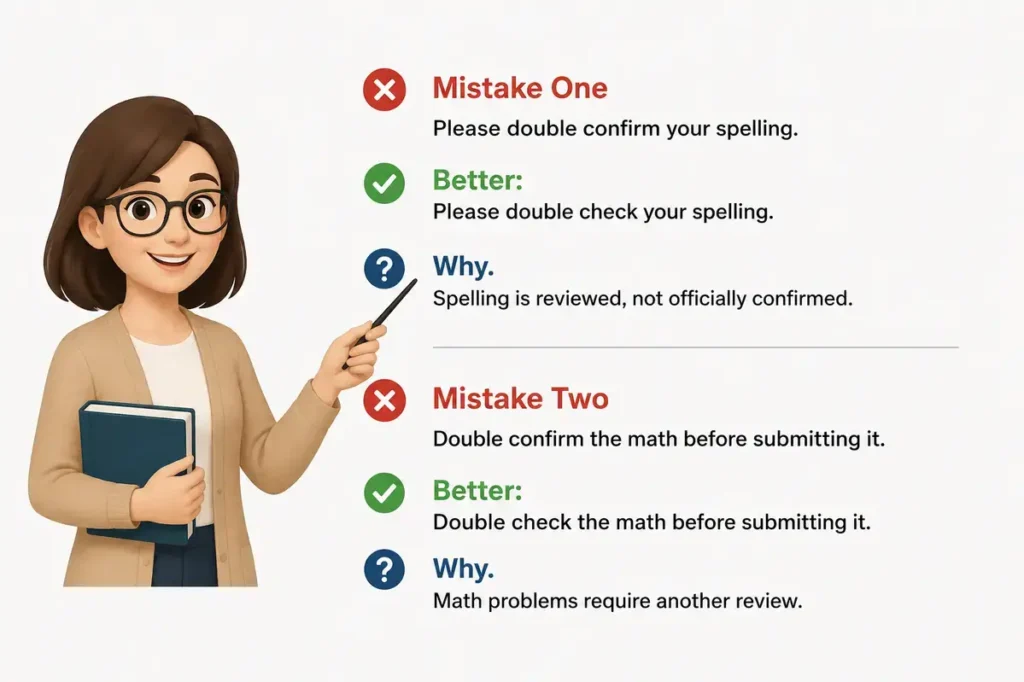
Many writers accidentally choose the wrong verb because check and confirm have related meanings. Here are some of the most common mistakes.
Mistake One
Please double confirm your spelling.
Better:
Please double check your spelling.
Why.
Spelling is reviewed, not officially confirmed.
Mistake Two
Double confirm the math before submitting it.
Better:
Double check the math before submitting it.
Math problems require another review.
Mistake Three
Double check your attendance.
Better:
Confirm your attendance.
Attendance requires acknowledgment, not inspection.
Mistake Four
Double check your reservation with the airline. This sentence is actually correct if you mean reviewing your booking details. If you mean contacting the airline for official verification, say: Confirm your reservation with the airline. The intended meaning determines the correct verb.
Memory Trick
A simple trick can help you remember the difference forever. Think about the first action. If you are looking for mistakes, use double check. If you are receiving official verification, use confirm.
Related Grammar And Usage Notes
English contains many verb pairs that appear similar but perform different jobs.
For example:
| Correct Pair | Difference |
|---|---|
| Check and Confirm | Review versus verify. |
| Look and See | Intentional action versus result. |
| Hear and Listen | Passive perception versus active attention. |
| Say and Tell | Speaking words versus giving information. |
| Borrow and Lend | Receiving versus giving temporarily. |
Learning these subtle differences helps you write more naturally and understand native speakers more easily.
Does American English Differ From British English
No significant difference exists on this topic. American English strongly prefers double check. British English also uses double check as the standard expression. Professional publications, newspapers, universities, businesses, and government organizations in both countries commonly use the phrase. The expression double confirm remains uncommon in both varieties of English. You may still encounter it in multinational companies, customer support messages, technical documentation, and workplaces influenced by direct translations from other languages. That does not make it standard English. When writing for a broad audience, double check remains the safest and most natural choice.
Key Takeaways
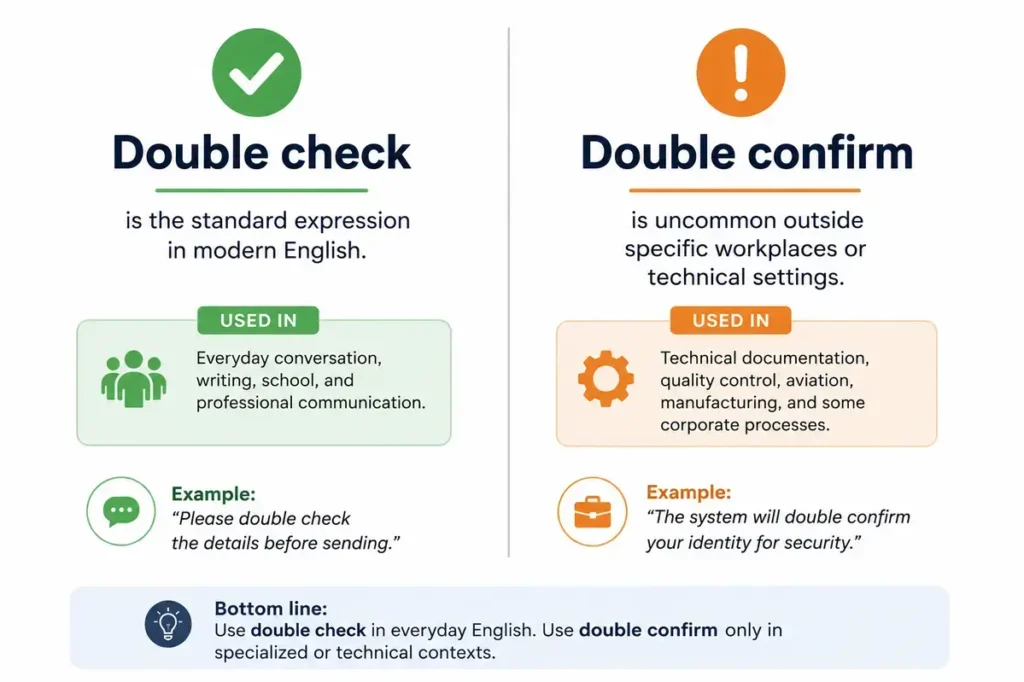
- Double check is the standard expression in modern English.
- Double confirm is uncommon outside specific workplaces or technical settings.
- Use double check when reviewing something again for mistakes.
- Use confirm when you need official verification or acknowledgment.
- Both American English and British English prefer double check.
- Professional editors almost always choose double check for general writing.
- Choosing the correct verb improves clarity and makes your writing sound more natural.
Conclusion
If you want someone to review information again, double check is the correct and natural choice. It is the expression you will hear from native speakers, see in books, read in newspapers, and find in professional writing. It works in business, education, publishing, healthcare, technology, and everyday conversation. Confirm has a different job. It means to verify or acknowledge that something is true or final. In most situations, it does not need the word double because the idea of verification already exists in the verb itself.
You may occasionally see double confirm inside company procedures or specialized industries. In those cases, the phrase often refers to obtaining two separate confirmations or repeating a confirmation step. Even then, many editors prefer clearer alternatives because they communicate the intended meaning more precisely. When you are unsure which expression to choose, remember one simple rule. If you are reviewing something again, double check. If you are verifying or acknowledging something, confirm. Following that distinction will make your writing clearer, more natural, and closer to the English used by experienced writers, editors, and native speakers.
Frequently Asked Questions
Is Double Check Or Double Confirm Correct?
Double check is the correct and natural expression in everyday English. It means to review something again to make sure it is accurate. Double confirm appears in some workplaces, but it is not a standard phrase for general writing.
Why Is Double Check More Common Than Double Confirm?
The verb check means to inspect or review. Adding double simply means performing that review again. The verb confirm already includes the idea of verification, so adding double often feels unnecessary.
Can I Use Double Confirm In Business Emails?
You can if your organization uses the expression as an internal term. For most business communication, double check or simply confirm will sound more natural and professional.
Is Double Confirm Grammatically Wrong?
Not always. The phrase is grammatically possible, but it is uncommon in standard English. Most editors replace it with double check or confirm because those choices are clearer.
What Does Double Check Mean?
Double check means to examine something one more time to catch mistakes or make sure everything is correct.
Example.
Please double check the contract before signing it.
What Does Confirm Mean?
Confirm means to verify, establish, or acknowledge that something is true, correct, or final.
Example.
Please confirm your attendance by Friday.
Can Check And Confirm Mean The Same Thing?
Sometimes they overlap, but they are not identical. Checking focuses on reviewing or inspecting something. Confirming focuses on proving or acknowledging that something is true. The intended meaning determines the correct verb.
Is Double Check Formal Or Informal?
Double check works well in both formal and informal English. You can use it in academic papers, business emails, technical documents, reports, and everyday conversations.
Is Double Check Used In American And British English?
Yes. Both American English and British English recognize double check as the standard expression. Readers in both countries immediately understand it.

Idioms, Expressions & Figurative Language
Mason Ellsworth is an American language writer with a passion for English expressions, figurative language, and everyday communication. He explains idioms, similes, popular phrases, and commonly misunderstood expressions in a straightforward, engaging style that helps readers improve both their writing and spoken English.